A Chapter of: Transforming the Financing of Early Care and Education
Graphics and Data Visualization
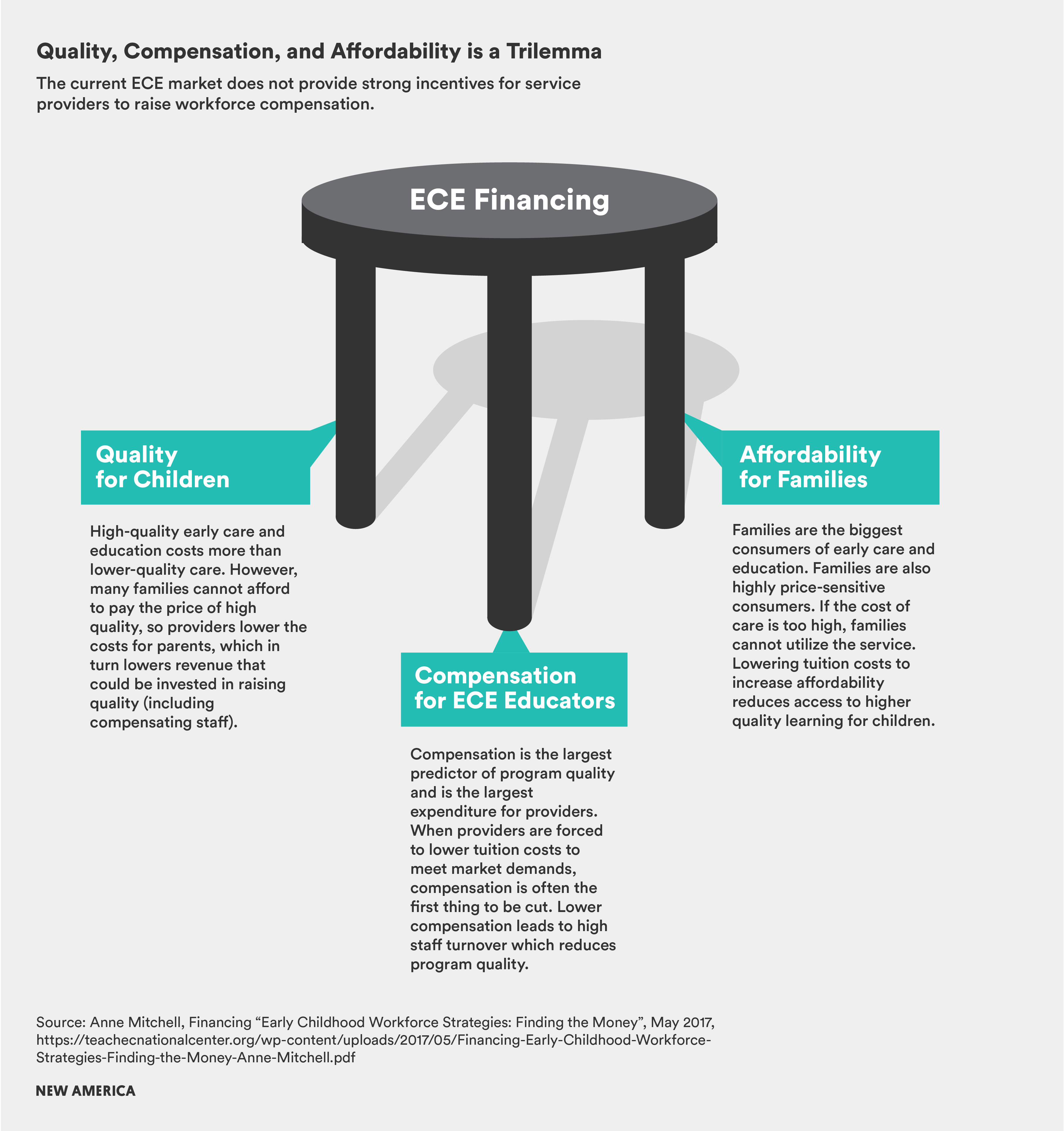
| Timeline for early education in the United States: | |
|---|---|
| Year(s) | Details |
| Mid-1800s | ECE programs are founded in the U.S. for children from toddlers to primary school age. Programs funded with tuition tended to focus on enrichment. Free programs intended for immigrant families and families with low incomes focused on “moral habits” and basic caretaking. |
| 1890s–1900s | Critics begin speaking out against child care outside of the home and supporting policies to allow mothers to stay home with children. |
| 1909 | The White House Conference on Children encourages aid to mothers to allow them to stay home with children, asserting that “home life is the highest and finest product of civilizations.” |
| 1919 | Mothers’ pension legislation is enacted in 39 states, plus Hawaii and Alaska. Financial assistance is provided with rules that exclude mothers who are widowed, divorced, married to men incapable of breadwinning, or are racial or ethnic minorities. |
| 1935 | The “Aid to Dependent Children” provision is passed through the Social Security Act, providing cash assistance to mothers except those of color and those with “illegitimate” children. |
| 1930s | President Roosevelt establishes nursery schools with public funding, to employ teachers and other school staff while protecting the well-being of pre-K children from “needy, under-privileged families.” Middle-class enrollment in private nursery schools grows during this time, and teachers in all settings are required to have ECE-specific training. |
| 1943–1946 | The Lantham Act of 1940 passes in response to World War II. Mothers working for the defense fund accessed child care through federal grants, marking the first time the federal government provided support for middle-income families. The program ends when the war does. |
| 1950s | Public attitudes are still deeply invested in the mother’s role in the home, though there are three times as many working mothers as there were before the war. Public funding is scarce, and most families rely on informal or private care. |
| 1964 | President Johnson declares his “War on Poverty” and establishes Head Start. Head Start’s multi-generational approach is intended to “strike at the basic cause of poverty.” |
| 1960s–1970s | States initiate funding kindergarten as part of the public-school system. |
| 1971 | President Nixon recommends, at the 1971 White House Conference on Children, that “the Federal government fund comprehensive child care programs, which will be family-centered, locally controlled, and universally available.” Congress agrees, and passes the Comprehensive Child Development Act to help support low-income families and working parents and centering on child development and early education. |
| 1972 | President Nixon surprises many by vetoing the bill, citing its potentially negative impact on family relationships. |
| 1974 | Title XX of the Social Services Block Grant subsidizes early care and education for low-income families and those receiving public assistance. |
| 1981 | Funds for Title XX are drastically reduced; money earmarked for child care is eliminated. |
| 1988 | The Family Support Act requires most welfare recipients to either work or attend school, and provides child care assistance to eligible families. The dependent care tax credit (established in 1954) has the income cap raised and removed, becomes a nonrefundable tax credit, and increases the amount taxpayers can claim for child care. |
| 1989 | The first National Child Care Staffing Survey finds that ECE teachers are underpaid and under supported, and they exit the profession at rates of over 40 percent. The study determines that workforce conditions and training are essential for high-quality programs. |
| 1989 | The Military Child Care Act (MCCA) establishes a system of high-quality child care centers and family child care programs, raises qualifications and compensation for teachers, and establishes a sliding scale for parent payment. |
| 1990 | Congress passes the Child Care and Development Block Grant Act (CCDBG), which authorizes the Child Care and Development Fund (CCDF). Funding is provided through vouchers to providers that parents choose. States are required to set quality standards and eligibility requirements. Funding levels are too low to cover all potentially eligible families. |
| 1990 | Congress passes the Head Start Expansion and Quality Improvement Act to reauthorize federal funding for Head Start and requires 10 percent of funds be channeled towards quality improvement, such as staff training. |
| 1996 | President Clinton passes the Personal Responsibility and Work Opportunity Act of 1996, establishing the Temporary Assistance for Needy Families (TANF) program with work requirements. The act increases federal ECE funds by $4 billion and redirects 4 percent of CCDF funding to quality improvement. |
| 1990s–2010s | State-funded pre-K programs expand significantly. By 2018, 44 states and the District of Columbia have[ ](http://nieer.org/wp-content/uploads/2019/08/YB2018_Full-ReportR3wAppendices.pdf)[state-funded pre-K programs](http://nieer.org/wp-content/uploads/2019/08/YB2018_Full-ReportR3wAppendices.pdf), serving one-third of four-year-olds and 5.7 percent of three-year-olds. |
| 2007 | The Head Start Reauthorization Act requires that by 2013, half of all Head Start teachers obtain at least a bachelor’s degree in early childhood education, but no guaranteed compensation increases. |
| 2011 | The four-year competitive grant program Race to the Top-Early Learning Challenge ([RTT-ELC](https://www2.ed.gov/programs/racetothetop-earlylearningchallenge/2013-early-learning-challenge-flyer.pdf)) awards over $1 billion to 20 states for improving program quality through use of Quality Rating Improvement Systems ([QRIS](https://www.newamerica.org/education-policy/edcentral/even-more-research-many-qs-remain-about-qris/)). |
| 2013 | Early Head Start-Child Care ([EHS-CC](https://www.ffyf.org/issues/ehs-ccp/)) Partnerships are established to foster coordination between Early Head Start grantees and local child care providers, with the goal of improving quality. In 2019, EHS-CC partnerships are funded at $805 million. |
| 2014 | The Child Care Development Block Grant program ([CCDBG](https://www.newamerica.org/education-policy/edcentral/ccdbgpasses/)) is reauthorized for the first time since 1996, and is funded at $400 million annually over six years. This reauthorization modifies the frequency of family eligibility audits to once per year and requires providers to pass annual fire, health, and safety inspections. |
| 2014 | Preschool Development Grants ([PDG](https://www.newamerica.org/education-policy/edcentral/preschool-dev-grants-win/)) distribute $250 million over four years to 18 states, increasing access to high-quality pre-K for[ ](http://blogs.edweek.org/edweek/early_years/2018/08/preschool_development_grants_boosted_access_to_high-quality_care_report_says.html)[49,000](http://blogs.edweek.org/edweek/early_years/2018/08/preschool_development_grants_boosted_access_to_high-quality_care_report_says.html) children in over 200 high-need communities. |
| 2018 | The Preschool Development Grants Birth through Five ([PDG B-5](https://www.newamerica.org/education-policy/edcentral/hhs-announces-details-about-new-pdg-b-5-program/)) program builds on the PDG program by extending opportunities for access to early learning programs. In December,[ ](https://www.acf.hhs.gov/occ/resource/pdg-b-5-initiative)[46 states](https://www.acf.hhs.gov/occ/resource/pdg-b-5-initiative) receive federal grants totaling $250 million towards this effort. |
| 2018 | CCDBG funding is more than[ ](https://www.newamerica.org/education-policy/edcentral/house-omnibus-bill-brings-good-news-early-childhood-advocates/)[doubled](https://www.newamerica.org/education-policy/edcentral/house-omnibus-bill-brings-good-news-early-childhood-advocates/), from $2.37 billion to $5.22 billion, to increase access to child care for more than[ ](https://www.clasp.org/sites/default/files/publications/2018/02/State%20Impact%20of%20Doubling%20CCDBG%20.pdf)[200,000](https://www.clasp.org/sites/default/files/publications/2018/02/State%20Impact%20of%20Doubling%20CCDBG%20.pdf) children. Funding for the Child Care Access Means Parents in School (CCAMPIS) program, which supports parents of young children attending higher education programs, is more than[ ](https://firstfocus.org/wp-content/uploads/2019/09/FirstFocus-ChildrensBudget2019-pages.pdf)[tripled](https://firstfocus.org/wp-content/uploads/2019/09/FirstFocus-ChildrensBudget2019-pages.pdf), from $15 million to $50 million annually. |
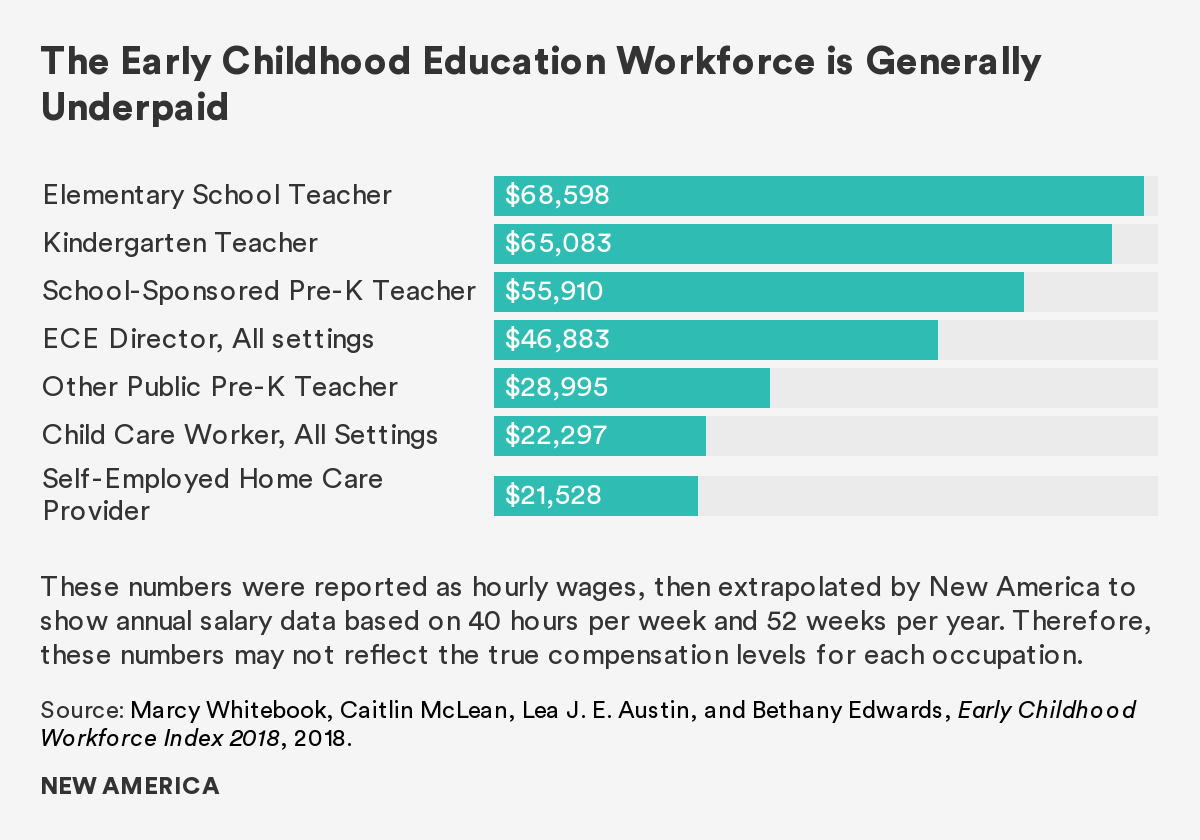
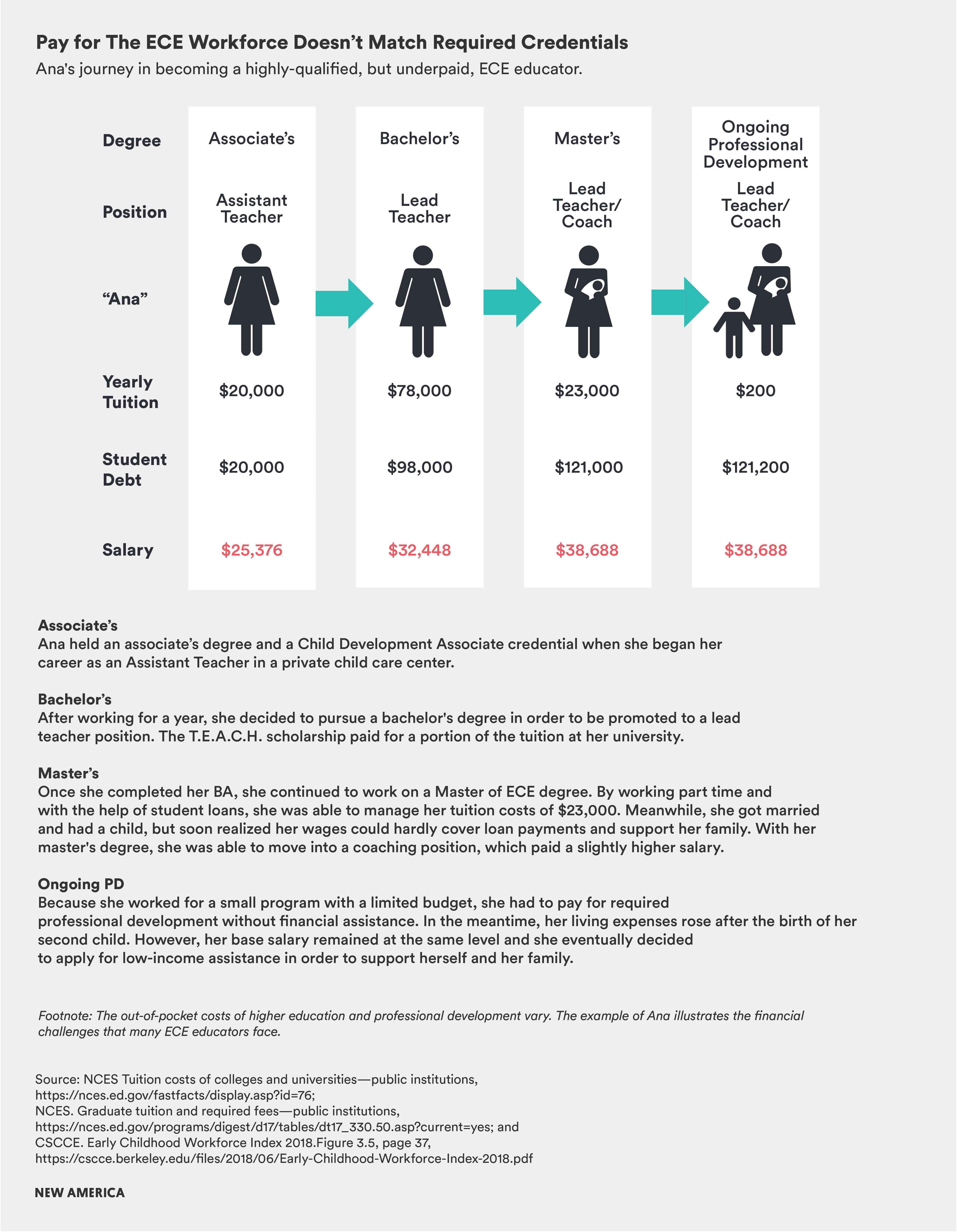
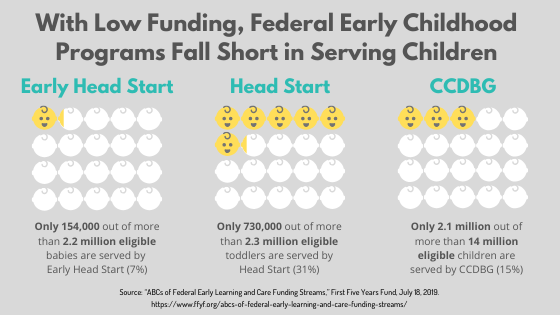
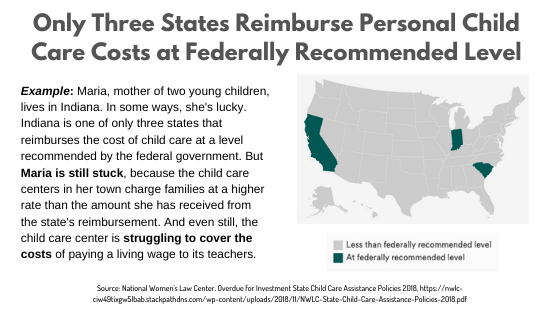
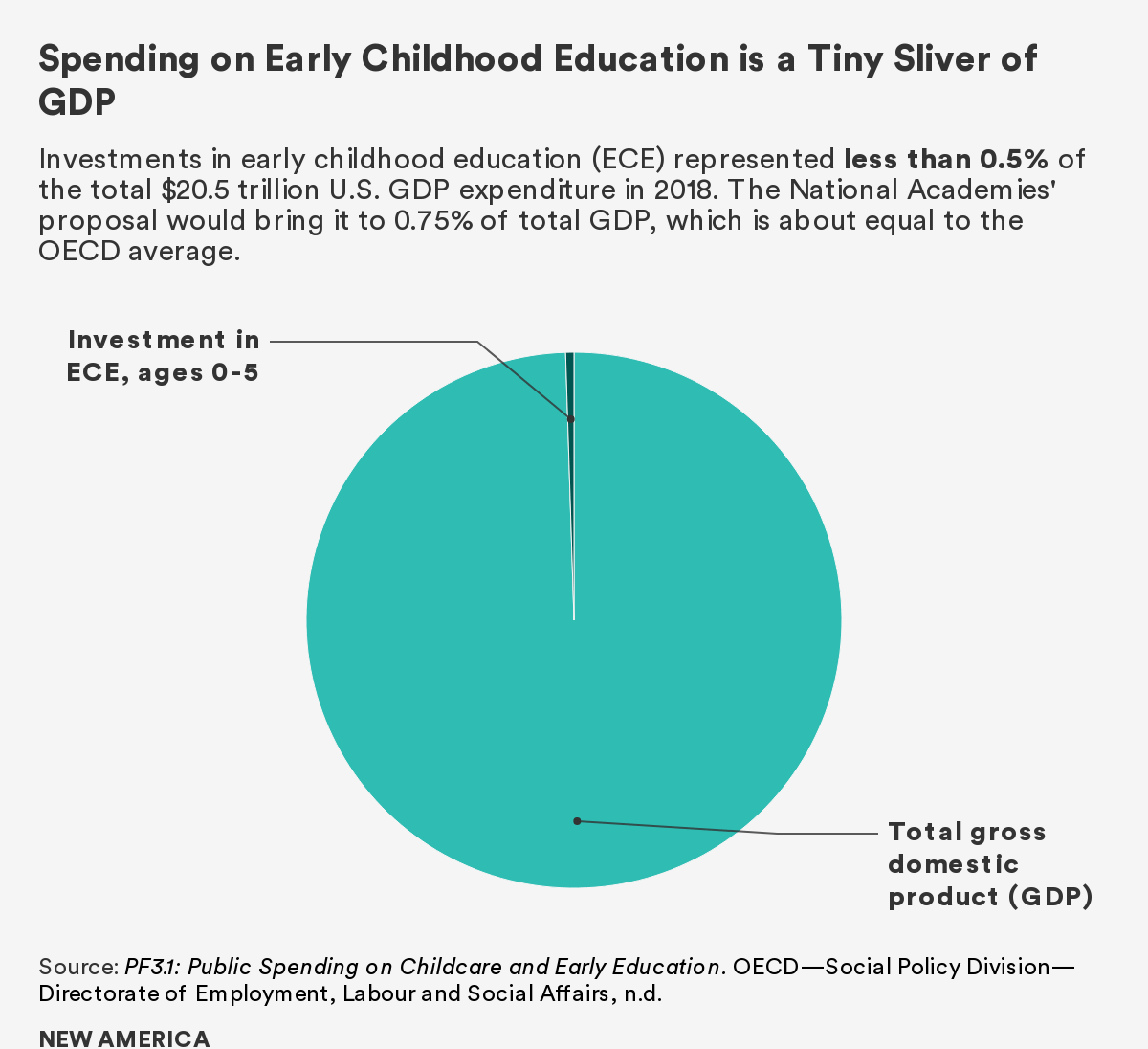
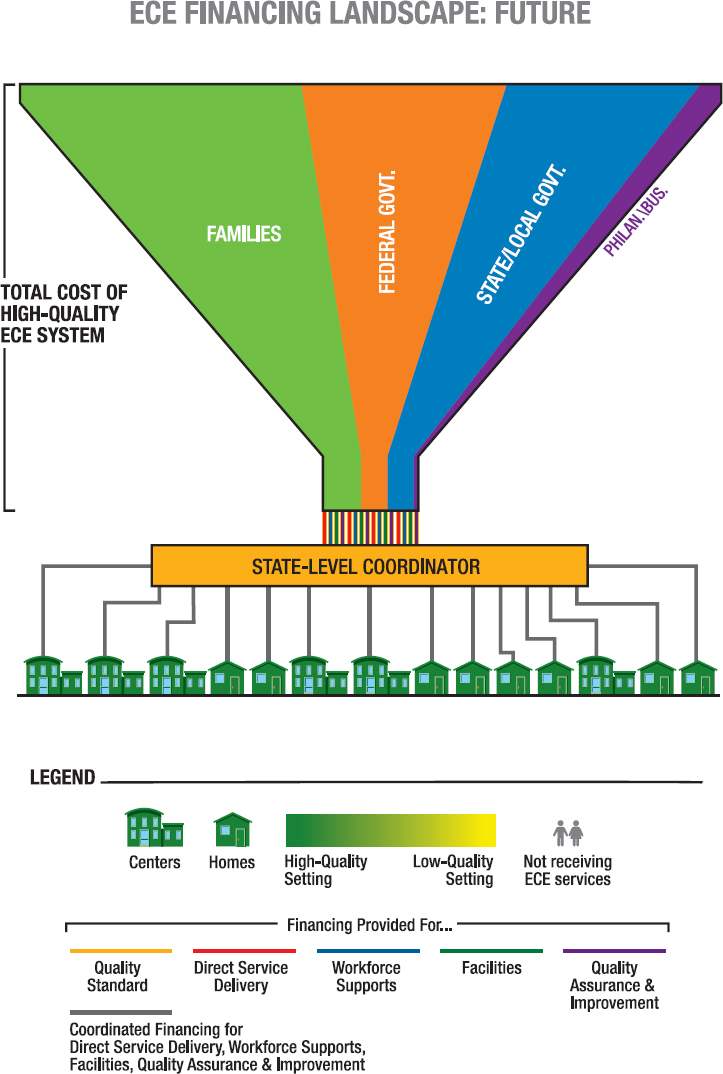
Source: Figure 7-3, https://www.nap.edu/read/24984/chapter/9#200
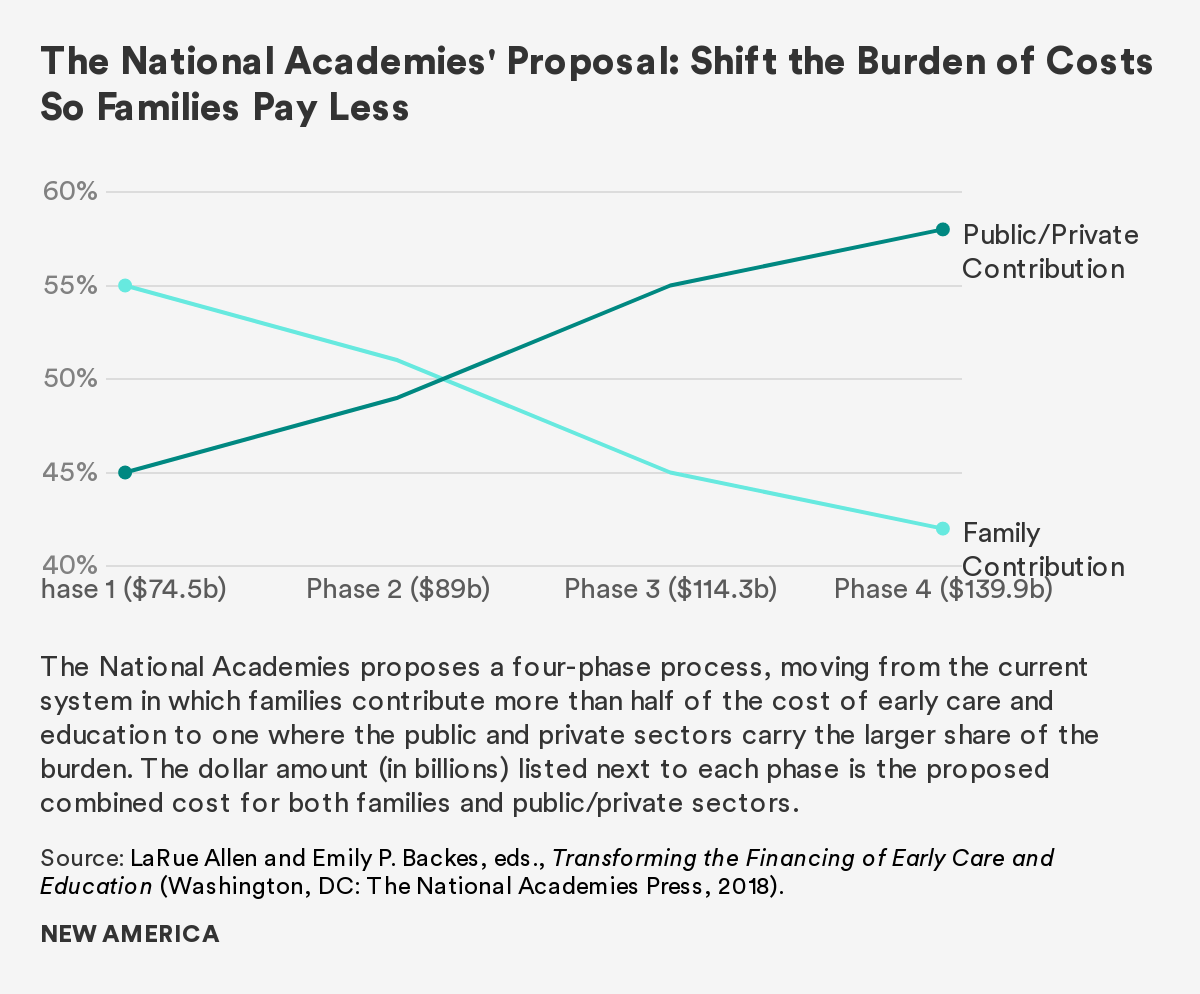
| Phase 1 | Phase 4 | |||
|---|---|---|---|---|
| Static | Dynamic | Static | Dynamic | |
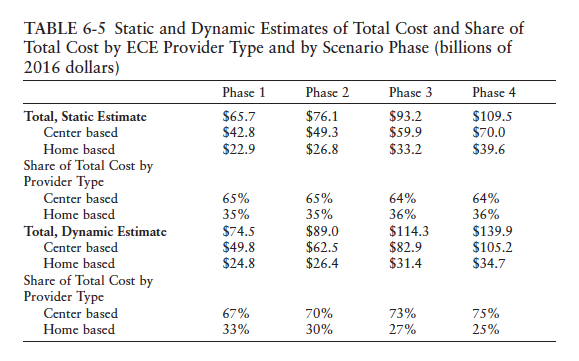
| Total Costs in Billions/Year (% of GDP) | 65.7(0.35%) | 74.5(0.4%) | 109.5(0.59%) | 139.9(0.75%) |
| Family Share (%) | 49% | 55% | 36% | 42% |
| Public Share (%) | 51% | 45% | 64% | 58% |

Transforming the Financing of Early Care and Education
- Frequently Asked Questions
- Moving Forward: Voices from the Field
- Introduction
- Landscape of Early Care and Education Financing
- Current Financing for Early Care and Education: Financing a Highly Qualified Workforce
- Current Financing for Early Care and Education: Affordability & Equitable Access
- Current Financing for Early Care and Education: Ensuring High Quality Across Settings
- Estimating the Cost of High-Quality Early Care and Education
- A Vision for Financing Early Care and Education
- Behind the Numbers
- Putting it into Context
- Learning from States and Other Countries
- Tools and Resources
- Graphics and Data Visualization
- Glossary