A Chapter of: Transforming the Financing of Early Care and Education
A Vision for Financing Early Care and Education

Decades of brain research show that high-quality early care and education (ECE) benefit children, families, and society as a whole. But we know that the majority of children attend low- or mediocre-quality programs. Increasing family access to high-quality ECE requires more public investment. The recommendations put forth by the consensus committee offer a vision for a transformed, effective financing structure that builds on six principles.
The committee also highlighted five goals that would be ensured under an integrated set of laws and policies:
● Providers will receive financial support based on the cost of high-quality programs.
● Providers meeting high standards will get core financial support to enable recruitment and retention of well-qualified teachers to meet children’s developmental needs.
● Families seeking early care and education programs will be charged no more than they can reasonably afford, with some paying nothing.
● Providers will see ongoing investments in a support and accountability infrastructure to help them maintain high quality.
● Public funding will be at a level that enables an adequate, equitable, and sustainable system.
Current ECE funding is inefficient and inadequate. As the committee says in its conclusion, “for too long, the nation has been making do with ECE policies and systems that were known to be broken.” Full implementation of the committee’s vision will require a transition period, political will, and political leadership at all levels of government. Below are the 10 recommendations from the committee for actors in federal, state, and local government; private sector stakeholders; institutions of higher education; and philanthropy. They fall into six areas: effective financing structure; cost sharing; transition planning; workforce transformation financing; business supports; and progress assessment.
An Effective Financing Structure
“To realize the considerable potential benefits of early education, an integrated framework of laws and policies is needed, in which financing is used to bring about an accessible, affordable, and high-quality system for all children from birth to kindergarten entry.” (p. 201)
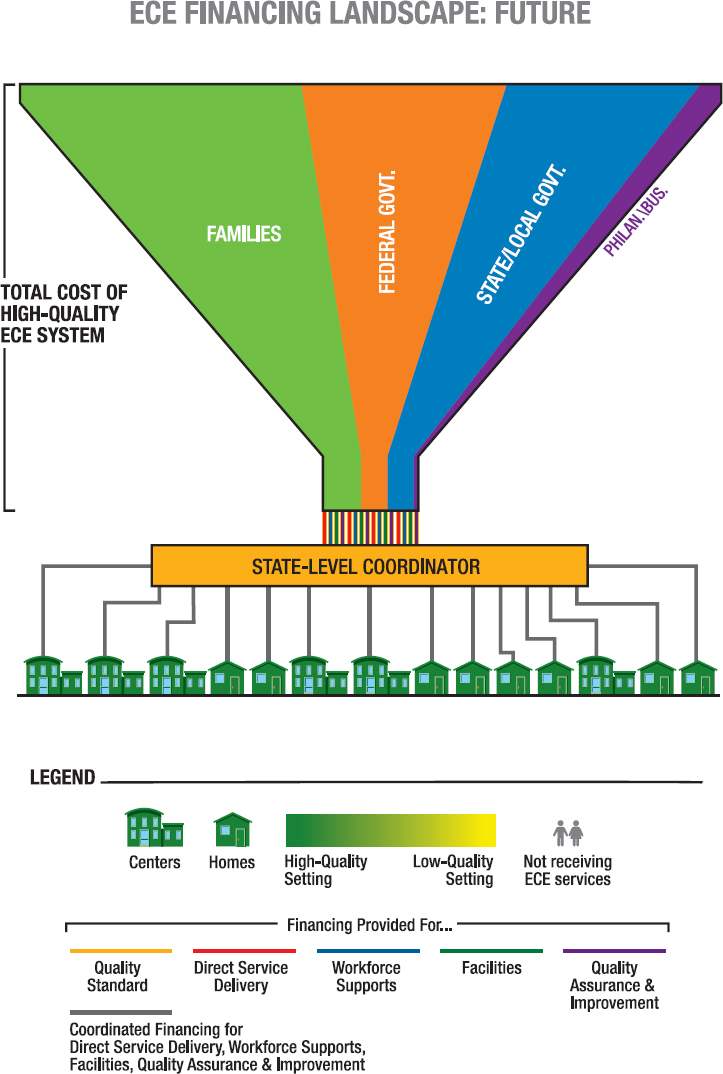
Source: Figure 7-3, https://www.nap.edu/read/24984/chapter/9#200
Consistent high-quality standards and cost-based payments
Recommendation 1: Federal and state governments should establish consistent standards for high quality across all ECE programs. Receipt of funding should be linked to attaining and maintaining these quality standards. State and federal financing mechanisms should ensure that providers receive payments sufficient to cover the total cost of high-quality ECE. Quality standards currently vary across states and federal programs, which means early care and education providers may be required to meet multiple sets of overlapping—and sometimes conflicting—requirements. This can be burdensome for providers and often results in confusion and inefficiencies. To ensure access to high-quality ECE for all children, the federal government and states should use consistent quality standards (linked to the Transforming the Workforce report) across all publicly funded programs and initiatives. Quality standards should address staff qualifications and compensation, professional development, coaching and mentoring, and quality monitoring and assurance. Federal and state funding should be set at the level necessary for providers to attain and maintain the quality standards. With regards to child care subsidies, for example, provider reimbursement rates should be set to reflect the actual cost of providing high-quality ECE and should reflect the costs of serving children with differing physical, emotional, and linguistic needs.
Ensuring Access to High Quality
Recommendation 2: All children and families should have access to affordable, high-quality early care and education, and access should not be contingent on parent income or work status.
The following are necessary to fulfill recommendation 2:
- ECE programs and financing mechanisms (with the exception of employer-based programs) should avoid setting eligibility standards that require parental employment, job training, education, or other activities.
- Federal and state governments should set uniform family payment standards that increase progressively with income and are applied if an ECE program requires a family contribution (payment).
- The share of total ECE system costs not covered by family payments should be covered by a combination of institutional support to providers who meet quality standards and direct assistance to families based on uniform income eligibility standards.
Federal ECE assistance programs are currently only available to parents who are employed or participating in approved education and training activities, increasing developmental gaps and inequities for young children whose parents are not employed. Research suggests that increasing access to ECE can actually have the effect of increasing parental employment.
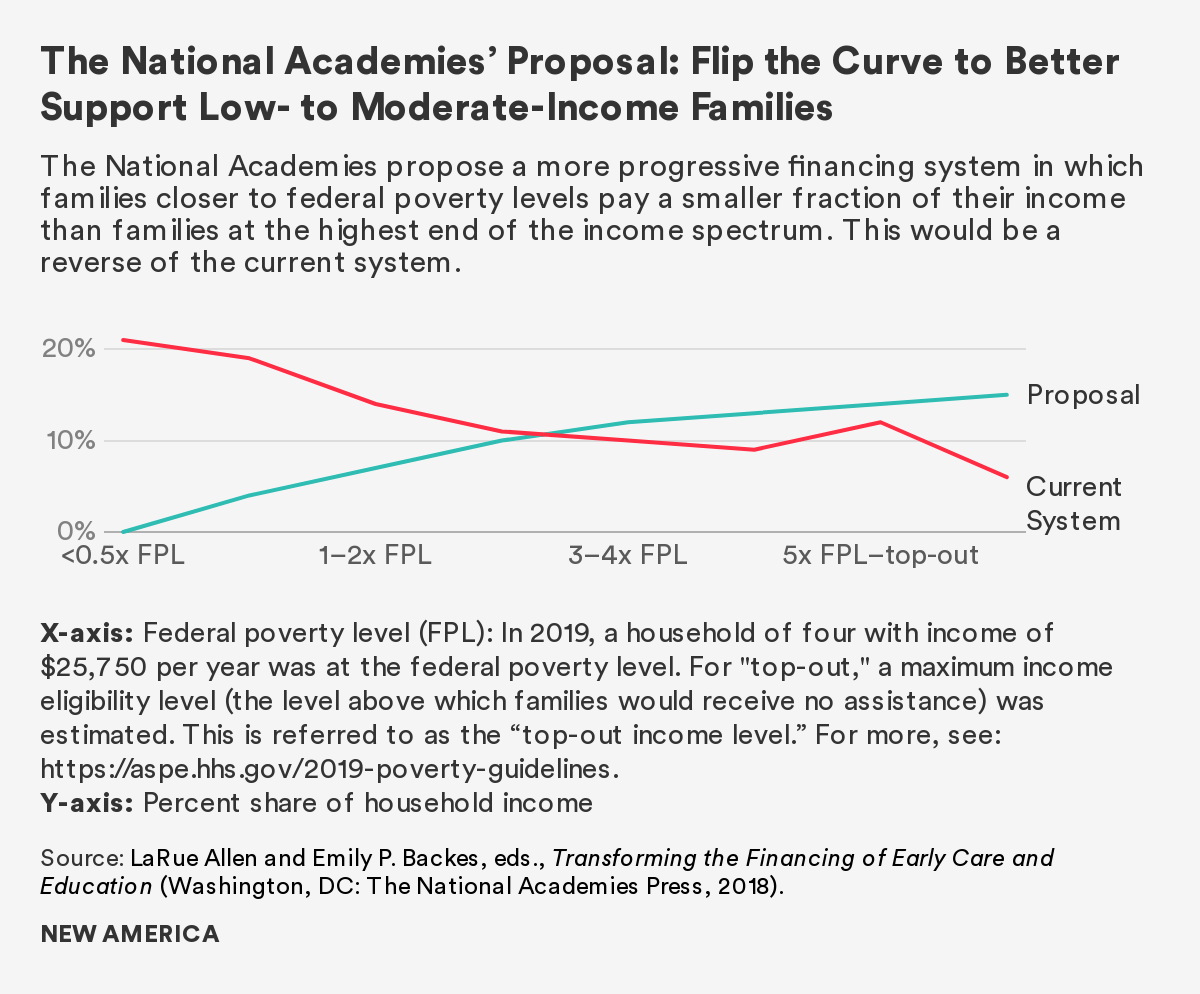
Uniform government family payment standards would help families select among a variety of ECE providers that meet their needs and preferences. These payment standards should be set to ensure that families of all income groups have access to high-quality ECE. The amount of family payment would be determined on a progressive scale so that the share of family payment expected increases as household income rises, reversing the current pattern where families with lower incomes ineligible for no-fee ECE options typically pay a larger share of their household income than do families with higher incomes. This kind of arrangement has the potential to reduce economic segregation, as ECE programs serving only children from families with low-incomes begin to also serve children from other socioeconomic backgrounds.
State-Level Coordination
Recommendation 3: In states that have demonstrated a readiness to implement a financing structure that advances principles for a high-quality ECE system and includes adequate funding, government or other state-level entities should act as coordinators for the various financing mechanisms that support early care and education, with the exception of federal and state tax preferences that flow directly to families.
State governments should act as coordinators of most of the revenue streams and financing mechanisms supporting ECE in order to eliminate the administrative burden on providers. States should only be given this responsibility after showing a willingness to implement a financing structure that advances the principles of high-quality ECE. States would distribute federal and state funds to providers and families and create an administrative structure that best fits the states’ needs. One way a state could show that it is ready to implement this recommendation is by meeting or exceeding Head Start standards in its pre-K programs and investing adequate funds to deliver high-quality ECE to infants and toddlers.
Even with a coordinated financing structure, multiple funding streams would still be needed. For example, some families may use Head Start services but also need ECE services during nonstandard work hours. A coordinated financing structure does not mean federal revenue streams should be consolidated and distributed to states as block grants, however. The recent history of block grants shows that the use of such grants often leads to decreased federal funding.
Sharing the Cost for High-Quality Early Care and Education
“To build adequate, equitable, and sustainable financing with effective incentives for quality, additional resources will need to come from a combination of public and private resources, with the largest portion of the necessary increase coming from public investments.” (p. 213)
Public Share of Costs
Recommendation 4: To provide adequate, equitable, and sustainable funding for a unified, high-quality system of ECE for all children from birth to kindergarten entry, federal and state governments should increase funding levels and revise tax preferences.
There is an urgent need for greater public investments to ensure all families can access high-quality ECE. The public share will increase during the transition period to a new financing system due to higher quality standards and costs that will make ECE less affordable for families unless they receive financial assistance. The committee estimates that its recommendations would require at least $140 billion of annual funding, equal to about 0.75 percent of U.S. gross domestic product, slightly less than the average 0.8 percent of GDP spent by OECD nations on ECE. The committee estimates that an affordable family contribution would yield about $58 billion, leaving a need of at least $82 billion in public funding, an increase of about $53 billion over current spending levels. How that cost should be distributed among levels of government and among revenue sources must be determined through political processes, where the benefits of a high-quality ECE system are weighed against raising taxes or reducing other public spending. Governments must decide whether to rely on a dedicated revenue source or on general tax revenue to fund the new ECE system. The committee emphasizes that increased ECE spending should not be offset by cutting other essential services to children and families.
If new taxes are imposed to pay for ECE, the tax burden should either be progressive or proportional, but not regressive. An income tax is a viable option for a progressive tax, while state sales taxes are likely to be regressive. A good tax source for funding ECE should also be stable over economic cycles and should increase with population growth.
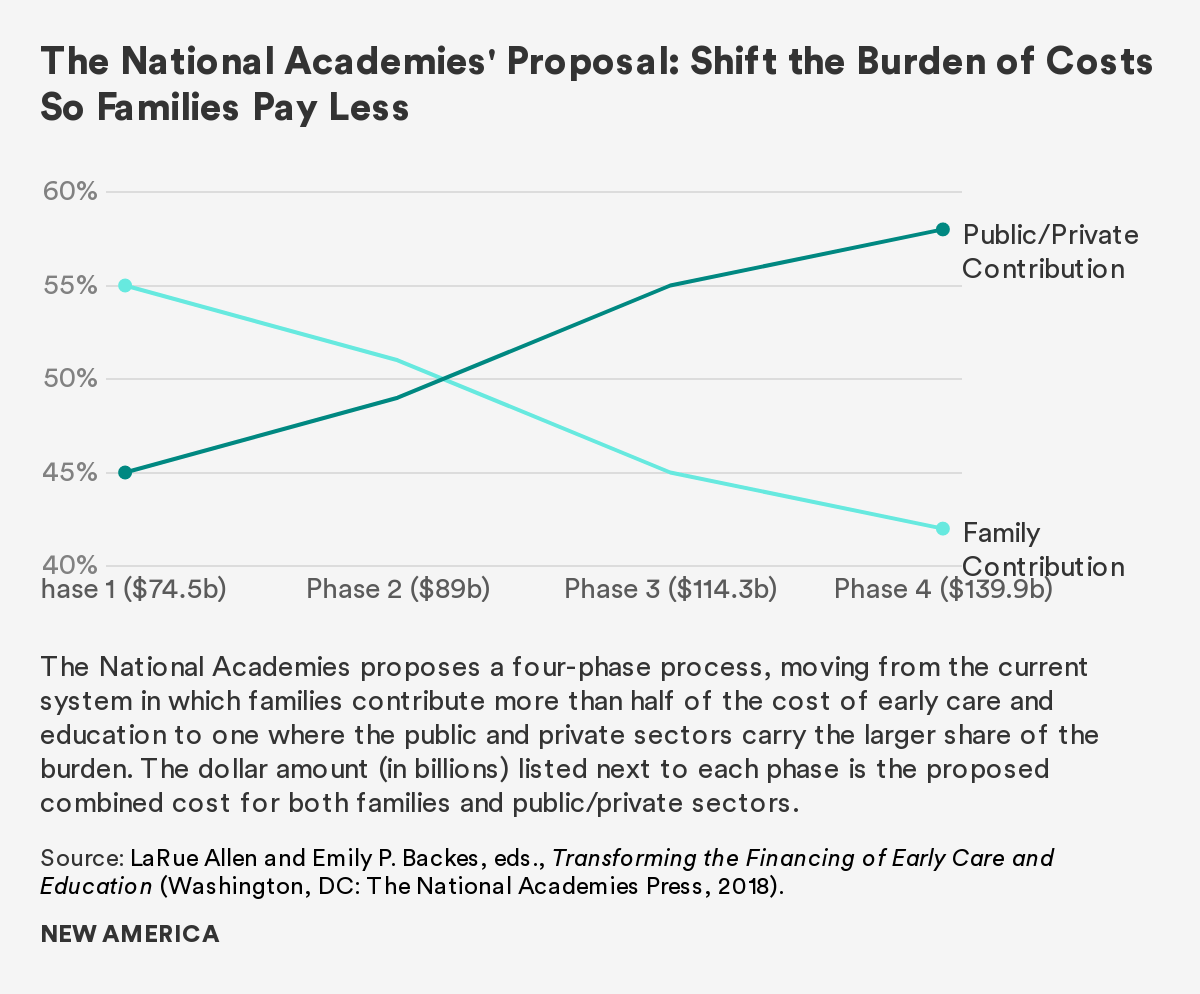
Families’ Share of Costs
Recommendation 5: Payments for families at the lowest income level should be reduced to zero, and if a family contribution is required by a program, that contribution should progressively increase as income rises.
The current ECE financing structure is regressive because the fees paid by low- and middle-income families generally account for a greater share of household income than fees paid by wealthier families. There are pros and cons to both no-fee approaches and approaches that require families to pay an affordable share of costs. A no-fee approach could promote socioeconomic integration in ECE settings, which has been shown to benefit all children. Such an approach would also ensure that no children lack access to ECE due to financial barriers. However, a no-fee approach also would transfer some resources from the public to the affluent, subsidizing high-income families, and the higher public cost of a no-fee approach could cause policymakers to limit eligibility to children from low-income families, further exacerbating economic segregation.
A Note on Other Private Sector Stakeholders:
“While employers’ and philanthropies’ financial contributions to early care and education are small relative to the scale of the contributions of parents and the public sector, this sector’s leadership and active participation in asserting the importance of and setting the vision for systemic transformation are essential. The private sector has the potential to play a critical role advocating for policies and leveraging available dollars to support high-quality ECE services and systems, particularly during the transition phases for moving from the current fragmented and failing system to an effective, high-quality ECE system.” (p. 220)
Planning for the Transition to High Quality
“Local-, state-, and national-level planning efforts, taken together, are critical to facilitating the implementation of an integrated financing system as envisioned in this report by identifying key stakeholders charged with moving the plans forward, building constituencies to support systemic transformation, and leveraging resources to bring about high-quality early care and education that is affordable and accessible for all children.” (p. 225)
Recommendation 6: A coalition of public and private funders, in coordination with other key stakeholders, should support the development and implementation of a first round of local-, state-, and national-level strategic business plans to guide transitions toward a reformed financing structure for high-quality early care and education.
Transitioning from the current ECE financing structure to an entirely new structure will require time, resources, and thoughtful coordination and planning. During this transition period, the private sector will have an important role, including in: building coalitions in support of initiatives to spur change, using investments to drive implementation of a new financing structure, and holding the public sector accountable for improving ECE equality. Developing public-private partnerships, such as the one in Virginia, will be important during the transition period to leverage resources and ensure a commitment in moving toward a high-quality system. Private funders should work with public funders and other stakeholders to develop and implement strategic business plans at the local, state, and national level to guide the transition toward a new financing structure.
Financing Workforce Transformation
Considering the financial resources needed for workforce transformation, compensation, higher education, and professional development must be part of the conversation. Because of limited funding in the system, qualification requirements have not significantly raised compensation.
System-Level Workforce Development
Recommendation 7: Because compensation is not currently commensurate with desired qualifications, the ECE workforce should be provided with financial assistance to increase knowledge and competencies and to achieve required qualifications through higher-education programs, credentialing programs, and other forms of professional learning. The incumbent workforce should bear no cost for increasing its knowledge base, competencies, and qualifications, and the entering workforce should see costs limited to a reasonable proportion of postgraduate earnings, so that diversity in the pipeline of ECE professionals is maintained and promoted.
The following are essential for achieving recommendation 7:
- Existing grant-based resources should be leveraged, and states and localities, along with colleges and universities, should work together to provide additional resources and supports to the incumbent workforce, as practitioners further their qualifications as ECE professionals.
- Government should provide appropriate supports in order to limit to a reasonable proportion of expected postgraduate earnings any expenses incurred by prospective ECE professionals not covered by existing financial aid programs.
Recommendation 8: States and the federal government should provide grants to institutions and systems of postsecondary education to develop faculty and ECE programs, and to align curricula with the science of child development and early learning and with principles of high-quality professional practice. Federal funding should be leveraged through grants that provide incentives to states, colleges, and universities to ensure higher-education programs are of high quality and aligned with workforce needs, including evaluating and monitoring student outcomes, curricula, and processes.
Under the current system, the cost of professional training is paid for either directly by the workforce or is shared between the workforce and employers. The current ECE workforce should not be financially responsible for any of the costs associated with additional training since it is unrealistic that these workers would be able to repay loans with future wages. The entering workforce should have financial assistance so that its education costs are limited to a reasonable proportion of future earnings. Asking providers to cover the costs would also pose serious difficulties since many are small businesses that operate with limited budgets. Therefore, additional federal and state funding will be necessary to help the workforce achieve higher levels of training and education.
Once workforce compensation reaches higher levels, it may be reasonable to ask ECE professionals to contribute to the cost of obtaining additional qualifications. The expected financial contribution from the workforce should still be a small percentage of expected future earnings. State officials will need to use public colleges and universities to promote high-quality, affordable training for ECE professionals and should create options to assist private institutions to make low-cost training available. Targeted financing mechanisms should be put toward supporting culturally and linguistically diverse professionals.
State leaders will also need to find ways to spur higher education programs to align coursework and experiences with the core knowledge and competencies needed by the ECE workforce. The federal government can play a role as well, by providing grants to state higher education systems to align curricula with the latest science of child development and early learning, ensure affordability for the workforce, and support faculty and program development. It will also be important for states to support efforts to streamline career pathways through the development of stackable credentials and coursework sequencing that ensures seamless articulation between preparation programs.
Business Supports
Because access to high-quality ECE depends on the financial viability of providers, the workforce needs to be supported with business, planning, and financial management tools, resources, and technical assistance. The 2014 CCDBG Reauthorization Act required states to take steps to improve the business practices of providers and mandated that states submit plans to provide technical assistance to providers. Since many providers might not have the expertise to manage business and financial responsibilities on their own, participation in a shared services alliance (SSA) can be helpful for cutting costs. The cost savings resulting from participation in an SSA could then be used to invest in quality improvement, such as higher compensation for ECE educators. Higher education programs for ECE professionals should include training focused on business and financial management to ensure that program leaders have the competencies necessary to ensure that their operations are sustainable.
Assessing Progress Toward Quality
“Given the large amount of resources required, it is essential to monitor the effects of key changes as they are phased in, to ensure investments yield desired results for children, the workforce, and families. It is also important to incentivize innovation and a diversity of approaches to quality improvement and to evaluate those innovations and approaches.” (p. 233)
Recommendation 9: The federal and state governments, as well as other funders, should provide sustained dollars for research and evaluation on early childhood education, particularly during the transition period, to ensure efforts to improve the ECE system are resulting in positive outcomes for children and in the recruitment and retention of a highly qualified workforce.
As ECE transitions into its new system, it will be important to monitor and evaluate the impact of the changes and their effect on the well-being of children, families, and the workforce. There is still not a strong evidentiary base on many important issues related to the workforce, including the effects of requiring particular degrees for ECE educators. Despite this lack of clear evidence, practical reasons exist for developing a system in which more of the ECE workforce has stronger qualifications. Stronger qualifications will strengthen the case for increasing compensation to the point necessary to recruit and retain well-qualified staff, will elevate the stature of the workforce and help it be seen as professional, and will lead to higher levels of well-being for employees. But these additional qualification increases and other sweeping changes to the ECE system should be carefully monitored to ensure investments yield the desired results.
Federal and state governments should fund sustained research to determine the success of efforts to improve the ECE system and workforce. Multiyear evaluations will be necessary throughout the transition to the new high-quality ECE system. Data should be collected to assess whether rising compensation levels are actually leading to the recruitment and retention of highly qualified staff. Government should also provide funding for facility needs assessments to understand which communities need newly constructed or renovated ECE facilities.
A comprehensive, nationwide system will be needed for the collection, reporting, sharing, and use of key information on the status of the ECE system both before and after the transition to high quality. While a number of monitoring systems are in place across the states, they are insufficient for tracking system-wide progress. This system should conceive of quality broadly and include not only structural features of care and education, such as teacher-child ratios, but also process measures, including observational measures of teacher-child interactions. Such a system should also include regular assessment of workforce well-being through the use of tools such as the Supportive Environmental Quality Underlying Adult Learning (SEQUAL) instrument that is administered directly to teachers and assistant teachers and measures how well staff is being supported to develop knowledge and skills on the job. A comprehensive system like this is essential for ensuring that new investments are leading to the desired outcomes.
Ongoing Data Collection and Research
Recommendation 10: The federal government should align its data collection requirements across all federal ECE funding streams to collect comprehensive information about the entire sector and sustain investments in regular, national data collection efforts from state and nationally representative samples that track changes in the landscape over time, to better understand the experiences of ECE programs, the workforce, and the developmental outcomes of children who participate in programs.
There are a number of holes when it comes to ECE data collection. More comprehensive and ongoing data about children, programs, and the workforce are needed. A revamped financing structure should include funding to align data collection requirements across all federal ECE funding streams. All federally funded programs should be required to submit the same type of data to allow for comparisons across settings. The federal government could also create incentives to encourage the incorporation of aligned data collection for state and local ECE programs. It is also important to understand whether or not all children have access to high-quality ECE experiences and are ready to learn when they enter elementary school.
Resources are needed for collecting data from a nationally representative sample of young children over regular intervals, similar to what currently takes place for older children via the National Assessment of Educational Progress (NAEP). For younger children, though, doing this accurately and appropriately will be more costly than for K–12 due to the need for one-on-one assessments. But spending on collecting data about children’s skills is essential for tracking whether investments in ECE are associated with improvements in child outcomes across a diverse set of measures. The federal government should also collect data at regular intervals to track children’s experiences in ECE settings and changes in the ECE workforce over time. There have been federal studies done before on the ECE sector but not on a regular basis, making it difficult to track change and progress over time. There is much to learn from data collection in the K–12 sector, particularly with NAEP and with the National Center for Education Statistics’ Schools and Staffing Survey, now known as the National Teacher and Principal Survey.
See the Glossary for key word definitions.

Transforming the Financing of Early Care and Education
- Frequently Asked Questions
- Moving Forward: Voices from the Field
- Introduction
- Landscape of Early Care and Education Financing
- Current Financing for Early Care and Education: Financing a Highly Qualified Workforce
- Current Financing for Early Care and Education: Affordability & Equitable Access
- Current Financing for Early Care and Education: Ensuring High Quality Across Settings
- Estimating the Cost of High-Quality Early Care and Education
- A Vision for Financing Early Care and Education
- Behind the Numbers
- Putting it into Context
- Learning from States and Other Countries
- Tools and Resources
- Graphics and Data Visualization
- Glossary