A Chapter of: Transforming the Financing of Early Care and Education
Estimating the Cost of High-Quality Early Care and Education

Key takeaways
- Early care and education is a labor-intensive industry, so staff qualifications and compensation largely drive the cost of service.
- The costs of a high-quality system will be much higher than current costs in large part due to the significantly higher levels of compensation required to recruit and retain a well-qualified workforce.
- There are many uncertainties inherent in projecting the national costs of implementing an ECE system that is drastically different than the current one.
Summary
Estimating the cost of providing high-quality early care and education is a vital first step in building a financing system that ensures access to high-quality ECE for all children. The total resources that need to be invested in a high-quality ECE system include on-site costs and system-level costs. On-site costs include maintaining appropriate staffing levels, compensating staff adequately, providing professional development, and paying for things like curriculum, facilities, and equipment.
The video above explains why costs are so high while early childhood teachers are paid so little. It was produced by Child Care Aware of America, a national advocacy group, and the Center for the Study of Child Care Employment at the University of California-Berkeley.
System-level costs include workforce development supports, such as off-site training, ongoing professional learning, and higher education; as well as costs related to quality assurance and improvement, such as data systems and licensing and accreditation.
Because early care and education generally requires a larger supply of staff than the K–12 school system due to lower student-teacher ratios, staff qualifications and compensation account for the largest share of costs. The costs of a high-quality ECE system will be much higher than current costs, because significantly higher levels of compensation will be needed to recruit and retain a well-qualified workforce. While it’s clear that current compensation is too low for ECE staff, it’s not entirely clear how high compensation needs to be set in order to attract and retain a qualified workforce. Some advocates propose that compensation levels for ECE educators be equal to that of kindergarten-to-third grade educators, but there are a number of challenges to achieving pay parity, including lower levels of unionization among early educators and a lack of protected funding sources dedicated to ECE. A new financing structure that includes dedicated, predictable, and sustainable funding sources could help address these challenges.
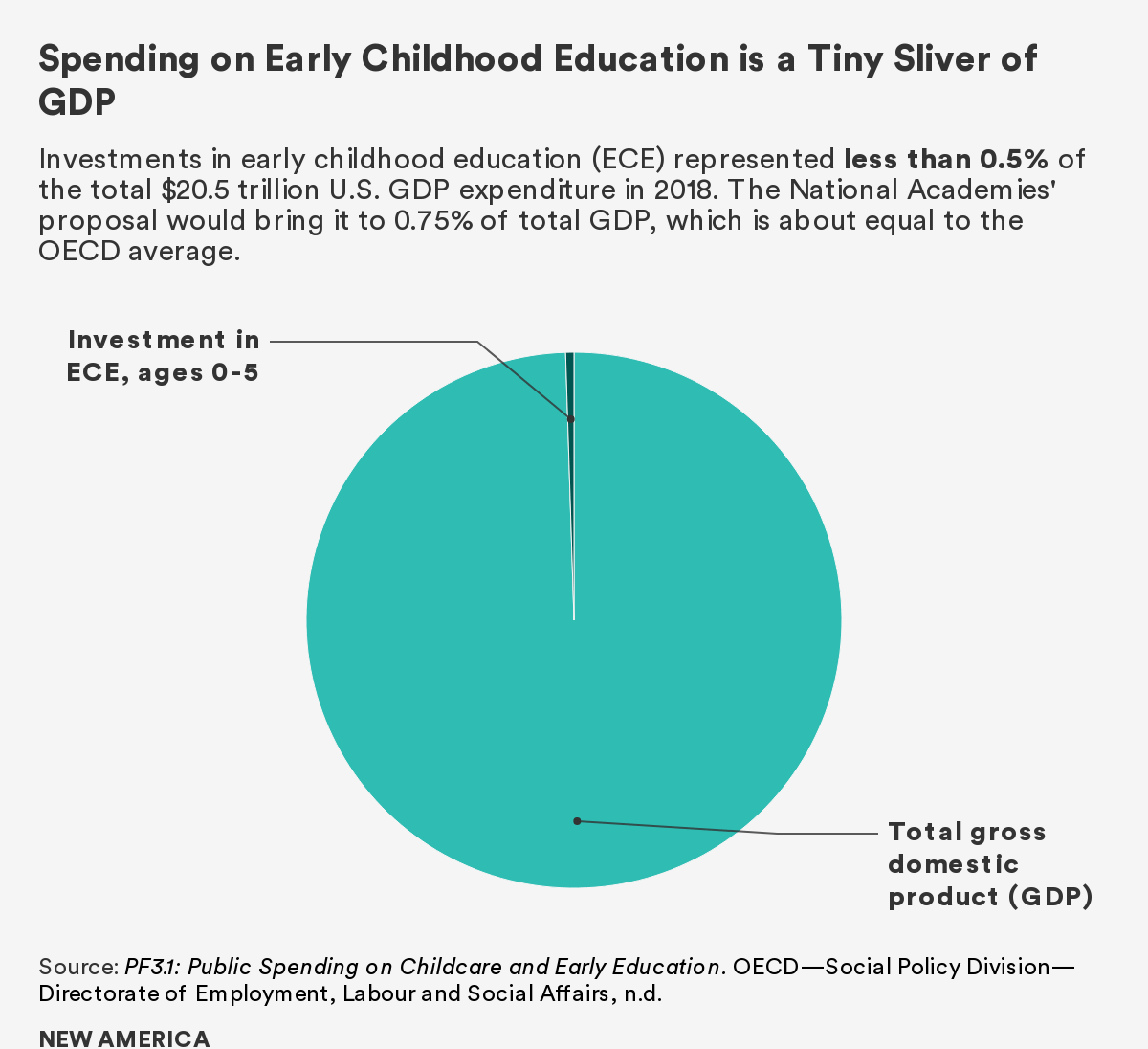
There are a number of uncertainties inherent in projecting the national, aggregate costs of implementing an improved ECE system. For example, it’s unclear exactly how much overall participation in ECE would increase under an entirely different set of conditions. It’s also unclear if the new system would lead to a substantial shift from home-based to center-based ECE services. For its cost estimate, the committee that wrote the report assumes more families will use center-based ECE options and will use more ECE hours per child. With these limitations in mind, the committee estimates that, once fully implemented, the total cost of offering accessible and affordable high-quality ECE with a highly qualified workforce would amount to at least $140 billion per year. Current federal and state ECE-related spending amounts to about $29 billion, well below what is necessary to support high-quality ECE for all children. While $140 billion is a large number, it represents only about 0.75 percent of the country's gross domestic product (GDP), slightly less than the average of 0.8 percent of GDP allocated to ECE for the nations in the OECD.
Part of establishing a system that provides affordable, high-quality ECE is determining a reasonable financial share for parents to pay to help offset the public costs. If it is determined that parents should pay for a portion of the cost of providing ECE, the payment schedule should be progressive: the cost for low- to middle-income families should be lower than that for more affluent families. If, on the other hand, the new system includes no fees for families, as is the case in the public K–12 system, a greater share of funding from private or public sources would be needed.
See Behind the Numbers for further discussion of cost estimates.
Key quotes from the report:
- "It is clear that the committee's estimate of the total cost of providing high-quality early care and education, reinforced by previous cost estimates, suggests that there is a significant gap between the amount of funding currently in the ECE system and the amount of money needed to support access to high-quality early care and education for all children." (p. 193)
- "These numbers are large but are not out of line with current international practice nor with current spending on K–12 education." (p. 193)
Questions for policymakers:
- How can political will be built to significantly increase local, state, and federal funding of early care and education?
- How does investment in an early care and education system fit with other priorities? What are the other top priorities? Are there investments in ECE that can benefit those other priorities?
- What are the pros and cons of designing an ECE system that is free for all families versus one that institutes a sliding scale payment system?
- What is a reasonable timeline for raising the quality of ECE to meet a higher standard?
- What are the most pressing issues in ECE financing? What will happen if we don’t address ECE financing?
- Could cost modelling be used to understand the current landscape?
- What is hampering resource allocation for sustainable and stable ECE program funding?
- Is your state or locality engaged in public-private partnerships that benefit early care and education? What looks promising? What has been challenging?
Questions for funders:
- How can private sources of funding be used to defray the cost of building a high-quality ECE system?
- How can philanthropic funders work with public agencies to spur pilots and innovations that become publicly supported if they prove successful?
Questions for the workforce:
- For service providers: What support is needed to help increase the quality of ECE services, in addition to funding, especially as it relates to increasing staff qualifications?
- For program administrators: What is your current capacity to manage multiple funding streams needed to expand access, and what would help you to manage these streams? What state-level supports or policies would help?
See the Glossary for key word definitions.

Transforming the Financing of Early Care and Education
- Frequently Asked Questions
- Moving Forward: Voices from the Field
- Introduction
- Landscape of Early Care and Education Financing
- Current Financing for Early Care and Education: Financing a Highly Qualified Workforce
- Current Financing for Early Care and Education: Affordability & Equitable Access
- Current Financing for Early Care and Education: Ensuring High Quality Across Settings
- Estimating the Cost of High-Quality Early Care and Education
- A Vision for Financing Early Care and Education
- Behind the Numbers
- Putting it into Context
- Learning from States and Other Countries
- Tools and Resources
- Graphics and Data Visualization
- Glossary