A Chapter of: Transforming the Financing of Early Care and Education
Current Financing for Early Care and Education: Affordability & Equitable Access

Key takeaways
- While Head Start and state pre-K resources aimed at low-income families contribute to equity of access, the programs often leave middle-class families without access to affordable, high-quality early care and education.
- The existing ECE system consists of a hodgepodge of various programs with conflicting eligibility criteria.
- Because of the high cost of early care and education, many low-income families are forced to rely on relatives and others to provide care rather than enroll their children in center-based care.
Summary
Analyzing current patterns of family use and spending when it comes to early care and education is helpful for understanding the shortcomings of the current financing structure. A majority of children will have at least one regular ECE provider by the time they are one year old. This percentage increases with a child’s age, with nearly three-quarters of four-year-olds having at least one regular ECE provider. The patterns of ECE usage by family income shows that the share of children in ECE increases as family income increases; the same pattern holds for the share of children in center-based rather than home-based care. Studies suggest that low-income families are less likely to use center-based care than high-income families and are more likely to rely on relatives for care, probably due to a combination of cost, convenience, and difficulty finding a center that offers care during non-traditional hours. These studies also suggest that families with lower incomes would likely make greater use of ECE if they could afford to do so.
See National Academies report: Figures 4-1 – Patterns of ECE utilization by income category, all children ages 0–5 years (not in kindergarten) and 4-2 – Share of children in center-based early care and education, by age and income category
See National Academies report: Table 4-2 – Average Weekly Hours of Care per Child, by Age Group and Type of Early Care and Education
There are two major programs that distribute funds directly to providers: federally funded Head Start programs and public pre-K programs primarily funded by states or localities. Participating families pay no cost for Head Start services. Some public pre-K programs require no payment, others require payment from some parents based on a sliding income scale, and others require some payment from all parents. While families are eligible to enroll children in Head Start if their income falls below a certain level, many but not all public pre-K programs are targeted at children from low-income families. In FY 2016, only 31 percent of eligible children ages three to five were served by Head Start. Less than 3 percent of eligible children under age three were served by Early Head Start in 2014–15. There is great variation among states in terms of children served by state-funded public pre-K programs. Across all public programs (public pre-K and special education enrollment plus Head Start) about 44 percent of four-year-olds and 16 percent of three-year-olds are currently served.
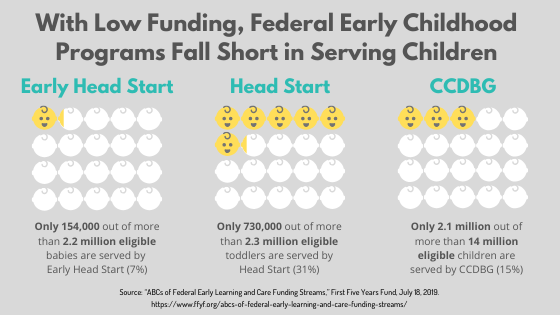
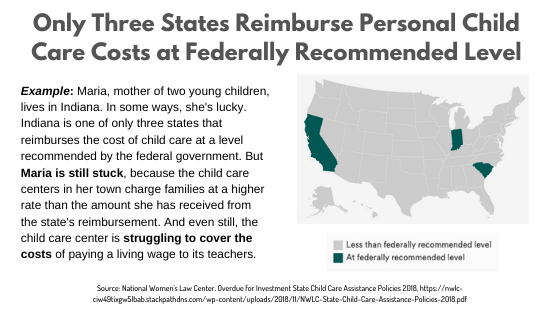
There are mechanisms in place to provide assistance to low- and moderate-income families in affording child care. Subsidies are issued on a sliding scale based on family size and income. Head Start is provided at no cost for families with incomes up to the federal poverty line, meaning a family may longer be eligible for the program if its income increases slightly. Even with child care subsidies some states require such high copayments that many low-income families may still be unable to afford ECE. Currently, only 11 percent of children who are eligible for child care assistance actually receive it. Due to limited funds, 20 states had waiting lists or froze intake for child care assistance in 2016. It’s important to note that these subsidies are restricted by federal law to families with parents who are employed or involved in education or training programs, so that some families will be ineligible for any sort of child care assistance. While there are tax regulations designed to assist families with paying for child care, such as the Child Care and Dependent Tax Credit, these credits tend to be more beneficial for middle- and upper-income families than for low-income families.
Key quotes from the report:
- "Studies have found that low-income families use less center-based care than do high-income families and more often rely on relatives to provide care." (p. 119)
- "The stark difference in ECE utilization patterns across income categories supports the hypothesis that the cost to families is an important determinant of children's access to early care and education." (p. 122)
- "While targeting low-income children responds to one aspect of equity, current provider-oriented mechanisms are insufficient to support access for all low-income families and do not address the middle-income gap." (p. 125)
- "Eligibility requirements that are tied to parental employment rather than children's developmental needs may increase instability in ECE arrangements." (p. 129)
Questions for policymakers:
- Given the fact that children of low-income families are more likely to use family, friend, and neighbor care, what policies can help increase the overall quality of these informal care settings?
- How can the recent increase in CCDBG funds best be used to both increase access and quality to ECE for children from low-income families? How is your state using the quality set-aside? What’s the priority need in your state in terms of access to ECE vs. quality? What are the tradeoffs of focusing on one over the other?
- How can current tax regulations be altered so that they offer more benefits to low-income families?
- What are current reimbursement rates for child care providers? What has your state done to increase these rates, particularly for high-quality early learning providers?
- Has your state considered contracting with early learning providers rather than reimbursing based on attendance? How might this impact providers’ ability to deliver more consistent quality?
See the Glossary for key word definitions.

Transforming the Financing of Early Care and Education
- Frequently Asked Questions
- Moving Forward: Voices from the Field
- Introduction
- Landscape of Early Care and Education Financing
- Current Financing for Early Care and Education: Financing a Highly Qualified Workforce
- Current Financing for Early Care and Education: Affordability & Equitable Access
- Current Financing for Early Care and Education: Ensuring High Quality Across Settings
- Estimating the Cost of High-Quality Early Care and Education
- A Vision for Financing Early Care and Education
- Behind the Numbers
- Putting it into Context
- Learning from States and Other Countries
- Tools and Resources
- Graphics and Data Visualization
- Glossary