A Chapter of: Transforming the Financing of Early Care and Education
Introduction

Key takeaways
- Early childhood is a critically important time in the human life cycle.
- The current fragmented system of early childhood care and education in the United States is underfunded, perpetuates racial and socioeconomic inequities, and prevents many families from accessing affordable, high-quality care.
- One major aspect of the Early Childhood Education (ECE) financing system needing reform is the workforce: as teachers continue to develop knowledge and competencies and acquire the minimum of a bachelor’s degree, they will need financial and workplace supports along with more competitive compensation.
Summary
Early childhood, the time between birth to age eight, is a period of tremendous learning and development. From the moment children are born, they are learning skills from their environment, experiences, and interactions with caregivers that will predict their success in life. ECE bolsters the development of both children and the economy by enabling parents to stay in the workforce while promoting children’s cognitive, social, and physical growth.
ECE investments are inarguably wise. Studies have shown that high-quality programs, like the Perry Preschool Project, yield returns of $10 for every dollar invested, while typical programs have a return on investment of $3 to $4. Five million children in the U.S. (about one in five) live in poverty, and economists estimate that access to ECE has the potential to reduce child poverty by 3 percent.
Yet for all of the potential within ECE, the system of delivery is fragmented, with uneven access, quality, and affordability, and a workforce that is as poorly unified as it is compensated.
Early care and education settings vary by facility (such as home-based or center-based), age served, and funding source. Public programs may be targeted at particular populations, such as Head Start, which serves families with low incomes, or universal, such as school-based pre-K.
- See National Academies report: Figure 1-1 – Service delivery settings where children from birth to kindergarten receive early care and education
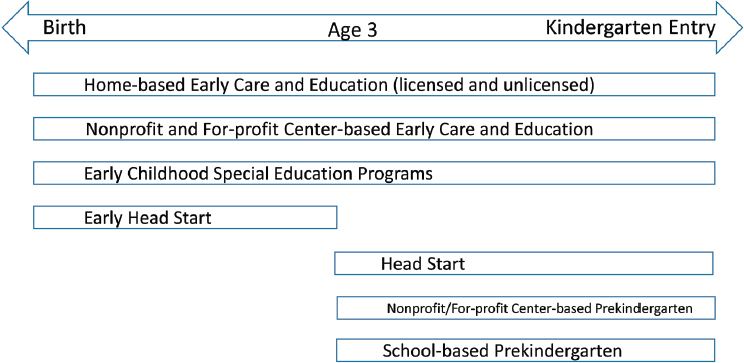
Funding sources for ECE include federal, state, and local revenue, as well as philanthropy and business sector investments, though most of the funding comes from parents. Funds may be distributed to providers, families, and the ECE workforce through a number of financing mechanisms, such as tax preferences, vouchers, and grants. Fragmentation in delivery, paired with perpetual underfunding, results in uneven quality and access to services, places financial burdens on families, and perpetuates inadequate wages for the ECE workforce.
The two-million-member workforce contributes to the outcomes of children and our future prosperity each day, while receiving little respect and low compensation. According to the 2018 Index from the Center for the Study of Child Care Employment, the median wage for child care workers was $10.72 in 2017 and just slightly higher for pre-K teachers, $13.94. Overall, 86 percent of teachers caring for infants and toddlers and 67 percent of pre-K teachers earned below $15 per hour. Half of all ECE professionals rely on public assistance. ECE teachers are being encouraged and, in some places, required to earn bachelor’s degrees, yet their inadequate wages make tuition payments burdensome and provide little incentive to remain in the field once the credential is achieved.
This financing report drew upon the six principles of high-quality early care and education defined in Transforming the Workforce in order to judge the current financing system and to innovate solutions. The report’s authors assessed research in fields such as early childhood, economics, and public policy; reviewed legislation, state and local budgets, and literature on the state of ECE in the U.S.; and analyzed a number of international ECE financing systems. From their thorough audit, the committee that wrote the report developed a framework and vision for the future of funding early care and education that will be explored in this guidebook.
- See National Academies report: Box 1-4 – Principles of High-Quality Early Care and Education
Key quotes from the report:
- “Early care and education (ECE) investments are critical because the early foundation needed for success in school and later in life is built during the beginning years of a child’s life. During this period, brain development and early learning occur rapidly and are greatly influenced by environments, experiences, and relationships. Each interaction an infant, toddler, or pre-kindergartener has with the adults in his or her life can influence neural, cognitive, and social and emotional development.” (p. 17)
- “Despite the great promise of investments in early care and education, its current financing structure only allows it to serve a fraction of the families who need high-quality care and hampers the development of a stable, highly qualified, and high-quality ECE workforce, making the financing structure neither sustainable nor adequate to provide the quality of care and learning children and families need.” (p. 18)
- “The inability of all American families to access affordable, high-quality early care and education increases the poverty rate among children and contributes to gaps in later educational outcomes across socioeconomic and racial/ethnic groups, resulting in greater likelihood of lifelong poverty for these children.” (p. 19)
- “The relevant systems and services are diverse, fragmented, and often decentralized at a time when children would benefit most from high-quality experiences that build on each other consistently over time.” (p. 27)
Questions for policymakers:
- How has your state made adaptations to address the recommendations of the Transforming the Workforce report?
- What is your state’s current investment in implementing one or more of those recommendations?
- What is the current financing system in your state or locality?
- Is public funding reaching the children who need it most? What are the gaps and how do you know?
- How does early childhood impact your state or locality’s workforce?
Questions for higher education:
- Has your institution taken steps to implement the relevant recommendations of the Transforming the Workforce report?
- What are the barriers for your institution to fully implement those recommendations?
- How do you think compensation and financing of early childhood education impacts the potential workforce and the current workforce?
Questions for the workforce:
- In what ways do you feel supported with resources and compensation that allows you to provide high-quality care for children?
- What would you change about the system? What would work better for children, families, and you?
- How are programs funded, and how does that impact providers’ ability to attract families, support the workforce, and cover expenses?
See the Glossary for key word definitions.

Transforming the Financing of Early Care and Education
- Frequently Asked Questions
- Moving Forward: Voices from the Field
- Introduction
- Landscape of Early Care and Education Financing
- Current Financing for Early Care and Education: Financing a Highly Qualified Workforce
- Current Financing for Early Care and Education: Affordability & Equitable Access
- Current Financing for Early Care and Education: Ensuring High Quality Across Settings
- Estimating the Cost of High-Quality Early Care and Education
- A Vision for Financing Early Care and Education
- Behind the Numbers
- Putting it into Context
- Learning from States and Other Countries
- Tools and Resources
- Graphics and Data Visualization
- Glossary