A Chapter of: Bringing Americans Home 2020
1. Introduction
Responding to the taking of an American hostage abroad requires a rapid, coordinated effort from the U.S. government. In the fall of 2014, President Barack Obama called for a comprehensive review of U.S. hostage policy after the brutal treatment and killings of Americans by the Islamic State (ISIS). As a result of the review, led by Lieutenant General Bennet Sacolick of the National Counterterrorism Center (NCTC), President Obama called for structural changes within the U.S. government and issued Executive Order 13698 (EO 13698), “Hostage Recovery Activities” and Presidential Policy Directive 30 (PPD-30), “U.S. Nationals Taken Hostage Abroad and Personnel Recovery Efforts.”
EO 13698 and PPD-30 reshaped the way the U.S. government was organized to handle hostage-takings, placing a particular emphasis on improving its ability to support the families of U.S. hostages. EO 13698 directed these changes by establishing the Hostage Recovery Fusion Cell (HRFC), Family Engagement Coordinator (FEC), the Office of the Special Presidential Envoy for Hostage Affairs (SPEHA), the Hostage Response Group (HRG), chaired by the National Security Council Staff and an Issue Manager for Hostage Affairs within the Intelligence Community. These structural and organizational changes were created to ensure that the government was organized to take rapid, coordinated action in response to a hostage-taking event.1
In 2019, the James W. Foley Legacy Foundation (JWFLF) published its initial assessment of the efficacy of the 2015 U.S. Hostage Policy Review and the implementation of PPD-30 and EO 13698.2 This report is an extension of that work, continuing to examine the way that the U.S. government creates and implements policy in support of U.S. nationals, and their families, who are taken hostage or wrongfully detained abroad.
The interviews that make up this report identified that the 2015 reforms of the hostage recovery enterprise have remained in effect and largely remain successful in helping the families of Americans held hostage access the U.S. government. At the same time, these interviews helped identify places where improvements can be made, specifically the declassification of information for families. In addition, this report identifies that the families of wrongful detainees have generally not benefited from the 2015 reforms and continue to have challenges accessing the U.S. government. The discussions with both hostage and wrongful detainee participants brought forth their concerns about the ability of the HRFC and SPEHA to influence the interagency and their desire for increased representation within the National Security Council.
Methods and Definitions
This report is based on a series of interviews with 25 individuals personally connected to a hostage or a wrongful detainee case, hereinafter referred to as participants. In every case examined within this report, the hostage or wrongfully detained person was a U.S. national.3 To more closely align with the U.S. government’s hostage policy, this report distinguishes in its analysis between hostage cases and wrongful detainee cases.
This report compares the experiences of participants connected to hostage cases with those connected to wrongful detention cases. The conventional definition of a hostage is a person detained and under the threat of death, injury, or continued detention by an individual or group in order to compel a third party to do (or abstain from doing) any act as an explicit or implicit condition of the person’s release.4 While this definition of hostage can be used to describe both individuals held by state and non-state actors, the U.S. government has adopted a narrower definition of the term “hostage.” Generally speaking, according to the U.S. government, hostages are individuals held by non-state actors, such as terrorist organizations, militant or criminal groups, pirates, or unknown captors.
From the U.S. government’s perspective, those individuals held by foreign governments are considered “detainees” rather than hostages. In some cases, these individuals are incarcerated for legitimate infractions of a foreign government’s criminal code. In other cases, foreign governments have arrested and detained U.S. nationals for inflated or fabricated charges as a means to place pressure on the U.S. government. This report will use the term “wrongful detainee” to refer to those individuals who have either:
- Been subject to arbitrary arrest or detention;
- Not been informed at the time of arrest, or thereafter, of the reasons for their arrest and have not been informed of any charges against them; or,
- Not been entitled to a trial within a reasonable timeframe.5
This report has adopted this definition of wrongful detainees largely because a U.S. government definition of the term either does not exist or has not been shared, a problem that has created a number of challenges for the families of those Americans detained abroad. Section two of this report describes these challenges in more detail.
The foreign governments holding wrongful detainees generally acknowledge that they are holding the U.S. national. In some cases, U.S. nationals are held by foreign governments, but the government holding them does not admit to being responsible for their detention. These individuals are termed “unacknowledged detainees” by the U.S. government and their cases are given the same standing as those of hostages within the U.S. government.
Interviewed Participants
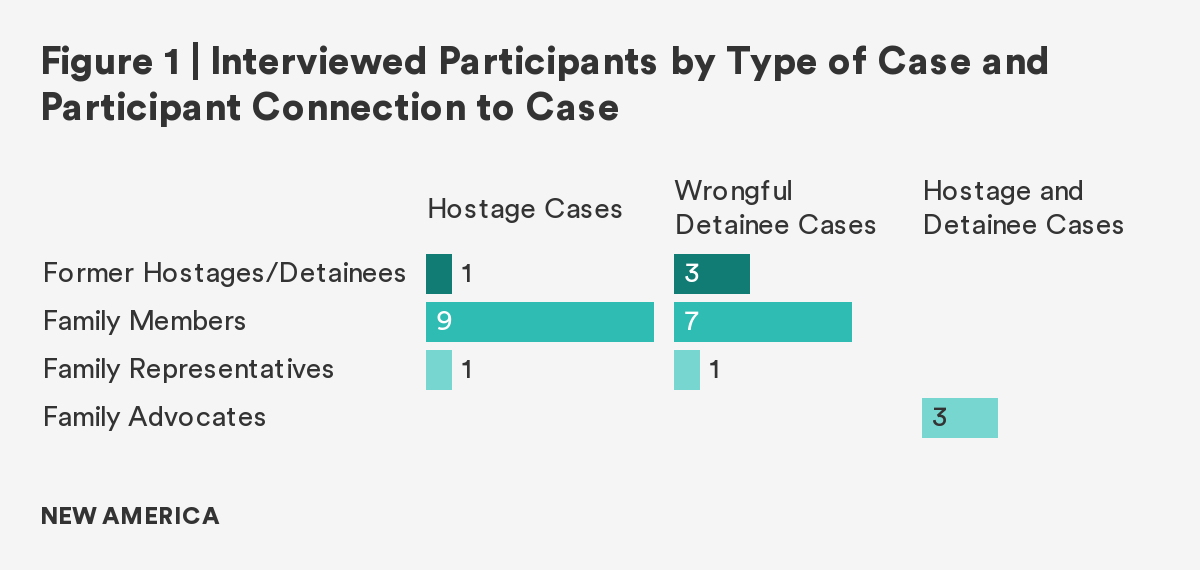
Of the 25 participants interviewed for this report, 11 were associated with hostage cases and 11 were associated with wrongful detainee cases. The remaining three participants were family advocates who provided insights to both types of cases. Their responses are utilized in both categories. The participants (excluding three family advocates) were directly involved in eight separate hostage cases and eight separate wrongful detainee cases, for a total of 16 separate cases. Participants involved in hostage cases included one former hostage, nine family members, and one family representative in addition to the three family advocates involved in both wrongful detention and hostage cases. Participants involved in wrongful detention cases included three former wrongful detainees, seven wrongful-detainee family members, and one family representative in addition to the three families. Figure 1 provides the breakdown of participants.
The cases represented in this study took place from the 2010s through the present. However, including more specific dates would have a negative impact on the participants’ confidentiality.
Interview Method
Interviews consisted of a series of questions focused on thematic areas drawn directly from PPD-30 to provide a qualitative understanding of the experiences of hostages, wrongful detainees, and their families. Each interview also included a quantitative assessment of the effectiveness of PPD-30 by assigning a numerical value indicating the degree to which each participant agreed or disagreed with a variety of statements asked during the interview process.6
JWFLF sought to ensure confidentiality throughout the interview process. In an attempt to prevent bias and protect the identity of the hostages, wrongful detainees, and their families, JWFLF assigned a random six-digit serial number to each case and permanently discarded each participant’s name. Analysis of each case was then carried out using the six-digit serial number. Dates and specific timeframes of kidnapping events were not recorded to ensure the protection of the participant’s identity. All interviews were conducted between November 2019 and February 2020.
One of the challenges in this study was obtaining a consistent number of responses for every question asked during the interview process. In some cases, not all questions were applicable to each participant’s experiences. In other cases, it was difficult to obtain a response to all questions because of the emotional impact of the interview question. JWFLF put the safety and emotional needs of the participants above its ability to glean information from the participant’s difficult experiences. For example, participants were given the opportunity and were strongly encouraged to refrain from answering questions that made them feel uncomfortable. In some instances, interviews were shortened, or questions were omitted at the interviewer’s discretion if the participant showed signs of increased anger, stress, and/or anxiety. It was not the intent of the interviewer for the participant to relive traumatic events, but to allow each of its participants the opportunity to be heard. Many families who have experienced a hostage-taking or a wrongful detention find it extremely difficult to recount and are understandably unwilling to examine their trauma any further.
This report will use these interviews to examine the impact of U.S. hostage policy on hostages, wrongful detainees, and their families. The second section of this report examines findings from the survey of participants regarding their evaluation of government efforts and discusses similarities and differences in the perceptions of participants involved in hostage and wrongful detainee cases. The third section discusses the key policy issues that shape differences in the government’s approach to hostage and wrongful detainee cases and how they impact hostages, detainees, and their families. Additionally, this report contains four appendices. Appendix A and B provide a list of requests and recommendations voiced by hostage and wrongful detainee families respectively. Appendix C and D provide further detail on survey responses for hostage participants and wrongful detainee participants, respectively.

Bringing Americans Home 2020
- Foreword
- Executive Summary
- 1. Introduction
- 2. Perceptions of the U.S. Government’s Hostage Recovery Enterprise
- 3. Key Concerns Amongst Hostage and Detainee Families
- Conclusion
- Appendix A: Current Needs, Requests, and Recommendations from Hostage Participants
- Appendix B: Current Needs, Requests and Recommendations from Wrongful Detainee Participants
- Appendix C: Hostage Interview Responses
- Appendix D: Wrongful Detainee Interview Responses
Citations
- Jen Easterly, “Foreword,” in Cynthia Loertscher, “Bringing Americans Home: The First Non-Governmental Assessment of U.S. Hostage Policy and Family Engagement” (New America / James W. Foley Legacy Foundation, June 24, 2019), https://www.newamerica.org/international-security/reports/bringing-americans-home/
- Cynthia Loertscher, “Bringing Americans Home: The First Non-Governmental Assessment of U.S. Hostage Policy and Family Engagement” (New America / James W. Foley Legacy Foundation, June 24, 2019), https://www.newamerica.org/international-security/reports/bringing-americans-home/
- This report adopts the definition of U.S. national used by EO 13698, which includes individuals who are “lawful permanent resident alien[s] with significant ties to the United States.” See EO 13698 available at: https://fas.org/irp/offdocs/eo/eo-13698.htm
- Language from Article 1 of the International Convention Against the Taking of Hostages (United Nations, 1979) available at https://treaties.un.org/doc/db/terrorism/english-18-5.pdf
- Language from Article 9 of the International Covenant on Civil and Political Rights (United Nations, 1966) available at https://www.ohchr.org/en/professionalinterest/pages/ccpr.aspx
- Participants were provided with five options to respond: Strongly agree, agree, neutral, disagree, and strongly disagree.