
Bringing Americans Home 2020
Abstract
This report, conducted by the James W. Foley Legacy Foundation (JWFLF), is a continuation of JWFLF’s initial assessment of the efficacy of the 2015 U.S. Hostage Policy Review and the implementation of PPD-30 and EO 13698. Based on confidential interviews with 25 participants, this report provides insights into how the U.S. government’s 2015 reforms of its hostage recovery enterprise continue to impact American hostage families. Additionally, this report examines the support wrongfully-detained U.S. nationals and their families receive from the government. This study is intended to spark and inform discussions that will continue to improve the U.S. government’s provision of support to hostages, wrongful detainees, and their families.
Acknowledgments
First and foremost, I would like to thank all of those who participated in this study and trusted the James W. Foley Legacy Foundation (JWFLF) with their experiences. Their bravery and determination to support Americans held overseas is what drives this research.
In addition, I owe a debt of gratitude to Diane Foley and the JWFLF Board of Directors for bringing me into the JWFLF family and for trusting me with this work. Contributing to the work of JWFLF, even in a small way, is incredibly rewarding and I’m grateful for the opportunity. I am grateful, as well, to Margaux Ewen, whose support was instrumental in connecting me with families and getting this report across the finish line.
Research like this requires context and I was fortunate to have a number of individuals inside and outside of government share their expertise with me as I wrote this report. While I will not name them here, I am indebted to them for giving me their time and for explaining the complexities of recovering and supporting Americans held abroad. Thank you all.
I would like to thank the team at New America who brought this report into its final shape, designing graphics, editing, and placing it online. Peter Bergan and David Sterman led that effort for JWFLF, but many others were involved. I am grateful to each of you.
In Memory Of:
This report is published in memory of Robert Levinson and Mustafa Kassem.
Dedication
We dedicate this 2020 Bringing Americans Home report to our compassionate and esteemed colleague, Rachel Briggs. Though a British citizen, she had the moral courage to see our desperate need in the United States and act to help us.
In 1996, while still studying at university, Rachel’s uncle was kidnapped in Colombia. For seven and a half months, she and her family were thrown into an alien world of fear, isolation and helplessness as others negotiated for his release. This experience left her determined to learn more about kidnapping and ultimately to help set up and then run Hostage UK, which was established in 2004.
After the death of James W. Foley, Rachel was one of the first people to visit the Foley family in New Hampshire. Summoning her inner strength and intimate understanding of hostage issues, Rachel moved to Washington DC from England in September 2015 to become the founding Executive Director of Hostage US.
With generous donations and a grant from the Ford Foundation following Jim’s horrific murder, the James W. Foley Legacy Foundation was able to support start-up expenses for Rachel to establish Hostage US. Rachel’s selfless choice to offer her considerable talents to us Americans facing the similar horror of the kidnapping of a loved one enabled Hostage US to build extensive pro bono partnerships in the healthcare, finance, legal and security sectors for former hostages and their families. She brought to this task her distinguished career as a policy advisor working on national security issues with governments and the private sector around the world, for which she was awarded an OBE (Officer of the British Empire) by Her Majesty the Queen in 2014. These skills allowed her to start a community of compassionate former government, legal and security experts in Washington DC to address the previously silent crisis of hostage taking.
We are all indebted and forever grateful to Rachel Briggs for the gift of her time and talents for American hostage families and returned hostages.
About the James W. Foley Legacy Foundation
The James W. Foley Legacy Foundation advocates for the freedom of all Americans held hostage abroad and promotes the safety of journalists worldwide. Find out more at www.jamesfoleyfoundation.org and by viewing the documentary, Jim, the James Foley Story.
Downloads
Foreword
In 2011 and 2012, four young Americans were drawn to the Syrian civil conflict. Two were talented freelance war correspondents, Steven Sotloff and James Foley, who were reporting on the emerging Syrian protests. The other two, Peter Kassig and Kayla Mueller, were compassionate aid workers seeking to assist civilians amid the conflict.
None of these young Americans ever returned home.
They were all kidnapped by the radical jihadist group known as the Islamic State (ISIS), beginning in November 2012. They were held captive, starved, and tortured until 2014 and 2015, when they were brutally murdered.
One of them was my son, James Foley. The U.S. government never engaged on his behalf, though it was aware of his kidnapping throughout the time he was held by ISIS. The FBI was not allowed to share any information with our family or interact with his captors when they reached out with proof of life. Jim’s brutal murder was confirmed only on national television.
None of our government’s hostage policies were ever honestly explained to us. Instead, we were deceived by repeatedly being told that Jim’s return was our government’s top priority, when it was not.
In the spring of 2014, our family was threatened three times with legal prosecution by a representative from the White House National Security Council should we dare to raise a ransom. And we were told clearly that the United States would never mount a rescue operation or ask another country to intervene on Jim’s behalf.
Jim, Steven, Peter, and Kayla were abandoned by our government.
The James W. Foley Legacy Foundation was born in 2014 out of a belief that the United States could do better to bring innocent Americans home from unjust detentions abroad.
In response to outcry after the deaths of these American hostages, as well as the deaths of Luke Somers in Yemen and Warren Weinstein in Pakistan, President Obama in 2015 ordered a U.S. Hostage Policy Review, which resulted in the establishment of an interagency Hostage Recovery Fusion Cell, Special Presidential Envoy for Hostage Affairs and Hostage Response Group chaired by the National Security Council staff at the White House. However, these changes, for the most part, applied only to U.S. nationals kidnapped by terrorists, pirates, or criminal groups; not to those wrongfully detained by a foreign government.
The foundation published an inaugural report, titled Bringing Americans Home, that revealed experiences of Americans kidnapped by terrorists were similar to those wrongfully detained by foreign governments.
Our second annual report is focused on the experience of all categories of wrongfully held Americans—whether taken captive by criminals, terrorists, pirates, or foreign governments. These results will be shared with both the U.S. government and nongovernmental organizations that work for the return of U.S. hostages and wrongful detainees and support their anxious families.
Our goal is to raise awareness of this issue and to prioritize the return of all Americans held abroad for their families.
Thank you for caring about our fellow Americans who are being denied their freedom. They truly depend on us to bring them home. Our government can certainly do better than it did for Jim, Steven, Peter, and Kayla.
With deep gratitude,
Diane Foley
Founder and President of the James W. Foley Legacy Foundation
Executive Summary
This report, conducted by the James W. Foley Legacy Foundation (JWFLF), is a continuation of JWFLF’s initial assessment of the efficacy of the 2015 U.S. Hostage Policy Review and the implementation of PPD-30 and EO 13698. This study was conducted from the perspective of American hostages, wrongfully held detainees, and their family members and representatives. It does not represent the perspective of all former hostages, detainees, and their families, but only presents the perspectives of those who participated in this study.
Based on confidential interviews with 25 participants, this report provides insights into how the U.S. government’s 2015 reforms of its hostage recovery enterprise continue to impact American hostage families. Additionally, this report examines the support wrongfully-detained U.S. nationals and their families receive from the government. All interviews were conducted between November 2019 and February 2020. This study is intended to spark and inform discussions that will continue to improve the U.S. government’s provision of support to hostages, wrongful detainees, and their families.
Key Findings and Recommendations
1) The results of the U.S. government’s 2015 reforms of the hostage recovery enterprise have been largely durable and effective, but the complexity of hostage cases demands continued improvements.
- The structures created by the U.S. government’s 2015 Hostage Review largely continue to function effectively. The creation of the Hostage Recovery Fusion Cell (HRFC) and the office of the Special Presidential Envoy for Hostage Affairs (SPEHA) improved governmental access for hostage families and this year’s hostage participants remained generally pleased with their ability to gain access to the U.S. government through these organizations. The U.S. government must continue to maintain the organizations created by EO 13698 and should ensure the HRFC’s sustainability by providing dedicated funding.
- Aside from securing the release of their loved ones, sharing information with families is one of the most important aspects of supporting the families of American hostages and was a focus of the 2015 reforms. Hostage participants are generally satisfied with the current status of information sharing, but have shared some concerns about the amount of information that is declassified for their use. The U.S. government should continue to focus on finding effective mechanisms to declassify information pertinent to the cases of American hostages and wrongfully held detainees.
- Upon their return home, American hostages and their families have to deal with a new challenge: the reintegration of their loved one after a traumatic event. Hostage participants shared that the U.S. government’s role during this timeframe is unclear, as is the level of support they can rely on during this difficult time. The U.S. government should strongly support the families of American hostages and wrongful detainees after their captivities and should clarify the support it can and will provide.
2) The families of Americans wrongfully detained by a foreign government, but whose detention the government acknowledges, have generally not benefited from the government’s 2015 reforms and require additional support.
- There is a notable disparity in the treatment of hostage and wrongful-detainee families by the U.S. government, with the latter receiving less attention, information, and access. While there are a variety of reasons for this disparity, the U.S. government can do more to support the families of those Americans wrongfully detained abroad. The U.S. government should conduct a review of its current procedures for supporting the families of wrongful detainees and identify available funding and changes that need to be made in current law, policy, and authorities to better support these families.
- One of the most impactful changes made by EO 13698 was the creation of the Family Engagement Coordinator (FEC) within the HRFC, a position that helped families gain consistent access to information. The wrongful detainee participants are largely unsatisfied with the consistency and accuracy of information shared with them, so access to a FEC would have a significant impact on the support the families of wrongful detainees receive. The U.S. government should create a family engagement coordinator position within the SPEHA’s office.
- Even though they are being held by foreign governments and not terrorist groups or criminals, Americans wrongfully detained are being held for leverage against the United States, making their cases very similar to hostage cases. In addition, courts and routine diplomacy are of limited utility in these cases, requiring the help of organizations such as the SPEHA’s office and, potentially, the HRFC. That said, it is unclear what criteria a case must meet for the U.S. government to consider a detention wrongful. The U.S. government should identify the criteria for a case to be considered a wrongful detention along with the entity within the U.S. government who makes that determination, and publicly share both.
3) While the current administration has placed an emphasis on bringing Americans home, hostage and detainee cases require continued focus and prioritization.
- One of the structural innovations of the government’s 2015 reforms was the creation of a sub-deputies committee at the National Security Council, the Hostage Response Group, as a mechanism to adjudicate interagency disputes about hostage cases. Hostage and wrongful detainee participants, however, expressed concerns that their loved ones’ cases lack dedicated representation at the National Security Council’s Deputies Committee and that the HRFC and the SPEHA’s office have limited abilities to coordinate the actions of the interagency and resolve their loved ones’ cases. The U.S. government should consider structural changes to enhance the ability of the HRFC and SPEHA’s office to direct hostage and wrongful detainee cases across the interagency.
- The SPEHA’s office has proven essential in assisting families and managing the diplomatic aspects of hostage and wrongful-detainee recovery efforts. Participants, however, noted with deep concern the reduction in the office’s ability to pursue diplomatic engagement, as well as an increase in vacant positions, during the vacancy of the SPEHA. Maintaining an appointed SPEHA and a fully staffed office must remain a priority for current and future administrations.
1. Introduction
Responding to the taking of an American hostage abroad requires a rapid, coordinated effort from the U.S. government. In the fall of 2014, President Barack Obama called for a comprehensive review of U.S. hostage policy after the brutal treatment and killings of Americans by the Islamic State (ISIS). As a result of the review, led by Lieutenant General Bennet Sacolick of the National Counterterrorism Center (NCTC), President Obama called for structural changes within the U.S. government and issued Executive Order 13698 (EO 13698), “Hostage Recovery Activities” and Presidential Policy Directive 30 (PPD-30), “U.S. Nationals Taken Hostage Abroad and Personnel Recovery Efforts.”
EO 13698 and PPD-30 reshaped the way the U.S. government was organized to handle hostage-takings, placing a particular emphasis on improving its ability to support the families of U.S. hostages. EO 13698 directed these changes by establishing the Hostage Recovery Fusion Cell (HRFC), Family Engagement Coordinator (FEC), the Office of the Special Presidential Envoy for Hostage Affairs (SPEHA), the Hostage Response Group (HRG), chaired by the National Security Council Staff and an Issue Manager for Hostage Affairs within the Intelligence Community. These structural and organizational changes were created to ensure that the government was organized to take rapid, coordinated action in response to a hostage-taking event.1
In 2019, the James W. Foley Legacy Foundation (JWFLF) published its initial assessment of the efficacy of the 2015 U.S. Hostage Policy Review and the implementation of PPD-30 and EO 13698.2 This report is an extension of that work, continuing to examine the way that the U.S. government creates and implements policy in support of U.S. nationals, and their families, who are taken hostage or wrongfully detained abroad.
The interviews that make up this report identified that the 2015 reforms of the hostage recovery enterprise have remained in effect and largely remain successful in helping the families of Americans held hostage access the U.S. government. At the same time, these interviews helped identify places where improvements can be made, specifically the declassification of information for families. In addition, this report identifies that the families of wrongful detainees have generally not benefited from the 2015 reforms and continue to have challenges accessing the U.S. government. The discussions with both hostage and wrongful detainee participants brought forth their concerns about the ability of the HRFC and SPEHA to influence the interagency and their desire for increased representation within the National Security Council.
Methods and Definitions
This report is based on a series of interviews with 25 individuals personally connected to a hostage or a wrongful detainee case, hereinafter referred to as participants. In every case examined within this report, the hostage or wrongfully detained person was a U.S. national.3 To more closely align with the U.S. government’s hostage policy, this report distinguishes in its analysis between hostage cases and wrongful detainee cases.
This report compares the experiences of participants connected to hostage cases with those connected to wrongful detention cases. The conventional definition of a hostage is a person detained and under the threat of death, injury, or continued detention by an individual or group in order to compel a third party to do (or abstain from doing) any act as an explicit or implicit condition of the person’s release.4 While this definition of hostage can be used to describe both individuals held by state and non-state actors, the U.S. government has adopted a narrower definition of the term “hostage.” Generally speaking, according to the U.S. government, hostages are individuals held by non-state actors, such as terrorist organizations, militant or criminal groups, pirates, or unknown captors.
From the U.S. government’s perspective, those individuals held by foreign governments are considered “detainees” rather than hostages. In some cases, these individuals are incarcerated for legitimate infractions of a foreign government’s criminal code. In other cases, foreign governments have arrested and detained U.S. nationals for inflated or fabricated charges as a means to place pressure on the U.S. government. This report will use the term “wrongful detainee” to refer to those individuals who have either:
- Been subject to arbitrary arrest or detention;
- Not been informed at the time of arrest, or thereafter, of the reasons for their arrest and have not been informed of any charges against them; or,
- Not been entitled to a trial within a reasonable timeframe.5
This report has adopted this definition of wrongful detainees largely because a U.S. government definition of the term either does not exist or has not been shared, a problem that has created a number of challenges for the families of those Americans detained abroad. Section two of this report describes these challenges in more detail.
The foreign governments holding wrongful detainees generally acknowledge that they are holding the U.S. national. In some cases, U.S. nationals are held by foreign governments, but the government holding them does not admit to being responsible for their detention. These individuals are termed “unacknowledged detainees” by the U.S. government and their cases are given the same standing as those of hostages within the U.S. government.
Interviewed Participants
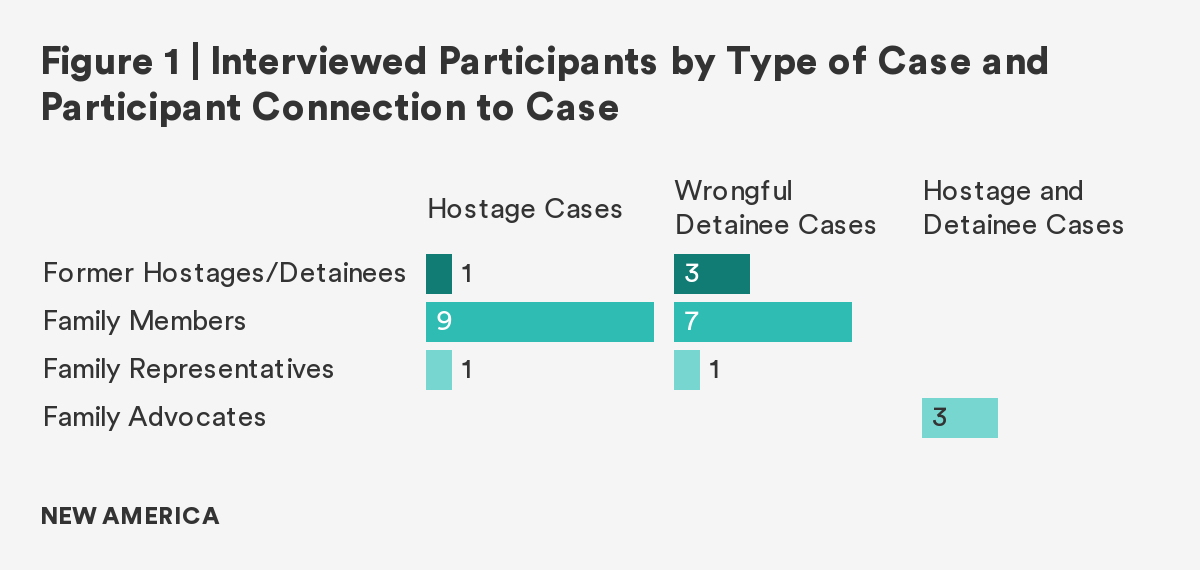
Of the 25 participants interviewed for this report, 11 were associated with hostage cases and 11 were associated with wrongful detainee cases. The remaining three participants were family advocates who provided insights to both types of cases. Their responses are utilized in both categories. The participants (excluding three family advocates) were directly involved in eight separate hostage cases and eight separate wrongful detainee cases, for a total of 16 separate cases. Participants involved in hostage cases included one former hostage, nine family members, and one family representative in addition to the three family advocates involved in both wrongful detention and hostage cases. Participants involved in wrongful detention cases included three former wrongful detainees, seven wrongful-detainee family members, and one family representative in addition to the three families. Figure 1 provides the breakdown of participants.
The cases represented in this study took place from the 2010s through the present. However, including more specific dates would have a negative impact on the participants’ confidentiality.
Interview Method
Interviews consisted of a series of questions focused on thematic areas drawn directly from PPD-30 to provide a qualitative understanding of the experiences of hostages, wrongful detainees, and their families. Each interview also included a quantitative assessment of the effectiveness of PPD-30 by assigning a numerical value indicating the degree to which each participant agreed or disagreed with a variety of statements asked during the interview process.6
JWFLF sought to ensure confidentiality throughout the interview process. In an attempt to prevent bias and protect the identity of the hostages, wrongful detainees, and their families, JWFLF assigned a random six-digit serial number to each case and permanently discarded each participant’s name. Analysis of each case was then carried out using the six-digit serial number. Dates and specific timeframes of kidnapping events were not recorded to ensure the protection of the participant’s identity. All interviews were conducted between November 2019 and February 2020.
One of the challenges in this study was obtaining a consistent number of responses for every question asked during the interview process. In some cases, not all questions were applicable to each participant’s experiences. In other cases, it was difficult to obtain a response to all questions because of the emotional impact of the interview question. JWFLF put the safety and emotional needs of the participants above its ability to glean information from the participant’s difficult experiences. For example, participants were given the opportunity and were strongly encouraged to refrain from answering questions that made them feel uncomfortable. In some instances, interviews were shortened, or questions were omitted at the interviewer’s discretion if the participant showed signs of increased anger, stress, and/or anxiety. It was not the intent of the interviewer for the participant to relive traumatic events, but to allow each of its participants the opportunity to be heard. Many families who have experienced a hostage-taking or a wrongful detention find it extremely difficult to recount and are understandably unwilling to examine their trauma any further.
This report will use these interviews to examine the impact of U.S. hostage policy on hostages, wrongful detainees, and their families. The second section of this report examines findings from the survey of participants regarding their evaluation of government efforts and discusses similarities and differences in the perceptions of participants involved in hostage and wrongful detainee cases. The third section discusses the key policy issues that shape differences in the government’s approach to hostage and wrongful detainee cases and how they impact hostages, detainees, and their families. Additionally, this report contains four appendices. Appendix A and B provide a list of requests and recommendations voiced by hostage and wrongful detainee families respectively. Appendix C and D provide further detail on survey responses for hostage participants and wrongful detainee participants, respectively.
Citations
- Jen Easterly, “Foreword,” in Cynthia Loertscher, “Bringing Americans Home: The First Non-Governmental Assessment of U.S. Hostage Policy and Family Engagement” (New America / James W. Foley Legacy Foundation, June 24, 2019), https://www.newamerica.org/international-security/reports/bringing-americans-home/
- Cynthia Loertscher, “Bringing Americans Home: The First Non-Governmental Assessment of U.S. Hostage Policy and Family Engagement” (New America / James W. Foley Legacy Foundation, June 24, 2019), https://www.newamerica.org/international-security/reports/bringing-americans-home/
- This report adopts the definition of U.S. national used by EO 13698, which includes individuals who are “lawful permanent resident alien[s] with significant ties to the United States.” See EO 13698 available at: https://fas.org/irp/offdocs/eo/eo-13698.htm
- Language from Article 1 of the International Convention Against the Taking of Hostages (United Nations, 1979) available at https://treaties.un.org/doc/db/terrorism/english-18-5.pdf
- Language from Article 9 of the International Covenant on Civil and Political Rights (United Nations, 1966) available at https://www.ohchr.org/en/professionalinterest/pages/ccpr.aspx
- Participants were provided with five options to respond: Strongly agree, agree, neutral, disagree, and strongly disagree.
2. Perceptions of the U.S. Government’s Hostage Recovery Enterprise
This report will build upon the work conducted by the James W. Foley Legacy Foundation in its 2019 report, providing the first non-governmental assessment of the implementation of EO 13698 and PPD-30.7 This section will draw upon interviews conducted with former U.S. hostages and wrongful detainees, their families, family representatives, and family advocates to analyze the impact of EO 13698 and PPD-30 on their interactions with the U.S. government.
In general, hostage participants interacted with the HRFC and SPEHA’s office while wrongful detainee participants worked with the SPEHA’s office but not the HRFC. Wrongful detainee participants also interacted with the U.S. Department of State’s Bureau of Consular Affairs, especially when a detention has not been classified as wrongful by the U.S. government. Therefore, this study included Consular Affairs in its examination of the experiences of wrongful detainee participants. Since not all participants had the same experiences, it is important to note that participants in this study only responded to questions related to agencies and offices with which they had relevant interactions.
This section will discuss how accessible the agencies and offices that make up the U.S. government’s hostage recovery enterprise are to the families of hostages and wrongful detainees, how well the U.S. government shares information with these families, and how clear the roles of these agencies and offices are to them. In addition, this section will examine the partnership between families and the U.S. government for recovery efforts, the priority that families feel the U.S. government assigns to their cases, and how well families understand U.S. hostage policy. Each of these discussions will address the perspectives of both hostage participants and wrongful detainee participants.
Accessibility of HRFC, SPEHA, and Consular Affairs to Hostages and Wrongful Detainees
Immediately following the kidnapping or detention of their loved one, one of the most difficult challenges for a family member is knowing where to go within the U.S. government for support. JWFLF asked its participants to what degree the HRFC, Consular Affairs, and SPEHA’s office was accessible to them after learning of their loved one’s captivity.
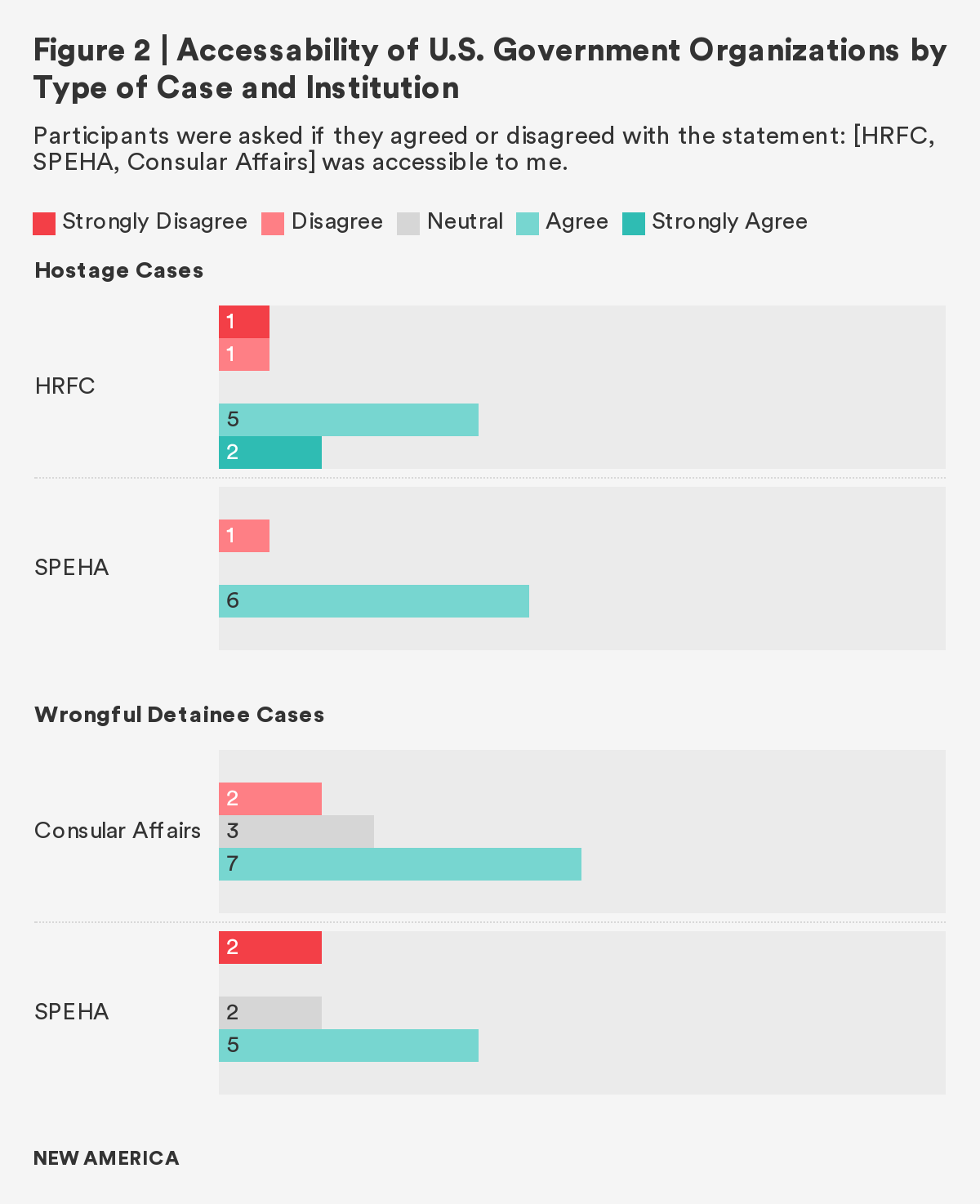
Both hostage and wrongful detainee participants in this year’s report generally agreed that the agencies and offices that make up the U.S. government’s hostage recovery enterprise were accessible to them. In JWFLF’s 2019 report, the ability of hostage families to access the U.S. government was a key concern for those who interacted with the U.S. government prior to the implementation of EO 13698 and PPD-30, while families who interacted with the government after the implementation of PPD-30 generally felt it was more accessible and helpful with their cases.8 The relatively positive perceptions in the 2020 interviews support the finding that the reforms made some difference.
Hostage Participant Responses
The majority, (seven of nine) hostage participants agreed (five) or strongly agreed (two) that the HRFC was accessible to them. The remaining participants disagreed (one) or strongly disagreed (one). The survey showed similar responses with the SPEHA’s office, where six of seven hostage participants agreed that the SPEHA was accessible to them. Only one participant disagreed that the SPEHA was accessible (Figure 2).
Most hostage participants agreed that they can reach out and call the HRFC at any time of the day. Other participants, however, expressed a decrease in accessibility to the HRFC with one participant sharing, “it had once been accessible but is not anymore, even with ongoing issues and concerns.”
While a majority of hostage participants agreed that the SPEHA’s office was accessible, some respondents shared their concerns over having less access to the SPEHA’s office due to the loss of Special Envoy Robert O’Brien when he was appointed national security advisor, and other personnel within the office. One participant shared that “it has been taking the SPEHA’s office longer to respond to our emails and requests” since the departure of O’Brien.
Wrongful Detainee Participant Responses
A slight majority, (seven of twelve) wrongful detainee participants agreed that Consular Affairs was accessible to them while the remaining participants strongly disagreed (two) or neither agreed nor disagreed (three). The perception of the SPEHA’s office was similar, showing a slight majority (five of nine) participants who agreed that the SPEHA’s office was accessible, while the remaining participants strongly disagreed (two) or neither agreed nor disagreed (two) (Figure 2). It is important to note that out of the eight wrongful detainee cases represented in this study, seven of the cases were recognized as wrongful or unlawful by the U.S. government, while one was not.
One family advocate shared that the family they were supporting “had to work way too hard to get the State Department’s attention and help.” Other participants shared similar responses, saying that “sometimes [Consular Affairs] will answer and other times they don’t. I had to use a third party to get any attention.” Another participant shared, “it took five months for Consular Affairs to initially respond to our case. No one returned phone calls or emails.”
Another participant expressed, “I started out trying to engage with the State Department at all levels, all the way up to the deputy secretary of state. My focus has more recently been shifted to the National Security Council because there seems to be a level of infighting going on at the lower level of the State Department and there seems to be differences [of opinion] in how my loved one’s case should be handled.” That participant continued, saying, “we’re going to the National Security Council to push for clarity on who is working on my loved one’s case so that there is some sort of continuity on how they are going to move forward.”
Access to the SPEHA’s office was solely dependent on whether a participant’s case was considered a wrongful detention. Participants shared that they remained working with Consular Affairs until their case was classified as a wrongful detention by the U.S. government. Several participants expressed their concern over not having access to the SPEHA because they believed that their case was “really a hostage situation because [my loved one] is really being held as a political pawn. At some point, working with Consular Affairs is not enough because we need a diplomatic solution to our case.”9
Even though wrongful detainee participants agreed that both offices were accessible, several participants shared their concerns over the high turnover rate within Consular Affairs and the SPEHA’s office. For example, one participant shared, “when turnover occurs, it puts a hard stop on our case.” Other participants reiterated this concern by sharing, “they [State Department] are accessible, but high turnover rate is a big problem. Each time there was a change, there’s a hard reset.” For some participants, accessibility was not the main concern, getting results was a more important issue. One participant shared, “the problem is not communication, it is getting results! I don’t feel neglected, I have had several calls, I fly in for meetings, I’ve been able to meet with senior officials. My problem is getting people at State to commit to the current policy and implement it.”
Consistency and Accuracy of Information
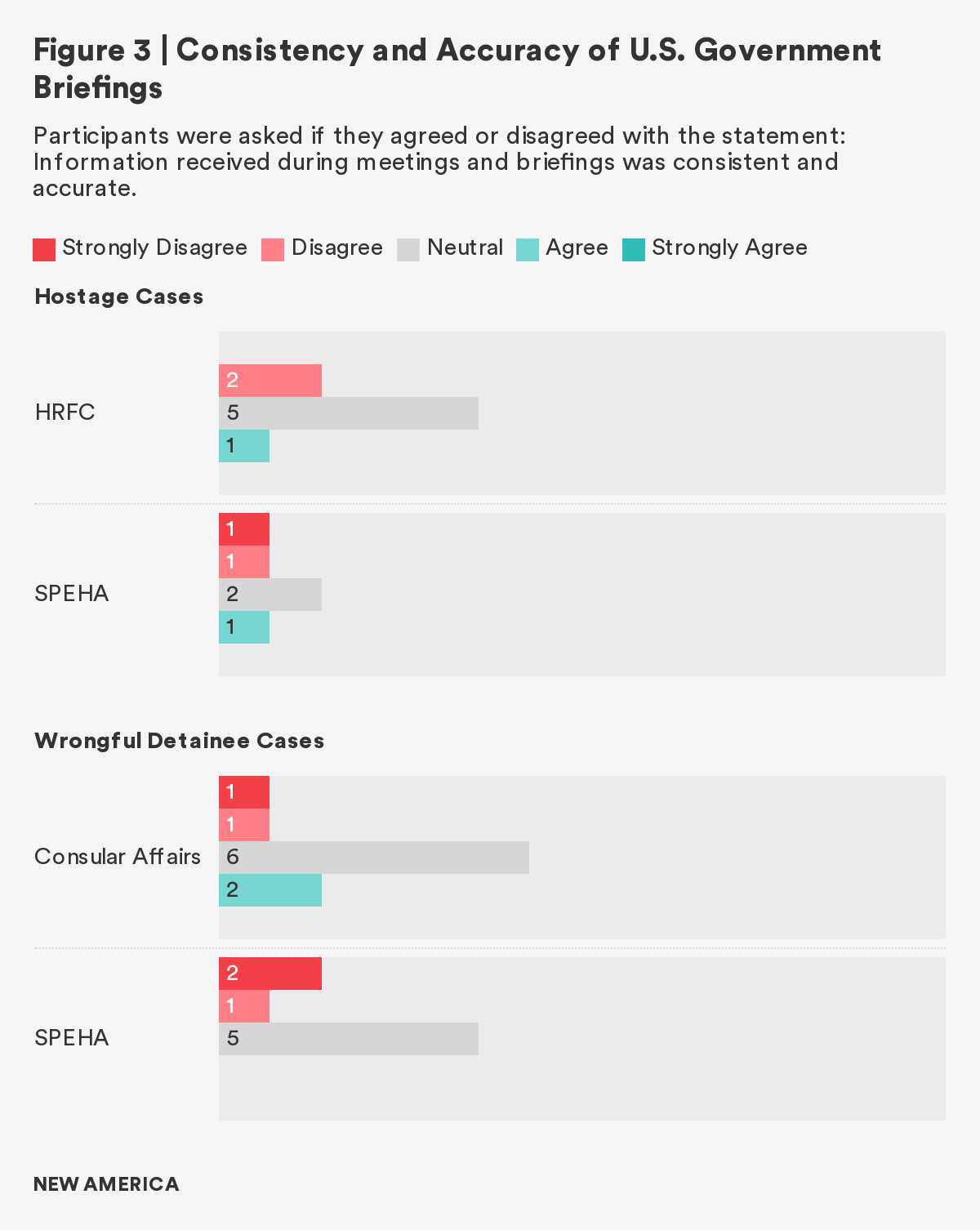
The consistency and accuracy of the information shared with hostage families was another major concern surrounding the need to improve the U.S. government’s interactions with hostage families. During the interviews for this report, participants generally expressed a lack of clear satisfaction with the consistency and accuracy of information shared with families. Prior to the implementation of EO 13698 and PPD-30, hostage families reported receiving inconsistent and sometimes contradictory information. After the implementation of PPD-30, 2019 respondents reported a significant increase from pre-PPD-30 respondents regarding consistency and accuracy of the information they received from the U.S. government.10 During the interviews for the 2020 report, participant responses showed a decrease in the satisfaction with the consistency and accuracy of information shared with families compared to 2019 responses.
Hostage Participant Responses
The majority (five of eight) hostage respondents neither agreed nor disagreed that they received consistent and accurate information from the HRFC. Two participants disagreed while only one participant agreed that the HRFC was consistent and accurate when sharing information about their case. Regarding the SPEHA’s office, only one individual agreed that the SPEHA’s office provided accurate and consistent information about their case while one participant strongly disagreed and another disagreed, and two neither agreed nor disagreed (Figure 3). A typical response from family members was that the SPEHA’s office did not provide “enough information on their part. It's mostly us giving them information instead of them giving us information.”
Wrongful Detainee Participant Responses
The majority (six of ten) of wrongful detainee respondents neither agreed nor disagreed that they received consistent and accurate information from Consular Affairs. Others strongly disagreed (one), disagreed (one), or agreed (two). With regard to the SPEHA’s office the majority (five of eight) of respondents neither agreed nor disagreed that they received consistent and accurate information. The remaining respondents strongly disagreed (two) and disagreed (one) (Figure 3).
Overall, the largest issue wrongful detainee families raised about consistency and accuracy of information being shared at the Department of State was related to their concern over the “really high” turnover rate. One family shared, “we don't get a lot of information. There’s also a high turnover rate which leads to a lot of misinformation. Our points of contact change constantly. We’ve had 3-4 different points of contact at Consular Affairs.”
Other wrongful detainee families shared that they requested weekly calls from Consular Affairs because they grew tired of not receiving any information and claimed that this was because Consular Affairs was short staffed. Family members, therefore, settled on bi-monthly updates. “It’s still frustrating because we are not receiving the allotted 30 minutes and are asked questions that they [Consular Affairs] should already know.” This leads some family members to believe that Consular Affairs is “filling the time up by asking questions that are already in the file.”
Another family shared their frustration because they are “not being updated by anyone at State and have to continue to request meetings to get any information whatsoever. So, it’s difficult, all of my answers are predicated [on whether] I would have any meetings at all if I wasn’t bugging people constantly.”
Regarding wrongful detainee interactions with the SPEHA’s office, some families expressed how much they liked working with former Special Envoy Robert O’Brien, but responses became very limited and “hard to comment” on because the SPEHA’s position has been vacant for so long.
One family member commented on the difficulty of getting a point of contact at the SPEHA’s office and that it was really “up to us to get information.” In addition, another family shared their impression that not having an appointed SPEHA left the office with limited influence to make decisions that would benefit their loved one’s case. One participant shared, “they are doing what they can but [they] are not in the position to make decisions as much as they would like to.”
Understanding of U.S. Departmental Roles
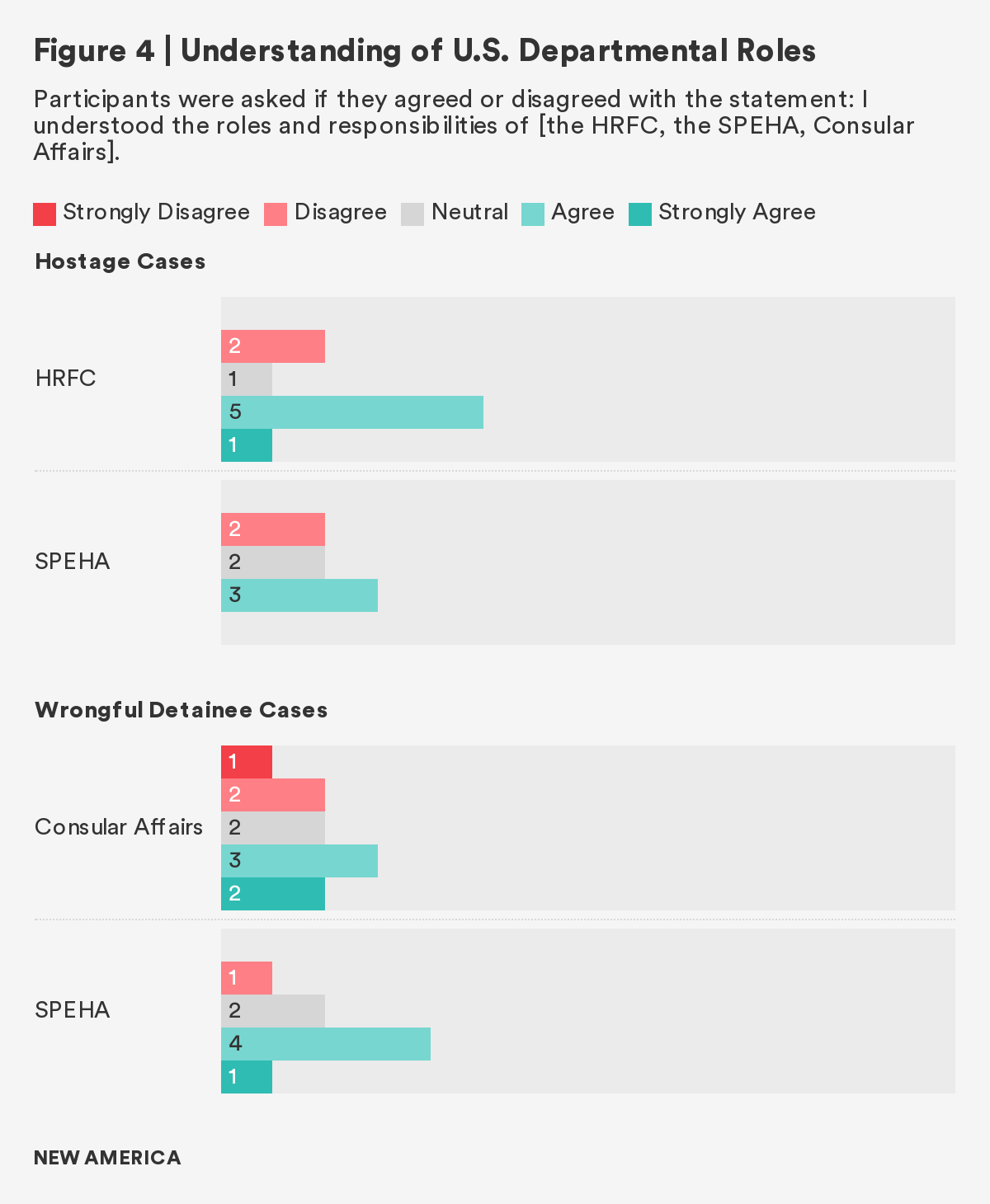
JWFLF’s 2019 report showed that the implementation of PPD-30 had an important impact on family members’ understanding of the roles and responsibilities of the various organizations within the U.S. government’s hostage enterprise.11 JWFLF asked its participants if they understood the role the HRFC, SPEHA, and Consular Affairs played in support of hostage or wrongful detainee recovery. Hostage respondents to this year’s report generally understood the roles of the HRFC and SPEHA, though some indicated they did not. Wrongful detainee respondents were somewhat more mixed in their assessment of whether or not they clearly understood the role of Consular Affairs.
Hostage Participant Responses
The majority (six of nine) of hostage participants who interacted with the HRFC strongly agreed (one) or agreed (five) that they had a clear understanding of the role the HRFC plays in support of hostage recovery and family engagement. Other participants either disagreed (two) or neither agreed nor disagreed (one). Regarding the SPEHA’s office, three participants agreed and two participants disagreed. The remaining two participants neither agreed nor disagreed that they understood the role the SPEHA’s office played in support of hostage recovery (Figure 4).
A common frustration shared by participants was confusion about whether the HRFC or SPEHA’s office was the lead agency in their loved one’s case. One family member shared, “I’m not sure who has the lead on our case. You don’t know when to go to either the SPEHA or HRFC.” Another family member shared, “I don’t know who I’m supposed to be talking to.” In some cases, the confusion appeared to have been based mostly on poor communication with the families, rather than interagency coordination. In other cases, there was confusion within the organizations themselves. According to one participant, neither the HRFC nor the SPEHA’s office was clear on which organization should be leading their case. This confusion within the hostage recovery enterprise was particularly upsetting for hostage participants, who were frustrated that bureaucratic confusion could hamper efforts to secure their loved ones’ releases and extend their loved ones’ arduous captivities.
Wrongful Detainee Participant Responses
Wrongful detainee participants reported mixed levels of understanding of the role of Consular Affairs. Half (five of ten) of JWFLF’s participants who interacted with Consular Affairs strongly agreed (two) or agreed (three) that they had a clear understanding of the role that Consular Affairs played in support of their loved one’s recovery. Others strongly disagreed (one), disagreed (two), or neither agreed nor disagreed (two) (Figure 4).
One participant expressed, “I'm having a hard time nailing down what exactly Consular Affairs is and what it's doing. I'm not sure exactly who I'm talking to. Initially, I thought Consular Affairs was responsible for participating in the negotiating, but recently was told they were not. So, I do not know who I've been talking to and what their roles are. I'm trying very hard to understand what Consular Affairs is.”
Other participants had a better understanding of the role of Consular Affairs. One participant explained that the office was responsible for visiting their family members in prison and checking on their overall wellness. Consular officers try to determine if their loved one is being fed, receiving legal representation, and whether they are being subjected to inhumane treatment such as torture and solitary confinement. However, these same participants were unclear if Consular Affairs was responsible for engaging with foreign governments in a more diplomatic manner. This concern was raised after a participant expressed concerns that the support they were receiving from Consular Affairs was insufficient to secure the release of their loved one. “It’s really a hostage situation,” the participant said, “because [my family member] is really being held as a political pawn. At some point, working with Consular Affairs is not enough because we need a diplomatic solution to our case.”
Most wrongful detainee participants who interacted with the SPEHA’s office (five of eight) strongly agreed (one) or agreed (four) that they had a clear understanding of the role the SPEHA’s office played in recovery of their loved one. One family member disagreed and the remaining two participants neither agreed nor disagreed (Figure 4). While wrongful detainee participants generally understood the role of the SPEHA’s office in their loved one’s case, there was some confusion about what tools the SPEHA had to secure their loved one’s release. “Can they make concessions?” one wrongful detainee participant asked, “Can they provide aid [to a foreign government]? Arrange prisoner swaps? What can the SPEHA’s office legally do?”
Information Sharing
Information sharing was a challenge raised by several participants in JWFLF’s initial 2019 examination of the U.S. government’s reorganization of its hostage recovery enterprise.12 This trend continued in the interviews undertaken as part of this report, with many of the same issues reappearing in the comments from JWFLF’s participants in this year’s responses. Hostage participants, in general, remain concerned about the level of completeness of the information they receive, while wrongful detainee participants were generally dissatisfied with the level of communication from the U.S. government related to their loved one’s case.
Hostage Participant Responses
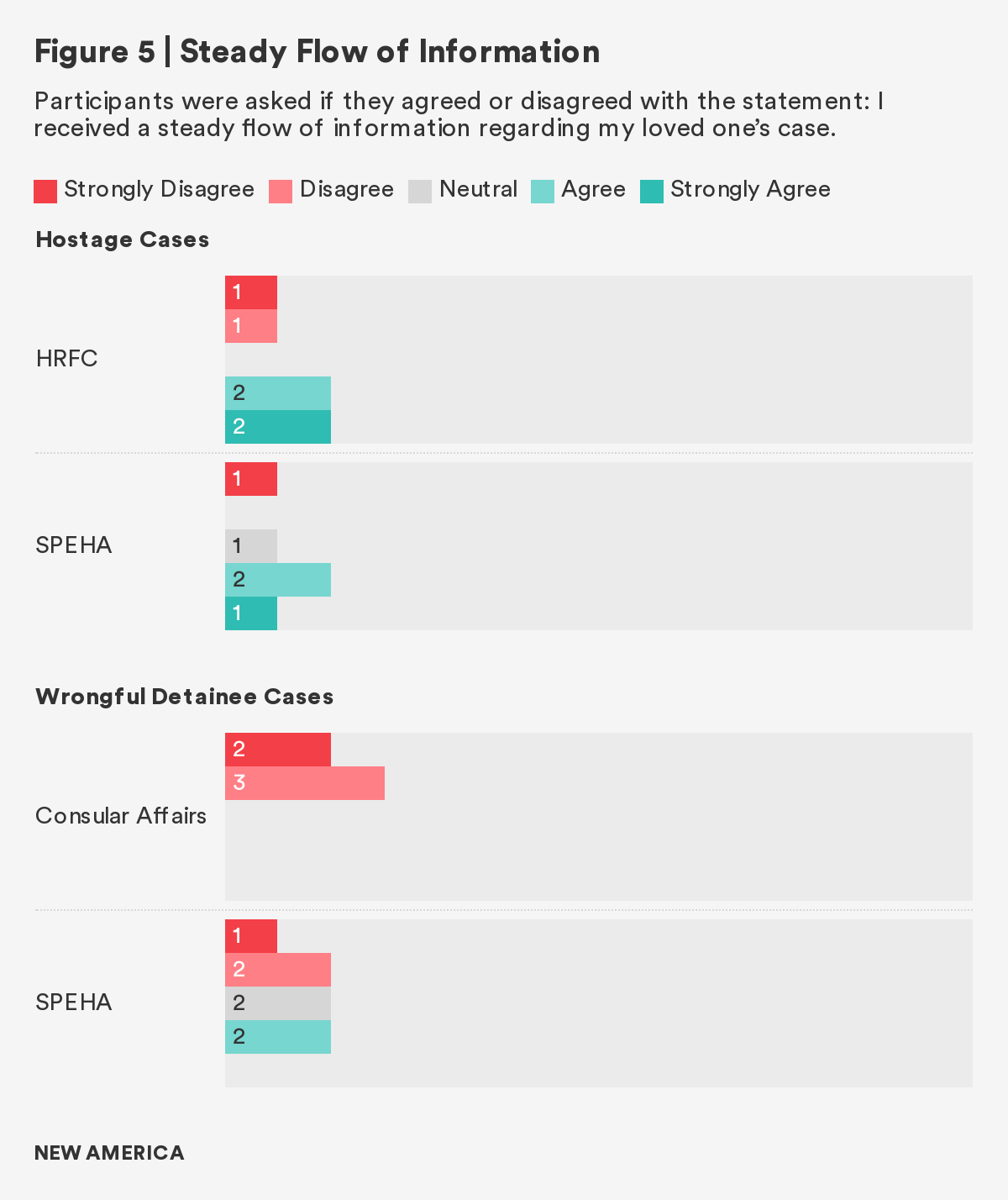
The majority (four of six) of participants who interacted with the HRFC strongly agreed (two) or agreed (two) that they received a steady flow of information regarding their loved one’s case. Other participants disagreed (one) and strongly disagreed (one). The same question yielded similar results regarding the SPEHA’s office. The majority (three of five) agreed (two) or strongly agreed (one). The remaining participants neither agreed nor disagreed (one) and strongly disagreed (one) that they received a steady flow of information regarding their loved one’s case (Figure 5).
“I have found when there is important information,” one participant shared, “I receive it right away from the HRFC.” Participants shared that the government also kept families informed about broader concerns within the hostage community. “The HRFC and Victim’s Services were great about letting families know about other releases before it hit the news,” another participant shared.
Other hostage participants were much less satisfied with the U.S. government’s information sharing. One participant said that they felt that the government shared “insufficient information” regarding their loved one's case, which left them feeling as though they did not “have all the details” and that they had no choice but to “trust [the U.S. government] blindly.” Another participant noted that “there has been very little information that has come from the U.S. government” about their loved one’s case. These experiences left the participant with very little confidence that the U.S. government would find a solution for their loved one’s case.
Regardless of their level of satisfaction with the government’s information sharing, most hostage participants brought up frustrations with the declassification of information within both the HRFC and the SPEHA’s office. Participants, broadly, expressed a desire to have increased access to information surrounding their loved ones’ cases, including complete, full, and timely access to all information and activities pertinent to the case. Participants expressed concerns with the restrictions placed on the U.S. government’s ability to declassify information and its willingness to do so. Several participants requested that the government create a mechanism through which they could receive an interim, limited security clearance in order to allow them to view the classified material pertinent to their case.
Another concern raised by hostage participants was information sharing between the government and third-party intermediaries (TPIs) working on behalf of the hostage family. One participant noted that, while the U.S. government will share information with them, they cannot share it with their TPI. “I find it a hindrance,” the participant said. “I have a person who is doing a lot of work, but the [government] is not working with him.” “I can’t utilize the information,” the same participant explained, “but if I have a person working on my behalf who can, then why can’t I share the information?” “I don’t get the sense that the government is trying to push [TPIs] aside,” said another participant. “When it comes to the bigger issue of what they're able to share, however,” the participant continued, “it's stifled.”
Wrongful Detainee Participant Responses
All the wrongful detainee participants strongly disagreed (two) or disagreed (three) that they had received a steady flow of information regarding their loved one’s case from Consular Affairs. Results were slightly more favorable from the SPEHA’s office where two participants agreed, two neither agreed nor disagreed, and the remaining participants disagreed (two) or strongly disagreed (one) (Figure 5).
Similar to hostage participants, one of the main concerns wrongful detainee participants shared involved classification issues. Participants shared that they were constantly being told, "we can't talk about that," "you don’t have a clearance," and "that’s classified." Some participants, in an attempt to find someone within the U.S. government who would share information, established relationships with Congressional staffers. “Even with Congress,” one participant shared “we'll ask what the State Department is saying, and they'll say, ‘not much.’ When the State Department does share information with Congress and we ask what was said, we get the same response as from State. ‘It’s classified.’” “What do we need to do to get past what is classified,” one participant asked in exasperation, “because we need to know more!” Others shared, “we get a little bit [of information] here and there, but mostly it’s us giving [the government] information.”
Another frustration raised by wrongful detainee participants involved a lack of interagency coordination and information sharing. “I have to be the one going from department to department, agency to agency, to share information, not only for my [loved one], but for the efforts of other departments and agencies as well,” shared one wrongful detainee participant. “If we don’t push for information, it’s not happening,” another wrongful detainee participant said.
Overall, wrongful detainee participants showed a level of fatigue from repeated disappointments with government information sharing about their loved one’s case. One wrongful detainee participant commented with frustration, “we’re not getting enough information whatsoever!” Another participant shared, “we have more to tell them then they have to tell us. That’s what the phone calls are for; not to give us information, but for them to get their information through us.” Some participants expressed doubts that the Department of State has any information, leading them to question whether the government is working on their loved one’s case at all. Additionally, participants are getting tired of hearing that they have “good ideas,” but that government officials are “going to see what happens.” Participants also expressed frustration that they did not receive updates about their loved ones’ cases. Instead, participants shared that they were told not to worry if they didn’t “see anything in the media, or if it’s not public, or if you don’t hear about it, or if we don’t tell you about it, that doesn’t mean that it’s not happening.” “It’s become normal,” one participant shared, “you get used to the response. It is what it is.”
Recovery Efforts Shared with Hostage and Wrongful Detainee Participants
A significant part of the U.S. government’s hostage review in 2015 and the subsequent changes directed by EO 13698’s restructuring of the government’s hostage enterprise was an attempt to sync up what President Obama described as “sincere, relentless efforts within the government” with hostage families. This, he believed, was an important step in ensuring hostage families, were treated as partners in the effort to recover their loved ones.13 This partnership is important to the families of hostages and wrongful detainees who have the most to lose from the continued captivity of their loved ones or from the consequences of a failed military rescue.
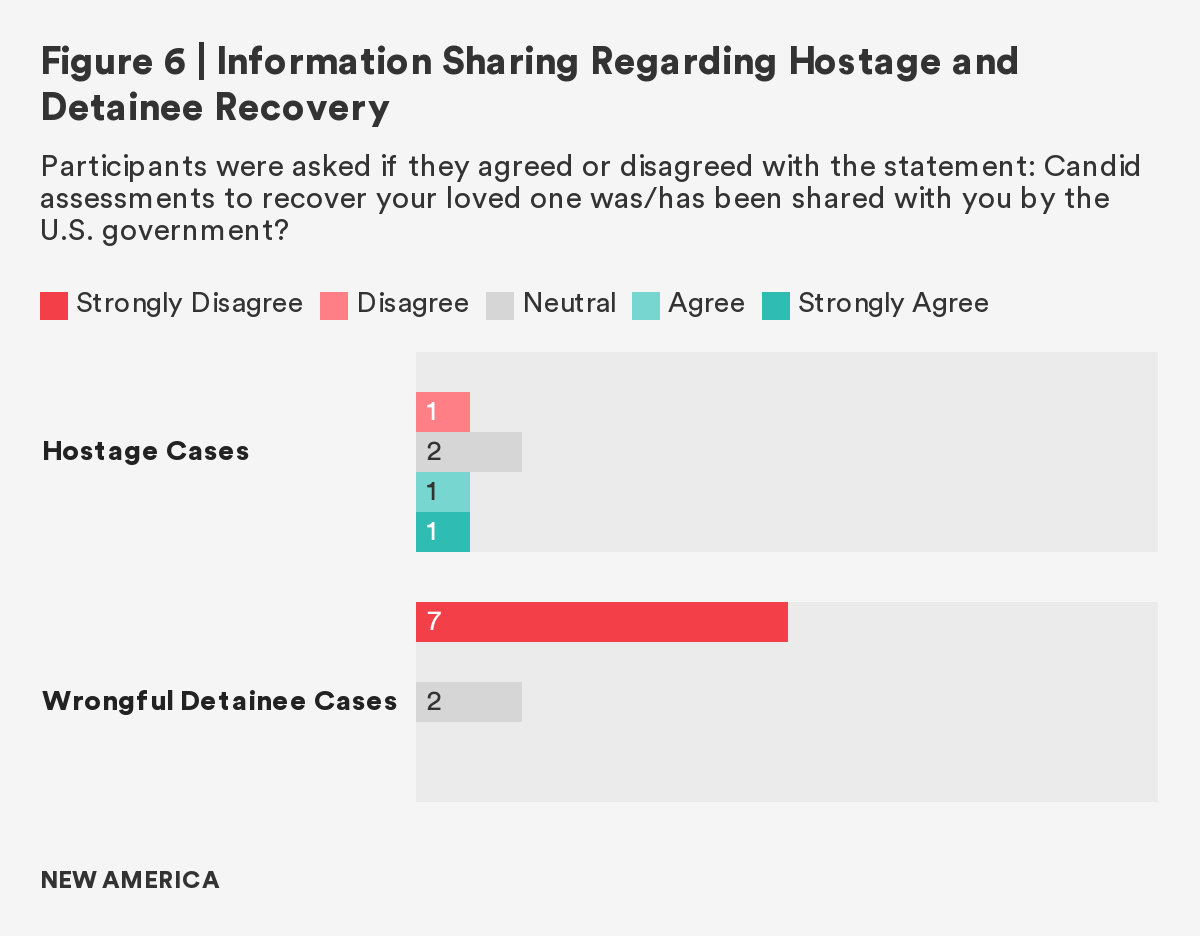
In the interviews with the 2019 and 2020 participants, JWFLF asked questions about the level of information sharing regarding recovery efforts.14 In the 2019 report, pre-PPD-30 participants generally disagreed that the U.S. government shared information regarding hostage recovery plans while post PPD-30 participants generally agreed that they did. In the interviews conducted for the 2020 report, hostage responses are mixed, while wrongful detainee responses are overwhelmingly negative (Figure 6). Hostage and wrongful detainee participants were most concerned with the U.S. government’s ability to recover their loved one and its openness in sharing candid assessment of recovery efforts.
Hostage Participant Responses
JWFLF asked its participants if the U.S. government shared candid recovery assessments for their loved ones. Of the five responses, two participants strongly agreed (one) or agreed (one), two neither agreed nor disagreed, and the remaining respondent disagreed (Figure 6).
While 2020 hostage responses were similar to 2019 post-PPD-30 responses, showing improvement in the provision of candid assessments regarding sharing recovery options after the implementation of PPD-30, there still remains concern over coordination between the HRFC and the Department of Defense.15
Some participants shared their concerns that the Department of Defense was withholding information from the HRFC and acting unilaterally without notifying the HRFC about details and the current status of their case. One participant expressed their “deep concern” about the risk that these unilateral operations might have on hostages broadly. Some participants argued that the HRFC’s standing within the U.S. government should be increased in order to prevent the Department of Defense from bypassing the HRFC.16
In addition to coordination of all the departments and agencies working towards the release of a hostage, bold leadership, lack of intelligence, and honesty and transparency were issues raised by participants. Participants shared their view on leadership attributes that they view as critically important to ensuring that their loved ones are released. They were particularly concerned that U.S. officials should have strong leadership skills that could affect change by influencing and engaging with top U.S. officials, as well as liaise and engage with multiple departments and agencies. From the participants’ perspective, the personality of the leadership in organizations working towards the release of their loved ones had a non-trivial impact on the safe return of their loved ones.
In addition, several participants indicated that they would like more transparency from the U.S. government regarding what the government can and cannot do to secure their loved one’s return. Participants also wanted more honesty about what the government is willing to do to bring their loved one home and what the government is unwilling to do. Other participants were less optimistic about the U.S. government’s ability to bring their loved ones home, citing minimal intelligence and influence in the areas where their loved ones are held.
Wrongful Detainee Participant Responses
When asked whether the U.S. government shared candid recovery assessments for their loved ones, the responses of wrongful detainee participants in the 2020 report mirrored those of pre-PPD-30 participants in the 2019 report.17 The majority (seven of nine) of wrongful detainee respondents strongly disagreed that the U.S. government shared information with them regarding recovery plans and strategies for their loved ones. Two participants neither agreed nor disagreed (Figure 6).
The interviews underscored the difficulty of securing the release of wrongful detainees, especially in cases where the foreign governments holding American nationals consider them leverage over the U.S. government. This is increasingly difficult when there are negative relationships between that government and the United States, a commonality in most wrongful detainee cases. These dynamics make the role of diplomacy an important part of recovery strategies for wrongful detainees. In addition, participants highlighted the importance of the SPEHA’s role in working with third party countries to influence foreign governments to release U.S. nationals.
Other families shared their frustration over not receiving any type of recovery plans or options to help bring their loved ones home. One participant shared, “we are not given any sort of sense where [loved one’s case] is within our government. I don’t know of any efforts in process.”
Often, adversarial governments willing to hold Americans as leverage will be holding more than one U.S. national. Wrongful detainee participants also shared their concerns about securing the release of their loved ones in these situations. Participants expressed their desire to know if the government had a coordinated plan to secure the release of all Americans held by the foreign government. Several wrongful detainee participants shared their confusion about what the release of a U.S. national meant for their loved one. One wrongful detainee shared, “Does one release indicate [the foreign government] is willing to continue negotiating or does it mean we missed our chance to get our loved one out? We don’t know.” Participants expressed concerns that the U.S. government’s departments and agencies may not be coordinated in their approach and that actions by one part of the government to secure the release of a wrongfully detained American might have an adverse impact on their loved ones.
Overall, bold leadership, intelligence, coordination, and communication between U.S. government departments and agencies, government response (diplomacy and military action), and third-party country and intermediary interactions were identified as important components required to recover an American held hostage or wrongfully detained abroad.
Prioritization of Hostage and Wrongful Detainee Cases
In JWFLF’s initial 2019 assessment of the efficacy of PPD-30’s implementation, the discussion of whether families of hostages and detainees felt as though the U.S. government considered their loved one’s case a priority was one of the most polarizing issues. Family members of hostages and detainees who interacted with the U.S. government prior to the implementation of PPD-30 often disagreed in the strongest possible terms that their loved one’s case was a priority for the U.S. government. Those family members who interacted with the U.S. government after the implementation of PPD-30 tended to agree that the U.S. government considered their loved one’s case a priority.18 In this year’s report, hostage participants generally agreed that the U.S. government considers their case a priority. The families of wrongful detainees, on the other hand, when asked about their perspective of whether the U.S. government considered their loved one’s case a priority had negative responses similar to those of the families of hostages prior to the implementation of PPD-30.
Hostage Participant Responses
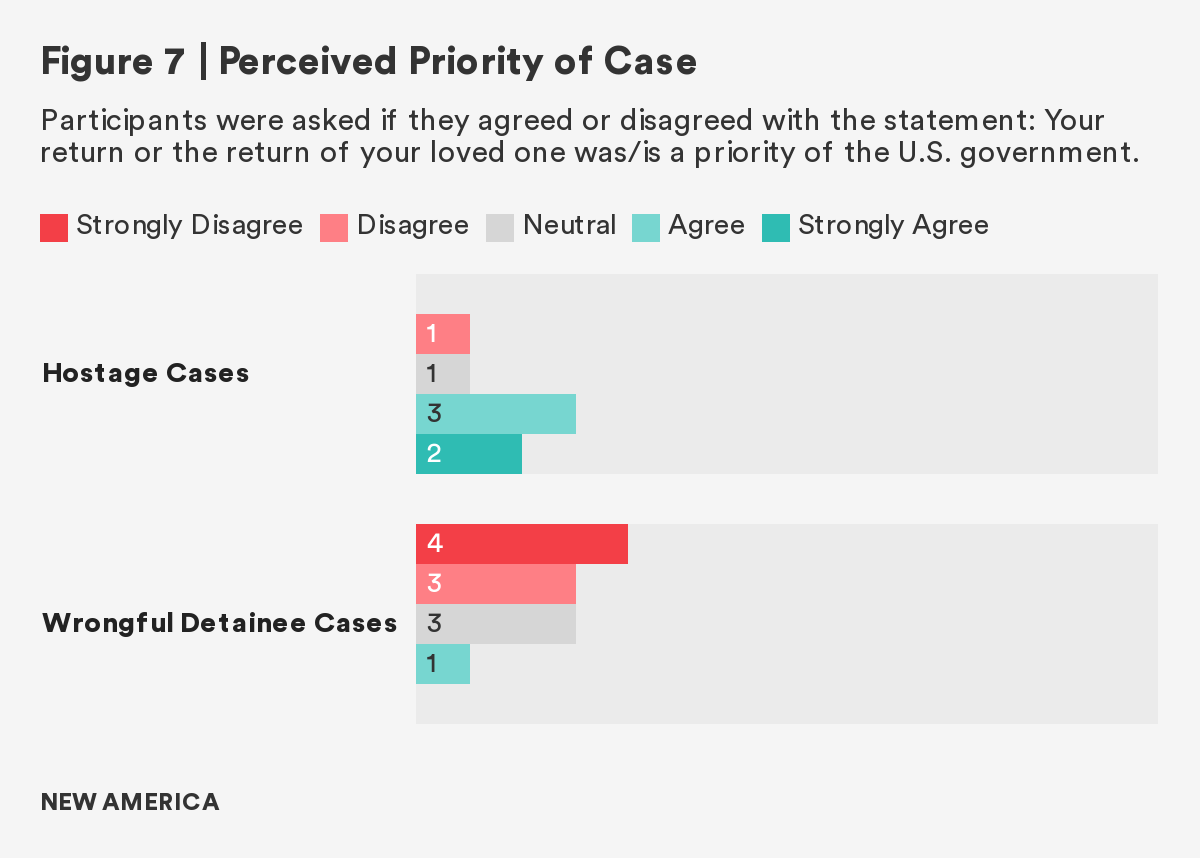
The majority (five of seven) of hostage participants said that they agreed (three) or strongly agreed (two) that their loved one was a priority of the U.S. government. One respondent neither agreed or disagreed and the other respondent disagreed with the statement that they believed their loved one’s cases were a priority of the U.S. government (Figure 7).
One of the main issues hostage families raised was their concern that the HRFC and SPEHA’s office do not have enough authority to push their loved one’s case to the priority level they think is required to achieve a resolution of their case.19 Families understand that the release of their loved ones is in competition with other national security concerns. Their request, however, is that their loved one’s case be “one of the top priorities.” One family member commented, “if they don’t have a seat at the table [National Security Council Deputies Committee], it’s a lot harder to have hostage issues as a top priority.” Several participants responded favorably to the former SPEHA, Robert O’Brien, becoming the national security advisor. From their perspective, this potentially raises the priority level of their loved one’s case. One hostage family member who developed a good relationship with O’Brien responded, “having someone working at a higher level on our behalf raises the priority of my [loved one’s] case.”
Hostage families also raised concerns about the vacancy in the SPEHA position at the Department of State created by O’Brien’s assumption of the national security advisor position.20 Overall, families viewed the vacancy as an indicator that hostage issues were not a top priority of the administration. Working with an acting SPEHA resulted in fewer attempts to coordinate diplomatic efforts overseas in addition to personnel gaps within the SPEHA’s office that limited the ability of the office to carry out the duties and responsibilities of the SPEHA.
Additionally, families expressed their desire to see more action and follow through from the government based on the discussions and plans presented to them during meetings and briefings with the HRFC and SPEHA’s office.
Wrongful Detainee Participant Responses
The majority (seven of eleven) of wrongful detainee participants strongly disagreed (four) or disagreed (three), that their loved ones were a priority of the U.S. government. An additional three other participants neither agreed nor disagreed and only one family member agreed that that their case was a priority of the U.S. government, stating, “my case only became a priority after receiving Congressional attention” (Figure 7).
Wrongful detainee families responded similarly to hostage families in expressing a desire for engagement at higher levels of government. One wrongful detainee participant shared that by not having “the highest levels of government” highlighting their case, “shows the lack of priority the U.S. government places on us.” Another participant shared that “it would show [our loved one’s case] is a priority if the president, secretary of state, or national security advisor would publicly address their case.”
Several wrongful detainee participants expressed their frustration with the Department of State over having to go to numerous meetings without learning anything noteworthy about their case. One participant shared that such meetings “show that they don’t take the case seriously and [it] is not a priority of the U.S. government. They were asking about the place my [loved one] was held. They knew nothing about the case. New people come in and have no idea about the case, asking me what I can tell them about my [loved one’s] case. To not know, really breaks your heart. That’s why I get the sense that we’re not a priority.”
Other participants stressed the difficulty of getting the Department of State to make their case a priority. Some participants recognized that the priority level of their case was dependent on their ability to advocate for their loved one. These participants recognized the importance of having legal support or a human rights advocate in the Washington, D.C. area to be able to help increase the priority level of their loved one’s case. One family member shared that “it’s beneficial to be able to interact with decision makers, people who set the policies, and people who can set into motion the recovery of your loved one.”
Overall, wrongful detainee participants are desperate to get their loved ones out and want their cases to be a high priority of the U.S. government. One family member stated, “I want [my loved one] to be a priority, because if they stay in there any longer, they’re not going to make it! … All they [the U.S. government] say is that all hostages and detainees are a priority. I want them to say that my [loved one] is a priority!”
Understanding of Laws and Policy
The reforms enacted by EO 13698 and PPD-30 were designed to improve the government’s effectiveness in bringing home American hostages and to help clarify the U.S. government’s hostage policy. A key theme in JWFLF’s 2019 assessment of PPD-30’s implementation was a lack of clarity of the U.S. government’s hostage policy prior to PPD-30. After PPD-30, family members indicated they had more clarity about the U.S. government’s hostage policy, but lacked clarity on other issues, specifically the issue of whether family members and their intermediaries could be prosecuted for the payment of ransoms.21 JWFLF again asked its participants during interviews for this report about their understanding of these laws and policies. The resultant discussions, below, demonstrate a continued lack of clarity about issues surrounding ransom amongst hostage families. Wrongful detainee families again shared narratives consistent with pre-PPD-30 hostage families, signaling confusion about the U.S. government’s policies surrounding wrongful detainee cases.
Hostage Participant Responses
Hostage participants generally understood U.S. hostage policy, although some who have had less experience working with the government expressed confusion about all the nuances and provisions of PPD-30. The biggest area of confusion for hostage participants, as in the 2019 report, centered around the U.S. government’s stance on the private payment of ransoms to secure the release of their loved ones.
The payment of a ransom to secure the release of a hostage can technically be considered a provision of “material support” to a designated terrorist organization, conduct which is criminalized under U.S. criminal code.22 Prior to the implementation of PPD-30, some hostage families were threatened with prosecution if they paid a ransom to secure the release of their loved one. After the 2015 Hostage Policy Review, the U.S. government reaffirmed its stance against providing concessions, including the payment of ransoms, to terrorist groups. At the same time, the Department of Justice released a statement highlighting the fact that no families of hostages had ever been prosecuted for paying a ransom to secure the release of their loved one.23
Hostage participants expressed concerns that, despite the Department of Justice’s statement, “nothing is in writing. It can change instantly.” Hostage participants also expressed confusion about how far the freedom from prosecution would extend. “If I were to pay a ransom,” said one hostage participant, “I couldn’t go pay it myself, I’d have to send a negotiator. Would they be exempted from prosecution as well?” Other hostage participants expressed similar concerns, asking whether banks and/or financial donors would be safe from prosecution as well.
The U.S. government likely has legitimate reasons for this public lack of clarity. If it is clear that the U.S. government supports the payment of private ransoms, terrorist groups could be better positioned to pressure families to pay ransoms. At the same time, the government is not adequately explaining the nuances of its position to hostage participants behind the scenes, which would allow them to be able to make informed decisions on how to best secure their loved one’s release.
Wrongful Detainee Participant Responses
Unfortunately, wrongful detainee families identified difficulties understanding laws and policies regarding their cases. One participant said, “I have no idea what the current policy is. I didn't know there was one until you just mentioned that.” Another participant expressed frustration over still not having a clear definition of what makes one individual a hostage and another a wrongful detainee. One more wrongful detainee participant discussed their frustration trying to get a clear definition of what made a detention wrongful, triggering access to the SPEHA’s office. Aside from a lack of clarity over the definitional differences between hostages, detainees, and wrongful detainees, wrongful detainee participants also shared a lack of clarity on what the SPEHA’s office was legally allowed to do to support their loved one’s case. The SPEHA’s diplomatic role was clear, but according to one wrongful detainee participant, it was unclear what the SPEHA’s office was legally authorized to do. “What are their legal obligations,” the participant asked, continuing, “What tools do they have? How are they best supposed to support wrongful detainees?”
These experiences were very similar to those pre-PPD-30 hostage families shared in the 2019 report.24 This lack of clarity is a major stressor for the families of wrongful detainees, increasing frustration during an already extraordinarily challenging experience. Participants have consistently shared a desire to be told the truth, even if that truth is difficult. For these participants, having a consistent definition of a wrongful detention case, even if that means their loved one is not considered one, at least helps them understand how to best move forward advocating for the release of their loved one. In addition, having clarity on what the SPEHA’s office can achieve helps them know when they need to find support outside of the U.S. government.
Citations
- Jen Easterly, “Foreword,” in Cynthia Loertscher, “Bringing Americans Home: The First Non-Governmental Assessment of U.S. Hostage Policy and Family Engagement” (New America / James W. Foley Legacy Foundation, June 24, 2019), https://www.newamerica.org/international-security/reports/bringing-americans-home/
- Cynthia Loertscher, “Bringing Americans Home: The First Non-Governmental Assessment of U.S. Hostage Policy and Family Engagement” (New America / James W. Foley Legacy Foundation, June 24, 2019), https://www.newamerica.org/international-security/reports/bringing-americans-home/
- This report adopts the definition of U.S. national used by EO 13698, which includes individuals who are “lawful permanent resident alien[s] with significant ties to the United States.” See EO 13698 available at: https://fas.org/irp/offdocs/eo/eo-13698.htm
- Language from Article 1 of the International Convention Against the Taking of Hostages (United Nations, 1979) available at https://treaties.un.org/doc/db/terrorism/english-18-5.pdf
- Language from Article 9 of the International Covenant on Civil and Political Rights (United Nations, 1966) available at https://www.ohchr.org/en/professionalinterest/pages/ccpr.aspx
- Participants were provided with five options to respond: Strongly agree, agree, neutral, disagree, and strongly disagree.
- Loertscher, “Bringing Americans Home: The First Non-Governmental Assessment of U.S. Hostage Policy and Family Engagement.”
- Loertscher, “Bringing Americans Home: The First Non-Governmental Assessment of U.S. Hostage Policy and Family Engagement,” 74–76.
- See the third section of this report on key concerns among hostage and detainee families for a more in-depth discussion of this issue.
- Loertscher, “Bringing Americans Home: The First Non-Governmental Assessment of U.S. Hostage Policy and Family Engagement,” 44.
- Loertscher, “Bringing Americans Home: The First Non-Governmental Assessment of U.S. Hostage Policy and Family Engagement,” 47.
- Loertscher, “Bringing Americans Home: The First Non-Governmental Assessment of U.S. Hostage Policy and Family Engagement,” 32–34.
- “Statement by the President on the U.S. Government’s Hostage Policy Review” (White House Office of the Press Secretary, June 24, 2015), https://obamawhitehouse.archives.gov/the-press-office/2015/06/24/statement-president-us-governments-hostage-policy-review
- This discussion uses the term “recovery efforts” to mean all options to secure the release of U.S. nationals held hostage or wrongfully detained, including: diplomatic engagement to facilitate releases; coercive diplomatic efforts, like sanctions to pressure foreign governments; negotiations facilitated by third parties; and military efforts. like hostage rescue operations.
- Loertscher, “Bringing Americans Home: The First Non-Governmental Assessment of U.S. Hostage Policy and Family Engagement,” 32, 42.
- See the third section of this report on key concerns among hostage and detainee families for a more in-depth discussion of this issue.
- Loertscher, “Bringing Americans Home: The First Non-Governmental Assessment of U.S. Hostage Policy and Family Engagement,” 33–43.
- Loertscher, “Bringing Americans Home: The First Non-Governmental Assessment of U.S. Hostage Policy and Family Engagement,” 37.
- See the third section of this report on key concerns among hostage and detainee families for a more in-depth discussion of this issue.
- See the third section of this report on key concerns among hostage and detainee families for a more in-depth discussion of this issue.
- Loertscher, “Bringing Americans Home: The First Non-Governmental Assessment of U.S. Hostage Policy and Family Engagement,” 26–30.
- Providing Material Support or Resources to Designated Foreign Terrorist Organizations, 18 U.S.C. § 2339B (2016).
- “Department of Justice Statement on U.S. Citizens Taken Hostage Abroad” Department of Justice Office of Public Affairs, June 24, 2015), https://justice.gov/opa/pr/department-justice-statement-us-citizens-taken-hostage-abroad
- Loertscher, “Bringing Americans Home: The First Non-Governmental Assessment of U.S. Hostage Policy and Family Engagement,” 26–27.
3. Key Concerns Amongst Hostage and Detainee Families
This report has examined the feedback from interviews with hostage participants and wrongful detainee participants to understand the impact of the U.S. government’s hostage policy. In the previous section, much of this examination has been quantitative, using numerical rankings that participants provided, often compared against the same type of rankings from the 2019 report. This section addresses some of the thematic issues and overarching concerns drawn from the interviews, where many voices shared common challenges or concerns. To the extent that JWFLF can provide a recommendation based on the input of participants and experts, we have done so, but in other cases we have simply tried to raise awareness about concerns shared by the families of hostages and wrongfully held detainees.
Many of the key concerns identified in this section revolve around the particular situation of wrongful detainees. Such concerns include a lack of clarity of definitions, particularly those differentiating hostages from wrongful detainees, as well as the limited and unclear access to the HRFC for wrongful detainees, questions over how the wrongfulness of a detention is determined, and concern over the extent to which detainees are able to access other resources seemingly provided by current policy. In addition, both wrongful detainee and hostage participants flagged concerns regarding the vacancy of the SPEHA position and the level of access to senior policymakers.
Impact of Definitions
The U.S. government classifies individuals as either hostages or detainees based on the identity of the group holding them, whether it is a non-state or state actor.25 There are reasons for this delineation based on the U.S. government’s capabilities and approach in handling these cases. The release of a person held by a foreign country is more diplomatically intensive than securing the release of someone held by a terrorist group, which would in turn, require more military, intelligence, and law enforcement support.
Many of the reasons for the differences in the support that the U.S. government provides the two groups involve legal authorities. Criminal and terrorist kidnappings are violations of U.S. law and, in these cases, the FBI will open a case, either using material support for terrorism or criminal kidnapping statues. As a result, the HRFC is able to access funds from the Victims of Crime Act of 1984 to support those family members. When U.S. nationals are detained by foreign governments, and those governments acknowledge that detention, no U.S. laws are broken since governments generally have the authority to arrest and detain individuals within their own borders. This, then, creates a challenge for supporting the families, as they do not qualify for the Victims of Crime Act funding the way that hostage families do. Further, the Department of State does not have a funding mechanism for providing a similar kind of support. In addition, these acknowledged detainees fall outside many of the authorities that authorize the capabilities that the intelligence community, Department of Defense, or the FBI use to support hostage cases. In essence, while these cases may be wrongful detentions, the fact that foreign governments have acknowledged the detention prevents families from receiving much of the funding and support from the HRFC.
These distinctions, however, are not necessarily clear to the families of detainees, who see their loved ones being held as political pawns similar to terrorist-held hostages and who, in trying to secure the release of their loved ones, have seen the diplomatic engagements and judicial processes available to them produce little effect. The lack of clarity has real effects; it increases confusion and difficulty during an already traumatic time. One family member commented that one of their biggest obstacles was the fact that they continued to “hit walls again and again because we were constantly trying to figure out the definitions.” This confusion creates wasted time and effort that could be used in constructive ways to secure the release of their loved ones.
This lack of clarity also creates frustration when families perceive that one group receives additional support that they are not entitled to, despite similar circumstances. As one of the following sections will discuss in more detail, the assumptions built into PPD-30 regarding access to diplomatic and judicial mechanisms for release are not always viable in foreign countries, some of which have an adversarial relationship with the United States. In these circumstances, many, but not all, of the differences between hostages and unjust detainees drop away, leaving family members feeling like they have few options to receive support. “We're all [in similar circumstances as] the hostage group, but with just different government responses,” a family member of a wrongful detainee commented.
Wrongful Detainee Access to the Hostage Recovery Fusion Cell
PPD-30 clearly indicates that the Department of State is the lead agency for wrongful detainee cases and the complications surrounding funding and authorities limit HRFC support of wrongful detainee family members. Despite this, PPD-30 contains language that facilitates some level of access for these families to the HRFC. PPD-30 states that in dealing with cases where a foreign government confirms that it has detained a U.S. national, “the Department of State may draw on the full range of experience and expertise of the HRFC as appropriate, including the HRFC's Family Engagement Coordinator's proficiency in providing and ensuring professionalism, empathy, and sensitivity to the psychological and emotional distress experienced by families in such cases.”26 It is unclear, however, in practice what it means to “draw upon the full range of experience and expertise” of the personnel at the HRFC. Do the HRFC’s personnel serve as advisors to individuals within the SPEHA’s office? Does the HRFC become actively engaged in these cases? If so, does State retain its status as the lead agency for the case? Does the HRFC become responsible for funding support to these cases? Even if these practical questions were answered, who determines which cases are authorized to draw upon the HRFC’s resources? The lack of clarity on when and how the Department of State is able to draw upon support from the HRFC has created a significant level of confusion about which organization is responsible for their cases among the families of acknowledged, wrongful detainees.
Wrongful detainee participants have expressed a need to better understand how and when their cases can receive support from the HRFC, in addition to understanding who makes this determination. Receiving this clarity would help wrongful detainee families better understand where to place their efforts in advocating for their loved ones.
What Makes a Detainee a Wrongful Detainee?
In addition to a lack of clarity on how wrongful detainees access the HRFC, there is confusion over what makes a detention case wrongful, thereby gaining access to the SPEHA’s office. In general, families have expressed concern that these guidelines are classified and are not shared. “We get a little bit here and there,” one participant shared, “[but] we need to know more.” One wrongful detainee participant shared that their loved one’s case was considered wrongful because their loved one did not receive any due process or any impartial judicial processes and was absent for more than one year. Other participants shared their concerns that the status of diplomatic ties between the U.S. and foreign governments played a role in whether a case was considered wrongful. Regardless, it is clear that there is no unclassified, publicly available definition of what makes a detention wrongful, nor, according to the individuals who participated in these interviews, are such distinctions being systematically shared with wrongful detainee families as a result of engagement with the Department of State.
In addition to not knowing what constitutes a wrongful case, participants also shared that they do not know who within the U.S. government would make the determination over whether their loved one’s case was considered wrongful and whether there is a process for those who the Department of State have decided are not wrongful cases.
For the family members of individuals detained by a foreign government, getting their loved one’s detention classified as wrongful is often the first of many hurdles they must overcome in order to receive the level of support and attention they feel is required to secure the release of their loved one.
Wrongful Detainee Access to other Means of Support
PPD-30’s distinction between the hostages and wrongful detainees and the general exclusion of detainees from the hostage recovery enterprise, was based—in part—on the idea that individuals held by state actors had access to additional mechanisms to secure their release, including judicial processes and diplomatic engagements.27 In the interviews that made up this report, wrongful detainee participants shared that this is largely not the case. Wrongful detainee participants shared that the legal processes they have engaged with within the countries where their loved ones are detained have been ineffective. From the perspective of these participants, these legal systems are largely for show, with the outcomes of the trials and sentences are either influenced by the foreign government or predetermined. These participants have, and will continue, to work within the legal system of the foreign government in hopes that it has an impact; however, they do not see the foreign legal system as a viable way to achieve the release of their loved one.
In addition, routine diplomatic engagements made by the Department of State’s Bureau of Consular Affairs were often viewed as insufficient to achieve the release of their loved ones. Wrongful detainee participants shared that often the government has either no diplomatic ties or strained diplomatic ties with the foreign governments holding their loved ones, making the achievement of a release through the routine diplomatic services offered by Consular Affairs unlikely.
In large measure, wrongful detainee participants shared that, in their experiences, the assumptions underlying the exclusion of acknowledged detainees from the hostage recovery enterprise are invalid. The mechanisms presumed to be available to this population are largely insufficient to secure the release of their loved ones, requiring an increased level of support from the U.S. government.
Vacancy of the SPEHA
Hostage and wrongful detainee participants also shared challenges created during the vacancy in the SPEHA’s office. The participants shared their concerns that, without an appointed SPEHA, the office was less able to perform its functions.
During the change in administrations between President Obama and President Trump, there was no SPEHA from January 2017 until May 2018. In the interviews that made up the 2019 report, families expressed concerns that the vacancy in the position hampered the ability of the office to perform its duties.28
During the timeframe that the interviews forming the 2020 report were conducted, the position was also vacant. In September 2019, Robert O’Brien, the then-SPEHA, was named as President Trump’s national security advisor.29 His assumption of the new role left a vacancy in the SPEHA’s position for more than five months, with the Principal Deputy Special Presidential Envoy for Hostage Affairs Hugh Dugan assuming the position in an acting capacity. During the interviews, participants again expressed concerns that the vacancy impacted the ability of the office to vigorously pursue options to secure the release of their loved ones. Overall, most families commented that the differences in working with an appointed SPEHA(s) and an acting SPEHA(s) were substantial, as the acting SPEHA tended not to have the same influence within the interagency as an appointed SPEHA. Additionally, participants noted that, during this timeframe, there were a number of vacant positions within the office normally held by career diplomats. In general, families noted that progress in their cases overall and, specifically, diplomatic efforts to resolve their cases, slowed significantly during the vacancy.
At the time of this writing, President Trump has announced the nomination of Roger D. Carstens, currently the deputy assistant secretary in the Bureau of Democracy, Human Rights, and Labor at the Department of State as the SPEHA.30 The appointment of a SPEHA continues to be an important part of ensuring the effective functioning of the hostage recovery enterprise and a signal of the priority the current administration places on bringing Americans home.
Access to Senior Policymakers
Families have expressed concerns that hostage and wrongful detainee cases do not have the appropriate standing to influence the various agencies within the U.S. government involved in resolving hostage and wrongful detainee cases.
Prior to the changes created by PPD-30, there was no systemic method for hostage cases to gain the attention of the White House. As the U.S. government conducted the 2015 Hostage Policy Review, there were a variety of perspectives over the role and standing of a hostage coordinator. In May 2015, prior to the announcement of the Obama Administration’s restructuring of the U.S. government’s hostage enterprise, Rep. John Delaney (D-Md.) introduced a bill to create a “hostage czar,” a National Security Council-level position dedicated to “coordinating efforts to locate and free U.S. hostages.”31 Some experts expressed concern that the creation of a position within the White House would signal to terrorist groups the opportunity for increased leverage.32
Ultimately, the Obama Administration decided against the creation of a National Security Council-level position. PPD-30 and EO 13698 created a pathway for hostage concerns to be elevated to the National Security Council through the Hostage Response Group (HRG).33 The HRG was designed as a sub-deputies’ committee led by the senior advisor to the president for counterterrorism.34 It is at that level where disputes within the interagency are decided and “policies and recovery strategies” presented by the HRFC are approved.35
From the government’s perspective, this has largely been successful. A 2016 review of the implementation of EO 13698 conducted by the NCTC found that the HRG was an “effective policy coordination body that ensures increased awareness and coordination of potential and ongoing recovery efforts across the USG.” In the NCTC’s assessment, the HRG had “achieved its objectives in this area.”36
Participants, however, have expressed concerns that this is not sufficient to achieve the release of their loved ones. While participants realize that other national security issues compete with the release of their loved one as priorities, some have expressed concerns that the various agencies within the U.S. government are pursuing efforts that are contradictory to those being enacted by the HRFC and the SPEHA’s office. Participants expressed concerns that the HRFC cannot sufficiently direct the activities of the interagency when necessary.
Participants also shared that they feel as though their cases are missing top level engagement within the U.S. government. Participants are often told that particular issues related to their cases are going to be decided at the Deputies Committee within the National Security Council. In both administrations, however, neither the director of the HRFC nor the SPEHA was a member of the Deputies Committee. Both hostage and wrongful detainee participants stated that former SPEHA Robert O’Brien’s assumption of the national security advisor role was helpful for increasing the priority of their cases, further highlighting the need for a voice within the White House to address hostage and detainee concerns.
While the U.S. government is unlikely to elevate the HRG above its current level as a sub-deputies committee, there are other mechanisms that can be employed to consolidate the HRFC’s influence over the resolution of hostage cases. The HRFC, for instance, should have jurisdiction over agents working cases within field offices, for instance, rather than the special agents in charge of their respective field offices. Formalizing relationships that would give more authority to the HRFC to direct hostage cases within the FBI could be an initial step in increasing the capacity of the HRFC to influence the resolution of hostage cases across the interagency. One hostage participant recommended elevating the position of SPEHA to that of an ambassador in order to increase the office’s authority within the interagency.
From the perspective of hostage and wrongful detainee participants, taking steps to increase the standing of the hostage recovery enterprise within the U.S. government would both increase the priority of hostage and wrongful detainee issues and increase the likelihood that their loved ones return home.
Citations
- Jen Easterly, “Foreword,” in Cynthia Loertscher, “Bringing Americans Home: The First Non-Governmental Assessment of U.S. Hostage Policy and Family Engagement” (New America / James W. Foley Legacy Foundation, June 24, 2019), https://www.newamerica.org/international-security/reports/bringing-americans-home/
- Cynthia Loertscher, “Bringing Americans Home: The First Non-Governmental Assessment of U.S. Hostage Policy and Family Engagement” (New America / James W. Foley Legacy Foundation, June 24, 2019), https://www.newamerica.org/international-security/reports/bringing-americans-home/
- This report adopts the definition of U.S. national used by EO 13698, which includes individuals who are “lawful permanent resident alien[s] with significant ties to the United States.” See EO 13698 available at: https://fas.org/irp/offdocs/eo/eo-13698.htm
- Language from Article 1 of the International Convention Against the Taking of Hostages (United Nations, 1979) available at https://treaties.un.org/doc/db/terrorism/english-18-5.pdf
- Language from Article 9 of the International Covenant on Civil and Political Rights (United Nations, 1966) available at https://www.ohchr.org/en/professionalinterest/pages/ccpr.aspx
- Participants were provided with five options to respond: Strongly agree, agree, neutral, disagree, and strongly disagree.
- Loertscher, “Bringing Americans Home: The First Non-Governmental Assessment of U.S. Hostage Policy and Family Engagement.”
- Loertscher, “Bringing Americans Home: The First Non-Governmental Assessment of U.S. Hostage Policy and Family Engagement,” 74–76.
- See the third section of this report on key concerns among hostage and detainee families for a more in-depth discussion of this issue.
- Loertscher, “Bringing Americans Home: The First Non-Governmental Assessment of U.S. Hostage Policy and Family Engagement,” 44.
- Loertscher, “Bringing Americans Home: The First Non-Governmental Assessment of U.S. Hostage Policy and Family Engagement,” 47.
- Loertscher, “Bringing Americans Home: The First Non-Governmental Assessment of U.S. Hostage Policy and Family Engagement,” 32–34.
- “Statement by the President on the U.S. Government’s Hostage Policy Review” (White House Office of the Press Secretary, June 24, 2015), https://obamawhitehouse.archives.gov/the-press-office/2015/06/24/statement-president-us-governments-hostage-policy-review
- This discussion uses the term “recovery efforts” to mean all options to secure the release of U.S. nationals held hostage or wrongfully detained, including: diplomatic engagement to facilitate releases; coercive diplomatic efforts, like sanctions to pressure foreign governments; negotiations facilitated by third parties; and military efforts. like hostage rescue operations.
- Loertscher, “Bringing Americans Home: The First Non-Governmental Assessment of U.S. Hostage Policy and Family Engagement,” 32, 42.
- See the third section of this report on key concerns among hostage and detainee families for a more in-depth discussion of this issue.
- Loertscher, “Bringing Americans Home: The First Non-Governmental Assessment of U.S. Hostage Policy and Family Engagement,” 33–43.
- Loertscher, “Bringing Americans Home: The First Non-Governmental Assessment of U.S. Hostage Policy and Family Engagement,” 37.
- See the third section of this report on key concerns among hostage and detainee families for a more in-depth discussion of this issue.
- See the third section of this report on key concerns among hostage and detainee families for a more in-depth discussion of this issue.
- Loertscher, “Bringing Americans Home: The First Non-Governmental Assessment of U.S. Hostage Policy and Family Engagement,” 26–30.
- Providing Material Support or Resources to Designated Foreign Terrorist Organizations, 18 U.S.C. § 2339B (2016).
- “Department of Justice Statement on U.S. Citizens Taken Hostage Abroad” Department of Justice Office of Public Affairs, June 24, 2015), https://justice.gov/opa/pr/department-justice-statement-us-citizens-taken-hostage-abroad
- Loertscher, “Bringing Americans Home: The First Non-Governmental Assessment of U.S. Hostage Policy and Family Engagement,” 26–27.
- While these definitions are generally accepted, it is notable that they are not explicitly made clear in either EO 13698 or PPD-30.
- “Presidential Policy Directive -- Hostage Recovery Activities” (White House Office of the Press Secretary, June 24, 2015), https://obamawhitehouse.archives.gov/the-press-office/2015/06/24/presidential-policy-directive-hostage-recovery-activities
- Luke Hartig, “How is U.S. Hostage Policy Working?” Panel Discussion, New America, Washington, D.C., June 24, 2019. https://www.newamerica.org/international-security/events/bringing-americans-home/
- Loertscher, “Bringing Americans Home: The First Non-Governmental Assessment of U.S. Hostage Policy and Family Engagement,” 41–42.
- Adam Edelman, “Trump Names Robert O’Brien as New National Security Adviser,” NBC, September 18, 2019, https://www.nbcnews.com/politics/white-house/trump-names-robert-o-brien-new-national-security-adviser-n1055801
- “President Donald J. Trump Announces Intent to Appoint Individual to a Key Administration Post” (The White House, February 21, 2020), https://www.whitehouse.gov/presidential-actions/president-donald-j-trump-announces-intent-appoint-individual-key-administration-post-7/
- David Francis, “Could a ‘Hostage Czar’ Have Saved Warren Weinstein? One Lawmaker Thinks So,” Foreign Policy, May 1, 2015, https://foreignpolicy.com/2015/05/01/could-a-hostage-czar-have-saved-warren-weinstein-one-lawmaker-thinks-so/
- Brian Michael Jenkins, “Should There Be a Hostage Czar?,” The Hill, June 1, 2015, https://thehill.com/blogs/pundits-blog/defense/243580-should-there-be-a-hostage-czar
- EO 13698 available at https://fas.org/irp/offdocs/eo/eo-13698.htm
- Seth Loertscher, “A View from the CT Foxhole: Rob Saale, Former Director, U.S. Hostage Recovery Fusion Cell,” CTC Sentinel 13, no. 1 (January 2020), https://ctc.usma.edu/view-ct-foxhole-rob-saale-former-director-u-s-hostage-recovery-fusion-cell/
- Loertscher, “A View from the CT Foxhole: Rob Saale, Former Director, U.S. Hostage Recovery Fusion Cell.”
- “Status Report on the Implementation of Executive Order 13698 Hostage Recovery Activities” (National Counterterrorism Center, September 30, 2016), 5, https://www.dni.gov/index.php/newsroom/reports-publications/reports-publications-2016/item/1634-status-report-on-the-implementation-of-executive-order-13698-hostage-recovery-activities
Conclusion
This report examined the support provided to American hostages, wrongfully held detainees, and their families through interviews with 25 individuals personally connected with both types of cases. Overall, the changes made to the U.S. government’s hostage recovery enterprise have improved the experiences of the families of hostages and, to a limited extent, wrongful detainees. The creation of the HRFC and the SPEHA’s office continue to be viewed as a successful mechanism for increasing the accessibility of the U.S. government to the families of both hostages and wrongfully held detainees. The responses of hostage participants were generally positive with regard to their experiences interacting with both the HRFC and SPEHA’s office, showing an increase in satisfaction with the government compared with 2019 pre-PPD-30 participants. There are, however, aspects of the hostage recovery enterprise where continued improvement is needed. Hostage participants identified a need to continue to focus on access to information, especially the declassification of information for families, and expressed some concerns about the HRFC’s influence within the interagency framework over plans for the recovery of their loved ones.
Wrongful detainee participants, on the other hand, reported experiences with the U.S. government that were very similar to the experiences of the 2019 participants who interacted with the government prior to the reforms of the hostage recovery enterprise and the implementation of EO 13698 and PPD-30. Wrongful detainee participants reported, in general, that they did not feel as though their loved ones’ cases were a priority for the U.S. government and shared confusion about where they could receive support within the U.S. government. Wrongful detainees also shared concerns about the transparency of the process required to gain support from the SPEHA’s office and HRFC and a lack of clarity over what requirements a detention must meet to be considered wrongful. While there are a variety of legal and procedural reasons for the differences in support between hostage and wrongful detainee cases, the end result is confusion, frustration, and concern from wrongful detainee participants that the U.S. government is not concerned with the return of their loved ones.
In general, the restructuring of the U.S. government’s hostage recovery enterprise has had a positive impact and has been largely successful. The successful efforts of the U.S. government to secure the release of Americans held abroad should continue to be a priority of U.S. foreign policy. The support provided to the families of these individuals, as well, should continue to be a priority for the U.S. government. Responsible changes to policy should be considered to expand the support from and access to the U.S. government to the families of those U.S. nationals wrongfully held by foreign governments. Hostage-taking by terrorist groups and the wrongful detention of U.S. nationals will continue to be a pressing concern as militants and adversarial governments continue to seek ways to find leverage with the United States. In this increasingly hostile environment, the recovery of U.S. nationals and the provision of support for their families should continue to be a priority of any administration seeking to place the interests of Americans first.
Citations
- Jen Easterly, “Foreword,” in Cynthia Loertscher, “Bringing Americans Home: The First Non-Governmental Assessment of U.S. Hostage Policy and Family Engagement” (New America / James W. Foley Legacy Foundation, June 24, 2019), https://www.newamerica.org/international-security/reports/bringing-americans-home/
- Cynthia Loertscher, “Bringing Americans Home: The First Non-Governmental Assessment of U.S. Hostage Policy and Family Engagement” (New America / James W. Foley Legacy Foundation, June 24, 2019), https://www.newamerica.org/international-security/reports/bringing-americans-home/
- This report adopts the definition of U.S. national used by EO 13698, which includes individuals who are “lawful permanent resident alien[s] with significant ties to the United States.” See EO 13698 available at: https://fas.org/irp/offdocs/eo/eo-13698.htm
- Language from Article 1 of the International Convention Against the Taking of Hostages (United Nations, 1979) available at https://treaties.un.org/doc/db/terrorism/english-18-5.pdf
- Language from Article 9 of the International Covenant on Civil and Political Rights (United Nations, 1966) available at https://www.ohchr.org/en/professionalinterest/pages/ccpr.aspx
- Participants were provided with five options to respond: Strongly agree, agree, neutral, disagree, and strongly disagree.
- Loertscher, “Bringing Americans Home: The First Non-Governmental Assessment of U.S. Hostage Policy and Family Engagement.”
- Loertscher, “Bringing Americans Home: The First Non-Governmental Assessment of U.S. Hostage Policy and Family Engagement,” 74–76.
- See the third section of this report on key concerns among hostage and detainee families for a more in-depth discussion of this issue.
- Loertscher, “Bringing Americans Home: The First Non-Governmental Assessment of U.S. Hostage Policy and Family Engagement,” 44.
- Loertscher, “Bringing Americans Home: The First Non-Governmental Assessment of U.S. Hostage Policy and Family Engagement,” 47.
- Loertscher, “Bringing Americans Home: The First Non-Governmental Assessment of U.S. Hostage Policy and Family Engagement,” 32–34.
- “Statement by the President on the U.S. Government’s Hostage Policy Review” (White House Office of the Press Secretary, June 24, 2015), https://obamawhitehouse.archives.gov/the-press-office/2015/06/24/statement-president-us-governments-hostage-policy-review
- This discussion uses the term “recovery efforts” to mean all options to secure the release of U.S. nationals held hostage or wrongfully detained, including: diplomatic engagement to facilitate releases; coercive diplomatic efforts, like sanctions to pressure foreign governments; negotiations facilitated by third parties; and military efforts. like hostage rescue operations.
- Loertscher, “Bringing Americans Home: The First Non-Governmental Assessment of U.S. Hostage Policy and Family Engagement,” 32, 42.
- See the third section of this report on key concerns among hostage and detainee families for a more in-depth discussion of this issue.
- Loertscher, “Bringing Americans Home: The First Non-Governmental Assessment of U.S. Hostage Policy and Family Engagement,” 33–43.
- Loertscher, “Bringing Americans Home: The First Non-Governmental Assessment of U.S. Hostage Policy and Family Engagement,” 37.
- See the third section of this report on key concerns among hostage and detainee families for a more in-depth discussion of this issue.
- See the third section of this report on key concerns among hostage and detainee families for a more in-depth discussion of this issue.
- Loertscher, “Bringing Americans Home: The First Non-Governmental Assessment of U.S. Hostage Policy and Family Engagement,” 26–30.
- Providing Material Support or Resources to Designated Foreign Terrorist Organizations, 18 U.S.C. § 2339B (2016).
- “Department of Justice Statement on U.S. Citizens Taken Hostage Abroad” Department of Justice Office of Public Affairs, June 24, 2015), https://justice.gov/opa/pr/department-justice-statement-us-citizens-taken-hostage-abroad
- Loertscher, “Bringing Americans Home: The First Non-Governmental Assessment of U.S. Hostage Policy and Family Engagement,” 26–27.
- While these definitions are generally accepted, it is notable that they are not explicitly made clear in either EO 13698 or PPD-30.
- “Presidential Policy Directive -- Hostage Recovery Activities” (White House Office of the Press Secretary, June 24, 2015), https://obamawhitehouse.archives.gov/the-press-office/2015/06/24/presidential-policy-directive-hostage-recovery-activities
- Luke Hartig, “How is U.S. Hostage Policy Working?” Panel Discussion, New America, Washington, D.C., June 24, 2019. https://www.newamerica.org/international-security/events/bringing-americans-home/
- Loertscher, “Bringing Americans Home: The First Non-Governmental Assessment of U.S. Hostage Policy and Family Engagement,” 41–42.
- Adam Edelman, “Trump Names Robert O’Brien as New National Security Adviser,” NBC, September 18, 2019, https://www.nbcnews.com/politics/white-house/trump-names-robert-o-brien-new-national-security-adviser-n1055801
- “President Donald J. Trump Announces Intent to Appoint Individual to a Key Administration Post” (The White House, February 21, 2020), https://www.whitehouse.gov/presidential-actions/president-donald-j-trump-announces-intent-appoint-individual-key-administration-post-7/
- David Francis, “Could a ‘Hostage Czar’ Have Saved Warren Weinstein? One Lawmaker Thinks So,” Foreign Policy, May 1, 2015, https://foreignpolicy.com/2015/05/01/could-a-hostage-czar-have-saved-warren-weinstein-one-lawmaker-thinks-so/
- Brian Michael Jenkins, “Should There Be a Hostage Czar?,” The Hill, June 1, 2015, https://thehill.com/blogs/pundits-blog/defense/243580-should-there-be-a-hostage-czar
- EO 13698 available at https://fas.org/irp/offdocs/eo/eo-13698.htm
- Seth Loertscher, “A View from the CT Foxhole: Rob Saale, Former Director, U.S. Hostage Recovery Fusion Cell,” CTC Sentinel 13, no. 1 (January 2020), https://ctc.usma.edu/view-ct-foxhole-rob-saale-former-director-u-s-hostage-recovery-fusion-cell/
- Loertscher, “A View from the CT Foxhole: Rob Saale, Former Director, U.S. Hostage Recovery Fusion Cell.”
- “Status Report on the Implementation of Executive Order 13698 Hostage Recovery Activities” (National Counterterrorism Center, September 30, 2016), 5, https://www.dni.gov/index.php/newsroom/reports-publications/reports-publications-2016/item/1634-status-report-on-the-implementation-of-executive-order-13698-hostage-recovery-activities
Appendix A: Current Needs, Requests, and Recommendations from Hostage Participants
This appendix presents a list of current needs, requests, and recommendations expressed by hostages and their families. This list of needs, requests, and recommendations are not listed in order of importance but are grouped by category. Although not all the needs necessarily fall under the purview of the government, they are listed here for reference. The inclusion of a need, request, or recommendation does not necessarily mean it was unanimously supported by participants.
Hostage Policy and Recovery Strategy
The requests and recommendations expressed by hostages and their families in terms of the hostage policy and recovery strategy are:
- For family members to receive security clearances—limited secret (read only).
- For the U.S. government to create more diplomatic ties with countries holding loved ones.
- For advanced notice of proposed recovery options.
- For improved access to high-level U.S. government officials.
- For creative compassionate reintegration support.
- For the Department of Justice to grant hostage negotiators and other parties involved in negotiations immunity.
- For the U.S. government to elevate the authority of the director of the HRFC.
- For the U.S. government to find creative ways to navigate their geopolitical constraints.
- For the U.S. government to improve relationships with foreign governments holding loved ones—and communication on a humanitarian level.
- For the U.S. to apply pressure on foreign governments to acknowledge that they are holding U.S. citizens.
- For the U.S. government to provide families a step-by-step recovery plan.
Communication, Information Sharing, and Government Transparency
The requests and recommendations expressed by hostages and their families in terms of communication, information sharing, and government transparency are:
- For the declassification of more information.
- For family access to secure lines at local FBI field offices to speak with U.S. officials—allowing U.S. officials to share more information over the phone.
- For the U.S. government to allow more information sharing with third-party hostage negotiation teams.
- For complete, full, and timely access to all information and activities pertaining to cases.
- For more honesty and transparency regarding what the U.S. government can and cannot do.
- For established criteria to determine if a family member can be trusted with information.
- For better communication between the SPEHA’s office and HRFC concerning hostage cases.
- For the SPEHA’s office to facilitate declassifying information the same way that the HRFC does.
Accountability for Hostage-Takers
The requests and recommendations expressed by hostages and their families in terms of accountability for hostage-takers are:
- For more clarity on what the U.S. government is doing to pursue kidnappers.
- For the identification of the location of loved ones’ remains.
- For the prosecution of captors and bringing them to justice.
Media Support
The requests and recommendations expressed by hostages and their families in terms of media support are:
- For more support getting a loved one’s name out to the public including addressing significant challenges getting media attention during the current political climate.
- For assistance in starting a media campaign.
- Upon the family’s approval, for the U.S. government to speak publicly about a loved one’s case.
Physical and Mental Health
The requests and recommendations expressed by hostages and their families in terms of the physical and mental health of the former hostage are:
- For mental health support from someone who has high level trauma experience and knows how to deal with challenges from being in captivity.
- For access to better psychological services outside the framework of the U.S. government.
- For clarification on how long the FBI’s Victim Services Division will be providing support.
- For more information regarding what type of mental health support is available for hostages and their families.
- For the identification of available resources for hostages’ children.
- For more support dealing with depression and anxiety of family members.
- For better connections between hostage families. Community is important for family members dealing with the stress and isolation.
Financial Guidance
The requests and recommendations expressed by hostages and their families in terms of financial guidance are:
- For resources to help with financial solvency in order to maintain a stable life after captivity.
- For support finding employment after captivity.
- For more information about what type of financial support is available to hostages and their families.
- For the IRS to provide criteria for someone who has been arbitrarily detained in order to relieve penalties.
- For financial support for travel to Washington, D.C.
Non-Governmental Organization Assistance
The requests and recommendations expressed by hostages and their families in terms of NGO assistance are:
- For continued additional pressure on the U.S. government advocating for the needs of individuals held hostage abroad.
- For continued assistance with communicating with HRFC and FBI’s Victim Services Division.
- For continued advice and moral support.
- For connection of families with someone who has experience dealing with the trauma associated with captivity.
General
Other general requests and recommendations are:
- For security and protection.
- For access to the Rewards for Justice program for a loved one’s case.
- For the provision of former hostages with official documentation to prove they were held hostage or arbitrarily detained.
- For more empathy and compassion from U.S. officials.
- For more trauma related training for U.S. officials who work directly with returning captives.
- For proof of life.
- For understanding of families’s need for privacy and desire not to be used as political pawns.
- For Congress to pay more attention to hostage cases and put pressure on the U.S. government.
Citations
- Jen Easterly, “Foreword,” in Cynthia Loertscher, “Bringing Americans Home: The First Non-Governmental Assessment of U.S. Hostage Policy and Family Engagement” (New America / James W. Foley Legacy Foundation, June 24, 2019), https://www.newamerica.org/international-security/reports/bringing-americans-home/
- Cynthia Loertscher, “Bringing Americans Home: The First Non-Governmental Assessment of U.S. Hostage Policy and Family Engagement” (New America / James W. Foley Legacy Foundation, June 24, 2019), https://www.newamerica.org/international-security/reports/bringing-americans-home/
- This report adopts the definition of U.S. national used by EO 13698, which includes individuals who are “lawful permanent resident alien[s] with significant ties to the United States.” See EO 13698 available at: https://fas.org/irp/offdocs/eo/eo-13698.htm
- Language from Article 1 of the International Convention Against the Taking of Hostages (United Nations, 1979) available at https://treaties.un.org/doc/db/terrorism/english-18-5.pdf
- Language from Article 9 of the International Covenant on Civil and Political Rights (United Nations, 1966) available at https://www.ohchr.org/en/professionalinterest/pages/ccpr.aspx
- Participants were provided with five options to respond: Strongly agree, agree, neutral, disagree, and strongly disagree.
- Loertscher, “Bringing Americans Home: The First Non-Governmental Assessment of U.S. Hostage Policy and Family Engagement.”
- Loertscher, “Bringing Americans Home: The First Non-Governmental Assessment of U.S. Hostage Policy and Family Engagement,” 74–76.
- See the third section of this report on key concerns among hostage and detainee families for a more in-depth discussion of this issue.
- Loertscher, “Bringing Americans Home: The First Non-Governmental Assessment of U.S. Hostage Policy and Family Engagement,” 44.
- Loertscher, “Bringing Americans Home: The First Non-Governmental Assessment of U.S. Hostage Policy and Family Engagement,” 47.
- Loertscher, “Bringing Americans Home: The First Non-Governmental Assessment of U.S. Hostage Policy and Family Engagement,” 32–34.
- “Statement by the President on the U.S. Government’s Hostage Policy Review” (White House Office of the Press Secretary, June 24, 2015), https://obamawhitehouse.archives.gov/the-press-office/2015/06/24/statement-president-us-governments-hostage-policy-review
- This discussion uses the term “recovery efforts” to mean all options to secure the release of U.S. nationals held hostage or wrongfully detained, including: diplomatic engagement to facilitate releases; coercive diplomatic efforts, like sanctions to pressure foreign governments; negotiations facilitated by third parties; and military efforts. like hostage rescue operations.
- Loertscher, “Bringing Americans Home: The First Non-Governmental Assessment of U.S. Hostage Policy and Family Engagement,” 32, 42.
- See the third section of this report on key concerns among hostage and detainee families for a more in-depth discussion of this issue.
- Loertscher, “Bringing Americans Home: The First Non-Governmental Assessment of U.S. Hostage Policy and Family Engagement,” 33–43.
- Loertscher, “Bringing Americans Home: The First Non-Governmental Assessment of U.S. Hostage Policy and Family Engagement,” 37.
- See the third section of this report on key concerns among hostage and detainee families for a more in-depth discussion of this issue.
- See the third section of this report on key concerns among hostage and detainee families for a more in-depth discussion of this issue.
- Loertscher, “Bringing Americans Home: The First Non-Governmental Assessment of U.S. Hostage Policy and Family Engagement,” 26–30.
- Providing Material Support or Resources to Designated Foreign Terrorist Organizations, 18 U.S.C. § 2339B (2016).
- “Department of Justice Statement on U.S. Citizens Taken Hostage Abroad” Department of Justice Office of Public Affairs, June 24, 2015), https://justice.gov/opa/pr/department-justice-statement-us-citizens-taken-hostage-abroad
- Loertscher, “Bringing Americans Home: The First Non-Governmental Assessment of U.S. Hostage Policy and Family Engagement,” 26–27.
- While these definitions are generally accepted, it is notable that they are not explicitly made clear in either EO 13698 or PPD-30.
- “Presidential Policy Directive -- Hostage Recovery Activities” (White House Office of the Press Secretary, June 24, 2015), https://obamawhitehouse.archives.gov/the-press-office/2015/06/24/presidential-policy-directive-hostage-recovery-activities
- Luke Hartig, “How is U.S. Hostage Policy Working?” Panel Discussion, New America, Washington, D.C., June 24, 2019. https://www.newamerica.org/international-security/events/bringing-americans-home/
- Loertscher, “Bringing Americans Home: The First Non-Governmental Assessment of U.S. Hostage Policy and Family Engagement,” 41–42.
- Adam Edelman, “Trump Names Robert O’Brien as New National Security Adviser,” NBC, September 18, 2019, https://www.nbcnews.com/politics/white-house/trump-names-robert-o-brien-new-national-security-adviser-n1055801
- “President Donald J. Trump Announces Intent to Appoint Individual to a Key Administration Post” (The White House, February 21, 2020), https://www.whitehouse.gov/presidential-actions/president-donald-j-trump-announces-intent-appoint-individual-key-administration-post-7/
- David Francis, “Could a ‘Hostage Czar’ Have Saved Warren Weinstein? One Lawmaker Thinks So,” Foreign Policy, May 1, 2015, https://foreignpolicy.com/2015/05/01/could-a-hostage-czar-have-saved-warren-weinstein-one-lawmaker-thinks-so/
- Brian Michael Jenkins, “Should There Be a Hostage Czar?,” The Hill, June 1, 2015, https://thehill.com/blogs/pundits-blog/defense/243580-should-there-be-a-hostage-czar
- EO 13698 available at https://fas.org/irp/offdocs/eo/eo-13698.htm
- Seth Loertscher, “A View from the CT Foxhole: Rob Saale, Former Director, U.S. Hostage Recovery Fusion Cell,” CTC Sentinel 13, no. 1 (January 2020), https://ctc.usma.edu/view-ct-foxhole-rob-saale-former-director-u-s-hostage-recovery-fusion-cell/
- Loertscher, “A View from the CT Foxhole: Rob Saale, Former Director, U.S. Hostage Recovery Fusion Cell.”
- “Status Report on the Implementation of Executive Order 13698 Hostage Recovery Activities” (National Counterterrorism Center, September 30, 2016), 5, https://www.dni.gov/index.php/newsroom/reports-publications/reports-publications-2016/item/1634-status-report-on-the-implementation-of-executive-order-13698-hostage-recovery-activities
Appendix B: Current Needs, Requests and Recommendations from Wrongful Detainee Participants
This appendix presents a list of current needs, requests, and recommendations expressed by wrongful detainees and their families. This list of needs, requests, and recommendations are not listed in order of importance but are grouped by category. Although not all the needs necessarily fall under the purview of the government, they are listed here for reference. The inclusion of a need, request, or recommendation does not necessarily mean it is unanimously supported by participants.
Wrongful Detainee Policy and Recovery Strategy
The requests and recommendations expressed by wrongful detainees and their families in terms of the wrongful detainee policy and recovery strategy are:
- To create a family engagement coordinator position within the Department of State, similar to the family engagement coordinator at the HRFC, who will ensure that wrongful detainee families receive coordinated, consistent, and accurate information from the U.S. government.
- To designate a specific group within the Department of State dedicated to reintegration.
- For the Department of State to provide clarification on how they classify wrongful or unlawful detentions.
- For more education and awareness for Congressional staffers on detainee-related issues. Currently, there is no mechanism in place for staffers to obtain information on wrongful detainees.
- For the Department of State to provide a pamphlet designed to help families identify available resources and designated offices that will help them navigate their case.
- For the empowerment of the people in charge of hostage and wrongful detainee cases.
- For the SPEHA’s position be filled with someone with the ability to create and lead diplomatic efforts, move policy, effect change, and liaise and engage with all the different agencies involved.
- For the creation of a new position at the national security advisor level (or deputies committee level) to champion hostage and wrongful detainee cases.
- For more guidance on how to prove that a loved one is wrongfully detained.
- For clearer guidelines on what to do and who to contact when an American is wrongfully detained.
- For more coordination between the HRFC and the SPEHA’s office pertaining to wrongful detainees.
- For better negotiation with foreign governments to get loved ones released.
- For the provision of a systematic checklist, instead of an ad hoc method, that explains what to do when an American is held abroad.
- For increased government-to-government communication and coordination to get a loved one out.
- For increased procedures to get foreign governments engaged.
- For the involvement of families more in the recovery process by using more creativity and incorporating family members’ ideas.
- For increased frequency of discussions regarding recovery options.
- For the U.S. to apply more pressure on states holding detainees for them to acknowledge that they are detaining U.S. citizens.
Priority and U.S. Government Messaging
The requests and recommendations expressed by wrongful detainees and their families in terms of the priority and U.S. government messaging are:
- For access to high-level U.S. officials (president, vice president, secretary of state, and national security advisor).
- For the administration and Department of State to publicly acknowledge wrongful detainee cases, showing they’re a priority.
- For a press release from the Department of State acknowledging wrongful detention.
- For more coordination with families when/if the U.S. government is going to make a public statement about a loved one’s case.
- For unified messaging from the U.S. government demanding the release of Americans held abroad.
Communication, Information Sharing, and Government Transparency
The requests and recommendations expressed by wrongful detainees and their families in terms of communication, information sharing, and government transparency are:
- For more communication and increased flow of information.
- For more communication between the U.S. government and third-party intermediaries to decrease the chances of both parties interfering with each other’s efforts.
- For honesty and transparency regarding information about what can and cannot be done. If government officials are not forthcoming, families won’t be able to trust them.
- For the Department of State and Consular Affairs to declassify more information as the HRFC does.
- Once the government learns of a detention of a U.S. national, they should engage with the families first, opposed to the families having to tell the government.
- When the State Department publishes statements about a loved one in captivity, for it to share information with the family about what motivated the government to publish the statement at that time.
Physical and Mental Health Support
The requests and recommendations expressed by wrongful detainees and their families in terms of the the physical and mental health support are:
- For psychological support to address survivor’s guilt and trauma from inhumane treatment.
- For compassionate reintegration support.
- For more funding for hostages and detainees upon their return.
- For a thorough medical checkup after release or rescue for returning wrongful detainees.
Financial Guidance
The requests and recommendations expressed by wrongful detainees and their families in terms of financial guidance are:
- For assistance identifying available resources to assist families with the cost of retaining a lawyer.
- For assistance identifying available funding to help returning wrongful detainees deal with financial issues incurred during captivity.
- For assistance obtaining power of attorney, guardianships, and receiverships while a family member is wrongfully detained.
- To allow the next of kin or appointed person to be able to receive information, making an exception to the Privacy Act.
- For the IRS to provide criteria for someone who has been arbitrarily detained in order to relieve penalties.
Non-Governmental Organization Assistance
The requests and recommendations expressed by wrongful detainees and their families in terms of NGO assistance are:
- For support in finding a local human rights lawyer within the United States.
- For the connection of volunteers who work well with the U.S. government to families.
- For efforts to allow volunteers to reach out to former government officials or congressional staff members.
- For the creation of a database consisting of wrongful detainee cases so people can see when similar cases occurred. Inclusion of which members of Congress and State officials were involved to ensure continuity of institutional knowledge.
- Having a champion who can work on behalf of families, navigate all different departments and agencies, work with the attorney general, be legally savvy, well-coordinated, connected, and familiar with the U.S. government.
- For more awareness of which third-party intermediaries families can call on in order to have access to high levels of the U.S. government.
General
- More hostage and wrongful detainee experts on congressional staffs.
- Provision of wrongful detainees with documentation to prove they were arbitrarily detained.
- Development of a procedural manual provided to members of Congress when one of their constituents has been held so they have a step-by-step process by which they can advise the family members, but also they themselves know how to proceed.
- The filling of vacant positions at the Department of State that were once filled by career diplomats
- For State Department officials to have sensitivity training on how to deal with families that are traumatized.
- For NGOs to train employees who travel overseas, increase security departments in companies and universities, and raise more awareness about the risks of arbitrary arrest.
- Guidance on how a family can get funding to help feed a loved one who is currently wrongfully detained.
- Having people in positions of power who are moved to do something for the greater good and surpass their job description.
- Appointments of Consular Affairs officers with special qualifications to adequately handle wrongfully detained Americans.
- To have a functioning U.S. Embassy in the country where a loved one is held.
Citations
- Jen Easterly, “Foreword,” in Cynthia Loertscher, “Bringing Americans Home: The First Non-Governmental Assessment of U.S. Hostage Policy and Family Engagement” (New America / James W. Foley Legacy Foundation, June 24, 2019), https://www.newamerica.org/international-security/reports/bringing-americans-home/
- Cynthia Loertscher, “Bringing Americans Home: The First Non-Governmental Assessment of U.S. Hostage Policy and Family Engagement” (New America / James W. Foley Legacy Foundation, June 24, 2019), https://www.newamerica.org/international-security/reports/bringing-americans-home/
- This report adopts the definition of U.S. national used by EO 13698, which includes individuals who are “lawful permanent resident alien[s] with significant ties to the United States.” See EO 13698 available at: https://fas.org/irp/offdocs/eo/eo-13698.htm
- Language from Article 1 of the International Convention Against the Taking of Hostages (United Nations, 1979) available at https://treaties.un.org/doc/db/terrorism/english-18-5.pdf
- Language from Article 9 of the International Covenant on Civil and Political Rights (United Nations, 1966) available at https://www.ohchr.org/en/professionalinterest/pages/ccpr.aspx
- Participants were provided with five options to respond: Strongly agree, agree, neutral, disagree, and strongly disagree.
- Loertscher, “Bringing Americans Home: The First Non-Governmental Assessment of U.S. Hostage Policy and Family Engagement.”
- Loertscher, “Bringing Americans Home: The First Non-Governmental Assessment of U.S. Hostage Policy and Family Engagement,” 74–76.
- See the third section of this report on key concerns among hostage and detainee families for a more in-depth discussion of this issue.
- Loertscher, “Bringing Americans Home: The First Non-Governmental Assessment of U.S. Hostage Policy and Family Engagement,” 44.
- Loertscher, “Bringing Americans Home: The First Non-Governmental Assessment of U.S. Hostage Policy and Family Engagement,” 47.
- Loertscher, “Bringing Americans Home: The First Non-Governmental Assessment of U.S. Hostage Policy and Family Engagement,” 32–34.
- “Statement by the President on the U.S. Government’s Hostage Policy Review” (White House Office of the Press Secretary, June 24, 2015), https://obamawhitehouse.archives.gov/the-press-office/2015/06/24/statement-president-us-governments-hostage-policy-review
- This discussion uses the term “recovery efforts” to mean all options to secure the release of U.S. nationals held hostage or wrongfully detained, including: diplomatic engagement to facilitate releases; coercive diplomatic efforts, like sanctions to pressure foreign governments; negotiations facilitated by third parties; and military efforts. like hostage rescue operations.
- Loertscher, “Bringing Americans Home: The First Non-Governmental Assessment of U.S. Hostage Policy and Family Engagement,” 32, 42.
- See the third section of this report on key concerns among hostage and detainee families for a more in-depth discussion of this issue.
- Loertscher, “Bringing Americans Home: The First Non-Governmental Assessment of U.S. Hostage Policy and Family Engagement,” 33–43.
- Loertscher, “Bringing Americans Home: The First Non-Governmental Assessment of U.S. Hostage Policy and Family Engagement,” 37.
- See the third section of this report on key concerns among hostage and detainee families for a more in-depth discussion of this issue.
- See the third section of this report on key concerns among hostage and detainee families for a more in-depth discussion of this issue.
- Loertscher, “Bringing Americans Home: The First Non-Governmental Assessment of U.S. Hostage Policy and Family Engagement,” 26–30.
- Providing Material Support or Resources to Designated Foreign Terrorist Organizations, 18 U.S.C. § 2339B (2016).
- “Department of Justice Statement on U.S. Citizens Taken Hostage Abroad” Department of Justice Office of Public Affairs, June 24, 2015), https://justice.gov/opa/pr/department-justice-statement-us-citizens-taken-hostage-abroad
- Loertscher, “Bringing Americans Home: The First Non-Governmental Assessment of U.S. Hostage Policy and Family Engagement,” 26–27.
- While these definitions are generally accepted, it is notable that they are not explicitly made clear in either EO 13698 or PPD-30.
- “Presidential Policy Directive -- Hostage Recovery Activities” (White House Office of the Press Secretary, June 24, 2015), https://obamawhitehouse.archives.gov/the-press-office/2015/06/24/presidential-policy-directive-hostage-recovery-activities
- Luke Hartig, “How is U.S. Hostage Policy Working?” Panel Discussion, New America, Washington, D.C., June 24, 2019. https://www.newamerica.org/international-security/events/bringing-americans-home/
- Loertscher, “Bringing Americans Home: The First Non-Governmental Assessment of U.S. Hostage Policy and Family Engagement,” 41–42.
- Adam Edelman, “Trump Names Robert O’Brien as New National Security Adviser,” NBC, September 18, 2019, https://www.nbcnews.com/politics/white-house/trump-names-robert-o-brien-new-national-security-adviser-n1055801
- “President Donald J. Trump Announces Intent to Appoint Individual to a Key Administration Post” (The White House, February 21, 2020), https://www.whitehouse.gov/presidential-actions/president-donald-j-trump-announces-intent-appoint-individual-key-administration-post-7/
- David Francis, “Could a ‘Hostage Czar’ Have Saved Warren Weinstein? One Lawmaker Thinks So,” Foreign Policy, May 1, 2015, https://foreignpolicy.com/2015/05/01/could-a-hostage-czar-have-saved-warren-weinstein-one-lawmaker-thinks-so/
- Brian Michael Jenkins, “Should There Be a Hostage Czar?,” The Hill, June 1, 2015, https://thehill.com/blogs/pundits-blog/defense/243580-should-there-be-a-hostage-czar
- EO 13698 available at https://fas.org/irp/offdocs/eo/eo-13698.htm
- Seth Loertscher, “A View from the CT Foxhole: Rob Saale, Former Director, U.S. Hostage Recovery Fusion Cell,” CTC Sentinel 13, no. 1 (January 2020), https://ctc.usma.edu/view-ct-foxhole-rob-saale-former-director-u-s-hostage-recovery-fusion-cell/
- Loertscher, “A View from the CT Foxhole: Rob Saale, Former Director, U.S. Hostage Recovery Fusion Cell.”
- “Status Report on the Implementation of Executive Order 13698 Hostage Recovery Activities” (National Counterterrorism Center, September 30, 2016), 5, https://www.dni.gov/index.php/newsroom/reports-publications/reports-publications-2016/item/1634-status-report-on-the-implementation-of-executive-order-13698-hostage-recovery-activities
Appendix C: Hostage Interview Responses
Each interview included a quantitative assessment of the effectiveness of PPD-30 by assigning a numerical value indicating the degree to which each participant agreed or disagreed with a variety of statements asked during the interview process. The numbers 1 = strongly disagree; 2 = disagree; 3 = neither agree nor disagree; 4 = agree; and 5 = strongly agree.
| Hostage Recovery Fusion Cell (HRFC) | Range; Average |
| The HRFC was accessible to me. | 1-5; 3.7 |
| Information received during meetings and briefings was consistent and accurate. | 2-4; 2.9 |
| I understood the roles and responsibilities of the HRFC. | 2-5; 3.6 |
| All my emails and calls were answered promptly. | 2-5; 3.8 |
| Were any requests for meetings denied? | All participants answered “No.” |
| Laws and policies were communicated clearly to me. | 2-4; 3.4 |
| I received a steady flow of information regarding my loved one’s case. | 1-5; 3.6 |
| Special Presidential Envoy for Hostage Affairs (SPEHA) | Range; Average |
| The SPEHA was accessible to me. | 2-4; 3.7 |
| Information received during meetings and briefings was consistent and accurate. | 1-4; 2.6 |
| I understood the roles and responsibilities of the SPEHA. | 2-4; 3.1 |
| All my emails and calls were answered promptly. | 2-5; 3.8 |
| Were any requests for meetings denied? | All participants answered “No.” |
| Laws and policies were communicated clearly to me. | 2-4; 3.3 |
| I received a steady flow of information regarding my loved one’s case. | 1-5; 3.4 |
| U.S. Government in General | Range; Average |
| Candid assessments to recover your loved one was/has been shared with you by the U.S. government? | 2-5; 3.4 |
| Your return or the return of your loved one was/is a priority of the U.S. government? | 1-4; 2.1 |
Citations
- Jen Easterly, “Foreword,” in Cynthia Loertscher, “Bringing Americans Home: The First Non-Governmental Assessment of U.S. Hostage Policy and Family Engagement” (New America / James W. Foley Legacy Foundation, June 24, 2019), https://www.newamerica.org/international-security/reports/bringing-americans-home/
- Cynthia Loertscher, “Bringing Americans Home: The First Non-Governmental Assessment of U.S. Hostage Policy and Family Engagement” (New America / James W. Foley Legacy Foundation, June 24, 2019), https://www.newamerica.org/international-security/reports/bringing-americans-home/
- This report adopts the definition of U.S. national used by EO 13698, which includes individuals who are “lawful permanent resident alien[s] with significant ties to the United States.” See EO 13698 available at: https://fas.org/irp/offdocs/eo/eo-13698.htm
- Language from Article 1 of the International Convention Against the Taking of Hostages (United Nations, 1979) available at https://treaties.un.org/doc/db/terrorism/english-18-5.pdf
- Language from Article 9 of the International Covenant on Civil and Political Rights (United Nations, 1966) available at https://www.ohchr.org/en/professionalinterest/pages/ccpr.aspx
- Participants were provided with five options to respond: Strongly agree, agree, neutral, disagree, and strongly disagree.
- Loertscher, “Bringing Americans Home: The First Non-Governmental Assessment of U.S. Hostage Policy and Family Engagement.”
- Loertscher, “Bringing Americans Home: The First Non-Governmental Assessment of U.S. Hostage Policy and Family Engagement,” 74–76.
- See the third section of this report on key concerns among hostage and detainee families for a more in-depth discussion of this issue.
- Loertscher, “Bringing Americans Home: The First Non-Governmental Assessment of U.S. Hostage Policy and Family Engagement,” 44.
- Loertscher, “Bringing Americans Home: The First Non-Governmental Assessment of U.S. Hostage Policy and Family Engagement,” 47.
- Loertscher, “Bringing Americans Home: The First Non-Governmental Assessment of U.S. Hostage Policy and Family Engagement,” 32–34.
- “Statement by the President on the U.S. Government’s Hostage Policy Review” (White House Office of the Press Secretary, June 24, 2015), https://obamawhitehouse.archives.gov/the-press-office/2015/06/24/statement-president-us-governments-hostage-policy-review
- This discussion uses the term “recovery efforts” to mean all options to secure the release of U.S. nationals held hostage or wrongfully detained, including: diplomatic engagement to facilitate releases; coercive diplomatic efforts, like sanctions to pressure foreign governments; negotiations facilitated by third parties; and military efforts. like hostage rescue operations.
- Loertscher, “Bringing Americans Home: The First Non-Governmental Assessment of U.S. Hostage Policy and Family Engagement,” 32, 42.
- See the third section of this report on key concerns among hostage and detainee families for a more in-depth discussion of this issue.
- Loertscher, “Bringing Americans Home: The First Non-Governmental Assessment of U.S. Hostage Policy and Family Engagement,” 33–43.
- Loertscher, “Bringing Americans Home: The First Non-Governmental Assessment of U.S. Hostage Policy and Family Engagement,” 37.
- See the third section of this report on key concerns among hostage and detainee families for a more in-depth discussion of this issue.
- See the third section of this report on key concerns among hostage and detainee families for a more in-depth discussion of this issue.
- Loertscher, “Bringing Americans Home: The First Non-Governmental Assessment of U.S. Hostage Policy and Family Engagement,” 26–30.
- Providing Material Support or Resources to Designated Foreign Terrorist Organizations, 18 U.S.C. § 2339B (2016).
- “Department of Justice Statement on U.S. Citizens Taken Hostage Abroad” Department of Justice Office of Public Affairs, June 24, 2015), https://justice.gov/opa/pr/department-justice-statement-us-citizens-taken-hostage-abroad
- Loertscher, “Bringing Americans Home: The First Non-Governmental Assessment of U.S. Hostage Policy and Family Engagement,” 26–27.
- While these definitions are generally accepted, it is notable that they are not explicitly made clear in either EO 13698 or PPD-30.
- “Presidential Policy Directive -- Hostage Recovery Activities” (White House Office of the Press Secretary, June 24, 2015), https://obamawhitehouse.archives.gov/the-press-office/2015/06/24/presidential-policy-directive-hostage-recovery-activities
- Luke Hartig, “How is U.S. Hostage Policy Working?” Panel Discussion, New America, Washington, D.C., June 24, 2019. https://www.newamerica.org/international-security/events/bringing-americans-home/
- Loertscher, “Bringing Americans Home: The First Non-Governmental Assessment of U.S. Hostage Policy and Family Engagement,” 41–42.
- Adam Edelman, “Trump Names Robert O’Brien as New National Security Adviser,” NBC, September 18, 2019, https://www.nbcnews.com/politics/white-house/trump-names-robert-o-brien-new-national-security-adviser-n1055801
- “President Donald J. Trump Announces Intent to Appoint Individual to a Key Administration Post” (The White House, February 21, 2020), https://www.whitehouse.gov/presidential-actions/president-donald-j-trump-announces-intent-appoint-individual-key-administration-post-7/
- David Francis, “Could a ‘Hostage Czar’ Have Saved Warren Weinstein? One Lawmaker Thinks So,” Foreign Policy, May 1, 2015, https://foreignpolicy.com/2015/05/01/could-a-hostage-czar-have-saved-warren-weinstein-one-lawmaker-thinks-so/
- Brian Michael Jenkins, “Should There Be a Hostage Czar?,” The Hill, June 1, 2015, https://thehill.com/blogs/pundits-blog/defense/243580-should-there-be-a-hostage-czar
- EO 13698 available at https://fas.org/irp/offdocs/eo/eo-13698.htm
- Seth Loertscher, “A View from the CT Foxhole: Rob Saale, Former Director, U.S. Hostage Recovery Fusion Cell,” CTC Sentinel 13, no. 1 (January 2020), https://ctc.usma.edu/view-ct-foxhole-rob-saale-former-director-u-s-hostage-recovery-fusion-cell/
- Loertscher, “A View from the CT Foxhole: Rob Saale, Former Director, U.S. Hostage Recovery Fusion Cell.”
- “Status Report on the Implementation of Executive Order 13698 Hostage Recovery Activities” (National Counterterrorism Center, September 30, 2016), 5, https://www.dni.gov/index.php/newsroom/reports-publications/reports-publications-2016/item/1634-status-report-on-the-implementation-of-executive-order-13698-hostage-recovery-activities
Appendix D: Wrongful Detainee Interview Responses
Each interview included a quantitative assessment of the effectiveness of PPD-30 by assigning a numerical value indicating the degree to which each participant agreed or disagreed with a variety of statements asked during the interview process. The numbers 1 = strongly disagree; 2 = disagree; 3 = neither agree nor disagree; 4 = agree; and 5 = strongly agree.
| Department of State Consular Affairs | Range; Average |
| Consular Affairs was accessible to me. | 2-4; 3.4 |
| Information received during meetings and briefings was consistent and accurate. | 1-4; 2.9 |
| I understood the roles and responsibilities of Consular Affairs. | 1-5; 3.3 |
| All my emails and calls were answered promptly. | 1-4; 2.9 |
| Were any requests for meetings denied? | All participants answered “No.” |
| Laws and policies were communicated clearly to me. | 1-4; 2.3 |
| I received a steady flow of information regarding my loved one’s case. | 1-3; 2.1 |
| Special Presidential Envoy for Hostage Affairs (SPEHA) | Range; Average |
| The SPEHA was accessible to me. | 1-4; 3.1 |
| Information received during meetings and briefings was consistent and accurate. | 1-3; 2.4 |
| I understood the roles and responsibilities of the SPEHA. | 2-5; 3.6 |
| All my emails and calls were answered promptly. | 1-4; 3 |
| Were any requests for meetings denied? | One participant answered “Yes.” |
| Laws and policies were communicated clearly to me. | 1-4; 3 |
| I received a steady flow of information regarding my loved one’s case. | 2-3; 2.4 |
| U.S. Government in General | Range; Average |
| Candid assessments to recover your loved one was/has been shared with you by the U.S. government? | 1-3; 1.4 |
| Your return or the return of your loved one was/is a priority of the U.S. government? | 2-5; 3.9 |
Citations
- Jen Easterly, “Foreword,” in Cynthia Loertscher, “Bringing Americans Home: The First Non-Governmental Assessment of U.S. Hostage Policy and Family Engagement” (New America / James W. Foley Legacy Foundation, June 24, 2019), https://www.newamerica.org/international-security/reports/bringing-americans-home/
- Cynthia Loertscher, “Bringing Americans Home: The First Non-Governmental Assessment of U.S. Hostage Policy and Family Engagement” (New America / James W. Foley Legacy Foundation, June 24, 2019), https://www.newamerica.org/international-security/reports/bringing-americans-home/
- This report adopts the definition of U.S. national used by EO 13698, which includes individuals who are “lawful permanent resident alien[s] with significant ties to the United States.” See EO 13698 available at: https://fas.org/irp/offdocs/eo/eo-13698.htm
- Language from Article 1 of the International Convention Against the Taking of Hostages (United Nations, 1979) available at https://treaties.un.org/doc/db/terrorism/english-18-5.pdf
- Language from Article 9 of the International Covenant on Civil and Political Rights (United Nations, 1966) available at https://www.ohchr.org/en/professionalinterest/pages/ccpr.aspx
- Participants were provided with five options to respond: Strongly agree, agree, neutral, disagree, and strongly disagree.
- Loertscher, “Bringing Americans Home: The First Non-Governmental Assessment of U.S. Hostage Policy and Family Engagement.”
- Loertscher, “Bringing Americans Home: The First Non-Governmental Assessment of U.S. Hostage Policy and Family Engagement,” 74–76.
- See the third section of this report on key concerns among hostage and detainee families for a more in-depth discussion of this issue.
- Loertscher, “Bringing Americans Home: The First Non-Governmental Assessment of U.S. Hostage Policy and Family Engagement,” 44.
- Loertscher, “Bringing Americans Home: The First Non-Governmental Assessment of U.S. Hostage Policy and Family Engagement,” 47.
- Loertscher, “Bringing Americans Home: The First Non-Governmental Assessment of U.S. Hostage Policy and Family Engagement,” 32–34.
- “Statement by the President on the U.S. Government’s Hostage Policy Review” (White House Office of the Press Secretary, June 24, 2015), https://obamawhitehouse.archives.gov/the-press-office/2015/06/24/statement-president-us-governments-hostage-policy-review
- This discussion uses the term “recovery efforts” to mean all options to secure the release of U.S. nationals held hostage or wrongfully detained, including: diplomatic engagement to facilitate releases; coercive diplomatic efforts, like sanctions to pressure foreign governments; negotiations facilitated by third parties; and military efforts. like hostage rescue operations.
- Loertscher, “Bringing Americans Home: The First Non-Governmental Assessment of U.S. Hostage Policy and Family Engagement,” 32, 42.
- See the third section of this report on key concerns among hostage and detainee families for a more in-depth discussion of this issue.
- Loertscher, “Bringing Americans Home: The First Non-Governmental Assessment of U.S. Hostage Policy and Family Engagement,” 33–43.
- Loertscher, “Bringing Americans Home: The First Non-Governmental Assessment of U.S. Hostage Policy and Family Engagement,” 37.
- See the third section of this report on key concerns among hostage and detainee families for a more in-depth discussion of this issue.
- See the third section of this report on key concerns among hostage and detainee families for a more in-depth discussion of this issue.
- Loertscher, “Bringing Americans Home: The First Non-Governmental Assessment of U.S. Hostage Policy and Family Engagement,” 26–30.
- Providing Material Support or Resources to Designated Foreign Terrorist Organizations, 18 U.S.C. § 2339B (2016).
- “Department of Justice Statement on U.S. Citizens Taken Hostage Abroad” Department of Justice Office of Public Affairs, June 24, 2015), https://justice.gov/opa/pr/department-justice-statement-us-citizens-taken-hostage-abroad
- Loertscher, “Bringing Americans Home: The First Non-Governmental Assessment of U.S. Hostage Policy and Family Engagement,” 26–27.
- While these definitions are generally accepted, it is notable that they are not explicitly made clear in either EO 13698 or PPD-30.
- “Presidential Policy Directive -- Hostage Recovery Activities” (White House Office of the Press Secretary, June 24, 2015), https://obamawhitehouse.archives.gov/the-press-office/2015/06/24/presidential-policy-directive-hostage-recovery-activities
- Luke Hartig, “How is U.S. Hostage Policy Working?” Panel Discussion, New America, Washington, D.C., June 24, 2019. https://www.newamerica.org/international-security/events/bringing-americans-home/
- Loertscher, “Bringing Americans Home: The First Non-Governmental Assessment of U.S. Hostage Policy and Family Engagement,” 41–42.
- Adam Edelman, “Trump Names Robert O’Brien as New National Security Adviser,” NBC, September 18, 2019, https://www.nbcnews.com/politics/white-house/trump-names-robert-o-brien-new-national-security-adviser-n1055801
- “President Donald J. Trump Announces Intent to Appoint Individual to a Key Administration Post” (The White House, February 21, 2020), https://www.whitehouse.gov/presidential-actions/president-donald-j-trump-announces-intent-appoint-individual-key-administration-post-7/
- David Francis, “Could a ‘Hostage Czar’ Have Saved Warren Weinstein? One Lawmaker Thinks So,” Foreign Policy, May 1, 2015, https://foreignpolicy.com/2015/05/01/could-a-hostage-czar-have-saved-warren-weinstein-one-lawmaker-thinks-so/
- Brian Michael Jenkins, “Should There Be a Hostage Czar?,” The Hill, June 1, 2015, https://thehill.com/blogs/pundits-blog/defense/243580-should-there-be-a-hostage-czar
- EO 13698 available at https://fas.org/irp/offdocs/eo/eo-13698.htm
- Seth Loertscher, “A View from the CT Foxhole: Rob Saale, Former Director, U.S. Hostage Recovery Fusion Cell,” CTC Sentinel 13, no. 1 (January 2020), https://ctc.usma.edu/view-ct-foxhole-rob-saale-former-director-u-s-hostage-recovery-fusion-cell/
- Loertscher, “A View from the CT Foxhole: Rob Saale, Former Director, U.S. Hostage Recovery Fusion Cell.”
- “Status Report on the Implementation of Executive Order 13698 Hostage Recovery Activities” (National Counterterrorism Center, September 30, 2016), 5, https://www.dni.gov/index.php/newsroom/reports-publications/reports-publications-2016/item/1634-status-report-on-the-implementation-of-executive-order-13698-hostage-recovery-activities
- Foreword
- Executive Summary
- 1. Introduction
- 2. Perceptions of the U.S. Government’s Hostage Recovery Enterprise
- 3. Key Concerns Amongst Hostage and Detainee Families
- Conclusion
- Appendix A: Current Needs, Requests, and Recommendations from Hostage Participants
- Appendix B: Current Needs, Requests and Recommendations from Wrongful Detainee Participants
- Appendix C: Hostage Interview Responses
- Appendix D: Wrongful Detainee Interview Responses
More About the Author

Cynthia Loertscher
James W. Foley Legacy Foundation