The Tweet of Damocles
Acknowledgments
The authors' first debt of gratitude is to those Syrians who supported this research but must remain anonymous for security reasons. As Aleksandr Solzhenitsyn once wrote, “may they please forgive me for not having seen it all nor remembered it all, for not having divined all of it.” The authors would also like to thank everyone at Caerus Associates who helped design, manage, and analyze the research cited in this paper. Finally, the authors would like to thank David Sterman, Candace Rondeaux, Daniel Rothenberg, and the reviewer of this paper, Alexandra Stark, for their excellent improvements. Any remaining errors are the fault of the authors alone.
Downloads
Executive Summary
On Sunday, October 6, 2019, U.S. Special Operations Forces were on patrol with the Syrian Democratic Forces (SDF), the mostly Kurdish militia that has been, since 2015, a key ally in the fight against the Islamic State (IS). That same day, Turkey’s President Recep Tayyip Erdogan convinced U.S. President Donald Trump over the phone that Turkey could stabilize northeastern Syria and address the issues keeping approximately 1,000 U.S. forces in the country.1 Later that same day, the White House issued a press release explaining that the U.S. forces “will no longer be in the immediate area.”2
On the ground in Syria the next morning, October 7, 2019, SDF commander Khalil Khalfo explained that, “at six [a.m.], we got a message telling us they’re leaving. That was it.”3 At 6:30 a.m., U.S. forces withdrew from an area that included four key border outposts inside a zone that U.S. special forces had been jointly securing with Turkish troops.4
The decision to withdraw American forces from northeastern Syria triggered a Turkish incursion into the area: Operation Spring of Peace. This operation, which began on October 9, 2019, and continues as of this writing, intends to push Syrian Kurdish militants from the border with Turkey and repopulate the towns in these areas with Syrian Arab refugees. To accomplish this mission, Turkey’s armed forces are using in-country allies drawn from the Syrian National Army (SNA), a militia made up of about thirty Syrian nationalist and religious factions. The Turkish-led offensive opened new fault lines in the Syrian conflict, ones that fundamentalist insurgent groups like IS will exploit to endure despite all efforts to defeat them.
The American relationship with the SDF was, in many ways, a model of effective American proxy warfare.5 The United States had learned some hard lessons on how to operate in the Syrian battlespace from 2011-14, and had applied them to its partnership with the SDF. The strategic purpose of U.S. cooperation with the SDF was clear at the outset: destroy the Islamic State’s existence as a territorial entity. These lessons and a more clearly defined strategy meant that the United States was far better equipped to develop a partner force capable of carrying out its mission. And because U.S. forces were deployed to the region and embedded with the SDF, they were much more effective at managing the complex relationship.
Yet, President Trump’s decision to withdraw U.S. forces, although rash, is not a symptom we can dismiss as an eccentricity of the Trump presidency. The reason this paper is entitled “The Tweet of Damocles” is not solely because of President Trump. Rather, it is because America’s foreign policy can change quickly, and because any proxy warfare campaign is so fragile and complex that it can unravel quickly. In the case of the U.S.-led fight against IS, we have seen an effective proxy warfare campaign undone with a phone call and a few tweets. However unusual the process, the fact that an intricate strategy of engaging proxies to fight in foreign wars can be so quickly undone is more likely to be the rule than the exception. This paper will describe broader challenges associated with the United States’ approach to proxy warfare and the limitations of even the most successful models of American proxy warfare when undertaken.
Key Findings
- The United States’ effort to back Syrian rebels from 2011-2014 was a failure. But the ways it failed are instructive for developing a more effective proxy warfare campaign. This period offers three lessons for future campaigns.
- Sponsors must assess whether they have clear, consistent, and achievable strategic objectives for the proxy relationship.
- Sponsors must assess whether their chosen proxies are capable of taking and governing territory.
- Sponsors must assess the extent to which they can mitigate three core problems of managing proxies: information deficiencies, principal-agent challenges, and international coordination problems.
- U.S. support to the SDF as part of the counter-IS war represents a largely successful model of proxy warfare because it applied the three lessons above. However, its eventual failure illustrates the unavoidable downside risk of proxy warfare: it is complex, unpredictable, and subject to the whims of shifting American foreign policy-making.
- The United States maintained a relatively clear strategic goal throughout the counter-IS campaign: to degrade and destroy IS as a territorial entity. The campaign succeeded in that objective with IS’s loss of its last territories in Iraq and Syria.
- The SDF was capable of taking territory from IS and governing it over time, providing a framework for a lasting military and political solution.
- By deploying troops and diplomats to northeastern Syria, the United States limited the information deficiencies, principal-agent issues, and international coordination challenges that undermined its earlier efforts.
- However, an inability to determine whether the United States was seeking merely to disrupt IS or aiming to fundamentally change the Syrian conflict created the conditions for the October crisis in the relationship once the initial objective was achieved.
- Proxy warfare is more often resourced to disrupt rather than to defeat an adversary. Proxy warfare campaigns often cannot address the complex social forces that gave rise to a terrorist group or fundamentally shift the political dimensions of a civil conflict.
- The Turkish proxy campaign in northeastern Syria will likely face two challenges: 1) principal-agent problems in trying to manage Turkey’s Syrian proxy force; and 2) issues in devolving governing authority over northeastern Syria to those proxies, a task for which they are ill-suited.
- Fundamentalist insurgents are better equipped than most proxies to survive internationalized conflicts in the Middle East. They have learned to avoid the pitfalls of proxy relationships and focus on developing effective local power.
- The United States will continue to wage war by proxy in the Middle East. However, American proxy warfare will fail to achieve objectives beyond disruption of an adversary for two principal reasons:
- American proxy strategy is inherently limited by the complexity of the mission and the ease with which that mission can be dismantled by even minor policy shifts from decision-makers.
- Using proxies as a force to change the social or political dimensions of a country’s conflict would require greater commitment to the proxy relationship (i.e., involving more substantial force and political backing) than the American public is likely to support in the Middle East for the foreseeable future.
Citations
- Alex Johnson et al., “U.S. Prepares to Withdraw from Northern Syria before Turkish Operation,” NBC, October 7, 2019, https://www.nbcnews.com/news/world/u-s-says-it-will-stand-aside-turkey-moves-syria-n1063106
- “Statement from the Press Secretary” (The White House, October 6, 2019), https://www.whitehouse.gov/briefings-statements/statement-press-secretary-85/
- Nabih Bulos and David S. Cloud, “Turkish Airstrikes Target Kurdish Fighters in Syria after U.S. Troop Pullout,” Los Angeles Times, October 9, 2019, https://www.latimes.com/world-nation/story/2019-10-09/syrian-kurds-mobilize-turkey-prepares-attack
- David Kilcullen, “Kurds: America’s Blood Sacrifice,” The Australian, October 12, 2019, https://www.theaustralian.com.au/inquirer/kurds-americas-blood-sacrifice/news-story/f01f7802a41c7cc82c1c81e847b00c70; Audrey Wilson, “Trump Gives Erdogan Green Light for Syria Incursion,” Foreign Policy, October 7, 2019, https://foreignpolicy.com/2019/10/07/trump-erdogan-turkey-syria-pyd-kurds-incursion-baghdad-protests-security-north-korea-talks/
- We define “effective” proxy warfare as following the three lessons for proxy warfare: 1) developing a strategy for how to use proxies; 2) selecting proxies with capabilities that match the sponsor’s strategy; and 3) designing a program to manage those proxies so that they can achieve the mission’s objectives. A “successful” proxy warfare campaign is one that connects all three of these lessons to achieve the policymakers’ articulated political goals.
Introduction
“Our [United States] Government is technically incapable of conceiving and promulgating a long-term consistent policy toward areas remote from its own territory. Our actions in the field of foreign affairs are the convulsive reactions of politicians to an internal political life dominated by vocal minorities.” – George Kennan, Baghdad, 1944.6
“This whole operation [is] under the tweet of Damocles” – U.S. Special Operations Forces Commander, April 2019.7
“[…] It is time for us to get out of these ridiculous Endless Wars, many of them tribal, and bring our soldiers home. WE WILL FIGHT WHERE IT IS TO OUR BENEFIT, AND ONLY FIGHT TO WIN.” – @RealDonaldTrump, 7:40 AM, October 7, 2019.8
On October 13, 2019, United States Secretary of Defense Mark Esper appeared on Face the Nation, a U.S. television program, to discuss the U.S. troop withdrawal from northern Syria. “It’s a very terrible situation over there,” he explained, “we have American forces likely caught between two opposing advancing armies and it's a very untenable situation.”9 But the two forces that Secretary Esper mentioned were hardly “advancing armies:” they were proxy forces supported by foreign sponsors. The proxies were on the frontlines; the regular armies were well behind them.
The first “army” was the Syrian Arab Republic’s armed forces—Bashar al-Assad’s military, which, according to a recent assessment, is effectively several special forces units supplemented by irregular militias organized and led by Russian and Iranian officers.10 As of October 2019, some of these light infantry troops were moving into northern Syria from the south to locations like Raqqa and Manbij in dump trucks and agricultural transport vehicles.11Others were establishing blocking positions along the M4, the lateral east-west highway that defines the southern edge of Turkey’s self-declared security zone.
The second “army” was the Syrian National Army (SNA), an anti-Assad Syrian force backed by Turkey. This force comprises up to 30 different factional brigades, mostly of ethnic Arab Syrian background, ranging from allegedly former CIA-funded moderates, to former secular nationalist fighters of the Free Syrian Army, to former members of Islamic State (IS) and Al Qaeda, according to some experts.12These forces seek to depopulate the Turkish-Syrian border region and expel Kurdish militias, in order to pave the way for the resettlement of up to 2 million Syrian Arab refugees in line with their Turkish sponsor’s strategy.13
Between these two advancing proxy forces lay not only the U.S. military, but another proxy force, the Syrian Kurds who the United States had armed and trained as part of its counter-IS strategy. It is a “very terrible situation over there,” as Secretary Esper said. This is not only because of the humanitarian catastrophe threatened by these advancing forces, nor is it because their divergent interests continue to complicate Syria’s battlespace. It is a terrible situation because what happened in northeastern Syria highlights the limitations of America’s ability to work with partner forces and proxies in the Middle East. In acting so irresponsibly in northeast Syria, the United States jeopardized its own troops, its strongest allies in the Syrian war, and its potential partnerships with proxies in the future. Those future proxies are likely to view a U.S. partnership with the following question: will we also be abandoned like Syria’s Kurds?
The withdrawal of October 2019 and resultant crisis may have been sparked—in the immediate sense—by President Trump’s particular style of diplomacy. On October 6, 2019, Turkey’s President Recep Tayyip Erdogan convinced U.S. President Donald Trump over the phone that Turkey could stabilize northeastern Syria and address any of the issues keeping approximately 1,000 U.S. troops in the country.14 Later that same day, the White House issued a press release explaining that the U.S. forces “will no longer be in the immediate area.”15 Trump further announced the new policy over Twitter, declaring, “it is time for us to get out of these ridiculous Endless Wars.”16 Yet the crisis that followed Trump’s announcement also reflected deeper challenges at the root of American proxy warfare strategy in the Middle East.
The U.S. partnership with the Syrian Democratic Forces (SDF) represented the best possible relationship the United States could have had with a non-state partner in the Middle East. There was a clear mission, strong international support for that mission, and a low-cost U.S. presence that could mentor and train SDF forces to carry out operations. American air superiority enabled coalition aircraft to provide robust close air support and intelligence, surveillance and reconnaissance (ISR) support to proxies on the ground, enabling their operations, while SDF ground forces spotted targets and controlled airstrikes, enhancing the efficacy of air operations.
Even so, America’s uncertainty about its strategic aims in Syria helped generate a crisis in the proxy relationship, highlighting the pitfalls of even successful relationships, as compared to the staying power of adversaries like Iran, Russia, the Syrian government, and fundamentalist groups like Al Qaeda. Brett McGurk, former Special Presidential Envoy for the Global Coalition to Counter ISIL, reacted to President Trump’s October 6 withdrawal announcement by wishing “my former SDF colleagues the best as they find new patrons.”17
Proxy warfare is addictive in part because it can be successful in advancing U.S. interests while protecting American lives. David French of the National Review offered a powerful illustration of how proxies can help U.S. forces: during the 2003-11 Iraq war, a two-month U.S.-led assault on Fallujah in 2004 involved 10,000 U.S. troops and resulted in 82 soldiers killed and 600 visibly wounded.18In contrast, the entire five-year, U.S.-backed counter-IS campaign in Syria involved 2,000-3,000 U.S. troops deployed and only nine killed, with three dying from non-combat causes and only six killed in action.19
The model of training local forces to fight wars with support from U.S. air power, advisers, and “enablers” such as equipment, weapons, and ISR support, variously called the “light footprint” or “by, with, and through” model, lets the United States work with partners in conflict zones who are willing to put themselves in harm’s way to protect their interests and thereby save American lives.20 These kinds of conflicts fought by proxy or surrogate forces are likely to continue, because while only 27 percent of Americans support military interventions, 59 percent support counterterrorism efforts in the Middle East.21 This discrepancy is why proxy war is politically popular: Americans want to continue fighting terrorists, just not at the expense of American lives.
But proxy warfare is fraught with challenges to U.S. policymakers, and this paper will describe some of the lessons learned from U.S. involvement in the Syrian war. The paper will be divided into two parts:
Part One will analyze how U.S. efforts failed to develop effective proxies in the Syrian war from 2011-2014. Proxy warfare is complicated, as the hasty withdrawal of U.S. troops from northeastern Syria illustrates. Our assessment of U.S. involvement in Syria’s war will distill the complexities of working with proxies into three questions:
- Does the sponsor have a political strategy for what it wants to accomplish?
- Do the capabilities of the proxy match what it is being expected to do?
- Has the sponsor mitigated the problems it faces managing its proxies?
Sponsors can craft a political strategy for proxies that addresses these questions fairly easily if the goal is simply disruption. With minimal sponsor commitment and support, proxy forces can pressure a state actor or disrupt terrorist and insurgent groups. But if the goal of partnering with a local proxy force is to change the political and social dimensions of a war, or to restructure the balance of power inside a state, then that proxy is not just going to have to fight wars, but also control and govern territory to achieve the sponsor’s aims.
To have the capability to control and govern territory, a proxy needs to have coercive power, the type of authority that leads to a monopoly on the use of force that can impose laws and a logic of violence in a given area. But to control and govern territory over an extended period of time, a proxy also needs to have administrative capacity, the ability to provide key (albeit often minimal) governance services for a population, and persuasive power, the ability to convince communities that their interests are best served by its continued control.
In addition to the need to align sponsor political strategies and proxy capabilities, it is essential to manage the problems that arise in proxy relationships, specifically information deficiencies, principal-agent problems, and coordination problems. A sponsor with a clear political strategy that is well-aligned with the capabilities of its chosen proxies can still fail if it is unable to manage those proxies well.
Part Two will use the three lessons identified above to evaluate three other cases of proxies currently fighting in the Syrian war.
The first case is the U.S.-led counter-IS coalition’s support for the SDF after 2014. In this case, we find that the United States successfully addressed the three key questions for the time period in which the relationship’s primary objective remained the defeat of IS. The United States set a clear objective, the destruction of IS as a territorial entity in Iraq and Syria. The SDF had both persuasive and coercive power, and minimal but effective administrative capacity. It not only seized territory after fighting IS, but also governed and controlled that territory and its population long after capturing it. The United States mitigated proxy management problems by embedding forces within the SDF structure, reducing principal-agent problems and information deficiencies.
As a result, the United States effectively destroyed IS’s self-declared territorial caliphate in Syria. Yet, internal divisions among U.S. policymakers on the first key question—the political strategy of working with the SDF—doomed the partnership once IS’s physical self-declared caliphate disappeared. While this effort resolved the immediate military objective, it brought divisions over the longer-term political strategy back to the forefront.
The second case examines Turkey’s Syrian proxies. The Turkish Armed Forces (Türk Silahlı Kuvvetleri, TSK) are similar to the U.S. armed forces in that both are NATO members, and they are similarly trained. Like American forces with the SDF, Turkey is physically present along with its proxy forces, reducing the costs associated with managing its proxies. But TSK does appear to allocate discrete operational areas to its proxies,22 with regular Turkish forces in support, rather than conducting integrated operations as U.S. Special Operations Forces (SOF) did when embedding partnering and mentoring teams within the SDF.23 Turkey does have a political strategy for its self-declared security zone in northern Syria, should it accomplish its military objectives. However, the extent to which Turkey’s stated strategy coherently resolves Ankara’s strategic dilemma of an insecure border with Syria is questionable.
Turkey’s most significant strategic challenges, however, lie not with its political strategy, but with the capability of Turkish proxies and Ankara’s ability to manage them. While Turkey, like the United States, has sought to address the second and third key questions by using its own forces alongside proxies, it struggles with principal-agent problems with regard to its management of proxies. In addition, Turkey’s proxies lack persuasive and administrative capabilities, instead relying on a combination of coercion and kinship with local Arab or tribal populations, rendering their control brittle, creating challenges with regards to Turkey’s resolution of the first key question.
The third case is the fundamentalist insurgency, which has survived in Syria’s war despite efforts to confront and defeat it.24 The fundamentalists may be the least proxy-like forces in Syria’s foreign sponsor-dominated civil war. They are included in this paper as a contrast to foreign-backed insurgents: fundamentalist groups emerged with a distinct focus on building persuasive, administrative and coercive capabilities that would give them resilient control over population and territory for an extended period of time. They were distinguished from other groups in the early years of Syria’s war, not necessarily because they did not accept foreign money, although the proportion of their income from foreign funding was likely lower.25 Rather, they were distinguished from other militants at the outset of Syria’s war because they maintained a diversified set of unrestricted funding sources whether local sources or external funders who tended to share their ideological goals and strategy and thus acted more as donors than external sponsors. As a result, when foreign donors gave fundamentalist insurgents money, those insurgents tended to use that money for governing and not just fighting. Because some of their foreign donations helped them govern, and because they focused on both governance and military operations from the outset, foreign money had the effect of improving fundamentalists’ ability to endure in Syria’s war, rather than increasing their dependence on foreign money and the complexities associated with the proxy relationship described above.26 Foreign money combined with locally generated sources of revenue to create a diverse and robust set of resources that fundamentalist militants could rely on to support operations and recruitment.
Citations
- George F. Kennan, Memoirs 1925-1950 (Atlantic-Little, Brown, & Co., 1967).
- Author’s Interview with U.S. SOF Commander, April 2019.
- @realDonaldJTrump, “....Almost 3 Years, but It Is Time for Us to Get out of These Ridiculous Endless Wars, Many of Them Tribal, and Bring Our Soldiers Home. WE WILL FIGHT WHERE IT IS TO OUR BENEFIT, AND ONLY FIGHT TO WIN. Turkey, Europe, Syria, Iran, Iraq, Russia and the Kurds Will Now Have To.....,” Tweet, Twitter, October 7, 2019, https://twitter.com/realDonaldTrump/status/1181172465772482563
- “Transcript: Secretary of Defense Mark Esper on ‘Face the Nation,’ October 13, 2019,” CBS Face the Nation, October 13, 2019, https://www.cbsnews.com/news/transcript-secretary-of-defense-mark-esper-on-face-the-nation-october-13-2019/
- Gregory Waters, “The Lion and The Eagle: The Syrian Arab Army’s Destruction and Rebirth” (Middle East Institute, July 18, 2019), https://www.mei.edu/publications/lion-and-eagle-syrian-arab-armys-destruction-and-rebirth
- @VOANews, “As U.S. Troops Withdraw from Syria, Syrian Army Troops Moved into Raqqa for Deployment to Strategic Positions, Sunday, October 20, Syrian State TV Reports.,” Tweet, Twitter, October 20, 2019, https://twitter.com/VOANews/status/1186058262212435973?s=20; @HassounMazen, “Syrian Army Troops on Their Way toward Ain Issa N Raqqa Transported by Trucks Normally Used to Transport Lambs and Sheep. Where Are the Military Vehicles and Troops Carriers 😅?,” Tweet, Twitter, October 14, 2019, https://twitter.com/HassounMazen/status/1183686609046298624?s=20
- Mehdi Hasan, “Everyone Is Denouncing the Syrian Rebels Now Slaughtering Kurds. But Didn’t the U.S. Once Support Some of Them?,” The Intercept, October 26, 2019, https://theintercept.com/2019/10/26/syrian-rebels-turkey-kurds-accountability/
- “Harekat Planının Ilk Detayları: İdlib Grupları Da Katılıyor,” Independent Turkey, October 8, 2019, https://www.independentturkish.com/node/78471/haber/harekat-plan%C4%B1n%C4%B1n-ilk-detaylar%C4%B1-idlib-gruplar%C4%B1-da-kat%C4%B1l%C4%B1yor
- Johnson et al., “U.S. Prepares to Withdraw from Northern Syria before Turkish Operation.”
- “Statement from the Press Secretary.”
- @realDonaldJTrump, ....“....Almost 3 Years, but It Is Time for Us to Get out of These Ridiculous Endless Wars, Many of Them Tribal, and Bring Our Soldiers Home. WE WILL FIGHT WHERE IT IS TO OUR BENEFIT, AND ONLY FIGHT TO WIN. Turkey, Europe, Syria, Iran, Iraq, Russia and the Kurds Will Now Have To.....”
- @brett_mcgurk, “Bottom Line: It’s Shameful to Leave Partners to Their Fate and the Mercies of Hostile Actors with No Thought, Plan or Process in Place. I Wish My Former SDF Colleagues the Best as They Find New Patrons. We Won a War Together. That’s Something Nobody Can Take Away from Us.,” Tweet, Twitter, October 13, 2019, https://twitter.com/brett_mcgurk/status/1183516758587707399?s=21
- David French, “A Tale of Two Battles,” National Review, October 10, 2019, https://www.nationalreview.com/2019/10/battles-fallujah-raqqa-show-why-america-needs-allies/
- This reflects deaths in Syria as of March 11, 2020. Information on casualties in both Iraq and Syria can be found at: “U.S. Military Casualties - Operation Inherent Resolve (OIR) Casualty Summary by Casualty Category,” Defense Casualty Analysis System, n.d., accessed March 5, 2020.
- A good comparative overview of US counterterrorism efforts using the “by, with, and through” model is Brian Katz, “Imperfect Proxies: The Pros and Perils of Partnering with Non-State Actors for CT” (CSIS, January 29, 2019), https://www.csis.org/analysis/imperfect-proxies-pros-and-perils-partnering-non-state-actors-ct.. This study does highlight some of the downsides of the model, but does not go into depth why these drawbacks exist and what their implications are for US security policy in the Middle East.
- Note that these figures were polled to only include Iraq and Syria, but reflect the likely American response to terrorist threats in the region more broadly. Dina Smeltz et al., “Rejecting Retreat” (The Chicago Council on Global Affairs, September 6, 2019), https://www.thechicagocouncil.org/publication/rejecting-retreat
- “Harekat Planının Ilk Detayları: İdlib Grupları Da Katılıyor.”
- Mike Giglio, “The Intelligence Fallout From Trump’s Withdrawal in Syria,” The Atlantic, October 18, 2019, https://www.theatlantic.com/politics/archive/2019/10/us-intelligence-disaster-looming-syria/600226/
- All “Salafi Jihadists” are “fundamental insurgents,” but not all fundamentalist insurgents are Salafi Jihadists. Salafi Jihadism describes a range of insurgents affiliated with Al Qaeda or IS groups. Ideologically similar, but not necessarily Salafi Jihadists, include groups like Ahrar al-Sham and Jaish al-Islam. We include both under the label “fundamentalist insurgents” because 1) both sets of groups use force to achieve their aims, and 2) their aims are “fundamentalist” in that they have a strict, literal interpretation of Islamic scripture. We believe this label is more useful than others, which are subjective (i.e., “extremists”) or fail to distinguish fundamentalist groups from the many others who fight as part of a religious project (i.e., “jihadists” or “Islamists”).
- As the section on fundamentalist insurgents will describe in detail, Ahrar al-Sham and Jabhat al-Nusra required joiners pay a fee to join as a signal of their commitment. These fees, pre-existing funds, and material seized in raids, comprised larger sources of initial funding than were available for other militias. As these militias grew, their control of territory allowed them to recoup funds through taxation, tolls paid at checkpoints, kidnap and ransom, and the sale of natural resources. Some sources on these funds include: Erika Solomon, Guy Chazan, and Sam Jones. “Isis Inc: how oil fuels the jihadi terrorists,” Financial Times, October 14, 2015, https://www.ft.com/content/b8234932-719b-11e5-ad6d-f4ed76f0900a; Patrick B. Johnston, Mona Alami, Colin P. Clarke, Howard J. Shatz, “Return and Expand? The Finances and Prospects of the Islamic State After the Caliphate,” RAND, 2019, https://www.rand.org/pubs/research_reports/RR3046.html; Charles Lister, “Profiling Jabhat al-Nusra,” Brookings Institute, July 2016, https://www.brookings.edu/wp-content/uploads/2016/07/iwr_20160728_profiling_nusra.pdf
- There were ethnic minority groups like the Druze and the Kurds in Syria who also established governance structures, but these were primarily defensive in nature. Like other anti-Assad rebels, the goals of fundamentalist forces were inherently offensive: they were trying to take over as much territory as possible and build a state.
Part One. Three Lessons from Syria’s Proxy Wars Before the Islamic State
War should be a last resort. Therefore, proxy warfare (like all other forms of warfare) is generally undesirable. However, if the United States is to engage in proxy warfare, U.S. efforts to develop proxies in Syria from 2011-2014 offer three lessons for how to evaluate its success:
- Develop a political strategy that defines the ultimate purpose and end-state of the relationship.
- Assess the capability of proxies to seize and control territory.
- Mitigate the three key challenges that sponsors face in managing those proxies.
This section illustrates these three lessons by examining U.S. efforts to develop proxies during the first four years of the Syrian civil war (2011-2014). The rest of the paper applies those lessons to evaluate the proxy warfare capabilities of other actors in the Syrian civil war. The three lessons drawn from this case can be applied to other cases in order to analyze the character of future proxy relationships.
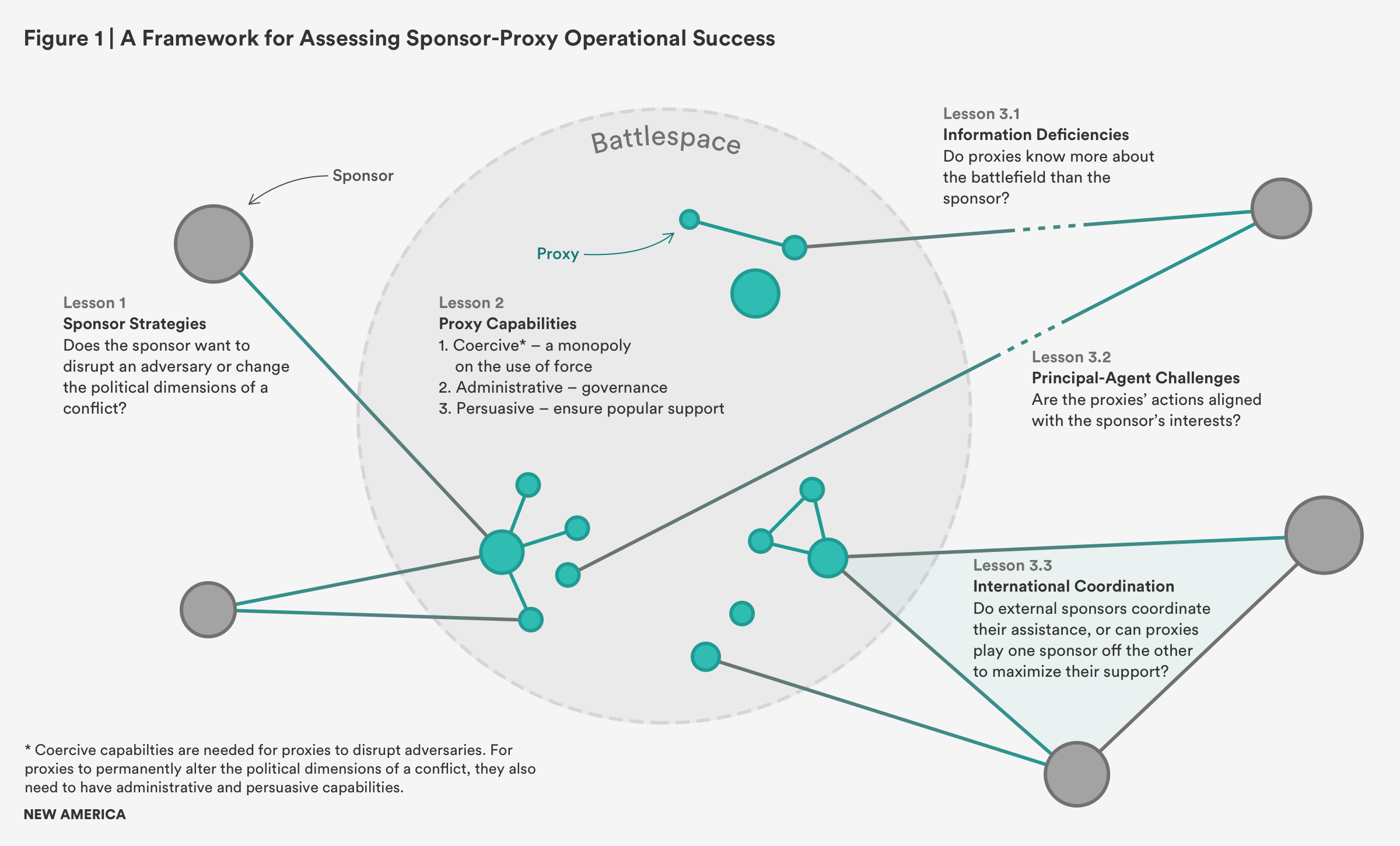
Lesson One is that a sponsor must assess its own strategy to determine the purpose for engaging with a proxy force. As we will show, the purpose of U.S. support to local governing councils in Syria shifted as the war progressed to such an extent that it was not clear what that support was intended to achieve. This was one of the reasons local councils failed to coordinate their activities, scale up, or become effective and resilient once they became targets of armed groups (shown in “Sponsor Strategies” in Figure 1 above).
Lesson Two is that a sponsor must assess the extent of its proxy’s capabilities. Can proxies achieve a monopoly over the use of violence in a given territory (coercive force)? Can they provide governance services and basic necessities (administrative capacity)? Can they persuade populations to support them (persuasive capability)? As we will show, coercive, administrative, and persuasive force are necessary for holding territory over an extended period of time against opposition. If sponsors engage proxies who lack administrative or persuasive capabilities, they should expect that these proxies will only be able to disrupt adversaries, not change the political or social dimensions of an ongoing conflict.
Lesson Three is that a sponsor must assess the extent to which it can mitigate three key factors in its relationship with a potential proxy: the problem of not knowing as much about the battlespace as potential proxies (“information deficiencies” in Lesson #3.1 above), the problem of controlling the proxy’s actions (“principal-agent challenges” in Lesson #3.2 above), and the problem of the sponsor having competing interests with other sponsors in the same conflict (“coordination challenges” in Lesson #3.3 above). The United States tried to develop proxy forces in Syria before the rise of IS, but failed to mitigate these three factors, and so its interests did not sufficiently align with the proxy to advance U.S. goals.
The following subsections will examine these lessons in the context of the U.S. support for Syrian rebels from 2011-2014, illustrating how the failure to heed them contributed to the failure of the proxy strategy.
Lesson One: Governing Without a Political Strategy
The U.S. efforts to back Syrian proxy groups from 2011-2014 failed to establish a clear political strategy. The United States most prominently funded Syrian local councils as a potential alternative for post-Assad governance. Aid to local councils was a critical component of U.S. proxy warfare efforts from 2011-2014, but this effort was plagued by a lack of U.S. strategy in the Syrian war. This lack of clear strategy also applied to the militant opposition. “The problem with American policy in Syria was in some ways the same as it always was: all tactics, no strategy,” explained a diplomat in the Middle East who described the U.S. political strategy for supporting insurgents as “a mess.”27The foreign money provided to support the local councils distorted their operations because, in the best of circumstances, they lacked the resources and vision to match the overarching strategy for how those councils would be used. This highlighted the critical first lesson of waging proxy warfare: the need for a sponsor to have a clear political strategy.
In October 2011, a Syrian activist named Omar Aziz published an essay online called “A Seminar for Establishing Local Councils.” The paper was circulated among anti-government activists and began a process of channeling local protest movements into organized municipal governance as another form of resistance.28 In January 2012, residents of Zabadani, a restive, strongly anti-government region in the mountains northeast of Damascus, were supposedly the first to form a local council. The concept expanded as other towns and city neighborhoods were “liberated” from Syrian government control by newly-active rebel forces.29
In 2012, while working at Caerus Associates, the authors studied 20 such local councils to better understand them.30 We conducted research in 12 of Syria’s 14 governorates in order to understand what local councils had in common despite differing demographics and conflict dynamics across the country.31 We found that, in areas where the Syrian government had disappeared, local councils acted like mini-governments, performing tasks such as cleaning streets, repairing municipal facilities, and keeping schools open. These councils were generally most active in medium-sized towns—small villages lacked the need for higher-order organization, and large cities were too complex for these ad hoc institutions to manage.32
The local councils that were most active were also far from the frontlines and were not based in strategic locations that would be of interest to armed groups, such as border crossings or highway interchanges.33 In addition to being in non-strategic locations away from battlefields, the councils that governed most visibly were based in places that were ethnically homogenous and lacked pre-conflict non-state governance. Ethnic minority areas, such as Kurdish regions in the northeast and Druze regions in the southern governorate of Suweida, had their own form of governance before the Syrian war broke out. These established parallel structures filled governance gaps during the war, but did not resemble the local council model.34
Local councils began receiving foreign funding in earnest in 2013.35 The purpose was to build a governing model for a “post-Assad Syria.”36But foreign sponsors failed to develop proxies capable of accomplishing the task, and as the war went into its third year and beyond, this strategy seemed increasingly at odds with reality.
Frances Brown, who conducted the most extensive evaluation of U.S. government support to local councils in Syria, concluded that U.S. government work with local councils lacked strategic coherence because it failed to adapt to the “political-military realities of the war.”37 Brown found that the initial logic of U.S. support to local councils matched Washington’s policy to plan for a post-Assad Syria. But, as early as 2013, as that possibility became more remote, “the objectives and assumptions of local political assistance in Syria diverged further and further from U.S. high-level policy decisions.”38
The lack of a viable strategy for U.S. support to local councils, combined with a rapid rise in foreign donor funds, meant that, in the words of one official, it was “like watching five-year-olds play soccer. No one played their position.”39 The programs were poorly implemented because, although the strategy might have looked good from Washington, its programs were unworkable once they reached Syria. By the time programs reached Syria, strategic guidance had “all bled into each other at the bottom. [Coordination] was still not working at the ground level.”40
The strategy of developing governing councils for a post-Assad Syria remained attractive in Washington, D.C. long after it had outlived its relevance in Syria. The net result was that the lack of a coherent political strategy undermined grassroots civilian-led local governance structures in Syria. In theory, local councils offered the persuasive and administrative capabilities that could help anti-Assad militants establish resilient, rather than merely brittle, control over territory they had captured. While there were capacity problems and myriad principal-agent problems, the United States worked with the councils through an uncoordinated bureaucracy that lacked strategic guidance. The result was that, after years of assistance, local councils did not develop governing capacity beyond the ideal circumstances where they existed far from the frontlines and locations of strategic importance.41
At first glance, it would seem strange to include foreign aid for governance as part of a paper on proxy warfare. But these local councils were part of a broader proxy war effort to install a more inclusive and technocratic government to replace that of Bashar al-Assad.42 Some local councils were nonpartisan service and aid delivery units,43 but their purpose was initially designed in Omar Aziz’s memo. Aziz’s mission, written two years before he died in a Syrian prison in 2013, was “the establishment of a network of…popular committees whose role was to protect the city and fill the vacuum on the day the security and the police would be forced to leave the city.”44 Thus, local councils were conceived of and supported as a revolutionary “parallel governance” project that provided the administrative and persuasive capabilities to complement the coercive military work of anti-Assad forces. However, when it became clear the Assad government would not simply fall, the United States never clarified what its political objective was in Syria’s war and what it was committed to do to pursue it.
Lesson Two: The Role of Persuasive and Coercive Capabilities in Aleppo
Beyond lacking a clear political strategic objective, the United States’ chosen proxies in Syria from 2011-2014 often lacked the capabilities to take and hold territory. Instead, other groups, notably the fundamentalist militias, successfully outcompeted the rebels backed by the United States. The experience of these fundamentalist groups also emphasizes the important role of persuasive and administrative capability in a competitive environment, as even their hold often proved brittle in the absence of such capabilities. The inability of U.S. proxies to compete effectively in the Syrian conflict due to a lack of capabilities contributed to policy failure.
From September 2013 to January 2014, a small group of researchers working with the authors traveled across Aleppo city.45 Although all were native Aleppans accustomed to the challenges of reporting in their city, they found this period especially challenging. Aleppo, Syria’s largest city, was the center of gravity for the war in Syria’s north. By the end of 2013, fighting was particularly intense: Syrian government forces ended a siege in the western third of the city, while IS fighters entered Eastern Aleppo by force. By January 2014, as pro-government districts were refortified, IS fighters were defeated by a coalition of anti-Assad forces.
As this was happening, the researchers carried out a panel survey over a four-month period of 561 residents across Aleppo’s 56 neighborhoods. They questioned residents from all parts of the city about their political attitudes, perceptions of safety, and daily experiences (e.g., the extent to which they traveled outside their neighborhood, the extent to which prices for commodities were affordable). In addition, researchers collected information about the location of military checkpoints (as an indicator for territorial control, enabling them to identify which insurgent or pro-regime group controlled which part of the city), and the location and operational status of bakeries (as a proxy for humanitarian conditions).
The researchers drew two conclusions about the relationship between power and allegiance in achieving territorial control during intrastate conflict. First, they found that political support for an armed group flowed from military strength. Armed groups did not control territory because people supported them; on the contrary, people began to support them when, and only when, they had established effective territorial control. Second, the researchers concluded that military force alone was not enough to sustain control over territory. In order to achieve resilient, rather than brittle control, armed groups need persuasive tools (i.e. methods of ensuring local legitimacy) along with administrative capacity (i.e., the ability to deliver governance and essential services) and not just coercive tools (i.e., the use of force to compel obedience).
In our Aleppo study, we found that fundamentalist insurgents received more support than members of the Syrian government or the political opposition. In total, 26 percent of respondents reported that “Islamic Brigades” (in effect, fundamentalist insurgents) were the “legitimate representative of the Syrian people.”46 This was the most popular choice after “No One” (39 percent), and a far more popular choice than either the official political Syrian opposition (1 percent) or the Syrian Government (12 percent).47
One reason why fundamentalist insurgents may have registered so much support from residents was not because Aleppans supported their ideology, but because they exerted a monopoly of violence in the neighborhoods they controlled, thereby enabling them to offer safety and predictability to populations in those areas. Before IS entered east Aleppo, neighborhoods such as Bustan al-Basha were protected by local militias. Although these militias were local to the neighborhood, residents felt unsafe with them precisely because they lacked a monopoly on violence: no single group was clearly in charge. Months later, residents in these same neighborhoods reported feeling safer and more supportive of fundamentalist insurgents than anyone else.48 These insurgents—in this case IS—were better trained and better equipped than the local militias in Bustan al-Basha, and more able to establish a monopoly of violence. Later, these neighborhood militias cooperated to force IS, a common enemy, to retreat from Aleppo. But this cooperation was short-lived, as an even more powerful adversary in the form of the Syrian Army defeated them two and a half years later.
The second conclusion from the Aleppo study is that, while military strength alone can achieve temporary control in the absence of opposition, such control is brittle—that is, it lacks resiliency in the face of an external or internal challenge. Insurgent groups need the full spectrum of coercive, administrative, and persuasive powers to achieve resilient control. IS’s rise to power in Aleppo was rapid but short-lived because it governed brutally and incompetently, establishing only brittle control that was quickly shattered when more militarily capable groups arrived to challenge IS.
While the extent of IS’s incompetence as governors would emerge later, this Aleppo study found early evidence of it. IS was the “strongest group” in 12 out of 56 neighborhoods in Aleppo by December 2013—more than any other armed actor not affiliated with the Syrian government. And while residents claimed that they supported IS in our surveys, the same respondents’ observable behaviors indicated that they feared IS instead.
For example, we took the average time for a vehicle or individual to pass an armed actor’s checkpoint as a remotely-observable indicator of local support, on the theory that checkpoints run by groups who had friendly relations with local populations would spend less time searching or interrogating those passing through. The more restrictive an actor’s checkpoints, the less local support that actor could count on—irrespective of statements by (potentially intimidated) respondents. During our Aleppo study, IS was by far the group with the highest proportion of restrictive checkpoints (41 percent).49 By contrast, Liwa al-Tawhid, a locally popular rebel group, had roughly the same number of checkpoints as IS but half as many restricted movements. Additionally, one-third of residents told us they avoided IS checkpoints entirely, 1.5 times higher than the average in Aleppo. As a result, IS needed a large military deployment to control the population in its territory, whereas the more locally-accepted Liwa al-Tawhid controlled almost as many neighborhoods but needed far fewer restrictive checkpoints (and a smaller number of armed actors) to control them.50
In Aleppo, we also found that IS imposed a logic of violence that residents at first found comforting due to its predictability. But IS only had coercive force, not persuasive or administrative capacity, making its control brittle. Residents supported IS because they feared it, and once a coalition of forces opposed to IS pushed it out, the population had no reason to continue to support the group.51Our first report in New America and ASU’s series on the future of proxy warfare found similar dynamics with regard to the rise of IS in Raqqa based on surveys conducted there.52
Lesson Three: Problems with Managing Proxies
The United States also faced difficulties managing its proxies in Syria, which posed problems even where efforts were made to improve their capabilities. U.S. assistance was often exploited because of the poor quality of the information on potential proxies. When the United States provided support, it frequently found its proxies pursuing ends or taking actions it opposed. To further complicate things, the United States struggled to coordinate other international actors, whose own efforts often disrupted or challenged American strategy. These management challenges also contributed to the policy’s failure.
Qutaiba Idlbi was an advisor to the Syrian opposition when he witnessed first-hand the chaos of sponsors trying to identify which Syrian rebel groups to support in the first few years of his country’s revolution. In 2012, he was in Syria with Okab Sakr, a Lebanese Shia Member of Parliament in charge of distributing Saudi money to Syrian rebels as a representative of Lebanese Prime Minister Saad Hariri.53 Qutaiba remembers the chaos of the meetings between Sakr and rebel commanders. These commanders would constantly inflate the size of their groups: the larger their group, the more funds they could receive. “It was, of course, all bullshit,” Qutaiba explained, but he did not have a way to question their figures.54 When he raised the point to Okab Sakr, Sakr justified the support given despite the lack of accountability: “‘We need to fill in the power gap that is happening in Idlib or else it will be filled by Ahrar [al-Sham] and [Jabhat al-] Nusra,’” Idlbi recalled him saying at the time.55
The fog of Syria’s early war gave many commanders the opportunity to raise tremendous amounts of money on the flimsiest of evidence that they actually commanded a rebel group. One of Idlbi’s most vivid memories was the first meeting between Sakr and Jamal Maarouf, organized for the ex-construction worker from Idlib to receive funds for his rebel group, the “Syrian Martyrs’ Brigade.”56 Maarouf “had a bunch of fighters from his smuggling network,” recalled Idlbi, but they had captured civilian registry centers near Maarouf’s hometown of Jebel Zawiya in northwestern Syria. In the meeting with Sakr, Maarouf presented a list of his fighters, which included 15,000 names and national ID numbers lifted from the civilian registry.57 Sakr promised Maarouf millions of dollars—according to one interview he promised $14 million—in that first meeting.58
With those start-up funds, Maarouf launched the “Syrian Martyrs’ Brigade,” which later became the “Syrian Revolutionaries Front,” a coalition of self-proclaimed moderates with over 20,000 fighters.59 Maarouf’s claims about the size of his force became self-justifying once the United States allegedly established the CIA-backed “Timber Sycamore” program, which tried to coordinate donations to Syrian insurgents from countries like Turkey, Qatar, Jordan, Saudi Arabia, Britain, and France.60 The early Saudi money helped Maarouf build an actual force that the United States would eventually support. The United States did eventually provide him with covert support, although its extent is disputed. None of that foreign money proved helpful enough to protect Maarouf from attack by Al Qaeda-linked militants in November 2014, after which he fled northwestern Syria for Turkey.61
Idlbi’s experience shows that finding proxies to support in Syria was messy and complex. This is the information deficiency challenge that all sponsors face when assessing a complex battlespace. As Idlbi experienced in his meetings with Maarouf, proxies are not carefully selected; rather, they are picked on the basis of extremely limited information. Although the complexities of selecting proxies are covered by the principal-agent problem (see below), we set information deficiencies aside as a separate problem for sponsors in the Syrian conflict. This is because the lack of knowledge by sponsors, including the United States, was so extreme as to not just cause problems inside one sponsor-proxy relationship; these deficiencies governed the sponsor’s entire reading of the conflict environment.62
Once a proxy like Maarouf was selected, principal-agent problems immediately emerged. Principal-agent relationships arise when one party delegates decisions and/or actions to a second party.63 Two problems have been identified in principal-agent situations: 1) “adverse selection,” in which principals lack accurate information about the motives or capabilities of proxies before working with them, and 2) “agency slack,” when the proxy takes actions that are not consistent with the preferences of the principal.
Myriad principal-agent problems arose in the early years of the Syrian war between foreign funders and their proxies inside Syria. The first and most important issue was the way in which foreign funding shifted the motivations of proxies away from their intended goals which were, at first, to protect protesters calling for Syrian president Bashar al-Assad’s ouster.64 These motivations changed once groups began receiving foreign funding.65 They “started to change the morals of the fighter,” explained Idlbi. After fighters started earning money to join a militia, Idlbi explained, “they started thinking ‘Why do I need to go and be killed if I am receiving a salary?’” Fewer fighters wanted to actually risk their lives in battle once it became apparent that they could receive a salary for joining a militia. “The Saudi funding had the unintentional effect of paying people to sit around,” Idlbi recalled.66 Foreign funding was intended to pay fighters to accomplish the goals they had initially set out to do, yet its consequences were to push rebel preferences further and further away from those of the sponsor. To make proxies fight harder, sponsors would have to pay more and more.67
Maarouf’s experience was uncommon—few insurgents got $14 million in start-up financing early on. Most needed to raise start-up cash in order to purchase weapons, usually through ad hoc Syrian donor networks (local and expatriate).68 Foreign funders paid for specific operations. Their support would facilitate buying the necessary weapons, ammunition, and troops to ‘liberate’ towns or cities, attack Syrian Army bases, defend critical supply routes, or break the siege of beleaguered neighborhoods of cities.69 Haid Haid, a Syrian activist and analyst of insurgent groups, describes how funding for these operations was “popular and had fewer strings attached—foreign donors wanted people to fight.” It was easier to raise money for operations, the results of which could clearly be seen on the battlespace, than for salaries that could easily be pocketed by commanders. As Haid explains, sponsors would “make a joint fund and give it to battalions who signed up…and is accepted by the leaders of the operation.”70
The opposition’s first offensive on Aleppo in July 2012 was one of the earliest high profile examples of a foreign-backed operation. Aleppo residents were among the least vocal in their opposition to Assad during the first year of the revolution, so revolutionaries wanted to bring the fight to Syria’s largest city. Reuters’ Erika Solomon documented the spirit of the attack on Aleppo in an interview with one of its commanders: “We liberated the rural parts of this province,” he explained. “We waited and waited for Aleppo to rise, and it didn’t. We couldn’t rely on them to do it for themselves so we had to bring the revolution to them.”71 But a Syrian activist with knowledge of the offensive, explained the darker side of rebel motives for attacking Aleppo: “They [rebels] wanted to attack Aleppo,” he said, because “the price was $15 million dollars. It devastated the city…they [rebel commanders] didn’t feel responsibility [to make a careful military plan]. They didn’t care. They just took the money.”72
The third problem, the international coordination problem, was clearly on display in the summer of 2013 when the CIA allegedly established “Timber Sycamore.” This program attempted to coordinate donations to Syrian insurgents from countries like Turkey, Qatar, Jordan, Saudi Arabia, Britain, and France.73 The CIA-backed “Operations Room,” (also known by its Turkish acronym, MOM— Müşterek Operasyon Merkezi—or “Joint Operations Center”) was a clearinghouse for insurgent funding in southern Turkey.74 The Operations Room allegedly tried to fill the gaps in foreign funding to proxies in Syria’s war by helping commanders pay their fighters a salary ($150 for a fighter, $300 for a commander) so that they did not have to carry out offensives willy-nilly to sustain their war effort.75 Funding from the Operations Room would usually include a monthly payment of salaries to fighters in approved rebel groups.
The Operations Room was dysfunctional. Ironically, it rarely supported operations. Instead, it would purchase weapons for an operation and give them directly to fighters, rather than pay them to buy the weapons themselves. Payments in cash, which was easy to steal, were only made in hard-to-reach areas (e.g., Ghouta, a besieged neighborhood in the Damascus suburbs). Proposals for attacking minority areas were strictly prohibited. These guidelines were to ensure that proxy forces did not commit human rights atrocities and that the commanders of these groups were not stealing from their troops. But because so many sponsor countries were in the Operations Room, proposals that were rejected inside the room might just as easily be approved in the back room. After a rebel group’s proposal was rejected by the Operations Room, “people [representing countries in the region] would go outside the room and give them ‘x’ amount of money and say ‘see what you can do,’” explained Idlbi.76
In the end, the U.S. effort to develop proxies in the early years of Syria’s war faced three simultaneous management problems:
- An Information Deficiency Problem, in which distant sponsors lack sufficient knowledge of the proxy’s operating environment to effectively assist or control them.
- A Principal-Agent Problem, in which proxies have different goals from sponsors or act in ways that undermine sponsor interests.
- An International Coordination Problem, in which multiple sponsors struggle to coordinate their sponsorship efforts, allowing proxies to “forum-shop” to maximize access to sponsor resources while minimizing loss of their own autonomy.
First, American policymakers had an information deficiency problem. It was nearly impossible to fact check claims by insurgent commanders like Jamal Maarouf, and certainly impossible to tell whether partnering with any of these forces would advance U.S. strategic interests in Syria. Second, the United States faced principal-agent problems in managing fighters on the ground, such as preventing commanders from stealing funds from their troops or selling equipment to adversaries they were supposed to be fighting.77 Third, donors faced coordination problems: countries in the region pursued divergent policies, aligned with their differing interests, despite being on the same “side” of the conflict. For proxies, this meant that if one donor wouldn’t support a project, commanders could simply approach another.
The three problems explained in this section plagued U.S. policy in Syria from 2011-2014 to such an extent as to undermine any political strategy, no matter how clearly defined. On their own, proxies faced barriers to success (i.e., capability and resources) as did their sponsors (i.e., lack of practical political strategy, limited in-country access). But without being able to monitor the behavior of proxies, without understanding proxies’ capacity or the context of the battlespace in which those proxies fought, and without proper coordination among sponsors, the U.S. effort was bound to fail.
Evaluating Proxy Warfare Efforts: Crafting Policy and Assessments Informed by the Three Lessons
The three lessons described above, 1) the need for a clear political strategy, 2) the need to assess proxy capabilities, and 3) the need to mitigate the problems associated with managing proxies, not only illustrate the failure in Syria from 2011-2014 but also offer a policy framework to guide future engagements with proxies and assess the effectiveness of other sponsors’ strategies.
- The first step is to assess the sponsor’s level of strategic ambition: is this conflict a high or low priority? We can define priority in this case as being whether or not the sponsor wants to change the social and political dimensions of a conflict (high priority) or merely to disrupt an adversary (low priority).78 If a conflict is high priority, then the sponsor is actively trying to change the political order (e.g., to support rebels in overthrowing the government). In the case of Syria from 2011-2014, the United States treated Syria as a high priority conflict rhetorically, but never resourced proxies on the ground adequately. If the conflict is low priority, then the sponsor is trying to eliminate specific threats (e.g., a leader or a cell planning an attack). Low priority conflicts are mainly ones where the sponsor intends to disrupt an adversary or target the network’s activities.
- The second step is to align strategy with the capability of the proxy force. We can define capabilities in this case using the theory of competitive control: a proxy with narrow-spectrum capabilities only has coercive tools to control populations. Proxies with broad-spectrum capabilities have not only coercive, but also administrative and persuasive tools. If a sponsor’s strategy is to disrupt an adversary, then the proxy does not need to be able to control territory or administer populations over an extended period of time. In that case, a sponsor only needs to select a proxy with coercive capabilities. If a sponsor’s strategy involves shifting the social and political dimensions of a conflict, then the sponsor needs a proxy with the ability to control territory over an extended period of time, against opposition (i.e., that proxy needs coercive, administrative, and persuasive capabilities sufficient to establish a full-spectrum “system of competitive control” in areas it controls).79
- The third step is that the sponsor needs to deploy strategies to mitigate the three challenges (noted above) associated with managing a proxy. Those mitigation strategies will depend on the sponsor’s strategy and its expectations of the proxy’s capabilities: If a sponsor needs a proxy to control territory or govern a population, then that sponsor needs to be able to monitor the battlespace and the forces it is supporting. That normally implies the need to deploy forces to the front line as partners.80 If the sponsor only needs to disrupt an adversary or counter terrorist group activity, it can supply support remotely to the proxy (i.e., either covertly or through established channels). If it has more expansive strategic goals or needs to control the proxy carefully, the sponsor must limit the principal-agent problem by being closer to the battlespace. If the conflict is internationalized, the sponsor must find common ground with international partners, or risk losing control over proxies who can otherwise “shop around” for sponsors.
Prior to the counter-IS campaign, U.S. strategy in Syria from 2011-2014 failed because it did not design the campaign in a way that provided policy responses and mitigation strategies for the issues described above. The United States never clearly defined its mission, vacillating between high and low priority goals while failing to align the capabilities of its chosen proxies with those goals. At one point, U.S. strategy asserted that “Assad must go,” but did not develop or resource a plan to assist anyone capable of accomplishing the task.81 Alternatively, a second strategy floated during this time was not to get rid of Assad, but to “cauterize” Syria by preventing the conflict from spilling over into other countries.82 A third strategy from 2011-2014 appeared to be supporting the rebels with enough resources not to defeat Assad but to pressure him into negotiating his demise.83 Neither of these latter two strategies were realistic in theory or in practice—consider as evidence the Syrian refugees who destabilized Europe and the unwillingness of Assad to negotiate, whatever the balance of power in the Syrian war. Moreover, the fact that all these strategies coexisted in the first place is further evidence of the inability to develop a clear plan for what the United States ought to do in Syria.
Inadequate strategy was not the only problem with U.S. involvement in the Syrian war between 2011 and 2014. There were also no proxies capable of accomplishing the tasks set out for them (i.e., control and govern territory), and no plan to manage the relationship or hold international partners accountable for pursuing their own strategies in the Syrian battlespace.
However, as will be seen in the next two case studies, when states take actions in line with the policy framework presented above, they can improve their chances for success. The framework also can help identify where likely points of failure for sponsor proxy strategies lie.
Updated at 10:30 a.m. on April 7, 2020: This report has been changed to conceal the identity of an individual who participated in this report.
Citations
- Erika Solomon, “The Rise and Fall of a US-Backed Rebel Commander in Syria,” Financial Times, February 9, 2017, https://www.ft.com/content/791ad3bc-ecfc-11e6-930f-061b01e23655
- Ghias Aljundi, “Local Governance Inside Syria: Challenges, Opportunities and Recommendations” (Institute for War & Peace Studies, 2014), https://iwpr.net/sites/default/files/download/publication/iwpr_syria_local_councils_report_web.pdf
- Aljundi.
- The authors worked at Caerus Associates, a research and design firm, which conducted field research in Syria from 2012 to 2015, collecting data on economic conditions, population attitudes, and local atmospherics, as well as information gathered through interviews and social media archives.
- Syria’s largest subnational administrative regions are called “governorates.” Governorates are the equivalent of states in the United States. The excluded governorates in our Caerus study were Quneitra, on the border with Israel, and the city of Damascus, which is a separate governorate from the city’s more pro-opposition suburbs. For more information on the methods of research we conducted at Caerus Associates, please refer to Nate Rosenblatt and David Kilcullen, “How Raqqa Became the Capital of ISIS: A Proxy Warfare Case Study” (New America, July 25, 2019), https://www.newamerica.org/international-security/reports/how-raqqa-became-capital-isis/
- Caerus reporting, November 2012-January 2013.
- The local council of Saraqeb was a notable exception to this finding. Saraqeb is situated at the intersection of two of northern Syria’s largest highways. Yet residents continued to govern themselves despite the presence of many armed groups. For how they did this, see: Anand Gopal, “Syria’s Last Bastion of Freedom,” The New Yorker, December 3, 2018, https://www.newyorker.com/magazine/2018/12/10/syrias-last-bastion-of-freedom
- These regions were governed by pre-existing municipal structures who were not as clearly organized as an ad hoc municipal government in opposition. In minority Kurdish and Druze communities, the municipal governments made more deliberate accommodations with the Syrian regime. See, for example, this dispatch from 2012: Phil Sands, “Syria’s Druze Community: A Silent Minority in No Rush to Take Sides,” The National, February 22, 2012, https://www.thenational.ae/world/mena/syria-s-druze-community-a-silent-minority-in-no-rush-to-take-sides-1.364426
- The Etilaf was formed in November 2012, with representatives for each of the provinces that began the institutionalization of “Local Councils.” This institutionalization continued in December 2012 with the creation of the “Assistance Coordination Unit,” which would channel the aid to local groups. The Local Administrative Council Units were formed in March 2013. One year later, there was a General Directorate for Local Councils that opened a ministry for local administrative units—mainly to manage Local Councils and Provincial Councils.
- “U.S. Government Assistance to Syria.” U.S. Department of State, May 9, 2013, https://2009-2017.state.gov/r/pa/prs/ps/2013/05/209197.htm
- Frances Z. Brown, “Dilemmas of Stabilization Assistance: The Case of Syria” (Carnegie Endowment for International Peace, October 2018), 1, https://carnegieendowment.org/files/WP_Brown_Syria_formatted_Corrected_Footers_FINAL_WEB_10252018.pdf
- Brown, 1.
- Brown, 35.
- Brown, 35.
- This lesson focuses on the importance of a political strategy, but the authors do not assume that Syria’s local councils would have been successful if they were supported by a clear strategy. Many other factors determined the lack of success for local councils, including shifts in the conflict environment that were outside the councils’ abilities to shape or control.
- Brown, “Dilemmas of Stabilization Assistance: The Case of Syria.”
- Daniel Moritz-Rabson, “In Wartime Syria, Local Councils and Civil Institutions Fill a Gap,” PBS Newshour, July 31, 2016, https://www.pbs.org/newshour/world/civil-society-emerges-syria-war
- “To Live in Revolutionary Time: Building Local Councils in Syria” (It’s Going Down, May 19, 2017), https://itsgoingdown.org/live-revolutionary-time-building-local-councils-syria/
- This section draws upon the authors’ previous research in “Mapping the Conflict in Aleppo, Syria” (Caerus Associates, February 2014), http://caerusassociates.com/wp-content/uploads/2014/02/Caerus_AleppoMappingProject_FinalReport_02-18-14.pdf
- Out of safety concerns, we used the term “Islamic Brigades,” as a proxy for all fundamentalist insurgents. The way we did this was to contrast “Islamic Brigades” with “local militias.” This helped respondents choose from fighters who were either from Aleppo (nearly all militias), or those who were not (mainly IS, since they were the brigade taking over territory in Aleppo city at the time).
- The surveys were conducted by referral sampling of 560 residents who resided in all 56 neighborhoods in Aleppo. These residents were surveyed once a month for four months. For more on the sampling methodology, please see the authors’ previous research in “Mapping the Conflict in Aleppo, Syria” (Caerus Associates, February 2014), http://caerusassociates.com/wp-content/uploads/2014/02/Caerus_AleppoMappingProject_FinalReport_02-18-14.pdf
- Safety was determined by asking subjective questions like “how safe is your neighborhood?” We also asked more objective questions, such as “How often do you let your children out of the home?” or “About how many times do you travel outside of your neighborhood each week?” and “How frequent are crimes such as stealing or kidnapping in your neighborhood?”
- Restrictive checkpoints were quantified by counting the proportion of residents being stopped as they passed the checkpoint. The most restrictive checkpoints are defined as being places where over half of residents are stopped as they pass through the checkpoint.
- Liwa al-Tawhid’s local legitimacy flowed from its leader, Abdul Qadr al-Saleh, who was from a village north of Aleppo.
- The theory that underpins this set of behaviors, which we designate the “theory of competitive control”, is described in detail in David Kilcullen, Out of the Mountains: The Coming Age of the Urban Guerrilla (New York: Oxford University Press, 2013,)132–14, 157–64.
- Rosenblatt and Kilcullen, “How Raqqa Became the Capital of ISIS: A Proxy Warfare Case Study.”
- Rania Abouzeid, No Turning Back: Life, Loss, and Hope in Wartime Syria (New York: W. W. Norton & Company, 2018), 107.
- Author’s interview with Qutaiba Idlbi, May 23, 2019.
- Author’s interview with Qutaiba Idlbi, May 23, 2019.
- The first name for the group was the “Jebel Zawiya Martyrs Brigade,” which was so named when it was a small group based in a mountainous region in Idlib. As Maarouf received more funding in 2012, he renamed the group the “Syrian Martyrs Brigade.” See: Cody Roche, “Syrian Opposition Factions in the Syrian Civil War,” Bellingcat, August 13, 2016, https://www.bellingcat.com/news/mena/2016/08/13/syrian-opposition-factions-in-the-syrian-civil-war/
- Author’s interview with Qutaiba Idlbi, May 23, 2019.
- Author’s interview with Qutaiba Idlbi, May 23, 2019; Author’s interview with Zaina Erhaim, January 3, 2020; Rania Abouzeid, “Syria’s Secular and Islamist Rebels: Who Are the Saudis and the Qataris Arming?,” Time, September 18, 2012, http://world.time.com/2012/09/18/syrias-secular-and-islamist-rebels-who-are-the-saudis-and-the-qataris-arming/
- Liz Sly, “The Rise and Ugly Fall of a Moderate Syrian Rebel Offers Lessons for the West,” Washington Post, January 5, 2015, https://www.washingtonpost.com/world/middle_east/the-rise-and-ugly-fall-of-a-moderate-syrian-rebel-offers-lessons-for-the-west/2015/01/04/3889db38-80da-4974-b1ef-1886f4183624_story.html
- Tom Bowman, “CIA Is Quietly Ramping Up Aid To Syrian Rebels, Sources Say,” NPR, April 23, 2014, https://www.npr.org/sections/parallels/2014/04/23/306233248/cia-is-quietly-ramping-up-aid-to-syrian-rebels-sources-say; Mark Mazzetti and Matt Apuzzo, “U.S. Relies Heavily on Saudi Money to Support Syrian Rebels,” New York Times, January 23, 2016, https://www.nytimes.com/2016/01/24/world/middleeast/us-relies-heavily-on-saudi-money-to-support-syrian-rebels.html
- Liz Sly, “U.S.-Backed Syria Rebels Routed by Fighters Linked to Al-Qaeda,” Washington Post, November 2, 2014, https://www.washingtonpost.com/world/us-backed-syria-rebels-routed-by-fighters-linked-to-al-qaeda/2014/11/02/7a8b1351-8fb7-4f7e-a477-66ec0a0aaf34_story.html
- The information deficiency problem is often covered as a separate issue within the broader principal-agent problem in the “adverse selection effect,” which describes when patrons “do not have adequate information about the competence or reliability of agents” before establishing a relationship with them. Idean Salehyan, “The Delegation of War to Rebel Organizations,” Journal of Conflict Resolution 54, no. 3 (2010): 495, https://www.jstor.org/stable/pdf/27820997.pdf?refreqid=excelsior%3Aacad61e647f197824920884cf004ee48. However, our reading of the adverse selection effect is that it is not adequately expressed inside a principal-agent relationship. Framing the problem as within the principal-agent relationship seems to work backward in describing why patron-proxy relationships failed, but is not a strong enough framework to explain why a given patron selected that proxy as opposed to others, or how the patron's reading of the battlefield shaped its interest in finding proxies to begin with.
- Robert W. Rauchhaus, “Principal-Agent Problems in Humanitarian Intervention: Moral Hazards, Adverse Selection, and the Commitment Dilemma,” International Studies Quarterly 53, no. 4 (December 2009): 871–84, https://doi.org/10.1111/j.1468-2478.2009.00560.x
- One account of the formation of armed groups at the beginning of Syria’s revolution describes them as “certainly not anyone’s first choice, nor…the application of a ready-made ideology of militant action. Rather, the military component emerged primarily as a by-product of the regime’s militarized confrontations with the popular protests from the outset. As this reaction grew, it gradually began to draw justification from ideologies already available to Syrians, including the idea of ‘jihad.’ But the strongest and most legitimate justifications have always been self-defence and the protection of civilians from regime brutality.” Yassin Al-Haj Saleh, Impossible Revolution. (Haymarket Books, 2017, 78). One early and prominent insurgent group who started as protectors of Syrian protestors was the Farouq Group. Abouzeid, No Turning Back, 37, 74.
- We define foreign funding as structured assistance channeled by foreign governments or non-governmental organized groups (i.e., charity groups, expatriate donor networks).
- Author’s interview with Qutaiba Idlbi, May 23, 2019.
- These payments highlighted the differences between opportunistic rebel groups, in which new members join for payoffs, and activist rebel groups, in which members are bound by solidarity around an in-group. At first, rebel groups like Maarouf’s were activist, but they changed to an opportunistic group once they received foreign funding. This made them less resilient over the long run than fundamentalist groups (i.e., Al Qaeda-affiliated insurgents), who we would categorize as “activist.” The paper does not delve into these distinctions, as it is not the focus, but acknowledges this dimension of analysis is useful in understanding the reasons some insurgents survived in Syria’s war and some did not. For these distinctions and examples in other conflicts, see Jeremy M. Weinstein, Inside Rebellion: The Politics of Insurgent Violence, Cambridge Studies in Comparative Politics (Cambridge; New York: Cambridge University Press, 2007).
- Author’s interview with an active U.S. Syrian expatriate fundraiser.
- Author’s interview with Haid Haid, May 21, 2019.
- Author’s interview with Haid Haid, May 21, 2019.
- Erika Solomon, “Rural Fighters Pour into Syria’s Aleppo for Battle,” Reuters, July 29, 2012, https://www.reuters.com/article/us-syria-crisis-aleppo-idUSBRE86S06T20120729
- Author’s interview with Anonymous, Spring, 2019. The details of another foreign-backed offensive in Syria (this one in Damascus in 2013) were leaked by Edward Snowden. They are described by Murtaza Hussein, “NSA Document Says Saudi Prince Directly Ordered Coordinated Attack by Syrian Rebels on Damascus,” The Intercept, October 24, 2017, https://theintercept.com/2017/10/24/syria-rebels-nsa-saudi-prince-assad/
- Bowman, “CIA Is Quietly Ramping Up Aid To Syrian Rebels, Sources Say”; Mark Mazzetti and Matt Apuzzo, “U.S. Relies Heavily on Saudi Money to Support Syrian Rebels.”
- Erika Solomon, “The Rise and Fall of a US-Backed Rebel Commander in Syria.”
- “The Rise and Fall of a US-Backed Rebel Commander in Syria.”
- Author’s interview with Qutaiba Idlbi, May 23, 2019.
- Jamie Dettmer, “Western, Gulf Weapons Supplied to Syria Rebels Leaked to Islamic State,” Voice of America, December 13, 2017, https://www.voanews.com/middle-east/western-gulf-weapons-supplied-syria-rebels-leaked-islamic-state
- This paper takes as a starting point that if the conflict in question was truly important, the patron would use its own forces to prosecute it directly. Therefore, the “High Priority” and “Low Priority” designations are not relative to all security priorities, but rather to security priorities that the sponsor is willing to delegate to a foreign force.
- Kilcullen, Out of the Mountains, 150, 167.
- This is in keeping with the strategy of “by, with, and through” described by Katz, “Imperfect Proxies: The Pros and Perils of Partnering with Non-State Actors for CT.”
- Fred Hof, Ambassador in 2012 for the Syria transition, explained the interagency confusion with the U.S. mission in Syria: “’Our view in the State Department was, fine, if this is the judgment the president comes to, that Assad should step aside, then what we should really have in place is an interagency strategy to make it happen.’ Hof regretted that the White House did not develop that strategy, on the assumption that ‘this guy [Assad] is toast.’” Source: Charles Glass, “Tell Me How This Ends: America’s muddled involvement with Syria,” Harpers, February 2019, https://harpers.org/archive/2019/02/american-involvement-in-syria/
- Andrew J. Tabler, Jeffrey White, and Simon Henderson, “Field Reports on the Syrian Opposition,” Washington Institute, March 12, 2013, https://www.washingtoninstitute.org/policy-analysis/view/field-reports-on-syria-and-the-opposition
- Aron Lund, “How Assad’s Enemies Gave Up on the Syrian Opposition,” The Century Foundation, October 17, 2017, https://tcf.org/content/report/assads-enemies-gave-syrian-opposition/
Part Two. Case Studies in Proxy Warfare
Comparative Case Study #1: The Counter-IS Coalition, 2015-2019
Although the rise of IS brought new horrors to Syria’s war, it also gave the U.S. government greater strategic clarity insofar as an obvious enemy had emerged that the United States could confront. American objectives changed in Syria to face this threat. By 2014, for all intents and purposes, the United States ended its support to opposition groups whose intention was to oust Assad in favor of supporting groups who would fight IS instead.84 This gave rise to a more clearly defined strategy for defeating IS. This shift in approach allows us to compare U.S. efforts to develop proxies in Syria’s war before the rise of IS (from 2011-2014) and after (from 2015-2019). These were, in effect, two separate conflicts within the same war.
This comparison suggests that the United States substantially improved its overall proxy strategy during the counter-IS effort, setting a relatively clear objective of destroying IS, choosing and developing a proxy capable of achieving that objective, developing its capabilities where they proved insufficient, and structuring the relationship in such a way to mitigate management problems (specifically by deploying forces to the battlespace). The U.S. efforts and their success are summarized and assessed in Table 1 and described more fully in this section.
However, the counter-IS coalition continued to wrestle with the broader questions of strategic alignment, most notably with regards to whether the campaign was a high or low priority for the United States. As a low-priority counterterrorism campaign, the effort was successful in destroying IS’s territorial holdings, but that ended up reopening unresolved debates over whether such disruption sustainably and sufficiently addressed American objectives or whether a high priority objective of changing the conditions of governance in the Syrian conflict was necessary.
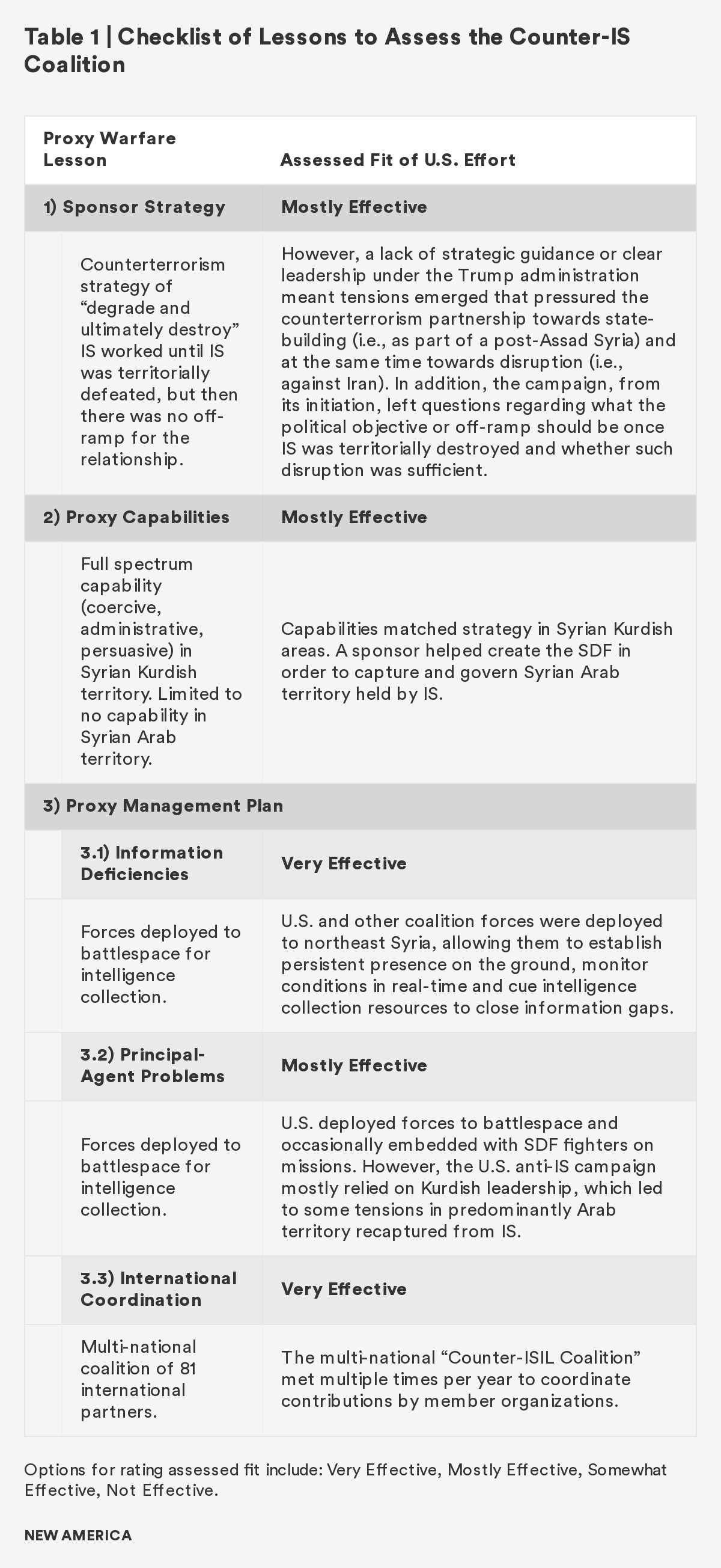
Sponsor Strategy
When the United States announced on September 10, 2014 that it had formed a multi-national coalition to defeat IS, it was not clear how large that coalition would grow or what ground forces would be involved. That coalition would eventually grow to 80 members, who supplied airstrikes, a deployment of 2,000 ground troops in Syria (mostly American Special Operations Forces), and intelligence and logistical support.85 The coalition succeeded beyond most expectations, but in 2017 faced a new administration with unpredictable foreign policy instincts. Thus, when that coalition reclaimed IS’s self-declared caliphate, it was undermined by shifting conceptions about the purpose of a partnership with the SDF, which had until 2019 been an effective model of U.S. proxy warfare. In the end, the U.S.-SDF partnership failed for a number of reasons, not least of which was a lack of strategic clarity on how to conclude that partnership.
President Barack Obama’s September 10th announcement clearly stated the U.S. strategic objective: to “degrade, and ultimately destroy, [IS] through a comprehensive and sustained counterterrorism strategy.”86 Importantly, the strategy did not seek to militarily resolve the broader Syrian conflict but only to destroy IS. IS controlled territory that spanned the Iraqi and Syrian borders and included 12 million people in a territory the size of Great Britain.87 To fight IS on the Iraq side of the border, the United States would work with Iraqi government forces, and predominantly Shi’a (and Iranian-backed) Popular Mobilization Forces, to rid the country of IS. U.S. forces would establish “National Guard Units,” composed of Sunni Arab locals in towns recaptured from IS to police and secure their neighborhoods.88
In Syria, implementing a “clear-hold-build” counterinsurgency strategy of this kind was more complicated because U.S. forces lacked a partner. Eventually, through connections from Iraqi Kurds, the United States began to partner with the Syrian Kurdish forces known as People’s Protection Units (Yekîneyên Parastina Gel, YPG) and Women’s Protection Units (Yekîneyên Parastina Jin, YPJ). Cooperation began with a joint defense of Kobane, a Syrian Kurdish village on the Turkish border, from September 2014 until February 2015. Surrounded by IS fighters and blocked by Turkish troops preventing them from crossing into Turkey, Kurdish forces withstood a brutal IS assault as U.S. forces started to support the defense with airstrikes. This support led to “the first major battlefield defeat inflicted on Islamic State,” and “provided the template” for U.S. cooperation with the Kurdish forces that would eventually form the nucleus of the SDF, as described by Syria expert Aron Lund.89
To “degrade, and ultimately destroy” IS was the strategy that drove coalition efforts for over four years. Inherent in the mission was not only to undermine IS but also to control territory captured from the group, and administer the population so as to prevent a resurgence or return of IS. This set of aims governed the U.S. strategy in Syria until President Trump announced via Twitter that IS had been defeated in December 2018.90 IS still controlled a small redoubt in eastern Syria at that time, but after a brutal six-week offensive in February and March 2019, it was fully recaptured.91
President Trump’s announcement of IS’s defeat, though premature, raised the long-postponed question: what would U.S. strategy now be toward its SDF proxy in Syria? As it turned out, absent clear leadership, U.S. strategy oscillated between two fundamentally incompatible approaches: a calibrated withdrawal, advocated by then-Special Presidential Envoy for the Global Coalition to Counter ISIL Brett McGurk, and an indefinite endgame in which the strategy would shift from countering IS to containing Iran, advocated by National Security Advisor John Bolton and Ambassador James Jeffrey, the head of State Department Syria policy by August 2018.92
These oscillating political strategies—neither of which took account of President Trump’s frequently and fervently expressed intention to withdraw from Syria as soon as IS was defeated—ultimately doomed the U.S.-SDF partnership. In December 2018, in the face of a withdrawal announcement by the president, McGurk urged the SDF to negotiate with the Syrian government while it still had leverage to secure a permanent political arrangement providing self-governing status.93 But by January 2019 he had resigned, and his responsibilities were given to Jeffrey. Jeffrey, according to sources in the SDF and at the State Department, supported Bolton’s position, which was to use the SDF to counter Iranian influence in the region.94Jeffrey convinced the SDF not to negotiate a political settlement with the Syrian regime because the United States had longer-term plans to work with the SDF to counter Iranian influence.95 But, as one special forces officer told one of the authors at the time, President Trump’s mercurial nature, and the fact that neither strategy had been cleared with the president in advance, meant that “this whole operation [is] under the tweet of Damocles.”96
Jeffrey managed the U.S.-SDF relationship for all of 2019.97 The SDF went to Damascus in May 2019 and failed to secure an agreement, likely because both parties felt they were in a strong position and did not feel the need to bargain anything away. The U.S.-SDF partnership endured through several U.S.-Turkey agreements that forced the SDF to dismantle its defenses and give up heavy weapons.98
SDF commander Mazloum Kobani described the experience as a betrayal: “We are now standing with our chests bare to face the Turkish knives,” he wrote in Foreign Policy.99 In a letter circulated to coalition commanders on October 7, Mazloum’s chief of staff wrote that “just yesterday, the people of north and east Syria greet you as saviors and torch bearers of freedom. Children gather each time they see you and express joy at the hope you bring to the future of our lands. These same children of Syria now may be dead at any moment.”100 Within 48 hours, on October 9, 2019, TSK armored columns—led by Turkish-backed proxies—crossed the frontier and began pushing SDF forces back.101
As of this writing, the future of the U.S.-SDF relationship is unclear. However, it is unlikely that SDF leaders will continue to work with the United States as before. There is “a pretty big chance” that the SDF gets folded into the Syrian government’s army, according to Ilham Ahmed, one of the SDF’s political leaders.102 The fallout from U.S. actions in northeastern Syria in the fall of 2019 could be enormous, particularly if the Syrian government absorbs the SDF into its own forces. Should it do so, U.S. adversaries such as Iran and Russia could learn U.S. special forces’ actics, techniques, and procedures (TTPs) from SDF forces who had worked with U.S. forces in the counter-IS effort.103
The main blunder was not in the way the United States government used the SDF to advance its goals in Syria, but in the lack of a consistent political strategy for the U.S.-SDF relationship after counter-IS operations concluded. While the shifting strategies among advisors in the Obama and Trump administration are more easily understood in Washington D.C., they are far more inscrutable to U.S. allies in the region. Washington’s failure to develop an off-ramp to its relationship with the SDF limited its success.
Proxy Capabilities
The counter-IS coalition relied heavily on the efforts of 50-70,000 in-country proxy force partners under the SDF.104 The United States matched its political goals to recapture and hold territory with a proxy that, at its core, was not only an effective fighting force but had the ability to govern territory, administer populations, and provide basic necessities. This made the U.S. political goals of retaking and controlling IS territory possible.
The SDF was the most capable U.S. partner in the Syrian War because it was a coherent force before the conflict began. In the early years of the Syrian war, this group, the Kurdish YPG/YPJ, was focused on controlling its own territory and protecting Kurdish civilians. As the United States began to work with the YPG/YPJ in the fall of 2014, two key problems emerged. First, the group’s coercive capabilities were closely affiliated with the Partiya Karkerên Kurdistanê (PKK), a designated terrorist group based in Turkey.105 Even if American commanders could legally work with this entity, they would face pressure from Turkish partners to stop enhancing the military capabilities of a terrorist organization that Ankara considered as great a threat as IS.106 This problem provided a warning about the potential for an eventual misalignment of capabilities and objectives in that the United States, while pursuing a low-priority goal of disrupting IS, was increasing the capabilities of a force in ways that at least some regional actors feared would shift the conflict fundamentally (in effect a high-priority result).
The dilemma was resolved legally but not in terms of the U.S.-Turkish relationship. The United States hoped to rehabilitate the YPG/YPJ by changing it from a terrorist group linked to the PKK into an entirely new force. General Raymond Thomas, former commander of U.S. Special Operations Command, said he insisted the YPG change their “brand.” “What do you want to call yourself besides the YPG?” Thomas asked, “With about a day’s notice, they declared that they were the Syrian Democratic Forces.”107 This rebrand helped U.S. forces skirt the legal ramifications of supporting a group whose leaders were closely aligned with the PKK, a U.S.-designated terrorist organization. But the problem was never truly resolved with Turkey, resulting in tensions between the counter-IS coalition and its SDF partners on the one hand, and Turkey’s leadership on the other.
The second problem was ensuring the SDF had the persuasive and administrative capability to control not just Kurdish territory but also Arab-majority areas recaptured from IS. The YPG/YPJ was a Kurdish force, yet the territory the United States wanted to capture from IS was predominantly Arab. To govern this territory without inciting an ethnic war between Arabs and Kurds in eastern Syria, the United States would need to add an Arab force to its Kurdish partners.
To resolve this second issue, U.S. forces embarked on a project to continuously add new Syrian Arab forces to the SDF so that it appeared to be (and would eventually become) a strong coalition of Kurds and Arabs intent on fighting IS and retaking its territory. As Aron Lund explained in December 2015, U.S. forces would use the SDF to “gradually glue more Arab groups onto a Kurdish core force.”108 The United States would not just remotely support this proxy, as in the past, but actively seek to shape its capabilities to deal with the strategic task it was expected to accomplish.
The United States built the governing capability in the SDF through Syrian Arab partners introduced by recommendations from the YPG/YPJ. The SDF “essentially introduced us to some Syrian Arabs whom we thought we might similarly help to fight,” explained then-Secretary of Defense Ash Carter, “and this was a mission to explore that possibility and get to know these people.”109 Over time, the balance of Kurdish and Arab forces started to equalize: many Arabs were frustrated that decision-making ultimately rested with Syrian Kurds,110 but still signed up in order to recapture their homelands while being protected by U.S. air power and special operations forces.111
When the SDF formed in October 2015, it consisted mainly of Syrian Kurdish YPG/YPJ units with some smaller units of Syrian Arabs that had supported the YPG/YPJ before the revolution, including a Syriac Christian militia.112 By 2016, 15-30 percent of the SDF were Syrian Arabs,113 a number that rose to roughly 50 percent in 2017,114 and then to over half according to a 2019 study.115 These increases in the proportion of Arab fighters were critical in ensuring that, when SDF recaptured territory in predominantly Arab regions, it had the necessary persuasive and administrative capacity to control that territory for an extended period of time.
Within a short time, given extensive U.S. support and its preexisting persuasive and coercive capabilities, the SDF transformed into a proxy that had a full spectrum of capabilities needed to help defeat IS in Syria and control the territory it captured afterward.
Managing the Relationship
The U.S.-SDF partnership worked well because it matched political strategies with proxy capabilities. It also worked because U.S. in-country deployments and multilateral diplomacy helped mitigate the three challenges of working with a proxy: 1) resolving the information deficit, 2) reducing principal-agent problems, and 3) minimizing international coordination issues.
U.S. forces in northeastern Syria were a “force multiplier” that enhanced the capability of SDF ground troops through air support, mentoring, and technical training. But U.S. forces had also been stationed in northeast Syria to monitor the battlespace in situ. This reduced the information deficit and the possibility of SDF forces acting on their own.
The first deployment arrived in October 2015: 50 troops who would “train, advise, and assist” SDF forces.116 These troops were designed to provide technical and intelligence support for the SDF, but were also present to ensure that U.S. assistance was going into the right hands and being properly used on the battlefield, minimizing principal-agent problems. By early 2016, the United States had expanded an airstrip in northeastern Syria to resupply the SDF directly.117 By 2017, U.S. deployed forces rose to roughly 2,000, and troops began to embed directly with SDF units, particularly during the offensive to recapture Raqqa, formerly the capital of the IS caliphate.118
Finally, international coordination under the counter-IS coalition was successful insofar as it focused on signing up as many international partners as possible (81 as of this writing) and only asking of them what they could contribute.119 Bringing these partners into the coalition resolved much of the international coordination challenge, reducing the chances that other countries might carry out operations on their own.120
The main criticism of the U.S.-SDF partnership stems from the fact that the biggest limits to the partnership were ignored until they grew too large to overlook. For example, the SDF detained thousands of IS foreign fighters and their families without any plan to prosecute or repatriate them. The United States also dealt with the international coordination issue effectively with every country except Turkey, and the tensions of that relationship finally spilled over in October 2019 when Turkish forces and their Syrian proxies invaded territory captured by the U.S.-backed SDF.121 However, in sum, the counter-IS coalition matched political strategy and partner capability and mitigated all three of the challenges associated with sponsor-proxy relations to such an extent as to defeat IS resoundingly over a large and complex battleground in a relatively short amount of time.122 It was only once coalition forces finished recapturing territory from IS did their lack of political leadership for a clear end state strategy reemerge to undermine the working relationship between the United States and the SDF.
Comparative Case Study #2: Turkey’s Intervention in Syria, 2018-Present
This section analyzes Turkey’s ongoing proxy warfare effort in northern Syria using our framework for assessing the three challenges of proxy warfare. The section assesses Turkey’s Operation Olive Branch (January-March, 2018) and Operation Spring of Peace (October 2019-present). We show how our proxy warfare framework can not only guide policymakers’ own approach, but also can help predict the relative success or failure of proxy warfare efforts by others.
The Turkish intervention established a more coherent strategic objective than the U.S. counter-IS strategy. Turkey consistently held out the twin objectives of waging a counterterrorism campaign to disrupt Kurdish militants and engaging in a larger state-building enterprise to develop a buffer zone to which refugees could return. Unlike the United States’ counter-IS strategy, Turkish strategy envisioned a clear off-ramp of returning territory to Syrian control and developing governance structures in any buffer areas that it might not return, helping address any drift between the low and high priority qualities of the strategy.
However, two key problems are immediately apparent in Turkey’s relationship with its proxies. First, Turkey’s partners lack the capabilities to reshape the social and political landscape of northeastern Syria without significant and protracted effort from Turkish forces. Turkey’s proxies have the capacity to seize territory from their adversaries in northeast Syria but lack the persuasive and administrative capabilities to hold that territory for an extended period of time. Their brittle hold will be tested by Kurdish guerrillas and, possibly, fundamentalist insurgents to such an extent that Turkish forces may need to be deployed in large numbers over a protracted period in order to support their proxies.
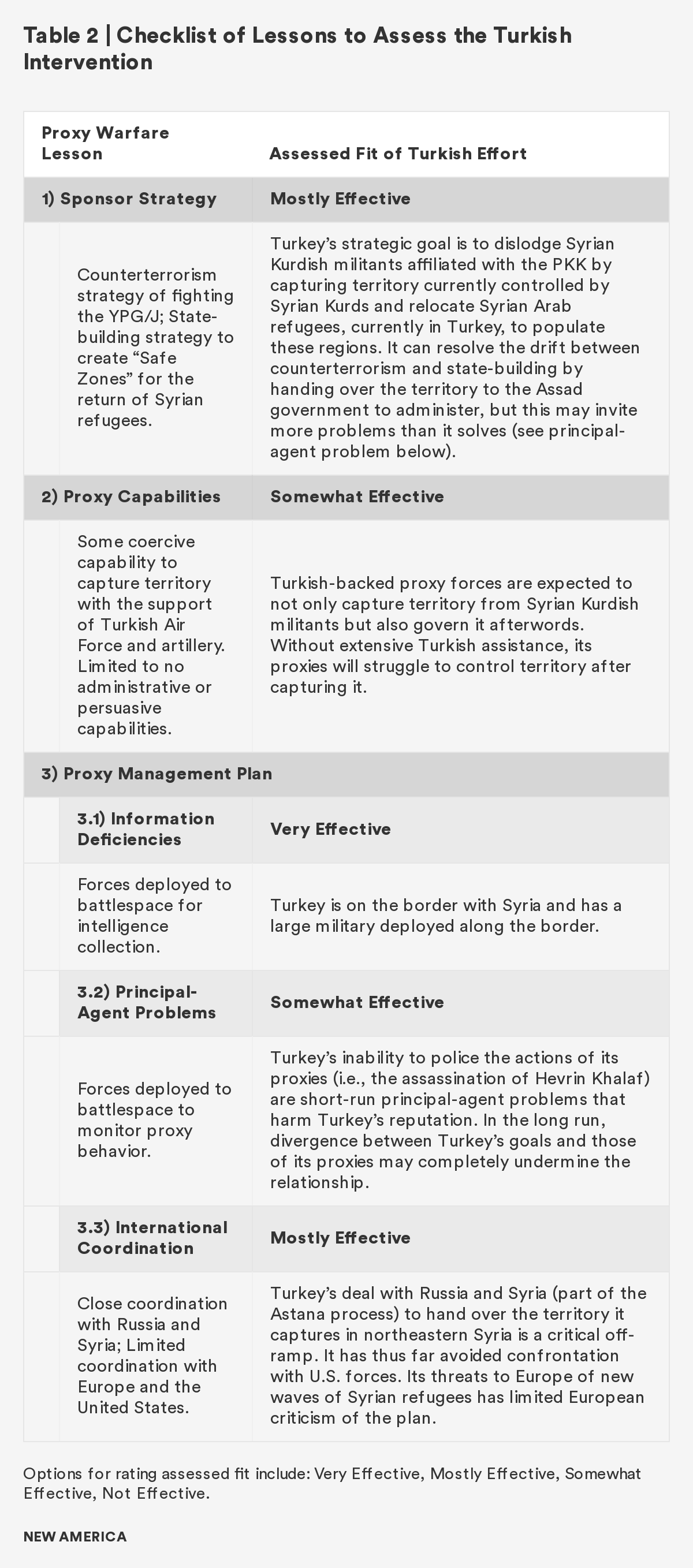
Second, Turkey faces challenges in managing its proxies. Turkey’s inability to police the actions of its proxies exemplifies the principal-agent problem. In the short run, Turkish proxies may commit war crimes or human rights abuses that harm Turkey’s reputation. In the long run, divergence between Turkey’s goals and those of its proxies may completely undermine the relationship. Turkey’s proxies see their partnership with Ankara as a means to regain lost territory and continue their fight against Assad.123 Turkey sees creating safe zones as a means to reduce the economic, social, and financial burden imposed upon Turkey by the Syrian refugee population, establish a Turkish-protected Arab-majority buffer zone between Turkey’s Kurdish minority population and autonomous Kurdish-controlled areas in Syria and Iraq, and create strategic depth on Turkey’s southern border. If northern Syria were eventually handed over to the Syrian government, as appears to be Turkey’s intent, Turkish-backed militias would likely be considered terrorists by Damascus. At least some proxies would likely transform into guerilla forces which, combined with two million resettled refugees and a flood of IS prison escapees, could form a new hub of fundamentalist insurgency.
Sponsor Strategy
Turkey’s proxy warfare strategy is well-developed and remains a strength in terms of the clarity of its mission and the political end state it envisions. Its goal is to dislodge Syrian Kurdish militants affiliated with the Partiya Karkerên Kurdistanê (PKK) by capturing territory controlled by Syrian Kurds and relocating Syrian Arab refugees, currently in Turkey, to populate these regions. This would change the demography of northern Syria, shifting it from a population that would most likely support Syrian Kurdish insurgents to one that would be more pro-Turkish—either through ethnic and political inclination, or because its vulnerable position would make it dependent on support from Ankara. The ultimate goal is to create a buffer, preventing the PKK, Turkey’s internal Kurdish insurgency, from using the Syrian side of the border as a safe haven.
The use of irregular proxy forces (often drawn from ethnic or religious minorities dependent on the central state) to secure frontiers and create buffer zones has a long history in Turkey. 124 In the late nineteenth and early twentieth centuries, the Hamidiye irregular light cavalry regiments (Hamidiye Hafif Süvari Alayları) were created by Ottoman Sultan Abdul Hamid II for precisely this purpose, enforcing a buffer zone on the empire’s eastern border with Russia. It was along the same Kurdish-Arab ethnic frontier that is a flashpoint today. Ironically, the Ottomans chose the Kurds as their preferred proxy, recruiting from the empire’s Kurdish tribal minority for the Hamidiye and other militias. The goal was to insulate the empire’s Anatolian heartland from restive Arab populations to the south. Thus, the recruitment of local, ethnically-oriented, communitarian militias in this region is nothing new.
In the present day, Turkey’s operations against the Syrian Kurds are driven by a belief that the Syrian conflict is an extension of an ongoing war against Kurdish separatists. Turkey’s current strategy uses a combination of its own regular troops, the Turkish Armed Forces (TSK), and proxy forces to push Syrian Kurdish militants away from its borders, establishing a 20-mile deep “safe zone” on the Syrian side of the border. Per an October 22, 2019 agreement, Moscow and Damascus would eventually take responsibility for northeastern Syria in exchange for allowing the TSK and its proxies to implement Turkey’s safe zone plan.125
The map below shows the deployment of Turkish troops and proxies as of January 2020. Turkey and the United States agreed on a ceasefire arrangement that would move SDF forces 30 kilometers out of the safe zone.126 That safe zone would comprise the region built out of the rectangle connecting Tell Abiad, Ras al-Ain, Tel Tamer, and Ain Issa.
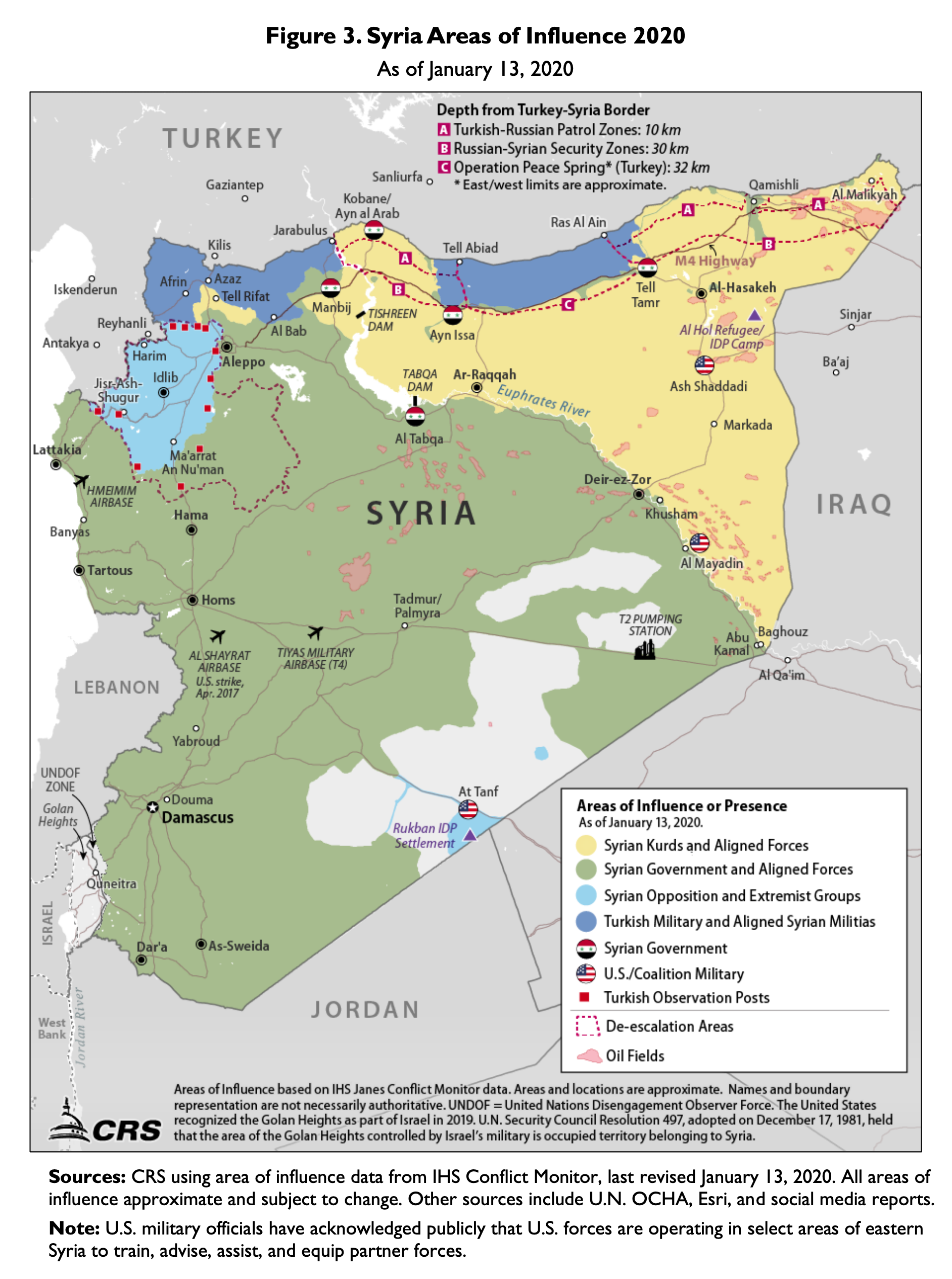
Turkey’s Long Desired Safe Zone
Turkey has pursued a strategy to install a safe zone in northern Syria in some form or another since 2011, though the terms of that safe zone have shifted over time.127 At the end of 2011, Turkey floated a proposal for a “buffer zone” in which it, along with NATO allies, would protect Syria’s opposition in a similar manner to the NATO intervention in Libya. This time, instead of using air-to-ground strikes to help Libyans topple Ghaddafi, the buffer zone would be an air protection zone.128 The Syrian opposition would be relocated inside this area in preparation for taking over the Syrian government. Turkey, like most countries at the end of 2011, believed that Bashar al-Assad and his government would fall in six months to a year.129
Turkey’s safe zone plans had changed by the end of 2014. When Turkish decision-makers no longer felt confident that Assad would be overthrown, their priority shifted to undermining the growing power of Syrian Kurds, who were beginning to receive U.S. counter-IS coalition assistance following their successful defense of Kobane. Turkey’s President Recep Tayyip Erdogan described Turkey’s revised plan in 2014 as “a no-fly zone and a safe zone” that would be an opportunity not only to support the Syrian opposition but also to repatriate Turkey’s 1.5 million, predominantly Arab, Syrian refugees.130 Erdogan’s comments elided the key goal of this plan, which was to push Syrian Kurds off the border. This point became clearer when Turkish Prime Minister Ahmet Davutoglu described the geographies in which Turkey’s safe zone would be implemented, which would involve Turkish troops on the Syrian side of the border nearly everywhere along the border, save a small amount of territory near Tell Abiad.131
By the end of 2014, Turkey and the United States were locked in an impasse that would last nearly five years. Turkey wanted the United States to help with its safe zone plan, and Washington wanted Ankara to aid its counter-IS mission. Neither party wanted to fully accede to the other’s demands, but since each needed cooperation from the other, both tried to keep the conversation open, mostly through joint exercises and temporary compromises.132 Somewhat understandably, frustrations with this kabuki dance would occasionally emerge, such as when President Erdogan accused the United States of being responsible for a “sea of blood” for its support of the SDF.133
By 2017, the Russian-Iranian-Hezbollah intervention bolstered the Syrian government to the point that Damascus had effectively won the civil war, rendering Turkey’s original regime-change objective moot. Thinking in Ankara now shifted: Turkish leaders became focused almost exclusively on countering Syrian Kurdish ascension. They assessed that Bashar al-Assad was going to remain in power and that Turkey therefore needed to balance against the YPG/YPJ which, with U.S. support, had taken over most of Syrian territory east of the Euphrates. Turkey started negotiating with Syria, Iran, and Russia over the right to invade Kurdish-held Syrian territory. The TSK launched Operation Euphrates Shield in 2016 to seize territory in northern Syria, and then negotiated some of it back to Syria, Iran, and Russia in 2017 through “de-escalation zones.”134
Turkey’s 2018 operation, Operation Olive Branch, became possible after Turkey-Russia negotiations, wherein Russia granted approval for Turkish planes to use airspace in northern Syria to launch airstrikes.135 Operation Olive Branch would become the model for Turkey’s strategy of invading northeastern Syria in October 2019 in that it involved using frontline ground forces comprised of largely proxy militias and advisers drawn from Turkish Special Forces (Özel Kuvvetler Komutanlığı, OKK), backed up by regular TSK ground troops and supported by artillery and air strikes, to push out YPG/YPJ forces, followed by a repopulation of the territory with displaced Syrian Arabs.136
In December 2018, President Erdogan convinced President Trump to let Turkey carry out its plans, an agreement that Trump walked back after resignations by Secretary of Defense James Mattis and counter-IS coalition head Brett McGurk, and under pressure from Republican leaders.137 The United States needed the SDF at that time because IS had not yet been territorially defeated.
But after March 2019, when IS’s last remaining enclaves of physical territory had disappeared, Turkey’s strategy for a safe zone in northeastern Syria was set. On October 7, 2019, in a call with Erdogan, Trump suddenly reversed assurances of continued support to the SDF that U.S. diplomats and military leaders had given until just days before and immediately withdrew U.S. forces from the proposed Safe Zone area, and gave the green light for Turkey’s Operation Spring of Peace, which duly commenced on October 9, 2019.138
According to one assessment,139 Spring of Peace had four immediate goals:
- a military objective to seize the territory outlined by the four towns in Figure 2;
- a public diplomacy objective to shape public opinion that the operation was in self defense and ultimately supported a peaceful end to the Syrian war;140
- a diplomatic objective to gather support for Turkey’s aims through negotiations, primarily with the United Statesand Russia; and
- a domestic political objective to gain Turkish public support for the operation, although this would mainly be determined by the military success of the operation.
The long term goal of Operation Spring of Peace is to force Syrian Kurdish militants and civilians to flee northeastern Syria so that Turkey can repopulate this territory with one to two million predominantly Syrian Arab refugees living in Turkey.141 As with its operation in Afrin, Turkey is likely to issue permits for refugees to return to this territory, in which it plans to build massive new housing complexes, including 200,000 homes, hospitals, mosques, recreation facilities, and schools.142
There are areas where Turkey’s strategy is less clear. The reconstruction phase shows the plan’s rough edges, since it is unclear whether the safe zone could support the proposed number of new arrivals,143 whether Turkey would force or encourage refugee resettlement (the former being a violation of customary international law),144 or if the international community would finance the project to begin with.145
Despite these challenges, Turkey has a clear strategic goal and a plan to reach it. Ankara also, unlike Washington with the SDF, has an off-ramp. After a six-hour negotiation between President Erdogan and Russian President Vladimir Putin on October 22 in Sochi, the political end state for Turkey’s operation became clear. In the short run, Russia and the Syrian government would allow Turkey to carry out its operation and, in exchange, Turkey would respect “Syria’s territorial sovereignty” and the country’s “political unity.”146 In other words, the territory Turkey captures will eventually be handed over to the Syrian government, in return for the establishment of Turkey’s desired safe zone.
Turkish leaders have been working on this plan in some form since the Syrian uprising began. While, over time, Turkey’s priority shifted from overthrowing Assad to undermining Syrian Kurdish militants, the safe zone plan is effectively the same: depopulate Turkey’s southern border of Syrian Kurds, replace them with populations less likely to support a Kurdish insurgency, and eventually hand over control of this territory to a Syrian national government. The problems with Turkish proxy strategy—other than the humanitarian implications—lie not with Turkey’s lack of a clear objective but the capability limitations of its chosen proxies and Turkey’s difficulties in managing them.
Proxy Capabilities
No plan survives the first encounter with the enemy. Although the Turkish strategy is well-defined, it is unclear whether Turkey’s proxies are capable of carrying it out.
On the one hand, Turkey’s proxies are well supplied and supported by the TSK, which gives them combat superiority over the SDF. The Turkish operational method—proxy forces in the lead, OKK advisers moving with them, artillery and air support and strong TSK regular units following close behind—is tactically sound and benefits from geographical proximity to Turkey. On the other hand, these forces have consistently demonstrated an inability to work together or to govern and administer territory. This suggests that Turkey’s proxies may have coercive force, but may lack the persuasive or administrative capability to control territory in northeastern Syria over an extended period of time.
The capability to assert control will be tested, especially if Turkish-backed proxies face a persistent guerrilla campaign waged by native Kurdish forces. A preview of the struggles of the Turkish campaign in northeastern Syria can be found in the predominantly Kurdish enclave of Afrin, where a guerrilla campaign opposes Turkish-backed proxies who are accused of looting, rape, and other war atrocities.147
For both Operation Spring of Peace and its predecessor, Operation Olive Branch, Turkey assembled a loose coalition of approximately 30 militias under an umbrella group called the “Syrian National Army” (SNA).148 These militias, through the SNA, officially report to the Syrian interim government, an anti-Assad political coalition based in northern Syria (see Figure 4 below for the militias involved in the operation).149 Turkey’s attempts at organizing the SNA factions yielded formal-sounding battle formations—the SNA has seven corps, which are then divided into brigades—but these titles simply reinforce pre-existing divisions within the force. Sasha al-Alou, a researcher at the Omran Center for Strategic Studies in Istanbul, described the SNA as a “coalition of factions,” explaining that the factions joined the SNA in exchange for agreements to keep their own structure.150
Syrians from across the country joined the SNA, making it a foreign force in northeastern Syria. The fact that SNA militias are being deployed to a foreign territory to fight a population that does not share their ethnic background or political goals will make pacifying and controlling the territory complicated. One clear indicator that the local population is not happy with the arrival of the Turkish-backed proxies is the sheer number of civilians who are leaving. “My interviews with locals indicate that the civilians who do not pick up weapons to defend their homes will attempt to flee to the Kurdistan Region of Iraq,” explained Elizabeth Tsurkov, an analyst of the Syrian conflict.151
Although the SNA has military police whose official purpose is to protect civilians, civilians in northeast Syria appear not to trust them, or to want their protection. Estimates of population displacement in the wake of the Turkish incursion vary widely, and it will be important to see how many people return once the initial fighting subsides, but UN figures suggest that approximately 180,000 people left their homes in northeastern Syria within the first month of Turkey’s operation.152
Aside from its military police, the SNA has little governance capacity. Local governing structures do exist in some areas, and sometimes are still called “Local Councils.”153 However, they are essentially platforms to distribute Turkish aid. According to Aymen al-Tamimi, a Syria analyst, it is a “model of governance in which autonomous local councils prefer to work directly with the Turks.”154 Sasha al-Alou also describes the problems of civilian oversight over the SNA: “the [Syrian] National Army is not subject to any political institution, and institutions of the political opposition have no authority over its formations.”155 This lack of oversight from civilian agencies that could perform governance tasks, along with the inability of the militias to govern, combined with their intense factionalism, makes it extremely unlikely that Turkey’s proxies will be able to control northeastern Syria without a large TSK deployment. Moreover, the ethnic divide between SNA troops and the local population, along with the religious fundamentalism of many SNA groups, make abuses more likely—while the SNA’s fragmented chain of command and factionalized structure make policing or prevention of abuses much harder.
Thus, Turkey’s SNA proxies will face the same capacity problems that U.S.-backed insurgents experienced from 2011-2014: they are not unified, and they lack the persuasive and administrative capacity to reshape the social and political landscape of northeastern Syria without significant effort from Turkish forces. Turkey’s proxies can capture territory, but cannot hold that territory for an extended period of time. These forces struggled to hold territory in Arab parts of Syria throughout the war; they will face even steeper challenges in asserting control over predominantly Kurdish areas, particularly if Syrian Kurds challenge their rule with an active guerrilla force, as many predict.156
Managing the Relationship
The problems facing Turkey’s proxy warfare efforts are not only due to the limited capabilities of Ankara’s chosen proxies, but also its difficulty managing them. As noted, a sponsor needs to mitigate information deficiencies, principal-agent problems, and international coordination challenges. Turkey is well placed to address the first and third challenges. However, the principal-agent challenge—in which many of the Syrian proxies Turkey supports seek victory over Assad while Turkey seeks rapprochement—may undermine the entire campaign.
On the positive side, Turkish forces are based inside northern Syria, which mitigates information deficiencies. Artillery and air observers and OKK advisers accompany the SNA, while regular TSK combat forces follow close behind. Relative to other proxy environments, TSK has a clear reading of the battlespace. TSK forces deployed in Syria include two armored brigades, two mechanized infantry brigades, one commando brigade, two gendarmerie special operations battalions, and assorted special forces teams of as many as 6,000 fighters.157
On the international coordination effort, President Erdogan is betting on his relationship with his U.S. counterpart and support from Russia to carry out his plan. In the first weeks of Turkey’s incursion, President Erdogan met with Russian President Vladimir Putin and U.S. Vice President Mike Pence. He met with President Trump on November 13 at the White House, and although bilateral issues remain unresolved, Erdogan received minimal public pushback from Trump despite credible reports of SNA atrocities and targeting of U.S. forces by TSK artillery. Erdogan has also threatened the European community with a new wave of Syrian refugees, which has led to silence from the European Union, hardly full-throated support for the campaign but sufficient for Turkey’s purposes.158 Although the international community’s interests are not fully aligned with Turkey’s, it is safe to assume that, for the moment, there are no major international or regional partners attempting to undermine Turkey’s efforts.
However, the principal-agent challenge is poised to harm Turkey in the long run. In the short term, Turkey’s proxies lack discipline and are prone to undermining Turkey’s reputation through brutal acts. In the longer term, divergence between Turkey’s goals for its safe zone and the goals of its proxies in partnering with Turkey may undermine Turkey’s effort to secure its border with Syria, replacing a Syrian Kurdish insurgency with a fundamentalist one.
In the immediate term, Turkish proxies pose a major reputational hazard inside Syria and abroad. “The SNA does not consist of well-disciplined forces,” explained one assessment, “They record and share all that they are doing on social media, which is not beneficial to the legitimacy of the operation.”159 This assessment proved correct, unfortunately, after Turkish-backed proxies murdered Hevrin Khalaf, a prominent Syrian Kurdish politician, and eight other civilians at a checkpoint.160
That proxy forces were in the lead and conducted risky operations left Turkey open to the reputational risks that come with these militias carrying out reprisals.161 Inside Syria, such seemingly random attacks terrify a population that perceives no logic to the violence, leading to chaos that quickly becomes costly for an occupying force.162 Abroad, Turkey is sensitive to reputational hazards, and to the related risk to the Turkish economy, which Trump has said he could “swiftly destroy” if “Turkish leaders continue down this dangerous and destructive path.”163 In the long term, Turkey’s goals are at odds with those of its proxies. This could lead to a breakdown of the relationship, so that even if they successfully expel Kurds from parts of northeastern Syria, the TSK and SNA may end up providing a safe-haven for fundamentalist insurgents that could threaten Turkey and the wider region.
On the one hand, Turkey sees the formation of the safe zone as an end in itself: the expulsion of Kurds from northeastern Syria, and their replacement by Syrian Arabs, would undermine the growing power of Syrian Kurdish militants and prevent the emergence of a safe haven for Turkish Kurdish insurgents. Once Turkey has repopulated this region with returning Syrian Arab refugees, it plans to turn the entire territory over to the Syrian government. Already as part of that agreement, brokered in Sochi on October 22, Turkish and Russian militaries are conducting joint patrols along parts of the Syrian and Turkish border.164
On the other hand, Turkey’s proxies believe they will capture territory from Syrian Kurds in order to create an enclave from which they can oppose the Syrian government. “As long as we have the civilians and a free army, with a small piece or a small town of Syria, we will liberate all of Syria again,” said Abdul Naser Jalel, a division commander in a Turkish-backed proxy.”165 Meanwhile, the SNA’s stated objectives reflect the insurgents’ ongoing revolutionary aims to “liberate the country from tyrants.”166 These objectives, along with the very name of the organization—the Syrian National Army—indicate that SNA leadership hopes to take over northeastern Syria as a means to continue to oppose the Syrian government.
Although these goals are not in opposition at the moment, they will be once the Turkish government begins to follow through on its promises to Russia to hand over the territory it captures to the Syrian government. If that happens, Turkey may find its proxies unwilling to be disarmed or integrated into the Syrian government’s forces. There are from 80,000 to 110,000 fighters in the SNA, according to various estimates.167 Their revolutionary goals either need to be accommodated, or, barring that, fighters in the SNA might become a guerrilla army. If refugees are returned to this area from Turkey, these SNA guerillas would find ready recruits among the one to two million returnees. In a worst-case scenario, this chaotic conflict zone might attract fundamentalist insurgents, posing a serious threat not just to Turkey, but to the wider region.
Comparative Case Study #3: Fundamentalist Insurgents in Syria, 2011-Present
Syria’s fundamentalist insurgency used lessons learned by militants who fought in Syria’s uprising in the 1970s and 1980s to develop a more coherent strategy than the rest of the militant groups that emerged in the early years of the current Syrian civil war. Fundamentalist insurgents did receive foreign funding, but also developed independent sources of funding early on in the Syrian civil war by requiring new joiners to pay a fee to join the group and by focusing on governance, which helped them develop local sources of revenue (e.g. taxation). In addition, the fundamentalists’ foreign funders tended to share the fundamentalists’ ideological orientation and often treated their funds more as donations than part of a proxy relationship.168 These diverse revenue streams, and the acceptance of local control by many fundamentalist donors, reduced the complexity of fundamentalist insurgents’ operations: because they did not rely on foreign funding, leaders in the fundamentalist insurgents could focus on the rapidly shifting internal dynamics of the war and not on traveling abroad to secure resources. In effect, fundamentalist insurgents put forward a relatively clear strategy of expanding control and influence, and limited the management problems that plagued other groups who embraced proxy relationships by limiting the control sponsors could exercise over them through diverse revenue streams.
Despite limited foreign funding, the fundamentalist insurgency had capabilities that aligned with their strategy. Fundamentalist insurgents were the only anti-Assad militants who combined coercive with persuasive and administrative capabilities in the early years of the war.169 This helped them govern and generate local support of the kind that is crucial in a drawn-out insurgency. Fundamentalist factions had several key advantages at the outset of Syria’s civil war, such as better training, equipment, experience, the possibility that they were not priority targets for the Assad government, and the ideological commitment of their members.
The focus on governance gave fundamentalists a massive early advantage. It helped them control territory with persuasive and coercive force, administer populations (albeit often in a rudimentary and oppressive manner) and gave them a more sustainable base from which to draw resources like money, recruits, and material. In turn, the success of fundamentalist governance efforts meant fundamentalists did not have to rely as heavily on foreign funding to raise money as other factions in the Syrian opposition, illustrating the alignment of fundamentalist strategy and capabilities.
One key reason why fundamentalist groups were able to govern from the outset is that the money they raised was not restricted to war-making. By contrast, no one would pay nationalist Syrian militants to carry out governance projects—not via the Operations Room, not via expatriate donor networks, and not through charities set up in the wealthy Arab states to fund militias.170 Fundamentalist groups were able to raise foreign start-up money for military campaigns and support their governance projects because their foreign donor networks believed in the religious mission as well as the military confrontation. Early support for fundamentalists included Da’wa efforts—proselytization—that involved providing persuasive and administrative services like education, taxation and charity, and carrying out essential governance functions such as the creation of a legal system under Shari’a law.
Leaders of the official Syrian opposition were not fully aware that the fundamentalist focus on state-building would come at their expense. People generally believed that the fundamentalists and the rest of the opposition had the same proximate goal of overthrowing Assad, and could disagree on what came after Assad once he was gone. As we have shown in our previous report in this ASU/New America Future of Proxy Warfare series, this misconception lasted until at least the summer of 2013.171 Martin Chulov, the Guardian journalist who has been reporting on Syria since the outbreak of the conflict, reported earlier in 2013 that a “schism [was] developing between the jihadists and residents,” quoting a rebel commander in Aleppo who said, plainly, “they [the Islamists] don’t want what we want.”172
Even if the rebels knew in advance that fundamentalists might eventually compete with them for control of parts of Syria, many thought they could at least use them to overthrow Assad first. “We want to topple the regime,” explained Ahmed Zeidan in 2012. Zeidan was a member of the Idlib Military Council, a coalition of militants based in northwest Syria. “Whoever offers us help,” he explained, “we will call our units whatever they want as long as they support us. We just want to finish [off Assad].”173 The jihadists were capable fighters, and armed groups cooperated with them despite ideological differences.174 Local militias needed them on the front lines, and couldn’t oppose them in rear areas.175 This gave jihadists like Jabhat al-Nusra, and big tent fundamentalist groups like Ahrar al-Sham and Jaish al-Islam, years to develop inroads into local communities.
A Vision for Local Jihad
Fundamentalists had long prized Syria as uniquely suitable for their purpose of developing an Islamic state. In The Master Plan, terrorism analyst and former New America International Security program fellow Brian Fishman describes how several members of Al Qaeda developed a seven-stage plan that would eventually lead to the announcement of a Caliphate. As Fishman puts it, the plan noted that Syria was a “geopolitical loophole” that was “uniquely vulnerable to jihadi pressure because the United States would not support the Assad regime.”176 Syria’s demographics also tilted in the jihadists’ favor, since the country was roughly 65 percent Sunni Muslim, whereas the Assad family represented an offshoot of Shi’a Islam that constituted 10 percent of the country’s population.177 That meant an uprising against Assad would garner popular support—even if that support partially broke down along confessional lines.
As the war against Assad began in earnest in 2012, two fundamentalist groups started to implement a thirty-year-old Salafi Jihadist plan of state-building in Syria. This plan was different than the one that had described how a fundamentalist Caliphate might emerge. It was based on the lessons of Abu Musab al-Suri, one of the combatants in Syria’s uprising in the 1970s and 1980s.178 Suri’s work, “Lessons Learned from the Jihad Ordeal in Syria,” included two key findings that were adopted by the fundamentalist insurgency in Syria’s war.
The first finding was that militants were far too dependent on foreign countries for support. Foreign support “restricted and crippled” the group, and, “once this support came to a screeching halt, hopes were dashed and the end was tragic.”179 To address this, al-Suri recommended the group become self-sufficient: “jihad revolutionary movements waging gang warfare cannot rely on outside sources for financing, weaponry, training and support,” he wrote, “they have to depend on themselves…unless they have a detailed and comprehensive plan for self-sufficiency in all areas they will end up at the mercy and whim of their financers and providers.”180
Suri’s second finding was that future uprisings should invest more heavily on indoctrinating new recruits in communities where they would be based. “The movement of the jihad cadres [abroad],” he wrote about the anti-Assad forces who fled abroad in the 1970s and 80s, “ended up being a permanent settlement. The revolution lost contact with the masses; its main natural source of financing, personnel, morale, and motivation.”181
Putting this in terms of competitive control theory, Suri (and those who applied his plan to Syria) recognized that, in order to establish a resilient system of territorial and population control, they needed to develop independent, coercive, persuasive, and administrative capabilities across a wide spectrum of military, governance, and essential-services tasks, and must retain the autonomy to control and allocate funds, personnel, and other resources in order to do so.
Seeking Local Contacts
While foreign funds were channeled to other militants, groups like Jabhat al-Nusra and Ahrar al-Sham implemented al-Suri’s recommendations and built highly trained, selective, and self-sufficient units with the long-term strategy of building an Islamic state in Syria. “While others were seeking foreign funding,” explained Kader Sheikhmous, a Syria analyst, “al-Nusra was doing the opposite, seeking local contacts. They took advantage of this situation and this was the smarter bet.”182
Fundamentalist groups established a system in which new recruits donated $1,500 to join the group.183 New recruits also needed to provide a reference from someone who could vouch for their bona fides. The donation provided by the fighter, along with the ideological and military training he underwent as part of the process of joining the group, meant that al-Nusra, and, to a lesser extent, Ahrar al-Sham, were exclusive groups. “Fighters who joined in 2011-2013 weren’t poor people looking for a salary,” explained Idlbi, “they were ideologically motivated fighters…That structure of training attracted people who were more middle-class fighters and from cities.”184 Unlike other militias, which largely depended upon foreign money, the system of fighter donations provided al-Nusra and Ahrar al-Sham with the start-up money to buy their first weapons without becoming dependent upon external sponsors and subject to their potential lack of strategic clarity and management troubles.
Although they had different political philosophies, both tried to persuade communities to give them their support.185 Starting in early 2012, they worked with local armed groups, invested in building relationships with community leaders, tackled corruption and lawlessness, and developed local proselytization (Da’wa) efforts to convince others to follow their thinking.186 Their approach to building community support has been described at great length: analysts have described al-Nusra’s approach as “persuasive,”187 “local,”188 “gradualist,”189 “in symbiosis with the broader opposition,”190 and, militarily, “a key source of resolve and command presence.”191 Meanwhile, research on Ahrar al-Sham has described it as incorporating all the major strains of political Islam,192 as a “populist revolutionary force”193 or an “Islamist alternative”194 to Al Qaeda or IS that rejects “purist” hardline Salafi-jihadism,195 and has promoted itself as “revisionist jihadism.”196
The two groups publicly disagreed in 2014,197 2015,198 2016,199 and their forces confronted each other in 2017,200 yet they shared similar approaches that focused on cultivating local ties, developing the ability to fundraise locally, and using foreign assistance to bolster their efforts rather than drive them.
Meanwhile, militants with predominantly foreign funding faded away over the course of the conflict. Chasing foreign funding, rather than seeking sustainable sources of local support, harmed these militants’ long-term survivability, resiliency, and internal cohesion. As early as 2013, a coalition of armed groups, including Ahrar al-Sham, Jabhat al-Nusra and three groups formerly within the Free Syrian Army, formally criticized the National Coalition for Syria’s opposition (the “Etilaf”) for spending its time outside the country and not respecting the sacrifices of those fighting in Syria.201 Coincidentally, illustrating just how out-of-touch the Etilaf was, its response criticized these armed groups for their timing, as Etilaf representatives were in New York at the United Nations General Assembly lobbying for international action to support the Syrian opposition.202
In conclusion, fundamentalists established resilient control, which they maintain to this day in Idlib province—and which, as of this writing, is one of the last remaining areas within Syria to survive outside regime control—because they were less concerned with foreign donors and more focused on developing not just a military strategy, but a fundamentally political one as well.
Fundamentalist groups beyond Ahrar al-Sham and Jabhat al Nusra, such as Jaish al-Islam, similarly spurned foreign money in order to build local ties. Even the Islamic State for many years embraced a similar strategy of focusing on local ties. However, IS grew exploitative in part due to its high proportion of foreign fighters, its technical inability to govern large territory or resolve complex management problems, and the intensity of the military campaign it faced.203
Fundamentalist insurgents proved to be the most effective non-proxy forces in the Syrian war, as they were far more reliant on raising money locally by controlling territory than on raising funds from foreign backers. This mentality helped them survive Syria’s drawn-out civil war because it reduced their reliance on foreign assistance, it reduced the need to respond to a foreign sponsor’s strategy in the event that it differed from their own, and it reduced the complexity of sponsor-proxy management. This independence and autonomy ensured that those fighters who did participate were more likely to be committed, since they would have more agency on the battlefield. The wide spectrum of persuasive, administrative, and coercive tools on which these groups could draw also gave them much more resilient control over territory and populations than other groups were able to achieve.
Despite the seeming defeat of its caliphate, IS may be the most well-resourced insurgency of the four main fundamentalist groups.204 A 2019 RAND study estimates that IS retains approximately $400 million,205 while a 2019 UN study put its estimated funds at $300 million.206 Other fundamentalist insurgents control territory around Damascus, Idlib, and the Aleppo countryside. As the Syrian war shifts from a phase emphasizing territorial control to one that focuses more on a simmering insurgency, the remaining pockets of anti-Assad resistance will overwhelmingly be run by fundamentalist insurgents.
Citations
- Faysal Itani and Nate Rosenblatt, “US Policy in Syria: A Seven-Year Reckoning” (Atlantic Council, September 10, 2018), https://www.atlanticcouncil.org/in-depth-research-reports/issue-brief/us-policy-in-syria-a-seven-year-reckoning/
- James F. Jeffrey and Nathan Sales, “Special Envoy for the Global Coalition to Defeat ISIS Ambassador James F. Jeffrey And Counterterrorism Coordinator Ambassador Nathan A. Sales” (U.S. Department of State, August 1, 2019), https://www.state.gov/special-envoy-for-the-global-coalition-to-defeat-isis-ambassador-james-f-jeffrey-and-counterterrorism-coordinator-ambassador-nathan-a-sales/; Lara Seligman, “Britain, France Agree to Send Additional Troops to Syria,” Foreign Policy, July 9, 2019, https://foreignpolicy.com/2019/07/09/britain-france-agree-to-send-additional-troops-increase-syria-us-withdrawal-uk/
- “Statement by the President on ISIL,” White House Office of the Press Secretary, September 10, 2014, https://obamawhitehouse.archives.gov/the-press-office/2014/09/10/statement-president-isil-1
- Rukmini Callimachi, “ISIS Caliphate Crumbles as Last Village in Syria Falls,” The New York Times, March 23, 2019, https://www.nytimes.com/2019/03/23/world/middleeast/isis-syria-caliphate.html
- “Statement by the President on ISIL.”
- Aron Lund, “Origins of the Syrian Democratic Forces: A Primer,” Syria Deeply, January 22, 2016, https://www.newsdeeply.com/syria/articles/2016/01/22/origins-of-the-syrian-democratic-forces-a-primer
- @realDonaldTrump, “We have defeated ISIS in Syria, my only reason for being there during the Trump Presidency.” Tweet, Twitter, December 19, 2018, https://twitter.com/realDonaldTrump/status/1075397797929775105?s=20
- Callimachi, “ISIS Caliphate Crumbles as Last Village in Syria Falls.”
- The “calibrated withdrawal” comment is drawn from a U.S. policy expert speaking at a roundtable hosted by the Atlantic Council, Foreign Policy Research Institute, and Konrad-Adenauer Stiftung :Aaron Stein and Emily Burchfield, “The Future of Northeast Syria” (Atlantic Council / Foreign Policy Research Institute, August 2019), https://css.ethz.ch/content/dam/ethz/special-interest/gess/cis/center-for-securities-studies/resources/docs/Atlantic_Council_The_Future_of_Northeast_Syria.pdf.; The “indefinite endgame” position was explained in an article in the Atlantic: Colin P. Clarke and Ariane Tabatabai, “America’s Indefinite Endgame in Syria,” The Atlantic, October 16, 2018, https://www.theatlantic.com/international/archive/2018/10/bolton-pledges-american-troops-syria-iran/573121/
- Brett McGurk, “Hard Truths in Syria,” Foreign Affairs, June 2019, https://www.foreignaffairs.com/articles/syria/2019-04-16/hard-truths-syria
- Jared Szuba, “It Took Almost a Year, but a Simple Shift in US Stance Led to Turkey’s Assault against Syria’s Kurds,” Defense Post, November 1, 2019, https://thedefensepost.com/2019/11/01/syria-us-shift-turkey-incursion-sdf/
- Author’s interviews with a Syrian Kurdish journalist and a former US government official working on the Syria portfolio. Also, see Szuba.
- Author’s interview with coalition SOF commander, April 2019.
- Jeffrey was not out on his own making these comments to the SDF; others in the administration supported this policy, as mentioned. However, the position was undercut by the President’s announced support for Turkey’s safe zone plan on October 6, 2019.
-
Aaron Stein, “The SDF’s Post-American Future,” Foreign Affairs, August 31, 2018,
https://www.foreignaffairs.com/articles/syria/2018-08-31/sdfs-post-american-future+&cd=2&hl=en&ct=clnk&gl=us - Mazloum Abdi, “If We Have to Choose Between Compromise and Genocide, We Will Choose Our People,” Foreign Policy, October 13, 2019, https://foreignpolicy.com/2019/10/13/kurds-assad-syria-russia-putin-turkey-genocide/
- Hard copy of a letter, dated October 7, 2019, by Heimin Kobane, Chief of Staff to General Mazloum Kobane, in the author’s possession.
- @RTErdogan, “The Turkish Armed Forces, together with the Syrian National Army, just launched #OperationPeaceSpring against PKK/YPG and Daesh terrorists in northern Syria. Our mission is to prevent the creation of a terror corridor across our southern border, and to bring peace to the area.” Tweet, Twitter, October 9, 2019, https://twitter.com/RTErdogan/status/1181921311846735872
- Mike Giglio, “‘The U.S. Should Have Committed to Its Promises,’” The Atlantic, October 26, 2019, https://www.theatlantic.com/politics/archive/2019/10/ilham-ahmed-interview/600847/
- Giglio, “The Intelligence Fallout From Trump’s Withdrawal in Syria.”
- For the 50,000 partner estimate see: “US Commander Says Syrian Arab Coalition Is Now Majority Group within SDF,” Rudaw, March 3, 2017, https://www.rudaw.net/english/middleeast/syria/03032017; For the 70,000 partner estimate see: Elizabeth Tsurkov, “The Seeds of Trump’s Abandonment of Syrian Kurds Were Sown by Obama,” Haaretz, October 10, 2019, https://www.haaretz.com/us-news/.premium-the-seeds-to-trump-s-abandonment-of-syrian-kurds-were-sown-by-obama-1.7959640
- The PYD (“Partiya Yekîtiya Demokrat,” the “Democratic Union Party”), a Syrian Kurdish political party representing the YPG (“Yekîneyên Parastina Gel,” the “People’s Protection Units”), a Syrian Kurdish militia that a U.S. State Department cable in 2007 called the “PKK’s political affiliate in Syria.” “Syrian Government Represses Pro-PKK Rallies,” Embassy Damascus, November 8, 2007, https://wikileaks.org/plusd/cables/07DAMASCUS1094_a.html; The YPJ (“Yekîneyên Parastina Jin,” the “Women’s Protection Units”) is the women’s version of the YPG.
- Greg Botelho, “Turkish Leader: U.S. Responsible for ‘sea of Blood’ for Supporting Syrian Kurds,” CNN, February 10, 2016, https://www.cnn.com/2016/02/10/middleeast/turkey-erdogan-criticizes-us/
- Ruby Mellen, “A Brief History of the Syrian Democratic Forces, the Kurdish-Led Alliance That Helped the U.S. Defeat the Islamic State,” Washington Post, October 7, 2019, https://www.washingtonpost.com/world/2019/10/07/brief-history-syrian-democratic-forces-kurdish-led-alliance-that-helped-us-defeat-islamic-state/
- Aron Lund, “Syria’s Kurds at the Center of America’s Anti-Jihadi Strategy,” Carnegie Endowment for International Peace, December 2, 2015, https://carnegie-mec.org/diwan/62158
- Ash Carter, “Media Availability With Secretary Carter in Erbil, Iraq” (U.S. Department of Defense, December 17, 2015), https://www.defense.gov/Newsroom/Transcripts/Transcript/Article/637203/media-availability-with-secretary-carter-in-erbil-iraq/
- Daniel Wilkofsky and Khalid Fatah, “Northern Syria’s Anti-Islamic State Coalition Has an Arab Problem,” War on the Rocks, September 18, 2017, https://warontherocks.com/2017/09/northern-syrias-anti-islamic-state-coalition-has-an-arab-problem/
- “US Commander Says Syrian Arab Coalition Is Now Majority Group within SDF.”
- Aron Lund, “Syria’s Kurds at the Center of America’s Anti-Jihadi Strategy,” Carnegie Middle East Center, December 2, 2015, https://carnegie-mec.org/diwan/62158?lang=en
- Barak Barfi, “Ascent of the PYD and SDF,” Research Note (Washington Institute for Near East Policy, April 2016), https://www.washingtoninstitute.org/uploads/Documents/pubs/ResearchNote32-Barfi.pdf
- “US Commander Says Syrian Arab Coalition Is Now Majority Group within SDF.”
- Amy Austin Holmes, “SDF’s Arab Majority Rank Turkey as the Biggest Threat to NE Syria” (Wilson Center, 2019), https://www.wilsoncenter.org/sites/default/files/sdf_arab_majority_rank_turkey_as_biggest_threat.pdf
- “Daily Press Briefing by the Press Secretary Josh Earnest 10/30/15” (The White House Office of the Press Secretary, October 30, 2015), https://obamawhitehouse.archives.gov/the-press-office/2015/10/30/daily-press-briefing-press-secretary-josh-earnest-103015
- Barfi, “Ascent of the PYD and SDF.”
- Thomas Gibbons-Neff and Liz Sly, “First Images Emerge of U.S. Special Operations Forces in the Fight to Retake Raqqa,” Washington Post, May 26, 2016, https://www.washingtonpost.com/news/checkpoint/wp/2016/05/26/first-images-emerge-of-u-s-special-operations-forces-in-the-fight-to-retake-raqqa/; John Ismay, “U.S. Says 2,000 Troops Are in Syria, a Fourfold Increase,” The New York Times, December 6, 2017, https://www.nytimes.com/2017/12/06/world/middleeast/us-troops-syria.html
- As the counter-IS coalition’s website explains, “there is a role for every country to play in degrading and defeating ISIS.” See “About Us – The Global Coalition To Defeat ISIS” (U.S. Department of State), accessed December 2, 2019, https://www.state.gov/about-us-the-global-coalition-to-defeat-isis/
- For examples of readouts from ministerial level meetings of the counter-IS coalition, please see: “The Global Coalition To Defeat ISIS,” U.S. Department of State, accessed December 2, 2019, https://www.state.gov/bureaus-offices/bureaus-and-offices-reporting-directly-to-the-secretary/the-global-coalition-to-defeat-isis/
- Russia, Iran, and the Syrian government of course remained concerned about U.S. activity within Syria as a violation of Syrian sovereignty but largely left the counter-IS effort alone. However, in early 2020 – in the wake of the fallout of the October crisis in the U.S. proxy strategy – Russia and Syria began to probe U.S. forces with Syria aiming to reclaim all of its territory. These probes are unlikely to directly and substantially challenge the U.S. effort as a whole in the absence of a U.S. policy decision to abandon the effort.
- This is not to say that it solved them entirely. For example, in order to placate Turkey, U.S. advisors resisted giving heavy weapons such as mortars and anti-armor missiles to the SDF. As a result, the force remained largely a light infantry force that relied on U.S. airstrikes (rather than its own artillery or bunker-busting munitions) to defeat IS forces in urban combat. In the battle of Raqqa, and in other engagements, this reliance on airstrikes amounted to using a sledgehammer to crack a nut—and resulted in significant property damage that might otherwise have been avoided.
- Carlotta Gall, “Syrian Rebels See Chance for New Life With Turkish Troops,” The New York Times, October 8, 2019, https://www.nytimes.com/2019/10/08/world/middleeast/turkey-kurds-free-syrian-army.html
- Janet Klein, Margins of Empire. (Place of publication not identified: Stanford University Press, 2016), 53–54, 170ff.
- Maxim A. Suchkov, “Putin, Erdogan Nail down Syria Deal,” Al-Monitor, October 22, 2019, https://www.al-monitor.com/pulse/originals/2019/10/russia-turkey-syria-deal.html
- Jen Kirby, “The US and Turkey Reached a Syrian Ceasefire. But What Does That Mean?,” Vox, October 17, 2019, https://www.vox.com/2019/10/17/20919566/turkey-syria-us-ceasefire-erdogan-pence-kurds
- Gonul Tol, “Turkey’s Endgame in Syria: What Erdogan Wants,” Foreign Affairs, October 9, 2019,.
- Aaron Stein, “The Origins of Turkey’s Buffer Zone in Syria,” War on the Rocks, December 11, 2014, https://warontherocks.com/2014/12/the-origins-of-turkeys-buffer-zone-in-syria/
- Stein.
- Serdar Karagoz, “Turkey in Full Cooperation with Anti-ISIS Coalition, Says President,” Daily Sabah, September 27, 2014, https://www.dailysabah.com/politics/2014/09/27/turkey-in-full-cooperation-with-antiisis-coalition-says-president
- “‘Güvenli Bölge’nin Çerçevesi Netleşiyor,” Anadolu Agency, October 16, 2014, https://www.aa.com.tr/tr/dunya/guvenli-bolgenin-cercevesi-netlesiyor/110451
- Stein, “The Origins of Turkey’s Buffer Zone in Syria.”
- Botelho, “Turkish Leader: U.S. Responsible for ‘sea of Blood’ for Supporting Syrian Kurds.”
- Tol, “Turkey’s Endgame in Syria: What Erdogan Wants.”
- Metin Gurcan, “Assessing the Post-July 15 Turkish Military,” Policy Notes (Washington Institute for Near East Policy, 2019), https://www.washingtoninstitute.org/uploads/Documents/pubs/PolicyNote59-Gurcan.pdf
- Tsurkov, “The Seeds of Trump’s Abandonment of Syrian Kurds Were Sown by Obama.”
- Leo Shane III, “US to keep 10 percent of its fighting forces in Syria, reversing Trump’s planned full withdrawal,” Military Times, February 22, 2019, https://www.militarytimes.com/news/pentagon-congress/2019/02/22/us-to-keep-10-percent-of-its-fighting-forces-in-syria-reversing-trumps-planned-full-withdrawal/
- Szuba, “It Took Almost a Year, but a Simple Shift in US Stance Led to Turkey’s Assault against Syria’s Kurds.”
- Metin Gurcan, “Operation Peace Spring: What Is the Turkish Army’s next Step?,” Al-Monitor, October 13, 2019, https://www.al-monitor.com/pulse/originals/2019/10/turkey-syria-united-states-operation-peace-spring-what-next.html
- These talking points were prominently made by President Erdogan in a Wall Street Journal Op-Ed: Recep Tayyip Erdoğan, “Turkey Is Stepping Up Where Others Fail to Act,” Wall Street Journal, October 14, 2019, https://www.wsj.com/articles/turkey-is-stepping-up-where-others-fail-to-act-11571093850.; Similar talking points were raised during Operation Olive Branch by Foreign Minister Mevlut Cavusoglu: Mevlut Cavusoglu, “The Meaning of Operation Olive Branch,” Foreign Policy, April 5, 2018, sec. https://foreignpolicy.com/2018/04/05/the-meaning-of-operation-olive-branch/
- Tol, “Turkey’s Endgame in Syria: What Erdogan Wants.”
- Tol, "Turkey's Endgame in Syria: What Erdogan Wants.”
- @MarcPierini1, “The Undocumented Assertion That 2-3 Million People Can Live in the Area Mapped Here Makes No Sense to Anybody Who Ever Traveled to These Baren Lands [I Have]. @FedericaMog @JHahnEU,” Tweet, Twitter, September 25, 2019, https://twitter.com/MarcPierini1/status/1177000025093791744
- Lara Seligman, “Turkey Begins Resettling Refugees in Northeastern Syria,” Foreign Policy, December 9, 2019, https://foreignpolicy.com/2019/12/09/turkey-resettling-refugees-northeastern-syria/
- Tol, “Turkey’s Endgame in Syria: What Erdogan Wants.”
- Suchkov, “Putin, Erdogan Nail down Syria Deal.”
- Tsurkov, “The Seeds of Trump’s Abandonment of Syrian Kurds Were Sown by Obama.” “Kurds signal move to new phase of guerrilla war on Turkish forces in Afrin,” Reuters, March 18, 2018, https://www.reuters.com/article/us-mideast-crisis-syria-afrin-statement/kurds-signal-move-to-new-phase-of-guerrilla-war-on-turkish-forces-in-afrin-idUSKBN1GU0KD; David Enders, “Afrin beginning to look less like a victory for Turkey as YPG mounts guerrilla campaign,” The National, April 3, 2018, https://www.thenational.ae/world/mena/afrin-beginning-to-look-less-like-a-victory-for-turkey-as-ypg-mounts-guerrilla-campaign-1.718407; “Car blast kills eight in Syria's Afrin, near Turkish border,” Reuters, October 31, 2019, https://www.reuters.com/article/us-syria-security-blast/car-blast-kills-eight-in-syrias-afrin-near-turkish-border-idUSKBN1XA0Z9; “Syria: Turkey must stop serious violations by allied groups and its own forces in Afrin,” Amnesty International, August 2, 2018, https://www.amnesty.org/en/latest/news/2018/08/syria-turkey-must-stop-serious-violations-by-allied-groups-and-its-own-forces-in-afrin/; Sirwan Kajjo, “Rights Groups: Abuses on the Rise in Syria’s Afrin,” Voice of America, June 1, 2019, https://www.voanews.com/extremism-watch/rights-groups-abuses-rise-syrias-afrin
- Dilara Hamit, Erdoğan Çağatay Zontur, “Free Syrian Army transforms into Syrian National Army,” Anadolu Agency, October 9, 2019, https://www.aa.com.tr/en/middle-east/free-syrian-army-transforms-into-syrian-national-army/1607384
- “Turkey’s Syrian National Army and Myth of United Syrian Opposition,” SouthFront, October 14, 2019, https://southfront.org/syrian-national-army-and-myth-of-united-opposition/
- Dia Odeh, Murad Abdul Jalil, and Tamim Hajj, “National Army: A Marriage of Convenience, or a Strategic Asset,” Enab Baladi, October 21, 2019, https://english.enabbaladi.net/archives/2019/10/national-army-a-marriage-of-convenience-or-a-strategic-asset/
- Tsurkov, “The Seeds of Trump’s Abandonment of Syrian Kurds Were Sown by Obama.”
- “Nearly 180,000 Displaced by Northeast Syria Fighting as Needs Multiply: UN Refugee Agency,” UN News, October 22, 2019, https://news.un.org/en/story/2019/10/1049761
- Odeh, Abdul Jalil, and Hajj, “National Army: A Marriage of Convenience, or a Strategic Asset.”
- Aymenn Jawad Al-Tamimi, “In Syria, It’s Either Reconciliation or Annexation,” The American Spectator, August 23, 2018, https://spectator.org/in-syria-its-either-reconciliation-or-annexation/.
- Odeh, Abdul Jalil, and Hajj, “National Army: A Marriage of Convenience, or a Strategic Asset.”
- “[The attack] will achieve rapid success only to be hit with an insurgency,” explained Turkey expert Aaron Stein. See Jack Detsch, “Turkey Launches Syria Invasion Hours after Informing US of Plans,” Al-Monitor, October 9, 2019, https://www.al-monitor.com/pulse/originals/2019/10/turkey-inform-us-plans-invade-northern-syria.html.; See also Tsurkov, “The Seeds of Trump’s Abandonment of Syrian Kurds Were Sown by Obama.”
- Metin Gurcan, “Turkey Has Multiphase Game Plan for Syria Operation,” Al-Monitor, October 10, 2019, https://www.al-monitor.com/pulse/originals/2019/10/turkey-syria-untied-states-three-phase-of-ankara-plan.html.
- Helen Regan and Tara John, “Turkey's president threatens to flood Europe with refugees as Syria offensive ramps up,” CNN, October 11, 2019, https://www.cnn.com/2019/10/10/politics/syria-turkey-offensive-displaced-intl-hnk/index.html
- Gurcan, “Operation Peace Spring: What Is the Turkish Army’s next Step?”
- The fighters recorded the murder on their cell phones. See: Martin Chulov, “Kurdish Politician among Nine Civilians Shot Dead by Pro-Turkey Forces in Syria,” Guardian, October 13, 2019, https://www.theguardian.com/world/2019/oct/13/female-kurdish-politician-among-nine-civilians-killed-by-pro-turkey-forces-in-syria-observers-say
- See, for example, the video recorded murder of two other Syrian Kurds. Ben Hubbard et al., “Syrian Arab Fighters Backed by Turkey Kill Two Kurdish Prisoners,” The New York Times, October 12, 2019, https://www.nytimes.com/2019/10/12/world/middleeast/turkey-invasion-syria-kurds.html
- Stathis N. Kalyvas, The Logic of Violence in Civil War, Reprinted, Cambridge Studies in Comparative Politics (Cambridge: Cambridge Univ. Press, 2009).
- Robert Burns, “Trump Threatens to ‘Destroy’ Turkey’s Economy with Sanctions,” AP, October 15, 2019, https://apnews.com/767054f1f99f40199a80bfea8e16ccdf
- And in some cases, the Syrian government’s forces are already present. See: Bethan McKernan and Julian Borger, “Turkey and Russia Agree on Deal over Buffer Zone in Northern Syria,” Guardian, October 22, 2019, https://www.theguardian.com/world/2019/oct/22/turkey-and-russia-agree-deal-over-buffer-zone-in-northern-syria?fbclid=IwAR0g7z74G7gLfKIaPkrd_cS-ms6HC8yVAgClf9ETYC6bLM0M0yFeO56raYI
- Gall, “Syrian Rebels See Chance for New Life With Turkish Troops.”
- Odeh, Abdul Jalil, and Hajj, “National Army: A Marriage of Convenience, or a Strategic Asset.”
- Fehim Tastekin, “Who are the Turkish-backed forces in latest Syria incursion?” Al-Monitor, October 13, 2019, https://www.al-monitor.com/pulse/originals/2019/10/turkey-syria-kurds-militias-in-operation-peace-spring.html; “‘National Army’ Restructured Having Merged With “National Front for Liberation” Enab Baladi, October 5, 2019, https://english.enabbaladi.net/archives/2019/10/national-army-restructured-having-merged-with-national-front-for-liberation/#ixzz6A2ExqFXY
- On the differences between donations and support in the vein of proxy warfare see, for example the discussion of “donated assistance” in Tyrone L. Groh, Proxy War: The Least Bad Option (Stanford, California: Stanford University Press, 2019).
- While minority regions (i.e., Kurdish, Druze) were more self-governing after the civil war emerged, these regions were neither directly opposing the Syrian government nor were they capturing new territory and administering it, like the fundamentalist groups were doing within the first few years of the war.
- Author’s interview with Qutaiba Idlbi, May 23, 2019.
- As we document in our paper, this came about following the rise of IS and its capture of Raqqa from summer of 2013 until the end of the year. Rosenblatt and Kilcullen, “How Raqqa Became the Capital of ISIS: A Proxy Warfare Case Study.”
- Martin Chulov, “Syria Crisis: Al-Qaida Fighters Revealing Their True Colours, Rebels Say,” Guardian, January 17, 2013, https://www.theguardian.com/world/2013/jan/17/syria-crisis-alqaida-fighters-true-colours
- Abouzeid, “Syria’s Secular and Islamist Rebels: Who Are the Saudis and the Qataris Arming?”
- Charles Lister, “Profiling Jabhat Al-Nusra” (Brookings, July 2016), https://www.brookings.edu/wp-content/uploads/2016/07/iwr_20160728_profiling_nusra.pdf
- As Rania Abouzeid reported in 2013 on the reaction to questions about the future of Syria: “The F.S.A. men…repeated a sentiment I have often heard when I ask that question: ‘We’ll deal with [al-Nusra] later, but right now we need them.’ One man said, ‘If the Army attacks us, will I tell them, ‘Don’t fight the Syrian Army’? No. I won’t say that. I will thank them. Who else is helping us?’” From: Rania Abouzeid, “Syrian Opposition Groups Stop Pretending,” New Yorker, September 26, 2013, https://www.newyorker.com/news/news-desk/syrian-opposition-groups-stop-pretending?verso=true
- Brian Fishman, The Master Plan: ISIS, Al Qaeda, and the Jihadi Strategy for Final Victory (New Haven: Yale University Press, 2016), 37.
- Fabrice Balanche. Sectarianism in Syria’s Civil War. The Washington Institute for Near East Policy, 2018.
- Hassan Hassan, “Two Houses Divided: How Conflict in Syria Shaped the Future of Jihadism,” CTC Sentinel, October 2018, https://ctc.usma.edu/two-houses-divided-conflict-syria-shaped-future-jihadism/; Interview with Kader Sheikhmous, May 21, 2019.
- “Lessons Learned from the Jihad Ordeal in Syria,” n.d., 6, Combatting Terrorism Center, https://ctc.usma.edu/harmony-program/lessons-learned-from-the-jihad-ordeal-in-syria-original-language-2/
- “Lessons Learned from the Jihad Ordeal in Syria,” 7.
- “Lessons Learned from the Jihad Ordeal in Syria,” 7.
- Author’s Interview with Kader Sheikhmous, May 21, 2019.
- Author’s Interview with Qutaiba Idlbi, May 23, 2019.
- Author’s Interview with Qutaiba Idlbi, May 23, 2019.
- Ahmed Abazeid, “The Great Competition Between Ahrar al-Sham and Jabhat al-Nusra (Ar.),”
- Even their names made their efforts clear: Harakat Ahrar al-Sham al-Islamiya (“The Islamic Movement of the Free Men of Syria”); And Jabhat al-Nusra’s original full name was Jabhat al-Nusra l’Ahli al-Sham min Mujahideen al-Sham fi Sahat al-Jihad (“The Salvation Front for the People of Syria by the Mujahideen of Syria in the Arena of Jihad”).
- Yasir Abbas, “Another ‘State’ of Hate: Al-Nusra’s Quest to Establish an Islamic Emirate in the Levant,” Hudson Institute, April 29, 2016, https://www.hudson.org/research/12454-another-state-of-hate-al-nusra-s-quest-to-establish-an-islamic-emirate-in-the-levant
- Ahmed Abazeid, “The Great Competition Between Ahrar al-Sham and Jabhat al-Nusra (Ar.),” Idraksy, March 9, 2017, http://idraksy.net/the-great-competition-between-ahrar-al-sham-and-tahrir-sham/?print=pdf
- Lister, “Profiling Jabhat Al-Nusra.”
- Samuel Heller, “The Governance Strategy of Jabhat Al-Nusra and Jabhat Fatah Al-Sham,” in How Al-Qaeda Survived Drones, Uprisings, and the Islamic State (Washington Institute for Near East Policy, 2017), 40–43, https://www.washingtoninstitute.org/uploads/Documents/pubs/PolicyFocus153-Zelin.pdf
- Jennifer Cafarella, “Jabhat Al-Nusra in Syria” (Institute for the Study of War, December 2014), http://www.understandingwar.org/sites/default/files/JN%20Final.pdf
- Hassan Hassan, “Jihadist Legacy Still Shapes Ahrar Al-Sham,” Tahrir Institute for Middle East Policy, June 3, 2016, https://timep.org/commentary/analysis/jihadist-legacy-still-shapes-ahrar-al-sham/
- Sam Heller, “Ahrar Al-Sham’s Revisionist Jihadism,” War on the Rocks, September 30, 2015, https://warontherocks.com/2015/09/ahrar-al-shams-revisionist-jihadism/
- Ali El Yassir, “The Ahrar Al Sham Movement: Syria’s Local Salafists,” Wilson Center, August 23, 2016, https://www.wilsoncenter.org/article/the-ahrar-al-sham-movement-syrias-local-salafists-0
- Sam Heller, “How Ahrar Al-Sham Has Come to Define the Kaleidoscope of the Syrian Civil War,” War on the Rocks, June 6, 2016, https://warontherocks.com/2016/06/how-ahrar-al-sham-has-come-to-define-the-kaleidoscope-of-the-syrian-civil-war/
- Heller, “Ahrar Al-Sham’s Revisionist Jihadism.”
- Sam Heller, “Muhammad al-Amin on Ahrar al-Sham’s Evolving Relationship with Jabhat al-Nusra and Global Jihadism,” Jihadology, December 9, 2014, https://jihadology.net/2014/12/09/guest-post-muhammad-al-amin-on-ahrar-al-shams-evolving-relationship-with-jabhat-al-nusrah-and-global-jihadism/
- Maxwell Martin, “Guest Post: A Strong Ahrar Al-Sham Is A Strong Nusra Front,” Jihadology, April 7, 2015, https://jihadology.net/2015/04/07/guest-post-a-strong-ahrar-al-sham-is-a-strong-nusra-front/
- Ahmed Abazeid, “The Great Competition Between Ahrar al-Sham and Jabhat al-Nusra (Ar.).”
- Ahmed Abazeid, “The Great Competition Between Ahrar al-Sham and Jabhat al-Nusra (Ar.).”
- The video has been removed from YouTube but is archived in the Wayback Machine: lewaatawheed, “بيان رقم ( 1 ) :: حول الائتلاف و الحكومةالمفترضة 24-9-2013,” Youtube archived via the Wayback Machine, September 24, 2013, http://tiny.cc/9mcylz ; Further background on the criticism and a list of groups involved can be found here: Valerie Szybala, “The Islamic Alliance Emerges” (Institute for the Study of War, September 26, 2013), http://www.understandingwar.org/sites/default/files/Backgrounder_IslamicAllianceEmerges_11Oct.pdf
- The response from the Etilaf posted on their website on September 26, 2013 read: “The Timing of the Brigades’ Statement Is Not Appropriate, But We Should Understand Their Concerns.” This post is no longer available but is summarized here: Szybala, “The Islamic Alliance Emerges,” 3.
- The rise and fall of IS is covered in a micro-history of the conflict in Raqqa from the time they captured it until after they had lost it to anti-IS coalition forces. See Rosenblatt and Kilcullen, “How Raqqa Became the Capital of ISIS: A Proxy Warfare Case Study.”
- The other three main groups being Al Qaeda affiliated groups, Ahrar al-Sham, and Jaish al-Islam.
- Patrick B Johnston et al., Return and Expand?: The Finances and Prospects of the Islamic State after the Caliphate, 2019, https://www.rand.org/content/dam/rand/pubs/research_reports/RR3000/RR3046/RAND_RR3046.pdf
- “Ninth Report of the Secretary-General on the Threat Posed by ISIL (Da’esh) to International Peace and Security and the Range of United Nations Efforts in Support of Member States in Countering the Threat” (United Nations Security Council, July 31, 2019), https://undocs.org/S/2019/612
Conclusion: What is the Future of America’s Proxy Warfare?
George Kennan traveled from Washington, D.C. to Moscow in the summer of 1944 to take up the post of Minister-Counselor (now usually called the Deputy Chief of Mission) at U.S. Embassy Moscow. From that position, less than two years later, he would write the so-called “Long Telegram,” the famous cable in which he outlined the nature of the U.S. struggle against the Soviet Union for the next half-century.
To travel from Washington to Moscow during World War II, Kennan had to fly by military plane through the Middle East and North Africa, with stops in Libya, Egypt, Iraq, and Iran. Kennan expressed glibly intolerant views while in the Arab world. Egypt was a “triangle of irrigated desert around the delta of a polluted stream.” Iraq was “a country in which man’s selfishness and stupidity have ruined almost all natural productivity.” Reflecting on this time in his memoirs, Kennan expressed remorse, describing his comments as “shallow and misleading” and admitting the Middle East and North Africa were “blind spots” in his understanding of the world.207
While Kennan’s observations of Middle Eastern society may indeed have been bigoted and shallow, his analysis of the future of the United States in the region was more characteristically incisive. The United States would not be able to carry out a consistent policy in the Middle East, he mused, because its democratic system privileged well-organized, “vocal minorities” who might hold very specific views. America’s democratic system, he argued, “is technically incapable of conceiving and promulgating a long-term consistent policy toward areas remote from its own territory.”208
Kennan’s assessment is just as valid in 2019 as it was in 1944. U.S. proxy warfare in Syria was, in the end, too complex to meet its objectives. This was even true for the U.S. partnership with the SDF, where, for a time, the United States aligned its political strategy with the capabilities of its proxy and built a strong working relationship with the SDF and global partners. But then the counter-IS coalition collapsed—with a helpful push from Presidents Trump and Erdogan—giving adversaries of the SDF and the United States all the evidence they needed that simply waiting out the United States and its allies without having to give anything away at the bargaining table was their best move.
It is just as likely that the flaws Kennan pointed to will endure, as America will rely more heavily on proxy forces in the Middle East in coming years. There is little public or political support for the large-scale combat deployment of American troops, let alone for a return to wars of occupation. Yet, there is also no end in sight to the Middle East’s wars. Conflicts continue in Yemen, Syria, Iraq, Libya, and the Palestinian territories, and the potential for new wars exists in other regional states, such as Algeria and Lebanon.
Conflicts create opportunities for America’s adversaries to shift the balance of power in the Middle East in ways that could, over time, overwhelm American allies. In some cases, regional conflicts also allow new safe havens to emerge for insurgents to plan attacks against Americans. To counter these threats at a reasonable cost to American lives and treasure, the United States must work with allies in the region. Sometimes, in the absence of formalized relationships with a state partner, those allies can be proxies—in effect, non-state allies.
But as attractive as proxies are, it is difficult to get them to advance U.S. strategic interests. Without the right preexisting capabilities or extensive in-country support, U.S.-backed non-state proxies in the Middle East can do little more than disrupt a state adversary or conduct counterterrorism operations that hurt an insurgent militarily. They cannot address the complex social factors that gave rise to a terrorist group or civil conflict in the first place. America increasingly uses proxies to fight its wars, but these are political wars that cannot be won by military force alone. U.S.-backed proxies in the Middle East might solve short-term dilemmas, but they hardly contribute to the long-term resolution of core issues affecting American interests in the region.
The product of this study is a framework to guide policymakers on how to fight proxy wars. According to that framework, three factors must align for a proxy warfare relationship to work: 1) a clear political strategy from the sponsor, 2) a clear assessment of the capacity of the proxy, and 3) an ability to reduce the three factors that can undermine a sponsor-proxy relationship: the information deficiency problem, the principal-agent problem, and the international coordination problem.
As Brian Katz, a fellow in the International Security Program at the Center for Strategic and International Studies, notes in his study on proxy warfare, there is a gap between the military objective for engaging proxies and the political strategy needed to use them in the first place. “Recent CT campaigns conducted via non-state proxies,” he writes, “had a primarily military objective—the defeat of the Islamic State—with no clear or achievable political end-state for which military operations were intended to serve.”209 Katz noted that using violence without a political strategy may be a “sub-optimal but necessary option when terrorist threats are exigent and diplomatic solutions are dubious.” But, he warns, “Sustaining those battlefield gains may be tenuous, however, if there is no political outcome to solidify them over the long-term.”210 Our research supports this assessment.
However, forming a clear or achievable political end-state is just the beginning. If the political strategy includes controlling territory, then those proxies need to have more than coercive capabilities. They must have a strategy or an ability to govern effectively. Finally, partnering with a proxy means trying to reduce the three factors that can undermine the relationship, even if the political strategy is clear and the proxy has well-demonstrated capabilities. The Turkish proxy war effort in northeastern Syria provides a warning of the dangers of engaging in proxy war with a clear strategic goal but without resolving the management challenges this paper has described.
The recent failure of the U.S.-SDF partnership shows that problems can emerge even when the proxy force is capable and the relationship is structured in such a way as to mitigate the downside risk of information deficiencies, agency problems, and coordination gaps. However, the partnership also provides a model for how the United States government could approach proxy warfare in the future, insofar as the United States is able to reduce shifts in strategic purpose and address the mismatch between presidential intent and agency planning.
The fatal flaw of the U.S.-SDF partnership recalls Kennan’s 1944 observation. Can the United States develop a long-term strategy for dealing with security challenges in the Middle East and carry them out with the strategic clarity necessary to succeed? The complexity of proxy warfare in general, and in the Syrian war in particular, should give policymakers pause when considering future engagements in the region.
Citations
- Kennan, Memoirs 1925-1950, 183–84.
- Kennan, 183–84.
- Katz, “Imperfect Proxies: The Pros and Perils of Partnering with Non-State Actors for CT,” 8.
- Katz, 8.
More About the Authors

David Kilcullen
Professor of War Studies, University of New South Wales; Professor of Practice, ASU; Author, The Ledger: Accounting for Failure in Afghanistan