Could Short-Term Pell Lead to a Pell Shortfall?
A public health crisis is looming large for Americans and for lawmakers in Congress. But in the background, efforts are underway by the Senate education committee to reauthorize the Higher Education Act. Lawmakers are focused on establishing a state-federal partnership program to increase investments in higher education, providing more information to students and their families so they can make informed choices about where to go to college, and simplifying the federal student aid program to reduce the maze of loan repayment options available to borrowers. But one controversial proposal to extend Pell Grants to very, very short-term programs could have significantly higher costs—for students as well as for taxpayers—than lawmakers are predicting. This could put Pell funding at risk, for the very students this policy seeks to help.
The proposal, which has been introduced as the JOBS Act and in the House Democrats’ College Affordability Act and proposed by the Trump administration, would allow Pell Grants to go to programs as short as eight weeks. Some versions of the bill would include only public and nonprofit colleges; others would also allow for-profits to participate.
There are good reasons to be concerned with the proposal on its face, since virtually no evidence suggests that programs that last only two months would provide students or taxpayers with a return on investment. That is not to say that short-term programs can’t be an important vehicle to equip students with labor-market skills, but we need smart policies to ensure quality and value for students and taxpayers alike. An experiment conducted by the Education Department into providing Pell for these programs has so far yielded no results. An in-depth look at several states’ short-term programs by the Institute for College Access & Success found gaping holes in the data that made it nearly impossible to compare programs across states, but it highlighted significant variation (and often, troubling outcomes) in the post-enrollment earnings that were available. For instance, the report showed that over half of students enrolled in non-credit, short-term programs in Iowa community colleges attended a program where graduates typically made around $35,100 in earnings. Another 44 percent were in health-related programs that netted average annual wages of only around $17,200. Research by the Community College Research Center found that short-term, stackable credentials—like the ones covered by existing legislative proposals—rarely yield much added labor-market benefit over a single certificate, and often net minimal wage gains. And other certificate programs already eligible for federal student aid have highly variable labor-market outcomes for their graduates, many yielding poverty-level wages. Among gainful employment certificate programs, two-thirds resulted in the average graduate earning no more than—and often less than—a typical high-school graduate.
But another significant area of concern should be the potential increase in costs to taxpayers and what that will mean for students. The Pell Grant program already faces shortfalls, and opening the floodgates to short-term credentials, especially at a time when the maximum award covers the lowest share of college costs in history, could put the entire program at risk. At first blush, it would appear there isn’t much to worry about in terms of costs. The Congressional Budget Office has estimated the costs at a paltry $1.2 to $1.3 billion over the next decade, a marginal increase for a nearly $30 billion per year program. The White House’s estimates are slightly higher, at $1.8 billion over 10 years.
CBO has been off on Pell Grant costs before, though. Way off. When Congress extended Pell Grants to students year-round, it estimated costs would be only $2.6 billion over five years. Only one year after the provision was implemented, the Education Department reported that the cost was already “10 times higher per year than expected.” Congress wound up eliminating the provision as enrollment in higher education skyrocketed during the Great Recession. Although lawmakers restored this provision a few years later, it’s an important reminder of how cost reductions play out in the Pell program. When things get tight, it’s politically difficult for Congress to cut Pell in obvious ways, like reducing the maximum Pell Grant, but it can and does make cuts in more under-the radar ways like eliminating year-round awards.
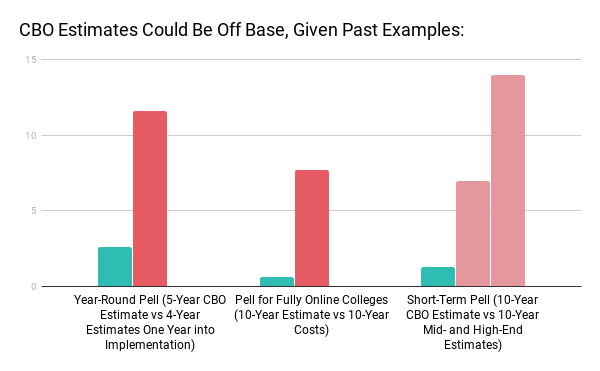
NOTES: Estimates in green are from CBO. Ten-year costs for year-round Pell, in red, are from the U.S. Department of Education’s FY 2012 Congressional Budget Justifications, and were calculated one year into implementation of the policy to estimate four subsequent years of projected costs by the Department. Ten-year costs for distance education, in red, are conservatively calculated based on 10 times the annual Pell receipt of entirely-online colleges. Short-term Pell mid- and high-range estimates, in light red, are based on the author’s calculations as explained in this post.
When proposing policies that could dramatically change the types of programs that schools can offer, it’s easy to underestimate how drastically institutional behavior can change. Look no further than a seemingly small change that led to the massive explosion in distance education programs. In 2005, Congress allowed colleges to begin operating entirely online, which meant lifting a cap that no more than half of students or courses could be online. The Education Department projected the total cost of the program would be around $697 million over 10 years, or $69 million per year. But that estimate turned out to be seriously off. In the 2018–19 award year alone, entirely-online schools got billions in federal aid dollars.
Based on back-of-the-envelope estimates, providing Pell Grants to short-term programs could be the next entry in the series of wildly-off estimates.
For starters, short-term Pell proposals would make a tectonic shift to allow federal aid to go to non-credit programs. These are continuing education programs—like commercial driver’s license programs or certified nursing assistant programs—not subject to the same levels of oversight from accreditors and other regulators. That’s largely because they generally can’t be applied toward a degree or certificate and because they haven’t been eligible for federal financial aid. This has allowed colleges to set up programs very quickly, which may be fine for programs designed for specific employers or programs that don’t receive federal dollars but which help students get the financial benefit of college-level skills and credentials. While some of the legislative proposals for very short-term Pell-financed programs would require non-credit programs to transfer into a credit-bearing program, they would still start out on the non-credit side, outside the scope of regulatory oversight.
We tend to think about the credit side of community colleges—everything from a general studies associate degree to an IT certificate program—in federal higher education policy conversations, since that’s where the financial aid money (currently) is. But non-credit courses and programs are a huge part of the broader mission of community colleges. According to the lobbying association for community colleges, more than two in five community college students are in noncredit programs—five million, in total. If just 10 percent of those students qualified for a Pell Grant, thanks to the policy change, and received an average grant of $1,000 (the maximum for short-term programs is around $3,000, prorated down to account for how short they are), $6 billion over 10 years would be added in new spending. If 20 percent qualified, the cost would be around $11 billion over 10 years, more than eight times the CBO projection.

Another big question is how for-profit colleges would respond, given what a significant driver they have been of other runaway cost increases. (Note that some of the existing proposals would exclude for-profits, a policy choice unlikely to be politically palatable, and which could still leave room for an influx of low-value credentials). If for-profit schools keep going at the rate CBO projects, the costs could be relatively marginal (maybe $1 or $2 billion), assuming about 10 percent of the current number of students at two-year schools and 5 percent of those at four-year schools become eligible for a $2,000 or $3,000 grant. If those schools instead flood the market with low-value credentials so short it’s easy to entice students to enroll, though, it is not hard to picture the costs hitting $3 billion or more, more than twice the total estimated cost of the policy, according to CBO. And this is easy to imagine, given an existing online infrastructure that would allow programs to scale up rapidly.
The consequences of blowing past the cost estimates could be significant, especially if a recession hits the U.S., as seems increasingly likely. During an economic downturn like the Great Recession, workers return to school in droves, stretching the costs of the program. In the aftermath of the COVID-19 pandemic, the financial ramifications could be even worse. And the Pell Grant program has an odd quasi-entitlement structure, funded through both the mandatory and the appropriations side of the federal budget. That means Congress has to fund all Pell recipients who are eligible, but it also must anticipate and meet the program’s needs before all those dollars are spent. If it misestimates the costs of Pell policies (whether due to higher-than-expected enrollment, or bigger-than-anticipated costs, or both), it’s forced to find even more money, both to make up for the under-funded piece of the program and to sustain the changes moving forward.
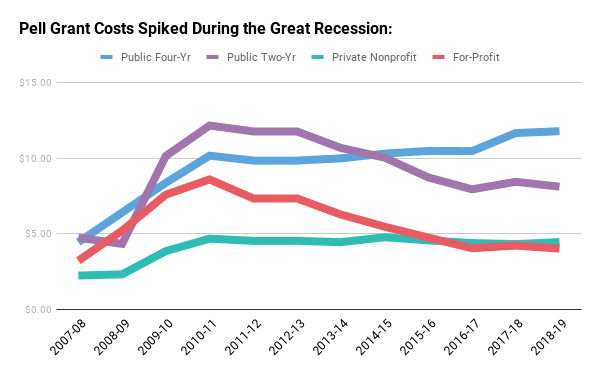
Often, lawmakers do that by first draining the program of any surplus money, forcing Congress to find new dollars to cover additional costs—if it can find those dollars, that is. During the last recession, it didn’t find the money. Instead, lawmakers hacked away at eligibility requirements, eliminating the year-round Pell Grant, cutting “ability to benefit” access for students without a high school diploma or GED, and more.
Those cuts disproportionately hurt today’s students: community college students, part-time students, and students of color, many of whom are already facing serious affordability challenges as the share of college costs covered by the Pell Grant continues to drop. In total, Congress cut Pell spending by more than $50 billion, according to the Center on Budget and Policy Priorities, much of which still has not been restored. The cuts made up for a surplus that became a $20 billion shortfall in just a couple of years. Today’s $9 billion surplus could disappear just as quickly and easily, and Congress would likely make up the difference by slashing benefits for millions of students.
That’s the bottom line: the choices Congress makes today will have serious implications tomorrow. And in the long term, expanding Pell Grants to short-term programs could mean that, in the future, it’s harder for millions of students to afford to go to college and less likely they’ll earn a credential that pays off.
Acknowledgments
New America would like to thank Arnold Ventures, the Bill & Melinda Gates Foundation, and The Joyce Foundation for their generous support of our work. The views expressed in this report are those of its authors and do not necessarily represent the views of the supporters, their officers, or their employees.
Downloads
More About the Authors

Clare McCann

Jinann Bitar
Senior Policy Analyst, Higher Education
Issues
Programs/Projects/Initiatives
Related