Community College Baccalaureate Programs: A State Policy Framework
Abstract
As additional states embark on the process of implementing four-year degrees at community colleges, they can learn from others’ experience for help navigating the legislative, regulatory, and program approval processes. This brief uses examples from states currently offering bachelor's degrees at their community colleges to provide guidance for policymakers setting up these degree programs.
Acknowledgments
We are grateful to Lumina Foundation for their generous support of this work, especially Holly Zanville. We also appreciate the partnership of Sameer Gadkaree and the Joyce Foundation. The support and advice of our New America colleagues made this report possible, including Mary Alice McCarthy, Debra Bragg, Sabrina Detlef, Riker Pasterkiewicz, Julie Brosnan, Fabio Murgia, Joe Wilkes, Naomi Morduch Toubman, and Samantha Webster.
Downloads
Introduction
In the late 1990s, Florida sat near the bottom of the states in terms of bachelor’s degree attainment.1 State leaders were not satisfied with their position and wanted to elevate economic and educational opportunities for Floridians. One strategy made Florida a pioneer among states: introducing baccalaureate programs in the community college. In 2001, the state legislature passed a bill authorizing St. Petersburg Community College, which was renamed St. Petersburg College, to confer bachelor’s degrees. Miami Dade and Chipola followed in 2002. Today, 27 of 28 Florida community colleges offer at least one bachelor’s degree, with nearly 200 programs currently operating in the system. In 2016–17, Florida community colleges conferred nearly 8,000 bachelor’s degrees.2 The state’s multi-pronged strategy to raise bachelor’s degree attainment seems to be working. Other states have taken notice of Florida’s success and followed suit.
While Florida stood nearly alone in 2001, 23 states now authorize community college baccalaureate degrees. Of these, six have begun authorizing these degrees since 2018.3 Interest in offering four-year degrees at the community college is still growing as the economy continues to reward higher credentials and advanced applied learning.
Baccalaureate programs at community colleges are opening up access to four-year degrees to a population of students either not well-served—or absent from—public and private four-year institutions. In Florida, for example, the average community college baccalaureate student is 31 years old, compared to 22 for upper-division students at public universities.4 Data collected by the state Department of Education indicate that three in four community college baccalaureate students are from populations historically underserved in higher education.5 While these programs are usually fairly small, their affordability and accessibility is opening the door to a bachelor’s degree for more students, without asking them to leave their home campus.
As additional states embark on the process of implementing four-year degrees at community colleges, they can learn from others’ experience for help navigating the legislative, regulatory, and program approval processes. This brief uses examples from states currently offering bachelor's degrees at their community colleges to provide guidance for policymakers setting up these degree programs. There are various ways to implement four-year degrees at the community college; the following sections include important considerations to implement them well.
Citations
- James L. Wattenbarger and Harry T. Albertson, “A Succinct History of the Florida Community College System,” Association of Florida Colleges, January 24, 2007, https://www.myafchome.org/assets/site/the%20florida%20community%20college%20system%20history%20with%20update.pdf
- “2016–17 FCS Bachelor’s Degree Completers,” Florida Department of Education, November 30, 2018, http://www.fldoe.org/core/fileparse.php/7592/urlt/1617BachCompleters.pdf
- Maria Claudia Soler, “Updating the National Landscape: State Adoption of Community College Degrees,” Community College Research Initiatives, University of Washington, November 2019, https://s3-us-west-2.amazonaws.com/uw-s3-cdn/wp-content/uploads/sites/158/2019/11/21214048/NewBA_DataNote3.pdf
- Emily Sikes, “OPPAGA Research on Florida College System Baccalaureate Degrees,” Florida Legislature’s Office of Program Policy Analysis & Government Accountability, March 10, 2015, http://www.trbas.com/media/media/acrobat/2018-01/70201696189400-18123310.pdf
- “The Florida College System Transparency, Accountability Progress, and Performance: To what extent are Florida College System baccalaureate programs educating underserved student populations?” Florida Department of Education, April 2014, http://www.fldoe.org/core/fileparse.php/7724/urlt/0083549-fcsbaccunderserved.pdf
Legislation
The process begins with legislation that grants colleges the authority to award bachelor’s degrees. Among the 23 states that have authorized community college baccalaureates, there is considerable variability in the types of degrees that colleges can offer, the agencies responsible for approving and regulating the programs, and the funding streams available to develop and sustain the programs.
Degree Types
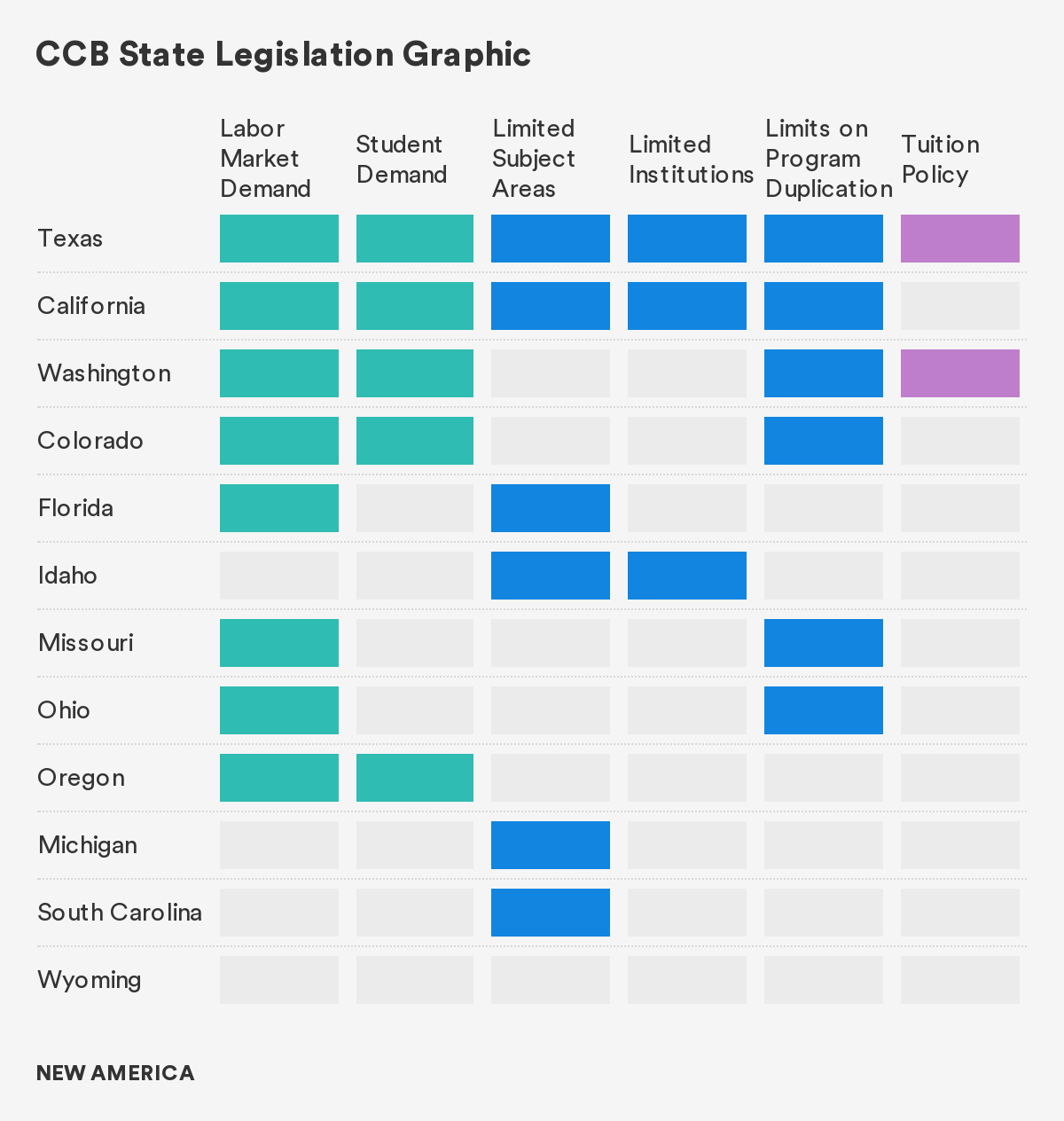
Of the 23 states with authorizing legislation, the majority specify that community college baccalaureate degrees need to have an occupational focus and prepare students for specific jobs in the regional labor market. For example, legislation in Wyoming and Washington consistently frames the community college baccalaureate in terms of “applied” degrees, such as the bachelor of applied science or bachelor of applied technology degrees, leaving more traditional, academic degrees to the purview of state universities.6 Other states identify allowable fields of study in statute, rather than limiting the type of bachelor’s degree that can be offered. For example, legislation in Michigan strictly limits community college baccalaureate programs to those in maritime technology, cement technology, and culinary arts.7
There are a number of advantages to limiting the range and types of baccalaureate programs that colleges can deliver to programs with a clear occupational focus and labor market demand. First, community colleges already deliver a wide range of career and technical education programs at the certificate and associate degree level, which distinguishes them from most four-year public universities. Building a seamless next step for students, especially those in applied and technical associate degree programs, to pursue a bachelor’s degree fills a gap in the higher education space in fields where universities may not be interested in offering a bachelor’s degree.
Second, while overly prescriptive legislation like Michigan’s limits the ability of colleges to respond to changes in the labor market, anchoring community college baccalaureate programs in labor market and student demand makes good sense. Furthermore, it may be easier for community colleges to build political support for baccalaureate authorization by tying it to local economic development needs and inclusive growth strategies. Finally, workforce-focused bachelor’s degrees fit more clearly in the mission of community colleges than those without a direct connection to the local labor market.
Pilots
A number of states, including Washington, California, and Texas, have taken an experimental approach to expanding the degree-granting authority of community colleges through pilot initiatives. In Texas, 2003 legislation authorized three community colleges to offer up to five baccalaureate programs apiece.8 In 2017, new legislation removed the pilot status of community college baccalaureates and extended the opportunity to propose limited baccalaureate programs to most community colleges.9 Similarly, Washington’s first community college baccalaureate legislation authorized a pilot at four institutions in 2005, and in 2010, the state passed additional legislation, opening the door for any community or technical college to propose a baccalaureate program.10
Pilots offer benefits and drawbacks, depending on how they are structured. On one hand, pilots give institutions and policymakers an opportunity to test program designs and recruitment strategies before expanding baccalaureate authorization across the state. Well-structured pilots with timely evaluations also generate important data about likely students and potential outcomes that can be helpful for designing future legislation and regulatory policies.
On the other hand, a pilot built around a mandatory program sunset can make it difficult to recruit students. In California, for example, authorizing legislation imposed a program sunset approximately five years after programs were to be launched.11 If prospective students know a program will disappear after they graduate, they may be less inclined to enroll. Furthermore, employers may question why a prospective hire’s bachelor’s program no longer exists. In short, states that are beginning to pursue community college baccalaureate authorization should consider a few well-structured pilots to test for student demand, labor market outcomes, and completion rates, without imposing an arbitrary program sunset date not tied to labor market demand.
Governance
Most legislation authorizing community college baccalaureate programs also identifies in statute the agency responsible for approving, monitoring, and, under the right circumstances, ending the programs. The entity varies by state: in Florida and Washington, it is the community college system, and in Texas and Ohio, the Coordinating Board and Department of Higher Education oversee all colleges in the states. While the best entity will depend on a state’s particular governance structures, it can be helpful to have a community college system in charge of the program approval process. Because four-year public universities generally resist efforts to extend baccalaureate degree-granting authority to community colleges, having them participate directly in the governance of the programs can paralyze state agencies charged with approving and monitoring the programs. An approval entity responsible for two-year institutions alone may be more flexible about program approval than a body that includes two- and four-year institutions because of internal pressure from four-year colleges. For example, in both Florida and Washington community colleges are under their own system, which has helped them expand CCB programs throughout the state. On the other hand, many states like Texas and Ohio do not have a single system of community colleges and a statewide entity makes the most sense for approving and monitoring programs.
One way to address the political pressure faced by bodies regulating both two- and four-year colleges might be for state legislation to clearly lay out goals for the number of programs approved. The program approval process could then establish standards for proposed program finance and evidence of demand and facilitate clear communication with local universities.
Funding
Baccalaureate education is generally more costly to deliver than the traditional associate degree and certificates programs offered by community colleges. The faculty required to teach the programs may be more expensive. Start-up costs, which often include reviews from regional and specialty accreditors, can be particularly steep. Meeting new accreditation requirements—around library holdings, laboratory space, and equipment, for example—imposes additional costs.
The 2019 Inside Higher Ed survey of community college presidents showed that respondents were concerned about adequately funding baccalaureate programs.12 Fifty-seven percent of those surveyed said they were worried states were not providing enough financial support to ensure that four-year degree programs are high-quality. Only 13 percent of respondents thought states were providing enough funding to adequately support bachelor’s programs at community colleges.
Start-up grants can help alleviate these costs and create stronger, more sustainable programs, particularly when colleges are just starting to offer these types of programs. In Texas, the state provided each college with $1.2 million in special funding to help cover start-up costs.13 But other states, like Ohio, did not provide start-up funding to their colleges.14
How much these programs cost students relative to bachelor’s degree programs offered by public four-year universities also needs attention. Legislation should clarify if the state will fund upper-division classes at the same level as lower-division community college classes or at the same level as upper-division classes at state universities. Depending on the program, upper-division courses can cost more than lower-division courses, so increased funding for them may be justified. As of 2014, for example, programs in Texas were reimbursed for upper-division courses at the same rate as universities.15 However, most states fund the upper-division and lower-division classes at the same, community college level.
State statute should also make clear whether institutions may use differentiated lower- and upper-division tuition rates to cover program costs. Florida charges almost exactly the same rate for lower- and upper-division courses, while in Washington, upper-division tuition at community colleges matches the average tuition at regional state universities.16 Forcing community colleges to charge the same rate for upper-division courses as that charged by public universities can help reduce some opposition to the programs from that sector and relieve some concerns around quality, but it also reduces the cost savings to students and the state. Policymakers will need to weigh those trade-offs.
Citations
- Revised Code of Washington § 28B.50.810 (2012) and Wyoming Statutes §21-16 (2019).
- Michigan Comp. Laws §389.121 (2012).
- Texas S.B. 286 (2003).
- Texas Educ. Code Ann. §130.302 (2017).
- Washington H.B. 1794 (2005) and S.B. 6355 (2010).
- Programs were to be launched by the 2017–18 academic year and sunset in the 2022–23 academic year. However, the sunset date has been extended until 2026. For political context and history of California’s baccalaureate pilot program, see Constance M. Carroll, "Pushing the Envelope: California’s Baccalaureate Pilot Program," in The Community College Baccalaureate: Supporting Regional Economic Development, ed. Constance M. Carroll and Rufus Glasper (Chandler, AZ: League for Innovation in the Community College, 2018), 27–33.
- Scott Jaschik and Doug Lederman, eds., 2019 Survey of Community College Presidents (Washington, DC: Inside Higher Ed, 2019), https://www.insidehighered.com/booklet/2019-survey-community-college-presidents
- Lindsay Daugherty, Charles A. Goldman, Lindsay Butterfield, and Trey Miller, Assessing the Potential to Expand Community College Baccalaureate Programs in Texas (Santa Monica, CA: RAND Corporation, 2014), https://www.rand.org/pubs/research_reports/RR745.html
- Ohio Rev. Code § 3333.051 (2018).
- Daugherty, et al.
- Revised Code of Washington § 28B.50.810 (2012).
Program Approval
The next step in starting bachelor’s degrees at community colleges is setting up what program approval looks like. Requirements may be more robust for these degrees than for the types of degrees traditionally offered by community colleges or public universities because these degrees are new, and states have a stake in ensuring that they are high-quality and non-duplicative. Program approval should include creating a clear line of consultation with other colleges and universities, deciding on criteria for approval, aligning with accreditation requirements, and building in accountability.
The Process
The program approval authority should lay out a clear process and timeline for colleges seeking to get their new four-year programs approved. For instance, the Florida College System uses a detailed, six-month timeline of the process, which includes formal consultation with the State University System of Florida and private colleges that culminates in a final decision by the State Board of Education based on a recommendation by the commissioner.17 State universities have 90 days, and independent colleges 60 days, to comment on proposed baccalaureate programs at community colleges before the programs can move forward.
This process will look different in different state contexts but should include consultation with the state’s four-year colleges. Community colleges and four-year colleges and universities together provide access to a variety of areas of study, types of degrees, and pathways into the workforce. For different sectors of higher education to work together cohesively, communication between community colleges proposing four-year programs and four-year institutions is critical from the earliest stages of the program approval process. Florida’s consultation process has resulted in productive relationships between community colleges and universities, where some of the four-year programs at community colleges serve as feeders to university graduate school programs. Similar patterns of community college baccalaureate students enrolling in graduate programs at public universities are emerging in Washington.
Criteria for Approval
State authorizing agencies require colleges provide a wide range of information when they are determining whether to approve a program. They ask for academic information, such as a description of the admission process and which classes will be included in the degree curriculum. They ask about labor market demand and unmet local hiring needs. They ask about institutional capacity around finances, accreditation, and faculty. Every state will emphasize different information, but we recommend that all states require colleges provide information in relation to the following four criteria:
Labor Market Demand
Community college bachelor’s programs should be required to provide evidence that they meet a local economic need. Given that the majority of these programs are in applied or technical fields, colleges should have to present data indicating that degrees earned in the proposed program would help meet local workforce demand. Evidence of local labor market demand could include hiring projections, skill and credential needs for relevant occupations, and employer testimony on their skill and hiring needs related to the proposed program. Florida, Ohio, Texas, and Washington all require that colleges establish labor market demand for proposed programs. Florida requires the use of very specific data and metrics to establish this demand, while the other states allow a bit more flexibility in terms of how colleges demonstrate this.18
Student Demand
In addition to providing evidence of labor market demand for baccalaureate graduates, colleges proposing a new program should also be required to show that there is enough student demand to sustain a new program. States such as Oregon and Colorado included clauses in legislation requiring evidence of student interest in a proposed baccalaureate program, alongside demand from employers.19 This makes good sense and can both help program approval bodies gauge the viability of a proposed degree and help institutions tailor outreach and recruitment efforts if the program is approved. Having local employers eager to hire graduates from a program is critical, but workforce demand is moot unless students want to enroll. Student demand is key to creating and sustaining a viable and valuable program.
Filling Gaps in Degree Offerings
New bachelor’s degree programs at community colleges should not duplicate what other public colleges and universities currently offer. The purpose of the community college baccalaureate is to expand states’ overall bachelor’s degree capacity in a cohesive way that supports positive education and labor market outcomes. Unacceptable duplication would consist of a community college and a public university within commuting distance offering the same bachelor’s program, while the university still had the capacity to enroll students. Most program approval proposals include a requirement for colleges to describe how their program is different from other, similar programs in the state.
Because bachelor’s degrees at the community college level tend to be more applied and technical than programs at a local university, they are generally not duplicative. An exception would be when four-year institutions offer a program—nursing, for example—where student and employer demand outstrip the supply of graduates. Without enough nurses with bachelor’s degrees, local health care access could suffer, so adding a new baccalaureate program at a local community college could help meet that need.
Institutional Capacity
Regardless of the funding structure set up by the state, start-up costs for new bachelor’s degree programs at community colleges can be significant. Before institutions embark on creating a new program, they should share a financial plan for starting and sustaining the program. States should specify resources colleges must have and outline resources they will give to supplement investment in the new degree program. States should also ask about plans around faculty, facilities like libraries and equipment, and programmatic and institutional accreditation. For example, the Washington state baccalaureate program approval process gets colleges ready to work with their accreditor to offer upper-division classes. This cuts down on the amount of work a college has to do to launch a program. The programmatic accreditation process, required in certain fields, is such that a program must operate, unaccredited, in order to demonstrate its worthiness. New programs requiring program-specific accreditation should demonstrate to the program approval entity that they are on the path to accreditation.
Accountability
States need to consider accountability structures that ensure college programs do not outlive their usefulness to local employers or students. Community college bachelor’s degree programs’ unique position as solutions to local workforce needs means that their usefulness may vary with economic trends. While programs may be successful in transitioning students to jobs with family-sustaining wages for years, local labor markets can and do change, and sometimes quickly. Changes may indicate a need to close an existing program that is no longer fulfilling its original purpose. Or if program graduates fail to attain local employment in the target field, the program may need to close. In these circumstances, program review may include provisions for closing programs. The sunset process should allow current students in the program to complete or transfer to another, similar program.
Citations
- “Baccalaureate Proposal Approval Process,” Florida Department of Education, July 2012, http://www.fldoe.org/core/fileparse.php/5592/urlt/0082804-flowchart.pdf
- “Notice of Intent,” Florida Department of Education, http://www.fldoe.org/core/fileparse.php/5592/urlt/NoticeIntentForm.pdf
- Oregon Revised Statutes § 341.013 (2019) and Colorado Rev. Stat. Ann. § 23-1-133 (2014).
Policy Alignment
Next, policymakers should ensure that the four-year degree at the community college is integrated and aligned with other higher education policies, which will help support the success and appropriate scale of these programs. Integration with policies like transfer, student success innovations, data, and financial aid can help or hinder the implementation of high-quality programs.
Transfer Policies
State transfer policies will need to facilitate not only students’ movement from community colleges to universities, but also between community colleges. For example, several Washington community and technical colleges offer an associate of applied science transfer degree, which is designed to prepare students to enter applied baccalaureate programs at their current campus or at any number of other two-year and four-year colleges that confer bachelor’s degrees. As in Washington, students in other states who complete transfer associate degrees should be able to connect to baccalaureate programs across the state. Furthermore, state policy should ensure that transfer policies related to things like a general education core and common course numbering applies to bachelor’s degrees at community colleges. Clarity on progression from the associate to baccalaureate level across institutions will only support more students in being able to earn a bachelor’s degree.
Clear and effective transfer policies should also support entry into bachelor’s programs at universities. Florida provides an example of how community college and university bachelor’s programs can coexist, increasing state capacity to provide bachelor’s degrees without dampening enrollment in either sector.20 Transfer rates from community colleges to state universities have remained strong and even grown after the introduction of community college bachelor’s programs. In 2010, just over 40 percent of upper-division bachelor’s students in the state university system held an associate degree from a Florida community college.21 While transfer pathways remain strong in the state, the number of students earning bachelor’s degrees from community colleges continues to grow each year. Healthy state transfer policy supports both pathways to the baccalaureate.
Student Success Strategies
Many states are undertaking innovative reforms in degree design and structure, particularly in their community colleges. Reforms like guided pathways, remedial education reform, and contextualized basic education set community colleges apart as places designed to support traditionally marginalized students, particularly adults. For instance, in guided pathways reforms, community colleges reorganize their course and degree offerings to effectively guide student choice to and through their major.22 Adding the last two years of a bachelor's degree is a logical extension of this reform, particularly for applied associate degrees that are not easily transferable to four-year colleges. In fact, this kind of curricular innovation builds out the career pathway to the next level of education. For instance, a networking program at Seminole State College in Florida and a computer science program at Renton Technical Institute in Washington create pathways to bachelor’s degrees for students in their certificate and associate programs. State policymakers should consider how these reforms can strengthen and redefine the baccalaureate degree at community colleges, making it more achievable for students from different backgrounds. These initiatives could even teach the state’s four-year colleges about innovative degree design.
Data Collection
Community colleges with four-year programs should monitor graduates’ outcomes to ensure the program is meeting its goals. Colleges can survey graduates, but response rates make it difficult or sometimes impossible to get a clear and unbiased picture of graduate outcomes. Getting data from the state unemployment insurance system, while it will miss some categories of workers, is useful to gauge program performance. However, these data have proven difficult for colleges to access.
State policy should allow colleges to tap into longitudinal data on employment and wages in fields with active community college bachelor's degrees to ensure programs are in tune with the local labor market and graduates are faring well. Furthermore, community colleges should be able to compare their four-year graduates’ employment and wage data with that of associate degree graduates and comparable university bachelor’s degree graduates to contextualize the outcomes. Agencies managing education and workforce data should be empowered to partner with colleges to conduct these analyses. More generally, state agencies should monitor and report on these outcomes to ensure programs are meeting the state’s goals and to inform policy around community college bachelor’s degrees.
State Financial Aid
State policy should be clear that eligible students who enter baccalaureate programs at community colleges can receive state aid, even if they have already earned an associate degree prior to enrollment. Students should be eligible for both higher education and workforce-focused financial aid until they earn a bachelor’s degree, rather than limiting aid to their first degree. Particularly on the workforce side, tuition support resources may not have been developed with applied baccalaureate degrees in mind. Existing and future financial aid policy should recognize that sometimes bachelor’s degrees are not standalone programs, but rather a sequence of two degrees, each valuable and each meriting financial aid resources for students with demonstrated need.
Citations
- Dennis A. Kramer II, Justin C. Ortagus, and Jacqueline Donovan, Competing for Bachelor’s Degrees: Are Community Colleges Cutting into the Market Share of Four-Year Institutions? EPRC working paper 201705 (Gainesville, FL: College of Education, University of Florida, 2017),https://eb42b468-7eea-4ea9-aec6-31d4fb8260e2.filesusr.com/ugd/0f8ca0_8ce023b998cb4739a3dcf7dceec709bd.pdf
- For a summary of transfer rates and outcomes for community college students, see “FCS Graduates Transfer and Perform Successfully in the SUS,” Florida Department of Education, August 2011, 5, http://www.fldoe.org/core/fileparse.php/7745/urlt/0078635-zoom2011-06.pdf
- Davis Jenkins, Hana Lahr, John Fink, and Elizabeth Ganga, What We Are Learning about Guided Pathways: Part I: A Reform Moves from Theory to Practice (New York: Community College Research Center, Columbia University, April 2018), https://ccrc.tc.columbia.edu/media/k2/attachments/guided-pathways-part-1-theory-practice.pdf
Recommendations
Several recommendations for future baccalaureate programs emerged from our research. Here are guiding principles for states interested in bringing baccalaureate programs to their communities, thereby offering more students an accessible, affordable way to earn a bachelor’s degree:
Legislation
- Frame four-year programs at community colleges as those with local labor market value.
- Identify the state entity tasked with reviewing and approving baccalaureate program proposals.
- Consider including supplementary resources to launch community college baccalaureate programs and creating tuition policy that reflects the cost of operating such programs.
Program Approval
- Open lines of communication between colleges and universities about proposed programs.
- Clarify acceptable means of demonstrating student and labor market demand for degrees.
- Align the state program approval process with the regional accreditation process.
- Create standards and processes for closing programs no longer meeting their intended purpose.
Policy Alignment
- Help community college baccalaureate degrees align with other reforms like guided pathways, integrated basic skills education, and remedial education reform; this will strengthen degrees and help serve traditionally underserved populations.
- Integrate programs into state transfer policy, including the general education core and transfer pathways.
- Provide labor market outcomes and student achievement data to colleges and relevant policymakers.
- Make students eligible for state financial aid, even if they have already earned an associate degree.
More About the Authors

Ivy Love
Senior Policy Analyst, Center on Education & Labor

Iris Palmer
Director, Community Colleges
Issues
Programs/Projects/Initiatives
Related