A Chapter of: Virtual Currency Donations
Use Cases
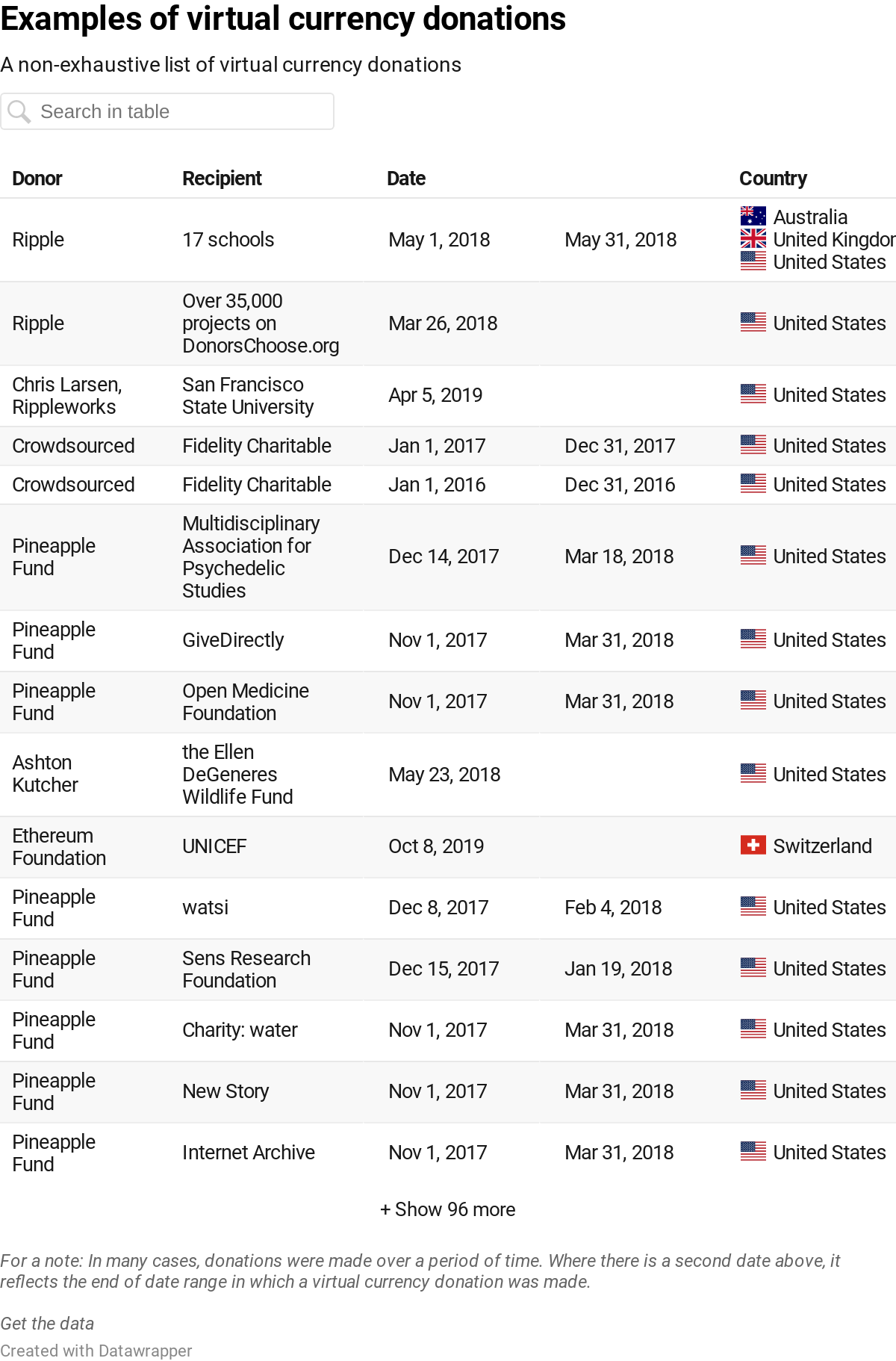
Individuals and companies that have profited from new asset classes can often make donations of these assets to CSOs. In the case of virtual currency, donors are occasionally embracing novel approaches in their gifts. In addition to the previously mentioned gifts to 60 charities from Pine, whose “Pineapple Fund” donated over $50 million worth of bitcoins,16 a virtual currency company donated the equivalent of $29 million to fund classroom projects listed on the education crowdfunding platform, DonorsChoose.17 These strategies are both intriguing and unconventional.
Smaller virtual currency donations from either individuals or organizations to their charities of choice are more common. For example, Fidelity Charitable reported $106 million in virtual currency donations since it started accepting these donations in 2015, including $30 million in 2018.18 All told, Fidelity Charitable estimates that in 2018 the United States saw over $1.3 billion in charitable donations of non-publicly traded assets, including virtual currencies, nearly three times more value than similar donations in 2014.19 Overall, however, virtual currency donations remain quite low relative to other forms of donation. One report estimates that only 2 percent of U.S. and Canadian charities accept Bitcoin.20 And the $30 million in virtual currency donations to Fidelity Charitable accounted for less than 1 percent of the over $9 billion donated to Fidelity Charitable in 2017.21
All told, Fidelity Charitable estimates that in 2018 the United States saw over $1.3 billion in charitable donations of non-publicly traded assets, including virtual currencies, nearly three times more value than similar donations in 2014
More broadly, while there has not been a concerted effort to catalog those donations—in part because they are frequently pseudonymous and challenging to track—our research has found over $200 million in publicly-recorded donations of virtual currency to charities across the world. This $200 million is both a significant figure on its own and yet still a relatively small figure compared to total annual charitable donations, which are estimated to reach over $400 billion in the United States alone.22
Virtual currency donations to charities could be transacted in a number of ways. But the most common mode we observe at the moment is a simple donation to an existing nonprofit through a website where the method of payment is from and to a virtual currency wallet—as opposed to a credit card or wire transfer.
For instance, during the recent wave of fires in Australia, the Australian Rural Fire Service raised over USD $1,500 in Bitcoin donations.23 In addition, we found a wide variety of organizations that have received donations made in virtual currencies: online knowledge communities such as the Wikimedia Foundation,24 journalistic organizations like the Freedom of the Press Foundation,25 houses of worship like a mosque in the United Kingdom26 and several churches in the United States,27 the Seattle Children’s Hospital,28 and the United Nations Children’s Fund (UNICEF).29
New America created and maintains the Blockchain Impact Ledger, a database of projects that harness virtual currencies and blockchains for social impact, and which demonstrate ways in which these technologies are being used around the world to address the United Nations Sustainable Development Goals.30 While virtual currencies currently play a small role in the overall work of civil society, the extant use cases and growth of virtual currencies in both civil society and other sectors suggests that increased future activity is likely.
The trajectory of virtual currency donations will be affected by the evolution of laws and regulations—including potential tax benefits—applied to those donations. Emerging laws or regulations that restrict movements of virtual currency, donations, or treat virtual currencies differently from fiat for donation purposes could have a chilling effect on donations.

Virtual Currency Donations
- Executive Summary
- Introduction
- About Our Organizations
- Methodology and Terminology
- First Principles of Civil Society
- Blockchain and Digital Currency
- Use Cases
- Key Findings
- Other Findings
- Conclusion
- Appendix 1: Virtual Currency Terminology
- Appendix 2: International Highlights
- Appendix 3: Australia
- Appendix 4: Bermuda
- Appendix 5: Canada
- Appendix 6: Denmark
- Appendix 7: Malta
- Appendix 8: Singapore
- Appendix 9: South Africa
- Appendix 10: Switzerland
- Appendix 11: United Kingdom
- Appendix 12: United States
Citations
- Helen Partz, Pineapple Fund Writes Farewell Post, Reports That All Funds Have Been Donated, Cointelegraph (May 11, 2018) (https://cointelegraph.com/news/pineapple-fund-writes-farewell-post-reports-that-all-funds-have-been-donated
- Niraj Chokshi, How to Get $29 Million for Classroom Projects? Just Ask, The New York Times (Mar. 30, 2018), https://www.nytimes.com/2018/03/30/us/donors-choose-donation-ripple.html
- Fidelity Charitable, 2019 Giving Report, https://www.fidelitycharitable.org/content/dam/fc-public/docs/insights/2019-giving-report.pdf at 15.
- Id.
- The Giving Block, Cryptocurrency Fundraising: Key Findings from the Global NGO Technology Report 2019 (Oct. 14, 2019), https://www.thegivingblock.com/post/cryptocurrency-fundraising-key-findings-from-The-global-ngo-technology-report-2019 ; see also, Nonprofit Tech for Good, Global NGO Technology Report 2019 https://www.funraise.org/techreport
- Michael Theis, 10 Largest Donor-Advised Funds Grew Sharply in 2018, The Chronicle of Philanthropy (Dec. 10, 2019), https://www.philanthropy.com/article/10-Largest-Donor-Advised-Funds/247685
- National Philanthropic Trust, Charitable Giving Statistics (accessed Feb. 14, 2020), https://www.nptrust.org/philanthropic-resources/charitable-giving-statistics/
- Christine Vasileva, Bitcoin for Charity: BTC Donations are on for Australian Bush Fires, Bitcoinist (Jan. 4, 2020), https://bitcoinist.com/bitcoin-donations-for-australian-wild-fires/
- Lisa Gruell, Wikimedia Foundation Now Accepts Bitcoin, Wikimedia Blog (July 30, 2014), https://blog.wikimedia.org/2014/07/30/wikimedia-foundation-now-accepts-bitcoin/ ; see also Sydney Ember, Wikipedia Begins Taking Donations in Bitcoin, The New York Times (July 30, 2014), https://dealbook.nytimes.com/2014/07/30/wikipedia-begins-taking-donations-in-bitcoin/
- Freedom of the Press Foundation, You can now support Freedom of the Press Foundation Using Cryptocurrency (June 18, 2018), https://freedom.press/news/you-can-now-support-freedom-press-foundation-using-cryptocurrency/
- Reuters, Looking for new way to Donate During Ramadan? London mosque now Accepts Bitcoin (May 28, 2018), https://www.reuters.com/article/us-religion-ramadan-crypto-currency/looking-for-new-way-to-donate-during-ramadan-london-mosque-now-accepts-bitcoin-idUSKCN1IT1EU
- See, e.g., Daniel Cawrey, St. John’s is ‘world’s first Catholic church to accept bitcoin’, CoinDesk (Apr. 15, 2014), https://www.coindesk.com/saint-johns-becomes-worlds-first-catholic-church-accept-bitcoin-donations ; Fern Creek United Methodist Church, Bitcoin Donations (last accessed Apr. 8, 2020), https://ferncreekumc.org/donate/bitcoin/
- Nikhilesh De, CryptoKitties Charity Auction Raises $15K for Children’s Hospital, CoinDesk (May 25, 2018), https://www.coindesk.com/cryptokitties-charity-auction-raises-15k-for-childrens-hospital
- United Nations Children’s Fund, UNICEF launches Cryptocurrency Fund (Oct. 8, 2019), https://www.unicef.org/press-releases/unicef-launches-cryptocurrency-fund
- New America, Blockchain Impact Ledger, https://www.newamerica.org/digital-impact-governance-inititiative/blockchain-trust-accelerator/reports/blockchain-impact-ledger/introduction/ (last accessed Jan. 22, 2020).