Twitter is one of the world’s most popular social media platforms,113 with over 330 million monthly active users around the globe.114 Like other social media platforms, Twitter has been heavily scrutinized for its role in facilitating the spread of misinformation and disinformation, particularly related to COVID-19. In response, Twitter launched a range of initiatives and efforts, which are documented, alongside regular updates, in an online repository hosted on the company’s website.115
In January 2020, the company shared that it expanded its dedicated search prompt feature to ensure content from authoritative sources appears at the top of search results related to COVID-19. According to the company, this feature is now available in approximately 70 countries, and the company has partnered with national public health agencies, the WHO, and local partners to ensure users have access to verified information.116 Twitter has also prevented its auto-suggest feature from directing users to misleading sources when they enter COVID-19 related search terms.117 This change was part of an expansion of the company’s “Know the Facts” prompt,118 which was established in 2019 to provide users with access to clear, legitimate information related to immunizations and vaccinations.119
Like Facebook, Twitter has stated that it is increasingly relying on automated and machine learning tools to moderate content during the pandemic.120 In particular, these automated tools will be used to identify reports related to pieces of content that are likely to cause harm and surface them for priority review and proactively identify violating content before it is reported.121 As a result of this increased reliance on automated tools, users have been told to expect more moderation errors.122 Consequently, the company has said it will not permanently suspend any accounts as a result of automated enforcement decisions. The company has also said it will maintain its appeals process, although there may be delays, and it will implement human review procedures where possible.123 The company shared that, during this pandemic, it will prioritize the review of content that poses a direct risk to the health and well-being of individuals124 and that content that requires contextual analysis, including misleading content related to the pandemic, will undergo human review.125 The platform has warned, however, that it will not be able to review every tweet that contains misleading or disputed information about the virus during this time.126
In addition, Twitter has responded to the rapid spread of misleading information related to the virus on the platform by expanding its definition of harmful content to include content that goes against guidance provided by “authoritative sources of global and local public health information.”127 Twitter enforces these policies with the support of its trusted partners, which include public health authorities and governments, and reviews content flagged for violating these policies against information provided by these trusted partners.128 In addition, the platform has shared that it will continue to enforce its policies on platform manipulation during this time, which prohibits the use of the Twitter platform “in a manner intended to artificially amplify or suppress information or engage in behavior that manipulates or disrupts people’s experience on Twitter.”129 The company has said that it has not yet seen any major coordinated platform manipulation efforts related to the virus.130
On April 22, the company also announced that it will prioritize the removal of content that could lead to the destruction or damage of critical 5G infrastructure.131 This policy shift is in response to the spread of an internet conspiracy theory that claims radio waves emitted by 5G technology are eliciting changes in people’s bodies that make them more susceptible to the coronavirus. The spread of such misinformation has resulted in dozens of acts of arson against wireless towers and telecom equipment, as well as the harassment of countless telecom employees in many countries.132
Under Twitter’s COVID-19 content policies, the company does not permit tweets that:
- Deny global or local health authority recommendations (e.g. related to social distancing)
- Deny established scientific facts about transmission of the virus and the difference between the virus and other diseases
- Promote unproven or harmful treatments, protection measures, diagnostic criteria, and cures for the virus
- Share claims that intend to manipulate behavior to support a third-party (e.g. the virus is not real, leave your house and support business X)
- Propagate information that creates panic, unrest, and disorder
- Share claims made by an individual who is impersonating a government or health official or organization (e.g. parody accounts)
- Promote the notion that certain nationalities or groups are more or less susceptible to the virus133
The company has outlined, however, that it may apply its public interest exception policy to cases in which world leaders and elected and other government officials have violated these COVID-19 content guidelines. In these cases, the company will determine that there is public interest value in keeping the content on the service, such as, the public will be able to know that these leaders are publishing misinformation. Therefore, instead of removing the content, Twitter will place the content behind a notice that provides context about the violation and allow people to view the content only if they wish to see it.134 Users have a right to access information, including from world leaders and elected and other government officials, as well as a right to know what their leaders are saying, especially during a crisis period such as this one. Online platforms are a major outlet for information and as a result companies should institute such a public interest exception and notice policy. However, companies should institute this policy responsibly. If a leader’s content violates the platform’s content policies, in most cases, it should be left up with a clear notice that explains why the content has been left up. In addition, this content should be fact-checked and platforms should provide additional context to users in the notice detailing whether the post contains misleading information. However, if content posted by these leaders poses imminent harm, platforms should remove this content just as they would for content from anyone else, as it can have significant offline consequences.
In an update on April 1, the company shared that since the expansion of its content policies during the pandemic, the company has removed over 1,100 Tweets with misleading and harmful content, and its automated tools have challenged over 1.5 million accounts for spam or manipulative behavior in COVID-19 discussions.135 These periodic updates are valuable for providing transparency and accountability around the platform’s efforts to combat misleading content during the pandemic. However, the company’s existing Twitter Rules Enforcement report does not currently cover moderation of misleading content. Going forward, Twitter should continue to provide periodic updates on its moderation efforts during the pandemic. Following the pandemic, the company should publish a comprehensive COVID-19-specific transparency report outlining the scope and scale of these moderation efforts during the pandemic as a whole. Further, the company should begin regularly reporting on the moderation of misleading content in its regular transparency report.
On May 11, Twitter also announced that it will begin appending labels to tweets that feature potentially misleading or harmful information related to the virus. These labels will direct users to a page, curated by the company or by an external trusted source, that contains additional information on the content of the tweet. The company has also stated that it will append a warning to certain tweets depending on their “propensity for harm and type of misleading information.” These warnings will notify users, before they view the tweet, that the information in the tweet goes against public health guidance. The company shared an infographic,136 included below, that outlines the scenarios in which the company would add a label, add a warning, remove, or take no action against a tweet that potentially contains misinformation during this time. Labels may be visible on tweets even when they are embedded or when they are being viewed by individuals who are not logged in.137 This new policy will also apply to posts shared by public officials, and may be applied retroactively.
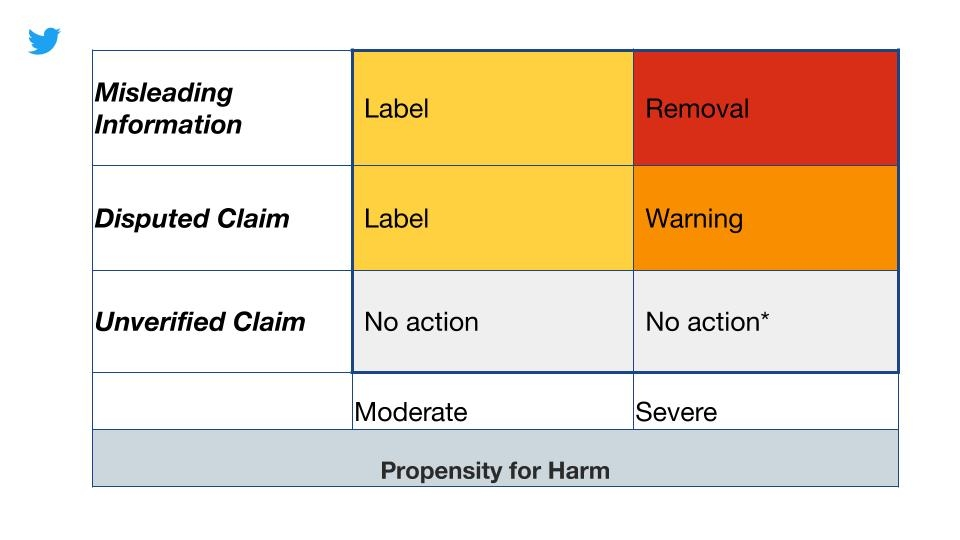
According to Twitter, the company will use its internal tools to proactively monitor content on the platform and to make sure that the company is not amplifying content by appending labels to them. Twitter is also working with its trusted partners to flag content that could yield harmful offline consequences, and will be prioritizing the review and labeling of content that could result in increased exposure to or transmission of the virus.138
As previously highlighted, advertising can also be a source of COVID-19-related misinformation and disinformation. As a result, Twitter has introduced new rules that only permit advertisers to explicitly or implicitly mention the virus in their ads if they are discussing “adjustments to business practices and/or models in response to COVID-19” and “support for customers and employees related to COVID-19.”139 Twitter does not permit advertisers to run ads that feature sensational content and inflated product prices, or which are for products that are in high demand as a result of the pandemic (e.g. face masks, alcohol hand sanitizers, etc.).140 Under Twitter’s political ads content policy,141 news publishers receive an exemption to these advertising rules and are able to promote content that discusses vaccines, treatments, and test kits.142 The company is also permitting government entities to disseminate public health information through advertising on the platform. Further, Twitter is using its “Ads for Good” program to provide advertising credit to nonprofit organizations so that they can run advertising campaigns for fact-checking services and promote reputable health information.143
During the pandemic, Twitter should publish periodic updates on its ad enforcement efforts, including the number of ads the company has removed for violating its COVID-19-specific ad policies and the number of ads that were erroneously permitted. Following the pandemic, Twitter should publish more comprehensive data outlining the scope and scale of its ad enforcement efforts during this time, especially as they relate to COVID-19-specific advertising policies. In addition, where appropriate, the FTC should enforce Section (5)(a) of the FTC Act, and hold businesses and sellers accountable when they engage in unfair and deceptive trade practices through online ad campaigns.
Citations
- Clement, "Most Popular," Statista.
- "Twitter by the Numbers: Stats, Demographics & Fun Facts," Omnicore, last modified February 10, 2020, https://www.omnicoreagency.com/twitter-statistics/
- "Coronavirus: Staying Safe and Informed on Twitter," Twitter Blog, https://blog.twitter.com/en_us/topics/company/2020/covid-19.html.
- "Launch Of A New Dedicated #KnowTheFacts Search Prompt," Twitter Blog, last modified January 29, 2020, https://blog.twitter.com/en_us/topics/company/2020/covid-19.html#knowthefacts.
- "Launch Of A New Dedicated," Twitter Blog.
- Del Harvey, "Helping You Find Reliable Public Health Information On Twitter," Twitter Blog, entry posted May 10, 2019, https://blog.twitter.com/en_us/topics/company/2019/helping-you-find-reliable-public-health-information-on-twitter.html.
- Harvey, "Helping You Find," Twitter Blog.
- Vijaya Gadde and Matt Derella, "An Update On Our Continuity Strategy During COVID-19," Twitter Blog, entry posted March 16, 2020, https://blog.twitter.com/en_us/topics/company/2020/An-update-on-our-continuity-strategy-during-COVID-19.html.
- Gadde and Derella, "An Update," Twitter Blog.
- Gadde and Derella, "An Update," Twitter Blog.
- Gadde and Derella, "An Update," Twitter Blog.
- Gadde and Derella, "An Update," Twitter Blog.
- Gadde and Derella, "An Update," Twitter Blog.
- Gadde and Derella, "An Update," Twitter Blog.
- Gadde and Derella, "An Update," Twitter Blog.
- Gadde and Derella, "An Update," Twitter Blog.
- "Platform Manipulation and Spam Policy," Twitter General Guidelines and Policies, last modified September 2019, https://help.twitter.com/en/rules-and-policies/platform-manipulation
- "Our Zero-Tolerance Approach To Platform Manipulation," Twitter Blog, last modified March 4, 2020, https://blog.twitter.com/en_us/topics/company/2020/covid-19.html#zero-tolerance
- "Broadening Our Guidance On Unverified Claims," Twitter Blog, last modified April 22, 2020, https://blog.twitter.com/en_us/topics/company/2020/covid-19.html#unverifiedclaims
- Adam Satariano and Davey Alba, "Burning Cell Towers, Out of Baseless Fear They Spread the Virus," The New York Times, April 10, 2020, https://www.nytimes.com/2020/04/10/technology/coronavirus-5g-uk.html
- Gadde and Derella, "An Update," Twitter Blog.
- "World Leaders On Twitter: Principles & Approach," Twitter Blog, last modified October 15, 2019, https://blog.twitter.com/en_us/topics/company/2019/worldleaders2019.html
- Gadde and Derella, "An Update," Twitter Blog.
- Yael Roth and Nick Pickles, "Updating our Approach to Misleading Information," Twitter Blog, last modified May 11, 2020, https://blog.twitter.com/en_us/topics/product/2020/updating-our-approach-to-misleading-information.html
- Roth and Pickles, "Updating our Approach," Twitter Blog.
- Roth and Pickles, "Updating our Approach," Twitter Blog.
- "Our Ads Policy For COVID-19," Twitter Blog, last modified April 2, 2020, https://blog.twitter.com/en_us/topics/company/2020/covid-19.html#adspolicy
- "Our Ads Policy," Twitter Blog.
- "Political Content," Twitter Business, https://business.twitter.com/en/help/ads-policies/prohibited-content-policies/political-content.html
- "Our Ads Policy," Twitter Blog.
- " #AdsForGood Support and Additional Protections," Twitter Blog, last modified March 4, 2020, https://blog.twitter.com/en_us/topics/company/2020/covid-19.html#adsforgood