Pandemic Planning for Distance Learning: Scenarios and Considerations for PreK–12 Education Leaders
Acknowledgments
This resource was developed and written by an instructional designer and two former teachers, one of whom (Kristina Ishmael) is a senior project manager with the Teaching, Learning & Tech team in New America’s Education Policy program. We thank Lisa Guernsey, Elena Silva, and Sabrina Detlef for their editorial support. Our work is made possible through generous grants from our Education Policy program funders. For detailed information about our funding, please visit New America’s Our Funding webpage. The views expressed in this report are those of its authors and do not necessarily represent the views of our funders.
Downloads
Introduction
PreK–12 districts are currently considering multiple options for the 2020–21 school year and beyond. Fully returning to traditional in-person settings seems unlikely next year, and recent guidance from the Centers for Disease Control lists the many safeguards that would need to be in place before buildings reopen and students are back to classrooms that resemble what they had before.1 It is clear that some type of distance learning—as well as efforts to ensure all students can get online—must be a part of districts' planning for the next school year and beyond. But terms used to describe distance learning are often muddled and misused, leading to misunderstandings about what students, parents, and teachers should expect.
As educators with expertise in designing, planning for, and implementing learning experiences using online tools and digital materials, we have created this resource to clarify the various types of distance learning that will likely take place this fall, as well as propose four possible scenarios for PreK–12 during and in the wake of this pandemic. In addition, we provide categorized lists of questions and considerations that school and district leaders will need to keep in mind. Where possible we provide links to resources and guidance published by organizations we know and trust that have specialized knowledge on the topics we outline.
These new models of teaching and learning require frequent and transparent communication. In the likelihood of these proposed scenarios, we encourage leaders to be as clear as possible to ensure every student, teacher, support staff, parent, and caregiver remains safe, healthy, and connected. Teachers and support staff need to know they are supported through successes and failures. Students need to know they are seen and heard, despite not always being together in person in school buildings. Parents also need to know they are seen, heard, and supported through these transitions. The well-being of every single stakeholder in and around the school is of utmost importance, and we encourage leaders to check in regularly with their community.
Context
The multidisciplinary field of distance education has been growing for decades, with new models and research emerging regularly to add to an already robust body of knowledge and expertise. Scholars have defined distance education as “planned learning that normally occurs in a different place from teaching, requiring special techniques of course design and instruction, communication through various technologies, and special organizational and administrative arrangements.”2 It is critical to emphasize “planned” within this definition to help us position the systematic considerations, resources, training, and development that are implemented to support distance learning.
The history of K–12 distance learning in the United States began in 1910 in the form of an instructional film.3 As technology evolved, so did distance learning. For example, in the 1920s, the Wisconsin School of the Air used educational radio to serve K–12 students.4 By 1994, K–12 learning via the web emerged from Laurel Springs School, a private school in California.5 At the turn of the century, in the 2000–01 academic school year, 40,000 to 50,000 students were estimated to have enrolled in at least one online course.6 Now, according to the Snapshot 2020 report from the Digital Learning Collaborative, “the percentage of students using digital content for instructional purposes in some form or fashion is approaching 100%” and, while data do not exist on how many online courses are completed by primary or secondary students each year, the report estimates it is at least “several million.”7
In the vast distance education landscape, communication technologies such as radio, television, mobile technology, and the internet act as the delivery methods for distance learning and distance education.8 However, communication technologies are not the sole focus of distance education; rather, distance education is a system that encompasses the benefits and challenges of teaching, learning, policy, and administration. In this context, online learning and online education are the most contemporary methods of delivering and accessing learning experiences in the field of distance education.9 According to Randy Garrison, an education professor at the University of Calgary, there are two approaches to online education.10 The first provides access to tools and employs techniques to deliver content for students to receive independently. The second transforms teaching and learning at a distance by leading educators and students to engage in collaborative communities of inquiry (COI).
During the past two-and-a-half months, educators, parents, and students were thrown into what may be described as crisis distance learning, or an impromptu pivot to distance learning delivery to meet the demands of state-wide shelter-in-place orders and federal recommendations. The spectrum of crisis distance learning ranged from “drive-by” course material pickups to telephone check-ins to haphazard online lesson plans and ad-hoc video conferences, all of which can be considered a low-fidelity migration to support continuity. Not only were students and their families challenged in unique situations, but educators were taking on multiple roles which, in a planned move to a well-structured online distance education system, would typically be distributed to an instructional designer, academic tutor, technology coordinator, librarian, media specialist, or guidance counselor. Furthermore, educational systems were forced to hastily develop and unveil continuity of learning and instructional plans to communicate a path forward. Most of these plans acted as “living documents” (meaning they were being updated even as they were being implemented) to address emergency needs as resources were identified, policies were formalized, and structures were developed.
Crisis distance learning exposed existing inequities in schools and districts. Those with broad access to devices and broadband internet, teachers and support staff already trained to use remote technologies, and families who remained employed and financially secure were vastly more prepared to slip into remote mode and support students. And schools and districts across the board were forced to acknowledge that they did not have systems in place to provide services to students with a range of needs, from English learners to students with disabilities. For example, the application of universal design principles (UDL) and accessibility guidelines was a challenge. In a more planned approach, mobile learning (a subfield of distance learning) could be leveraged to deliver instruction and communicate both synchronously or asynchronously with students if access to the internet or computers is limited. Also, some mobile design principles (such as a focus on intuitive and simple interfaces) are closely related to UDL and accessibility policies; features like voice recognition and the ability to zoom in on text can support students with disabilities while also affording younger learners an opportunity to engage with the content.
A more planned approach will also take better advantage of delivery methods that are both asynchronous (when interactions happen over time) and synchronous (happening in real time). For example, we can shift away from traditional teacher-centered models—in which an educator presents in a one-way delivery method, utilizes a static artifact such as a textbook, and works through a linear assessment plan—and move towards a student-centered learning design. By putting students in the center of the learning process, educators can employ active learning strategies including problem-based learning to encourage both critical thinking and reflection in a meaningful way.11 This kind of teaching and learning can occur in any number of environments, whether in-person, blended, or at a distance (see diagram below on how these overlap). Distance learning is usually facilitated through learning management systems (LMS), online learning environments (OLE), and the integration of asynchronous discussion forums and synchronous video conferencing. These tools help to promote student interactions with classmates, teachers, and class content.
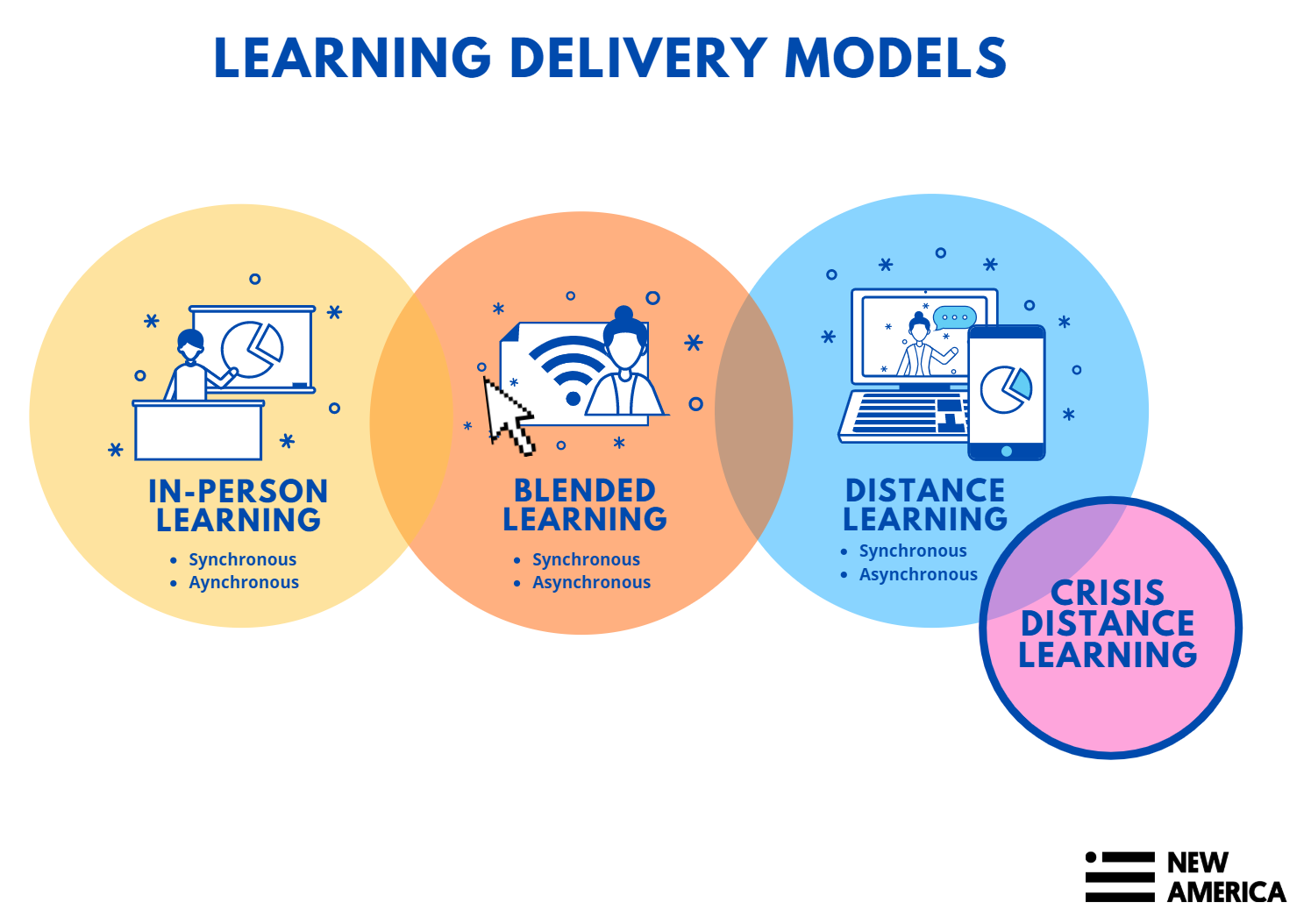
Distance learning, as with other modalities and models, offers advantages and limitations. However, the advantages are not achieved by merely replacing face-to-face content with online content. Instead, we need to map the complexity of the learning delivery models and balance the exchange of educational theory with pragmatic decisions including costs, technical support, accessibility, functionality, and quality assurance standards. We should use self-reflection, inquiry, and analysis to share our experiences, findings, and best practices in order to adopt solutions, strategies, and processes within our own professional communities. Now, with a few months to prepare for the 2020–21 academic school year, we can use lessons from the field of distance education to make decisions from a systems perspective.
Citations
- See the Centers for Disease Control and Prevention (website), https://www.cdc.gov/coronavirus/2019-ncov/community/schools-childcare/schools-decision-tool.html
- Michael Moore and Greg Kearsley, Distance Education: A Systems View of Online Learning, 3rd ed. (Boston, MA: Cengage Learning, 2011), 2, https://books.google.com/books/about/Distance_Education_A_Systems_View_of_Onl.html?id=dU8KAAAAQBAJ
- Paul Saettler, The Evolution of American Educational Technology (Charlotte, NC: Information Age Publishing, 2004), https://www.infoagepub.com/products/The-Evolution-of-American-Educational-Technology
- William Bianchi, “Education by Radio: America's Schools of the Air,” TechTrends: Linking Research and Practice to Improve Learning 52, no. 2 (April 2008): 36–44, https://www.learntechlib.org/p/65567
- Michael Barbour, “The Promise and the Reality: Exploring Virtual Schooling in Rural Jurisdictions,” Education Faculty Publications 128 (2011), https://s3.amazonaws.com/newamericadotorg/documents/The_Promise_and_the_Reality__Exploring_Virtual_Schooling_in_Rural.pdf Laurel Springs School (website), “Laurel Springs School, Pioneer in Online K–12 Education, Marks 20th Anniversary,” January 17, 2012, https://laurelsprings.com/laurel-springs-school-pioneer-in-online-k-12-education-marks-20th-anniversary/
- Tom Clark, "Virtual Schools: Trends and Issues. A Study of Virtual Schools in the United States," a paper commissioned by WestEd for the Digital Learning Resource Network (October 2001), https://eric.ed.gov/?id=ED462923.
- Snapshot 2020: A Review of K–12 Online, Blended, and Digital Learning (Durango, CO: Digital Learning Collaborative, February 2020), 5, 21, https://www.evergreenedgroup.com/s/DLC-KP-Snapshot2020-1.pdf
- In this report, we use the term distance learning to emphasize the learning that takes place through these methods; we use the term distance education when we are reflecting the terminology more commonly used in research studies and historical literature and when we are referring to a full system of education delivered at a distance.
- Joi L. Moore, Camille Dickson-Deane, and Krista Galyen, "e-Learning, Online Learning, and Distance Learning Environments: Are They the Same?" The Internet and Higher Education 14, no. 2 (2011): 129–135, https://eric.ed.gov/?id=EJ916456
- Randy Garrison, "Implications of Online Learning for the Conceptual Development and Practice of Distance Education," Journal of Distance Education 23, no. 2 (2009): 93–103,https://files.eric.ed.gov/fulltext/EJ851906.pdf
- Rebecca Heiser and Penny Ralston-Berg, “Active Learning Strategies for Optimal Learning,” in Handbook of Distance Education, eds. M. Moore and W. Diehl (New York: Routledge, 2019), 281–294.
Definitions
The Aurora Institute (formerly known as iNACOL) published The Online Learning Definitions Project in 2011, from which we draw many of our definitions for this report.12 Where definitions are from other sources, we have cited the source.
| Distance Education | General term for any type of educational activity in which the participants are at a distance from each other—in other words, are separated in space. They may or may not be separated in time (asynchronous vs. synchronous). In this report, the term distance education is used when referring to a system of education, its history, and its many component parts. |
| Distance Learning | In this report, we use the term distance learning when focusing on the learning taking place when teachers and students are separated by distance. |
| Online Learning | A form of distance learning in which instruction and content are delivered primarily over the internet.{{13}} The term does not include print-based correspondence education, broadcast television or radio, videocassettes, and stand-alone educational software programs that do not have a significant internet-based instructional component. Used interchangeably with virtual learning, cyber learning, and e-learning. |
| Mobile Learning | A form of distance learning that originated in 2005 with the emergence of and widespread access to personal electronic devices. |
| Synchronous Learning | Learning in which participants interact at the same time and in the same space. |
| Asynchronous Learning | Learning that occurs in elapsed time between two or more people. Examples include email, online discussion forums, message boards, blogs, podcasts, etc. |
| Blended Learning | Situations in which a student learns at least in part at a supervised brick-and-mortar location away from home and at least in part through online delivery with some element of student control over time, place, path, and/or pace; often used synonymously with hybrid learning. |
| Learning Management System (LMS) | Technology platform through which students access online courses or digital instructional materials. An LMS generally includes software for creating and editing course content, communication tools, assessment tools, and other features for managing the course. |
| Online Learning Environments (OLE) | Online spaces where interactions between teachers and students occur. A number of tools can be used to create or bring OLEs into existence, such as an LMS, a content management system (CMS), a virtual learning environment (VLE), a knowledge management system (KMS), a collaborative learning environment (CLE), or other digital tools associated with the development, administration, and delivery of online learning.{{14}} |
| Video Conferencing | Interactive communication technologies which allow two or more locations to interact via two-way video and audio transmissions simultaneously. Examples of video conferencing tools that have become familiar during the COVID-19 crisis include Zoom, Microsoft Teams, and Google Meet. |
| Universal Design for Learning (UDL) | A framework to improve and optimize teaching and learning for all people based on scientific insights into how humans learn.{{15}} The Aurora Institute applies this definition to online learning in particular, noting that UDL is for the design of learning objects and environments which ensure accessibility for all users. |
| Accessibility | A person with a disability is provided an equal opportunity to acquire information, receive a service, and participate in a learning experience with ease of use and independence. Accessibility must meet the Americans with Disabilities Act (ADA) standards which includes Web Content Accessibility Guidelines (WCAG){{16}} and comply with Individuals with Disabilities Education Act (IDEA) and Section 504 of the Rehabilitation Act. |
Citations
- See the Centers for Disease Control and Prevention (website), https://www.cdc.gov/coronavirus/2019-ncov/community/schools-childcare/schools-decision-tool.html
- Michael Moore and Greg Kearsley, Distance Education: A Systems View of Online Learning, 3rd ed. (Boston, MA: Cengage Learning, 2011), 2, https://books.google.com/books/about/Distance_Education_A_Systems_View_of_Onl.html?id=dU8KAAAAQBAJ
- Paul Saettler, The Evolution of American Educational Technology (Charlotte, NC: Information Age Publishing, 2004), https://www.infoagepub.com/products/The-Evolution-of-American-Educational-Technology
- William Bianchi, “Education by Radio: America's Schools of the Air,” TechTrends: Linking Research and Practice to Improve Learning 52, no. 2 (April 2008): 36–44, https://www.learntechlib.org/p/65567
- Michael Barbour, “The Promise and the Reality: Exploring Virtual Schooling in Rural Jurisdictions,” Education Faculty Publications 128 (2011), https://s3.amazonaws.com/newamericadotorg/documents/The_Promise_and_the_Reality__Exploring_Virtual_Schooling_in_Rural.pdf Laurel Springs School (website), “Laurel Springs School, Pioneer in Online K–12 Education, Marks 20th Anniversary,” January 17, 2012, https://laurelsprings.com/laurel-springs-school-pioneer-in-online-k-12-education-marks-20th-anniversary/
- Tom Clark, "Virtual Schools: Trends and Issues. A Study of Virtual Schools in the United States," a paper commissioned by WestEd for the Digital Learning Resource Network (October 2001), https://eric.ed.gov/?id=ED462923.
- Snapshot 2020: A Review of K–12 Online, Blended, and Digital Learning (Durango, CO: Digital Learning Collaborative, February 2020), 5, 21, https://www.evergreenedgroup.com/s/DLC-KP-Snapshot2020-1.pdf
- In this report, we use the term distance learning to emphasize the learning that takes place through these methods; we use the term distance education when we are reflecting the terminology more commonly used in research studies and historical literature and when we are referring to a full system of education delivered at a distance.
- Joi L. Moore, Camille Dickson-Deane, and Krista Galyen, "e-Learning, Online Learning, and Distance Learning Environments: Are They the Same?" The Internet and Higher Education 14, no. 2 (2011): 129–135, https://eric.ed.gov/?id=EJ916456
- Randy Garrison, "Implications of Online Learning for the Conceptual Development and Practice of Distance Education," Journal of Distance Education 23, no. 2 (2009): 93–103,https://files.eric.ed.gov/fulltext/EJ851906.pdf
- Rebecca Heiser and Penny Ralston-Berg, “Active Learning Strategies for Optimal Learning,” in Handbook of Distance Education, eds. M. Moore and W. Diehl (New York: Routledge, 2019), 281–294.
- The Online Learning Definitions Project (Vienna, VA: iNACOL, October 2011), https://aurora-institute.org/wp-content/uploads/iNACOL_DefinitionsProject.pdf
Scenarios
A return to full in-person teaching and learning in the fall is highly unlikely. Experts are using historical data to predict what will happen this fall and winter, but many school and community leaders acknowledge there are too many unknowns to commit to bringing groups of people together in brick-and-mortar school buildings in the same way as before. Additionally, the CDC guidance released in mid-May suggests that school buildings should not open until a school system is able to protect children and employees at higher risk for severe illness and screen students and employees for symptoms.13 School district leaders are facing difficult decisions on how to proceed with in-person learning, such as reducing the number of students in buildings at any one time and changing hourly, daily, or weekly schedules. These in-person considerations, which will depend on local and state guidance, are numerous, complex, and beyond the scope of our expertise in developing this resource. Our focus here is on the distance learning side of the puzzle.
We have envisioned four scenarios that involve distance learning to varying degrees, and the considerations we pose for leaders are designed to assist in thinking through the distance-learning components of these scenarios. None are perfect solutions—each has its own set of challenges and drawbacks and we recognize that each district is approaching this from different contexts, depending on levels of funding, resources, and support up to now. We lay them out here to simply help leaders think through what might work best for their families and students and to consider how and if to undertake various elements of each.
- Scenario A: Brick to Click Learning
- Scenario B: Click to Brick Learning
- Scenario C: Blended Learning
- Scenario D: Online Learning
Please note that in all of the scenarios below, the cost of making these changes will need to be taken into account. Although we do not attempt to break down costs in this resource, the investment needed to make changes will differ greatly across school districts depending on multiple factors, including whether districts need to consider outlays for extending internet connectivity at home for students and teachers. Moving to these modes of learning requires districts to plan ahead and work with community organizations to ensure that high-speed internet access is available to students in their homes. (For example, schools can partner with city agencies, public libraries, or housing associations to provide portable Wi-Fi hotspots.)
Scenario A: Brick to Click Learning
In scenario A, the ABC school district has decided to resume traditional in-person classes with the flexibility to quickly pivot to distance education in the event of a COVID-19 outbreak. The superintendent of ABC worked closely with county government and health officials to monitor the CDC guidance and state education agency guidelines to reopen in phases.
Over the course of the summer, all teachers and support staff will receive professional development in online learning, ideally spread out over weeks so that they are not asked to digest and process a whole new way of working in a compressed time frame. While the goal is to return to traditional in-person classes, the expectation of all teachers will be to mirror their classrooms in online learning environments. The likelihood of another rise in infections is relatively high, so this model will allow for a quick pivot to online learning. For example, if the number of cases jumps quickly mid-week, the district would send home instructional materials within 48 hours and then continue learning online the following week.
This scenario requires all educators, support staff, students, parents, and caregivers to remain nimble in the likelihood that there are quick changes in the way learning is accessed.
Scenario B: Click to Brick Learning
In scenario B, the EFG school district has decided to start with online learning and plans to resume traditional in-person classes on a modified basis when safe to do so. The superintendent of EFG worked closely with county government and health officials to assess the situation, but deemed it best to start online and continue monitoring public health before resuming school in-person.
Over the course of the summer, all teachers and support staff will receive professional development, ideally spread out over the summer, in how to teach using online learning environments, and professional learning will be ongoing throughout the school year.14 All academic instruction will be conducted online for the duration of the school year, while plans for in-person learning (when safe to resume) will focus on advising and building teacher-student relationships. In-person schedules will allow teachers, support staff, and students to rotate through the buildings following a half-day schedule every day or full-days one to two times per week. In-person classes may not be fully attended, since it will be up to parental and caregiver choice, so teachers and support staff will be expected to maximize their limited time to support students with technology troubleshooting, mental health, social-emotional learning, relationship-building, and special services that are difficult to provide over the internet.
This scenario requires all educators, support staff, students, parents, and caregivers to consider online learning the primary method of working towards competency in a grade level and/or content area, while in-person learning is focused on relationship-building and developing non-academic skills.
Scenario C: Blended Learning
In scenario C, the LMN school district has decided to institute a blended learning model across all schools. Blended learning is a combination of learning that takes place in a school building and in an online environment that can include both synchronous and asynchronous learning opportunities. The leaders of LMN decided on this model because they wanted to offer as regular a school calendar as possible.
Over the course of the summer, all teachers and support staff will receive additional professional learning on how to teach using blended learning methods. The LMN school district will work to ensure some uniformity in schedules across the buildings. Schools may consider one of the seven blended learning models (see Instructional Strategy section below), or any combination thereof. Younger learners may benefit from more in-person instruction if possible, whereas older students may be able work more independently in an online setting. For example, students may have one in-person learning day with the rest of the week’s learning completed online. Schools that already work in a blended environment have the capability to quickly move to full online mode if there is an outbreak of COVID-19, because the coursework already lives online within a learning management system (LMS). Brick-and-mortar activities, such as direct instruction, can be moved to video conferencing, and other face-to-face activities can be adapted for an online experience.
This scenario requires all educators, support staff, students, parents, and caregivers to consistently approach teaching and learning in two delivery formats—in-person and online.
Scenario D: Online Learning
In scenario D, the XYZ school district has decided to move all learning experiences and services online through a proactive, purposeful, and systems-based approach. The superintendent of XYZ chose this delivery model to provide flexibility for all stakeholders through both synchronous and asynchronous modalities and to limit any health and safety risks potentially posed by having students and staff reenter school buildings.
Professional development is needed to prepare for a structured approach for the 2020–21 academic school year. Over the course of the summer, all teachers and support staff will receive at least two weeks (80 additional hours) of professional learning in online learning. In addition to professional development workshops and training on online pedagogy and the technology tools, the XYZ school district recognizes the value and the power in developing mentoring relationships and learning communities for ongoing continuous knowledge and improvement. Furthermore, the technical infrastructure needs to take an “all-hands-on-deck” approach to provide scalable, secure, and intuitive solutions that support state and federal policies.
Because this scenario means that teachers never see their students in person, it requires all educators, support staff, students, parents, and caregivers to find ways to use communication technologies (even phone calls) to pay close attention to the development of each child and ensure that appropriate grade-level growth is happening while learning takes place at a distance. In addition, it may be a scenario that is most appropriate for high schools and middle schools only; requiring younger students to do all work online at home would require an adult to be at home with them, which puts a large burden on working parents.
Citations
- See the Centers for Disease Control and Prevention (website), https://www.cdc.gov/coronavirus/2019-ncov/community/schools-childcare/schools-decision-tool.html
- Michael Moore and Greg Kearsley, Distance Education: A Systems View of Online Learning, 3rd ed. (Boston, MA: Cengage Learning, 2011), 2, https://books.google.com/books/about/Distance_Education_A_Systems_View_of_Onl.html?id=dU8KAAAAQBAJ
- Paul Saettler, The Evolution of American Educational Technology (Charlotte, NC: Information Age Publishing, 2004), https://www.infoagepub.com/products/The-Evolution-of-American-Educational-Technology
- William Bianchi, “Education by Radio: America's Schools of the Air,” TechTrends: Linking Research and Practice to Improve Learning 52, no. 2 (April 2008): 36–44, https://www.learntechlib.org/p/65567
- Michael Barbour, “The Promise and the Reality: Exploring Virtual Schooling in Rural Jurisdictions,” Education Faculty Publications 128 (2011), https://s3.amazonaws.com/newamericadotorg/documents/The_Promise_and_the_Reality__Exploring_Virtual_Schooling_in_Rural.pdf Laurel Springs School (website), “Laurel Springs School, Pioneer in Online K–12 Education, Marks 20th Anniversary,” January 17, 2012, https://laurelsprings.com/laurel-springs-school-pioneer-in-online-k-12-education-marks-20th-anniversary/
- Tom Clark, "Virtual Schools: Trends and Issues. A Study of Virtual Schools in the United States," a paper commissioned by WestEd for the Digital Learning Resource Network (October 2001), https://eric.ed.gov/?id=ED462923.
- Snapshot 2020: A Review of K–12 Online, Blended, and Digital Learning (Durango, CO: Digital Learning Collaborative, February 2020), 5, 21, https://www.evergreenedgroup.com/s/DLC-KP-Snapshot2020-1.pdf
- In this report, we use the term distance learning to emphasize the learning that takes place through these methods; we use the term distance education when we are reflecting the terminology more commonly used in research studies and historical literature and when we are referring to a full system of education delivered at a distance.
- Joi L. Moore, Camille Dickson-Deane, and Krista Galyen, "e-Learning, Online Learning, and Distance Learning Environments: Are They the Same?" The Internet and Higher Education 14, no. 2 (2011): 129–135, https://eric.ed.gov/?id=EJ916456
- Randy Garrison, "Implications of Online Learning for the Conceptual Development and Practice of Distance Education," Journal of Distance Education 23, no. 2 (2009): 93–103,https://files.eric.ed.gov/fulltext/EJ851906.pdf
- Rebecca Heiser and Penny Ralston-Berg, “Active Learning Strategies for Optimal Learning,” in Handbook of Distance Education, eds. M. Moore and W. Diehl (New York: Routledge, 2019), 281–294.
- The Online Learning Definitions Project (Vienna, VA: iNACOL, October 2011), https://aurora-institute.org/wp-content/uploads/iNACOL_DefinitionsProject.pdf
- See “Schools During the COVID-19 Pandemic,” a one-page decision tree document published on or before May 14, 2020 by the Centers for Disease Control and Prevention, https://www.cdc.gov/coronavirus/2019-ncov/community/schools-childcare/Schools-Decision-Tree.pdf
- For more on developing effective ongoing professional learning, see Melissa Tooley’s “What Does High-Quality Research Say About Developing Teacher Practice?,” a New America blog post summarizing a 2017 report that outlines promising practices for growing teachers’ knowledge and skills in service of their students., https://www.newamerica.org/education-policy/edcentral/what-does-high-quality-research-say-about-developing-teacher-practice/
Elements to Consider
The following questions are intended to help district and school leaders think about the multiple dimensions of their systems affected by moving to a “brick to click,” “click to brick,” blended learning, or online learning model. Some of the questions are followed by footnotes; click on the superscript number to see quick links to resources specific to that topic. An annotated list of resources is at the end of this report.
Operational Management and Administration
- Mission, Vision, Goals, and Strategic Plans: How will you continue to work towards meeting these when education is delivered online?
- Policy Alignment: How will your school district administer, deliver, and sustain high-quality distance education that aligns with state and federal policy?
- Strategic Staffing: Will your school district identify and hire instructional designers, student support specialists, IT support and technology infrastructure administrators, leadership managers and executives, and administrative support staff?15
- Budgets: Could you revise budgets to purchase new technologies, hire additional staff, and fund student support services? How will you determine equitable, cost-effective, and scalable technology tools to deliver course content and material; support teacher and student interactions; and manage administrative procedures like student services, financial accounts, student enrollment and registration, and quality assurance procedures? Many operating costs will shift from supporting physical facilities to purchasing technology tools and infrastructure.
- Timeline: How will you create a well-defined timeline for faculty and staff to implement course materials and instructional components in an online format? In most cases, it takes months to develop, design, and implement online courses. Using project management skills to articulate a scope of work, outline tasks, and define who will complete the task and when is critical. Will you pilot various approaches? Will you develop benchmarks? Will you expand cross multiple phases?
- Change Management: How will you prepare for a systemic and cultural shift? For those shifting to a student-centered instructional approach (which, as noted above, could be supported by technology-assisted pedagogical methods, such as acting on student ideas emerging from conversation encouraged in online chats), how will this change teachers’ perceptions of their roles?
- Communication: How will you communicate decisions quickly, safely, and effectively with staff, students, and families?
- Staff Meetings: How will you deliver scheduled and ad-hoc staff meetings both in person (using social distancing measures) and online?
- Staff Communication: Which communication channels will you use? Will your IT department support specific tools (Microsoft Teams, Slack, Google Groups, etc.)?
- Bussing: Families are supported in however they choose to get their children to/from schools. If considering bussing options, how will students be seated on the bus? What types of screening for symptoms might be conducted before children get on the bus? How will drivers sanitize buses between routes? What health and safety precautions will be taken for bus riders and drivers?
Professional Learning
- Summer: How will you use the summer months to provide professional development on how to teach using online tools and digital materials? How will teachers be involved in making decisions about what instructional materials should be integrated into course content online?16
- Ongoing Support: How can professional learning be better embedded in the week-to-week routines of teachers and made relevant to specific challenges they face in their virtual or in-person classrooms?
- Teacher-Led: How could you take advantage of this moment to build more opportunities for teachers to take the lead in developing and implementing professional learning. How might you encourage collaboration across teacher teams?17
- Professional Learning Community (PLC) or Department Meetings: How will these meetings be scheduled and delivered virtually?
Policy, Standards, and Assessment
- Attendance and Participation: Consider shifting terminology from attendance to participation. Participation may look like attending in person, attending synchronous classes, submitting work, participating in discussion boards and office hours, and contributing to learning journal reflection blogs. How will you determine the criteria for participation? How will your school district determine its attendance window for state reporting?
- Grading: When done well, blended and online learning presents the same level of rigor (in both content and expectations for student learning) as in-person learning, and grading scales should remain consistent. In what ways can students show mastery of standards and skills expected in each content area and grade level? How can grading reflect that? How often are teachers expected to update grades? How will you communicate with parents regarding failures or lack of student engagement?
- Instructional Time: District leaders should not expect teachers, support staff, and students to continue the average amount of instructional time for in-person courses. How will your school district make adjustments for synchronous and asynchronous learning times?18
- Teacher Evaluations: How will you determine what constitutes best practices for blended and online instruction, and how will you modify teacher evaluation processes to reflect those? How can best practices in blended and online schools be applied to assess how teachers are effectively leading? How will you consult with your state education agency and teachers’ union to approve teacher evaluation?
- Course Quality: Not only does online learning need to meet state learning standards, but it also needs to meet quality standards defined by third-party evaluators in the field. How are courses being evaluated for standards-alignment, rigor, and more?19
- Assessment: In online environments, schools will need to implement new ways of measuring students’ growth and determining whether they have mastered new skills and concepts. How will you use assessment to continue driving instruction and ensure tests are administered with integrity? For example, the LMS may have options that can be enabled to employ proctoring services and tools to reinforce academic integrity, such as a lockdown browser. What approaches will you ask your teachers to take and what tools will they need? What will you do to measure and address learning loss from the spring semester of 2020?
Information Technology
- District-Issued Devices: Devices administered by a school district are the property of the district. What devices do students have access to for online learning? How will the devices be distributed, monitored, repaired when necessary, and returned? Will different devices be used for primary versus secondary students? How will work and data on these devices be maintained and kept safe through various cloud infrastructures (Box, G Suite, Dropbox)?
- Connectivity: Are you certain all students can get online at home?20 What is your plan for assessing the connectivity needs of your students21 Could schools establish partnerships with community organizations, such as public libraries, to provide hotspots for home use or to set up Wi-Fi areas in parking lots and other spaces where students can go online at a safe distance?
- Tools: Which tools already vetted and approved by the school district will be used to conduct teaching and learning in person and online? If there are additional ed tech tools needed to execute certain activities, what is the process of getting these approved by the district in an expedited manner to avoid any interrupted learning?
- Learning Management System (LMS): In order to efficiently and effectively deliver content online, it is critical to have an LMS in place. What LMS will your district use? How will teachers and support staff be trained on it? Will a different LMS be used in primary versus secondary schools? Most LMS have an integration with the school's student information system (SIS) in order to populate courses and enroll students. How will this be handled? Who will be in charge of enrolling students in courses?
- District-Supplied Email: Will all students have access to a district-supplied email account?
- Audio/Video Conferencing: Synchronous learning modalities require these systems. Which audio/video conference tool will your school district use? How can you ensure that it is Family Educational Rights and Privacy Act (FERPA) and Children's Online Privacy Protection Act (COPPA) compliant to maintain student data privacy?
- Single Sign-On: Consider whether your school district should use single sign-on. How would a single sign-on ease student access to all district-approved software?
- Acceptable Use Policies (AUP) and Responsible Use Policies (RUP): Students will need training on AUP and RUP for all technology. How will your school district provide training and ensure each student has completed it prior to signing the policy agreement?
- Data Security and Privacy: All teachers and support staff need training on upholding data security and privacy when outside of the physical school building and when it comes to posting student work and information. How are IT teams delivering this training and how are they ensuring that every teacher and support staff has successfully completed it? Authentication and password protections help ensure designated people have access to courses, content, and information. How will your school district designate these people? Will teachers and support staff be considered, or will it only be IT staff? Who will communicate these policies and standards in easily digestible formats to teachers, support staff, students, parents, and caregivers?22
- Content Management System (CMS): Teachers and support staff will need access to all of their courses, instructional materials, and resources in one place. How will a CMS be used to provide ease of use for teachers and support staff?
Social, Emotional, and Academic Support Services
- School Counselors, Psychologists, and Nurses: Teachers will need access to and training in trauma-informed practices. This can help them identify when students may be struggling without directly asking for help. How will students access the services of counselors and psychologists when online? How can their interactions remain safe, secure, and confidential? How can telehealth services, including mental health services, be provided to students and staff?
- Librarians and Media Specialists: How can school librarians and media specialists continue to collaborate with teachers, support staff, and students in an online environment? How can physical books and artifacts be shared with students? How can school librarians and media specialists ensure that every student has access to the digital collections available? How can librarians develop consortium partnerships to increase access to library resources, catalogs, and information systems? How can your school districts dedicate full-time librarian support for learners at a distance?
- Extracurricular Programs: How will extracurricular clubs continue when moving online? Will they regularly meet online like they do in person? Which sports will be able to offer training and exercise routines in safe ways, and will they still have access to tracks, fields, and equipment? What is the role of club sponsors, coaches, and program directors in blended or online environments?
Content and Materials
- Print Instructional Materials and Manipulatives: How will print instructional materials be accessed digitally? Will your district allow students to take print instructional materials and manipulatives (blocks, beads, puzzles, and other physical learning tools) home when transitioning to online?
- Digital Instructional Materials: How are your digital instructional materials accessed? Is it through a specific platform or is it pushed out through the LMS? Can every student and parent access them? How will they be organized (e.g., modules, folders, calendar, etc.)?
- Open Educational Resources (OER): OER are freely available resources that can be downloaded, edited, and shared. How will your district take advantage of OER? How might you leverage this growing body of resources to support online and blended teaching and learning?23
- Culturally Relevant and Responsive: How will you work to bring digital materials into blended and online courses that are relevant to your students and that include characters, historical figures, or stories to which they can relate?24
- Purchased, Curated, or Created: What currently owned instructional materials will support this type of learning? Will additional instructional materials need to be procured? Will purchased materials serve every learner? Will your school district curate resources? Will your school district create resources? How and by whom will these resources be reviewed for standards-alignment and quality?
- Multimodal: How will presentations, videos, text, interactives, images, audio files, and simulations be adaptable to an online format or experience? Will students have access to tools that enable them to create and view these materials?
- Library Collection: How might you partner with public libraries to share digital collections and enable students, parents, and educators to obtain public library cards for checking out e-books and participating in virtual programming?
Instructional Strategy
- Instructional Practice: Some schools were already shifting their instructional practices toward inquiry-based learning prior to Spring 2020 a move that enables students to have more agency over their learning and be more engaged in content. How will you approach inquiry-based learning in an online learning environment? How will leaders support shifting instructional practice to encourage more inquiry-based learning or project-based learning?
- Blended Instructional Models: In order to increase engagement and accountability in all four of our scenarios, teachers and support staff may consider blended instructional models. How can teachers of different grade levels use these various instructional models?25
- Digital Tools: How can teachers, support staff, and students utilize video conferencing and other digital tools (e.g., screen sharing, white boards, recorded lessons, chat rooms, etc.) to collaborate, communicate, create, and problem-solve?
- Collaboration: How can teachers collaborate with students to ask thoughtful questions, seek out answers, research, and create projects showing their learning?
- Prioritizing Human Relationships: Shifting to an online environment can affect the one-on-one relationships needed to support each student’s social-emotional development and academic and cognitive growth. How will you use technology to assist in preserving or developing relationships (using online translation services, for example) while prioritizing human relationships and human-to-human interaction?26
Special Populations
- Special Education Services: Every teacher and support staff member should know which students are on an Individualized Education Plan (IEP) or 504 Plan (named after a section of the Rehabilitation Act of 1973) and what accommodations and modifications are required for their students’ learning experiences. How will these plans be shared with other teachers and support staff? How will classroom teachers, special education teachers, and paraeducators provide services in the online learning environment? How will occupational therapy, physical therapy, and/or speech/language therapy continue online?27
- English Language Learner Services: Every teacher and support staff member should know which students are identified as English learners and their level, as well as what accommodations and modifications are required for learning. How will these plans/files be shared with other teachers and support staff? How will classroom teachers, English learner teachers, and paraeducators provide services in the online learning environment? How and when will English learners be assessed for reclassification?28
- Linguistic Diversity and Language Support: Which digital materials will need to be offered in languages other than English? Will translation services and translation tools be made available to students and their families?29
- Multi-Tiered Systems of Support (MTSS): How will students receiving tiered interventions continue to receive small group/specialized instruction? How often will benchmarks be given to assess whether students need to change tiers? When will these discussions take place with teachers and support staff?
- Student Characteristics and Preferences: Online learning can be more inclusive, if thoughtfully and purposely designed and supported with teacher facilitation. How will your school district assess student characteristics and preferences in their learning? How will these data be used in course creation and delivery?
- Accessibility and Universal Design for Learning (UDL): Online learning reduces barriers for students with disabilities if UDL principles are embedded in course content. How will your school district ensure classes are accessible? How can instructional designers be leveraged to help design classes using UDL principles?30
Parental and Caregiver Engagement
- Parent and Caregiver Access: Will parents and caregivers have access to the digital tools their children are using? How will they get access to these tools and platforms?
- Parent and Caregiver Training: Some of these devices and tools are new to parents and caregivers. What training will be provided to help them feel comfortable with their use? How will your school district develop and share resources, including documentation and getting started activities, for parents and caregivers on technologies their children will be using? How can your school district provide basic tutorials on how to use LMS (even if these are from the student’s point of view) and other tools?
- Parent and Caregiver Communication: How will you ensure multiple communication channels are used to reach every parent and caregiver? What translation and interpretation services will be required to reach non-English speaking families? When and how often will your school district engage parents and caregivers?
- Parent and Caregiver Learning Community: Just as students in these new scenarios need community, so too do their parents and caregivers. How will your school district encourage parents and caregivers to develop a learning community where they can connect synchronously and asynchronously? Are there tools/platforms that the school district uses that could also be used with parents and caregivers?
- Tutoring: Will you provide parents and students with resources and guidance for connecting with online tutoring or one-on-one support
- At-Home Learning Environment: How can you help parents and family members create opportunities for studying, learning, and connecting? What kinds of at-home adventures and games (scavenger hunts within apartment buildings, online bingo, word puzzles, and more) can you facilitate that would bring families together for learning moments, especially in households with young children? In situations where space is limited and more than one family may be residing together, how can you help support students’ needs?
Citations
- See the Centers for Disease Control and Prevention (website), https://www.cdc.gov/coronavirus/2019-ncov/community/schools-childcare/schools-decision-tool.html
- Michael Moore and Greg Kearsley, Distance Education: A Systems View of Online Learning, 3rd ed. (Boston, MA: Cengage Learning, 2011), 2, https://books.google.com/books/about/Distance_Education_A_Systems_View_of_Onl.html?id=dU8KAAAAQBAJ
- Paul Saettler, The Evolution of American Educational Technology (Charlotte, NC: Information Age Publishing, 2004), https://www.infoagepub.com/products/The-Evolution-of-American-Educational-Technology
- William Bianchi, “Education by Radio: America's Schools of the Air,” TechTrends: Linking Research and Practice to Improve Learning 52, no. 2 (April 2008): 36–44, https://www.learntechlib.org/p/65567
- Michael Barbour, “The Promise and the Reality: Exploring Virtual Schooling in Rural Jurisdictions,” Education Faculty Publications 128 (2011), https://s3.amazonaws.com/newamericadotorg/documents/The_Promise_and_the_Reality__Exploring_Virtual_Schooling_in_Rural.pdf Laurel Springs School (website), “Laurel Springs School, Pioneer in Online K–12 Education, Marks 20th Anniversary,” January 17, 2012, https://laurelsprings.com/laurel-springs-school-pioneer-in-online-k-12-education-marks-20th-anniversary/
- Tom Clark, "Virtual Schools: Trends and Issues. A Study of Virtual Schools in the United States," a paper commissioned by WestEd for the Digital Learning Resource Network (October 2001), https://eric.ed.gov/?id=ED462923.
- Snapshot 2020: A Review of K–12 Online, Blended, and Digital Learning (Durango, CO: Digital Learning Collaborative, February 2020), 5, 21, https://www.evergreenedgroup.com/s/DLC-KP-Snapshot2020-1.pdf
- In this report, we use the term distance learning to emphasize the learning that takes place through these methods; we use the term distance education when we are reflecting the terminology more commonly used in research studies and historical literature and when we are referring to a full system of education delivered at a distance.
- Joi L. Moore, Camille Dickson-Deane, and Krista Galyen, "e-Learning, Online Learning, and Distance Learning Environments: Are They the Same?" The Internet and Higher Education 14, no. 2 (2011): 129–135, https://eric.ed.gov/?id=EJ916456
- Randy Garrison, "Implications of Online Learning for the Conceptual Development and Practice of Distance Education," Journal of Distance Education 23, no. 2 (2009): 93–103,https://files.eric.ed.gov/fulltext/EJ851906.pdf
- Rebecca Heiser and Penny Ralston-Berg, “Active Learning Strategies for Optimal Learning,” in Handbook of Distance Education, eds. M. Moore and W. Diehl (New York: Routledge, 2019), 281–294.
- The Online Learning Definitions Project (Vienna, VA: iNACOL, October 2011), https://aurora-institute.org/wp-content/uploads/iNACOL_DefinitionsProject.pdf
- See “Schools During the COVID-19 Pandemic,” a one-page decision tree document published on or before May 14, 2020 by the Centers for Disease Control and Prevention, https://www.cdc.gov/coronavirus/2019-ncov/community/schools-childcare/Schools-Decision-Tree.pdf
- For more on developing effective ongoing professional learning, see Melissa Tooley’s “What Does High-Quality Research Say About Developing Teacher Practice?,” a New America blog post summarizing a 2017 report that outlines promising practices for growing teachers’ knowledge and skills in service of their students., https://www.newamerica.org/education-policy/edcentral/what-does-high-quality-research-say-about-developing-teacher-practice/
- Education Resource Strategies, a national nonprofit consultancy, highlights how a few districts have transitioned staff. See “Navigating the Moment: 3 Bright Spots and 1 Focus Spot from School Districts Responding to the COVID-19 Pandemic,” https://www.erstrategies.org/cms/files/4497-covidbrief1final.pdf
- The American Center for the Study of Distance Education, based at Penn State, provides a list of webinars, trainings, and professional learning for distance education, some of which are focused on PreK–12 education., https://sites.psu.edu/acde/
- For more on how to develop these professional learning models, see The Teacher-Led Professional Learning website, a project of the Pahara-Aspen Teacher-Leader Fellows program, https://www.teacherledprofessionallearning.org/
- For example, a March 27, 2020 report published by the Illinois State Board of Education suggested instructional time based on grade level. See page 17 of Remote Learning Recommendations During COVID-19 Emergency for a chart of “suggested minimum and maximum times of engagement by each student in remote learning activities,” https://www.isbe.net/Documents/RL-Recommendations-3-27-20.pdf
- Quality Matters, a nonprofit organization created to help ensure the quality of online courses, publishes resources on professional learning, rubrics, and communities., https://www.qualitymatters.org/
- See the Southern Educational Foundation’s April 2020 issue brief, “Distance Learning During COVID-19: 7 Equity Considerations for Schools and Districts,” https://www.southerneducation.org/covid-19-digital-equity/
- The nonprofit EducationSuperHighway’s new website DigitalBridgeK–12 provides details on the internet download speeds needed to provide different modes of distance learning and offers a Homework Gap Toolkit for assessing and managing the connectivity needs of students., https://digitalbridgek12.org/toolkit/#assess-need
- The U.S. Department of Education provides more information on this topic, as well as how to handle FERPA with a quick transition to crisis distance learning., https://studentprivacy.ed.gov/Security
- The Making Connections: PreK–12 OER in Practice interactive report from New America’s Teaching, Learning & Tech team provides more information on this topic, including resources to get started and for professional learning., http://wwww.newamerica.org/prek12oer
- Sabia Prescott and Jenny Muñiz, “We Don’t Have to Sacrifice Cultural Relevancy While Learning Online,” EdCentral (blog), New America, March 25, 2020., https://www.newamerica.org/education-policy/edcentral/we-dont-have-to-sacrifice-cultural-relevancy/
- Blended Learning Universe, an online hub curated by the Clayton Christensen Institute, outlines seven learning models (station rotation, lab rotation, individual rotation, flipped classroom, flex, a la carte, and enriched virtual) and what each entails. https://www.blendedlearning.org/models/#lab
- For more on how to take a “tech-assisted, human-powered” approach to digital and online learning, particularly with young children and families, see Tap, Click, Read: Growing Readers in a World of Screens, a Jossey-Bass book and website by Lisa Guernsey and Michael H. Levine., http://www.tapclickread.org/
- The National Center for Learning Disabilities provides relevant and timely information to support students with disabilities. Their most recent publication addresses key terms for online learning and implications for students with disabilities. See “Key Terms Regarding Online Learning and Education Technology: A Resource for Educators and Parents During the COVID-19 Disruption,” https://www.ncld.org/wp-content/uploads/2020/04/Key-Terms-Regarding-Online-Learning-and-Education-Technology-A-Resource-for-Educators-and-Parents-During-the-COVID-19-Disruption.04012020.pdf
- New America’s English Learner team developed the English Learners Resource Hub, which provides a robust collection of research, policy recommendations, and helpful ways to support this growing student population. https://www.newamerica.org/education-policy/reports/el-resource-hub/
- In response to school closures, New America’s English Learner team curated a list of digital resources to support EL students. https://www.newamerica.org/education-policy/edcentral/digital-resources-el-students/
- The nonprofit CAST (once known as the Center for Applied Special Technologies) provides a comprehensive website of research, professional learning, and resources to learn more about UDL. http://www.cast.org/
Conclusion
We hope that the four scenarios and the elements to consider will help all kinds of school districts. While we would love to say what the future holds in PreK–12 teaching and learning, we simply have more questions to consider.
- What best practices and lessons learned will be carried forward?
- What systemic changes have shifted our policies, relationships, and practices?
- How will we ensure that students and families with less connectivity and fewer resources get the most support?
Of all the questions now, the biggest question is what will be our new “normal”? As we envision post-pandemic PreK–12 education, it is possible that a blend of all four scenarios intertwine to form a more-inclusive and multimodal approach to teaching, learning, and serving the community. Previous barriers to high-quality content and materials, technology and connectivity, and cooperation between institutions may dissolve and ease as we are forced to acknowledge the inequities that always existed. But to get there, whole communities will need to work together to ensure that students and families have the resources they need, whether it is internet access or access to mental health support and tech troubleshooting. No matter our particular context, this is the opportunity to support and engage every learner, everywhere.
Citations
- See the Centers for Disease Control and Prevention (website), https://www.cdc.gov/coronavirus/2019-ncov/community/schools-childcare/schools-decision-tool.html
- Michael Moore and Greg Kearsley, Distance Education: A Systems View of Online Learning, 3rd ed. (Boston, MA: Cengage Learning, 2011), 2, https://books.google.com/books/about/Distance_Education_A_Systems_View_of_Onl.html?id=dU8KAAAAQBAJ
- Paul Saettler, The Evolution of American Educational Technology (Charlotte, NC: Information Age Publishing, 2004), https://www.infoagepub.com/products/The-Evolution-of-American-Educational-Technology
- William Bianchi, “Education by Radio: America's Schools of the Air,” TechTrends: Linking Research and Practice to Improve Learning 52, no. 2 (April 2008): 36–44, https://www.learntechlib.org/p/65567
- Michael Barbour, “The Promise and the Reality: Exploring Virtual Schooling in Rural Jurisdictions,” Education Faculty Publications 128 (2011), https://s3.amazonaws.com/newamericadotorg/documents/The_Promise_and_the_Reality__Exploring_Virtual_Schooling_in_Rural.pdf Laurel Springs School (website), “Laurel Springs School, Pioneer in Online K–12 Education, Marks 20th Anniversary,” January 17, 2012, https://laurelsprings.com/laurel-springs-school-pioneer-in-online-k-12-education-marks-20th-anniversary/
- Tom Clark, "Virtual Schools: Trends and Issues. A Study of Virtual Schools in the United States," a paper commissioned by WestEd for the Digital Learning Resource Network (October 2001), https://eric.ed.gov/?id=ED462923.
- Snapshot 2020: A Review of K–12 Online, Blended, and Digital Learning (Durango, CO: Digital Learning Collaborative, February 2020), 5, 21, https://www.evergreenedgroup.com/s/DLC-KP-Snapshot2020-1.pdf
- In this report, we use the term distance learning to emphasize the learning that takes place through these methods; we use the term distance education when we are reflecting the terminology more commonly used in research studies and historical literature and when we are referring to a full system of education delivered at a distance.
- Joi L. Moore, Camille Dickson-Deane, and Krista Galyen, "e-Learning, Online Learning, and Distance Learning Environments: Are They the Same?" The Internet and Higher Education 14, no. 2 (2011): 129–135, https://eric.ed.gov/?id=EJ916456
- Randy Garrison, "Implications of Online Learning for the Conceptual Development and Practice of Distance Education," Journal of Distance Education 23, no. 2 (2009): 93–103,https://files.eric.ed.gov/fulltext/EJ851906.pdf
- Rebecca Heiser and Penny Ralston-Berg, “Active Learning Strategies for Optimal Learning,” in Handbook of Distance Education, eds. M. Moore and W. Diehl (New York: Routledge, 2019), 281–294.
- The Online Learning Definitions Project (Vienna, VA: iNACOL, October 2011), https://aurora-institute.org/wp-content/uploads/iNACOL_DefinitionsProject.pdf
- See “Schools During the COVID-19 Pandemic,” a one-page decision tree document published on or before May 14, 2020 by the Centers for Disease Control and Prevention, https://www.cdc.gov/coronavirus/2019-ncov/community/schools-childcare/Schools-Decision-Tree.pdf
- For more on developing effective ongoing professional learning, see Melissa Tooley’s “What Does High-Quality Research Say About Developing Teacher Practice?,” a New America blog post summarizing a 2017 report that outlines promising practices for growing teachers’ knowledge and skills in service of their students., https://www.newamerica.org/education-policy/edcentral/what-does-high-quality-research-say-about-developing-teacher-practice/
- Education Resource Strategies, a national nonprofit consultancy, highlights how a few districts have transitioned staff. See “Navigating the Moment: 3 Bright Spots and 1 Focus Spot from School Districts Responding to the COVID-19 Pandemic,” https://www.erstrategies.org/cms/files/4497-covidbrief1final.pdf
- The American Center for the Study of Distance Education, based at Penn State, provides a list of webinars, trainings, and professional learning for distance education, some of which are focused on PreK–12 education., https://sites.psu.edu/acde/
- For more on how to develop these professional learning models, see The Teacher-Led Professional Learning website, a project of the Pahara-Aspen Teacher-Leader Fellows program, https://www.teacherledprofessionallearning.org/
- For example, a March 27, 2020 report published by the Illinois State Board of Education suggested instructional time based on grade level. See page 17 of Remote Learning Recommendations During COVID-19 Emergency for a chart of “suggested minimum and maximum times of engagement by each student in remote learning activities,” https://www.isbe.net/Documents/RL-Recommendations-3-27-20.pdf
- Quality Matters, a nonprofit organization created to help ensure the quality of online courses, publishes resources on professional learning, rubrics, and communities., https://www.qualitymatters.org/
- See the Southern Educational Foundation’s April 2020 issue brief, “Distance Learning During COVID-19: 7 Equity Considerations for Schools and Districts,” https://www.southerneducation.org/covid-19-digital-equity/
- The nonprofit EducationSuperHighway’s new website DigitalBridgeK–12 provides details on the internet download speeds needed to provide different modes of distance learning and offers a Homework Gap Toolkit for assessing and managing the connectivity needs of students., https://digitalbridgek12.org/toolkit/#assess-need
- The U.S. Department of Education provides more information on this topic, as well as how to handle FERPA with a quick transition to crisis distance learning., https://studentprivacy.ed.gov/Security
- The Making Connections: PreK–12 OER in Practice interactive report from New America’s Teaching, Learning & Tech team provides more information on this topic, including resources to get started and for professional learning., http://wwww.newamerica.org/prek12oer
- Sabia Prescott and Jenny Muñiz, “We Don’t Have to Sacrifice Cultural Relevancy While Learning Online,” EdCentral (blog), New America, March 25, 2020., https://www.newamerica.org/education-policy/edcentral/we-dont-have-to-sacrifice-cultural-relevancy/
- Blended Learning Universe, an online hub curated by the Clayton Christensen Institute, outlines seven learning models (station rotation, lab rotation, individual rotation, flipped classroom, flex, a la carte, and enriched virtual) and what each entails. https://www.blendedlearning.org/models/#lab
- For more on how to take a “tech-assisted, human-powered” approach to digital and online learning, particularly with young children and families, see Tap, Click, Read: Growing Readers in a World of Screens, a Jossey-Bass book and website by Lisa Guernsey and Michael H. Levine., http://www.tapclickread.org/
- The National Center for Learning Disabilities provides relevant and timely information to support students with disabilities. Their most recent publication addresses key terms for online learning and implications for students with disabilities. See “Key Terms Regarding Online Learning and Education Technology: A Resource for Educators and Parents During the COVID-19 Disruption,” https://www.ncld.org/wp-content/uploads/2020/04/Key-Terms-Regarding-Online-Learning-and-Education-Technology-A-Resource-for-Educators-and-Parents-During-the-COVID-19-Disruption.04012020.pdf
- New America’s English Learner team developed the English Learners Resource Hub, which provides a robust collection of research, policy recommendations, and helpful ways to support this growing student population. https://www.newamerica.org/education-policy/reports/el-resource-hub/
- In response to school closures, New America’s English Learner team curated a list of digital resources to support EL students. https://www.newamerica.org/education-policy/edcentral/digital-resources-el-students/
- The nonprofit CAST (once known as the Center for Applied Special Technologies) provides a comprehensive website of research, professional learning, and resources to learn more about UDL. http://www.cast.org/
Resources
The following list of resources is not definitive or exhaustive, but this collection of resources can help get you started in your planning. Some resources are general, while others address specific considerations noted in the table.
| Resource | Description | Considerations Addressed |
|---|---|---|
| 7 Equity Considerations for Schools and Districts | Brief outlining seven equity considerations for districts implementing distance learning, including examples of how some districts have addressed them. Developed by the nonprofit Southern Education Foundation, whose goal is to advance equitable policies and practices that elevate learning for low-income students and students of color in the Southern states. | Internet connectivity |
| A Blueprint for Back to School | Framework for reopening schools based on six areas: school operations, whole child supports, school personnel, academics, distance learning, and other general considerations. Developed by the American Enterprise Institute, a public policy think tank. | General |
| Always Ready for Learning | Resource for district leaders based on diagnostic school-system information, rapid planning, and individualized coaching. Developed by expert organizations, including The Learning Accelerator, The Learning Innovation Catalyst, Highlander Institute, International Society for Technology in Education (ISTE), InnovateEDU, catalyst:ed, 2Revolutions, KnowledgeWorks, PowerMyLearning, Transcend, and Afton. | General |
| ACSDE Webinars and Professional Learning | List of webinars, trainings, and professional learning for distance education, some of which are focused on PreK–12 education. From the American Center for the Study of Distance Education, based at Penn State, which aims to facilitate collaboration among individuals and institutions in the U.S. and overseas. | Professional learning |
| Blended Learning Models | Comprehensive resource hub dedicated to all things blended learning, including information on seven models, how to get started, and research to support this type of learning. Developed by Blended Learning Universe, which is part of the Clayton Christensen Institute. | Blended instructional models |
| CAST | Comprehensive website for Universal Design for Learning, including research, professional learning, and resources. Developed by CAST, a nonprofit education research and development organization that work to expand learning opportunities for all individuals. | Accessibility |
| Designing a High-Quality Online Course | Comprehensive resource identifying how to best design online courses, including principles of effective online instruction, content presentation, and professional learning. Developed by the California Department of Education. | Course quality |
| DigitalBridgeK–12 | Details on the internet download speeds needed to provide different models of distance learning and a Homework Gap Toolkit for assessing and managing the connectivity needs of students to help keep them learning during COVID-19. Developed by the nonprofit EducationSuperhighway. | Internet connectivity |
| Digital Resources for EL Students | Curated list of digital resources to support English learner students during school closures. From New America’s English Learner team. | English learners |
| Distance Learning | Curated list of digital resources (and some printable resources for those without online access) for administrators and educators in PreK–12 settings. Includes resources for parent support, mental health support, and more. Developed by the San Diego County Office of Education. | General |
| Distance Learning Solutions | Curated list includes non-U.S. resources available in languages other than English, which could spark ideas for American schools. Gives tools that can enable materials to be used offline, which could be helpful in low-resourced communities that do not have stable or high-speed internet. Developed by UNESCO. | General |
| English Learners Resource Hub | Robust collection of research, policy recommendations, and helpful ways to support English learners, a growing student population. From New America’s English Learner team. | English learners |
| Essential Questions for 2020–2021 Reopening: A Planning Workbook for Education Leaders | Planning document with three scenarios for PreK–12 schools reopening in the 2020–21 school year. The spreadsheet can be used digitally or in print to help guide key conversations about next school year. Developed by Bellwether Education, a nonprofit policy and research consultancy. | General |
| Guidelines on Distance Education during COVID-19 | Guiding document on distance education across educational contexts developed by the Commonwealth of Learning, an intergovernmental organization in British Columbia, Canada. | General |
| Key Terms Regarding Online Learning and Education Technology: A Resource for Educators and Parents During the COVID-19 Disruption | Glossary of the most commonly used terms in online learning and implications for students with disabilities, designed to avoid educational jargon. Developed by the National Center for Learning Disabilities, a nonprofit dedicated to improving the lives of every child and adult with learning and attention issues. | Students with disabilities |
| Learning Keeps Going | Comprehensive site with ed tech tools, strategies for online learning, professional learning resources, and a help desk to field questions. Developed by the International Society for Technology in Education (ISTE), in partnership with EdSurge, State Ed Tech Directors Association (SETDA), Consortium for School Networking (CoSN), and Education Week. | General |
| Making Connections: PreK–12 OER In Practice | Comprehensive website for PreK–12 open educational resources (OER), including historical information, a map of schools, curated list of resources to get started, and a curated list of professional learning resources. Developed by the Teaching, Learning & Tech team at New America. | OER |
| Moving Education Online | Curated site of resources to support students, teachers, and leaders in PreK–12 schools, and parents moving to distance learning. Developed by Athabasca University, the global leader in distance education. | General |
| National Standards for Quality Online Learning Standards | Three sets of standards for online teaching, online programs, and online courses, an evolution of standards first developed by iNACOL, the International Association for K–12 Online Learning, (now known as the Aurora Institute). | Course quality |
| Navigating the Moment | Document highlighting three bright spots and one focus spot as schools respond to crisis distance learning. Bright spot #3 addresses how several schools have transitioned staff. Published by nonprofit Education Resource Strategies. | Strategic staffing |
| Pandemic-Response Webinars Offer New Pointers on Early Ed and Tech | Summary of webinars on the topic of early learners and technology with helpful resource for parents and caregivers, as well as educators of young learners. From New America’s Early & Elementary Education and Teaching, Learning & Tech teams. | Parent and caregiver involvement |
| PreK–12 Resources for Educators | Curated list of digital instructional materials, sortable by grade levels (K–2, 3–5, 6–8, 9–12) and by topic (literacy, STEM, etc.) that can support blended or distance learning. Developed by Penn State College of Education. | Content and materials |
| Protecting Student Privacy: Data Security: K–12 and Higher Education | Site dedicated to guidance, policy considerations, checklists, and more to ensure student data privacy meets federal requirements. Developed by the U.S. Department of Education’s Privacy Technical Assistance Center and the Student Privacy Policy Office. | Data privacy and security |
| Quality Matters | Website for nonprofit organization created to help ensure the quality of online courses (both higher ed and K–12) through professional learning, rubrics, and communities. | Course quality |
| Remote Learning Recommendations During COVID-19 Emergency | Information and clarification for districts, schools, leaders, teachers, students, and parents as they plan and implement crisis distance learning in response to COVID-19. The suggested instructional time chart on page 17 is useful in planning online learning experiences. Created by the Illinois State Board of Education. | Instructional time |
| Report on Classifying K–12 Blended Learning | Report (published May 2012) on models of blended learning providing definitions, structures, and more. From the Innosight Institute (now known as the Clayton Christensen Institute for Disruptive Innovation). | Blended learning models |
| Resources for Remote Learning | Curated list of remote learning resources categorized by audience: students and families, educators, and school and system leaders. From partners of the social change organization Emerson Collective. | General |
| Resources on Key Topics and Tough Issues | List of policy briefs and resources supporting K–12 competency-based education, personalized learning, blended and online learning, policy needs, and more. Developed by the Aurora Institute (formerly called iNACOL, the International Association for K–12 Online Learning). | General |
| Return to School Roadmap | Roadmap of actions in seven areas for school leaders for planning and implementing a safe return to school. A project of Opportunity Labs LLC, a consultancy for nonprofits and startups. | General |
| School Resource Hub | Comprehensive resource for school leaders to support distance learning, including documents that explain various policy considerations, provide platform and tool information, and offer instructional materials. Developed by Instruction Partners, a consultancy for improving schools and teachers’ practice. | General |
| Supporting Student Success Through Time & Technology | Step-by-step guidance on moving to blended learning with examples from schools and districts that have done so. Report published in 2014 by the National Center on Time and Learning. | Blended learning models |
| Tap, Click, Read: Growing Readers in a World of Screens | Website that explores “tech-assisted, human-powered” approaches for developing and prioritizing social interaction, conversation, and language development. Includes one-pagers and PDFs about apps, e-books, and other technologies for educators and families; focused on children’s learning from birth through age 8. From the Jossey-Bass book of the same name co-authored by New America’s Lisa Guernsey with Michael H. Levine. | Prioritizing human relationships |
| Teacher2Teacher | Website designed to build an educator community with peer-to-peer resource sharing, professional learning opportunities, and social media engagement. Developed by the Gates Foundation. | General |
| Tools and Technology | Site provides lists of tools and technology for students with disabilities. Developed by an alliance of non-partisan groups committed to the success of students with disabilities. | Students with disabilities |
| Wide Open School | Searchable and interactive library of resources designed to support educators and families during COVID closures, with sections grouped by grade level (PreK–5 or 6–12). Produced by Common Sense Media in collaboration with more than a dozen partners, including PBS, Khan Academy, and the National Head Start Association. | Content and materials |
Citations
- See the Centers for Disease Control and Prevention (website), https://www.cdc.gov/coronavirus/2019-ncov/community/schools-childcare/schools-decision-tool.html
- Michael Moore and Greg Kearsley, Distance Education: A Systems View of Online Learning, 3rd ed. (Boston, MA: Cengage Learning, 2011), 2, https://books.google.com/books/about/Distance_Education_A_Systems_View_of_Onl.html?id=dU8KAAAAQBAJ
- Paul Saettler, The Evolution of American Educational Technology (Charlotte, NC: Information Age Publishing, 2004), https://www.infoagepub.com/products/The-Evolution-of-American-Educational-Technology
- William Bianchi, “Education by Radio: America's Schools of the Air,” TechTrends: Linking Research and Practice to Improve Learning 52, no. 2 (April 2008): 36–44, https://www.learntechlib.org/p/65567
- Michael Barbour, “The Promise and the Reality: Exploring Virtual Schooling in Rural Jurisdictions,” Education Faculty Publications 128 (2011), https://s3.amazonaws.com/newamericadotorg/documents/The_Promise_and_the_Reality__Exploring_Virtual_Schooling_in_Rural.pdf Laurel Springs School (website), “Laurel Springs School, Pioneer in Online K–12 Education, Marks 20th Anniversary,” January 17, 2012, https://laurelsprings.com/laurel-springs-school-pioneer-in-online-k-12-education-marks-20th-anniversary/
- Tom Clark, "Virtual Schools: Trends and Issues. A Study of Virtual Schools in the United States," a paper commissioned by WestEd for the Digital Learning Resource Network (October 2001), https://eric.ed.gov/?id=ED462923.
- Snapshot 2020: A Review of K–12 Online, Blended, and Digital Learning (Durango, CO: Digital Learning Collaborative, February 2020), 5, 21, https://www.evergreenedgroup.com/s/DLC-KP-Snapshot2020-1.pdf
- In this report, we use the term distance learning to emphasize the learning that takes place through these methods; we use the term distance education when we are reflecting the terminology more commonly used in research studies and historical literature and when we are referring to a full system of education delivered at a distance.
- Joi L. Moore, Camille Dickson-Deane, and Krista Galyen, "e-Learning, Online Learning, and Distance Learning Environments: Are They the Same?" The Internet and Higher Education 14, no. 2 (2011): 129–135, https://eric.ed.gov/?id=EJ916456
- Randy Garrison, "Implications of Online Learning for the Conceptual Development and Practice of Distance Education," Journal of Distance Education 23, no. 2 (2009): 93–103,https://files.eric.ed.gov/fulltext/EJ851906.pdf
- Rebecca Heiser and Penny Ralston-Berg, “Active Learning Strategies for Optimal Learning,” in Handbook of Distance Education, eds. M. Moore and W. Diehl (New York: Routledge, 2019), 281–294.
- The Online Learning Definitions Project (Vienna, VA: iNACOL, October 2011), https://aurora-institute.org/wp-content/uploads/iNACOL_DefinitionsProject.pdf
- See “Schools During the COVID-19 Pandemic,” a one-page decision tree document published on or before May 14, 2020 by the Centers for Disease Control and Prevention, https://www.cdc.gov/coronavirus/2019-ncov/community/schools-childcare/Schools-Decision-Tree.pdf
- For more on developing effective ongoing professional learning, see Melissa Tooley’s “What Does High-Quality Research Say About Developing Teacher Practice?,” a New America blog post summarizing a 2017 report that outlines promising practices for growing teachers’ knowledge and skills in service of their students., https://www.newamerica.org/education-policy/edcentral/what-does-high-quality-research-say-about-developing-teacher-practice/
- Education Resource Strategies, a national nonprofit consultancy, highlights how a few districts have transitioned staff. See “Navigating the Moment: 3 Bright Spots and 1 Focus Spot from School Districts Responding to the COVID-19 Pandemic,” https://www.erstrategies.org/cms/files/4497-covidbrief1final.pdf
- The American Center for the Study of Distance Education, based at Penn State, provides a list of webinars, trainings, and professional learning for distance education, some of which are focused on PreK–12 education., https://sites.psu.edu/acde/
- For more on how to develop these professional learning models, see The Teacher-Led Professional Learning website, a project of the Pahara-Aspen Teacher-Leader Fellows program, https://www.teacherledprofessionallearning.org/
- For example, a March 27, 2020 report published by the Illinois State Board of Education suggested instructional time based on grade level. See page 17 of Remote Learning Recommendations During COVID-19 Emergency for a chart of “suggested minimum and maximum times of engagement by each student in remote learning activities,” https://www.isbe.net/Documents/RL-Recommendations-3-27-20.pdf
- Quality Matters, a nonprofit organization created to help ensure the quality of online courses, publishes resources on professional learning, rubrics, and communities., https://www.qualitymatters.org/
- See the Southern Educational Foundation’s April 2020 issue brief, “Distance Learning During COVID-19: 7 Equity Considerations for Schools and Districts,” https://www.southerneducation.org/covid-19-digital-equity/
- The nonprofit EducationSuperHighway’s new website DigitalBridgeK–12 provides details on the internet download speeds needed to provide different modes of distance learning and offers a Homework Gap Toolkit for assessing and managing the connectivity needs of students., https://digitalbridgek12.org/toolkit/#assess-need
- The U.S. Department of Education provides more information on this topic, as well as how to handle FERPA with a quick transition to crisis distance learning., https://studentprivacy.ed.gov/Security
- The Making Connections: PreK–12 OER in Practice interactive report from New America’s Teaching, Learning & Tech team provides more information on this topic, including resources to get started and for professional learning., http://wwww.newamerica.org/prek12oer
- Sabia Prescott and Jenny Muñiz, “We Don’t Have to Sacrifice Cultural Relevancy While Learning Online,” EdCentral (blog), New America, March 25, 2020., https://www.newamerica.org/education-policy/edcentral/we-dont-have-to-sacrifice-cultural-relevancy/
- Blended Learning Universe, an online hub curated by the Clayton Christensen Institute, outlines seven learning models (station rotation, lab rotation, individual rotation, flipped classroom, flex, a la carte, and enriched virtual) and what each entails. https://www.blendedlearning.org/models/#lab
- For more on how to take a “tech-assisted, human-powered” approach to digital and online learning, particularly with young children and families, see Tap, Click, Read: Growing Readers in a World of Screens, a Jossey-Bass book and website by Lisa Guernsey and Michael H. Levine., http://www.tapclickread.org/
- The National Center for Learning Disabilities provides relevant and timely information to support students with disabilities. Their most recent publication addresses key terms for online learning and implications for students with disabilities. See “Key Terms Regarding Online Learning and Education Technology: A Resource for Educators and Parents During the COVID-19 Disruption,” https://www.ncld.org/wp-content/uploads/2020/04/Key-Terms-Regarding-Online-Learning-and-Education-Technology-A-Resource-for-Educators-and-Parents-During-the-COVID-19-Disruption.04012020.pdf
- New America’s English Learner team developed the English Learners Resource Hub, which provides a robust collection of research, policy recommendations, and helpful ways to support this growing student population. https://www.newamerica.org/education-policy/reports/el-resource-hub/
- In response to school closures, New America’s English Learner team curated a list of digital resources to support EL students. https://www.newamerica.org/education-policy/edcentral/digital-resources-el-students/
- The nonprofit CAST (once known as the Center for Applied Special Technologies) provides a comprehensive website of research, professional learning, and resources to learn more about UDL. http://www.cast.org/
More About the Authors

Rebecca Heiser
Lead Instructional Designer, The Pennsylvania State University World Campus

Kristina Ishmael
Senior Research Fellow, Teaching, Learning, & Tech Program

Jennifer Payne
Educational Technology Coordinator, Cherry Creek Elevation