A Chapter of: Engaged Dads and the Opportunities for and Barriers to Equal Parenting in the United States
Attitudes Toward Gender and Care
The survey findings tell a complicated story about U.S. parents’ beliefs about gender equality in parenting and caregiving. In general, fathers and mothers alike are on board with equal parenting. The vast majority of fathers (86 percent) and mothers (88 percent) agree that “mothers and fathers should divide caregiving responsibilities equally at home.” Three-fourths of parents (75 percent of fathers and 76 percent of mothers) say mothers and fathers should share the work of caring for a baby equally.
One focus group respondent said of greater gender equality in parenting: “I really think roles are starting to intertwine. No longer are there standard roles for men and women. There are a higher degree of dual-income homes without the mom at home doing caregiver stuff. These tasks are divided and conquered now.”
Yet other focus group participants saw less equality in parenting around them than they would like. “Many people are surprised or act like it's a big deal when they find out that a father is just doing his fatherly duties in taking care of his children. I understand the history of this subject matter, where the women who couldn't work had to stay home and tend to the kids, but times have changed, and so should perspectives.”
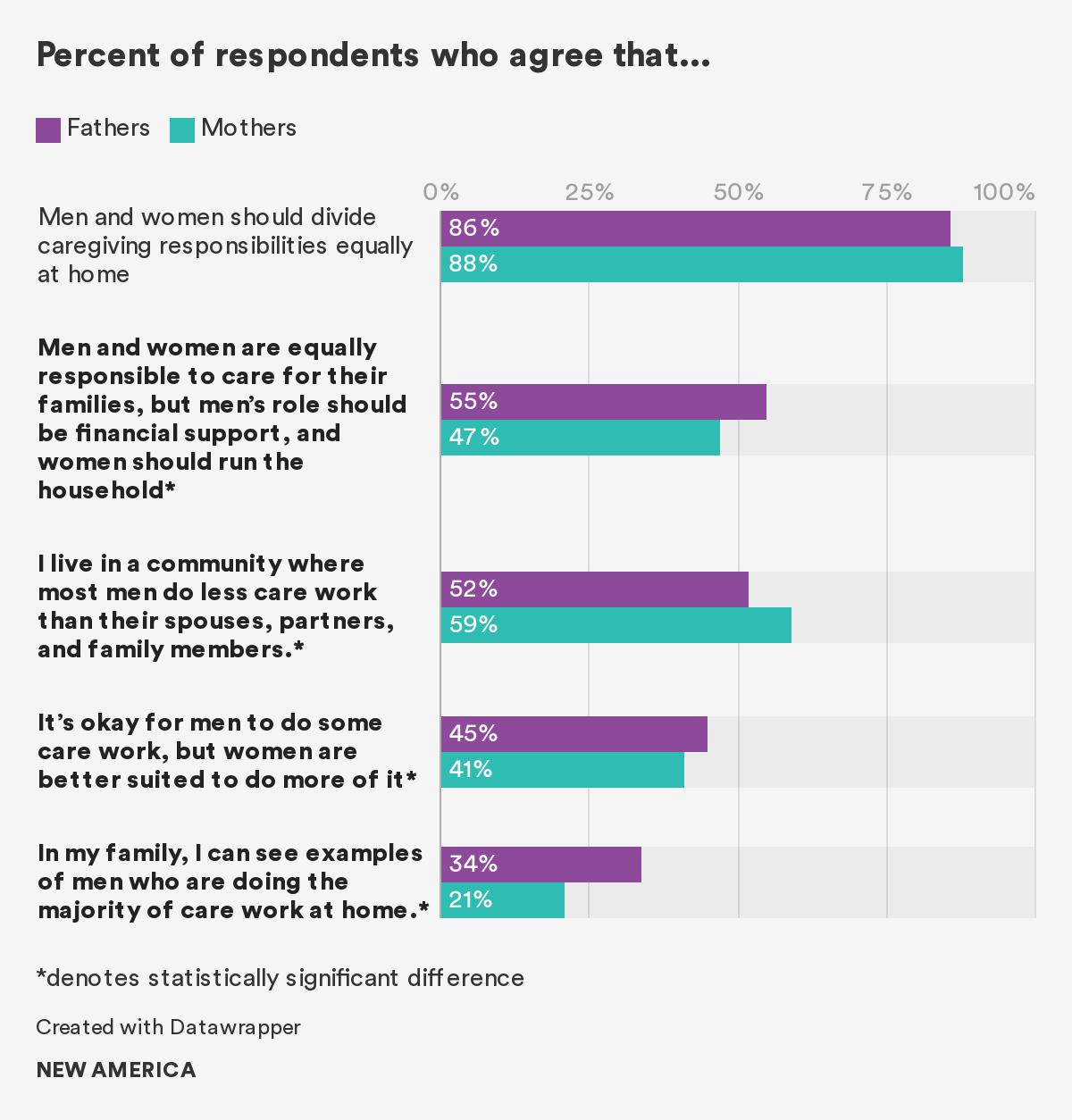
The survey data also reveal that many parents see unequal distribution of care work between men and women. Just over half of fathers (52 percent) said that they live in a community where they see most men do less care work than their spouses or other family members. Mothers (59 percent) were even more likely to say this. There is an even bigger gap between mothers’ and fathers’ perceptions when assessing the gender breakdown of care work at home in their own families, with only one-third (34 percent) of fathers saying they see examples of men doing the majority of care work, while just one-fifth of mothers (21 percent) say the same.
What’s behind this disconnect between a belief in equal responsibility and such unequal levels of engagement in care work between men and women?
The answer may lie in the survey finding that about half of parents agree with statements that support something like a separate spheres model of organizing families, even though these statements contradict other findings, namely with respondents’ agreement with the idea that the genders should share caregiving equally. Just over half of fathers (55 percent) and 47 percent of mothers say that though men and women should both be responsible for caring for their families, women should take on responsibility for the household while men take on responsibility for family finances. And 45 percent of fathers say that while it’s okay for men to engage in care work, mothers are “better suited to do more of it.” Mothers are only slightly less likely to agree with that statement.
How some respondents can believe both statements—that men and women should equally share the responsibilities of care and that women should take responsibility for the household, while men handle finances—requires further study. It may be that some respondents believe financial providing and financial management are part of the total equation of “caring for children.” Or perhaps they think shared responsibility for caregiving and household tasks does not mean shared participation. The belief that women are better suited to care might lead to situations in which women become de facto caregivers and men become de facto breadwinners, despite an overall belief in gender equality.
One focus group participant shared insight into these contradictory feelings. He expressed feelings of guilt about his lesser involvement in the direct care of his daughter, due to the work demands on him, and anger that he was regarded as “super dad” for doing everyday things like taking his daughter for a walk. Yet, he also expressed some support for the notion of separate spheres. Indeed, he defined his role as a father as supporting his wife in getting what she needed to take care of their daughter. “I’ve been told my job as the father is to protect and provide for my family. I don't think that precludes me from also being there to love and nurture and bond. Oftentimes I tend to think of my role as helping to eliminate barriers or obstacles or issues for my wife so she can be freed to have the time, patience, etc. to provide that direct child care that I sometimes am not able to be present for.”
"I’ve been told my job as the father is to protect and provide for my family. I don't think that precludes me from also being there to love and nurture and bond."
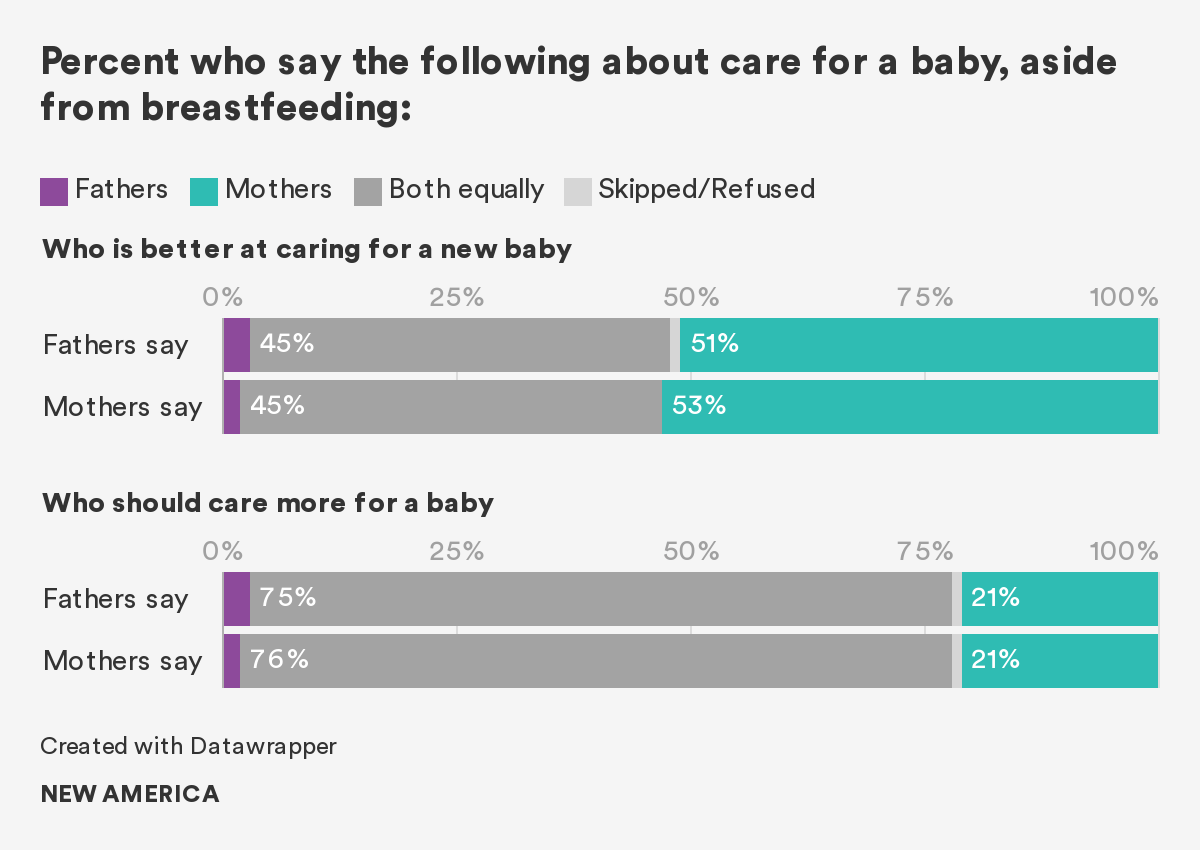
One reason for these beliefs that mothers should take on the primary caregiver role for their children might lie in respondents’ understanding of women’s suitedness to the role of caregiving as biological or natural. When asked whether, aside from breastfeeding, women or men did a better job caring for a baby, over half of mothers (53 percent) and fathers (51 percent) said that mothers were better caregivers to babies than fathers. Slightly fewer respondents (45 percent of fathers and 45 percent of mothers) said that mothers and fathers do an equally good job of caring for a baby.
One focus group respondent felt that it was clear that mothers were better suited to caring for babies, but also felt that left an important role for fathers to play in supporting their partners and stepping in when they need rest: “I think women are surely better suited to take care of babies, which is only natural. Though, women need all of the help that they can get from their male partners, especially in the weeks after the trauma of birth. Men need to be able to fully support their partners and step in when they need a break. Men can bottle feed in the night so that mom gets sufficient rest.”
Another respondent agreed that women were better suited to caring for babies due to what he called “mother’s intuition,” though he was unsure if that was due to nature or nurture. Yet he believed that didn’t preclude fathers from stepping up or that fathers could not become the primary caregiver and develop their own intuition. “I don't know if it’s nature or nurture, but I have definitely seen my wife's ‘mother's intuition’ kick in. It’s certainly a lot more fine tuned than mine is. When our daughter was an infant my wife was completely locked in and had an infinite amount of patience. Now as our daughter has gotten older my wife's patience is a little shorter than mine is. There are amazing mothers and fathers, and I know several colleagues who are stay-at-home dads and have developed that fathers instinct muscle. I think part of it is nature and that intimate connection that a mother will always have with her children, but it doesn't preclude the father from being able to step up and deliver that same level of care, attention, and love.”
The belief in the inherent superiority of women may become a cause for defaulting to women as caregivers and men as providers, whenever families are forced to decide who should do what.
Overall, these findings suggest a complicated and at times contradictory evolving understanding of what equal responsibility for parenting looks like. While respondents overwhelmingly support equality in parenting, the belief in the inherent superiority of women may become a cause for defaulting to women as caregivers and men as providers, whenever families are forced to decide who should do what.
That belief may also lead couples to feel that though mothers and fathers can both perform paid work and care for children, supporting fathers in their careers is non-negotiable, while supporting mothers is only vital insofar as their wages are essential to the household and/or it doesn’t interfere with their caregiving. Importantly, around half of respondents rejected these beliefs in a special mother’s advantage in childrearing and instead believe fathers and mothers to be equally suited to these tasks. Furthermore, findings from previous sections suggest beliefs in different roles for men and women do not stop men from taking an active daily role in childcare.