A Chapter of: Engaged Dads and the Opportunities for and Barriers to Equal Parenting in the United States
How Do Dads Engage in Caregiving?
The Men and Care survey asked parents how often they do a variety of common caregiving activities for their children. More mothers than fathers report engaging in each of these activities on a daily basis. The differences between mothers and fathers are statistically significant for each activity, except for play with children, as shown in the following figure. Nonetheless, a majority of fathers report engaging in all of the listed activities on a daily basis.
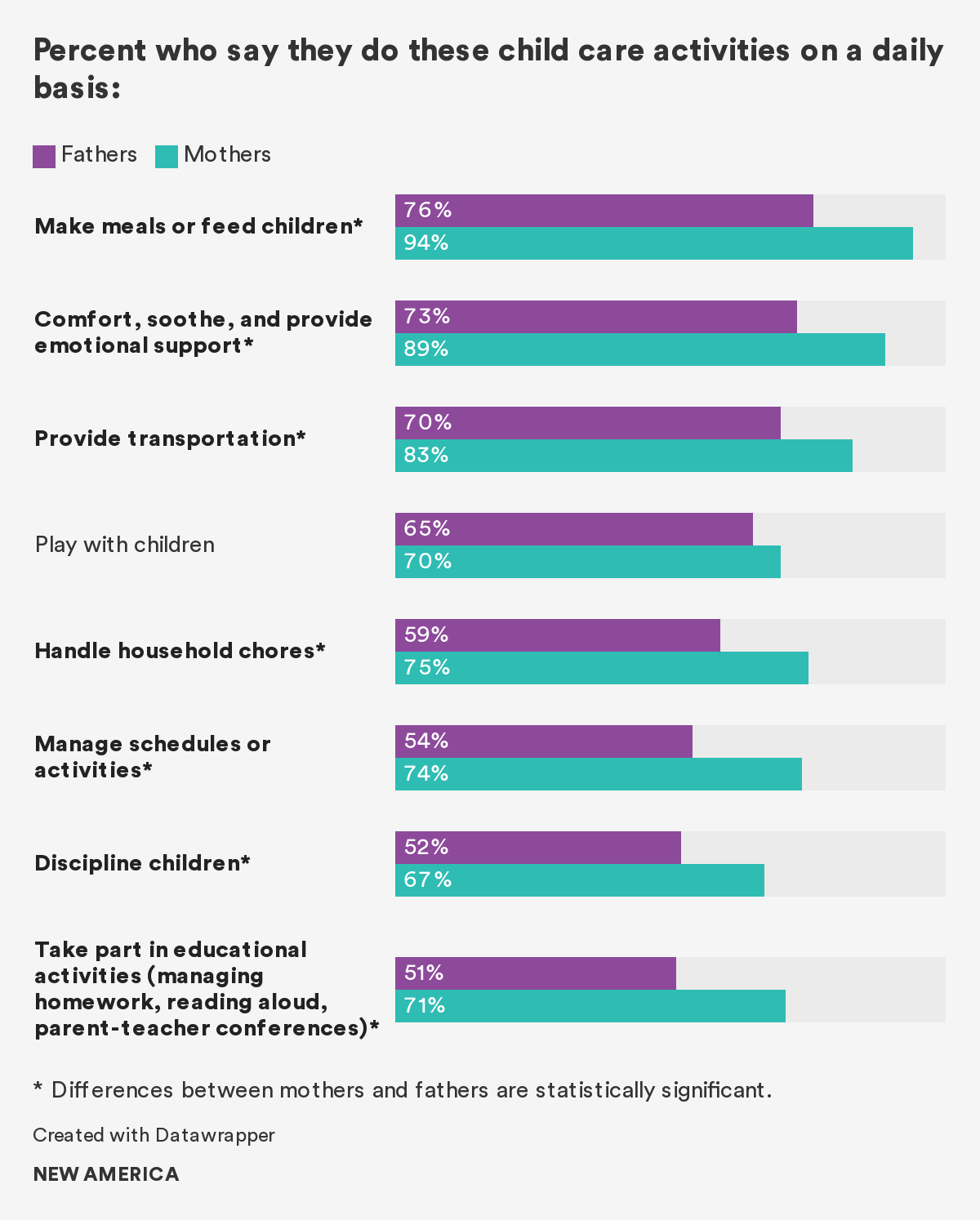
The widest gaps in daily activity between mothers and fathers are in taking part in educational activities (71 percent of mothers reported engaging in this activity daily, while just 51 percent of fathers did so) and managing children’s schedules and activities (74 percent for mothers and 54 percent for fathers). There is an average 15-point gap between mothers and fathers by daily activity, with the narrowest gender gap in playing with children.
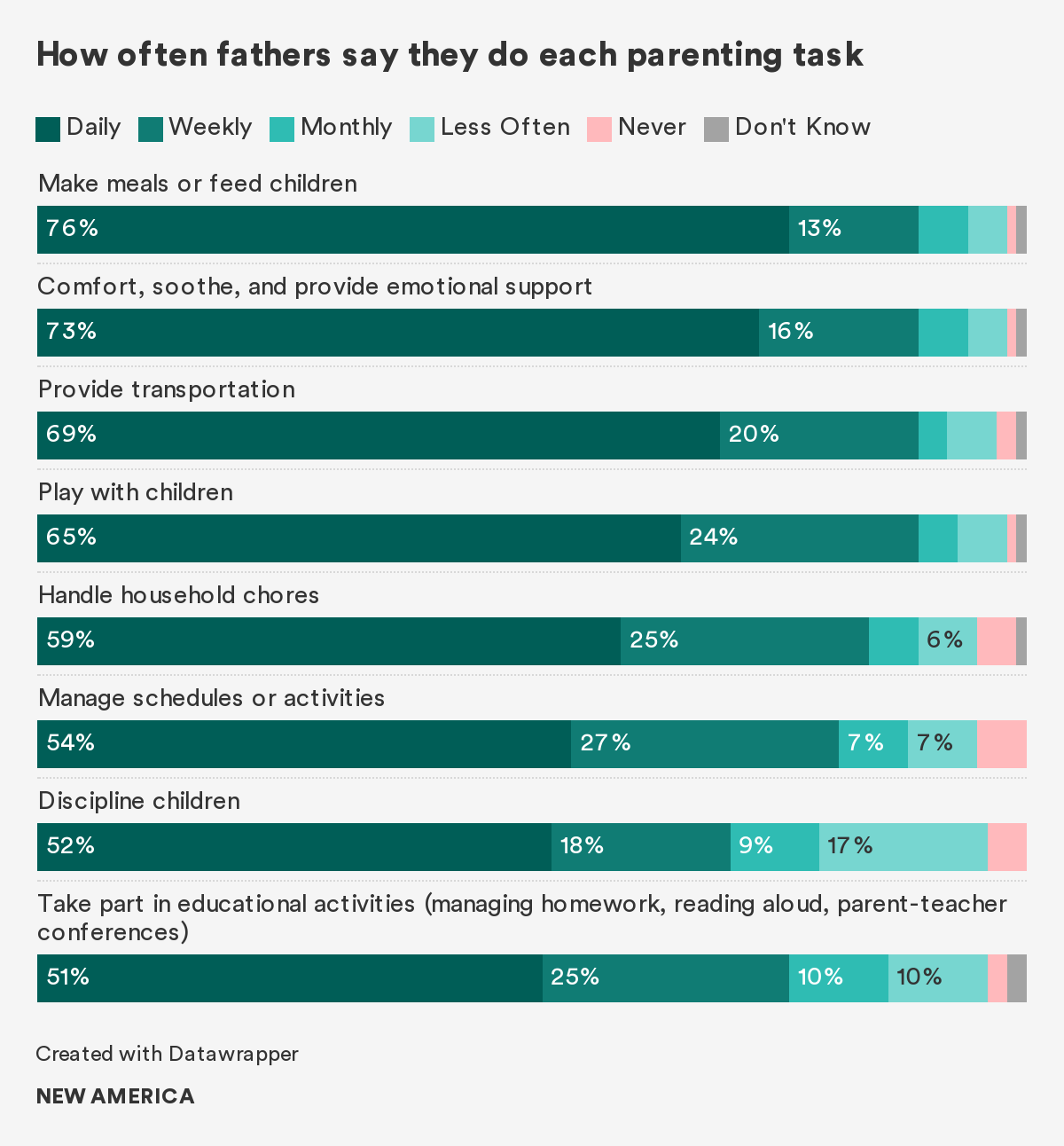
As shown in the following figure, other fathers reported engaging in these activities on a weekly, monthly, or less frequent basis.
The survey data showing that fathers report more daily engagement in preparing food, cooking, and feeding children than in any other parenting task was echoed by the focus group participants. Several fathers in the focus group described meal planning and preparation as the most important thing they do to take care of their children in a given month. Meal preparation came up frequently when focus group respondents described the previous day with their children. For instance, one respondent, who works from home, provided snacks to his oldest children after they got out of school and then planned to cook dinner for them later that evening, while his fiancé worked outside the home. “Today I am working from home. In the morning, my fiancé got the three older kids ready for school, and the baby was still sleeping. So I only interacted with the baby for about half an hour in the morning before my fiancé took him to daycare. The three older kids came back from school at 2:45 p.m., so I took a 20-minute break from work to interact with them and check their school work, as well as to get them started on their homework. I also got snacks ready for them to eat. I stopped working at 5 p.m., so I checked their homework and sent them outside to ride their bikes. And now I will be taking all three kids and going to the daycare to pick up the baby. Once we come home, then I will spend some time playing with all the kids and getting dinner ready for them.”
Meal planning for some dads is not just about feeding their children three times a day, but is about their children’s overall health and development. One focus group participant said, “I don't let them eat fast food and cook from scratch most days, so they get healthy nutritional meals at home. I try to use a good amount of organic and overall natural products and eliminate as many processed products as possible. I also pack healthy snacks for them to take to school every day. I also give them organic kids vitamins every day.” Several focus group participants said meal planning and supporting their children’s nutrition were some of the most important activities they did for their children’s well being in a given month.
The next most frequent activity fathers reported engaging in is comforting and soothing their children, indicating emotional connection with their children, in addition to direct care. Only about half of fathers reported daily engagement in managing children’s schedules or activities, disciplining their children, or taking part in educational activities.
Just 5 percent of fathers said they never manage their children’s schedules or activities, and fewer fathers than that reported never engaging in the other activities. However, the survey findings and focus group responses indicate dads are less involved than mothers in this daily management of tasks. One focus group dad said he sees this inequality in managing activities: “I am often the only father chaperone on field trips. Right now, I'm at my younger child's swim class: 15 mothers, three fathers (and 95 percent of the class are boys.) When my wife goes away for even one night, I'm often asked if I can handle it (yes, of course I can).”
The survey found that unengaged fathers—that is, fathers who do not ever make meals for their children, comfort them, take part in their education, provide them transportation, or play with them, are a rare exception.
Though mothers continue to perform more daily child care than fathers, the majority of fathers reported engaging in the daily care of their children through several different tasks. Though fathers, on average, are less likely than mothers to engage in these tasks on a daily basis, they do report doing these activities on a weekly or monthly basis, and at rates that exceed the existing gaps in daily activity between mothers and fathers. It is not the case that mothers engage in a host of activities that fathers do not take part in at all.
The most profound difference between fathers and mothers is not what they do for their kids, but how often they do it.
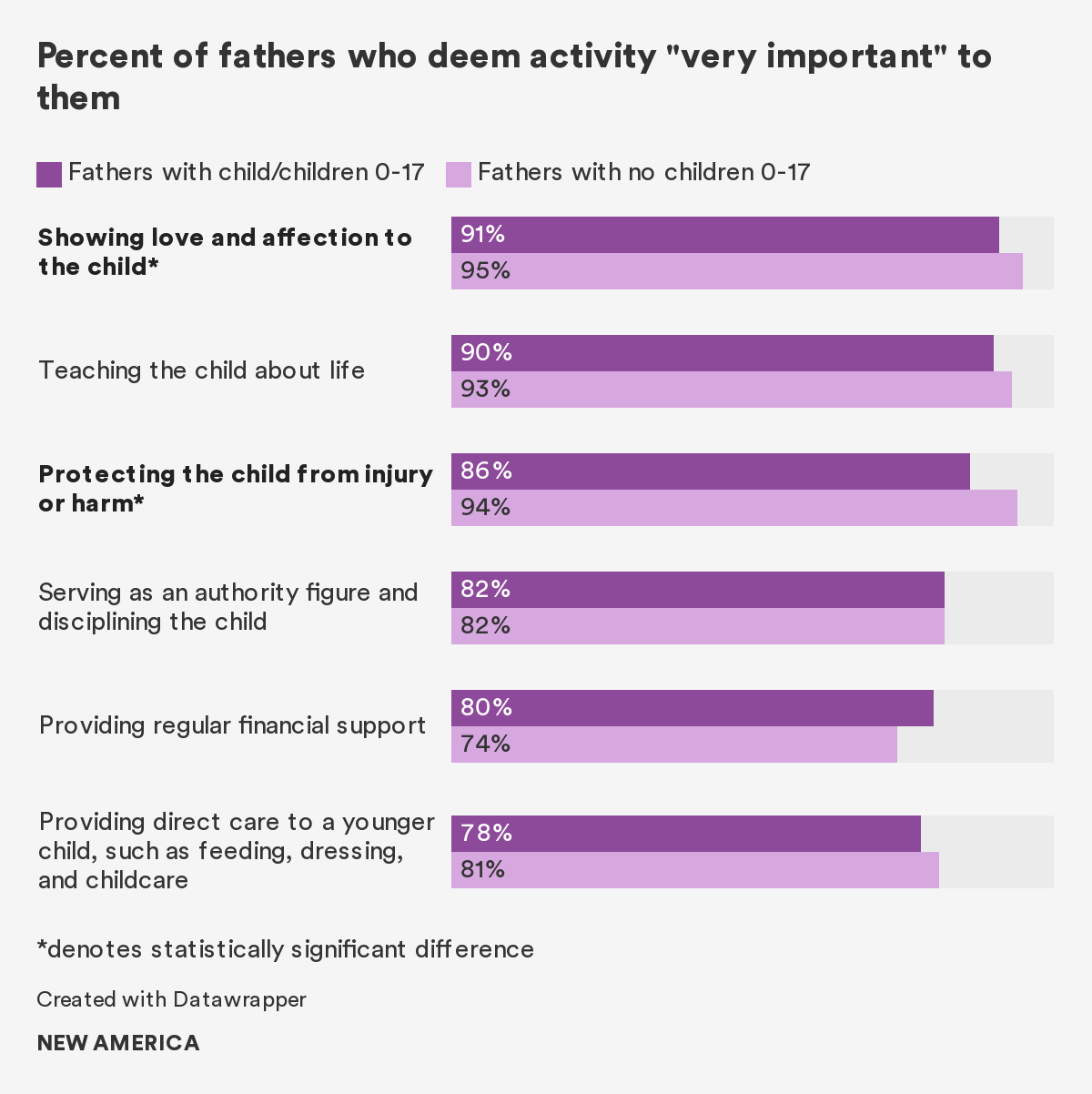
Importance of Activities
The survey asked all parents how important six various parenting activities were to them, and to parents of the opposite gender (see Figure 3). The majority of fathers shared the belief that all six of these activities were very important. However, fathers were more likely to rate long-term, emotional engagement tasks as very important than concrete activities like financial providing and feeding and dressing their children. Over 90 percent of fathers said showing love and affection and teaching their children about life were very important to them. There were only two significant differences between fathers who still have children under age 18 and fathers whose children are all adults. Surprisingly, fathers whose children are all 18 and older were more likely than fathers who still have children between infancy and age 17 to regard showing love and affection and protecting their children from harm as very important.
Majorities of all respondents across race and gender believed these tasks to be very important to both mothers and fathers.