A Chapter of: Building Systems in Tandem
Designing Complementary State and Local First 10 Initiatives
Many communities throughout the state of Maine, urban and rural, face significant challenges in improving educational outcomes for children, including poverty, unemployment, opioid misuse, and trauma. These challenges will become even more acute in the aftermath of the COVID-19 pandemic and the widespread closures of schools and early childhood programs. In 2018, state leaders in Maine identified ways in which their efforts to support children and their families were impaired. According to Lee Anne Larsen, the early learning team coordinator at the Department of Education (DOE), the biggest obstacle has been the lack of coordination among the various stakeholders—early education and care providers, public school educators, and health and social services providers—who often do not realize how much their aims overlap and the potential for sharing resources. As a result, families struggle to navigate the transition from early childhood services to the K–12 system; early childhood providers often do not have well-established connections to public schools and may feel powerless to smooth these transitions; and public school educators are unaware of resources they could draw on to build relationships with families and better support them. Besides hampering progress, the absence of coordination can lead to frustration and finger-pointing all around.
“In partnering, we stand a better chance at building a systemic approach,” says Larsen. Her view is consistent with a growing research consensus. In 2015, the National Academy of Medicine’s Transforming the Workforce report summarized decades of research and concluded that improving outcomes for young children requires: (1) successive years of high-quality education and care that span early childhood and elementary school, (2) coordination between early childhood programs and elementary schools to ensure alignment and well-organized transitions, and (3) coordination of the education, health, and social services that serve young children and their families.2
For Maine, putting this view into action has raised two critical questions, which take on even greater importance in addressing opportunity gaps in the aftermath of the COVID-19 pandemic and widespread closures of schools and early childhood programs:
- How can communities improve, align, and coordinate the programs and services that serve young children and their families across the early childhood through elementary school years?
- How can state agencies best guide and support this work?3
Beginning in 2018, Larsen and Sue Reed, the DOE’s early childhood specialist at the time,4 determined that they would address these two questions in tandem, and they created complementary initiatives—a state inter-agency team and a companion initiative in 13 communities throughout Maine.
Larsen explains the rationale that underlies Maine’s two-level state and local approach: “Our hope was to build better capacity at the state level to continue supporting the design and expansion of First 10 communities after the grant funding was gone while at the same time forging stronger coordination across state agency programs.”
Maine chose the First 10 framework to guide and structure this work.5 The state’s experience has generated a wealth of new lessons about aligning early childhood education, K–12 education, and health and social services. This experience represents one state’s approach to connecting state and local system-building in a coordinated way so that the two efforts inform and support each other. As such, it may prompt similar creative thinking about this type of coordination in other states and communities.
First 10 Schools and Communities
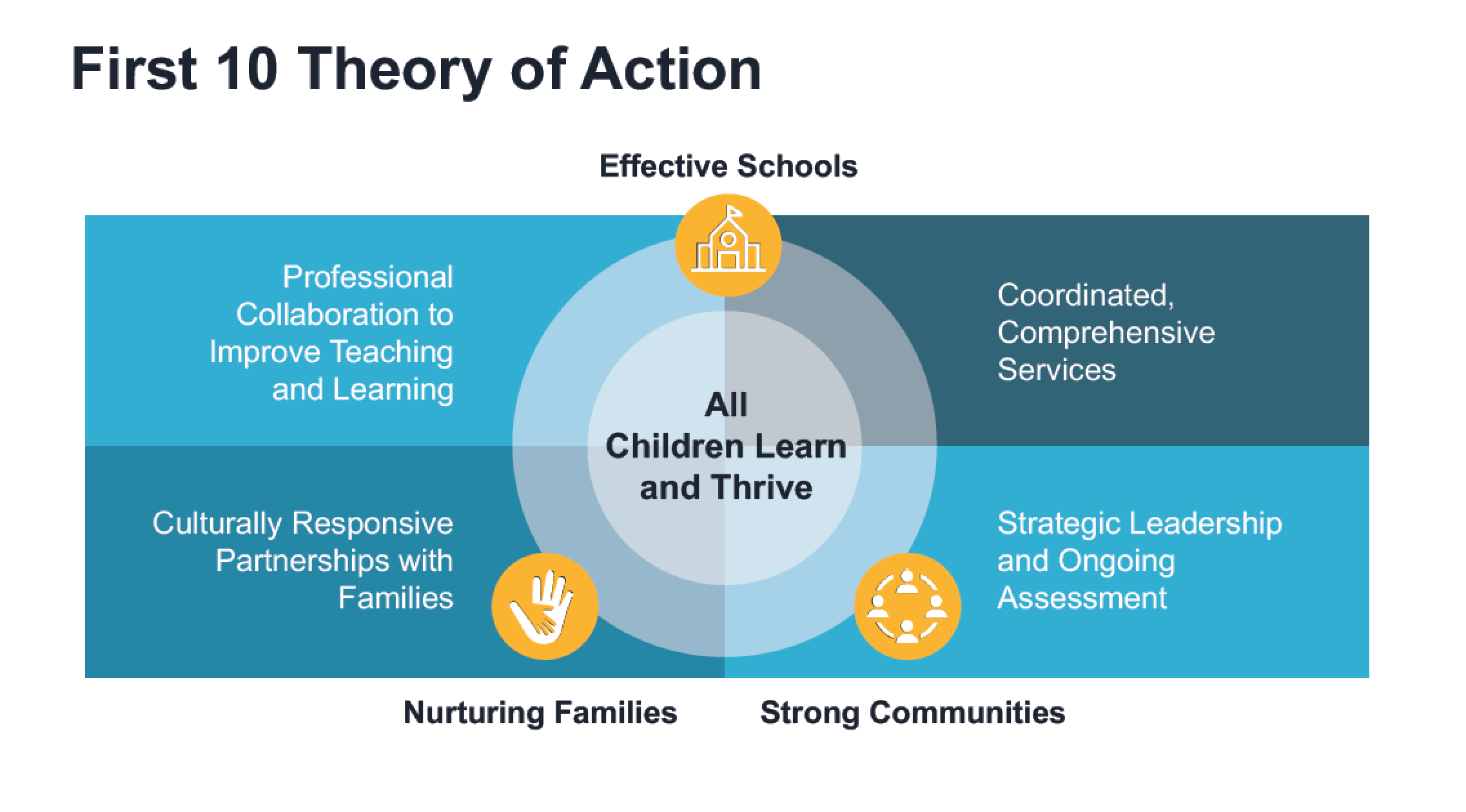
First 10 partnerships bring together school districts, elementary schools, early childhood programs, and community agencies to improve the quality and coordination of education and care for young children and their families. These partnerships conduct needs assessments and then build plans around four broad strategies to address the needs of their communities:
- Support professional collaboration to improve teaching and learning
- Coordinate comprehensive services for children and families
- Promote culturally responsive partnerships with families
- Provide strategic leadership and ongoing assessment
Typical First 10 practices include providing school-based play and learn groups, coordinating connections to health and social services, improving the quality of early childhood programs, coordinating the transition to kindergarten, conducting joint pre-K and kindergarten professional development, and improving early grades curriculum and instruction.6
First 10 draws on a long history of research on transitions, early childhood system-building, and community schools; on the contemporary P–3 and community schools movements; and in particular on the work of pioneers such as Sharon Lynn Kagan, Kristie Kauerz, Robert Pianta, Sharon Ritchie, and Ruby Takanishi.7
The Context: Expanding High-Quality Prekindergarten in Collaboration with School Districts
At the time this project was designed, Maine was approaching the fourth year of its federal Preschool Expansion Grant (the first round of these “PEG” grants). Thirteen communities had formed small teams that included different configurations of school and/or district leaders, pre-K and kindergarten teachers, and Head Start administrators. These teams had managed the expansion of high-quality preschool classrooms in each community.
As the DOE’s early childhood specialist, Reed had been overseeing the PEG program. She was pleased with the expansion of preschool classrooms and the intensive professional learning for teachers that had accompanied the expansion, but consistent with Larsen’s observations, Reed had concerns about the lack of coordination of programs and services. Kindergarten teachers were impressed with the skills and knowledge of routines that the children from PEG classrooms brought to kindergarten, yet the transition was still difficult as a result of large differences in curriculum and instruction across the two settings. The transition for children who had not participated in pre-K was even harder.

Further, the children and families participating in the PEG classrooms benefited from extensive family services and linkages to comprehensive health and social services. These supports were often no longer provided in kindergarten. Many districts were not connected to regional providers of such services, which was especially problematic in rural areas where such services are scarce. Finally, Reed was aware that many children were not experiencing any programming during the critical age 0–3 years, a gap she was eager to see filled.
As early childhood–elementary school collaboration was a requirement of the PEG grants,8 and with these considerations in mind, Reed and Larsen decided that developing and implementing what would eventually be called First 10 plans would be the primary new focus of the fourth year of these PEG grants (which were later extended).
Maine’s State Inter-Agency First 10 Team: Collective Learning, Coordination, and Policy
Maine’s First 10 state team is designed to connect the various offices across the DOE and DHHS that impact children and families. Representatives include the DOE commissioner’s chief of staff, the DOE’s chief innovation officer, the state Children’s Cabinet coordinator, the Head Start collaboration director, and representatives from the offices of child care, early intervention, student support services, behavioral health, literacy, and math, among others.
The team began with collective learning. The group reviewed relevant research on early childhood—elementary school collaboration, community schools and integrated student supports, and the First 10 approach. Team members shared information about the programs and initiatives they administer in order to identify the full range of resources available as well as opportunities for improved coordination.

The team also wanted to learn about relevant work underway in Maine and elsewhere. Members organized presentations by a community school site manager, the leader of a rural trauma-informed program, two of the 13 participating Maine PEG communities, and the state Head Start collaboration director, who presented on the role of Head Start family service coordinators. Joan Wasser Gish from Boston College’s Center for Optimized Student Supports presented on state efforts around the country to expand integrated student supports. As this list suggests, interest in community schools and integrated student supports emerged as a strategy for better meeting the health and social service needs of children and families.
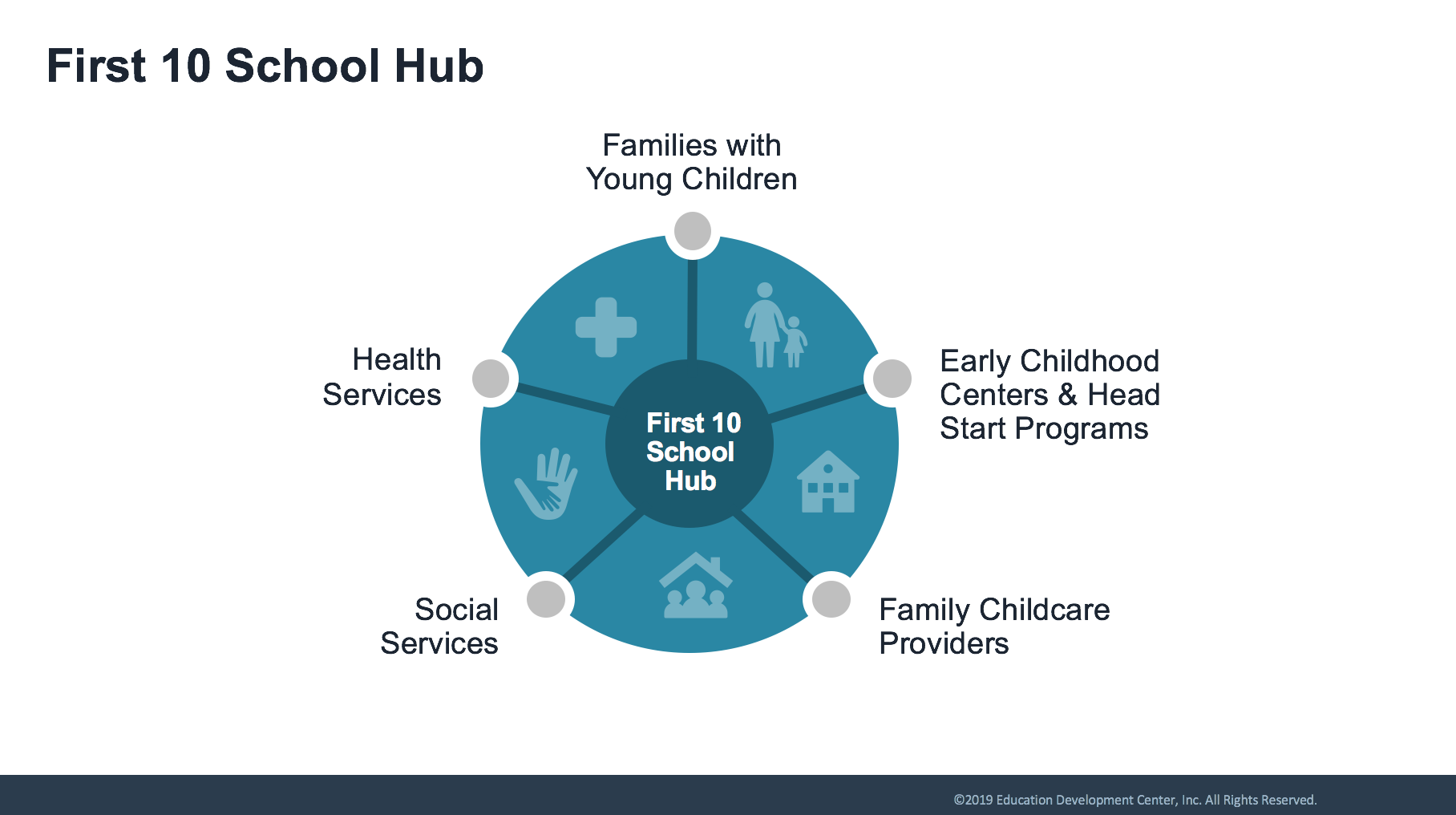
The state team discussed a variety of policy and technical assistance strategies to support local First 10 implementation and the provision of comprehensive services more generally, generating ideas that have been shared throughout their respective agencies and with their respective commissioners. The team determined that the First 10 school hub model—in which integrated student supports are provided to children and families beginning before children enter kindergarten and continue throughout elementary school—would be particularly helpful in the state’s many rural settings (to see school hub model, click here or see full description in section 5). The team has begun to engage in conversations with DOE’s legislative liaison and the chief innovation officer about how future legislation might be shaped to best support First 10 school hubs. The First 10 team also serves as an organizational platform for responding to federal funding opportunities.
Finally, a central component of the First 10 team’s work has been to monitor the progress of the 13 First 10 community initiatives and learn from their implementation.
Policy Suggestions from 13 Communities
As a concrete example of the complementary nature of Maine’s state and local approach to First 10, 13 communities from across the state came together in May 2019 with members of the state First 10 team. Each community had followed a common planning process to develop and begin implementing First 10 plans. The state team members engaged with community teams as they presented their plans and what they were learning as they implemented them. The local teams also suggested how state policy and technical assistance could support strategies in a session explicitly designed for this purpose.
The following themes emerged from these suggestions:
Provide state guidance and communication
- Communicate the important message that schools cannot do it alone: it takes a village.
- Help communicate to local education committees the importance of a focus on the early years and collaboration with early childhood programs.
Streamline policy
- Streamline licensure procedures across schools and providers.
Facilitate learning and exchange
- Facilitate ongoing community-to-community learning and exchange.
- Support administrators in better understanding pre-K teaching, learning, and care.
Support comprehensive services
- Create a state directory of services available across state agencies.
- Designate regional one-stop liaisons to aid in resource referral.
- Facilitate closer connections between school districts and regional DHHS offices.
- Help improve early intervention capacity.
Provide targeted support for mental health and trauma
- Provide professional learning opportunities for all staff on supporting student mental health needs, including summer institutes.
- Provide additional mental health and social-emotional health services.
These suggestions have helped inform the state team’s working agenda, demonstrating the benefits of Maine’s two-level approach. Moving forward, additional priorities include developing a state First 10 website and funding and designing a next-generation First 10 initiative that includes support for local First 10 coordinators. The implementation experience of Maine’s 13 First 10 community teams, the companion initiative to the state team, is described below.

Citations
- LaRue Allen and Bridget B. Kelly, eds. Transforming the Workforce for Children Birth Through Age 8: A Unifying Foundation (Washington, DC: The National Academies Press, 2015), https://doi.org/10.17226/19401
- For more on the relationship between state and local efforts to coordinate early childhood and elementary school programs and services, see David Jacobson, Building State P–3 Systems: Learning from Leading States (Washington, DC: Center for Enhancing Early Learning Outcomes, 2016).
- Reed has since retired. Nicole Madore is currently Maine’s early childhood specialist.
- The author provided technical assistance to Maine’s state and local teams in support of this initiative.
- Jacobson, All Children Learn and Thrive. For more information on First 10, see David Jacobson, Four Strategies for Getting the First 10 Years of a Child’s Life Right. Education Week, February 4, 2020, and EDC’s First 10 Theory of Action (website).
- Sharon Lynn Kagan and Kristie Kauerz, Early Childhood Systems: Transforming Early Learning (New York: Teachers College Press, Columbia University, 2012); Sharon Ritchie, Kelly Maxwell, and Richard M. Clifford, “FirstSchool: A New Vision for Education,” in School Readiness and the Transition to Kindergarten in the Era of Accountability, ed. Robert C. Pianta, Martha J. Cox, and Kyle Snow, 85–96 (Baltimore, MD: Paul H. Brookes Publishing, 2007); Ruby Takanishi, First Things First! Creating the New American Primary School (Alexandria, VA: National Association of Elementary School Principals, 2016); Kristie Kauerz and Julia Coffman, Framework for Planning, Implementing, and Evaluating Prek–3rd Grade Approaches (Seattle, WA: College of Education, University of Washington, 2013); Lisa Guernsey and Sara Mead, A Next Social Contract for the Primary Years of Education (Washington, DC: New America, 2010); Laura Bornfreund, Elise Franchino, Amaya Garcia, Aaron Loewenberg, Cara Sklar, and Kristina Ishmael, Supporting Early Learning in America Policies for a New Decade (Washington, DC: New America, 2020); and John Rogers, Community Schools: Lessons from the Past and Present (Flint, MI: Charles S. Mott Foundation, 1998). For more on this history, see All Children Learn and Thrive, pages 4–11 and 62–64.
- Following the language of the Preschool Expansion Grant, originally the Maine DOE used the term “B–3” to refer to this initiative. The state team has now switched to “First 10,” which I use throughout this series.