A Chapter of: The Great Correction
Future of Work
The term future of work is a euphemism for the pending wave of disruption to job markets courtesy of a range of complex forces. Technology, the advent of industrial automation, and varying degrees of workforce readiness for the so-called jobs of the future came at us fast during the pandemic. Add in the long standing tension between traditionalists for whom productivity must be seen requiring a physical presence at an office or work location, and the modernists who have been clamoring for wider acceptance of remote work and workplace flexibility, and the future of work is a complex domain indeed. All of this complexity and the far off horizon issue many employers and employees thought they could forestall has been fast forwarded to today.
Indeed, in a matter of months, for those so fortunate to have kept their employment amid depression-level joblessness, the future of work came fast. Glitzy city center offices were quickly vacated as social distancing norms took hold. Video conferencing services such as the eight-year-old upstart, Zoom, succeeded in doing in months what other platforms have taken decades to achieve—gain ubiquity as a utility for remote workers, learners, and many others who turned to these services for a semblance of normalcy. Indeed, the onset of the future of work was so rapid that habitually itinerant business travelers turned to Zoom, making the platform more valuable than all U.S. airlines combined.
While no small screen is a long-term substitute for a person-to-person connection, in an age beset by climate change and travel fatigue, the proof that we can in fact carry on the vast majority of business remotely may be hard to reverse. Some companies, especially those that already offered flexible work options, including being supportive of bring your own device (BYOD) policies, work from home options, among others, were among the most resilient in the crisis. While not all employers will be able to provide this flexibility, nor will many want to as the toll of cabin fever and lost team camaraderie sets in, the fact that so much work can continue at a distance is an opportunity not a threat. The fact that only 7 percent of the U.S. labor force enjoyed these benefits pre-pandemic is a point of vulnerability.
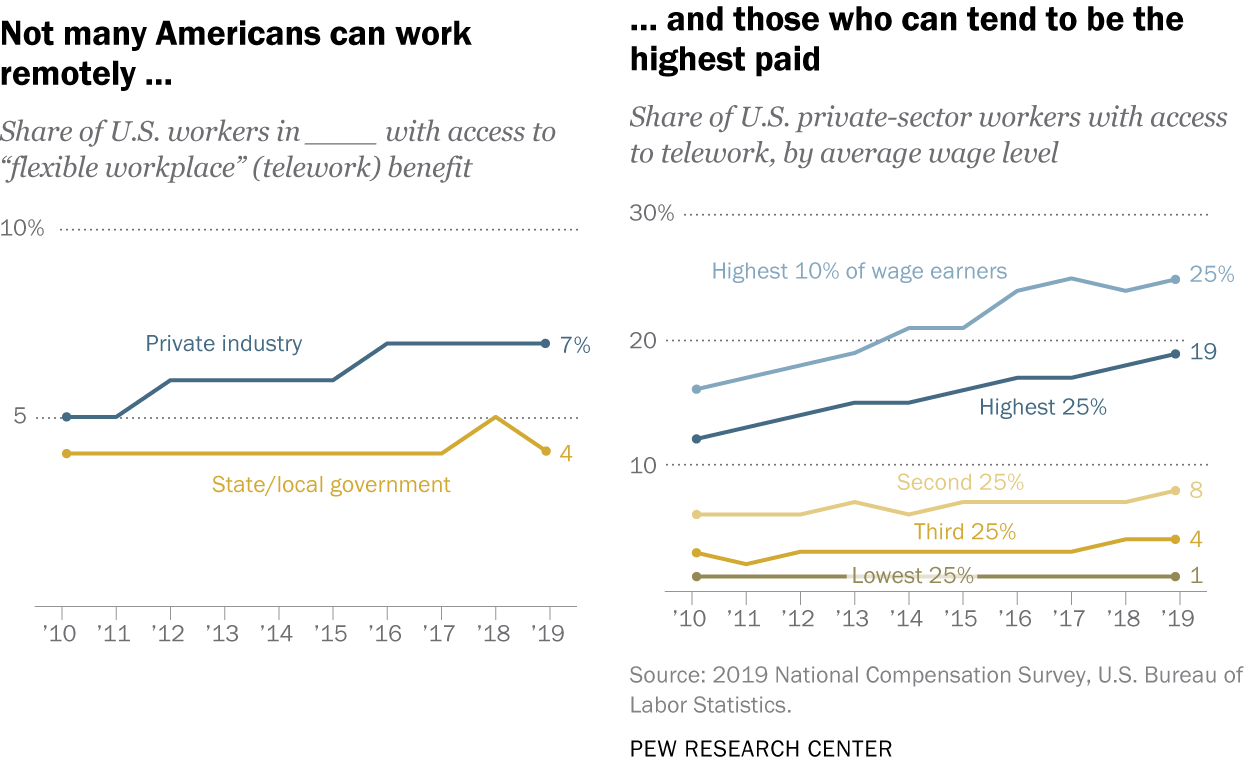
Despite lockdown conditions changing throughout the country, many employers have already made the call for the full year, with large technology firms being among the first to tell their workforce they should remain at home through the balance of 2020. Here too, as in other areas in this report, optionality is the key, especially as remote work will likely become a permanent condition for millions of employees. For employers that clung to a productivity model where hours labored in a physical location are a proxy for productivity, notwithstanding the productivity, morale, and cost drains of slow commutes, the pandemic was hard to adapt to. The post-pandemic reality may be harder still, as it is likely flexible working options and permanent work from home or remote work opportunities may remain de rigueur, particularly for service and knowledge workers.
This reality will add further downward pressure on real estate markets, particularly in the commercial segment as tenants weigh the costs and benefits of billions spent on owning or renting high-end real estate that was functionally a vacant or stranded asset for an entire year. How market demand and the physical return to work recovers later in 2020 will very much depend on the severity and likelihood of a second COVID-19 wave hitting the United States in the fall, as well as the prospects of a vaccine, better contact tracing, and workplace and commuter hygiene standards.
Just as a cottage industry has emerged around cyber risk management and health, safety and environmental issues (HSE), apprehensions about the return to work and a new (unsettling) normal, will require the emergence of high-assurance services about office cleanliness, social distancing facilities, and the potential of a staggered work and school week. One of the bigger challenges to overcome are the already overcrowded mass transit systems across the United States, which could be a veritable petri dish if the incidence of community spread of COVID-19 is not entirely abated. Given the choice and the unfortunate prospect of class action lawsuits over employee safety standards, business, political, and community leaders will be cautious to make the call that all is in fact clear. When they do, the lingering effects of the world’s largest work from home experiment, along with the deleterious toll on confidence to work in the traditional form (long crowded commutes and all) may be hard to overcome.
The Great Correction
- Checklist
- Introduction
- Household Economy
- Community Resilience
- A Pandemic of Racism
- Election Integrity
- Healthcare Surge Capacity
- Supply Chain Management
- Universal Access to Digital Services
- Banking and Payment Systems
- Economic Resilience
- Future of Work
- Epidemiological Readiness
- Porous Lines of Defense
- Institutions
- Policy Considerations