A Chapter of: The Cost of Connectivity 2020
Focus on the Fees
Internet service plans feature a litany of additional fees and hidden costs that consumers must navigate to determine the total price. In this section, we examine four common types of ancillary fees: (1) installation and activation fees; (2) equipment fees; (3) penalties for exceeding data caps; and (4) early termination fees and minimum contract lengths.
Activation and Installation Fees Are Common Upfront Costs
When consumers subscribe to internet service, they pay additional one-time set-up fees for a technician visit to the home for service installation, or for a self-installation kit from the provider to guide them through installation themselves. Some providers may charge service activation fees instead of, or in addition to, these installation fees.
The average installation fee in our dataset is $53.74, and the average activation fee is $27.79. The average U.S. installation fee and activation fee are $70.38 and $26.35 respectively. They are both higher than Europe’s average installation fee and activation fee at $36.16 and $29.42 respectively. Asia’s average installation fee and activation fee are $99.38 and $0 respectively.
These fees can add an additional 0 to 1,000 percent to advertised monthly prices. For example, several ISPs in Amsterdam advertise $100 professional installation fees for plans that cost between $30 to $60 per month, meaning that installation alone can cost three times as much as the monthly price for internet service. The activation fees charged by the same ISPs in Amsterdam also come to anywhere from an additional 50 to 130 percent of the advertised monthly price. In the United States, CenturyLink, Charter under its Spectrum brand, Comcast under its Xfinity brand, and Verizon charge $99 or more for installation in some cities, which can amount to an additional 100 to 500 percent of the advertised monthly price for service.
Within our dataset, 18 ISPs offer consumers the option to self-install, which can reduce installation costs by $62.44 on average.62 Most of these ISPs offer self-installation for free; 14 ISPs advertise a self-installation option for $0. The average self-installation fee found for our dataset is $10.48. U.S. providers that offer a self-installation option include AT&T, CenturyLink, Charter under its Spectrum brand, Comcast under its Xfinity brand, EarthLink, Frontier, Raw Bandwidth, and Sparklight, with the average self-installation fee at $9.30.
Equipment Fees are Common, Complex, and Expensive
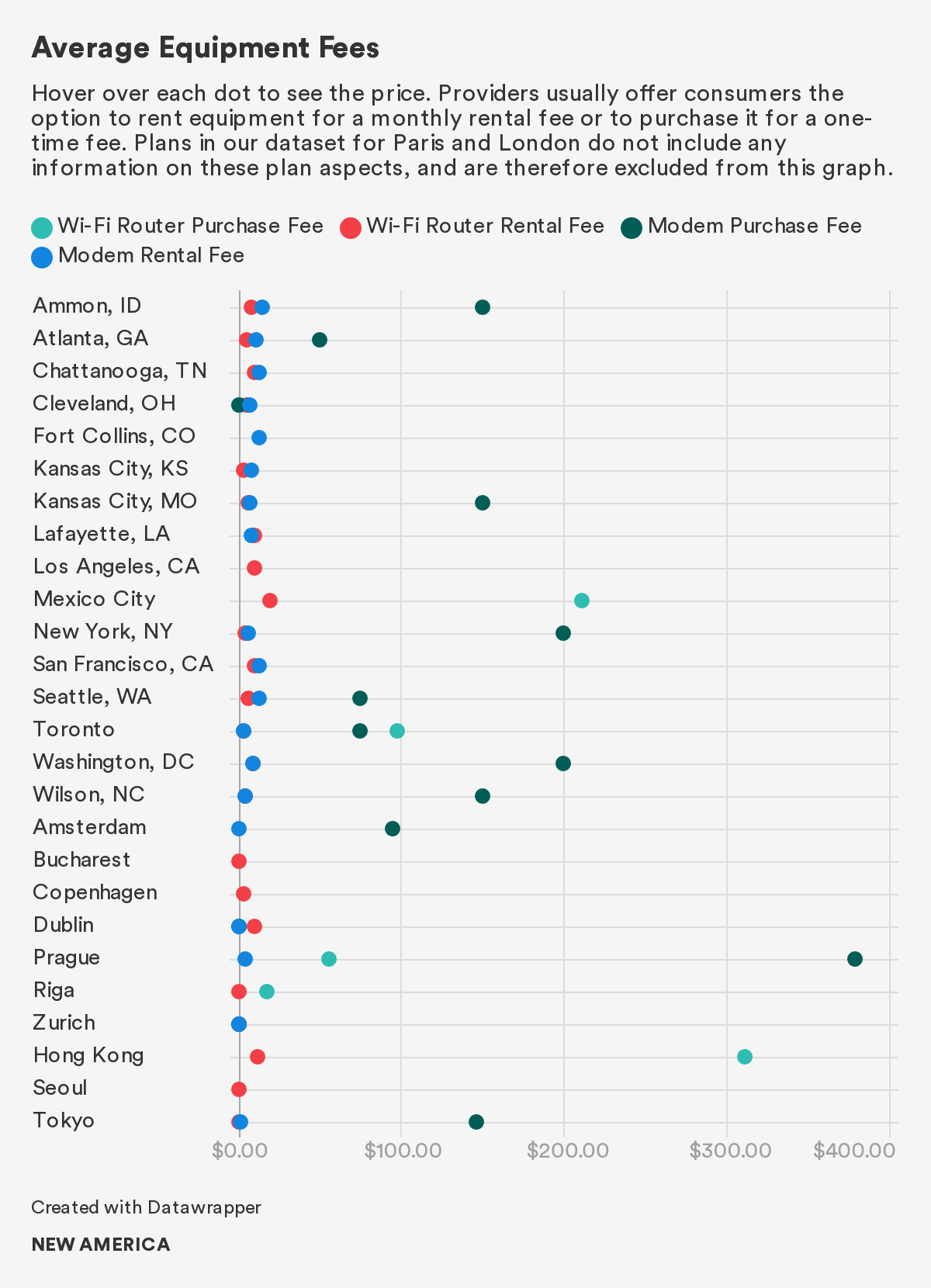
Consumers also pay equipment fees. Providers usually offer consumers the option to rent or purchase equipment directly. Not every provider offers both options or requires both a Wi-Fi router and modem for internet access. Providers sometimes allow consumers to use their own equipment, but it’s up to the consumer to determine if their equipment is compatible with the provider’s network. We do not record third-party equipment fees in our dataset, and all equipment fees in our dataset reflect the purchase or rental fees a consumer would pay for purchasing or renting that equipment directly from the provider.
A modem connects a home network to the internet by translating the traffic into a format that can be sent over the ISPs infrastructure.63 A router directs traffic from the internet to devices on the home network, usually including devices using Wi-Fi.64 While these devices have historically been separate, there are now modem/router combination devices available on the market, like Comcast’s Wireless Gateway devices.65
Consumers can generally save money over the long term if they choose to purchase equipment instead of renting it, but ISPs dictate whether the option to purchase equipment is available. Equipment from one provider may not be compatible with other providers’ networks, however. Additionally, consumers may not always be able to pay the larger fee to purchase this equipment upfront, and may only be able to pay a smaller monthly fee to rent instead.
ISPs may sometimes impose additional equipment-related costs. For instance, KCCoyote charges an additional $25 wireless router set up fee if it is done at the time of installation. Our analysis does not account for these additional fees.
Our study focuses on four types of equipment fees. We examine the prices providers advertise for consumers to buy or rent two types of equipment: Wi-Fi routers and modems. We analyze each of these plan aspects independently below: (1) Wi-Fi router purchase fees; (2) Wi-Fi router rental fees; (3) modem purchase fees; and (4) modem rental fees.
Wi-Fi Router Purchase Fee
The average fee for buying a Wi-Fi router from the ISP is $83.29 in our dataset. These fees fall anywhere between an additional 0 to 558 percent of the advertised monthly price for service. Toronto’s Ebox is on the high end of this range. For example, the ISP advertises a $111.78 Wi-Fi router purchase fee for its $20.04 per month 15 Mbps plan. Nordic in Prague charges $119.93 for Wi-Fi router purchases for plans ranging from $27.40 to $38.49—this purchase fee is an additional 288 to 404 percent of the advertised monthly price.
Since equipment purchase fees are usually charged upfront, consumers cannot always pay these higher one-time fees to buy the Wi-Fi router instead of renting it, if both options are available. Europe has the most expensive average Wi-Fi router purchase fee at $30.44. Our dataset, however, includes no data on advertised Wi-Fi router purchase fees in Asia or the United States, except for Snip Internet in Cleveland, which advertises a $0 Wi-Fi router for purchase.
Wi-Fi Router Rental Fee
The average monthly Wi-Fi router rental fee is $3.56 in our dataset. Comparing rental fees across markets, the average Wi-Fi router rental fee for the U.S. is $6.13 per month. The average U.S. Wi-Fi router rental fee is more than three times that of Europe, which is $1.55 per month. The average Wi-Fi router rental fee advertised in Asia is $0.71. In the United States, AT&T, CenturyLink, Charter under its Spectrum brand, Comcast under its Xfinity brand, and Verizon advertise options for renting Wi-Fi routers from them for a fee, with some promotional offers that include free router rentals. Google Fiber and two local brands in Cleveland rent Wi-Fi routers for free, as well as Altice under its Optimum brand in New York.
The fees can significantly increase a consumer’s monthly bill. For example, the 15 Mbps plan from Comcast in Kansas City, Kan. advertises a Wi-Fi router rental fee that is an additional 65 percent of the advertised monthly cost. So even though the monthly price for the plan is advertised at $19.99, with a monthly Wi-Fi router rental fee of $13, the combined price for internet service and Wi-Fi router rental would be $32.99.66 Even for the next fastest option advertised by Comcast under its Xfinity brand in Kansas City, Mo., a 60 Mbps download speed plan with a monthly price of $29.99, the $13 monthly Wi-Fi router rental fee is an additional 43 percent of the monthly price.
Modem Purchase Fee
The average modem purchase fee is $97.63. These fees constitute anywhere from 0 to 959 percent of advertised monthly prices. O2 in Prague charges the highest purchase fee for a modem, $379.23, for plans advertised with monthly prices anywhere from $43.51 to $75.21. A consumer who wants to purchase a modem from O2 therefore might pay anywhere from six to nine times the advertised monthly service price upfront for one of these plans.
Comparing purchase fees across continents, plans in North America offer the lowest averages, with the average modem purchase fee coming to $87.92. The average modem purchase fee in Europe comes to $155.77. ISPs in Asia charge the highest for purchasing modems at $146.38.
Within the United States, the average modem purchase fee is $126.81. In some cases, the fee is an additional 300 percent of the monthly price. Additionally, CenturyLink charges more for purchasing a modem in some cities than in others. It charges $100 for a modem purchase in Seattle, but $150 in Ammon, Idaho.
Modem Rental Fee
The average modem rental fee is $6.39 per month. These fees amount to anywhere from an additional 0 percent to 75 percent of advertised monthly prices. At the high end of this range is the $15 modem rental fee charged by Wave in San Francisco, which comes to an additional 75 percent of the $19.95 monthly price for internet service.
Comparing rental fees across markets, the average advertised modem rental fees are highest in the United States, followed by Asia and Europe. The average U.S. modem rental fee at $9.86 is more than seventeen times that of Europe’s, $0.58, and eight times higher than Asia’s, $1.17.
Within the United States, the average monthly modem rental fee is $9.86. These monthly modem rental fees can constitute anywhere from 0 to 75 percent of the advertised monthly price. In some cases, like the WOW! (WideOpenInternet) plans in Cleveland that advertise a flat $10 per month for modem rental regardless of plan speed, this fee is an additional 13 to 25 percent of the monthly plan price. In the case of the plans offered by RCN in Washington, D.C., a $10 monthly modem rental fee is 20 to 50 percent of advertised monthly plan prices. Modem rental fees significantly increase the price of slower plans, which may initially appear more affordable than faster speed plans. For example, Wave in San Francisco charges the same $15.00 monthly modem rental fee for both its 50 Mbps download speed plan and its 500 Mbps download speed plan. The monthly price for the 50 Mbps download speed plan is $19.95, which means that the monthly modem rental fee is over an additional 75 percent of the advertised monthly price for the plan.
Data Caps Add Risk of Overage Fees
Data caps further increase the cost of internet service while limiting users’ data consumption. Of the 131 plans in our dataset that advertise data caps, the average cap is 720.94 GB. The average penalty for exceeding the cap is $94.40 per 50 GB.67 Notably, most of the plans with data caps are in the United States. In Europe, all plans advertised no caps or did not specify. In Asia, only one city specified a cap. Of the 10 U.S. plans that advertise data caps, the average cap is 976.92 GB and the median data overage penalty is $10 per 50 GB. While it is difficult to extrapolate with such limited European and Asian data, this research suggests that data caps are much more common in the United States.
These caps have several implications for consumers. First, they make it harder for consumers to decide how much data to purchase.68 Research suggests that consumers often pick suboptimal packages.69 If consumers do not accurately anticipate their data consumption, they may choose plans that include allowances that are too small or large. In the former scenario, they risk incurring overage penalties; in the latter, they pay for data they don’t use. The risk of overage fees falls hardest on low-income households that are unable to pay for unexpected fees.70
Data caps can also discourage the use of even moderately bandwidth-intensive services, including streaming video, but also things like internet-based phone systems.71 Data caps can also inhibit use of more data-intensive telehealth services, which is especially problematic during the COVID-19 pandemic, as telehealth services can help reduce virus transmission by obviating the need for in-person doctor visits. Moreover, some universities have advised students to conserve data usage by turning off camera and microphone functions while attending online classes, which can undermine student participation.72
Furthermore, data caps can have anticompetitive effects on the wider ecosystem, especially if an ISP selectively applies data caps to preference its own content while deprioritizing competitors.73 This scenario became reality in June 2020, when AT&T announced it would exclude the new HBO Max streaming service, which AT&T owns, from consumer data caps. This move, which may have violated the federal net neutrality rules that the FCC repealed in 2017, effectively increased the price of competing streaming services such as Netflix and Hulu, which are not given preferential treatment.74
Lastly, the COVID-19 pandemic has led many observers to question whether data caps are actually necessary.75 As schools, businesses, and states across the country closed in rapid succession in March 2020, many ISPs responded by quickly eliminating their data caps to accommodate the surge in home internet usage.76 The fact that the caps were lifted almost immediately suggests that ISPs had significant excess capacity on their networks all along, and were using data caps to create artificial scarcity. For example, Comcast, which lifted its data caps on March 13, has been able to meet a 32 percent increase in peak traffic since March 1 and an increase of 60 percent in some areas.77 In general, ISPs claim that data caps are necessary to manage peak congestion, but there is little technical rationale to support this assertion—particularly given that data caps apply to all hours of the day, not just peak hours.78
Early Termination Fees and Contract Lengths Make it Difficult to Switch Providers
ISPs can lock consumers into contracts with early termination fees and length requirements, which impose high switching costs.79 Contracts generally vary from month-to-month to 12 months or even 24 months. Within our dataset, the median contract length is 12 months, and the average early termination fee is $162.76. Plans in Asia have the longest median contract length of 24 months, followed by those in Europe, where the median contract length is 12 months. The median contract length in the United States is one month, which reflects the majority of plans in our U.S. dataset and suggests that most plans are not subject to long-term contracts or early termination fees. Nonetheless, a significant portion of plans—123 out of 296 plans—in our U.S. dataset have at least a 12-month contract term. For plans with long-term contracts, U.S. consumers pay the highest average early termination fee at $195.84. In comparison, consumers in Asia and Europe pay $124.12 and $110.63 in average early termination fees respectively.80 It’s also worth noting that some ISPs, such as Frontier at the time of data collection, charge an additional “disconnection fee.”
While consumers can avoid early termination fees by subscribing to plans with a month-to-month contract (so-called no contract plans) if ISPs offer the option, ISPs advertise significant cost savings relative to month-to-month options for plans with long-term contracts. Comcast, kci.net, and Webpass advertise plans at the same speed, but they are priced differently according to contract length. For example, in Atlanta, Comcast under its Xfinity brand advertises a 1,000 Mbps download speed plan on a month-by-month basis for $100 a month. That same plan is advertised for $90 a month with an annual contract. Over the course of a year, an individual can save $120—equivalent to more than an entire month of service—by committing to Comcast service for 12 months. When we compare these plans with different contract length requirements across our entire dataset, the average cost savings is $17.08 a month.81
Despite these potential cost savings, contracts come with trade-offs for consumers. Namely, contract length requirements and early termination fees lock in consumers and stifle competition. The ability to switch between providers serves as an important check on market power that encourages ISPs to compete with lower prices, better customer service, and innovative offers.82 Consumers canceling their service hurts providers’ bottom lines, and providers have a strong incentive to keep consumers satisfied when they know that consumers can easily exit their contracts. Just the threat of exit, too, can deter anti-consumer behavior. Early termination fees shift this dynamic in the ISP’s favor by creating friction in the consumer’s ability to exit the contract. In addition, lock-in contracts stifle competition by deterring new entrants from entering the market.83 As former FCC Chairman Tom Wheeler noted, these fees create “disincentives to competition” for ISPs.84 Consumers have to pay these substantial costs to get out of their contracts—even if they are seeking to switch providers for better customer service or because the speeds they experience do not match advertised speeds.
These contract terms and their lock-in effects can also play a role in creating disincentives for providers to upgrade their infrastructure. These contract terms affect consumers’ ability to take advantage of newer technologies that may come to market during their contract period. At the same time, research also demonstrates that ISPs do not tend to upgrade their infrastructure in areas where they face little to no competition.85
Rather than getting rid of early termination fees, some U.S. providers subsidize switching costs by offering to cover early termination fees for consumers who switch over. For example, Charter will give consumers who switch over from another provider a check for the amount of the consumer’s early termination fee charged by their previous provider on the final bill, so long as these consumers subscribe and install qualifying service.86 Verizon, meanwhile, will give consumers who switch over a credit for the amount of their billed termination fee.87 These strategies have the potential to remedy imbalances that providers impose on consumers through lock-in effects.88 Nonetheless, even with the promise of reimbursement, early termination fees are substantial costs for consumers to incur upfront. In addition, securing this credit often requires consumers to fill out paperwork, which means that there may be trade-offs in time and energy.89

Citations
- We calculated this number by taking the average difference between installation and self-installation fees for all plans that specified both.
- “What is a Modem,” Linksys, last accessed May 27, 2020, https://www.linksys.com/us/r/resource-center/what-is-a-modem/
- Melanie Pinola, “Understanding Wi-Fi and How It Works,” Lifewire, May 1, 2020, https://www.lifewire.com/what-is-wi-fi-2377430
- Molly McLaughlin, “Modem vs. Router: How Do They Differ?” Lifewire, April 9, 2020,https://www.lifewire.com/difference-between-modem-and-router-4159854 ; “Router vs. Modem: What’s the Difference?” Comcast, February 8, 2019, https://www.xfinity.com/hub/internet/modem-vs-router
- This combined price excludes other fees that a consumer would have to pay, such as installation fees, activation fees, and data overage penalties.
- The average data overage penalty fee was calculated using the average data overage penalty for Toronto ISP Ebox, which came to $20.29/GB. Ebox does not specify one fee, but charges between $0.40 and $40.17 per GB over the data cap, so the average overage penalty was calculated assuming one plan charged the lowest end of the range, and another charged the highest. Swisscom in Zurich, eo Hikari, NTT East, and Softbank in Tokyo, Wave in Seattle, and Netvigator in Hong Kong, specify data caps but not the corresponding penalty.
- Danielle Kehl and Patrick Lucey, Artificial Scarcity: How Data Caps Harm Consumers and Innovation, (Washington, DC: New America, June 2015), https://static.newamerica.org/attachments/3556-artificial-scarcity/DataCaps_Layout_Final.a7ef6b9029da4dd29324757e5710b903.pdf
- See, e.g., United States Government Accountability Office, Broadband Internet: FCC Should Track the Application of Fixed Internet Usage-Based Pricing and Help Improve Consumer Education, (Washington, DC: United States Government Accountability Office, November 2014),https://www.gao.gov/assets/670/667164.pdf
- See, e.g., Katie Watson, “Data Caps and Vulnerable Populations,” February 4, 2016, Benton Institute for Broadband & Society, https://www.benton.org/blog/data-caps-and-vulnerable-populations
- Katie Watson, “Data Caps and Vulnerable Populations,” February 4, 2016, Benton Institute for Broadband & Society, https://www.benton.org/blog/data-caps-and-vulnerable-populations
- See, e.g.,”Reducing Zoom Data and Bandwidth Use,” Cornell University, last updated March 27, 2020, https://it.cornell.edu/zoom-zoomforcourses/reducing-zoom-data-and-bandwidth-use
- See, e.g., Applications of AT&T Inc. and DIRECTV for Consent to Assign or Transfer Control of Licenses and Authorizations, MB Docket No. 14-90, Memorandum Opinion and Order, para. 213, https://www.fcc.gov/document/fcc-releases-order-approving-att-directv-transaction
- While AT&T isn’t implementing this self-preferencing on its home internet plans at this time, the lack of sufficient guardrails in the form of net neutrality protections does not rule out this possibility in the future; Nilay Patel, “HBO Max won’t hit AT&T data caps, but Netflix and Disney Plus will,” Verge, June 2, 2020, https://www.theverge.com/2020/6/2/21277402/hbo-max-att-data-caps-netflix-disney-plus-streaming-services-net-neutrality ; Jon Brodkin, “AT&T exempts HBO Max from data caps but still limits your Netflix use,” Ars Technica, June 2, 2020, https://arstechnica.com/tech-policy/2020/06/att-exempts-hbo-max-from-data-caps-but-still-limits-your-netflix-use/
- Rob Pegoraro, The Coronavirus Might Have Just Killed ISP Data Caps,” Fast Company, March 21, 2020, https://www.fastcompany.com/90480069/the-coronavirus-might-have-just-killed-isp-data-caps
- Kathleen Burke, “Keep All Americans Connected By Prohibiting Data Caps During the COVID-19 Pandemic,” Public Knowledge (blog), March 27, 2020, https://www.publicknowledge.org/blog/keep-all-americans-connected-by-prohibiting-data-caps-during-the-covid-19-pandemic/
- Jon Brodkin, “Comcast waiving data caps hasn’t hurt its network—why not make it permanent?,” Ars Technica, March 31, 2020, https://arstechnica.com/tech-policy/2020/03/comcast-waiving-data-cap-hasnt-hurt-its-network-why-not-make-it-permanent/
- Danielle Kehl and Patrick Lucey, Artificial Scarcity: How Data Caps Harm Consumers and Innovation, (Washington, DC: New America, June 2015), 7, https://static.newamerica.org/attachments/3556-artificial-scarcity/DataCaps_Layout_Final.a7ef6b9029da4dd29324757e5710b903.pdf
- Tyler Cooper, “Internet Contracts and Fees: what you need to know,” BroadbandNow, July 16, 2018, https://broadbandnow.com/guides/internet-contracts-and-fees-explained
- We calculate the average early contract termination fee using two data points for the Magnet plan advertised in Dublin. Magnet charges between $124.62 and $249.25 for early contract termination. We include one data point for the minimum fee and another for the maximum, coming to an average contract termination fee of $186.94 for Magnet.
- We calculated this number by taking the average difference between early termination fees for plans that advertised same speeds, but different monthly prices for different contract lengths.
- See, e.g., Oren Bar-Gill and Omri Ben-Shahar, “Exit from Contract,” Journal of Legal Analysis, 6 no.1, (October 2014): 151–183, https://doi.org/10.1093/jla/lau003
- Oren Bar-Gill and Omri Ben-Shahar, “Exit from Contract.”
- Tom Wheeler, “Prepared Remarks of FCC Chairman Tom Wheeler: ‘The Facts and Future of Broadband Competition,’” Federal Communications Commission, September 4, 2014, https://www.fcc.gov/document/chairman-remarks-facts-and-future-broadband-competition
- See H. Trostle and Christopher Mitchell, Profiles of Monopoly:Big Cable and Telecom, (Institute for Local Self-Reliance, July 2018), https://ilsr.org/wp-content/uploads/2018/07/profiles-of-monopoly-2018.pdf
- “Contract Buyout Eligibility and Redemption Details,” Residential Terms of Service, Charter Communications, last accessed May 27, 2020, https://www.spectrum.com/policies/contract-buyout
- “Early Termination Fee Instructions,” Verizon, last accessed May 27, 2020, https://www.verizon.com/myvzwidgets/Widgets/etf/views/etfview.html
- See, e.g., Oren Bar-Gill and Omri Ben-Shahar, “Exit from Contract,” Journal of Legal Analysis, 6 no.1, (October 2014): 151–183, https://doi.org/10.1093/jla/lau003
- See, e.g., “Early Termination Fee Instructions,” Verizon, last accessed May 27, 2020, https://www.verizon.com/myvzwidgets/Widgets/etf/views/etfview.html