A Chapter of: How You Say It Matters
Part 2: Creating the Message
Behind the Scenes
Now that you have a better understanding of the science behind effective communication and what can cause failed messages, it is important to learn how to put that into practice. This section will cover the process for creating successful messages and highlight aspects that make them effective. Tailor these guidelines to fit your own institutional culture, resources, and needs.
1. Create Your Team
A diverse team will help create and deploy communications about predictive system findings most effectively. Ideally, teams should be as diverse as possible considering available resources. Social diversity (such as race/ethnicity, gender, etc.) and diversity of professional background (like communications experts and those in advising or institutional research), are both important for the creation of effective messages. Consider hiring undergraduates to help provide a sense of how messages will be heard by students and bring more diversity to your team. Diversity will bring important nuance to how you construct your messages.
2. Select the Messenger
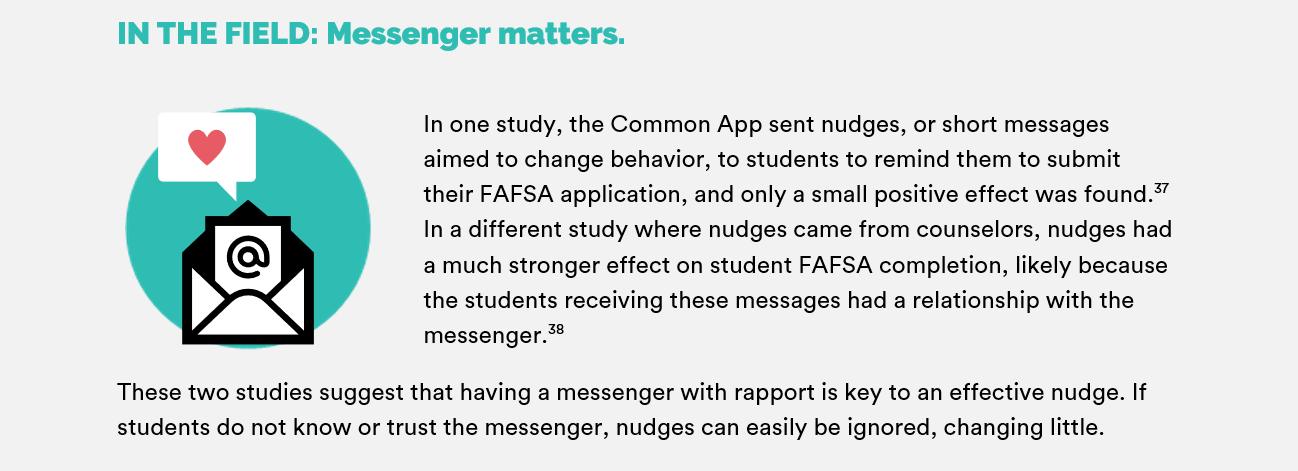
Who the message comes from matters. The best messengers are entities and individuals with whom your students have a relationship or rapport. The stronger the students’ relationship with the sender, the more likely they will respond to the message and engage in the desired behavior change.
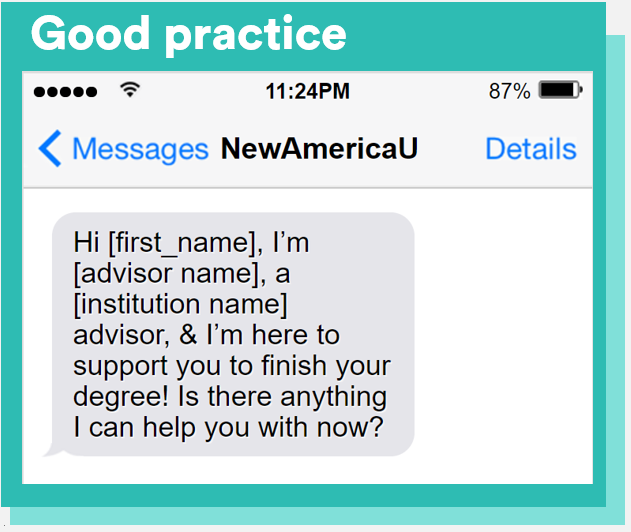
It is important that messengers identify themselves. Otherwise, students may ignore the message or think it is spam. When messengers do identify themselves, but have little rapport with students, the results vary. Some experiments have been successful in changing student behavior with messages that come from an entity with weaker ties to students, like an advising office or The Common Application (Common App).34 Other experiments used messengers that students were more familiar with, such as individual counselors.35 My analysis of the literature on nudging in higher education suggests that students are more likely to respond to and follow through with messages that come from senders they know and trust. For example, Georgia State University creates this connection by introducing students to their advisers on the first day of class and characterizing the chatbot as the school's mascot, Pounce. The university has found that if students have a face to go with the name and a relationship to the messenger, they are more likely to feel an affinity and use them as a resource. Below is an example of how to introduce a messenger to a student.
Image 1636
3. Choose the Modality
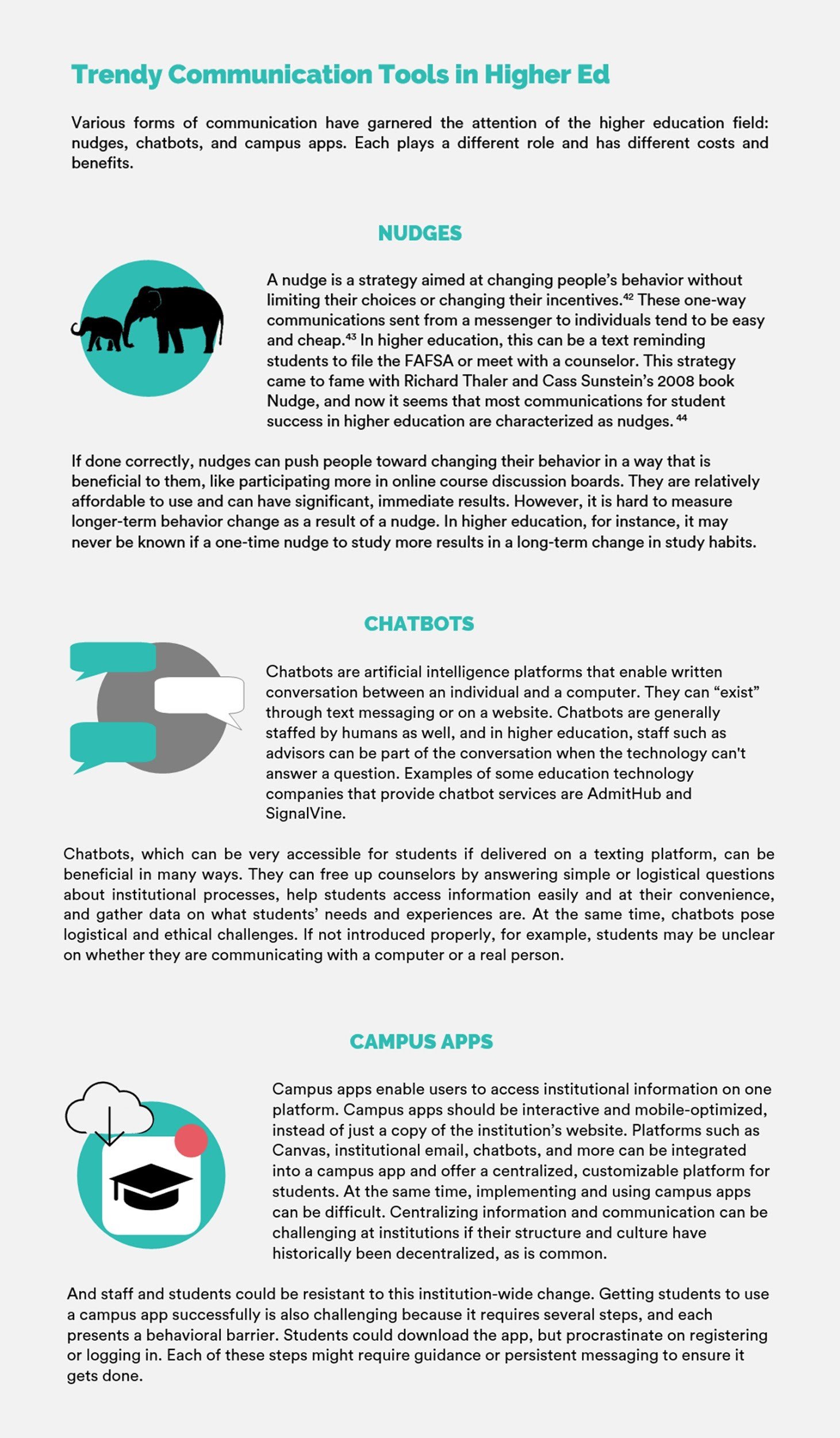
The platform, or modality, on which you deliver your messages also matters. Messages can be sent via email, text, campus app, social media, campus portals or print. Select whichever students are most likely to read, trust, and respond to. This decision may or may not require an institutional shift to a new platform, but in the end the choice should ensure students receive your message in a timely manner through a channel that is not overcrowded with messages from different parts of the college.
While text messaging can be more effective than email, the best platform is the one that is best for your institution and students. Each is “best” depending on what it is being compared to, so do some research on what platforms work at your institution. Sometimes leveraging existing platforms by focusing on critical points in the student timeline can make them more efficient and effective.
4. Create and Test Your Message
After choosing a platform, your team has to create the messages you will send to students or select which vendor-created messages you will use.
If you are creating your own messages, testing these on students will help clarify what works. Use resources you already have to test messages and gather feedback. Student employees or focus groups work well and are efficient, but students should be compensated for their participation. Another option is to engage in A/B testing—testing and comparing two options—to create successful messages. Finally, work across departments to gain important insight into the impact of messages. Check-ins and informal feedback from staff across departments are especially important in decentralized institutions, as the impact of a message on one group of students could be different on another. The creation and testing of messages is an iterative process, and you should expect to return to this step several times.
Thorough analysis of the student body throughout the communication life cycle, including demographics, behaviors, culture, and needs, is important for crafting a successful message about predictive findings. Insufficient research and understanding are likely to lead to an unsuccessful message. Without proper analysis, you can send messages that are irrelevant, unhelpful, or even offensive to students out of ignorance of student likes, wants, and needs.
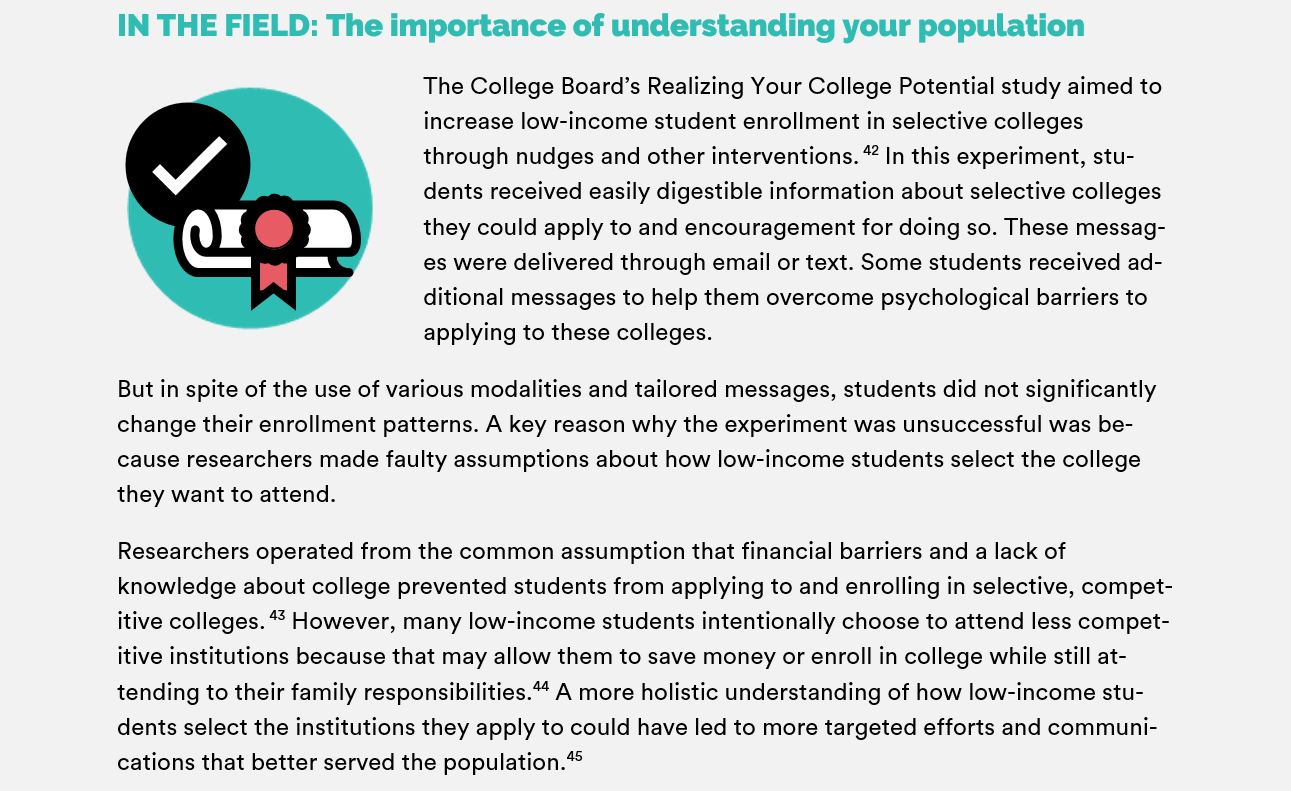
Image 2046
5. Decide When to Press “Send”
Your team should brainstorm about when the best times are to reach out to students. Consider sending messages during high-leverage points, like course registration, to get students to complete an action. Avoid sending messages very early or late at night, on weekends or on holidays. Using data on how students respond to your messages can also help determine the most favorable times to send a particular message. You are likely to find that sending text messages during holidays tends to result in higher unsubscribe rates or unread messages. Finally, institutions should consider developing and implementing a campus-wide communication strategy so that important messages, such as those from a counselor, are not lost in the noise.
6. Train Your End User
Before and during outreach to students, ensure end users, such as counselors, faculty advisers, and administrators, are trained at interpreting and communicating predictive analytics findings. Users should be able to understand the institution’s strategy with predictive analytics, what goes into the model, what predictive scores mean, and how to communicate findings effectively and ethically. Work on the front end will help ensure successful communication of the tool’s findings.
The Message
Once all of the research and preparation work has been done, implement the following components to make a message successful.
Message Structure and Content
Start with a Proper Greeting
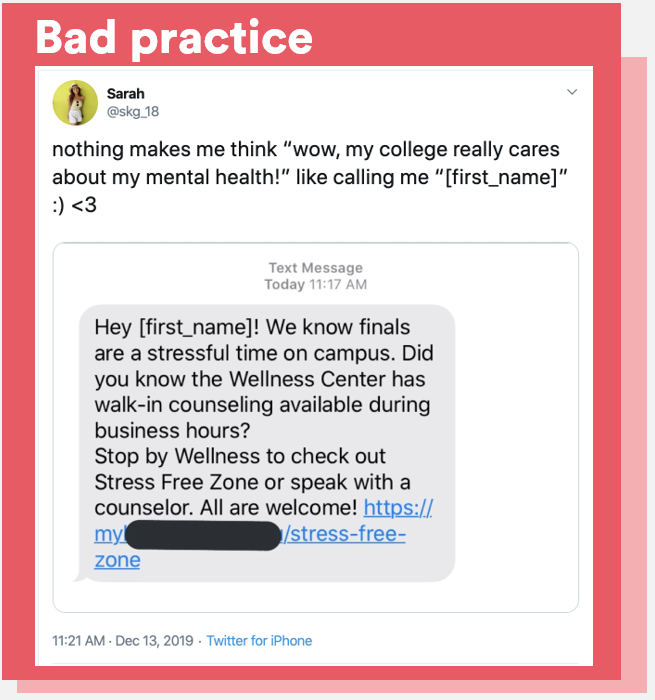
A proper greeting uses the student’s name and identifies who the messenger is. Personalizing a message helps increase response rates and show that the institution cares about the student.47 Identifying the messenger helps establish and strengthen the student-messenger relationship.
Image 2148

Be sure not to leave the student’s name blank. Careless messages hurt rapport. In Image 22, an institution did not fill in the blank for a student’s name and the student did not appreciate that.
Image 22
Make the Message Interactive
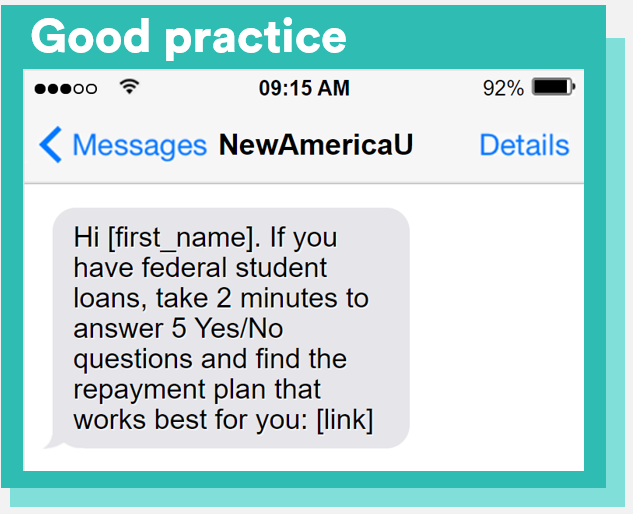
Making the message interactive will make it more likely that students take the desired action. You should include a link to the action you want the student to take, such as a link to make an advising appointment. Including an interactive component reduces the amount of actual and psychological barriers to task completion for students and allows them to complete the task immediately. If you cannot make a message interactive, include clear and concise instructions on how to complete the action so that students know exactly what to do instead of leaving them wondering how to fix the problem.
Image 2349
Be Brief
Lengthy emails are likely to be overlooked or ignored. It is best to be brief and get to the point so that students can take action. Students, like all people, do not have the time to decipher lengthy emails.
Be Positive but Realistic
Messages should be positive so that students are not discouraged, especially because communicating predictive system findings can often be sensitive in nature. Making students feel like they are not the only ones struggling, encouraging them to get help, and emphasizing that they have the capacity to improve their academic performance will minimize harm and increase the likelihood that they take action.
At the same time, it is important to be realistic, especially when students are struggling. Being overly positive can diminish the gravity of a problem, blind students to the real consequences of their situation, or set unrealistic expectations. Be sure to balance a positive tone with a realistic approach so that students are both encouraged to continue their education but are not set up with false hopes for their success.
Case in point: at one institution using predictive analytics, faculty advocated for a small but important distinction in how they communicated to students. Students who were performing poorly in classes were originally told that “it’s not too late” to improve their grades. However, due to several factors, including faculty course policy, it was more accurate to tell students that “it may not be too late” to improve their grades. This change was successfully implemented to reflect a message that was both positive but realistic.
Similarly, do not tell students something that is not true. Ultimately, predictive analytics is intended to help students and the university succeed. This can make communicating less than ideal findings to students challenging for end users. While it may be tempting for end users to manipulate findings to sound more positive, they must be honest with students. Both students and institutions will benefit from the truth.
Give the Value Proposition
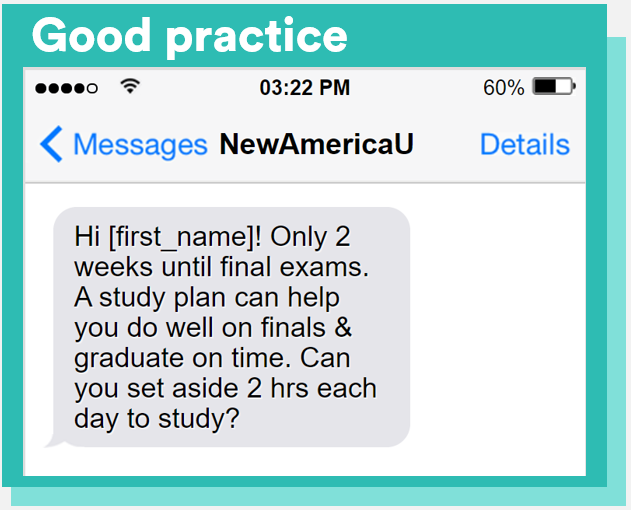
It can be challenging to encourage behaviors that do not have an immediate payoff. Including an explanation about why an action is important in a message could help students understand why it benefits them and convince them to do it. For example, making an appointment for tutoring can seem unnecessary; students may convince themselves that they will just study more next time. But if the message makes the value of meeting with a tutor clear and explicit by using behavioral economics strategies, students will be more likely to take the desired action. As always, it is important to be positive in phrasing the value proposition of an action so as not to provoke anxiety.
Image 2450
Avoid-isms
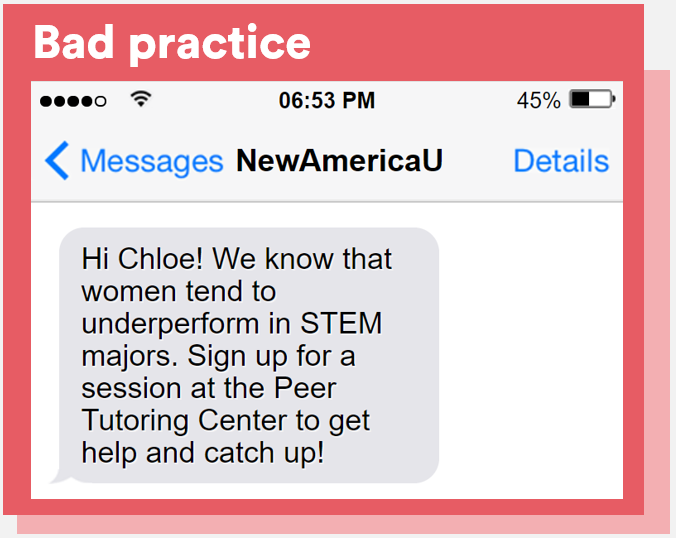
It should go without saying: avoid “-isms” and discrimination. Comments that are racist, sexist, able-ist, homophobic, etc. are unethical, ineffective, hurtful to students, and will likely result in other negative consequences for the institution. Be especially careful not to include microaggressions, or comments that are subtly prejudiced toward marginalized groups, like in Image 25. Ensure both message creators and end users are up to date on their bias training to avoid microaggressive or outright problematic messages. Having a diverse team can also help recognize and flag when a message might be offensive.
Image 25

Citations
- Kelli A. Bird, Benjamin L. Castleman, Jeffrey T. Denning, Joshua Goodman, Cait Lamberton, and Kelly Ochs Rosinger, “Nudging at Scale: Experimental Evidence from FAFSA Completion Campaigns,” National Bureau of Economic Research working paper no. 26158 (August 2019), https://www.nber.org/papers/w26158.pdf; Oded Gurantz, Jessica Howell, Mike Hurwitz, Cassandra Larson, Matea Pender, and Brooke White, “Realizing Your College Potential? Impacts of College Board’s RYCP Campaign on Postsecondary Enrollment,” EdWorkingPaper (May 2019): 19–40, https://doi.org/10.26300/nqn3-sp29
- Lindsay C. Page, Benjamin L. Castleman, and Katharine Meyer, “Customized Nudging to Improve FAFSA Completion and Income Verification,” Educational Evaluation and Policy Analysis 42, no. 1 (2020): 3–2, https://doi.org/10.3102%2F0162373719876916
- Mabel, Castleman, Bettinger, and Choe, “Nudges to the Finish Line—Preliminary Research Brief".
- Bird, Castleman, Denning, Goodman, Lamberton, and Ochs Rosinger, “Nudging at Scale.”
- Page, Castleman, and Meyer, “Customized Nudging.”
- Richard H. Thaler and Cass Sunstein, Nudge: Improving Decisions about Health, Wealth, and Happiness (New Haven: Yale University Press, 2008).
- Thaler and Sunstein, Nudge: Improving Decisions.
- Thaler and Sunstein, Nudge: Improving Decisions.
- Gurantz, Howell, Hurwitz, Larson, Pender, and White, “Realizing Your College Potential?”
- Don Hossler and Karen Gallagher, “Studying Student College Choice: A Three-Phase Model and the Implications for Policymakers,” College and University 51 (1987), https://www.researchgate.net/publication/234741450_Studying_Student_College_Choice_A_Three-Phase_Model_and_the_Implications_for_Policymakers
- Jim Jump, “Ethical College Admissions: Questioning Assumptions on Undermatching,” Inside Higher Ed, June 17, 2019, https://www.insidehighered.com/admissions/views/2019/06/17/new-studies-low-income-students-are-important-we-should-resist-emphasis
- Constance Iloh, “An Alternative to College “Choice” Models and Frameworks: The Iloh Model of College-Going Decisions and Trajectories,” College and University 94, no. 4: 2–9, https://www.aacrao.org/research-publications/quarterly-journals/college-university-journal/article/c-u-vol.-94-no.-4-fall-2019/an-alternative-to-college-choice-models-and-frameworks-the-iloh-model-of-college-going-decisions-and-trajectories
- Christopher J. Bryan, David S. Yeager, Cintia P. Hinojosa, Aimee Chabot, Holly Bergen, Mari Kawamura, and Fred Steubing, “Harnessing Adolescent Values Boosts Healthy Eating,” Proceedings of the National Academy of Sciences 113, no. 39 (September 2016): 10830–10835, https://www.pnas.org/content/113/39/10830
- Daniel J. Howard, Charles Gengler, and Ambuj Jain, “What's in a Name? A Complimentary Means of Persuasion,” Journal of Consumer Research 22, no. 2 (September 1995): 200–211, https://doi.org/10.1086/209445
- Mabel, Castleman, Bettinger, and Choe, “Nudges to the Finish Line—Preliminary Research Brief".
- Mabel, Castleman, Bettinger, and Choe, “Nudges to the Finish Line—Preliminary Research Brief".
- Mabel, Castleman, Bettinger, and Choe, “Nudges to the Finish Line—Preliminary Research Brief".