
How You Say It Matters
Abstract
This report provides guidelines on how to effectively, ethically, and equitably communicate predictive analytics findings to students. It explains the science behind effective messaging, outlines how institutions should prepare for messaging students, and highlights what a successful message should, and should not, include. Administrators and predictive analytics end users, such as academic advisers, should follow these guidelines to inform university communication and predictive analytics strategy and practice.
Acknowledgments
This report was made possible by the contributions of many. Thank you to the interviewees listed in the appendix for sharing their time and knowledge with me. I am grateful to Andrew Magliozzi of AdmitHub and Benjamin Castleman of the University of Virginia for reviewing the report and sharing their feedback. Thank you to New America colleagues Steve Burd and Sabrina Detlef for editorial support, as well as Riker Pasterkiewicz, Julie Brosnan and Fabio Murgia for graphics and communications support. Special thanks to my colleague Iris Palmer for her guidance, edits, and support. Thank you to The Kresge Foundation and the Bill & Melinda Gates Foundation, whose generous support made this work possible. The views in this report are mine alone.
Downloads
Part 1: The Science Behind Communicating
Introduction
Imagine it’s your first year on your new college campus. There are so many new people to meet, things to learn, and institutional processes to wrap your head around. It’s been a tough few weeks, but you are confident that this year will be different, that your old habits—procrastination, working alone, not asking questions—will stay behind. You’ve even heard that your current institution has some cool new technology to help you do better in school. You recall that this technology was mentioned at orientation, but you don’t really remember much else about it.
Now it’s halfway through the semester and you just went through your first round of midterms. That was tough. Despite having done all the right things, like studying in groups, going to office hours, and practicing good time management, you still feel like you didn’t do as well on your exams as you would have liked. It was pretty hard to give school your all while you were juggling multiple jobs and stressed about cutting corners to stay within your budget. And the troubling news you got from back home in the middle of midterms didn’t leave you in the best headspace to concentrate. "Oh well", you think, you really did do your best, so you’re probably ok. It’s probably just new student jitters.
You wake up the day after your last midterm to your phone’s buzzing. There’s a message. You don’t recognize the sender, but curiosity gets the most of you, so you open it:
Image 11
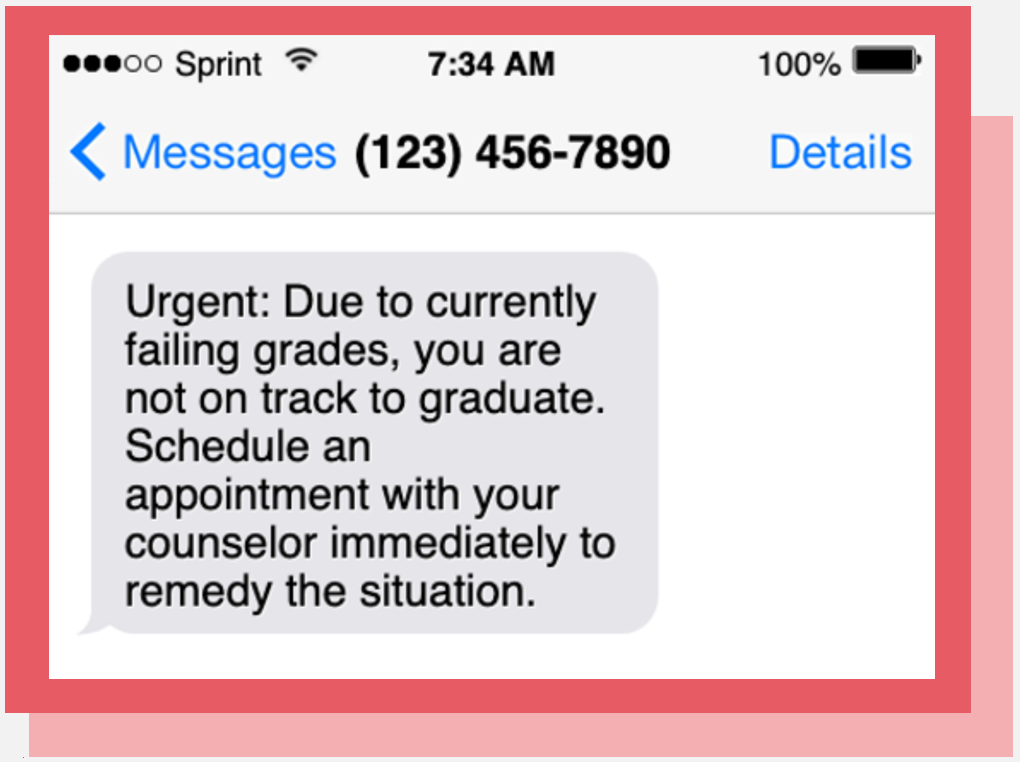
“What. The. Heck. Who is this? How do they know my grades?” A million questions race through your head as you scramble to check your grades. Last you remember, you were doing ok. Not straight A’s, but you were definitely passing everything. Did your midterms really go that badly?
Shoot. You really are failing. Not all of your classes, but one really important course for your major, the one you’ve been struggling with the most. This message is just the cherry on top of a series of challenges, self-doubts, and obstacles during your education. Let’s face it—you were right when you told yourself you weren’t college material. This message is just proof of that.
This scenario shows the hazards of communicating predictive findings to students without care. Though sent with good intentions, this anonymous message is counterproductive, increasing this student’s anxiety, self-doubt, and even her likelihood of dropping out.
Predictive analytics has taken higher education by storm, with its promise of closing equity gaps, raising student retention rates, and increasing tuition revenue by keeping students enrolled. Many colleges and universities have made an investment in predictive analytics for student success initiatives, and even more are looking into implementing, expanding, and strengthening the technology.2
While having clean data, accurate algorithms, and strong ethical principles are vital to putting predictive systems in place to improve student success, these are only a start toward creating the institutional change necessary to help more students graduate. An algorithm alone cannot create change; action is necessary. Getting advisers and other end users to communicate the predictive system findings to students is a vital step in successfully using predictive analytics and doing so equitably is of utmost importance.
This report offers research-based guidelines to colleges for engaging in effective, ethical, and equitable communication about predictive analytic system findings to students. It covers how to approach the first engagement with students: how an early alert end user, such as a counselor or adviser, can tell students that a problem has been identified, connect them with resources, and create the behavior change needed for success. It is also a guide for institutional leadership to consider when working with students, faculty, and staff to implement predictive analytics at their institution.
Why Communication Matters
Communicating with students can seem easy, intuitive, and low-stakes, and an entire report on the subject may seem like overkill. But as the example above shows, having good intentions does not guarantee success, and ineffective communication can cause serious harm. Extensive behavioral science research shows that how institutions communicate to students really matters.3 This is especially the case with communicating predictive system findings, as these messages relay potentially sensitive information to students. Carefully communicating with students matters for the following reasons.
It matters for student success
How colleges communicate predictive findings to students can help or hinder their success. Communicating effectively can serve to minimize barriers between students and resources and help them follow through with their intentions and goals. Effective communication can also serve to strengthen students’ sense of belonging and confidence in their abilities, an important aspect of student success. Poor communication, however, is unlikely to spur change in a student, and may, in fact, impede success. For example, unclear communication can leave students wondering what they are supposed to do if they fail a course. And as the example above shows, a carelessly worded message can make students feel like they are not meant for college, and inadvertently push them to drop out.
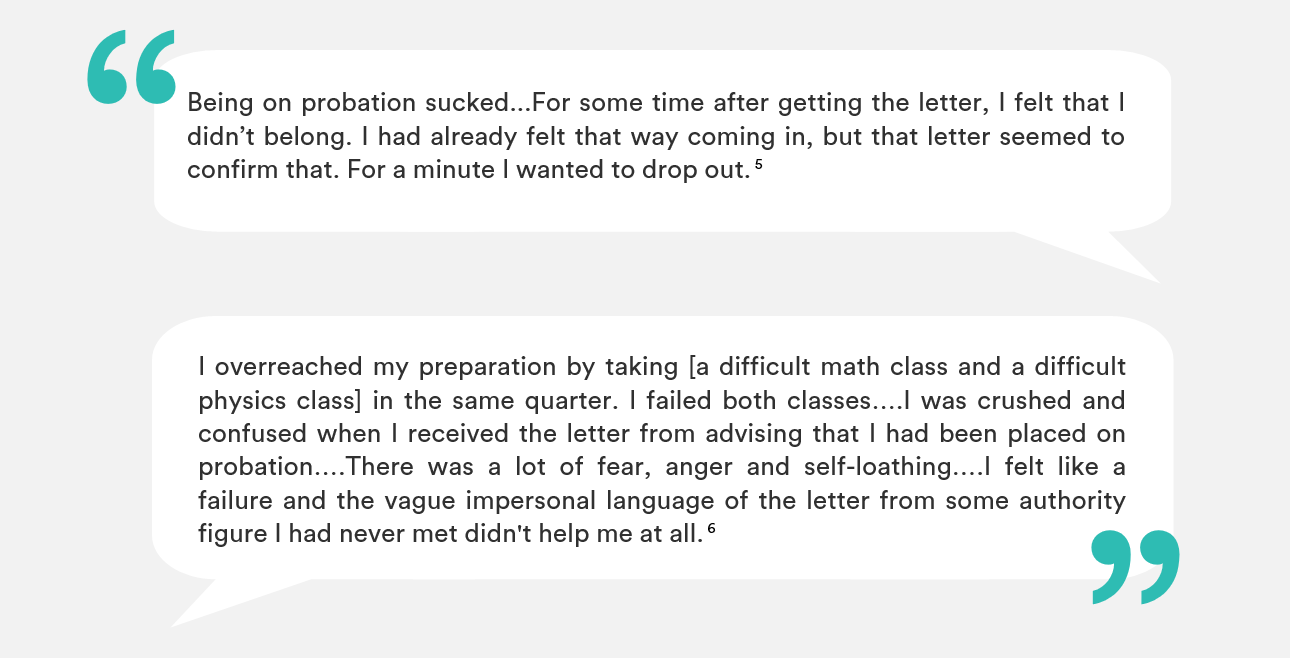
Students can also react negatively to messages communicating difficult information. Shannon Brady's dissertation for Stanford's Graduate School of Education on how students react to probation letters gives us two such examples.4 Students are likely to have similar negative reactions to predictive system messages that are critical of their academic performance.
Image 2: Student reactions to probation letters
It matters for your investment56
Predictive analytics can cost a lot of money and social or political capital, so appropriately and effectively communicating findings to students is essential to ensuring your institution’s investment pays off. Effective, ethical, and equitable communications will keep students in school, helping institutions reach their retention, graduation, and revenue goals. Careless or ill-prepared messages can lead to unmet goals and an inefficient use of the capital invested in predictive analytics.
It matters for educational equity
How predictive system findings are communicated to students has serious equity implications. Today’s students are more diverse than ever: 42 percent are students of color and 24 percent have children or other dependents.7 Their needs and challenges differ from traditional college students who are younger, tend to be wealthier, and can focus exclusively on their academics. Poor communication can exacerbate challenges that students face. For example, a message without clear instructions on how to make an advising appointment could confuse a first-generation student who needs an appointment urgently but does not know how to schedule one or have relatives and friends who can help. And a message that lacks a growth mindset could exacerbate a student of color’s already strong sense of lack of belonging. Communicating predictive findings without care can have unintended consequences that add to the challenges today’s students face and hurt their chances of graduating. Institutions must use messages about predictive system findings as an opportunity to refer students to resources and better support students of color, low-income students, and other under-resourced or non-traditional students on their path to graduation.
About Predictive Analytics
Predictive analytics is the use of mathematical models that use patterns in past data to predict or forecast future events. Colleges often use predictive analytics to help retain and graduate students. Institutions do this by developing models based on the demographic, behavioral, and/or academic data of past students to calculate a score for each current student, which represents that student’s likelihood of graduating or dropping out. This predictive score, or risk score, can change depending on student behaviors, actions, or circumstances. For example, if a student fails to meet with an advisor, his or her risk score rises.
These risk scores are generally not communicated to students. Instead, an end user of the predictive analytics system, like an academic adviser, has access to what is commonly known as an early alert dashboard, which helps the adviser see if a risk score changes significantly. End users typically send messages to students urging them to take actions that will lower their risk score and effectively improve their chances of graduating.
The Science Behind Communicating
Communicating predictive system findings is especially tricky because it aims to inform students of a potentially unpleasant fact while simultaneously persuading them to change their behavior. However, using concepts from several subfields within behavioral science can help end users and institutions create effective messages.
Behavioral economics and social psychology provide the key concepts and techniques that shape these communications. Behavioral economics helps explain how individuals make choices, and thus how a message can be structured to cause behavior change.8 Social psychology studies how individuals behave in a social context, or the way certain factors affect our behavior in relation to others, and informs how individuals may interpret a message.9 Using behavioral economics and social psychology together ensures that messages are effective, ethical, and equitable and support students in their educational goals.
Behavioral Economics
Behavioral economics is a relatively new field of study that blends economics and psychology.10 Contrary to traditional economics, which operates on the premise that humans are rational decision makers, behavioral economics argues that they are irrational beings that make decisions within their context and available resources.11 Concepts such as loss aversion, decision fatigue, and heuristics all come from behavioral economics.12
Behavioral economics helps explain how people’s surroundings lead them to make decisions, and more importantly, how to help them make better ones. When it comes to communicating predictive findings, behavioral economics can inform how a message is structured to help students be successful. What follows are several behavioral economics concepts that can make a message more effective.
Social Proof
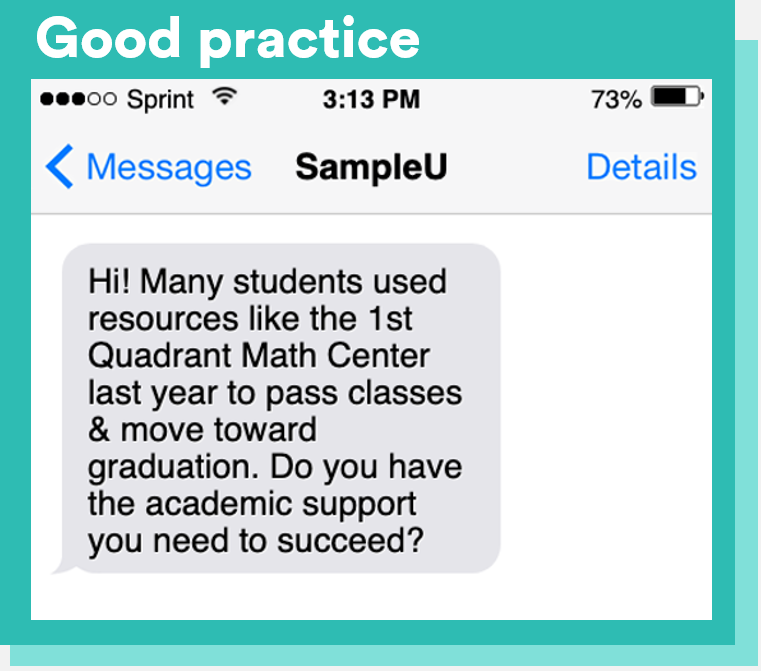
People are more likely to do things their peers are doing.13 For predictive analytics purposes, you may be more successful in persuading students to take a certain action, like going to the writing center or meeting with an adviser, if you let them know other students are doing it too. Sending a message that says “60 percent of your peers in your major attended a writing center workshop and found it helpful” could convince the recipient to do the same. The ongoing project, "Nudges to the Finish Line," provides several examples of messages that exemplify the use of this concept and others. See Images 3 and 4 for good examples of social proofing.
Image 314
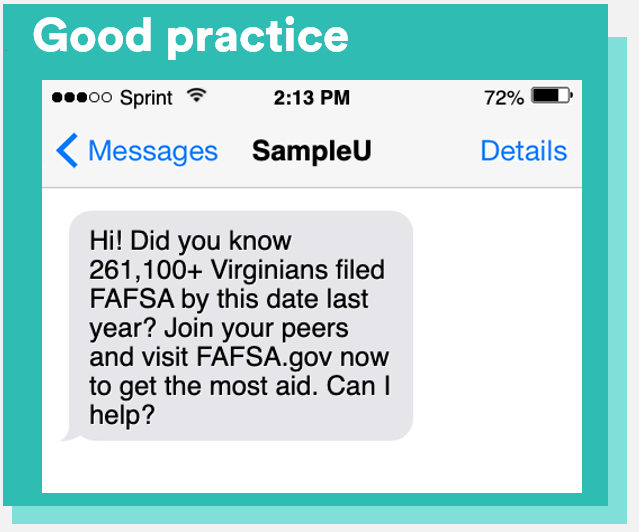
Image 415
Loss Aversion
Studies of human behavior have shown that people prefer to protect what they have over potential gains. This concept is known as loss aversion.16 Take this scenario: when given the option of choosing between having (A) a 100 percent chance of winning $250 or (B) a 25 percent chance of winning $1,000, most people choose option A because they would rather be certain of winning a small amount than taking the risk of not winning anything.17
For predictive analytic purposes, sending messages that make students aware of what they may lose as a result of inaction is likely to encourage them to change their behavior. Telling students that not enrolling in classes on time could cost them a spot in required major courses may encourage them to act more quickly, for example. However, institutions must use these types of loss aversion strategies in an ethical manner. Employing this technique in a dishonest way may lead to undesirable consequences for students, such as undue anxiety and a lack of sense of belonging.18 Coupling loss aversion with inclusionary and positive language can help students be aware of what they may lose while making them feel like an important part of the institution. Images 5 and 6 show how to employ loss aversion ethically in your messages to students, while Image 7 shows a bad example.
Image 519
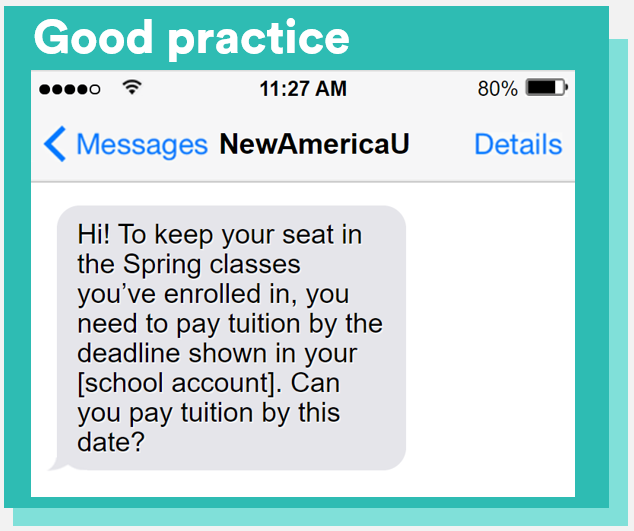
Image 620
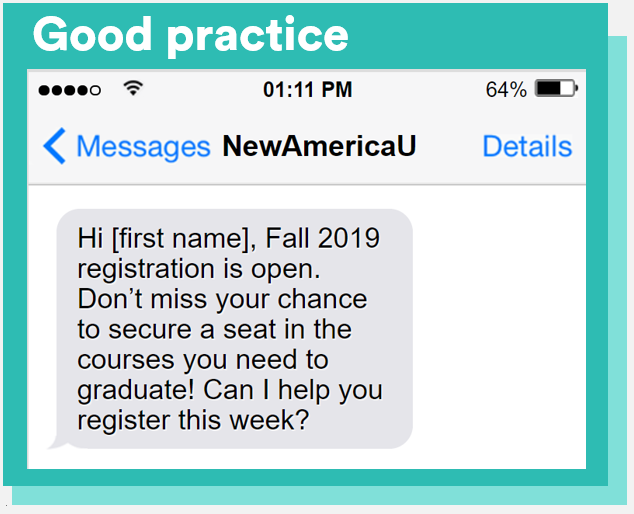
Image 7
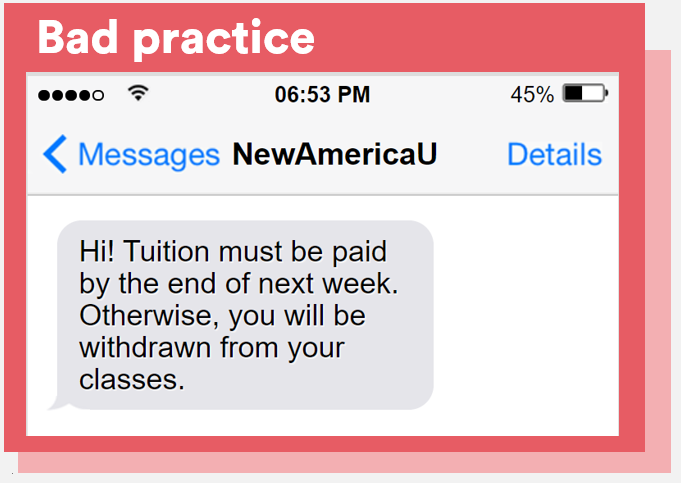
Minimizing Hassle
Students have a lot on their plates, so an effective message will make a desired change in behavior as easy to accomplish as possible. A predictive analytics message should provide clear and simple instructions so that students know exactly what they have to do, how to do it, and can act immediately. If you want students to set up an appointment with their major adviser, for example, include a link to make an appointment or have them reply to the message with times they are available and send a calendar invitation. To encourage students to enroll in courses on time, include instructions on how to do so in the message. In other words, the easier the better. Image 8 is an example of a message that includes clear instructions, reduces the mental energy necessary to take action, and therefore minimizes hassle.
Another benefit of designing messages to minimize hassle for students is that it may force an institution to simplify institutional processes that are more complicated than they need to be. Messages with clear instructions coupled with more efficient institutional processes make it easier for students to take action.
Image 821
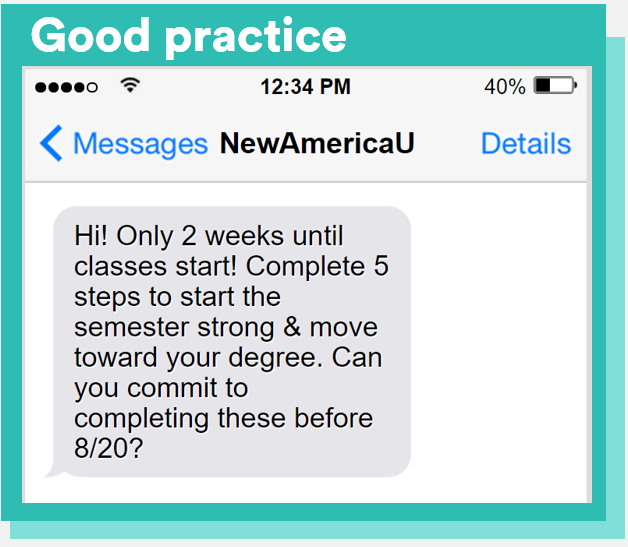
Timing
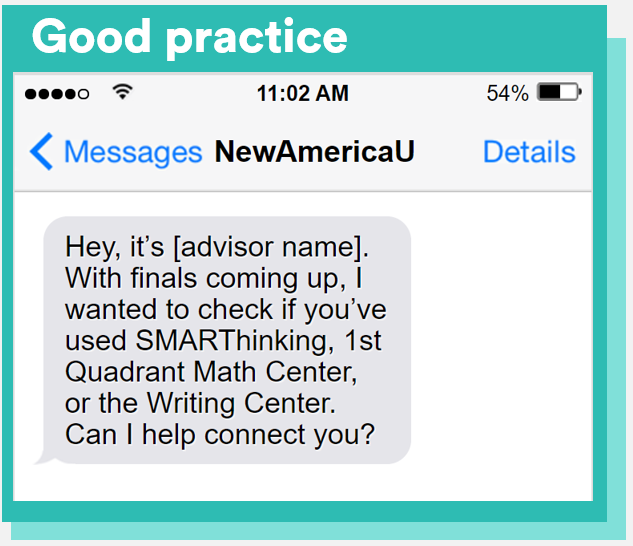
In addition to minimizing hassles, sending messages in a timely manner will make them more effective and increase the likelihood that students engage in the desired behavior change. Messages sent during high-leverage junctures make it more likely that students will take action (see Image 9).22 Periods such as course registration, midterms, or the FAFSA deadline may be the optimal time to contact students. On the other hand, trying to communicate with students during a holiday break or summer vacation is unlikely to be effective.
Image 923
Preserving Choice
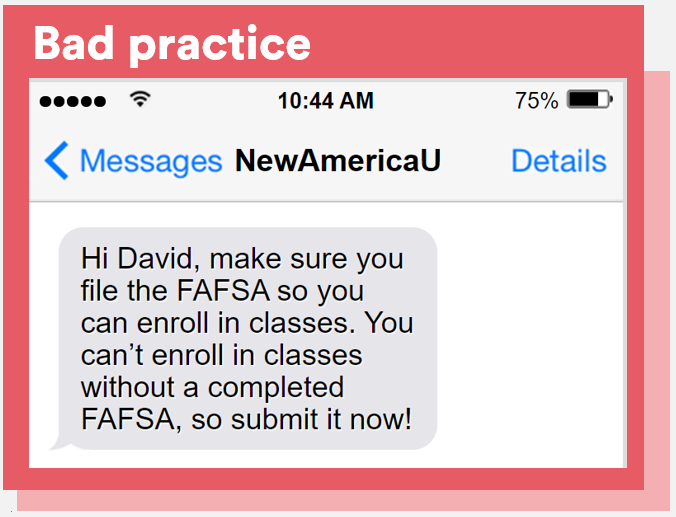
When communicating predictive system findings to students and trying to influence their behavior, it is essential to preserve student choice. In other words, you do not want students to take a certain action because you left no other option. An example of how this can happen is by making something dependent on the completion of another task, like enrolling full time in order to receive a tuition discount. Some students may not be able to enroll full time, and without other options, could choose to not enroll in the institution at all.
Another example might be when course enrollment is tied to FAFSA completion. While this may seem like a two-for-one deal for the institution (students file the FAFSA and enroll in classes on time), it may put students in a challenging situation if they are ineligible to file. It could also leave students out of their education entirely: if they do not file the FAFSA, they are not able to enroll in classes or receive financial aid. Messages that try to change behavior while limiting student choice, like in Image 10, are unethical and ineffective.
Image 10
Social Psychology
Social psychology is the study of “the nature and causes of individual behavior in social situations” and includes concepts such as the sense of the self, social influence, group processes, prejudice, and discrimination.24 It explores how humans think and behave in the context of their relationships and greater society.
As it relates to predictive analytics, social psychology helps us understand how the content of a message can affect the receivers’ self-conception and their relationship to those around them. Using social psychology to create messages ensures that communication is both effective and ethical. Implement or be aware of the following social psychology concepts when communicating predictive findings to students in order to minimize harm.
Growth Mindset
Studies have shown that believing that one’s abilities can change and improve with dedicated effort can improve performance, and that students with this kind of growth mindset perform better on a task than those with a fixed mindset (believing that talent and ability is innate).25 Communicating predictive findings with a growth mindset sends a message to students that they have the ability to change their behaviors and improve their academic outcomes instead of being stuck in their current ways. As a result, students feel more positive about their potential despite their academic challenges.
Image 11
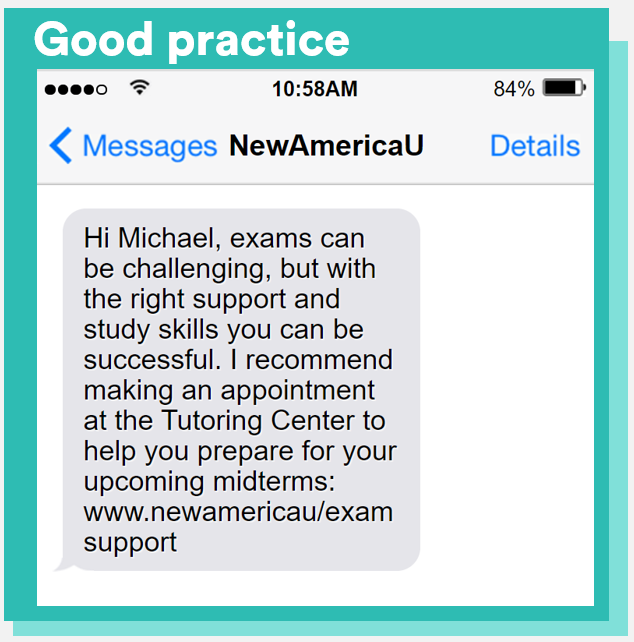
Image 12
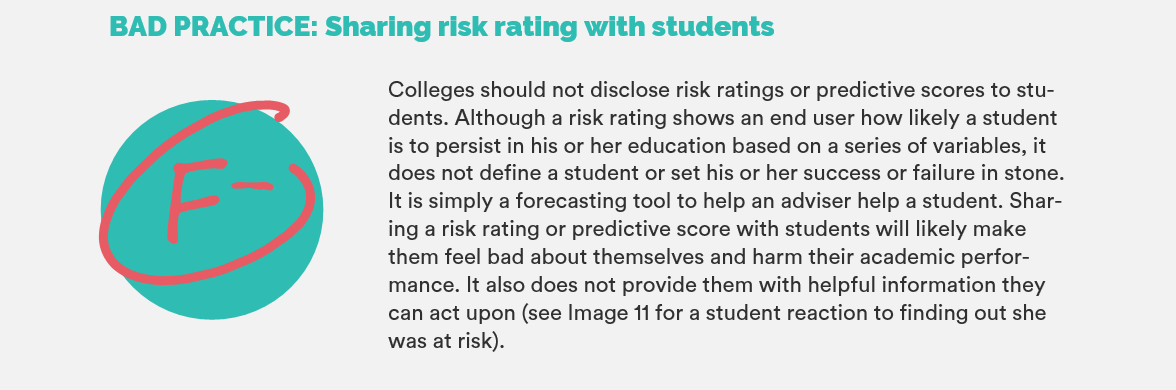
Image 13
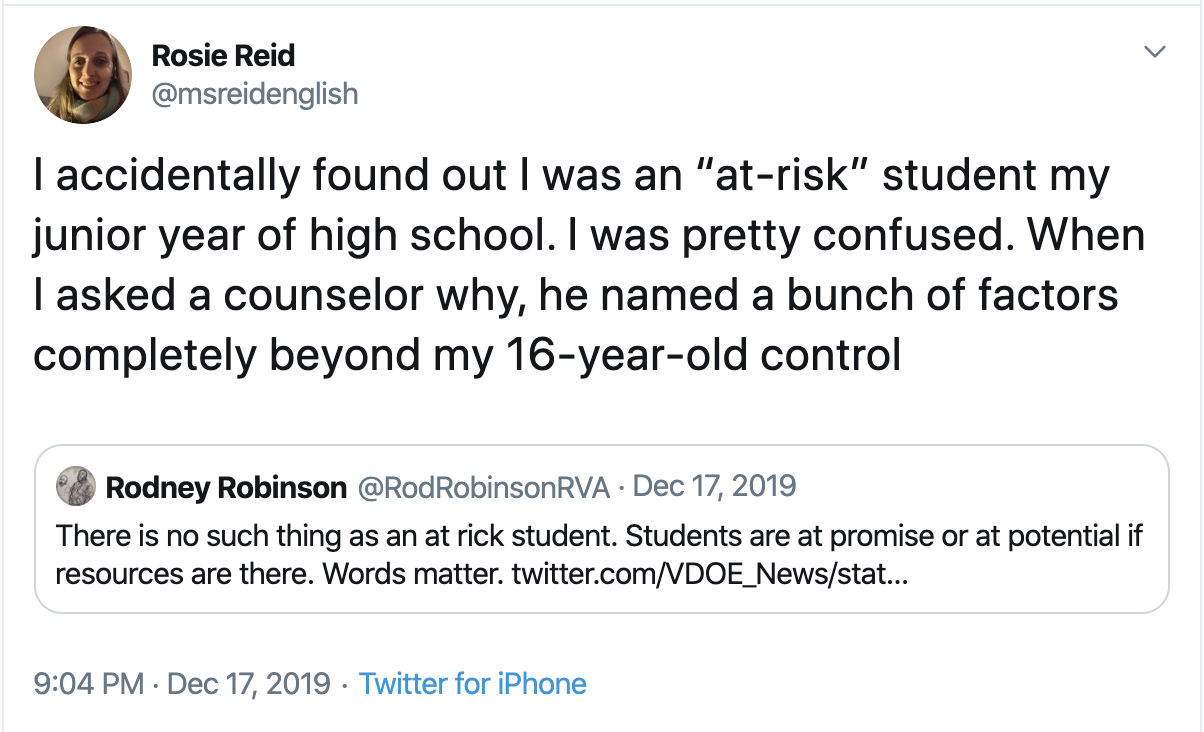
Interdependent Focus
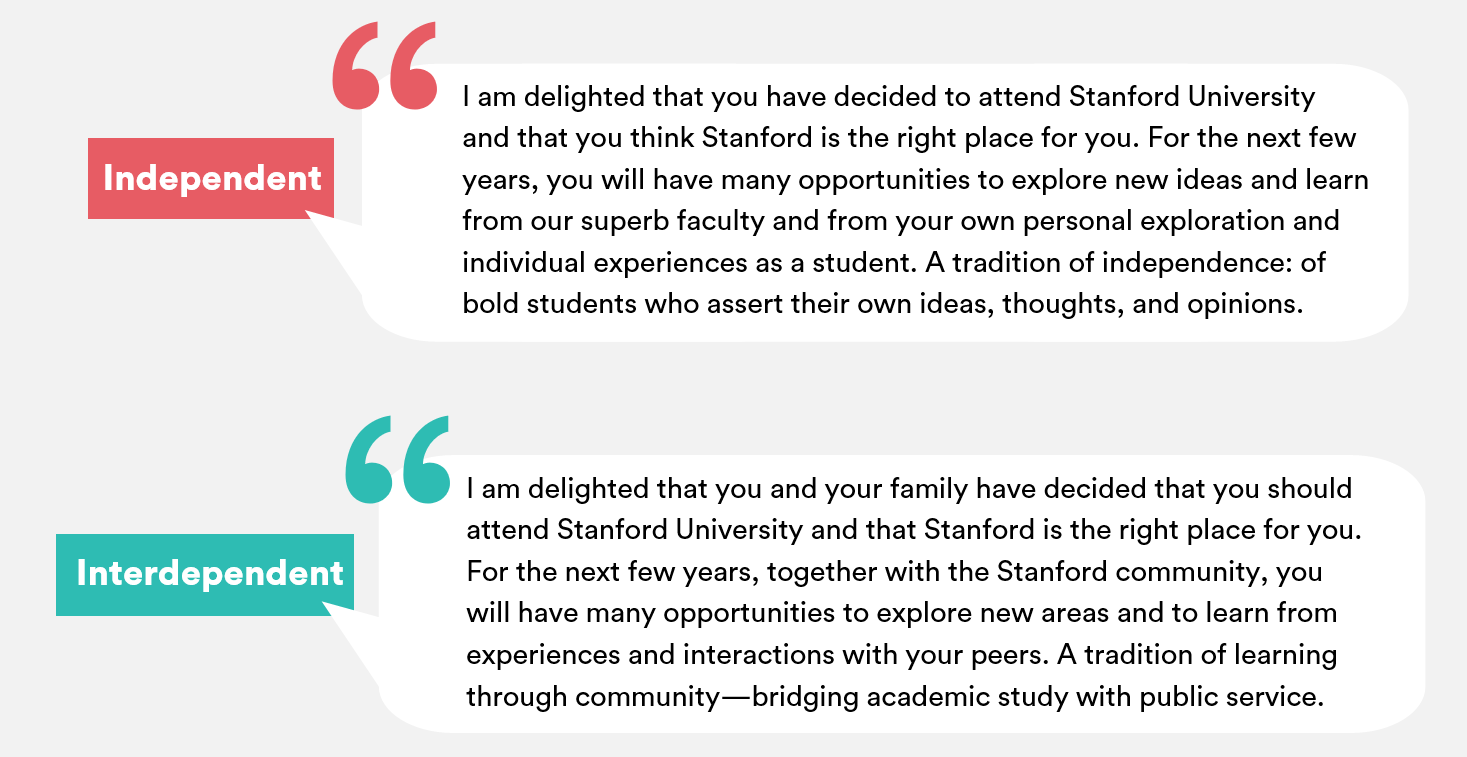
Some studies suggest that whether messages are worded to highlight independence or communal thinking can affect how students respond. One experiment compared admission letters with either an independent or interdependent tone (see Image 13 for an independent message followed by an interdependent message). An independent tone emphasizes individualism and assertiveness, while an interdependent tone emphasizes groups and collaborative behavior. Researchers found that letters with an interdependent, or more group-oriented, tone led to more low-income student enrollment as compared to an independent letter that highlighted individualism.26 The interdependent letter highlighted values of community and collaboration that aligned with students’ own. Similarly, communication with a greater focus on the “we” as opposed to “me” could make it more likely that students change their behavior, especially if they come from more interdependent communities, like low-income, first-generation, or immigrant backgrounds, because these messages remind them that they are part of the school community and will be supported.27
Table 1: Independent vs. Interdependent Messages
Belonging
Humans have an inherent need to feel that they belong to a group. Lacking a sense of belonging has shown to negatively affect peoples’ performance, including students.28 A study on probation letters sent to students, for instance, found that they were more likely to persist at their institution when letters showed care and concern and expressed that students were an important part of the institution’s community.29 Students who received a probation letter that only described the procedural process of probation without expressing concern were more likely to feel like they did not belong at the institution and were less likely to persist and earn a degree.
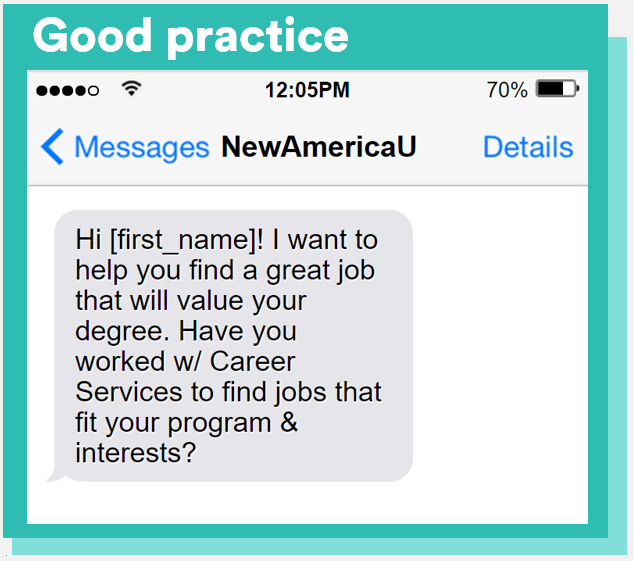
Communicating concern over behavior or academic performance from predictive system findings, like a drop in grades that qualifies someone for probation, can cause students to question their place at the institution, if not done with care. Messages like that in Image 14 express care for students and their outcomes and could reinforce their sense of belonging.
Image 1430
Stereotyping and Stereotype Threat
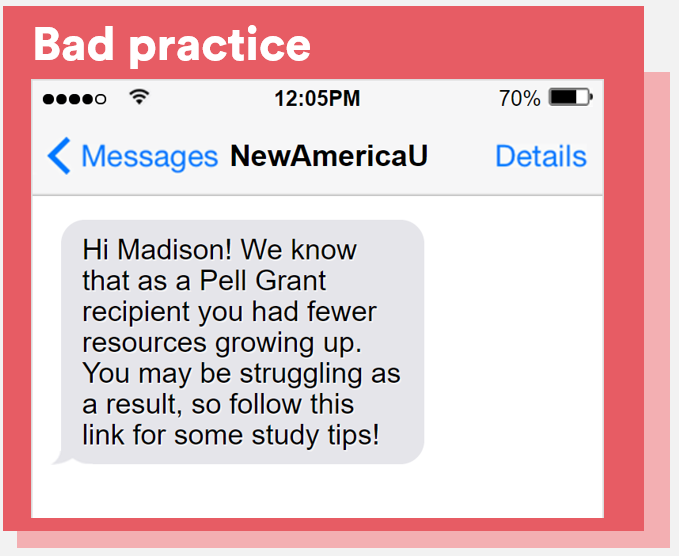
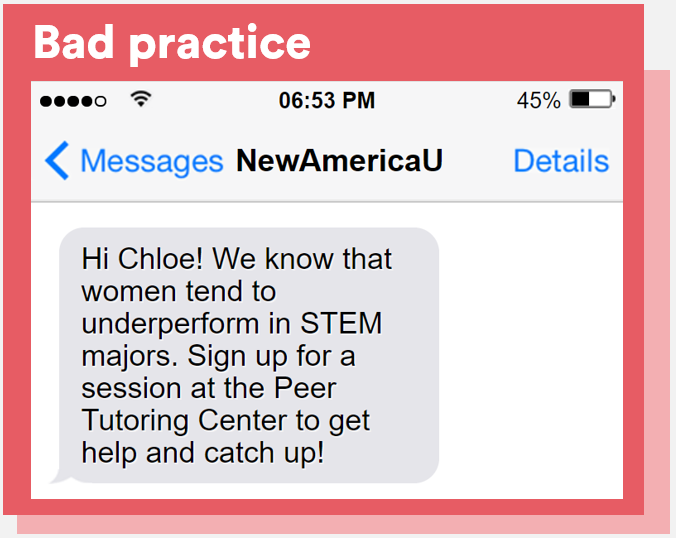
In communicating predictive system findings to students, it is important to not make assumptions about why someone is struggling in school or what obstacles they face based on assumed or known characteristics, such as race, gender, or parenting status. Even if shared with good intentions, assuming things about students' experience in college based on stereotypes, as in Image 15, is likely to be hurtful to students, damage your relationship with them, and could imperil their academic progress.
Image 15
Profiling and stereotyping students can lead to other unfortunate outcomes beyond damaging a sense of belonging, such as tracking students into certain majors or professions that pay less. When acting upon a predictive finding, an end user may feel inclined to help students succeed by tracking them into “easier” majors, like public health instead of pre-med. While there is nothing wrong with switching majors, it is problematic to advise an “easier” route without first providing support for students in their chosen major, especially if the student is underrepresented in that field.
Stereotyping can also lead to stereotype threat, the social phenomenon where individuals are or believe they are at risk of conforming to a stereotype about their social group.31 Stereotype threat can hinder an individual’s performance on a task. In various studies, individuals who took an exam and held a marginalized social identity (such as a woman taking a science exam with two men, or one person of color taking an exam with two white people) actually performed worse on the task because they were stressed about confirming a stereotype.32
End users should be careful to avoid communicating bias and stereotypes to students when sending messages about predictive system findings, whether unintentionally or not. If students receive a message saying that they are unlikely to graduate because they are low-income or a student of color, this message could trigger a series of thoughts, behaviors, and events that leads to underperforming. Bias training and thorough research and testing of messages can help prevent this.
Self-Fulfilling Prophecy
Stereotyping can lead to a self-fulfilling prophecy, the social psychology phenomenon where an individual thinks something will happen and then acts in a way that makes that outcome occur.33 Self-fulfilling prophecies can be self-imposed or imposed by others. In the context of higher education, students who learn they have a low predictive score may take that to mean they are not “college material” and, as a result, study less, perform poorly, and eventually drop out. Although a low predictive score does not explicitly state that a student is not college material, the student can come to understand that and then engage in counterproductive behaviors that make failure seem inevitable. Poorly communicated predictive findings can lead to the very behaviors you are trying to change or prevent.
Citations
- Except where noted, message content was created by the author.
- Amelia Parnell, Darlena Jones, Alexis Wesaw, and D. Christopher Brooks, Institutions’ Use of Data And Analytics for Student Success: Results from a National Landscape Analysis (Washington, DC: National Association of Student Personnel Administrators, 2018), https://www.naspa.org/images/uploads/main/DATA2018_DOWNLOAD.pdf
- Gregory M. Walton and Geoffrey L. Cohen, “A Question of Belonging: Race, Social Fit, and Achievement,” Journal of Personality and Social Psychology, 92, no.1 (2007): 82–96, https://psycnet.apa.org/record/2006-23056-007; Brady, “A Scarlet Letter?”; and Nichole Stephens, Stephanie A. Fryberg, Hazel R. Markus, Camile S. Johnson, and Rebecca Covarrubias, “Unseen Disadvantage: How American Universities’ Focus on Independence Undermines Academic Performance of First-Generation Students,” Journal of Personality and Social Psychology 102, no. 6 (2012): 1178–1197, https://inequality.stanford.edu/sites/default/files/Markus-paper-1.pdf
- Shannon T. Brady, “A Scarlet Letter? Institutional Messages About Academic Probation Can, But Need Not, Illicit Shame and Stigma,” PhD diss., Stanford University, 2017, https://stacks.stanford.edu/file/druid:xq150gy8094/BradyS_Dissertation_Final-augmented.pdf
- Brady, “A Scarlet Letter?”, 23.
- Brady, “A Scarlet Letter?”, 23.
- Lumina Foundation (website), “Today’s Student,” https://luminafoundation.org/campaign/todays-student/
- Alain Samson, ed., The Behavioral Economics Guide 2018 (London, UK: Behavioral Science Solutions, 2018), https://www.behavioraleconomics.com/the-be-guide/the-behavioral-economics-guide-2018/
- American Psychological Association (website), “Social Psychology Studies Human Interactions,” https://www.apa.org/action/science/social/; and Saul McLeod, “Social Psychology,” Simply Psychology (website), 2017, https://www.simplypsychology.org/social-psychology.html
- Alain Samson, ed., The Behavioral Economics Guide 2014 (London, UK: Behavioral Science Solutions, 2014), https://www.behavioraleconomics.com/the-be-guide/the-behavioral-economics-guide-2014/
- Samson, Guide 2014.
- Daniel Kahneman and Amos Tversky, "Prospect Theory: An Analysis of Decision under Risk," Econometrica 47, no. 2 (1979): 263–91, https://doi.org/10.2307/1914185; behavioraleconomics (website), “Loss Aversion,” https://www.behavioraleconomics.com/resources/mini-encyclopedia-of-be/loss-aversion/; Kathleen D. Vohs, Roy F. Baumeister, Jean M. Twenge, Brandon J. Schmeichel, and Dianne M. Tice, Decision Fatigue Exhausts Self-Regulatory Resources (2005), https://www.psychologytoday.com/files/attachments/584/decision200602-15vohs.pdf; and Amos Tversky and Daniel Kahneman. "Judgment under Uncertainty: Heuristics and Biases," Science 185, no. 4157 (1974): 1124–131, http://www.jstor.org/stable/1738360
- Robert Cialdini and Steve Martin, “Science of Persuasion,” YouTube video, 11:50, November 26, 2012), https://www.influenceatwork.com/principles-of-persuasion/; and Samson, Guide 2014.
- Several of the example messages I use are from an ongoing project, Nudges to the Finish Line. For an interim report on the project’s impacts, please read Zack Mabel, Ben Castleman, Eric Bettinger, and Alice Choe, “Nudges to the Finish Line—Preliminary Research Brief,” September 2019, https://nudge4.org/wp-content/uploads/2019/10/N2FL-Research-Brief-September-2019.pdf. For more information on the full set of messages used in the study, please contact [email protected].
- Mabel, Castleman, Bettinger, and Choe, “Nudges to the Finish Line—Preliminary Research Brief".
- Samson, Guide 2014.
- Daniel Kahneman and Amos Tversky. "Prospect Theory: An Analysis of Decision under Risk," Econometrica 47, no. 2 (1979): 263–91, https://www.jstor.org/stable/1914185?seq=1; and Samson, Guide 2014.
- Claude Steele and Joshua Aronson, “Stereotype Threat and the Intellectual Test Performance of African Americans,” Journal of Personality and Social Psychology 69, no. 5 (1995): 797–811, https://pdfs.semanticscholar.org/0d9d/adea3250b20eaf7f658d84621e60d7c44b74.pdf?_ga=2.61359726.312801967.1580845730-355640464.1580845730. Also see Pauline Rose Clance and Suzanne A. Imes, “The Impostor Phenomenon in High Achieving Women: Dynamics and Therapeutic Interventions,” Psychotherapy: Theory Research and Practice 15 (1978): 241–247, http://www.paulineroseclance.com/pdf/ip_high_achieving_women.pdf; and Carissa Romero, “What We Know About Belonging from Scientific Research,” Mindset Scholars Network, July 2015, http://mindsetscholarsnetwork.org/wp-content/uploads/2015/09/What-We-Know-About-Belonging.pdf
- Mabel, Castleman, Bettinger, and Choe, “Nudges to the Finish Line—Preliminary Research Brief".
- Mabel, Castleman, Bettinger, and Choe, “Nudges to the Finish Line—Preliminary Research Brief".
- Mabel, Castleman, Bettinger, and Choe, “Nudges to the Finish Line—Preliminary Research Brief".
- Marissa Keech, Anne La, Faith Rankin, and Erika Kim, Campaign & Script Best Practices: Principles for Increased Student Engagement, (Boston, MA: AdmitHub, 2020), https://www.admithub.com/resources/campaign-script-best-practices/
- Mabel, Castleman, Bettinger, and Choe, “Nudges to the Finish Line—Preliminary Research Brief".
- Robert A. Baron, Donn Erwin Byrne, and Jerry M. Suls, Exploring Social Psychology (London, UK: Allyn & Bacon, 1989).
- Carol S. Dweck and Ellen L. Leggett, “A Social-Cognitive Approach to Motivation and Personality,” Psychological Review 95 (1988): 256–273, https://www.unco.edu/cebs/psychological-sciences/about-us/faculty-staff/pugh-kevin/dweck_leggett88.pdf
- Nichole Stephens, Stephanie A. Fryberg, Hazel R. Markus, Camile S. Johnson, and Rebecca Covarrubias, “Unseen Disadvantage: How American Universities’ Focus on Independence Undermines Academic Performance of First-Generation Students,” Journal of Personality and Social Psychology 102, no. 6 (2012): 1178–1197, https://inequality.stanford.edu/sites/default/files/Markus-paper-1.pdf
- Stephens, Fryberg, Markus, Johnson, and Covarrubias, “Unseen Disadvantage.”
- Romero, “What We Know About Belonging”; and Mary Murphy and Sabrina Zirkel, “Race and Belonging in School: How Anticipated and Experienced Belonging Affect Choice, Persistence, and Performance,” Teachers College Record 117, no. 12 (2015): 1–40, https://www.tcrecord.org/Content.asp?ContentId=18154
- Brady, “A Scarlet Letter?”
- Mabel, Castleman, Bettinger, and Choe, “Nudges to the Finish Line—Preliminary Research Brief".
- Claude Steele and Joshua Aronson, “Stereotype Threat and the Intellectual Test Performance of African Americans,” Journal of Personality and Social Psychology 69, no. 5 (1995): 797–81, https://pdfs.semanticscholar.org/0d9d/adea3250b20eaf7f658d84621e60d7c44b74.pdf?_ga=2.61359726.312801967.1580845730-355640464.1580845730
- Steele and Aronson, “Stereotype Threat.”
- Robert K. Merton, "The Self-Fulfilling Prophecy," The Antioch Review 8, no. 2 (1948): 193–210, https://doi.org/10.2307/4609267
Part 2: Creating the Message
Behind the Scenes
Now that you have a better understanding of the science behind effective communication and what can cause failed messages, it is important to learn how to put that into practice. This section will cover the process for creating successful messages and highlight aspects that make them effective. Tailor these guidelines to fit your own institutional culture, resources, and needs.
1. Create Your Team
A diverse team will help create and deploy communications about predictive system findings most effectively. Ideally, teams should be as diverse as possible considering available resources. Social diversity (such as race/ethnicity, gender, etc.) and diversity of professional background (like communications experts and those in advising or institutional research), are both important for the creation of effective messages. Consider hiring undergraduates to help provide a sense of how messages will be heard by students and bring more diversity to your team. Diversity will bring important nuance to how you construct your messages.
2. Select the Messenger
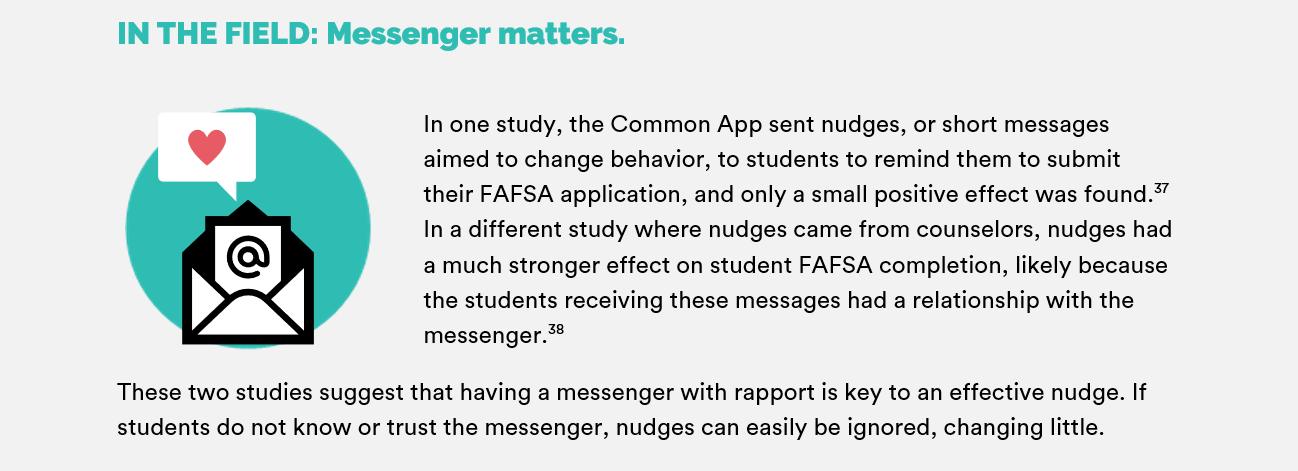
Who the message comes from matters. The best messengers are entities and individuals with whom your students have a relationship or rapport. The stronger the students’ relationship with the sender, the more likely they will respond to the message and engage in the desired behavior change.
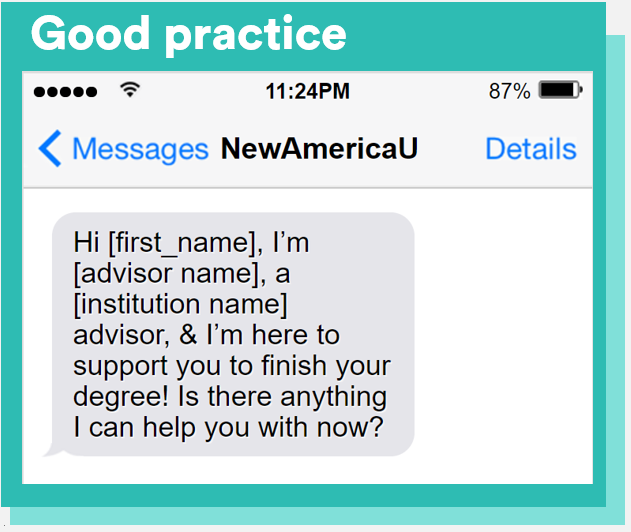
It is important that messengers identify themselves. Otherwise, students may ignore the message or think it is spam. When messengers do identify themselves, but have little rapport with students, the results vary. Some experiments have been successful in changing student behavior with messages that come from an entity with weaker ties to students, like an advising office or The Common Application (Common App).34 Other experiments used messengers that students were more familiar with, such as individual counselors.35 My analysis of the literature on nudging in higher education suggests that students are more likely to respond to and follow through with messages that come from senders they know and trust. For example, Georgia State University creates this connection by introducing students to their advisers on the first day of class and characterizing the chatbot as the school's mascot, Pounce. The university has found that if students have a face to go with the name and a relationship to the messenger, they are more likely to feel an affinity and use them as a resource. Below is an example of how to introduce a messenger to a student.
Image 1636
3. Choose the Modality
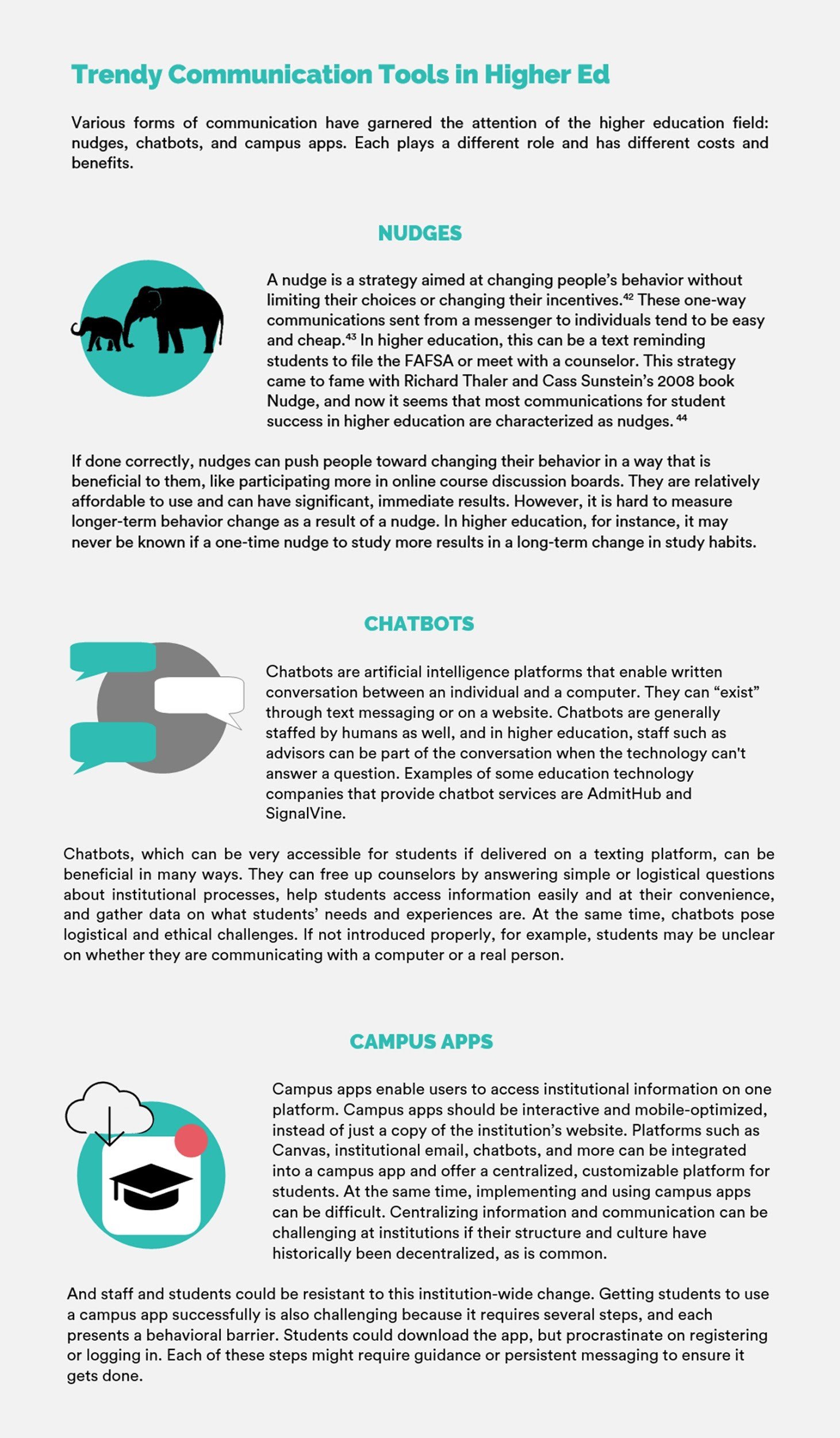
The platform, or modality, on which you deliver your messages also matters. Messages can be sent via email, text, campus app, social media, campus portals or print. Select whichever students are most likely to read, trust, and respond to. This decision may or may not require an institutional shift to a new platform, but in the end the choice should ensure students receive your message in a timely manner through a channel that is not overcrowded with messages from different parts of the college.
While text messaging can be more effective than email, the best platform is the one that is best for your institution and students. Each is “best” depending on what it is being compared to, so do some research on what platforms work at your institution. Sometimes leveraging existing platforms by focusing on critical points in the student timeline can make them more efficient and effective.
4. Create and Test Your Message
After choosing a platform, your team has to create the messages you will send to students or select which vendor-created messages you will use.
If you are creating your own messages, testing these on students will help clarify what works. Use resources you already have to test messages and gather feedback. Student employees or focus groups work well and are efficient, but students should be compensated for their participation. Another option is to engage in A/B testing—testing and comparing two options—to create successful messages. Finally, work across departments to gain important insight into the impact of messages. Check-ins and informal feedback from staff across departments are especially important in decentralized institutions, as the impact of a message on one group of students could be different on another. The creation and testing of messages is an iterative process, and you should expect to return to this step several times.
Thorough analysis of the student body throughout the communication life cycle, including demographics, behaviors, culture, and needs, is important for crafting a successful message about predictive findings. Insufficient research and understanding are likely to lead to an unsuccessful message. Without proper analysis, you can send messages that are irrelevant, unhelpful, or even offensive to students out of ignorance of student likes, wants, and needs.
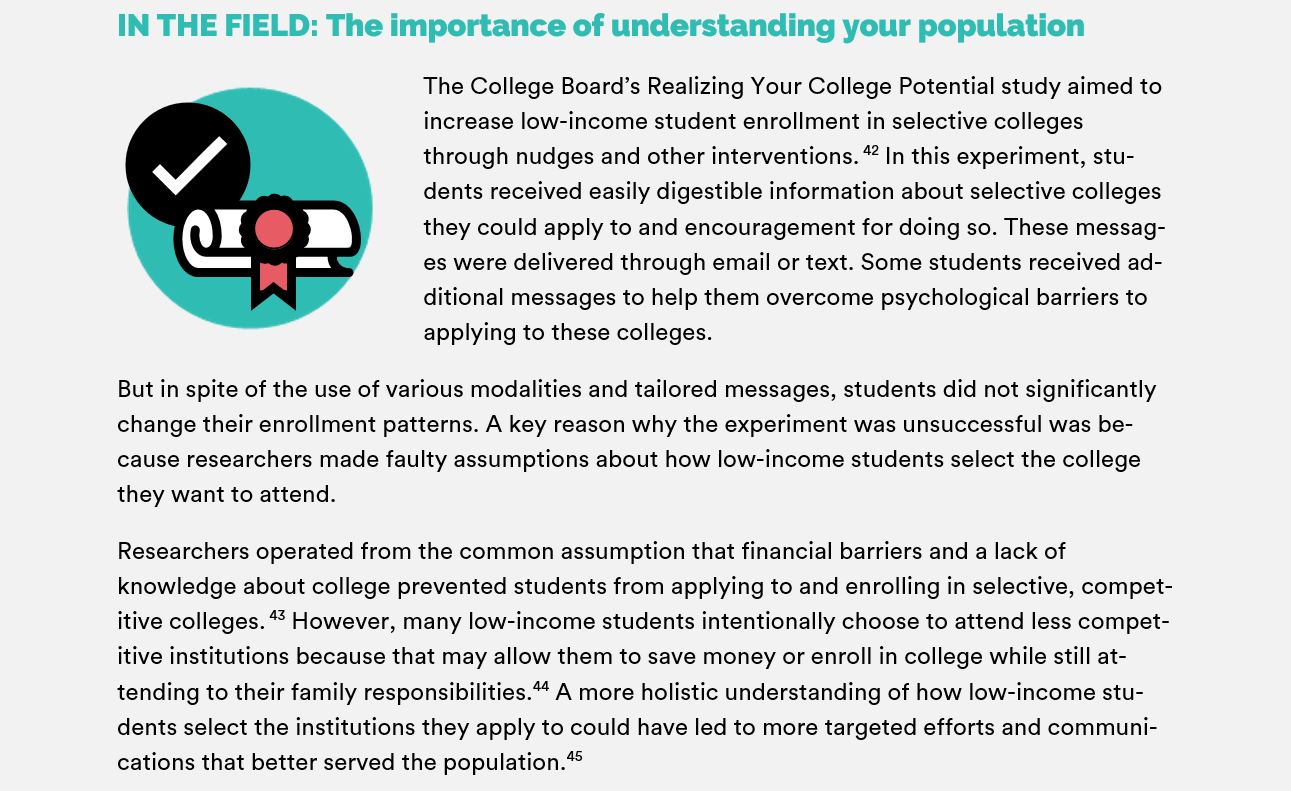
Image 2046
5. Decide When to Press “Send”
Your team should brainstorm about when the best times are to reach out to students. Consider sending messages during high-leverage points, like course registration, to get students to complete an action. Avoid sending messages very early or late at night, on weekends or on holidays. Using data on how students respond to your messages can also help determine the most favorable times to send a particular message. You are likely to find that sending text messages during holidays tends to result in higher unsubscribe rates or unread messages. Finally, institutions should consider developing and implementing a campus-wide communication strategy so that important messages, such as those from a counselor, are not lost in the noise.
6. Train Your End User
Before and during outreach to students, ensure end users, such as counselors, faculty advisers, and administrators, are trained at interpreting and communicating predictive analytics findings. Users should be able to understand the institution’s strategy with predictive analytics, what goes into the model, what predictive scores mean, and how to communicate findings effectively and ethically. Work on the front end will help ensure successful communication of the tool’s findings.
The Message
Once all of the research and preparation work has been done, implement the following components to make a message successful.
Message Structure and Content
Start with a Proper Greeting
A proper greeting uses the student’s name and identifies who the messenger is. Personalizing a message helps increase response rates and show that the institution cares about the student.47 Identifying the messenger helps establish and strengthen the student-messenger relationship.
Image 2148

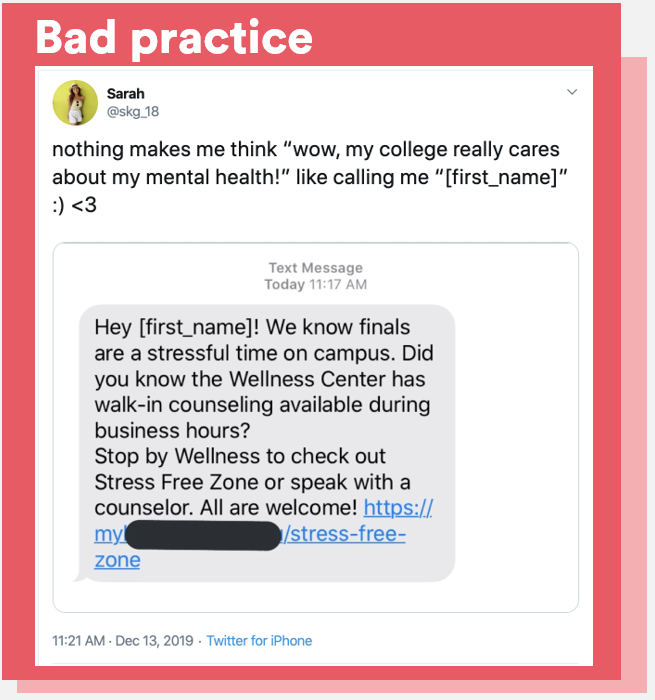
Be sure not to leave the student’s name blank. Careless messages hurt rapport. In Image 22, an institution did not fill in the blank for a student’s name and the student did not appreciate that.
Image 22
Make the Message Interactive
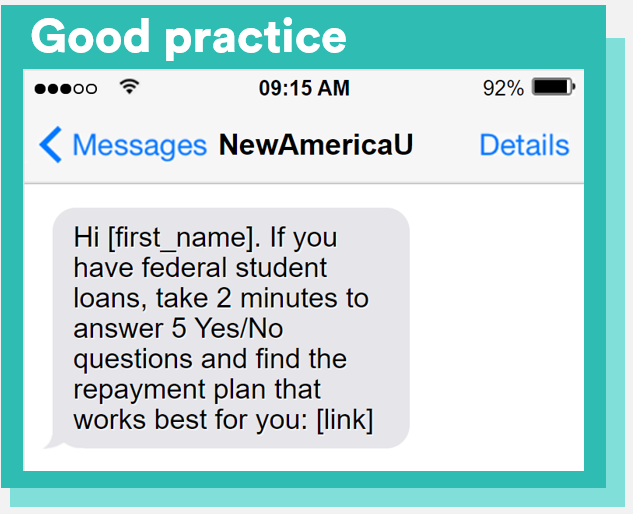
Making the message interactive will make it more likely that students take the desired action. You should include a link to the action you want the student to take, such as a link to make an advising appointment. Including an interactive component reduces the amount of actual and psychological barriers to task completion for students and allows them to complete the task immediately. If you cannot make a message interactive, include clear and concise instructions on how to complete the action so that students know exactly what to do instead of leaving them wondering how to fix the problem.
Image 2349
Be Brief
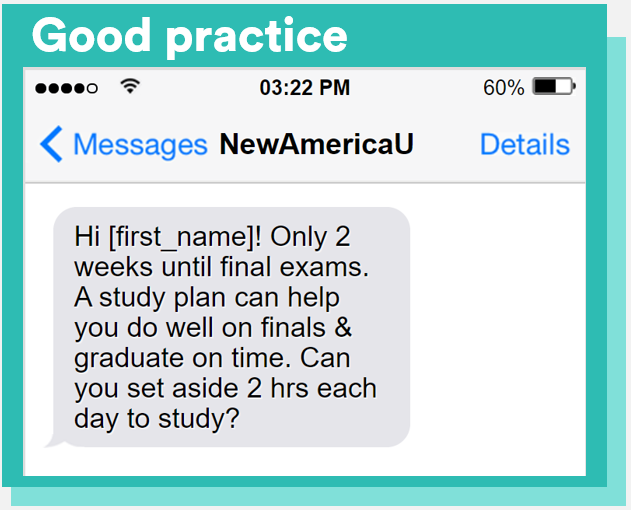
Lengthy emails are likely to be overlooked or ignored. It is best to be brief and get to the point so that students can take action. Students, like all people, do not have the time to decipher lengthy emails.
Be Positive but Realistic
Messages should be positive so that students are not discouraged, especially because communicating predictive system findings can often be sensitive in nature. Making students feel like they are not the only ones struggling, encouraging them to get help, and emphasizing that they have the capacity to improve their academic performance will minimize harm and increase the likelihood that they take action.
At the same time, it is important to be realistic, especially when students are struggling. Being overly positive can diminish the gravity of a problem, blind students to the real consequences of their situation, or set unrealistic expectations. Be sure to balance a positive tone with a realistic approach so that students are both encouraged to continue their education but are not set up with false hopes for their success.
Case in point: at one institution using predictive analytics, faculty advocated for a small but important distinction in how they communicated to students. Students who were performing poorly in classes were originally told that “it’s not too late” to improve their grades. However, due to several factors, including faculty course policy, it was more accurate to tell students that “it may not be too late” to improve their grades. This change was successfully implemented to reflect a message that was both positive but realistic.
Similarly, do not tell students something that is not true. Ultimately, predictive analytics is intended to help students and the university succeed. This can make communicating less than ideal findings to students challenging for end users. While it may be tempting for end users to manipulate findings to sound more positive, they must be honest with students. Both students and institutions will benefit from the truth.
Give the Value Proposition
It can be challenging to encourage behaviors that do not have an immediate payoff. Including an explanation about why an action is important in a message could help students understand why it benefits them and convince them to do it. For example, making an appointment for tutoring can seem unnecessary; students may convince themselves that they will just study more next time. But if the message makes the value of meeting with a tutor clear and explicit by using behavioral economics strategies, students will be more likely to take the desired action. As always, it is important to be positive in phrasing the value proposition of an action so as not to provoke anxiety.
Image 2450
Avoid-isms
It should go without saying: avoid “-isms” and discrimination. Comments that are racist, sexist, able-ist, homophobic, etc. are unethical, ineffective, hurtful to students, and will likely result in other negative consequences for the institution. Be especially careful not to include microaggressions, or comments that are subtly prejudiced toward marginalized groups, like in Image 25. Ensure both message creators and end users are up to date on their bias training to avoid microaggressive or outright problematic messages. Having a diverse team can also help recognize and flag when a message might be offensive.
Image 25
Citations
- Kelli A. Bird, Benjamin L. Castleman, Jeffrey T. Denning, Joshua Goodman, Cait Lamberton, and Kelly Ochs Rosinger, “Nudging at Scale: Experimental Evidence from FAFSA Completion Campaigns,” National Bureau of Economic Research working paper no. 26158 (August 2019), https://www.nber.org/papers/w26158.pdf; Oded Gurantz, Jessica Howell, Mike Hurwitz, Cassandra Larson, Matea Pender, and Brooke White, “Realizing Your College Potential? Impacts of College Board’s RYCP Campaign on Postsecondary Enrollment,” EdWorkingPaper (May 2019): 19–40, https://doi.org/10.26300/nqn3-sp29
- Lindsay C. Page, Benjamin L. Castleman, and Katharine Meyer, “Customized Nudging to Improve FAFSA Completion and Income Verification,” Educational Evaluation and Policy Analysis 42, no. 1 (2020): 3–2, https://doi.org/10.3102%2F0162373719876916
- Mabel, Castleman, Bettinger, and Choe, “Nudges to the Finish Line—Preliminary Research Brief".
- Bird, Castleman, Denning, Goodman, Lamberton, and Ochs Rosinger, “Nudging at Scale.”
- Page, Castleman, and Meyer, “Customized Nudging.”
- Richard H. Thaler and Cass Sunstein, Nudge: Improving Decisions about Health, Wealth, and Happiness (New Haven: Yale University Press, 2008).
- Thaler and Sunstein, Nudge: Improving Decisions.
- Thaler and Sunstein, Nudge: Improving Decisions.
- Gurantz, Howell, Hurwitz, Larson, Pender, and White, “Realizing Your College Potential?”
- Don Hossler and Karen Gallagher, “Studying Student College Choice: A Three-Phase Model and the Implications for Policymakers,” College and University 51 (1987), https://www.researchgate.net/publication/234741450_Studying_Student_College_Choice_A_Three-Phase_Model_and_the_Implications_for_Policymakers
- Jim Jump, “Ethical College Admissions: Questioning Assumptions on Undermatching,” Inside Higher Ed, June 17, 2019, https://www.insidehighered.com/admissions/views/2019/06/17/new-studies-low-income-students-are-important-we-should-resist-emphasis
- Constance Iloh, “An Alternative to College “Choice” Models and Frameworks: The Iloh Model of College-Going Decisions and Trajectories,” College and University 94, no. 4: 2–9, https://www.aacrao.org/research-publications/quarterly-journals/college-university-journal/article/c-u-vol.-94-no.-4-fall-2019/an-alternative-to-college-choice-models-and-frameworks-the-iloh-model-of-college-going-decisions-and-trajectories
- Christopher J. Bryan, David S. Yeager, Cintia P. Hinojosa, Aimee Chabot, Holly Bergen, Mari Kawamura, and Fred Steubing, “Harnessing Adolescent Values Boosts Healthy Eating,” Proceedings of the National Academy of Sciences 113, no. 39 (September 2016): 10830–10835, https://www.pnas.org/content/113/39/10830
- Daniel J. Howard, Charles Gengler, and Ambuj Jain, “What's in a Name? A Complimentary Means of Persuasion,” Journal of Consumer Research 22, no. 2 (September 1995): 200–211, https://doi.org/10.1086/209445
- Mabel, Castleman, Bettinger, and Choe, “Nudges to the Finish Line—Preliminary Research Brief".
- Mabel, Castleman, Bettinger, and Choe, “Nudges to the Finish Line—Preliminary Research Brief".
- Mabel, Castleman, Bettinger, and Choe, “Nudges to the Finish Line—Preliminary Research Brief".
Conclusion
Predictive analytics for student success has the potential to make positive change in higher education and students’ lives, but it comes with the responsibility of ensuring that findings are appropriately communicated from end users to students. This seemingly simple task of communication requires institutions to be well informed so that they can take advantage of the full potential of their investment in predictive analytics to help students graduate.
At the same time, predictive analytics should be seen as a tool in a toolbox, not a solution to higher education challenges on its own. Predictive analytics should be implemented alongside broader institutional and policy reforms that help make the higher education system more equitable and easier to navigate for students. Otherwise, predictive analytics will continue to be a Band-Aid over a larger problem.
The field of predictive analytics and communicating its findings in higher education is rapidly evolving and many institutions do not have the resources or infrastructure to hire a vendor or engage in rigorous message testing. Sharing what your team has found to be effective for communicating predictive analytics findings will help other institutions help their students, regardless of institutional access to resources. Embracing a collegial nature will help more students and institutions be successful.
As the country and its higher education system experience rapidly evolving changes and become even further stratified, retaining students and helping them finish their degrees is more important than ever. Predictive analytics and effective, ethical, and equitable messages can be a part of institutions' strategies to fulfill their mission of educating students and closing equity gaps.
This research-based guide can help institutions better communicate with their students. By putting in work on the front end and being intentional, institutions can minimize harm toward students and maximize their opportunity to obtain a degree.
Appendix: List of Interviews Conducted
Bryan Cook, PhD, Vice President of Data and Policy Analysis, APLU
August 7, 2019
Andrew Magliozzi, CEO, AdmitHub
August 27, 2019 and December 12, 2019
Amelia Parnell, PhD, Vice President for Research and Policy, NASPA
September 18, 2019
Jeffrey Meece, EdD, Vice President of Strategy, Mongoose
October 25, 2019
Jamie Riepe, Chief Revenue Officer, SignalVine
October 29, 2019
Marty Major, Director of Partner Success, Gecko Engage
October 28, 2019
Eric Stoller, Vice President of Digital Strategy, Gecko Engage
October 28, 2019
Caroline Altman-Smith, Deputy Director of Education, The Kresge Foundation
November 6, 2019
William Moses, Managing Director of Education, The Kresge Foundation
November 6, 2019
Jeff Mutimer, Vice President of Marketing, SignalVine
November 21, 2019
Jeannine Sato, Director of Communications, Duke University
November 25, 2019
Chris Hopkins, Chief Strategy Officer, Ready Education
November 26, 2019
Benjamin Castleman, PhD, Associate Professor, University of Virginia and Director, Nudge4Solutions Lab
December 11, 2019
Tracy Gale, Communications Manager of Information Technology, University of Florida
December 12, 2019
Tiffany Mfume, PhD, Assistant Vice President for Student Success and Retention, Morgan State University
December 16, 2019
Shannon Brady, PhD, Assistant Professor of Psychology, Wake Forest University
December 20, 2019
Lindsay Page, PhD Associate Professor of Research Methodology, University of Pittsburgh
December 20, 2019
Lynn Brabender, Assistant Director of Office of Urban Initiatives, APLU
January 30, 2020
Samantha Levine, Learning Collaborative Manager of Office of Urban Initiatives, APLU
January 30, 2020
Elizabeth Adams, PhD, Associate Vice President of Undergraduate Studies, California State University, Northridge
February 12, 2020
Lynn Brabender, Assistant Director of Office of Urban Initiatives, APLU
March 2, 2020
Jamie Schnur, Director of Higher Education Support Services, Hobsons
March 3, 2020
Catherine See, Starfish Account Manager, Hobsons
March 3, 2020
Timothy Renick, PhD, Senior Vice President for Student Success, Georgia State University
March 6, 2020
Carol Cohen, Assistant Vice President for University Advisement, Georgia State University
March 20, 2020
Lindsey Fifield, Chatbot Project Director, Georgia State University
March 20, 2020
More About the Author

Alejandra Acosta
Policy Analyst, Higher Education
Related