A Chapter of: The Comeback Story
Accelerators and Roadblocks
Accelerator: Employer Education Benefits
Among comebackers who recognize the need for a degree, access to employer education benefits was very much tied to the nature of their jobs. Lower-wage and younger workers had the least access to employer education benefits. More than a third (35 percent) said their employer offered no educational benefits and 7 percent said they did not know if their employer offered tuition benefits. (See Figure 6.) Of those who did work for employers that had a tuition assistance program, 12 percent said they personally did not qualify for the benefits, and 19 percent said they qualified but had not used the benefits. A quarter (26 percent) said they had qualified for the benefits and used them.
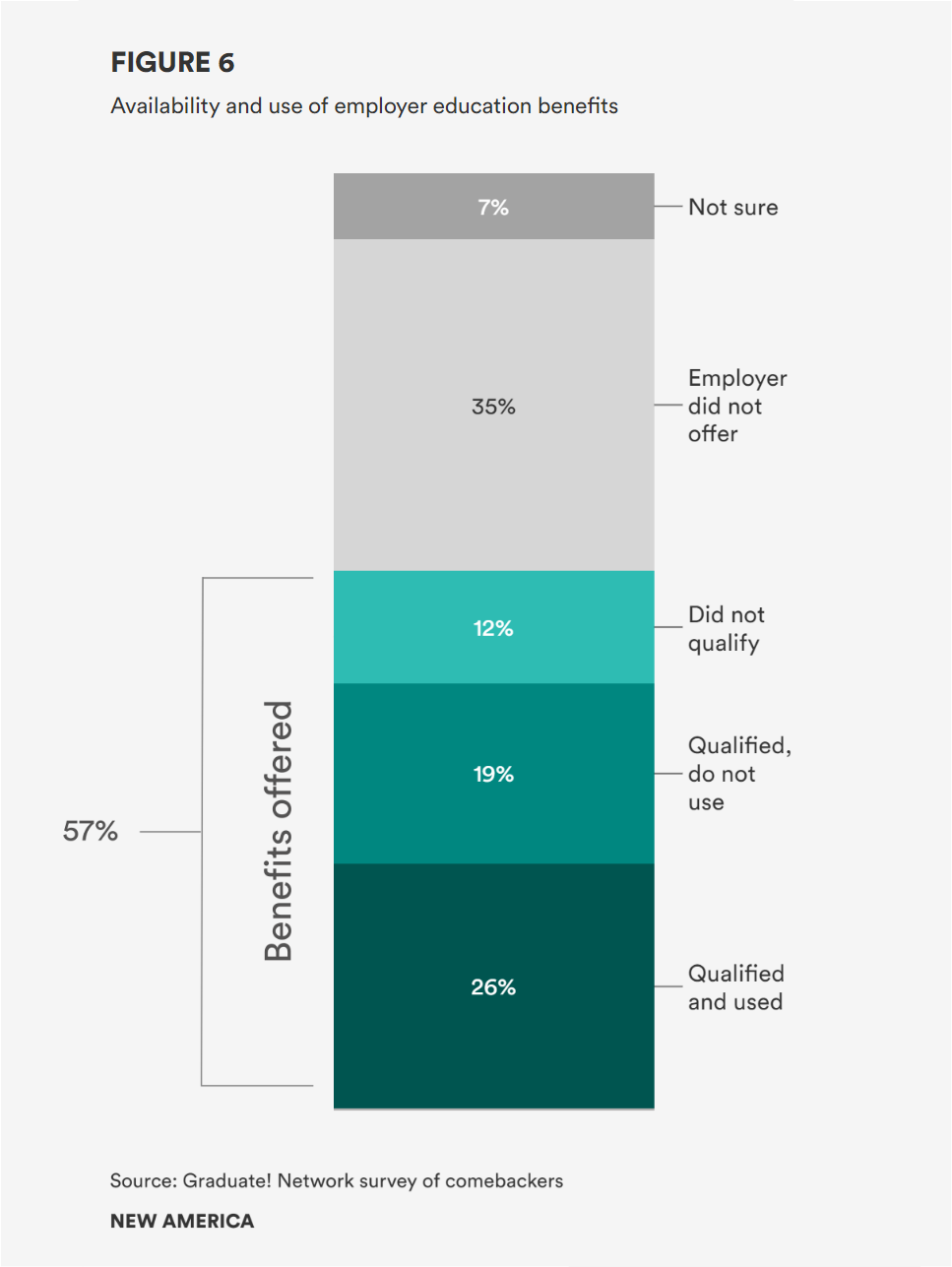
Of those who did report employer education benefits, those in higher income brackets were more likely to say they had access to employer benefits and were more likely to use them. Comebackers earning $24,000 or less were more likely to say their employer did not offer education benefits or that they did not qualify for benefits even though their employers offered them. The older the worker, the more likely he or she was to have used employer education benefits, peaking at age 50.
Bridging The Talent Gap
The Graduate! Network’s Bridging The Talent Gap initiative documents the signaling effect of a degree for employers. More than 70 percent of the 4,000 small and medium-sized employers that participated in the initiative said that more education beyond high school increased worker retention, productivity, profits, customer satisfaction, and development of in-house leadership skills. Employees at these companies overwhelmingly agreed that the personal and professional benefits they stood to gain from postsecondary education are worth the effort (90 percent and 87 percent, respectively.) Three-quarters of employees also noted that education costs (beyond employer support) are a big challenge. About half were challenged to keep up with work while devoting time to studies, and 61 percent reported that keeping up with their family responsibilities was challenging while in school. Employers estimated that only 54 percent of the education benefits they offered were utilized by employers.
Accelerator with Reservations: Non-Degree Credentials
Non-degree credentials, including those offered by colleges and universities, are commonly considered a way to jumpstart or accelerate a career and are another way returning adult students are forging a path to graduation. Not surprisingly, almost a third (30 percent) of comebackers who approached the Graduate! Network had earned a non-degree credential and another 11 percent were considering or working on a non-degree credential. (See Figure 7.)
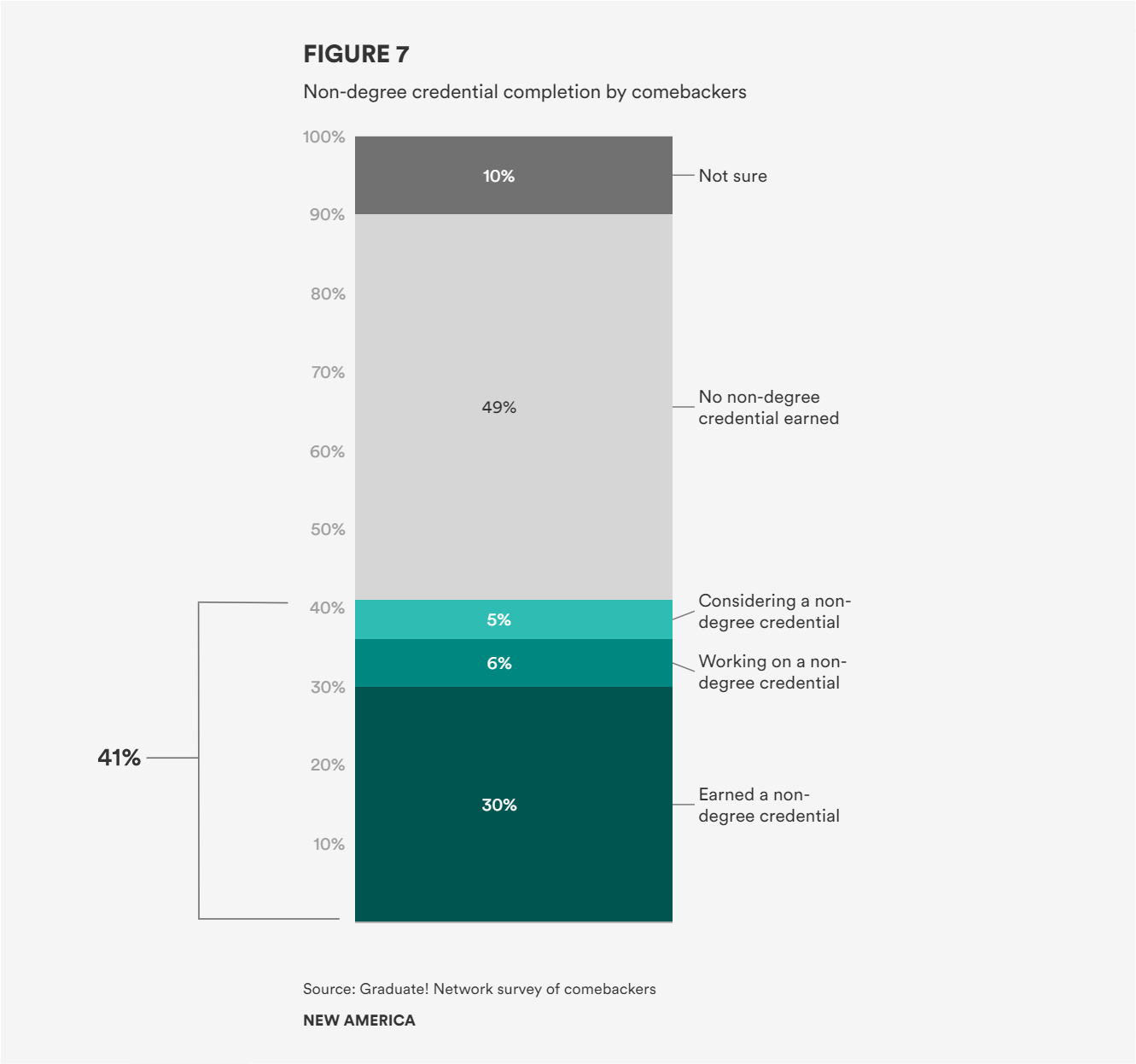
Survey respondents who had not yet re-enrolled in a degree program were even more likely to have earned a non-degree credential (39 percent). Of those who earned non-degree credentials, more than a third (36 percent) were in a program affiliated with a college or university. Some colleges allow these credentials to be counted toward a degree, through an assessment process. More than 50 percent of non-degree credentials were awarded in three areas of study: health care, business, and technology.
Unlike degrees, which many said they were pursuing as a personal goal, comebackers tended to view non-degree credentials as a more cost-effective (in terms of money and time), accessible way to boost their economic and career prospects. Some, however, realized the limitations of a non-degree credential. One person said:
I talked to my sister, who just graduated two years ago from college. She said to me one day, “why don't you just go on back to school for real?” “What do you mean go back to school for real? I am at school for real.” She said, “no, you take classes and you are being a real student, and doing all the work, but yet you don't get any credit for it. You get a certificate. Oh, whoop dee, but you need to go back to school and finish your degree.”
This question of whether employers value certifications as much as degrees was also mentioned by another comebacker: “I worked hard to reach a certain level where I've attained a lot of certification in the business world. Actually, when I go to apply for a position in this day and age, that four-year degree is required. I have…the certifications…that you need to be in the business world, but I did not have that four-year degree. Now, I cannot pass the hiring for that level of a position without the four-year degree.”
Roadblock: Owing Money
Student institutional debt not only keeps students from completing their degrees the first time around, it prevents them from going back to finish, not just at their college but at other institutions. Schools commonly withhold official transcripts from students who owe money, effectively barring them from applying to another college. This practice keeps students from finishing a degree at their own college or elsewhere and restricts their earning potential and their ability to repay their debt.
Student institutional debt comes in many forms: unpaid tuition and fees (such as library and lab fees), fines for non-payment, parking fines, and other non-tuition costs. Students with unpaid college bills are often forced to withdraw without earning a degree, regardless of how much credit they had earned (and partially paid for). Colleges may put a hold on student transcripts because of overdue fees, and often deny enrollment to students who have an unpaid balance. And depending on who owns the debt, the amount owed can balloon even more over time, as interest, fines, and collection fees are heaped on top of the original debt, yet students may not be aware of the debt accumulation. One student said:
One of the issues I had when I left college– …college was my housing. When I left college, I was back to sleeping on different couches. I didn't have a stable address and I didn't go to commencement. Which meant I didn't get loan counseling when I left. It turned out they were sending bills for student loans to an address I didn't live at, and I had no idea until I was already in default. The loan counseling needs to be done before you graduate, you need to sit down, and if someone is going to be homeless, and they know this or if they end up homeless, how are they going to access their bills? What is the solution for that?
According to Policy Matters Ohio, when student institutional debt is referred to the state’s Attorney General’s Office, the amount owed can balloon even more over time, as interest, fines, and collection fees are heaped on top of the original debt. Many schools and some states have policies that withhold transcripts from and bar registration of students with institutional debt, preventing them from re-enrolling in school and effectively trapping them in low-wage jobs. Black, LatinX, part-time, older, and first-generation students, who attend two-year schools at higher rates, are disproportionately affected by this issue.
In the past few years, some institutions have started programs to forgive outstanding debt up to a few hundred dollars. In particular, Wayne State University’s Warrior Way Back program has received national recognition for this practice.
Another comebacker added that first generation students are
not familiar with deferment or forbearance or an income-based repayment or anything. I wasn't told, I learned that on my own. There should be some follow-up or there should be, like I said, like a war room or something where everyone comes in and they say, “Okay, let's sit down, let's look at how much experience you have. Let's see how long it's going to take for you to find a job.” Just like metrics like six months, “we'll call you to see if you got the job yet, and if not, the school will try to figure out something,” because, unfortunately, once commencement is over and you graduate, you're on your own. It's like a cutoff.
A related issue is a lack of understanding of federal loan structures from when comebackers first attended college. The federal loan program is structured to allow students to borrow more than the cost of tuition and fees. If the federal loan awards exceed the amount covering tuition and other fees, students receive a loan “refund.” This refund amount becomes a liability that the student is required to repay to the federal government. One interviewee explained that
what they don't tell you is that you could decline when you look at your financial aid package, or you don't have to take the loan out. I don't know if it was because of my age, because at that time I was young. I just thought that [the loan refund] comes along with it. I didn't think at that time that I can just say no. I was listening to other people, and they were like, “you could just use the refund money to buy yourself a car, or to pay up on your rent,” and stuff like that. That's what I was seeing around me, is people getting refunds, and thinking it was—I thought it was normal. I'm not going to lie. I thought that was normal behavior at that time to just simply take out as many loans as you need, and just use the extra money to do whatever. At that time, I didn't know you could decline, and say, “no, I don't need that much. I just need just enough to really just pay my tuition, and my books, and whatever electronic devices I need in order to pass the courses.” I can do that. I didn't decline anything either. I just, whatever they gave me, I accepted it.