The Comeback Story
Abstract
The new majority of college students have adult responsibilities, such as parenting, earning a living, and paying for college. Unfortunately, adult students are often treated as an afterthought by colleges and policymakers. Over the last 20 years, more than 37 million students have left without receiving a degree that would greatly improve their economic prospects.
This joint report from the Graduate! Network and New America examines the journeys of determined individuals who get back on track, persevere, and earn their degree—known as comebackers—to show how policy makers and postsecondary institutions can design systems that support success for this new majority and better serve all students.
Acknowledgments
We are grateful for many insights and contributions from colleagues. Special thanks to Lumina Foundation, particularly Frank Essien, Wendy Sedlak, and Courtney Brown. Thanks to Matt Sigelman of Burning Glass Technologies and Sallie Glickman for thoughtful conversations on this project. Thanks to Bridgett Strickler of the Graduate! Network for sharing lessons from Bridging The Talent Gap; Cedric Deadmon for challenging us to deepen the equity and inclusion perspectives; advisory board members Dan Ash (Bridging the Talent Gap), Amy Ellen Duke-Benfield (National Skills Coalition), David Mahan and Lee Nimocks (Kentucky Council on Postsecondary Education), Greg Cumpton (Ray Marshall Center, University of Texas at Austin), Jessica Gibson (Tennessee Higher Education Commission), Julie Peller (Higher Learning Advocates), Doug Shapiro and Faye Huie (National Student Clearinghouse); project team members Dan Bradley and Alexandra Yanovski-Bowers; Patricia Steele, Tait Kellogg, and Donté McGuire of Higher Ed Insight for their contribution to qualitative assessment components; and all the member communities of the Graduate! Network, especially those who contributed data to this project through the Comeback Tracker. Communications and graphics support came from Riker Pasterkiewicz, Hana Hancock, and Fabio Murgia and copyediting support from Sabrina Detlef.
About The Graduate! Network
The Graduate! Network’s mission is to increase the number of comebackers earning college degrees. Its work and findings are proof that many adults who want to go back to college can do so successfully with the right assistance. The Network mobilizes, seeds, connects, and supports regional initiatives focused on comebacker degree attainment. Network communities are regional collaborative adult postsecondary completion initiatives which share core beliefs, values, strategies, programmatic interventions, technologies and methodology. The Graduate! Network is actively collaborating with communities or statewide institutions in over 20 states, including the first-of-its-kind state-wide implementation in Tennessee (TN Reconnect Community Network).
Data That Move Us, an initiative of The Graduate! Network, is a robust data capture, analysis, interpretation, and reporting program designed to boost adult college degree completion among historically disadvantaged people. This mission aligns with New America’s goal to improve educational outcomes among this population.
Downloads
Introduction
All educational pursuits are a journey, and students start their journeys with the belief that they will complete a degree and graduate. But as we know, this journey for many is interrupted. Over the last 20 years more than 37 million students have left college without receiving a degree. Finishing a college degree would greatly improve these former students’ economic prospects. Unfortunately, adult students are often treated as an afterthought by colleges and policymakers. But here is a reality check: According to the National Center for Educational Statistics, over 40 percent of current college students are over the age of 25, almost 30 percent have children, and over 60 percent work at least part time.
The new majority of college students now have adult responsibilities, such as parenting, earning a living, and paying for college. The challenge and opportunity for postsecondary institutions is to design systems that support success for this new majority. Furthermore, serving adult students well by design shows postsecondary institutions how to better serve all students.
Drawing on the Graduate! Network’s 15 years of working with this population of students, we honor these determined individuals who are intent on completing their degrees, by designating them comebackers. The Graduate! Network coined the term to underscore their potential and their tenacity this time around. However, addressing returning comebackers’ needs can be challenging when colleges, states, and researchers only have limited information about what these adults need to re-enter college and be successful. This report is presented using their journey as our framework—one of getting back on track, persevering, and earning their degree, as it provides new information for colleges, employers, governments, and organizations seeking to improve postsecondary outcomes.
Filling a Gap in Postsecondary Research
As researchers and social change leaders, we are focused on less visible populations in the postsecondary ecosystem. Adults with some college credit but not a degree who want to return to finish a credential have been long overlooked as a population that can contribute to the social and economic well-being of regions and communities. Written off as “failures” for decades and defined by deficit, these adults strike us as having been dealt a triple blow. First, the sheer number of non-completers indicated to us that there is a systemic failure in the learning and achievement continuum from high school to and through college. Second, despite the numbers indicating systemic failures, this population has long been branded with the stigma of personal failure. Third and most recently, they are now the “it” population for ed-techs and higher education institutions facing a “cliff” of freshly minted high school graduates, and often sought out for profit reasons and to fill seats without provisions for actual completion of their goals.
Our goal is to understand how to successfully bring comebackers back to complete their degrees, mitigating challenges created by past postsecondary attempts, and respecting the complexity of their lives. We view comebackers as individuals and a population with a multitude of talents and gifts to offer themselves, their families, their communities, colleges, employers, and the world.
Our investigation started with three questions:
- How do comebackers’ attitudes, aspirations, and perceived strengths influence their re-enrollment, persistence, and completion?
- What is the definition of persistence in the context of adults going back to and through college?
- What is predictive of re-enrollment and non-re-enrollment? What is predictive of graduation and non-completion?
Our research consisted of analysis of quantitative and qualitative data produced by and collected from Graduate! Network communities that use a common database dubbed the Comeback Tracker. Our study set is unique in the postsecondary attainment ecosystem in that it provides a longitudinal view of student progress across institutions. On the quantitative side, we analyzed administrative data and enrollment records from the National Student Clearinghouse (NSC) for more than 7,800 comebackers, and also ran our data through a predictive model. On the qualitative side, we surveyed 325 comebackers, and completed focus groups of comebackers in three Graduate! Network communities and one-on-one interviews with 15 others in five Graduate! Network communities. Taken together, our research not only sheds light on factors associated with academic progress, but also incorporates social and emotional insights along with the voices of the adult students. See the Research Overview section for more details on our data sources and methodology.
Study Findings
Here are the main findings of our research:
- Of comebackers who got back on track and then graduated, 69 percent stayed continuously enrolled until they finished.
- Starts and stops were not unusual for comebackers who graduated. One in five had one or more stop-outs in route to graduation. In talking to comebackers, we learned that for many, a stop-out or even multiple stops were not a sign of giving up, but rather a period of enrollment dormancy during which they were laying the groundwork or waiting for a more opportune time to resume their education.
- The concept of persistence as traditionally defined is not useful in describing comebackers. Even tinkering with the parameters of the definition seems arbitrary: When do we declare a student not persisting—after an absence of one semester? An academic year? Two years? What about students who pick up again after a decade? What if the comebacker switches majors or institutions? The concept of perseverance is more useful in this context.
- For one in 10 comebackers who graduated, the barrier they faced was an administrative one. Clearing bureaucratic tangles like filing a graduation application or paying off a balance due to the school was often all it took for these students to be awarded a degree. In other instances, transfer credit and/or credit through prior learning assessment allowed colleges to grant a degree upon a student’s re-enrollment. In still other circumstances, community colleges awarded a two-year degree based on classes completed at a four-year college (i.e., reverse transfer). In a very real sense, these comebackers had already made it to the finish line but were being prevented from crossing.
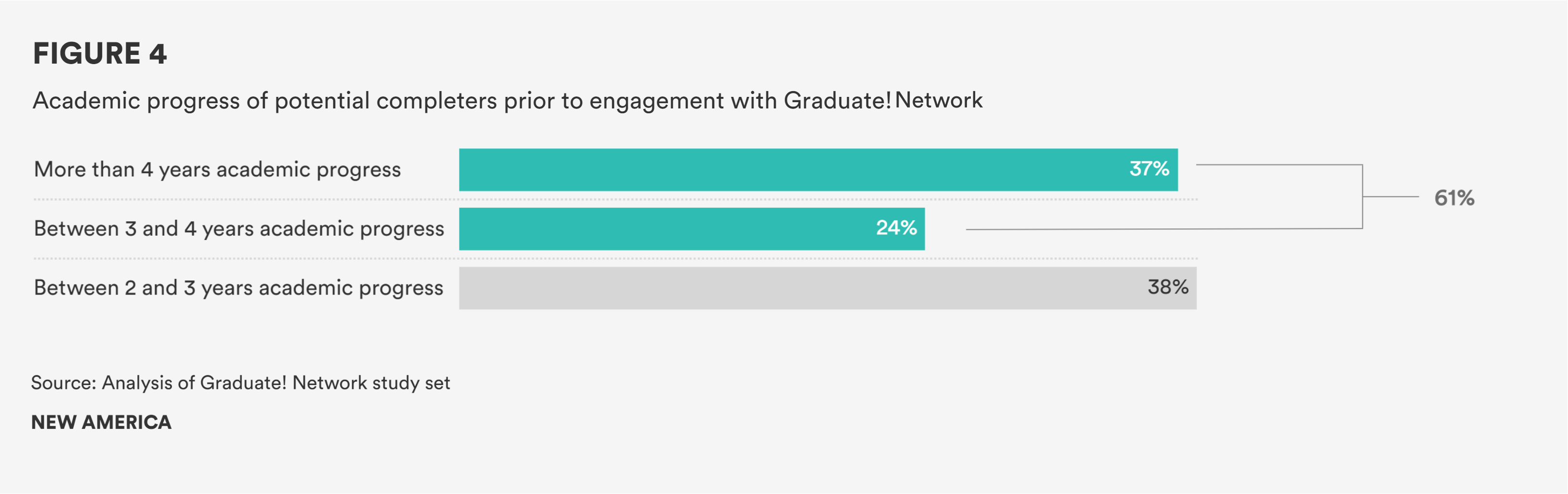
- Taking a closer look at potential completers, a subset of comebackers who had stopped out with two years or more of academic progress, close to two-thirds (61 percent) had earned almost four years’ worth of credit but no degree had been conferred. In this situation, comebackers were thought to be “swirling” between programs and institutions, with no firm game plan to make it to the finish line.
- The motivation for returning to school tended to be intrinsic and deeply personal. The top reason for finishing school was personal goal; other reasons cited were being a role model to family and personal satisfaction. Personal reasons held as the prime motivation across all income brackets.
- Supportive school faculty and staff—even more than family members, mentors, and advisors—was the top factor that helped comebackers persevere and get through school, cited by 88 percent of survey respondents.
A Note on Recent Events
The research for this report was completed by February 2020, just as the first wave of coronavirus infections reached the United States. The analysis and findings in this report do not, therefore, reflect changes in the status, condition, views, attitudes, or aspirations of comebackers brought about by widespread closures (including colleges and universities), job losses, and health impacts stemming from the COVID-19 pandemic.
But just as the pandemic is shining a light on health disparities between subgroups of the U.S. population, so too are we starting to see small negative effects on comebackers who are considering returning to school or are on track to finish a degree. Early program data indicate that fewer comebackers than anticipated for this time of year are enrolling for the first time after engaging with a Graduate! Network program, particularly comebackers who report family annual incomes of less than $24,000. Similarly, more comebackers than expected who were matriculating at the start of the pandemic had to stop out during the term, notably true for Black, Latinx, Asian, and other non-white categories of race and ethnicity. It is likely that both these trends are due to changes in health, employment status, and financial standing for comebackers brought about by recent events.
Tremendous uncertainty remains around when the pandemic can be brought under control and when the economy will recover. This uncertainty extends to colleges and universities themselves, which are suffering from cratered revenues due to locked down campuses and a sudden and massive shift to virtual instruction. Our report shines a light on the inequities comebackers face in their journey to complete a degree, and these inequities will no doubt be exacerbated as long as this uncertainty remains. But the existential crises colleges and universities are facing now are also an opportunity for looking at comebackers in a new light. It is in this spirit that we offer this research.
The First Try
Who are Comebackers?
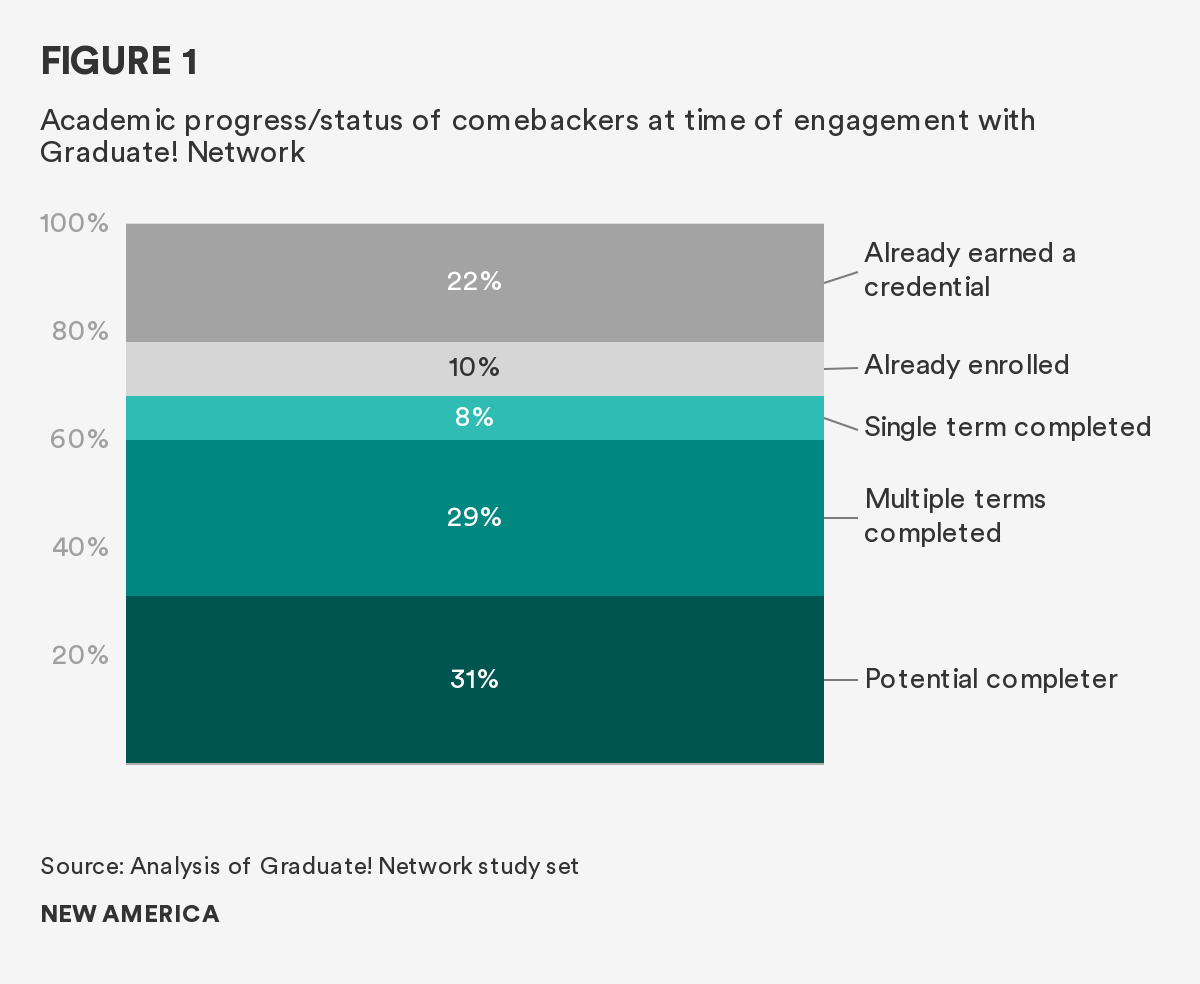
The National Student Clearinghouse (NSC) defines the “some college, no degree” population as individuals with some postsecondary education and training but who have not completed and are no longer enrolled. NSC’s analysis of the entire U.S. “some college, no degree” population over five years (ending in 2018) shows 32 percent of students completed only a single term, 56 percent completed multiple terms, and 12 percent were enrolled for two years or more. NSC coined the term potential completers for students who had completed at least two years’ worth of enrollment but had not earned a degree. Among comebackers working with the Graduate! Network who fit into the “some college, no degree population,” the percent that were potential completers was nearly four times larger.
Many comebackers were ignored by higher education or experienced closed doors because they did not precisely fit a college’s recruitment profile. The Graduate! Network community programs are designed to meet them at any point, work with them through issues that are holding them back, prepare them for a successful re-enrollment, and connect them to other services as needed. This “open door” policy sheds additional light on the comebacker population. One in five students who engaged with a Graduate! program had already earned a two-year credential (22 percent), usually a certificate or an associate degree, and were seeking another degree. (See Figure 1.) The postsecondary landscape, which now includes extensive online course offerings and programs, has become increasingly complex, and these individuals wanted guidance and support to navigate it. We have found that the transition between two- and four-year institutions requires additional support, especially if an adult learner is trying to transfer credits into a four-year program.
Another one in 10 adults seeking assistance were already enrolled in college but were worried about stopping out. These students were struggling academically or financially, or faced non-academic struggles related to child care, transportation, or other challenges, and were well on their way to joining the “some college, no degree” ranks without assistance from Graduate! Network programs.
The Graduate! Network also attracts subsets of the comebacker population that historically have faced barriers to postsecondary opportunity, including systemic discrimination: they are predominantly (70 percent) people of color. The ethnic breakdown we see shows a majority of Black comebackers on the east coast, Latinx and Black in the upper Midwest, and Latinx in Texas, New Mexico, and California. Sixty-four percent identify as female. Before COVID-19, forty-three percent had a family annual income of $24,000 or less, and another 40 percent earned up to $56,000 annually.
Why They Stopped Out on the First Try
Former students reported that they stopped out the first time around for a myriad of reasons, often related to structural inequities. A Black comebacker summed up her hesitation about attempting college with a systemic assessment, saying that “with all the stuff that we went through and the struggle and with poverty and the neighborhoods we lived in and schools that I attended, I just really felt like I shouldn't be here.” Another comebacker spoke of her struggles with racial bias and her own self-doubt: "I was really hesitant at first about even going into” a program to earn a B.S. in finance “because…there's not many African Americans in it. I just have to be honest about that. That in itself was intimidating.”
Some had been told that college was necessary, or a family expectation, but without a clear explanation of why. We heard from those who were the first in their family to attempt college but had no idea or guidance on how to navigate the experience or what their goals should be. One comebacker articulated it simply, echoing what we heard from many: “The first time around, I didn't know what I wanted to do. I was just told to go to school.”
Finding yourself torn between an opportunity you have been told is good and your reality that it is not working for you can be hard for young people to articulate, especially to those in perceived authority. “I just wanted to get a job and earn money” was one common refrain. Some first-time students worked part-time while attending school, attempting to “pay as they go” but then burned out. A “college degree was not at the top of my list,” said another comebacker, even though the financial aid office “people were helpful. They thought it was something else going on, but I have to be honest, there was nothing else going on. I didn't know why I was there. I was just told to go to school.”
Family expectations and the reluctance to disappoint was another strong theme, especially for lower-income students who recognized the sacrifices their families made to get them to college. “[I thought] I really hope I don't disappoint people. For some people it's a huge disappointment when you make the decision not to go back or leave school.” Especially for families with little or no understanding of postsecondary education systems, and who have made enormous sacrifices for a child, stopping out directly translates into a narrative of personal failure.
Some stop-outs were precipitated by a change in circumstance—death of a parent, pregnancy, illness, substance abuse that spiraled out of control, incarceration, an accident, or other circumstances that cut into the ability to pay for college. These stories are intense and personal. Comebackers recounted taking care of parents who are chronically ill or dying, struggling through addiction, dealing with divorces and bankruptcies.
Why They Want to Return to College
Comebackers approach the process of going back to school with life experience under their belts. Graduate! Network comebackers were mostly in their early 30s (average: 32.7 years old; median: 30 years old). An average of 3.7 years had elapsed since they stopped out from their prior college enrollment.
While it is hard to translate satisfaction and self-actualization into program metrics that influence policy and funding considerations, when asked why they wanted to finish school, the most commonly cited reason was personal achievement (41 percent). (See Figure 2.) “I think it was a combination of self-determination, for me, to graduate, because I had started school and dropped out, like I said, and I just wanted to finish. I just wanted to finish, like self-accomplishment. Accomplishment was so important,” one person told us. Another comebacker said, “I wanted to just have that tangible piece of paper that we've all just worked very hard for. Starting something and then stopping, you always have in the back of your mind. It's like, ‘I really want to complete this.’" Another said, “this is my first opportunity to really choose it for myself. There’s a real sense of satisfaction associated with completing that degree for me. That’s what motivates me right now.”

Being a role model for family was the top reason for 7 percent of comebackers. One told us, “it was definitely a combination of wanting to finish what I started, but then also—none of my immediate family members went to college, so I wanted to be that person who could be an inspiration in the family.” This person wanted to be able to say, "Look, college can work. You can do it."
Improving economic and career prospects are strong motivators as well: 22 percent of comebackers connected college completion with increased earnings potential, 13 were hoping to change careers once they graduated, and 12 percent were motivated by opportunities for better jobs. One comebacker explained his realization that “the people that started with me would have bachelor's degrees, and we'd be making the same amount of money and I'd be just as smart as they were, and my bosses would say, ‘Hey, I gave [a promotion] to so-and-so [who had a degree].’ That's really what finally made me go back,” he said, “just finally feeling like I wanted to be able to say on paper that I'm just as good as everyone else.”
With graduation comes the benefit of becoming alumni of a college and networking with peers, and comebackers are quick to recognize the power of the new network they can now access. One said: “At Moore, I'm on the board of alumni and I really did do the networking that I wanted to do, because I really believed that going to college is an opportunity for you to meet people. Because I believe that people can help you further in life, with careers and getting a job, and things like that. If you don't have any network to pull from, people you know to help you, where are you going to get that from?”
Although our interviews with comebackers happened before the massive job losses due to COVID-19, they understand the signaling power of a degree, or lack thereof, for employment. “I realized too that although today's environment doesn't guarantee you a job, showing schools in your LinkedIn profile but not having finished meant something to some employers,” one told us.
What They Are Looking For
Primarily, comebackers are looking for a signal that college is indeed an option for them, and like all consumers today, they are looking for answers now. One student emphasized that this was not a fast process:
That was actually one of the biggest challenges for me initially, I wasn't aware and could not find any one-stop shopping view of what the different universities, either online or here in the area, could offer. That was pretty labor-intensive for me, pursuing recruiters in each of those schools and finding out what it was they could offer me, submitting transcripts. That was a lengthy process. Actually, that was probably the biggest latency in me getting back into classes, was working through different schools, what it was that they would accept off of previous transcripts. That piece is still a little bit of a hassle, I think, for the student. I think that took eight months to a year to really do that.
Too often colleges create administrative hurdles that are not well explained and are exacerbated by the lack of response from admissions offices. This is the space the Graduate! Network fills. One student told us, “I just figured it was a great time [to go back to college] while I have all this work experience. Really look for a program that could fit around my schedule, working full time at two jobs….I knew if I had someone to help me be accountable that it might push me. That's when I landed upon Graduate! Philadelphia.”
College admissions processes can be challenging for any student, and many comebackers expressed frustration with offices that were only open when they were at work, sometimes necessitating taking a day off from work to go to the campus. One vividly expressed his frustration in having to “badger” people on campus, nicknaming himself “the old dude” in the process:
I would call the registrar's office and they would say, “well, that person's not in right now.” I ended up getting so frustrated. I took a day off of work and actually went onto their campus and I talked to every person in that department and they said, “go to this office and to this office and to this office.” They got to the point where like, “the old dude is coming to your office.” After I spent a whole day on campus and I finally got to this one person and he said, “okay. I heard your name’s been circling around campus.” As soon as I'm leaving the parking lot, he calls and says, “Colin, you've been accepted.” It was almost like a pledging process. They were like, “You did it. You badgered us enough, you really want this, so, welcome. Let's see if you graduate.”
In looking for the right school and program, comebackers want to build on what they have already achieved, and they are concerned about the cost. By definition, comebackers have earned college credits which should afford them advanced academic standing when they re-enroll. However, this depends on the willingness of each college or system to accept transfer credits from other institutions. Often, information about these processes, and the offices that handle them, are not clearly and easily found on college websites.
In general, recognition of prior learning is not a uniformly accepted or applied practice. A new report from the Western Interstate Commission for Higher Education highlights the promising but fragmented landscape of prior learning assessment, as does a report from New America. Credit for prior learning or prior learning assessment (PLA) is the process of evaluating and awarding college credit for the equivalent college-level learning acquired outside of a postsecondary institution, such as at a job, during military service, at corporate training, and even through some types of volunteer work.
Finally, comebackers are interested in accelerated courses that run five to eight weeks, year-round starts that are not confined to the semester or trimester or even the quarter schedule, hybrid class models (online and in-person) that allow them the flexibility to learn online as needed, and evening and weekend classes. As one comebacker said,
I needed some schedule flexibility, so I sought out a school that had evening classes and an eight-week format. That was going to be workable for me with my schedule at work. I also was looking for a way to keep costs down. I’m using my G.I. Bill to cover tuition right now, so somewhere that had reduced credit hour tuition rates for veterans was appealing because I’ll be able to make my VA dollars go a little bit further that way. I was also looking for somewhere that would accept a lot of my previously earned credits and didn’t have time limit caps on a lot of those educational requirements. I was able to take basic and general ed requirements that I had completed years and years ago and still can still apply those to the degree I’m seeking now.
The Comeback
Getting Back on Track: Who Is Most Likely to Re-enroll
Many former students find the right school and re-enroll on their own, but others need guidance and time to prepare before they can apply to a school. Often, comebackers need advice from an unbiased source to help understand and pare down their college options and remind them to stay on task. One summed this up in these words: “Just having talked with the people at the Graduate! program, just having them here hearing me out and what I wanted to do, and providing resources to make sure I accomplish that. Then for me, just being on top of things, stuff like that and everything, and also…reaching out for help, [whether] that will be financial or just finding resources, that was something that helped me.”
Graduate! Network data show that comebackers who had a handful of meetings with a Graduate! advisor were 2.4 times more likely to re-enroll, and those who had 14 or more interactions with an advisor were four times more likely to re-enroll. Most comebackers who re-enrolled did so within six months of asking for help (59 percent); however, some took up to a year (17 percent), while close to a quarter took more than a year to re-enroll (24 percent). Financial issues topped the list of reasons why comebackers had not yet re-enrolled: being tied down by loan payments from their previous school and/or a child’s school, owing money to a previous school, or not finding a school with affordable tuition. In general, there was a strong reluctance among comebackers to take out loans, for fear of adding to an existing debt load or not being able to pay them back and then having wages garnished.
Systems and technology may have changed since they were last in school, and many comebackers benefit from personalized attention. One told us:
The coach that I had at that time was really vital. She was the one person that actually knew what I was up to. She was instrumental in helping me look at what programs there were, going on the website….By the time I called my old school, you're needing to know what your old login is. You don't even know. You're like, “how many digits was my student ID? What button do I need to press to reset? What technical assistance do I need to call now?” That sort of thing. Finding your high school diploma. Those kinds of things were, I think, the most instrumental.
More than a third (39 percent) of adults who sought help from the Graduate! Network went on to re-enroll; close to half of these re-enrollees (49 percent) were potential completers. In fact, more than one comebacker was only one course away from completion. One said: “I kept flunking this math class, and I never went back to school.” The advisor suggested contacting the college: “She's like, ‘You're so close. You just need this one class to finish up those credits, to have that degree in your hand and with that, you can use that as an upside-down degree program with Whitworth University.’ Because I told her what I want to do, and she just helped me on the path, because I was lost and frazzled, because it's just like, I don't get any sleep, I'm all over the place, and she put me on the right path.”
Persevering: Who Actually Enrolls and Their Pathways to Graduation
Comebackers have amazing stories of perseverance. One student told us, “I still had periods of homelessness at college. There was no one on campus….I could go to say, ‘I'm in this situation. What do I do?’ Instead, I was… threatened with getting charges for trespassing even though I was a student on campus because I was sleeping in a campus building.”
Our analysis shines a light on comebacker enrollment patterns and how these students progress through school once they re-enroll. Sometimes it took a lot to re-enroll. One comebacker told us of four enrollments before he found The Graduate! Network. He shared his story of connecting with a staff member at that first university: “she literally leaned over the counter and said, ‘Honey, if you can't figure out how to enroll in this school, you will never make it.’…I realized that their enrollment process…was intentionally designed to weed people out.”
In line with what we know about momentum and higher education completion, the more academic progress the student made the first time around, the more likely he or she was to be continuously enrolled or to have made it to graduation without stopping out. One comebacker said, “once you start from community college and then you go to the university…it's like, ‘you didn't start this to stop again.’ I didn't want to stop again.” While most returning students who graduated stayed continuously enrolled, close to a third of comebackers traveled a different pathway.
These pathways included the 11 percent of former students who graduated as soon as they re-enrolled. (See Figure 3.) In many of these cases, clearing administrative tangles like filing a graduation application or overcoming financial hurdles like paying off a bursar’s balance was all it took to be awarded a degree. In other instances, colleges awarded transfer credit and/or credit through prior learning assessment that allowed them to grant a degree upon a student’s re-enrollment. In still other circumstances, community colleges awarded a two-year degree based on classes completed at a four-year college.
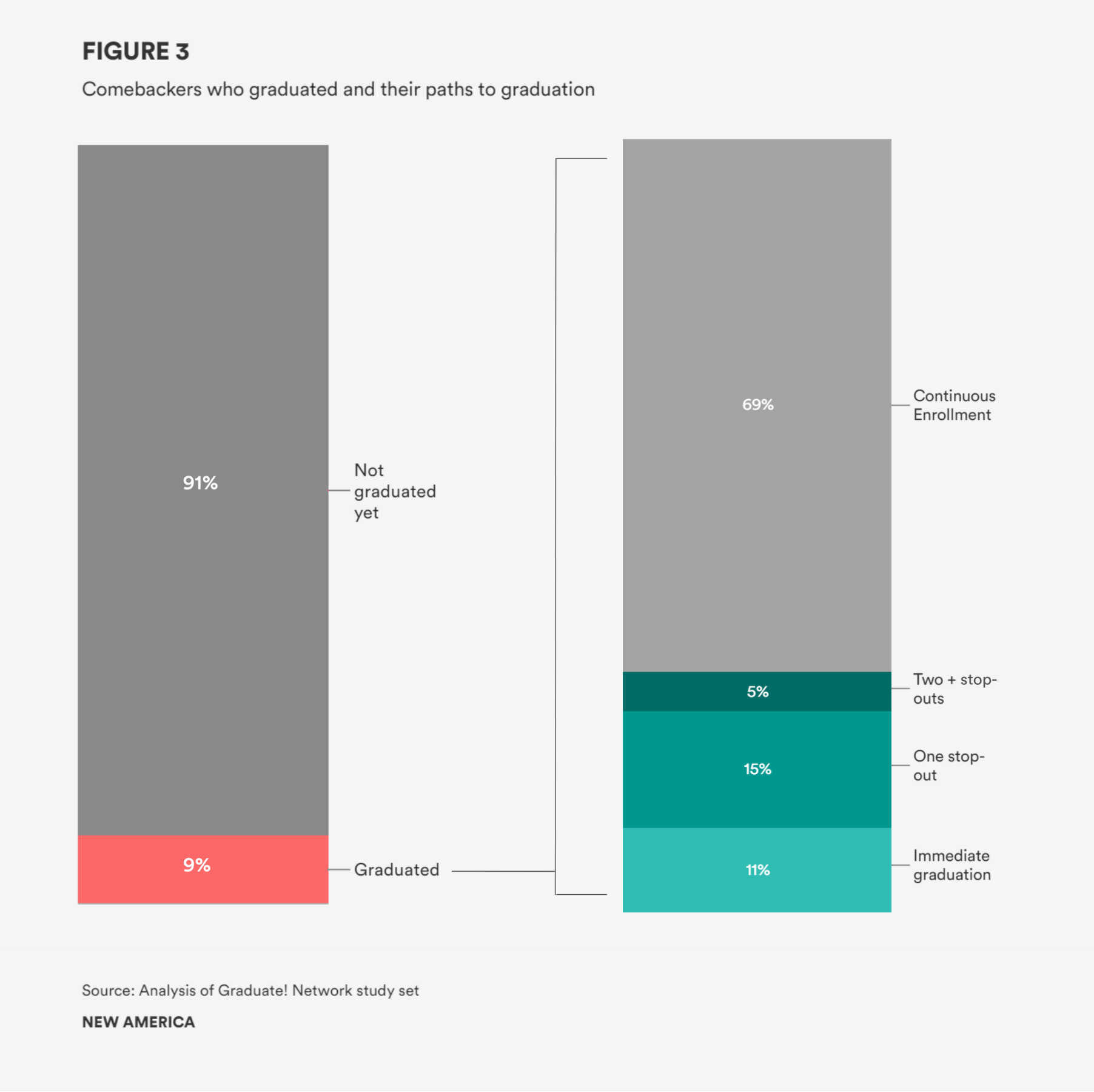
Twenty percent of comebackers had at least one period of not being enrolled before they graduated. Indeed, for many, a stop-out was not a sign of giving up, but rather a period of enrollment dormancy during which the comebacker was laying the groundwork or waiting for a more opportune time to resume their studies. In our study set, over 40 percent of comebackers who had re-enrolled after engaging with The Graduate! Network stopped out at least one more time afterwards.
This significant minority of comebackers highlights why we need to rethink persistence measures for this type of returning student. Persistence is traditionally defined as the percentage of students of any age who return to college at any institution for their second year, and it is thought to be predictive of both student retention and graduation. This definition clearly reflects the typical experience of a traditional student: it has a “seasonality” component to it, with attendance tied to the fall semester; there is an underlying assumption that enrollment will be continuous from year to year; and this continuous period of enrollment happens early in matriculation.
And yet, this definition of persistence is not very useful when applied to the entire population of adults who return to school to complete their degrees. Given that they already had accumulated college credits, the majority of comebackers who engaged with The Graduate! Network (54 percent) did not wait for fall semester to re-enroll, and only a third (34 percent) remained continuously enrolled at the same time the following year. Furthermore, attempting to adjust this definition of persistence—by changing enrollment windows or severing the tie to fall semester starts—do not result in measures that are any more meaningful.
Given that starts and stops are not unusual for the comebacker population, a more applicable term is perseverance. A comebacker who has stopped out is not necessarily a drop-out. Indeed, there may be very good reasons for a comebacker to have periods of non-enrollment on his or her way to graduation and to take more time to complete a program. We need to broaden our thinking on what it means to be persistent and allow room for these additional pathways to graduation.
Crossing the Finish Line: Who Graduates and How
As discussed earlier, potential completers are comebackers with at least two years of college experience. The reality of how to support them to completion is more nuanced.
The more academic progress a comebacker had had prior to engaging with a Graduate! Network program, the more likely it was a recent college experience–less than a year of not being in college. For potential completers, those who had completed two or more years of school prior to engaging with a Graduate! Network program, almost 70 percent had been out of school for less than a year before engaging with a Graduate! Network program. Among comebackers with fewer than two years’ worth of credits, only 43 percent had been out of school for less than a year. Of comebackers who had completed a single term, only 11 percent were recently enrolled.
That said, this population has typically done a lot of swirling through higher education, with no degree to show for it. Many potential completers had finished significantly more than two years’ worth of academic progress prior to engaging with a Graduate! program: potential completers who engaged with a Graduate! Network program had already finished an average of 3.9 years of higher education and a median of 3.5 years. Sixty-one percent of potential completers who engaged with The Graduate! Network had earned close to or more than four years’ worth of college coursework with no degree ever conferred. (See Figure 4.) They were also much more likely to have attended more than one institution.
The data from Graduate! Philadelphia, the Network’s longest running program, allowed us to look at what other characteristics, besides credit accumulation, predicted successful graduation. We found that among the most predictive factors of graduation was the time that had elapsed since the comebacker was last enrolled (the shorter the better), not having defaulted on student loans, and the amount of time the Comebacker engaged with a Graduate! advisor. According to the predictive analysis, the longer a Comebacker engaged with a Network program, the more likely he or she was to have graduated. This finding makes sense: comebackers who take time and seek out assistance to sort out issues—finding the right program, preparing academically, addressing financial issues (including outstanding and defaulted-on debt), transferring credit—put themselves on a path to ultimate success. The same analysis also found a wide age distribution for comebackers who graduated, with similar engagement rates for all age groups (20–65) with a small but noticeable increased likelihood of completion for comebackers in their mid-40s.
Challenges to Staying Enrolled
Our interviews with students and our survey shed light on why more than a third of students stop out even after re-enrolling. Staying enrolled is hard even for the most determined.
A shift in personal situation was the most common reason cited by comebackers who are currently not taking classes, which includes things like a change in marital status, caretaking responsibilities of aging parents or children, or illness. One mother described her day: “I literally was taking my daughter to school and then I would leave to go to work and then…on my lunch, I would go to class and I would come back to work and then…I'll go get my daughter, take her to my parents, and then I would go to class or go to work depending on…the day. It was just—it’s a lot.” This type of schedule is unsustainable for many comebackers. Comebackers not currently enrolled are waiting for the right time and support to finish what they started.
Balancing school and work forced some comebackers to take a pause. Comebackers who stopped out acknowledge that work is almost always the priority. One interviewee said, “just negotiating when courses would start and work is [hard] and that's what pays bills, honestly. That's where my benefits like health insurance reside, so I had to make sure I could find a way to balance the time with my work requirements.”
Financial difficulties also came into play. Running out of financial aid, no longer being eligible for employer education benefits, job loss, or unexpected expenses such as medical bills forced many students out of college. One comebacker told us, “I went to a community college and I was working 10 jobs, and I just couldn't pay it. The bills were—I mean, they were amazing…I just gave up, and I went [and] got a job in the factory.” Financial stress significantly adds to overall stress, and we found that the lower their income bracket, the more likely comebackers were to have stopped out.
What Got Comebackers to the Finish Line
With all this stress and pressure, we wanted to investigate what gets comebackers through school and to graduation. After all, 100 percent of comebackers who responded to our survey who were not taking classes at the time of the survey said they would consider going back to college.
Eighty-eight percent of comebackers who graduated cited supportive school faculty and staff as the top factor that got them through, and this was confirmed in our focus groups and interviews. (See Figure 5.) One graduate said, “I had a very good relationship with every single professor that I've had, and because of them, I got accepted at [graduate school] because they wrote recommendation letters for me.” Returning adult students particularly appreciated instructors who valued the experience they brought to the classroom and welcomed opportunities to draw upon these experiences in class discussions and projects. One graduate told us that faculty “would even adjust some courses for me because I said, ‘Okay, I've done this part of the course for 15 years’….They would actually make adjustments for me.”
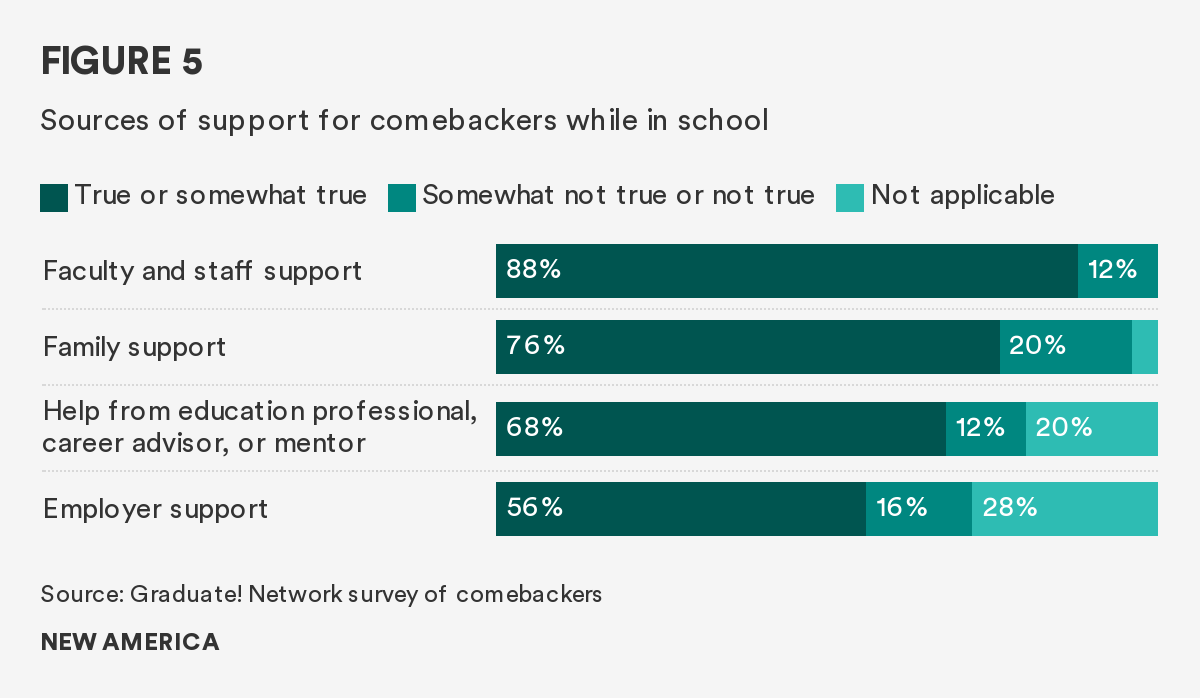
While graduates believe that faculty were key to getting them through school, other staff and supportive programs were also important to them, although feelings about the level of support were more mixed. “In terms of the university administration, yes, they would provide me with support if I reached out; however, they were not there constantly for me,” said one person we interviewed. It is also important to note that comebackers were not passive in their educational journeys. Those who had the capacity worked hard to create the supports they saw missing for returning adults. One graduate shared her story of creating those holistic supports for comebackers. She said, “I actually created a student organization basically for nontraditional students so that we could get scaffoldings that we needed because we didn't have it.”
While family commitments, particularly caregiving responsibilities, made it difficult for comebackers to re-enroll and complete their degree, family support also got comebackers through school. This support was not just encouragement from spouses, partners, children, grandchildren, or parents, but also came in the form of financial assistance with tuition or other school-related expenses. One graduate told us, “there was a lot of late nights and a lot of stress and difficulty just keeping everything together…in addition to work. Mentally and emotionally, my boyfriend and friends were very supportive because it was definitely stressful.”
As mentioned above, comebackers who graduated did not always feel they had the support of their employers. Those who did spoke of flexibility to take classes, especially when these classes were offered only at certain times of the year; time off to complete practicums or internships; and financial benefits, such as tuition assistance. One comebacker said, “my job was very supportive. I essentially came back to this job because they were going to give me the flexibility to take classes when I need them and flex my schedule.”
Accelerators and Roadblocks
Accelerator: Employer Education Benefits
Among comebackers who recognize the need for a degree, access to employer education benefits was very much tied to the nature of their jobs. Lower-wage and younger workers had the least access to employer education benefits. More than a third (35 percent) said their employer offered no educational benefits and 7 percent said they did not know if their employer offered tuition benefits. (See Figure 6.) Of those who did work for employers that had a tuition assistance program, 12 percent said they personally did not qualify for the benefits, and 19 percent said they qualified but had not used the benefits. A quarter (26 percent) said they had qualified for the benefits and used them.
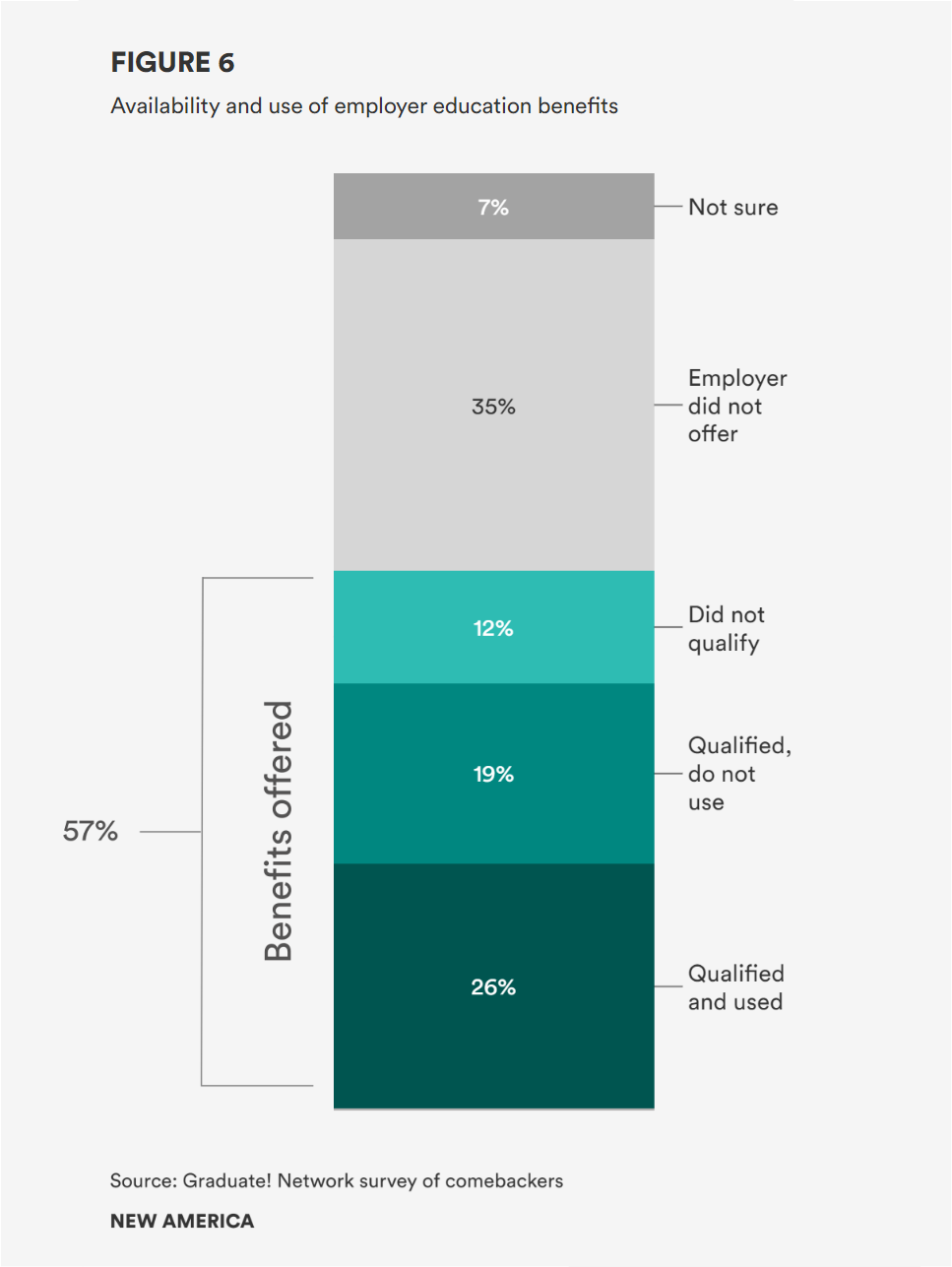
Of those who did report employer education benefits, those in higher income brackets were more likely to say they had access to employer benefits and were more likely to use them. Comebackers earning $24,000 or less were more likely to say their employer did not offer education benefits or that they did not qualify for benefits even though their employers offered them. The older the worker, the more likely he or she was to have used employer education benefits, peaking at age 50.
Bridging The Talent Gap
The Graduate! Network’s Bridging The Talent Gap initiative documents the signaling effect of a degree for employers. More than 70 percent of the 4,000 small and medium-sized employers that participated in the initiative said that more education beyond high school increased worker retention, productivity, profits, customer satisfaction, and development of in-house leadership skills. Employees at these companies overwhelmingly agreed that the personal and professional benefits they stood to gain from postsecondary education are worth the effort (90 percent and 87 percent, respectively.) Three-quarters of employees also noted that education costs (beyond employer support) are a big challenge. About half were challenged to keep up with work while devoting time to studies, and 61 percent reported that keeping up with their family responsibilities was challenging while in school. Employers estimated that only 54 percent of the education benefits they offered were utilized by employers.
Accelerator with Reservations: Non-Degree Credentials
Non-degree credentials, including those offered by colleges and universities, are commonly considered a way to jumpstart or accelerate a career and are another way returning adult students are forging a path to graduation. Not surprisingly, almost a third (30 percent) of comebackers who approached the Graduate! Network had earned a non-degree credential and another 11 percent were considering or working on a non-degree credential. (See Figure 7.)
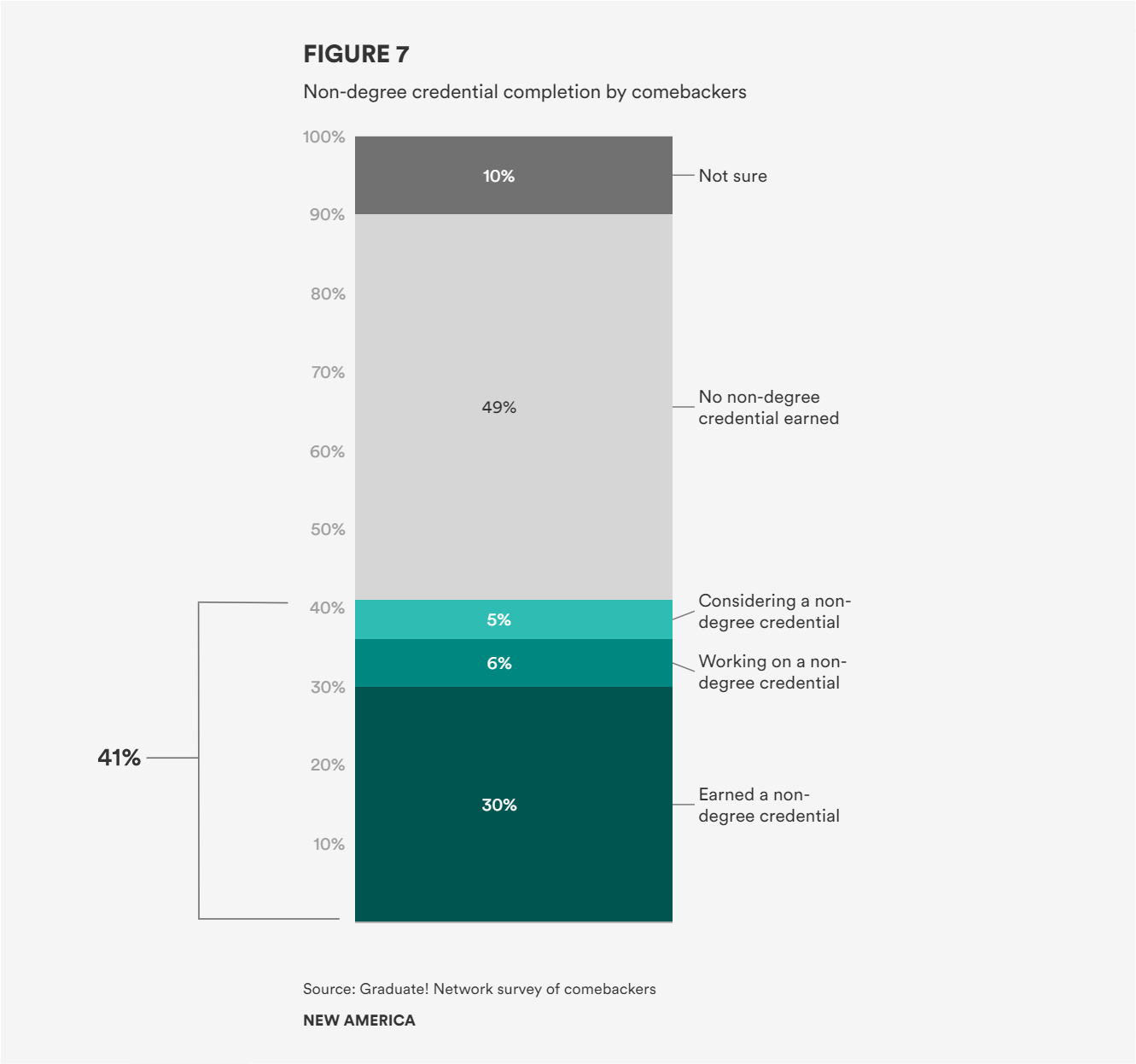
Survey respondents who had not yet re-enrolled in a degree program were even more likely to have earned a non-degree credential (39 percent). Of those who earned non-degree credentials, more than a third (36 percent) were in a program affiliated with a college or university. Some colleges allow these credentials to be counted toward a degree, through an assessment process. More than 50 percent of non-degree credentials were awarded in three areas of study: health care, business, and technology.
Unlike degrees, which many said they were pursuing as a personal goal, comebackers tended to view non-degree credentials as a more cost-effective (in terms of money and time), accessible way to boost their economic and career prospects. Some, however, realized the limitations of a non-degree credential. One person said:
I talked to my sister, who just graduated two years ago from college. She said to me one day, “why don't you just go on back to school for real?” “What do you mean go back to school for real? I am at school for real.” She said, “no, you take classes and you are being a real student, and doing all the work, but yet you don't get any credit for it. You get a certificate. Oh, whoop dee, but you need to go back to school and finish your degree.”
This question of whether employers value certifications as much as degrees was also mentioned by another comebacker: “I worked hard to reach a certain level where I've attained a lot of certification in the business world. Actually, when I go to apply for a position in this day and age, that four-year degree is required. I have…the certifications…that you need to be in the business world, but I did not have that four-year degree. Now, I cannot pass the hiring for that level of a position without the four-year degree.”
Roadblock: Owing Money
Student institutional debt not only keeps students from completing their degrees the first time around, it prevents them from going back to finish, not just at their college but at other institutions. Schools commonly withhold official transcripts from students who owe money, effectively barring them from applying to another college. This practice keeps students from finishing a degree at their own college or elsewhere and restricts their earning potential and their ability to repay their debt.
Student institutional debt comes in many forms: unpaid tuition and fees (such as library and lab fees), fines for non-payment, parking fines, and other non-tuition costs. Students with unpaid college bills are often forced to withdraw without earning a degree, regardless of how much credit they had earned (and partially paid for). Colleges may put a hold on student transcripts because of overdue fees, and often deny enrollment to students who have an unpaid balance. And depending on who owns the debt, the amount owed can balloon even more over time, as interest, fines, and collection fees are heaped on top of the original debt, yet students may not be aware of the debt accumulation. One student said:
One of the issues I had when I left college– …college was my housing. When I left college, I was back to sleeping on different couches. I didn't have a stable address and I didn't go to commencement. Which meant I didn't get loan counseling when I left. It turned out they were sending bills for student loans to an address I didn't live at, and I had no idea until I was already in default. The loan counseling needs to be done before you graduate, you need to sit down, and if someone is going to be homeless, and they know this or if they end up homeless, how are they going to access their bills? What is the solution for that?
According to Policy Matters Ohio, when student institutional debt is referred to the state’s Attorney General’s Office, the amount owed can balloon even more over time, as interest, fines, and collection fees are heaped on top of the original debt. Many schools and some states have policies that withhold transcripts from and bar registration of students with institutional debt, preventing them from re-enrolling in school and effectively trapping them in low-wage jobs. Black, LatinX, part-time, older, and first-generation students, who attend two-year schools at higher rates, are disproportionately affected by this issue.
In the past few years, some institutions have started programs to forgive outstanding debt up to a few hundred dollars. In particular, Wayne State University’s Warrior Way Back program has received national recognition for this practice.
Another comebacker added that first generation students are
not familiar with deferment or forbearance or an income-based repayment or anything. I wasn't told, I learned that on my own. There should be some follow-up or there should be, like I said, like a war room or something where everyone comes in and they say, “Okay, let's sit down, let's look at how much experience you have. Let's see how long it's going to take for you to find a job.” Just like metrics like six months, “we'll call you to see if you got the job yet, and if not, the school will try to figure out something,” because, unfortunately, once commencement is over and you graduate, you're on your own. It's like a cutoff.
A related issue is a lack of understanding of federal loan structures from when comebackers first attended college. The federal loan program is structured to allow students to borrow more than the cost of tuition and fees. If the federal loan awards exceed the amount covering tuition and other fees, students receive a loan “refund.” This refund amount becomes a liability that the student is required to repay to the federal government. One interviewee explained that
what they don't tell you is that you could decline when you look at your financial aid package, or you don't have to take the loan out. I don't know if it was because of my age, because at that time I was young. I just thought that [the loan refund] comes along with it. I didn't think at that time that I can just say no. I was listening to other people, and they were like, “you could just use the refund money to buy yourself a car, or to pay up on your rent,” and stuff like that. That's what I was seeing around me, is people getting refunds, and thinking it was—I thought it was normal. I'm not going to lie. I thought that was normal behavior at that time to just simply take out as many loans as you need, and just use the extra money to do whatever. At that time, I didn't know you could decline, and say, “no, I don't need that much. I just need just enough to really just pay my tuition, and my books, and whatever electronic devices I need in order to pass the courses.” I can do that. I didn't decline anything either. I just, whatever they gave me, I accepted it.
Recommendations
Supporting Re-enrollment
Recognize the potential of comebackers of all ages to graduate
Comebackers have the drive and potential to complete their degrees at any age, particularly if they see clear connections between degrees and employment and are supported before they re-enroll and while they are in college. Data suggest that there is a peak of interest that leads to degree completion for comebackers in their 40s, and colleges and funders should recognize this group. The longstanding deficit narrative of stopping out as failure and wastefulness is counterproductive. Government agencies, elected officials, higher education and civic leaders, and employers already recognize the value of a degreed workforce, yet do not message this broadly and consistently. Especially now, when employment will be key to recovery from the COVID-19 economic fallout, adult learners will need to hear they are valued and see a clear path forward. Nonprofits, states, and colleges should create messages that speak to comebacker potential and use a growth mindset to urge comebackers to re-enroll in college and finish their degrees.
Target state and institutional outreach to potential completers
States and colleges should follow the examples of Mississippi, Indiana, Tennessee, and many other states that have created campaigns targeting potential completers to encourage them to return to college and finish their degrees. Individual colleges like Wayne State University, University of Akron and the University of Memphis also have programs targeted at reengaging adults who may have stopped out. These institutions are reaching out to students who have been stopped out for a number of years. As one student put it, “for me, the Office of Adult Focus at the University…are very supportive….Also, they have some scholarships specifically for adult learners there.” These campaigns include features like direct outreach to stop-outs, financial aid to return to college, and coaching. This type of support and encouragement make a big difference for returning adult students.
Eliminate punitive policies tied to student institutional debt
Reforms should include waiving financial holds and more institutional debt forgiveness. Institutional debt not only keeps students from completing their degrees the first time around, it prevents them from going back to finish. One comebacker told us: “Initially they said, ‘Oh, you would definitely qualify possibly to get a scholarship to help pay towards your education,’ but it wouldn't help pay for post-dated, back tuition. That was the biggest barrier.” Wayne State’s innovative Warrior Way Back program should serve as a model for other colleges. The program provides forgiveness of a balance up to $1,500 for students who have not attended class at the college for at least two years, as long as they remain at the university for at least three semesters, earning passing grades.
Waive application fees
It may seem like a small amount of money, but application fees can be a barrier for an adult living paycheck to paycheck. Any out of pocket expense can be a major setback to this population. Providing application fee waivers can be a relatively low-cost way to show students that you want them to return to the college. This practice was a hallmark of the Graduate! model when it was launched in Philadelphia and has been adopted across the Network.
Ensure adequate software and hardware
We heard mixed feelings from comebackers about online classes. Many appreciated the flexibility this modality gave them, but many also found it hard to be motivated in an online environment. However, with the advent of COVID-19, many more returning students will need to take classes online. This makes possible resource inequalities even more pressing. States, colleges, and the federal government should explore sustainable ways to provide laptops and stable internet access to comebackers who want to continue their education.
Move all applications and enrollment processes online
Making comebackers walk around campus to re-enroll is frustrating under normal circumstances and downright dangerous during a global pandemic, and can be a significant barrier for returning adult students. When the college puts up these types of barriers, it makes comebackers feel discouraged and unwanted. One returning student told us, “I would always call the registrar's office and they would always say, ‘well, that person's not in right now.’ I ended up getting so frustrated. I took a day off of work and…I talked to every person in that department.” Colleges should put all enrollment systems online and conduct user testing to ensure that the systems are usable and staff are being responsive to prospective students. Forcing this population to produce high school transcripts is also a significant burden. One student told us, “I actually had to physically go to the board of education and sign the paperwork….to get high school information from years back and it was a process.” Colleges should accept previous college transcripts in lieu of old high school records.
Be able to answer key questions
Available staff and, to the extent possible, websites should help students answer the following questions quickly and easily:
- How many credits have I earned?
- How long will it take me to graduate?
- How much will it cost me?
- What can I expect to get out of it?
This can seem deceptively simple. Unfortunately, it is all too rare. As one student described it, “that was pretty labor-intensive for me, pursuing recruiters in each of those schools, and finding out what it was they could offer me, submitting transcripts.” Another said, “I was confused…I created a checklist and just things that I needed to work on.” Some colleges do not even make it clear how much it will cost. A comebacker told us, “I just looked at all the different schools and all the different programs and all the different tuition and book fees….Some of the websites do have the things online, like tuition fees and costs. Some don’t. Just very time-consuming.” On top of basic information about progressing through their courses, many returning students would like to know what kind of labor market return they can generally expect. Colleges should consider accessing and clearly sharing labor market outcomes for their programs.
Money
Design financial aid programs to support comebackers
Money is a huge stressor for adults trying to return to college. It is worth re-emphasizing that the lower down the socio-economic ladder adults were, the less likely they were to graduate and the more they needed their degree to create a stable life for themselves and their families. As one comebacker put it, “I was not making a lot of money to sustain my family…[it] literally feels like you're in the water and it's at your nose level. I'm making it, but how can I live an abundant life?” States and colleges can help alleviate this stress by providing grant funding for comebackers to supplement the federal Pell Grant. Programs like Tennessee Reconnect and the Arkansas Academic Challenge Scholarship provide scholarships to help address the cost of returning to college. Schools can also help. We have already brought up the University of Memphis and the University of Akron. Purdue University’s Span Plan also provides scholarships to non-traditional students. This can be particularly valuable for those swirling in the higher education system, using up their eligibility for other financial aid programs. As one comebacker put it, “I got to my last semester of my undergrad, [but] when I went back, I'm out of my Pell Grant and my subsidized and unsubsidized [loans].” Comebackers are also often unaware that they are eligible for financial aid but need to fill out the FAFSA, and, like younger students, they note that the FAFSA forms are challenging to complete.
Improve employer education benefits
More than half of comebackers we surveyed worked for employers who offered benefits (57 percent), but only a quarter used them. Given the importance of financial resources to these students, this lack of uptake tells us that these benefits must be flawed. Worse, comebackers’ access to employer education benefits is very much tied to the nature of their jobs. Lower-wage and younger workers had the least access, while the higher a comebacker’s income bracket the more likely he or she was to have access to employer benefits and have used them.
Employer education benefits are mostly paid as reimbursement to students. One comebacker said, “there were employer benefits towards education, but you had to pay up front and then you had to pass and then you will be reimbursed. You weren't always reimbursed the whole amount.” Employers should consider tuition policies through an equity lens and ensure that lower-paid employees, who would most benefit economically from completing their degree, take full advantage of the benefit.
Employers should also make their benefits clear and transparent. One comebacker said, “when I first looked into it, it was a little bit vague….It's a little bit of a process to where you have to gather up…transcripts. It's a little bit of work and I think that's what might discourage some people from doing it.” Another told us, “the job that I'm at now, it reimburses you as long as you get good grades….If I do good they'll reimburse me, but I have to work for them for three years after that…[or] I'll have to pay it back.”
Academic and Support Structures
Encourage faculty mentoring of comebackers
Colleges should consider setting up programs that encourage faculty to form mentoring relationships with returning adult students. With a small stipend for the professor and institutional support in matching the faculty member with the returning adult, colleges could reinforce what comebackers said was the biggest key to their success: supportive faculty relationships. This type of mentoring could be facilitated through department chairs, with the support of the non-traditional student office. We know this kind of awareness and relationship-building would produce results. Adult students bring a wealth and variety of life experience to the classroom, and faculty, informed by such a program, would be more likely to invite these perspectives and integrate them into class discussions. As one comebacker noted,
I think that having professors that ask us to include some of our experiences in our academic responses….They understand that we can read and synthesize the research we’ve done and probably regurgitate that into a paper, but that also we can apply that to some real work-based situation, or some real experience-based situation, and that is seen as valid synthesis of that information as well, and not just the traditional citing someone else’s document. I appreciate that. That again, adds to my own engagement and interest in the course, just to be able to, in real-time, interpret it as being relevant to my work.
Improve coaching and support through to graduation
One in 10 adults who connect with a Graduate! Network program is already enrolled in school who find themselves at risk of stopping out and are seeking guidance and support outside of their schools. Among the top reasons why enrolled students said they were at risk for stopping out was that they found themselves in an unsustainable financial position and needed additional assistance to stay enrolled. Other reasons currently enrolled students cited were concerns about their declared major, academic struggles, thoughts about transferring to another school, or uncertainty about their job prospects after graduation. One comebacker said, “just being in contact with the counselors over and over again…[was] constantly motivating,” particularly the “suggestions [for] how to approach time management.” Another pointed out that “they have a system…where you can actually choose a time if you need to speak to someone about registering for classes or if you have just a general question….That really helped me a lot.”
Maintain engagement with students who have stopped out
The best way to get students to a degree is to help keep them from dropping out in the first place, and improved guidance is key. But comebackers have periods of not being enrolled that do not indicate a complete stop. Colleges should maintain communication with students who are not currently enrolled to keep them engaged and looking to that school when they are ready to return.
Embed certificates into degree programs
Changing degree design can help people progress through their program and connect to the workforce more quickly, especially if they are changing career. The BYU-Pathway program is a good example; it has created a degree where students, instead of only earning a bachelor's degree at the end, earn three certificates and an associate degree along the way.
Be clear about which certificates accelerate degree completion
Not all non-degree credentials can be applied toward a degree, including those offered by colleges and universities. Two in five comebackers, including those who have not yet re-enrolled in a degree program, had earned, were working on, or were considering a non-degree credential. Comebackers tended to view non-degree credentials as an accessible and cost-effective way to boost their economic and career prospects, unlike degrees, which many said they were pursuing as a personal goal.
Thinking about credentials as a pathway to a degree requires students to research the value of each credential to the college that interests them. Comebackers expressed frustration around what they felt was the undervaluation of non-degree credentials by colleges. One said,
if you’re working in some kind of public service or civil service, the chances are those people have tons and tons of certifications and credentials that have never been converted into college credit. I think that it does a disservice to those people providing community work like that, that we cannot find a way to equate [sic] that training and those certifications into some sort of college credit….We’ve dedicated hundreds of hours to training and have gone through validation processes, and been credentialed, and certified, and marked qualified in a lot of areas that no university that I found was willing to accept on its own, without me jumping through a lot of other hoops.
Recent findings by Burning Glass Technologies shows value in stacking technical credentials on top of degrees as arbitrage for a better paying job, rather than using credentials to build toward a degree. Colleges should clearly note which credentials are stackable toward a degree and which do not translate into credit toward a degree.
Design degree completion programs for faster graduation
Many comebackers have an excess of college credit and lots of real-world experience but have not managed to meet the criteria for a degree from any previous college. One way to help them is to create a completion degree program with flexible requirements that allow them to fit their previous college and work experience into that structure and more quickly earn their degree. It can also help when degree completion programs provide accelerated courses to fill in the requirements students may not have met. For example, the Bachelor’s of Science in Organizational Leadership and Learning at the University of Louisville is designed to take into account the full range of experience that adults bring to the table through recognition of credit earned at other colleges and knowledge gained outside of the classroom. It also provides eight-week accelerated classes. This kind of design can be incredibly helpful for returning adults. One comebacker told us, “I feel like these eight-week evening classes are really designed for non-traditional students and that they are understanding of the fact that we do have careers in addition to the school that we're taking on.” More and more programs also allow students to move fluidly between in-class and remote participation. One student said, “you can come to class or you can work from home online….I like to see the professor, ask questions, talk to them. That's me, that's the way I'm used to learning.” This person appreciated the fact that “you don't necessarily have to be in class, or if you have a circumstance where you can't come to class.” Such programs are becoming more common across the country.
Award credit for learning outside the classroom
Adult students bring a wealth and variety of life experience to the classroom, and faculty do well when they invite these perspectives and integrate them into class discussions. As one comebacker noted,
I think that having professors that ask us to include some of our experiences in our academic responses—whether it’s a discussion post or a paper—they understand that we can read and synthesize the research we’ve done and probably regurgitate that into a paper, but that also we can apply that to some real work-based situation, or some real experience-based situation, and that is seen as valid synthesis of that information as well, and not just the traditional citing someone else’s document. I appreciate that. That again adds to my own engagement and interest in the course, just to be able to, in real-time, interpret it as being relevant to my work.
Recent research has shown that PLA increases completion and reduces time to degree for students. The comebackers we spoke to really appreciated having their learning recognized and some were frustrated with a lack of information about the opportunities for PLA. One comebacker noted that the schools are “really honoring that we are still working in a career field in some way; that's been good. I appreciate that a lot.”
Some comebackers pointed out the difficulty in accessing those opportunities. One said, “I kept trying to figure out, ‘I hear that you guys have tests for experience [so we can] test out of different classes’….I wasn't really given the options to test out. I had to ask for them. I had to push.” Another comebacker said, “I found during my researching process they would mention that they gave some credit for work experience and life experience. When I looked at what those processes actually were, they were very labor-intensive, very financially intensive. For those of us using G.I. Bill or something, we cannot use those benefits for that kind of equivalency.” This student found that the promise of PLA “really turned into, it was more of just a byline on the promotional materials and in practice; there wasn’t any really good way to do that.”
Building PLA systematically into more college programs and connecting students to them through degree design and good advising, is key to serving returning adults well.
Honor as many old credits as possible
Many colleges are stingy with the credit they offer for classes at other colleges, particularly if that attendance was years ago. Colleges should try to be more generous with their students. They should also be more transparent. One comebacker told us, “going back, I didn't know what was going to transfer from the community colleges…what would transfer over, and it was like pulling teeth to be able to get [that information]”. Another told us about the difficulty of being able to reach someone with an answer, like “counselors from local schools,” and “getting…some pushback as far as how outdated some of my credits were or what transferred over,” which “just had me discouraged about the whole process.”
Research Overview
Data Sources
The research presented in this report is based on analysis of data and information collected through several sources:
- Administrative data collected by 12 Graduate! Network communities (as of early March 2020): Albuquerque, NM; Cleveland, OH; Corpus Christi, TX; Detroit, MI; Greensboro, NC; Kansas City, MO; Louisville, KY; Philadelphia, PA; Rhode Island; San Antonio, TX; St. Louis, MO; and Spokane, WA.
- National Student Clearinghouse (NSC) enrollment and graduation records (as of early March 2019)
- A survey of comebackers conducted in December 2019 (n=325) and fielded in seven Graduate! Network communities
- Focus groups of comebackers conducted in January/February 2020 in three Graduate! Network communities: Cleveland, OH; Kansas City, MO; and Philadelphia, PA
- One-on-one phone interviews conducted in February 2020 with comebackers in five Graduate! Network communities: Albuquerque, NM (2); Cleveland, OH (4); Kansas City, MO (3); Philadelphia, PA (5); and Spokane, WA (1)
Methodology
Quantitative and qualitative research methods were used for this report.
Quantitative analysis: The full study set for the quantitative analysis consisted of 7,843 adults who had some degree of contact with a Graduate! Network program and were in the “some college, no degree” category, meaning they had completed at a minimum one term of coursework but were not matriculating when they contacted the program. These student-level administrative data records were augmented by enrollment and graduation records obtained from the NSC. Unless otherwise noted, the analysis presented in this report is for this study set.
Using NSC’s methodology for determining how much college students completed before stopping out the first time around, the study set is broken down this way: single-term enrollee (959), multiple-term enrollee (3,345), and potential completer (3,539). This study set is not a random sampling of the “some college, no degree” population. Rather, it is a subset with a particular point of view—comebackers who have demonstrated some degree of motivation to return to school, as evidenced by engaging with a Graduate! Network program. This engagement ranges from completing an online intake form to extensive, ongoing contact with a Graduate! Network advisor.
Data were analyzed using standard descriptive statistics and cross tabulations. For the predictive analysis, we used the “decision tree” model.
Qualitative analysis: Three qualitative research activities were conducted for this project, in this order: (1) a survey of comebackers, (2) focus groups of comebackers, and (3) one-on-one phone interviews with comebackers. Unlike the quantitative analysis, where the study set was limited by the ability to match program data against NSC records, the survey was sent to all comebackers in seven Graduate! Network communities who meet the minimum threshold of engagement. A single link to an online survey was sent to all recipients. Upon entry into the survey, respondents were sorted into separate tracks based on their responses to two questions: first, whether they had contacted their Graduate! Network program officially in stop-out (if yes, they moved to the second sorting question; if no, they were sent to the end for a general set of questions); and second, what their actions were after engaging with the program. For this second sorting question, respondents were sent to four separate groups: (1) respondents who had not gone on to enroll, (2) respondents who went on to enroll and were still matriculating, (3) respondents who went on to enroll and were back in stop-out, and (4) respondents who went on to enroll and graduated. All respondents were asked a set of questions at the end regarding their views on the value of a college degree, the availability of employer benefits, their actions related to non-degree credentials, and basic demographic information. A total of 325 comebackers completed the survey, and responses were analyzed using basic descriptive statistics and cross tabulations.
Findings from the survey were used to craft questions and protocols for the focus groups and phone interviews, though each activity focused on a specific subset of comebackers. Those who made it to graduation were recruited for the focus groups. Those who went on to re-enroll after engagement—they might have still been matriculating, or they might have gone back into stop-out—were recruited for the phone interviews. Transcripts were generated for all the focus groups and interviews. They were reviewed and tagged for key concepts and compelling quotes.
Synthesis: The final step of the research process was to combine the findings of the quantitative and qualitative activities and to identify key concepts and trends. An advisory group of national experts from the arenas of higher education, policy, and research provided guidance and feedback throughout the entire process.
Data Limitations
We acknowledge the following limitations of our data:
- Data collection was completed just before the onset of COVID-19 and therefore do not reflect changes in status, condition, views, attitudes, or aspirations of comebackers brought about by widespread closures, job losses, and health impacts.
- The study set was limited to adults for whom there were corresponding enrollment and graduation records from NSC, which was done through a process of matching name and date of birth from The Graduate! Network’s administrative data. Instances where there was an incorrect or missing date of birth or where there had been a name change or difference in recorded name resulted in unmatched records. Adults with unmatched records were not included in the study set.
- There was incomplete demographic information for our study set, limiting our ability to draw strong conclusions when cross tabulating against these variables, especially for family annual income. The percentages of non-blank responses for key demographics cited in this report were: gender identity, 83 percent; race/ethnicity, 74 percent; family annual income, 40 percent.
- Some data collection methods were optional and relied on self-reported perceptions and behaviors.
- Some of the data collection methods had low response rates, limiting our ability to draw strong conclusions.
- Some data collection methods were conducted in a setting where services and programs were taking place, possibly resulting in social desirability bias.
More About the Authors

Hadass Sheffer
Senior Fellow, co-Founder and past President of the Graduate! Network, Inc.

Iris Palmer
Director, Community Colleges

Annette B. Mattei
Issues
Programs/Projects/Initiatives
Related