A Chapter of: Congressional Brain Drain
Compensating Congressional Staff: A Human Capital Analysis
The personnel expenditure and resource allocation analyses above illuminate how and when the decline in legislative capacity began, though only in the aggregate across common job titles and major office functions. In this section, we use CCS data to conduct a human capital analysis. Human capital analysis more precisely observes professional characteristics at the individual worker level to predict compensation. Using data only available from the CCS, we can assess the factors that influence given congressional staffers’ salaries based on their employing offices, job assignments, knowledge, skills, and abilities, as well as education and identity.
The human capital approach rests on straightforward logic about which staffers should be expected to earn more. Job title analyses are misleading because they assume all staffers holding the same title have similar education, experience, and expertise. And, as we already noted, the job title inflation that occurred while staff compensation declined creates more noise than signal. And, most importantly, the human capital analysis includes staff from both chambers and all types of employing offices (i.e., committee and leadership offices), not just House member personal offices.
First, it is reasonable to expect the inherent organizational hierarchy in Congress to determine salaries, so we first note the staffers’ chamber (House = 0, Senate = 1), office type (Personal = 0, Committee = 1, Party Leadership/Elected Officer = 3) and whether or not they work for the majority party (Minority party = 0, Majority party = 1). Second, we account for job titles. Though they may be imperfect, it is still reasonable to expect supervisors to earn significantly more than more common job titles like legislative assistant or professional staff member. Third, we measure tenure as described above, and the institutional knowledge measure is normalized on a scale of 0-1. Fourth, we use LegiStorm data on staffers’ highest educational attainment. Note that the JD degree is omitted because it is perfectly collinear with the job title “counsel.” And, finally we include standard identity variables for age (measured in five-year intervals), gender (binary), and race (white = 0; BIPOC = 1).
Figure 12 shows the results of a linear regression model predicting annualized salary. The plots are the marginal effects associated with each independent variable; the lines are a measure of uncertainty.56
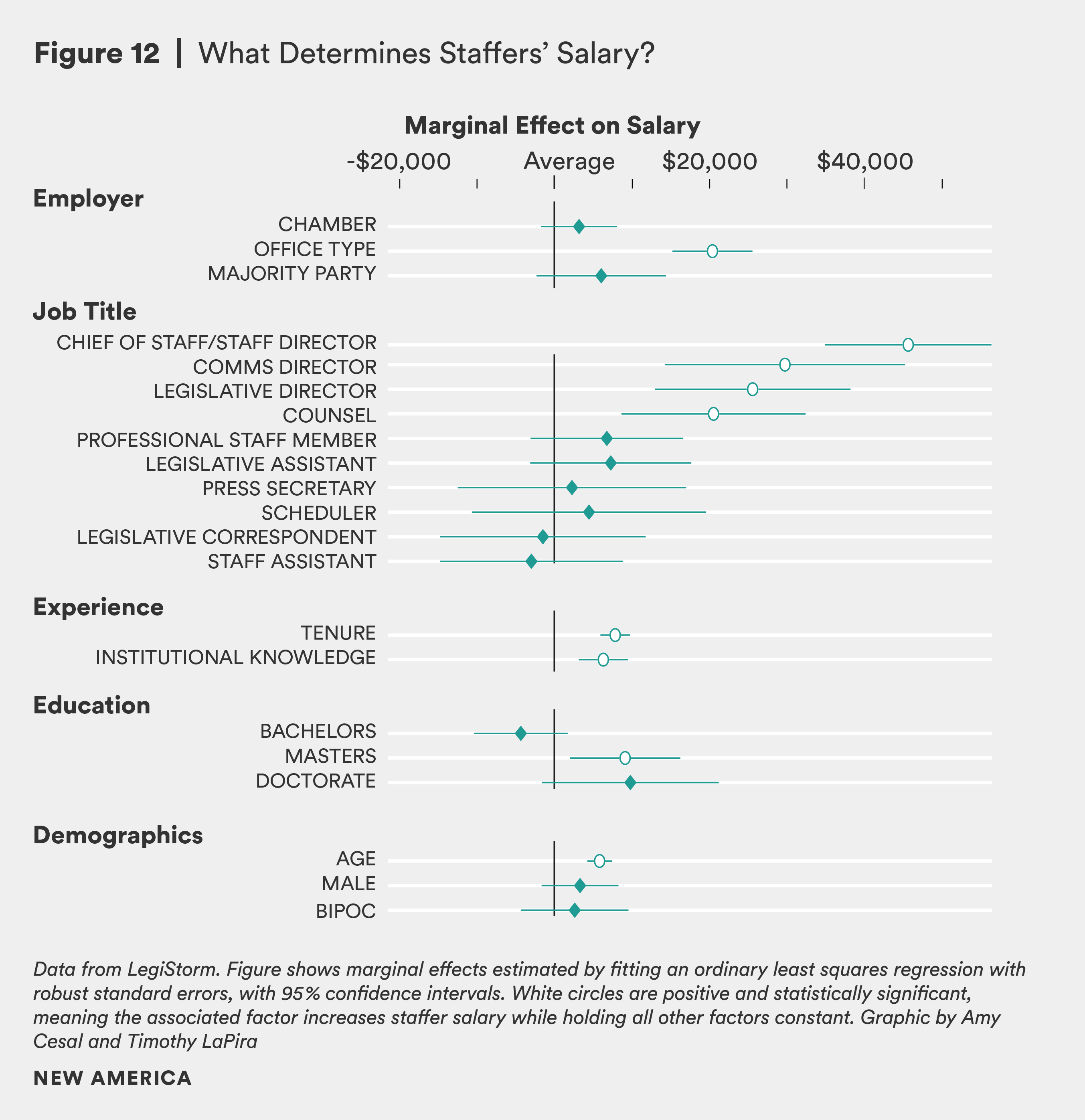
Job titles do matter, but only for those holding positions of supervisory authority. After controlling for all other factors, staffers holding mid-level positions such as press secretary or professional staff member do not earn more than those in entry-level positions like legislative correspondent or staff assistant. The statistically insignificant difference between low- and mid-level staff is likely due to the downward pressure of declining personnel budgets and the highly competitive job market on Capitol Hill, as we document above. Members of Congress exploit their job-sellers’ market status.
Alternatively, holding a counsel job (or having a law degree) earns staff $20,000 more per year than they would otherwise earn with the same experience. Legislative directors earn $25,000 more than counsels, and communications directors get paid an additional $5,000 more than legislative directors. Staff directors and chiefs of staff earn an average of $46,000 more than the typical staffer, all else equal. In other words, senior staff earn more than twice what a legislative assistant earns, even after controlling for other factors. These large inequalities cannot be attributed to senior staffers’ experience or knowledge alone, but instead to the inefficient and unequal legislative staff job market. The higher salary margins for senior staff is independent from how much we may expect them to be paid based on their age, experience on Capitol Hill, and knowledge of legislative procedure.
Congressional offices pay for experience, suggesting members value staffers who spend significant time on the Hill and those who develop their knowledge, skills, and abilities. A one standard deviation increase in tenure—equal to roughly 2.5 years of experience—translates into nearly $9,000. And, staffers’ institutional knowledge is rewarded at a rate of roughly $6,000 for every one additional correct answer in the procedural pop quiz. In addition, the only demographic variable that predicts salary is age, which can reasonably be expected to reflect alternative professional and life experience. Recall the majority of staff are under the age of 35, and two in five are under 30. Among our study, there is not a distinguishable difference in pay for BIPOC and female staffers compared to white staffers holding the same position, though we know these groups are both underrepresented and less likely to advance to more senior roles.57 Overall, pay discrepancies do exist between Black and white staffers on average, perhaps because white staffers are more likely to hold senior titles.58
These results are counterintuitive given the long-term trend of declining tenure and age among staff. Members reward employees’ knowledge and experience, yet they have sharply reduced their staffers’ salary over the course of several Congresses. The declining purchasing power of a Capitol Hill paycheck compels staffers to leave the Hill after an average of three years. In other words, members’ of Congress management of human capital is extremely inefficient for their immediate needs and woefully inadequate for the institution as a whole.
Ultimately, our research reveals a notable paradox: Members both reward knowledge and experience and also offer little incentive for staff to stay long enough to develop the kinds of knowledge and experience that can be rewarded.

Citations
- The model estimates ordinary least squares coefficients, with 95 percent confidence intervals for heteroskedastic-corrected (HC3) robust standard errors.
- Ritchie and You, 2020.
- LaShonda Brenson, “New LegiStorm Report Shows the Highest Pay Disparity Between Black and White Staffers on the Hill in 20 Years,” Joint Center For Political and Economic Studies, June 18, 2020. https://jointcenter.org/new-legistorm-report-shows-the-highest-pay-disparity-between-black-and-white-staffers-on-the-hill-in-20-years/