A Chapter of: Considering an Online Program Management (OPM) Contract
Introduction
The novel coronavirus pandemic sparked change overnight for millions of students and thousands of professors at thousands of colleges around the United States as it began to spread during the spring semester in 2020. Face-to-face instruction ground to a halt and students and schools had to navigate a rapid and chaotic move to remote learning. As they move from cobbled-together emergency remote learning to what will likely be a full semester or two of online learning this fall and winter, schools are rightly trying to figure out how to deliver quality distance education. That is challenging under the best of circumstances, but it is especially difficult without the benefit of time and money to carefully plan and execute.
While many colleges were already developing and expanding online education programs prior to the pandemic, for others, the move to online education is new. To establish an online presence, many colleges are looking for support from outside companies that specialize in the business. At the same time, with more schools considering online education as a way to diversify their enrollment and revenue pools, the pandemic may lead to more distance education in the long term. Schools are moving online fast, while looking to the future.
In looking to the future, many colleges appear to be considering online program management companies (OPMs). Online program managers are third-party companies—contractors to the institution—that agree to develop and maintain online programming. While some OPMs provide just the technology platform and perhaps support in translating in-person courses to online ones, others are full-service, handling everything from the course design to faculty training to recruitment of students.1
These OPMs have seen increased interest from colleges. While the marketplace of OPMs is fairly opaque, in its second-quarter filing, one of the most prominent OPMs, 2U, said that “university demand is markedly up.”2 Stock market returns have been strong for publicly traded companies that engage in OPM work.3 Accrediting agencies we spoke with confirm they have received more questions in recent months about partnerships to outsource online program offerings.4
This is not at all surprising, given the very real need to have online programs now and the desire of some to have more online programs even once the pandemic is over. But colleges considering an OPM partnership need to be careful and diligent. While some OPMs may deliver a platform that works for students and faculty, others promise the moon and deliver only shoddy quality offered by sketchy providers, even leading to the collapse of some colleges.5 Schools can learn from what has gone wrong and take steps to ensure that they avoid potential significant financial and reputational damage.
There are providers that have engaged in predatory recruiting practices, like in Concordia University’s partnership with an OPM called HotChalk. A whistleblower lawsuit alleged that HotChalk ran a “classic boiler room,” engaging in misleading practices to recruit students into its programs, including one that became one of the largest providers of education master’s degrees in the country, which duped thousands of students using practices that ran afoul of federal law.6
Other providers saw the rapid decline of admissions standards, enrolling unqualified students into low-quality programs where they were destined not to succeed. In Morthland College’s partnership with an OPM called KEEN, for instance, employees alleged that pressure quickly grew for the school to admit students from sports academies who they felt were not academically qualified for admission. Following a state investigation and federal sanctions based on the school’s financial and other issues, the institution’s access to federal financial aid was cut off and the college was fined.7 Morthland College officially shuttered in 2018, having lost most of its students.
Pockets of the OPM market are also packed with for-profit college executives who left schools embroiled in scandal to operate instead in the relatively shadowy regulatory environment of the OPM market. As our colleague Kevin Carey wrote in an exposé of the industry, executives from Kaplan, University of Phoenix, and Career Education Corporation are among those helping to run OPMs.8
For-profit colleges are themselves converting to the OPM model, becoming service providers for online education rather than colleges subject to more stringent rules and requirements. Kaplan University was recently purchased for $1 by Purdue University, while Kaplan Higher Education locked in a contract to handle marketing, recruiting, and other OPM services with a long-term contract.9 Zovio, the publicly held company formerly known as Bridgepoint Education, recently announced a similar public-proprietary model, in which the company’s Ashford University would be purchased for $1 by the University of Arizona in exchange for a contract in which Zovio will continue to run the online school with a long-term contract promising nearly 20 percent of the revenue from the program, on top of hundreds of millions in fees for its services.10
Grand Canyon Education, Inc., which operates as an OPM company to Grand Canyon University, said that since the start of the pandemic, it has seen “an increase in universities inquiries for possible partnerships,” both in the form of improving online programs for traditional students and through new growth in online education programs for adult students to help shore up colleges’ finances for the long term.11 The company reported particular business opportunities with colleges in the Midwest and Northeast, noting that most of the interested institutions had previously established similar, failed partnerships.12
One of the potentially riskiest parts of OPM partnerships is the length and terms of the contracts themselves. An analysis by The Century Foundation of more than 75 public-college contracts with OPMs found that most were long-term—longer than five years—and nearly one in four had aggressive terms governing the college’s ability to end the contract.13 In most (68 percent), the OPM was designated to develop the online course, and in nearly one in three, the OPM was expected to offer instruction, rather than faculty at the college.14 And more than half guaranteed the OPM a share of the college’s revenue from the program, ranging from 35 percent to the exorbitant rate of 80 percent.15
An analysis by The Century Foundation found most OPM contracts were long-term, many had aggressive terms governing the institution’s ability to end the contract, and more than half guaranteed the OPM as much as 80 percent of tuition revenue.
The revenue-share arrangements that many OPMs use have been enabled by a loophole in federal regulations. Federal law explicitly prohibits institutions of higher education or their contractors from offering any kind of incentive to recruiters based on the recruiters’ activities in admissions, enrollments, or financial aid—a protection designed to avoid incentives for the kind of aggressive, high-pressure recruitment tactics commonly seen in the for-profit colleges of the past that too often leave students with large debt loads and a degree of little value in the workforce.16 But subregulatory guidance from the Education Department in 2011 carved out an exception, allowing companies unaffiliated with an institution and that provide “bundled services,” including recruiting activities, to evade the requirement.17 That guidance gave rise to the revenue-sharing model used by many OPMs today in their contracts with colleges. Numerous experts in recent years have called for the rescission of that guidance and the enforcement of incentive compensation laws.18
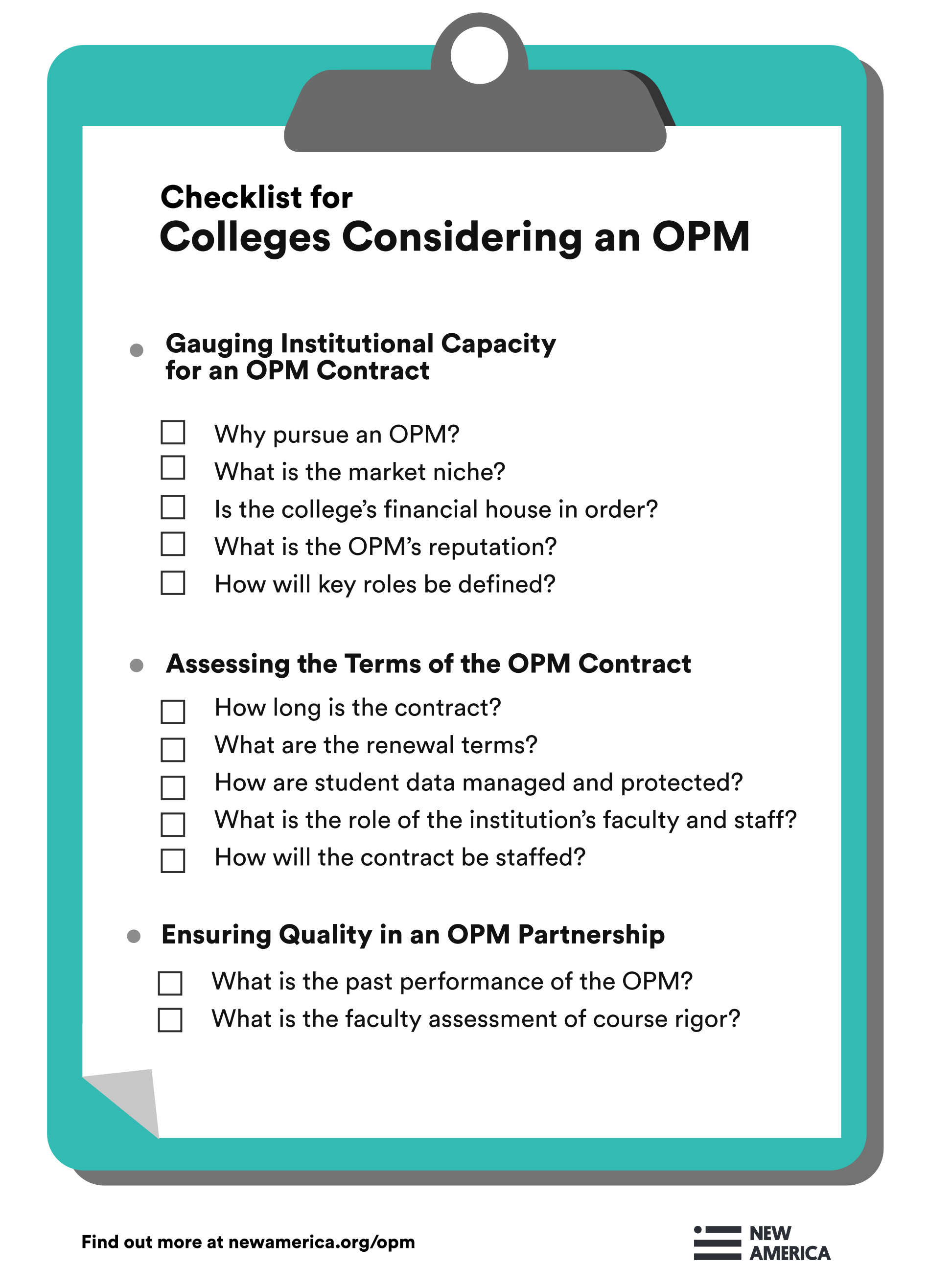
This is all to say that, as schools consider how to address distance learning, they should also consider the not-insignificant risks of partnering with OPMs. Contracts are often long, difficult to escape, and expensive. Colleges that see online programs as a financial salvation may learn that the reality is far less rosy. And the reputational risk if things go south could damage the university far beyond any potential upside of the programs. This brief identifies many of the key questions that an institution should ask of itself and its potential online program management contractors before they decide to pursue such an arrangement.

Citations
- For more, see Margaret Mattes, The Private Side of Public Higher Education (New York: The Century Foundation, August 7, 2017), https://tcf.org/content/report/private-side-public-higher-education/
- Chip Paucek (company participant), “2U, Inc. Earnings Call,” July 30, 2020, Seeking Alpha (website), https://seekingalpha.com/article/4362686-2u-inc-twou-ceo-chip-paucek-on-q2-2020-results-earnings-call-transcript?part=single
- Google Finance, Market Summaries for TWOU, LOPE, and ZVO (February 7, 2020 to August 7, 2020), available at finance.google.com
- New America interviews with national and regional accrediting agencies, June to July 2020.
- Mattes, The Private Side of Public Higher Education; and Kevin Carey, “The Creeping Capitalist Takeover of Higher Education,” Highline, April 1, 2019, https://www.huffpost.com/highline/article/capitalist-takeover-college/
- Carey, “The Creeping Capitalist Takeover.”
- Isaac Smith, “Morthland College Investigated by State, Federal Agencies; Fined Millions Over Alleged Mishandling of Federal Funds,” The Southern Illinoisan, September 25, 2017, https://thesouthern.com/news/local/communities/westfrankfort/morthland-college-investigated-by-state-federal-agencies-fined-millions-over-alleged-mishandling-of-federal-funds/article_0bd62e4f-af67-559c-b277-f863255d4f52.html
- Carey, “The Creeping Capitalist Takeover.”
- Robert Shireman, “There’s a Reason the Purdue-Kaplan Deal Sounds Too Good to be True,” The Chronicle of Higher Education, April 30, 2017, https://www.chronicle.com/article/theres-a-reason-the-purdue-kaplan-deal-sounds-too-good-to-be-true/
- Melissa Korn, “University of Arizona to Acquire Ashford University in Online Push,” Wall Street Journal, August 3, 2020, https://www.wsj.com/articles/university-of-arizona-to-acquire-ashford-university-in-online-push-11596452400; and Kevin Carey, “Proposed Merger Blurs the Line Between For-Profit Colleges and Public Universities,” New York Times, August 11, 2020, https://www.nytimes.com/2020/08/11/upshot/university-of-arizona-ashford-zovio-online-college.html
- “Grand Canyon Education (LOPE) Q2 2020 Earnings Call Transcript,” The Motley Fool, August 4, 2020, https://www.fool.com/earnings/call-transcripts/2020/08/05/grand-canyon-education-lope-q2-2020-earnings-call.aspx
- “Grand Canyon Education Q2 2020 Earnings.”The company has since announced a contractual arrangement with Valparaiso University to develop and manage some of the institution’s online graduate programs.
- Stephanie Hall and Taela Dudley, Dear Colleges: Take Control of Your Online Courses (New York: The Century Foundation, September 12, 2019), https://tcf.org/content/report/dear-colleges-take-control-online-courses/
- Hall and Dudley, Dear Colleges.
- Hall and Dudley, Dear Colleges.
- Robert Shireman, “The Sketchy Legal Ground for Online Revenue Sharing,” Inside Higher Ed, October 30, 2019, https://www.insidehighered.com/digital-learning/views/2019/10/30/shaky-legal-ground-revenue-sharing-agreements-student-recruitment
- Eduardo M. Ochoa, “Dear Colleague Letter re: Implementation of Program Integrity Regulations,” U.S. Department of Education, DCL GEN-11-05, March 17, 2011, https://ifap.ed.gov/sites/default/files/attachments/dpcletters/GEN1105.pdf
- Shireman, “The Sketchy Legal Ground”; and The Evolution of the For-Profit College Industry: New Challenges for Oversight (Oakland, CA: The Institute for College Access and Success, December 2019), https://ticas.org/wp-content/uploads/2020/01/the-evolution-of-the-for-profit-college-industry.pdf