
Considering an Online Program Management (OPM) Contract
Acknowledgments
New America would like to thank the Bill & Melinda Gates Foundation for its support of this project, and Arnold Ventures for its generous support of our work. The views expressed in this report are those of its authors and do not necessarily represent the views of the foundations, their officers, or employees.
Downloads
Introduction
The novel coronavirus pandemic sparked change overnight for millions of students and thousands of professors at thousands of colleges around the United States as it began to spread during the spring semester in 2020. Face-to-face instruction ground to a halt and students and schools had to navigate a rapid and chaotic move to remote learning. As they move from cobbled-together emergency remote learning to what will likely be a full semester or two of online learning this fall and winter, schools are rightly trying to figure out how to deliver quality distance education. That is challenging under the best of circumstances, but it is especially difficult without the benefit of time and money to carefully plan and execute.
While many colleges were already developing and expanding online education programs prior to the pandemic, for others, the move to online education is new. To establish an online presence, many colleges are looking for support from outside companies that specialize in the business. At the same time, with more schools considering online education as a way to diversify their enrollment and revenue pools, the pandemic may lead to more distance education in the long term. Schools are moving online fast, while looking to the future.
In looking to the future, many colleges appear to be considering online program management companies (OPMs). Online program managers are third-party companies—contractors to the institution—that agree to develop and maintain online programming. While some OPMs provide just the technology platform and perhaps support in translating in-person courses to online ones, others are full-service, handling everything from the course design to faculty training to recruitment of students.1
These OPMs have seen increased interest from colleges. While the marketplace of OPMs is fairly opaque, in its second-quarter filing, one of the most prominent OPMs, 2U, said that “university demand is markedly up.”2 Stock market returns have been strong for publicly traded companies that engage in OPM work.3 Accrediting agencies we spoke with confirm they have received more questions in recent months about partnerships to outsource online program offerings.4
This is not at all surprising, given the very real need to have online programs now and the desire of some to have more online programs even once the pandemic is over. But colleges considering an OPM partnership need to be careful and diligent. While some OPMs may deliver a platform that works for students and faculty, others promise the moon and deliver only shoddy quality offered by sketchy providers, even leading to the collapse of some colleges.5 Schools can learn from what has gone wrong and take steps to ensure that they avoid potential significant financial and reputational damage.
There are providers that have engaged in predatory recruiting practices, like in Concordia University’s partnership with an OPM called HotChalk. A whistleblower lawsuit alleged that HotChalk ran a “classic boiler room,” engaging in misleading practices to recruit students into its programs, including one that became one of the largest providers of education master’s degrees in the country, which duped thousands of students using practices that ran afoul of federal law.6
Other providers saw the rapid decline of admissions standards, enrolling unqualified students into low-quality programs where they were destined not to succeed. In Morthland College’s partnership with an OPM called KEEN, for instance, employees alleged that pressure quickly grew for the school to admit students from sports academies who they felt were not academically qualified for admission. Following a state investigation and federal sanctions based on the school’s financial and other issues, the institution’s access to federal financial aid was cut off and the college was fined.7 Morthland College officially shuttered in 2018, having lost most of its students.
Pockets of the OPM market are also packed with for-profit college executives who left schools embroiled in scandal to operate instead in the relatively shadowy regulatory environment of the OPM market. As our colleague Kevin Carey wrote in an exposé of the industry, executives from Kaplan, University of Phoenix, and Career Education Corporation are among those helping to run OPMs.8
For-profit colleges are themselves converting to the OPM model, becoming service providers for online education rather than colleges subject to more stringent rules and requirements. Kaplan University was recently purchased for $1 by Purdue University, while Kaplan Higher Education locked in a contract to handle marketing, recruiting, and other OPM services with a long-term contract.9 Zovio, the publicly held company formerly known as Bridgepoint Education, recently announced a similar public-proprietary model, in which the company’s Ashford University would be purchased for $1 by the University of Arizona in exchange for a contract in which Zovio will continue to run the online school with a long-term contract promising nearly 20 percent of the revenue from the program, on top of hundreds of millions in fees for its services.10
Grand Canyon Education, Inc., which operates as an OPM company to Grand Canyon University, said that since the start of the pandemic, it has seen “an increase in universities inquiries for possible partnerships,” both in the form of improving online programs for traditional students and through new growth in online education programs for adult students to help shore up colleges’ finances for the long term.11 The company reported particular business opportunities with colleges in the Midwest and Northeast, noting that most of the interested institutions had previously established similar, failed partnerships.12
One of the potentially riskiest parts of OPM partnerships is the length and terms of the contracts themselves. An analysis by The Century Foundation of more than 75 public-college contracts with OPMs found that most were long-term—longer than five years—and nearly one in four had aggressive terms governing the college’s ability to end the contract.13 In most (68 percent), the OPM was designated to develop the online course, and in nearly one in three, the OPM was expected to offer instruction, rather than faculty at the college.14 And more than half guaranteed the OPM a share of the college’s revenue from the program, ranging from 35 percent to the exorbitant rate of 80 percent.15
An analysis by The Century Foundation found most OPM contracts were long-term, many had aggressive terms governing the institution’s ability to end the contract, and more than half guaranteed the OPM as much as 80 percent of tuition revenue.
The revenue-share arrangements that many OPMs use have been enabled by a loophole in federal regulations. Federal law explicitly prohibits institutions of higher education or their contractors from offering any kind of incentive to recruiters based on the recruiters’ activities in admissions, enrollments, or financial aid—a protection designed to avoid incentives for the kind of aggressive, high-pressure recruitment tactics commonly seen in the for-profit colleges of the past that too often leave students with large debt loads and a degree of little value in the workforce.16 But subregulatory guidance from the Education Department in 2011 carved out an exception, allowing companies unaffiliated with an institution and that provide “bundled services,” including recruiting activities, to evade the requirement.17 That guidance gave rise to the revenue-sharing model used by many OPMs today in their contracts with colleges. Numerous experts in recent years have called for the rescission of that guidance and the enforcement of incentive compensation laws.18
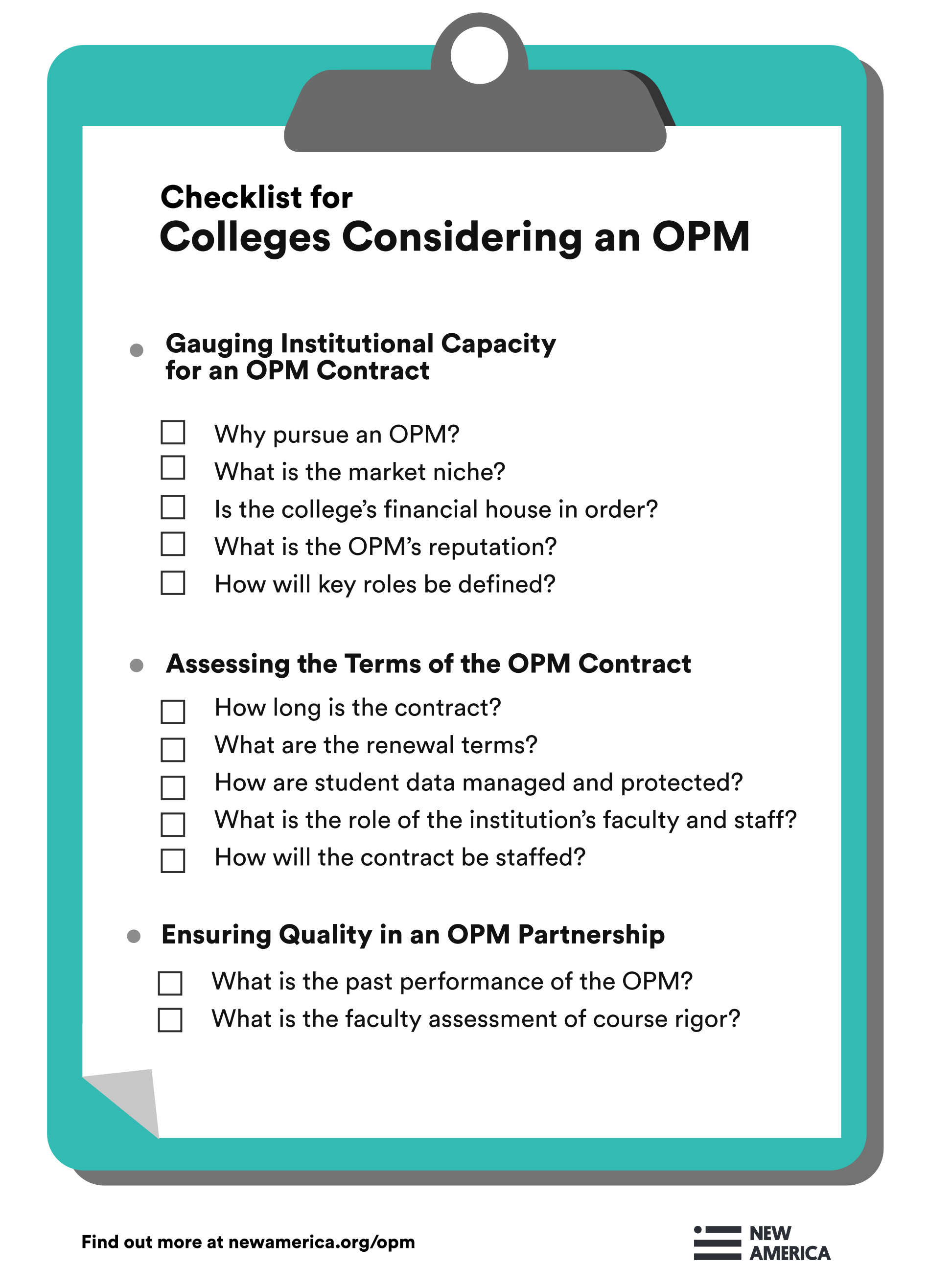
This is all to say that, as schools consider how to address distance learning, they should also consider the not-insignificant risks of partnering with OPMs. Contracts are often long, difficult to escape, and expensive. Colleges that see online programs as a financial salvation may learn that the reality is far less rosy. And the reputational risk if things go south could damage the university far beyond any potential upside of the programs. This brief identifies many of the key questions that an institution should ask of itself and its potential online program management contractors before they decide to pursue such an arrangement.
Citations
- For more, see Margaret Mattes, The Private Side of Public Higher Education (New York: The Century Foundation, August 7, 2017), https://tcf.org/content/report/private-side-public-higher-education/
- Chip Paucek (company participant), “2U, Inc. Earnings Call,” July 30, 2020, Seeking Alpha (website), https://seekingalpha.com/article/4362686-2u-inc-twou-ceo-chip-paucek-on-q2-2020-results-earnings-call-transcript?part=single
- Google Finance, Market Summaries for TWOU, LOPE, and ZVO (February 7, 2020 to August 7, 2020), available at finance.google.com
- New America interviews with national and regional accrediting agencies, June to July 2020.
- Mattes, The Private Side of Public Higher Education; and Kevin Carey, “The Creeping Capitalist Takeover of Higher Education,” Highline, April 1, 2019, https://www.huffpost.com/highline/article/capitalist-takeover-college/
- Carey, “The Creeping Capitalist Takeover.”
- Isaac Smith, “Morthland College Investigated by State, Federal Agencies; Fined Millions Over Alleged Mishandling of Federal Funds,” The Southern Illinoisan, September 25, 2017, https://thesouthern.com/news/local/communities/westfrankfort/morthland-college-investigated-by-state-federal-agencies-fined-millions-over-alleged-mishandling-of-federal-funds/article_0bd62e4f-af67-559c-b277-f863255d4f52.html
- Carey, “The Creeping Capitalist Takeover.”
- Robert Shireman, “There’s a Reason the Purdue-Kaplan Deal Sounds Too Good to be True,” The Chronicle of Higher Education, April 30, 2017, https://www.chronicle.com/article/theres-a-reason-the-purdue-kaplan-deal-sounds-too-good-to-be-true/
- Melissa Korn, “University of Arizona to Acquire Ashford University in Online Push,” Wall Street Journal, August 3, 2020, https://www.wsj.com/articles/university-of-arizona-to-acquire-ashford-university-in-online-push-11596452400; and Kevin Carey, “Proposed Merger Blurs the Line Between For-Profit Colleges and Public Universities,” New York Times, August 11, 2020, https://www.nytimes.com/2020/08/11/upshot/university-of-arizona-ashford-zovio-online-college.html
- “Grand Canyon Education (LOPE) Q2 2020 Earnings Call Transcript,” The Motley Fool, August 4, 2020, https://www.fool.com/earnings/call-transcripts/2020/08/05/grand-canyon-education-lope-q2-2020-earnings-call.aspx
- “Grand Canyon Education Q2 2020 Earnings.”The company has since announced a contractual arrangement with Valparaiso University to develop and manage some of the institution’s online graduate programs.
- Stephanie Hall and Taela Dudley, Dear Colleges: Take Control of Your Online Courses (New York: The Century Foundation, September 12, 2019), https://tcf.org/content/report/dear-colleges-take-control-online-courses/
- Hall and Dudley, Dear Colleges.
- Hall and Dudley, Dear Colleges.
- Robert Shireman, “The Sketchy Legal Ground for Online Revenue Sharing,” Inside Higher Ed, October 30, 2019, https://www.insidehighered.com/digital-learning/views/2019/10/30/shaky-legal-ground-revenue-sharing-agreements-student-recruitment
- Eduardo M. Ochoa, “Dear Colleague Letter re: Implementation of Program Integrity Regulations,” U.S. Department of Education, DCL GEN-11-05, March 17, 2011, https://ifap.ed.gov/sites/default/files/attachments/dpcletters/GEN1105.pdf
- Shireman, “The Sketchy Legal Ground”; and The Evolution of the For-Profit College Industry: New Challenges for Oversight (Oakland, CA: The Institute for College Access and Success, December 2019), https://ticas.org/wp-content/uploads/2020/01/the-evolution-of-the-for-profit-college-industry.pdf
Gauging Institutional Capacity for an OPM Contract
Before seriously considering an OPM partnership—a contract that will lock the institution into a new or expanded online market for postsecondary education, often with serious financial implications for the institution—a college should assess its own circumstances, outline its goals in considering the partnership, and establish basic requirements.
Why Pursue an OPM?
When partnering with any vendor, the college should have a clear understanding of what its goals are for the partnership. The college should consider why it is looking for support and what it wants its programs to look like as a result of the partnership. If the goal is to diversify the college’s revenue stream by starting new graduate programs, a well-designed OPM contract approached with due diligence might be a reasonable choice. It is important to note that starting up a new, online undergraduate degree can be tricky to accomplish well with OPMs because of the stronger support (and, therefore, increased costs) that undergraduate students typically need and the lower price point (and much lower loan limits) for these students. If the college is looking to support its faculty in the pivot online due to the COVID-19 pandemic, hiring instructional designers to develop new offerings or partnering with a technical assistance organization to improve the quality of online offerings might be a better option. A good instructional designer can help a college understand how to support faculty in using the existing learning management system (LMS) to support remote teaching, explore different synchronous and asynchronous teaching methods, consider how to assess student learning authentically in an online environment while minimizing cheating, and think about other ways to improve instruction at a distance. Before approaching any OPM, the college should have a clear understanding of what services it needs and what organization or individual could best provide them.
What’s the Market Niche?
A first-order question for a college thinking about using online education as a growth strategy or a quick source of cash, rather than those who are just trying to make sure their students are getting a quality education in the time of COVID-19, should be where it sees market potential. As more and more colleges move their programs online, including community colleges that offer a low price point and brand-name mega-institutions that have already enrolled huge numbers of students online, the competition for online students has grown fierce.19 A college considering entering that marketplace must be realistic in setting expectations for enrollment—and should assess whether the costs required to enter into an OPM partnership or otherwise establish an online-learning presence are merited, based on those realistic estimates and based on other, less-rosy scenarios. If a program would have to multiply in size or rapidly hit large enrollment numbers in order to be cost-effective, it is likely not a good fit for the institution.
Is the College’s Financial House in Order?
An OPM can help to provide the up-front technology required to transition a brick-and-mortar program to online education. But the college itself needs to have the financial wherewithal to stand up new programs, often in a new modality, and to ensure the program meets its standards for quality, including providing services to students that may not be included in the OPM contract. Recent history is littered with the permanently closed campuses of colleges that sought to get out of a dire financial situation by entering the online marketplace and growing tuition revenue without the necessary financial stability to follow through.20 Does the college have the financial stability to maintain quality online programs, and to sustain a loss if the partnership does not pan out or enrollment goals are not met?
What Is the OPM’s Reputation?
As in any business partnership, colleges also need to consider the reputation and circumstances of the companies with which they are considering establishing relationships. Before an institution puts its reputation on the line by partnering with another company, it must ensure that the OPM is a good fit. In particular, it should examine whether the OPM’s model and market fit with the institution’s own profile; whether the OPM has the financial viability to pay whatever up-front costs it is promising to pay, or if it may go broke trying and leave the school without a contractor; and whether the OPM has a positive history and reputation in working with other institutions, or whether it has failures in its past.
How Will Key Roles Be Defined?
One of the biggest questions will be the terms of the partnership as it relates to the role of the institution versus the role of the OPM. OPM contracts can fall across a wide spectrum of control, from managing the technology to handling the instruction. The institution should consider key roles it will maintain. For example, while the OPM should provide support in converting in-person courses to online, faculty should retain a strong role in ensuring the course includes comprehensive and rigorous content. Teaching and assessment are core responsibilities of a college and core to the governance model that underpins most institutions’ leadership models.21 But some OPMs have undermined that relationship. For instance, The Century Foundation found that the University of North Dakota’s contract with Pearson requires that the institution request any curriculum changes of Pearson, which evaluates the anticipated effect of those changes on enrollment and subordinates UND faculty judgment to the OPM’s assessment.22
Citations
- Hallie Busta, “Moody’s: Competition, Consolidation Shape Online Education Market,” Education Dive, April 11, 2019, https://www.educationdive.com/news/moodys-competition-consolidation-shape-online-education-market/552525/; and Continued Growth in Online Education Will Intensify Competition, Shifting Market Share (New York: Moody’s Investors Service, April 8, 2019).
- See, for example, the case of Morthland College mentioned earlier in this report, as well as the now-shuttered Concordia University.
- For instance, the American Association of University Professor (AAUP) Statement on Government of Colleges and Universities, originally developed in 1966, states that “when an educational goal has been established, it becomes the responsibility primarily of the faculty to determine the appropriate curriculum and procedures of student instruction.” Found at: https://www.aaup.org/report/statement-government-colleges-and-universities
- Hall and Dudley, Dear Colleges.
Assessing the Terms of the OPM Contract
Once the institution has evaluated the above questions about its reasons and expectations for establishing newly online programs, it is time to get down to brass tacks: assessing what contract terms are reasonable, acceptable, and prudent. This step is critical. The Century Foundation investigated the OPM contracts of more than 70 institutions and found that well over half of those with a defined end were signed for more than five years;23 more than one in four made escaping the contract difficult, with strict terms for winding down contracts or provisions for automatic renewal; and among the more than half of contracts that utilized a revenue-share model, the OPM share ranged from 35 percent to 80 percent.24 The recommendations from that report urged institutions not to purchase packaged services of recruiting, instructional design, and other services, and not to share revenue, but rather to contract for what is needed and pay for it up front.25 Those cautions are based on the examples—some egregious—found in the report; and we walk through several components below.
How Will the Contract Be Financed?
The institution, in weighing all of the components of the agreement, must decide whether to opt for a revenue share. Under this model, any revenue earned from the program is split between the OPM and the institution itself, often with the OPM keeping the majority of the revenue and in some cases, as much as 80 percent. Particularly in less-profitable programs, this can place a significant burden on the institution. In some models, institutions agree to use both a revenue-share component and a fee-for-service component for different aspects of the contract. While a revenue-share model reduces the up-front costs to the institution, many of the most significant problems seen with OPMs—aggressive recruiting practices, egregious contract terms, poor quality outcomes—have been seen in cases where the institution elected to use a revenue-share model. Such a financing mechanism may not be worth the risk—or the costs—unless the terms established fit well within the institution’s best practices for financial management and contract oversight. Moreover, revenue sharing makes little sense in quickly pivoting existing programs, as is the case for many institutions currently considering the rapid transition to online learning.
Institutions should consider a fee-for-service model, like the one championed by Noodle and available from other OPMs.26 While the up-front costs are higher, the institution retains far more control over the program, its quality, and student enrollment practices. The college also enjoys far less risk of the reputational damage or financial catastrophe of some of the revenue-share examples discussed throughout this brief.
If the institution does choose a revenue-share model, it is critical that the amount promised to the OPM be reasonable, even accounting for the increased costs the institution will face in serving students through an online format and the reasonable estimates of how many students are likely to enroll in the program. The institution should consider what the revenue-sharing level in the contract is, as well as whether it changes over time and whether any funds are guaranteed to the OPM if revenue falls below certain targets. Those are key “fine-print” questions that can undermine the financial viability of a revenue-share agreement. Additionally, the institution should take steps to ensure that current and future students are protected, and academic integrity is preserved, by retaining control over recruiting practices, admissions decisions, and curricula development.
How Long Is the Contract?
When an institution contracts with an OPM company, particularly through a revenue-share agreement, the college should think carefully about how long it plans to implement the program before reevaluating whether or not its goals are being met. Six of the contracts reviewed in the study by The Century Foundation lasted as long as seven to 10 years; in 2018, the now-permanently shuttered Concordia University entered into a 20-year contract with its OPM.27 The exact length of an appropriate contract depends, of course, on the other terms of the contract and the institution’s reasonable expectations for growth of the program, but institutions should seek to avoid contracts longer than five years. The longer the contract, the more challenging it becomes for a college to find a new partner.
What Are the Renewal Terms?
Institutions should also be cautious to ensure they can reasonably exit a contract. Several of the revenue-share contracts that The Century Foundation examined included severe provisions requiring, for instance, notice that the institution intended to terminate the contract years before it was set to expire; automatic renewals; and exclusivity provisions saying the college could not partner with other companies to engage in similar activities after the contract was ended.28 An institution should scrub the contract to ensure it will have the ability to change or leave a contract when it believes termination is appropriate. Additionally, the institution should establish clear expectations around the ownership of the course material, since OPMs often offer their programs on proprietary technology and may withhold the information after a contract expires. A transition plan will provide the institution assurances that it has the ability, both legally and practically, to exit the contract.
How Are Student Data Managed and Protected?
Ensuring student data are appropriately handled should be a high priority for institutions when considering an OPM contract. When assessing data management in an OPM contract, institutions should focus on what kind of data are collected, how the information is shared, and how it is kept safe.
Institutions should be clear on what data the OPM collects and carefully assess its privacy policies. Are the data collected essential for the OPM's services, or are non-essential data, like information on student health, discipline, or geolocation, collected? While data collection is necessary for effective OPM services, institutions should be clear on whether all data collected are necessary for the service. The institution should also understand whether student information is personally identifiable and if it is ever anonymized. Most OPMs do collect personally identifiable information but should anonymize it if shared with a third party. This can help the institution ensure that students' information is kept safe. Ideally, the institution should have someone with data privacy expertise assess how data are being anonymized, what other controls are in place, and whether the risks of re-identification are low enough.
Whether data are shared or sold to third parties is also important for institutions to consider. In fact, some contracts give third parties the ability to profit from student data but keep this information vague or unclear about who has authority over student information.29 It is when OPMs sell or share data to third parties that issues can arise. Institutions should work with their OPM to understand if data will be accessible or sold to third parties, who those third-party vendors are, exactly what data will be shared, and how third parties may use student data. An institution's chief information officer (CIO) or attorney can help the institution manage this aspect of the OPM relationship and ensure that appropriate checks and balances between the OPM and institution are in place, and the third party's privacy and security measures are the same or similar to the OPM's.
Finally, the institution should take the time to understand how student data are kept safe through technical, administrative, and physical protections. The college should know which OPM staff have access to institutional data and ensure that only those essential staff have data access. There should be an administrative record of who accesses the data and regular audits of these records. The OPM's data privacy and security protocols should also be clear. For instance, the institution should inquire whether OPM staff can access data remotely and what company data security protocols are. OPMs should have trained their staff on how to safely handle data digitally and physically, keeping laptops, servers, mobile devices, and accounts safe. An Institution can also ask OPMs if they have passed industry standard tests for privacy and security. Human error is a common cause for data breaches, so institutions should not take safety measures for granted.
What Is the Role of the Institutions’ Faculty and Staff?
Among the most important questions in assessing a potential OPM contract are the roles of the institution’s faculty and staff. With some OPMs, the company provides little more than a technology platform and some support in instructional design; in others, faculty are much more constrained in their curriculum-development roles and simply teach a course that has effectively been designed by the OPM.30 Some OPM contracts have crossed the lines of appropriateness entirely; a whistleblower lawsuit against one OPM, HotChalk, alleged that it had “recruited, hired, employed, supervised, and managed all or substantially all” of the instructors for Concordia University’s online program.31
Institutions should be careful to ensure that academic control resides with them. Faculty, admissions officers, and educational providers should not be employees of the OPM itself, but rather employees of the institution. Faculty should play a strong role in helping to develop the curricula for online courses and should have built-in entry points to revise curricula as needed, without undue interference. Admissions decisions should always rest with the college; this is particularly important if the institution opts for a revenue-share agreement in which the OPM is engaged in recruiting activities. This can bring a substantial risk if the OPM engages in aggressive marketing practices and lowered admissions standards, as was seen with Morthland College.32 The institution must ask these questions and hash out the gray areas of faculty roles—with faculty involvement in the discussions—prior to signing a contract.
Citations
- Still other contracts studied by The Century Foundation had no clear end date.
- Hall and Dudley, Dear Colleges.
- Hall and Dudley, Dear Colleges.
- Sydney Johnson, “With $14M Fundraise, Noodle Wants Colleges to ‘Pick and Choose’ How They Build Online Programs,” EdSurge, December 1, 2017, https://www.edsurge.com/news/2017-12-01-with-14m-fundraise-noodle-wants-colleges-to-pick-and-choose-how-they-build-online-programs
- Hall and Dudley, Dear Colleges; and Lilah Burke, “HotChalk Sues Concordia Portland for $302 Million,” Inside Higher Ed, April 20, 2020, https://www.insidehighered.com/quicktakes/2020/04/20/hotchalk-sues-concordia-portland-302-million
- Hall and Dudley, Dear Colleges.
- Hall and Dudley, Dear Colleges.
- Hall and Dudley, Dear Colleges.
- Carey, “The Creeping Capitalist Takeover.”
- Smith, “Morthland College Investigated by State, Federal Agencies.”
Ensuring Quality in an OPM Partnership
Critically, an institution must ensure that its online programs meet its own standards for quality and that students are receiving a valuable postsecondary education. Analysts from Moody’s have warned that online education, particularly in partnership with OPMs, could lead to “brand dilution,” and is particularly dependent on the institution’s quality.33
Accrediting agencies are required under federal regulations to approve any contracts related to outsourcing more than 25 percent of a program, including to an OPM.34 However, accrediting agencies have historically done so with varying degrees of rigor.35 And new regulations that took effect on July 1, 2020, will now permit accreditors to defer decisions on such contracts to their staff rather than the full commission of the agency, as well as require them to make speedier decisions.36 Thus, accreditor reviews of OPM contracts are likely to be at least as perfunctory as they have been in the past, if not more so.37 Moreover, OPMs fall largely outside the sphere of current federal oversight, and are largely unexamined by the Education Department.
Colleges are therefore, in effect, the only real check on the quality of the OPMs they contract with. And they will continue to bear responsibility for the quality of the education they provide. The questions in this brief are designed to help the institution assure quality. They complement other suggestions in this document related to faculty involvement in developing courses, as well as regarding the key roles of the institution as opposed to the roles of the OPM in establishing a partnership.
What Is the Past Performance of the OPM?
The institution should carefully vet the OPM to ensure it is qualified and experienced enough, and meets the institution’s standards for, a corporate partnership. As experts from Moody’s have noted, a “lack of published research on the success rates of OPMs and the outcomes, financial or educational, that universities have had from such engagements….makes it more difficult for universities to make an informed decision on whether to engage third parties, which ones, and on what kind of contract.”38 The college should investigate past programs (both current and no longer operating, if applicable) to assess the OPM’s track record and ask about institutions’ experiences with the OPM. The OPM should be able to provide its own, verifiable information on customer satisfaction, as well as student success in the programs. And the institution should ask OPMs about their executives’ pasts, as well; many OPM executives are former executives of notorious for-profit colleges like Kaplan, University of Phoenix, and Career Education Corporation, all schools with long histories of abuses.39
What Is the Faculty Assessment of Course Rigor?
Faculty involvement in assessing the OPM and its programs is critical. The institution should invite faculty into the process of considering the partnership and ensure that the institution’s instructors are comfortable with the level of rigor the OPM provides—before any contract is signed. Course audits of other courses offered by the OPM could be helpful in deciding whether to partner with the company. Faculty should also be engaged in developing new courses and establishing online programs; involved in the curriculum development; and should serve as evaluators of the course prior to launching it with students.
Citations
- Busta, “Moody’s”; and Continued Growth in Online Education.
- Institutions are legally prohibited from outsourcing more than 50 percent of a program. See: 34 CFR 668.5, https://www.google.com/url?q=https://www.law.cornell.edu/cfr/text/34/668.5&sa=D&ust=1598987540960000&usg=AFQjCNG61zpLFCTmDoeTNxRJYY_eC2F17w
- Information from a New America scan of accreditor policies and interviews with several accrediting agencies.
- 34 CFR 602.22.
- For recommendations on how accreditors should improve their reviews of contracts, see Stephanie Hall, “Letter to Michale S. McComis re: Proposed Revisions to the Standards of Accreditation,” April 29, 2020, https://drive.google.com/file/d/1k5ffAgKAU3cL6qBcCc65310-7Y47F1jn/view
- Continued Growth in Online Education.
- Carey, “The Creeping Capitalist Takeover.”
Conclusion
Institutions have good reason to proceed with caution in considering a possible OPM contract—and that has never been more true than during this COVID-19 crisis. Students are facing personal and financial challenges that will make success in higher education even more difficult. Institutions are looking to online education in both the short and the long term as a way to protect against the public-health and financial concerns they now face, potentially flooding the market and making it even harder to corner a share of the online postsecondary education market. And risk lurks around every corner, with poor-quality or predatory providers willing to take advantage of the situation. The questions that we have offered here provide a framework for beginning the conversation on college campuses about whether to partner with an online program management company, and if so, how and with whom to establish that contract.
More About the Authors
Alejandra Acosta
Policy Analyst, Higher Education

Clare McCann

Iris Palmer
Director, Community Colleges