A Chapter of: Unpacking Inequities in Unemployment Insurance
Unemployment Insurance Isn’t Enough to Keep the Family Fed
After Francis was furloughed in March from his luxury retail sales position, he waited to apply for assistance. In April, he applied for UI; and in May, he applied for food stamps. When he was interviewed in July, he still hadn’t heard back from either. His brother has been helping him, “holding the bills down until I see my checks coming in," said Francis, who lives with his brother in the Bronx. "Also, New York City [has] a lot of food initiatives, where they deliver food to your home, if you like. My brother's a senior, so he gets food delivered to the house, which has been a blessing.”
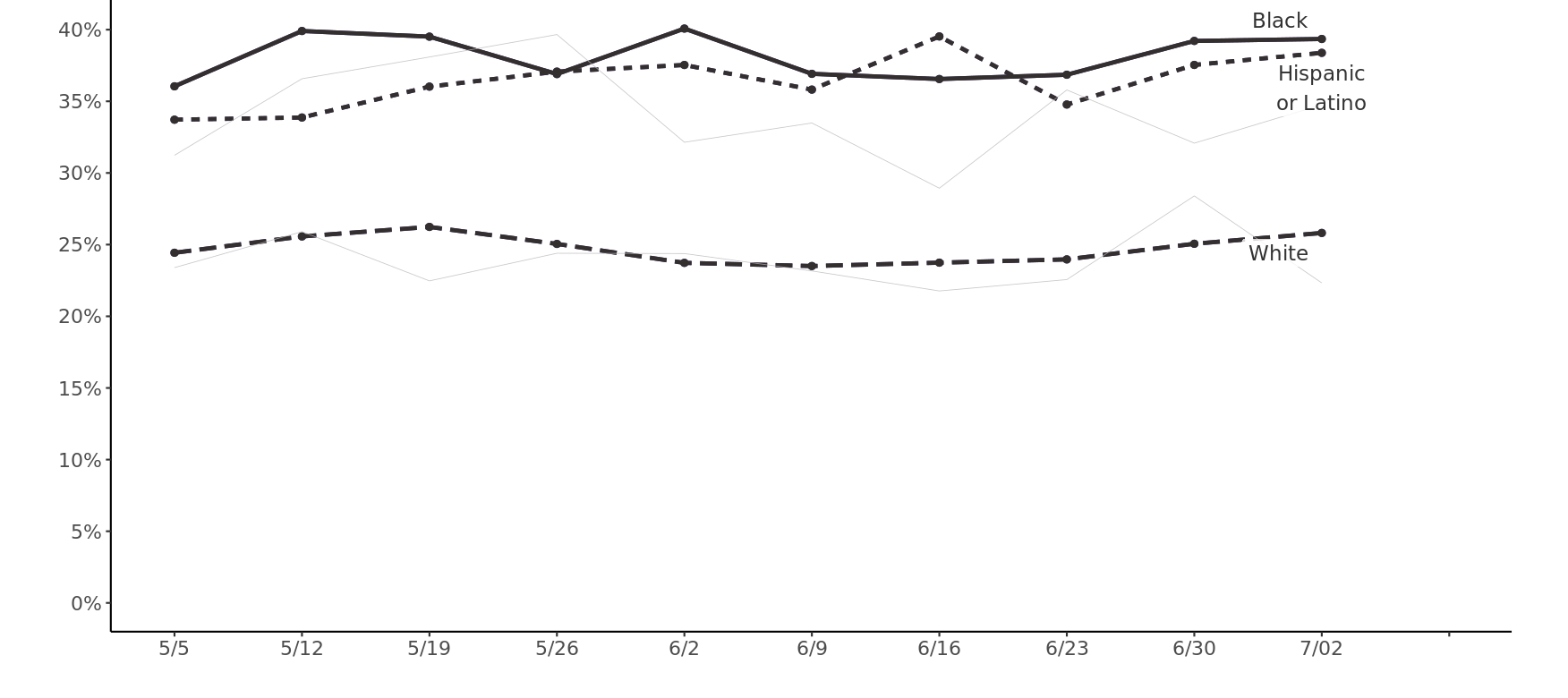
One long-term consequence of insufficient access to UI payments is an increase in food insecurity. The number of families experiencing food insecurity—defined as “the disruption of food intake or eating patterns because of lack of money and other resources”—has soared since the beginning of the COVID-19 pandemic—and there are clear racial disparities when it comes to which families are more likely to lack adequate access to food. According to the COVID-19 Pulse Survey, administered by the Census, food insecurity is almost 50 percent higher for Black families compared to white families, and rates of food insecurity among Latinx families are almost as high as among Black families. For example, in the first week of July, 24 percent of white families said they didn’t have enough to eat, while 38 percent of Black families and 36 percent of Latinx families experienced food insecurity.
Food Insecurity by Race, Households with Children
Hunger and food security does not exist in a vacuum. Lack of access to basic necessities is a result of interrelated disadvantages that marginalize certain communities. The economic fallout of the pandemic is exacerbating existing inequalities, and the following factors have led to a drastic increase in food insecurity among Black and Latinx families. Other factors leading to higher rates of food insecurity among families of color include neighborhood inequality, wealth gaps, and the rising cost of food—which have skyrocketed during the pandemic. Egg prices have increased 16 percent and, overall, food prices have increased by 4 percent, the largest month-over-month increase since 1974.
Wealth Gaps Lead to Racial Differences in Available Resources
Wendy, who owns a party supply shop in Queens, New York, applied for food stamps when she was forced to close her business. When she first applied, she was only offered $16/month. The department went by the amount she earned last year. But "they shouldn’t have looked at what I made last year," she said during her July interview. "If I don’t have anything in the bank now, what does it matter?” Black and Latinx workers had less of a financial cushion to fall back upon when they lost their jobs: like Wendy, not many had money in the bank.
Black households have less than seven cents for every dollar held by white households. In 2016, the median white family (or average middle-class family) held $149,703 in wealth, compared to $13,024 for the median Black family. According to a survey fielded by Pew Research in April, 73 percent of Black adults and 70 percent of Latinx adults said they did not have enough emergency funds to last three months, while only 47 percent of white adults said the same. This means that white families are more likely to have a financial cushion. For Black and Latinx families, however, there’s a greater chance there is less wealth to tap into, and families go hungry.
Neighborhood Inequality Makes it Harder to Access Affordable Food
Neighborhood inequality is an important driver of racial disparities across a range of outcomes. Low wage workers and people of color are more likely to live in food deserts, or areas in which there is limited access to supermarkets and healthy food items. For example, in Birmingham, Alabama, 88,000 residents live in food deserts, and the vast majority are Black or Latinx.
Black and Latinx families are also less likely to have access to a car than white families. While only 6.5 percent of white families did not have a car, 12 percent of Latinx families and 19.7 percent of Black families lacked access to a vehicle. This makes it even harder for families to seek out new food options. Living in a community with little access to fresh groceries either means an individual has to expend time and resources to go to another neighborhood to get food, or that they must make do with corner stores, which tend to be more expensive and have less options. The end result: Black and Latinx families, as compared to white families, pay more for food that is often lower quality, or spend more time than white families accessing other options. Particularly during the pandemic, when public transit may be unsafe or inaccessible, this is a significant hurdle.
Increasing Food Security for Black and Latinx families
Baron, a single father of two, applied for UI and for the Supplemental Nutrition Assistance Program (SNAP). He explained, “I will tell you what—the food stamps. That’s been my lifesaver," he said. "I would definitely be in a worse place than I am now if it had not been for food stamps. I got the maximum amount.” SNAP has important long-term benefits for families. However, not enough families receive SNAP, and the benefit levels are too low. Benefits often run out by the end of the month, with the majority of SNAP recipients spending 80 percent of their benefits in the first two weeks. Increasing benefit levels is essential to ensuring that families have enough food to last the whole month.
Improving the application process for SNAP is also crucial to meeting the needs of recipients. Baron said that “if unemployment was handled like food stamps were handled no one would be complaining. Let’s say—I applied for food stamps on a Monday and had it by Friday. Everything was done quickly and very smoothly.” However, SNAP is administered differently in every state and in some cases is administered by the county. This means that the experience varies tremendously. Ensuring that all applications are processed as smoothly as Baron’s would make sure fewer people go hungry.
Furthermore, while states were given the option to increase benefit levels for families who were receiving SNAP but not receiving the maximum, they could not increase the overall maximum state-allowed allotment. This meant that families who were most in need before the pandemic and receiving the maximum allotment of SNAP benefits saw no increase in their benefits. Congress should increase the allotment by shifting from the “thrifty” meal plan to the “low cost” meal plan, which would increase benefit levels.
Finally, the federal government should consider adding a community eligibility component to SNAP. The National School Lunch Program already contains a community eligibility component, where every student in a high-poverty school receives free and reduced-priced lunch. Creating a similar provision in SNAP for communities that are particularly hard-hit by the economic fall-out of the pandemic would ensure no one goes hungry, prioritizing access and reducing administrative burdens for the remainder of the pandemic.

Unpacking Inequities in Unemployment Insurance
- Introduction
- “Not Designed for Us”: Navigating a System that Never Intended to Serve You
- A Focus on Fraud Over Accessibility: The Punitive Design of UI
- “People Don’t Want to Work” and Other Myths about UI
- Southern Generosity Isn’t Extended to all Southerners
- The Digital Divide and UI Modernization: States’ Moves to Online Applications Worsen Accessibility
- Last Hired, First Fired: Black, Latinx Workers and the Fight for Jobs
- The Power of Employers
- Unemployment Insurance Isn’t Enough to Keep the Family Fed
- Learning from Past Economic Recessions
- Where Do Workers Turn When the Government Fails Them? To the Community.