A Chapter of: Unpacking Inequities in Unemployment Insurance
A Focus on Fraud Over Accessibility: The Punitive Design of UI
What is a state's primary mandate when it comes to UI: To administer the prompt delivery of unemployment benefits to eligible applicants or is it to focus on identifying potential fraud and minimizing payouts?
How UI administrators perceive their mandate—either allowing workers’ access to the benefits they’ve earned or keeping people out—drives the design of the overall program. As it stands now (more than ten years since the Great Recession, when many state programs were depleted), UI is over-calibrated to try to catch people committing fraud. This fraud-centric design comes at the expense of the most marginalized members of the workforce—workers of color, low-income workers, and women. That harm comes during their most vulnerable time—an unexpected job loss and being left to navigate a system that’s programmed to make them feel like they’re doing something wrong, even when they aren’t.
Following the last recession, states passed restrictive measures to replenish their trust funds and modernize computer systems. State UI programs were depleted to the point where they had to borrow from the federal government to pay benefits. Legislators had the option to boost taxes on businesses to maintain the program or slash benefits for workers amid persistent, high unemployment. Under the pressure of business interests, many states chose the latter to shore up trust funds, resulting in significant reductions in benefit amounts and duration and the tightening of eligibility requirements — some even implemented required skills tests before an application could be started. Some states narrowed the scope on what a qualifying event was for separation, increased the earnings amount a worker would need to qualify, or reduced the mechanisms available for applying, such as only being able to submit an application online. These all serve as impediments to applying, in place to add to the barriers one must overcome before accessing UI. Due to the pandemic, many of these requirements have been waived; still, they need to be reviewed as part of long term improvements to UI.
Across the board, workers have suffered under these new measures, as the nationwide average of those receiving benefits has fallen from 36 percent before the Great Recession to 27 percent. An analysis by Nyanya Browne and William Spriggs of Howard University found that, “just 13 percent of Black people out of work from April to June received unemployment benefits, compared with 24 percent of white workers, 22 percent of Hispanic workers and 18 percent of workers of other races.”
As recipiency rates have decreased, the number of benefits that were improperly denied (or should’ve been approved) have increased. The improper denial rate for separation reasons reached just over 17 percent in 2017, compared with 8 percent in 2007, and the improper denial rate for non-separation reasons was at 17.5 percent, compared with 9.9 percent.
“Part of this increase in erroneous denial has to do with the fact that systems have been over-calibrated to prevent overpayments at the expense of paying appropriate benefits,” said Michele Evermore, senior researcher and political analyst at NELP, in testimony before the U.S. Senate Finance Committee.
“Overconcentration on suspicion of fraud, especially when not coupled with a corresponding focus on employer fraud, worker misclassification, and UI system errors and failures, can wreak havoc on UI programs.”
Take Michigan, for example: The state’s Unemployment Insurance Agency (UIA) owed the federal government nearly $4 billion by late 2010. At the same time, the state's auditor general flagged that UIA possibly failed to properly resolve millions of dollars in overpayments and fraud penalties during the last recession. State legislators decided they needed to improve efficiency and upgrade the UIA system; so the state contracted private tech vendors to develop the Michigan Integrated Data Automated System, or MiDAS, to determine unemployment eligibility and track case files. In the end, MiDAS flagged nearly 40,000 workers for fraud, in which a staggering 93 percent of those were inaccurate, according to NELP. What’s worse, the penalty for fraud in Michigan is four times the amount paid, plus 12 percent interest; and many of those affected by these measures lost everything. Detroit Attorney Jonathan Marko, who represented Michigan residents in bringing a claim against the state, said: "Some of these people committed suicide. Some lost their homes. Some had to declare bankruptcy."
UIA Director Steve Gray said in an interview with the New York Times that UIA was “built to assume that you’re guilty and make you prove that you’re innocent.” Governor Gretchen Whitmer has moved to shift the state's focus from catching fraud to speeding up payment processing. During the pandemic, this shift has been necessary and a relief.
Gov. Ron DeSantis (R-Fla.) admitted in an interview with WFOR in Miami that the state’s unemployment insurance system is structured to not pay out claims. The state’s Republican leadership has also acknowledged in interviews with Politco and other news outlets that they’ve left the system underfunded for over a decade on purpose, opting for cuts in benefits for the unemployed rather than raising tax obligations for businesses. Again, this meant that—rather than receiving 26 weeks of insurance payments—Floridians receive only 12 weeks, while having plenty of hoops to jump through to even get that.
How the Federal Government Incentivizes this Behavior
The Department of Labor (DOL) raised the stakes for states to maintain accuracy in UI payments in April 2019, when it announced a series of incentives for states to reduce what the department deemed to be “a high level of improper payments” in unemployment benefits. The department created two new awards to recognize states in their efforts to crack down on “improper payments,” including the "Program Integrity Excellence Award" which acknowledges states demonstrating excellence in minimizing their UI improper payment rates.
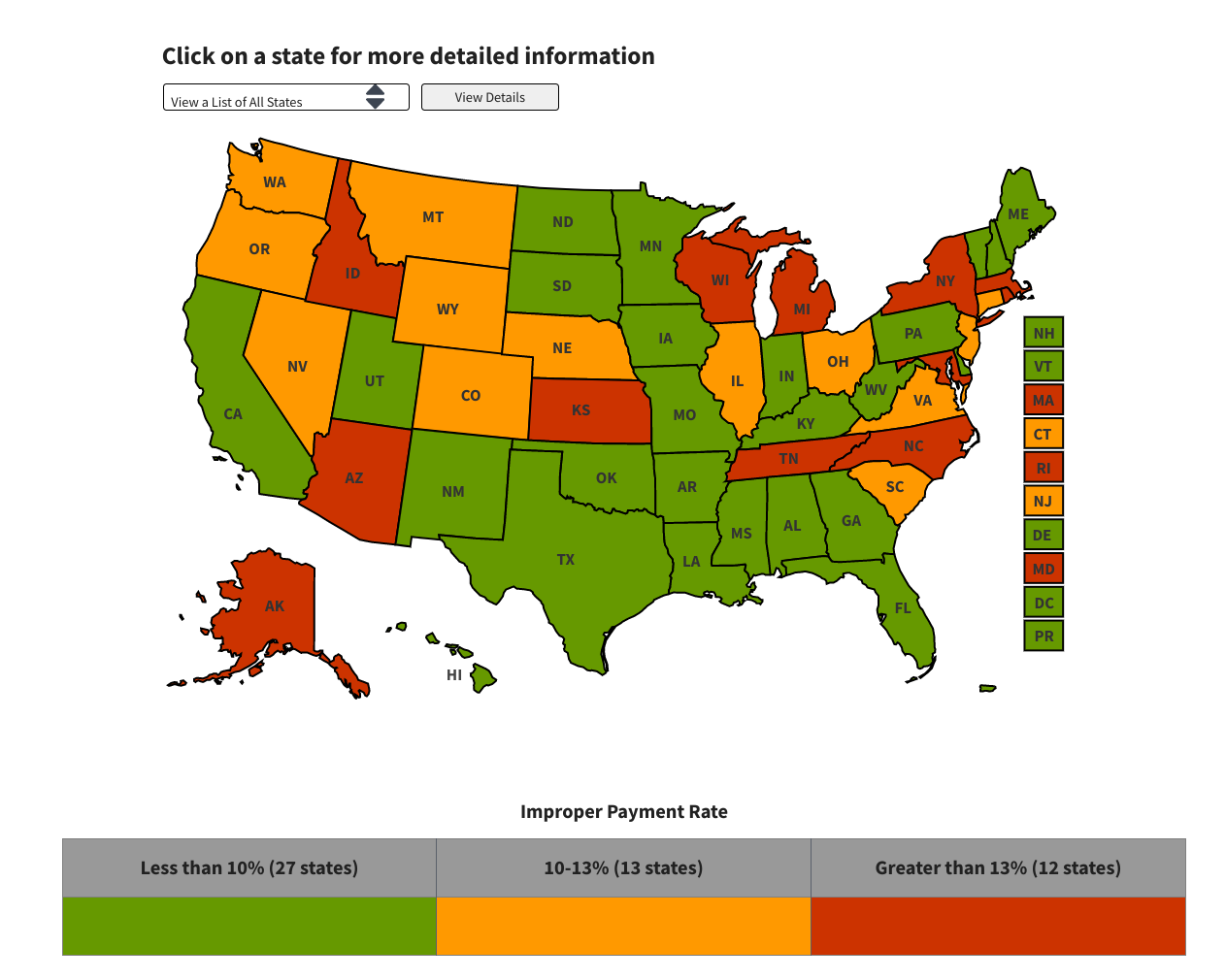
DOL also developed an accuracy map to monitor and define how state unemployment insurance programs were performing in maintaining a low rate of fraudulent payments. Note that the accuracy map only tracks overpayments and fraudulent payments issued to applicants, demonstrating the punitive approach that shapes how UI is distributed to applicants across the nation. By focusing on overpayments, the department is not held accountable for determining other errors created by the state, or even an employer, when it comes to UI payments—such as underpayments—which are also payment inaccuracies. The map also doesn’t reflect cases in which eligible UI applicants are erroneously denied benefits. Rather than considering the many ways in which state unemployment insurance systems fail and make errors, or considering the ways in which workers might make mistakes while maneuvering through a confusing application process, the accuracy map highlights how the federal government is complicit in this punitive approach that assumes overpayments are the core issue.
Fraud Detection Should Not Come at the Expense of Workers
The punitive design has left an emotional scar on workers. There’s a high emotional, and financial, burden that comes with being wrongly accused of fraud. Some workers have had such bad experiences with unemployment insurance that they’ve decided never to rely on it, even if it means that they don’t know where they will go to find necessary support.
Take Inez and her husband Mique, Chicago residents, for example. The couple didn’t pursue applying for unemployment insurance due to a past traumatic experience three years ago when they were denied benefits. At that time, they were expecting their second child, and Inez told our research team that her husband wanted to support her not only financially, but also emotionally, since she was near term.
After completing his workday, Mique’s employer asked if he wanted to take an extra shift. Inez’s husband declined so that he could return home and be there for her. The next day, his employer told him that he didn’t need to return for his shift, with no additional explanation. According to Inez, Mique was never told that he had been fired, which would’ve made him ineligible for UI.
But not knowing when his next shift would be and only that he’d been asked not to return, Inez’s husband applied for unemployment insurance coverage through the Illinois Department of Employment Security (IDES). He was approved. However, after several weeks of receiving his weekly payments totaling $700, he received notification that his employer contested his application, claiming that he’d been fired and denied suitable work. The couple saw it as unfair, saying that he hadn’t been informed about his employment status by his employer; and if he knew that, he wouldn’t have applied for UI.
IDES accused Mique of fraud and sent him a letter claiming that he would be automatically investigated if he applied ever again, “whether his claim was legitimate or not,” Inez said. The entire experience was so stressful that, when Mique contracted COVID-19 and lost work, he still chose not to apply.
While we certainly empathize with state employees responsible for reviewing applications, especially as their workload has increased drastically due to COVID-19, states’ focus on fraud often comes at the expense of already vulnerable workers and creates incentives that are misaligned with the ultimate goal of getting benefits to eligible workers.
Speaking on the condition of anonymity, two contractors told us about poorly designed processes and fraud detection in the state they are working with that led to applicants being denied due to human bias and not as the result of legitimate fraud.
One contractor told us that nobody has “a definition of ‘fraud,’ or any clear cut process or guidelines to follow” and that workers believe they will be personally punished if any claim they work on is later found to be fraudulent. So they are highly incentivized to flag applications for fraud, both to make sure they’re covered and to quickly move work items out of their queue.
The contractor also said they were confident that, “whatever identity theft or fraud does exist, it's in the applications that go through automatically. Filing a ‘clean’ claim is not really that hard. I cannot believe that any fraudster is spending hours waiting on hold every day, week after week, struggling to clear their ‘work items’ in pursuit of a $200 payout.”
The contractors we spoke with also shared a few examples of what might cause an application to be flagged for fraud, including that “too many people living at one address will cause workers to reject a whole batch for fraud.” They added that there wasn’t any definition of “too many,” and that it’s just “what feels wrong to them.”
At a time when millions of people have lost their jobs, are struggling to make ends meet, and may decide to move in with extended family members or close friends (and some of our interviewees did), it makes complete sense that you might have more than one or two eligible applicants or workers living at the same address.
The contractor also noted that getting flagged for “identity verification is where many of the worst problems happen, because if you even get to this office, you’re assumed to be a fraudster until you can prove you’re not.” Examples of what might lead an application to the identity verification queue included:
- “A first or last name that is "too long" can get truncated in any of the dozen government computers. At that point, it will fail automatic name matching and you go into the manual process where few claims ever come out alive.”
- “Alternate ‘Anglicized’ first names are common in some ethnic groups—a real observed example is birth certificate says Graciela, driver's license says Grace. This will fail the automatic match, and the human reviewer will usually reject it too.”
- Similarly, there were many examples of Vietnamese names not "matching" official records because of spaces between names, nicknames, and/or inconsistency of which portions of the name were shoehorned into first-middle-last name fields.
One contractor ended by telling us that for many of the state’s fraud signs, “it makes even less sense for a fraudster to do it, but [they] never even consider that question.”
The other told us, unsurprisingly, some employees flag “international sounding names,” adding:
“There’s no automated fraud detection here; claimants are reviewed manually by humans on the hunt for any sign of fraud. When you hire people and tell them their job is to find fraud, they’re going to find fraud where none exists. We’ve just trained racism into the system.”
Government system’s do a poor job of handling names that don’t follow the traditional American convention of “First, Middle, Last” or that include characters outside of the English alphabet, leading names to be misprinted on social security cards or the same name appearing differently on a credit card and a school ID. What’s worse, they build algorithms on top of faulty processes and biases that perpetuate inequities and lead to negative and deeply unjust—if not dangerous—outcomes for people of color.
The many wrong assumptions we make about names have been covered extensively by engineers and sociologists alike. Still, states implement fraud detection systems meant to catch “criminal cartels and fraud rings” which, by the way, are most likely using very common, "American-sounding" names.
Short of any legitimate attempts to identify fraud, which probably begins with closely monitoring fraud and looking for patterns in fraudulent applications, the government should make it their explicit goal to optimize for letting people in, not keeping them out. Otherwise, as one contractor put it, they’re “just spending more money on trying to catch fraud than they would in paying out claims,” and doing a lot of harm along the way.
In many ways, our current UI system is not unlike the criminal justice system, where research shows communities of color are consistently profiled and criminalized based on racial biases. This shouldn’t come as a surprise, since the unemployment system exists against the backdrop of a country reeling from centuries of racial inequity, and the system was designed to exclude a large segment of Black and Latinx workers from the start. The stereotypes about the most marginalized workers seeking financial support during crises are rooted in painful and inaccurate beliefs: that they are trying to game the system. The persistent belief that workers seeking unemployment benefits, especially those who are low-wage workers and workers of color, are lazy, refuse to work, or are trying to exploit the system allows policymakers and program administrators to make decisions such as cutting benefits, making it more difficult to apply, and investing in fraud detection systems that keep more people out than they let in. And while these decisions harm all workers, they disproportionately punish workers of color by discouraging them from applying at all, or inaccurately flagging them for fraud or abuse.
Whether automated or manual, racism and bias must be rooted out of all processes—especially when they are being used to determine someone’s ability to receive critical benefits. Low-income workers and workers of color have to navigate a system that, not only was not designed for them, but is also designed to penalize them. Instead of focusing on creating fraud where it doesn’t exist, a state’s mission should be to make systems easy-to-use for eligible applicants and to identify fraud within a greater context of accessibility. This includes improving the user experience, using plain language, reducing access barriers for workers with disabilities, language, or literacy limitations, and prioritizing the needs of applicants—especially during this critical time.

Unpacking Inequities in Unemployment Insurance
- Introduction
- “Not Designed for Us”: Navigating a System that Never Intended to Serve You
- A Focus on Fraud Over Accessibility: The Punitive Design of UI
- “People Don’t Want to Work” and Other Myths about UI
- Southern Generosity Isn’t Extended to all Southerners
- The Digital Divide and UI Modernization: States’ Moves to Online Applications Worsen Accessibility
- Last Hired, First Fired: Black, Latinx Workers and the Fight for Jobs
- The Power of Employers
- Unemployment Insurance Isn’t Enough to Keep the Family Fed
- Learning from Past Economic Recessions
- Where Do Workers Turn When the Government Fails Them? To the Community.