A Chapter of: “This War is Out of Our Hands”
Introduction
One snowy morning in February 2020, in the small Russian hamlet of Akbulak, near the Kazakh border, a line of funeral mourners filed into a movie theater to bid farewell to one of the village’s sons. The body of the deceased, a 27-year-old man named Gleb Mostov, had rested in a casket all through the night in the modest house of his father. Bereaved for his son, the father politely turned away reporters. “Sorry, guys,” he told them, “I’m dealing with my grief here.”
Far less polite, however, were the plainclothes Russian security officers and soldiers who’d cordoned off the theater and prohibited the press from entering. The circumstances of Mostov’s death had remained a mystery until his parents disclosed the truth to a local newspaper: he’d been an officer in the Russian army, a trained sniper, who’d been killed on the battlefield in faraway Libya.1 For some of the mourners, the news hardly came as a shock. “First, Afghanistan, then Chechnya, Ukraine, and now Syria and Libya. Why are you surprised?” a woman asked her husband as they entered the cinema.
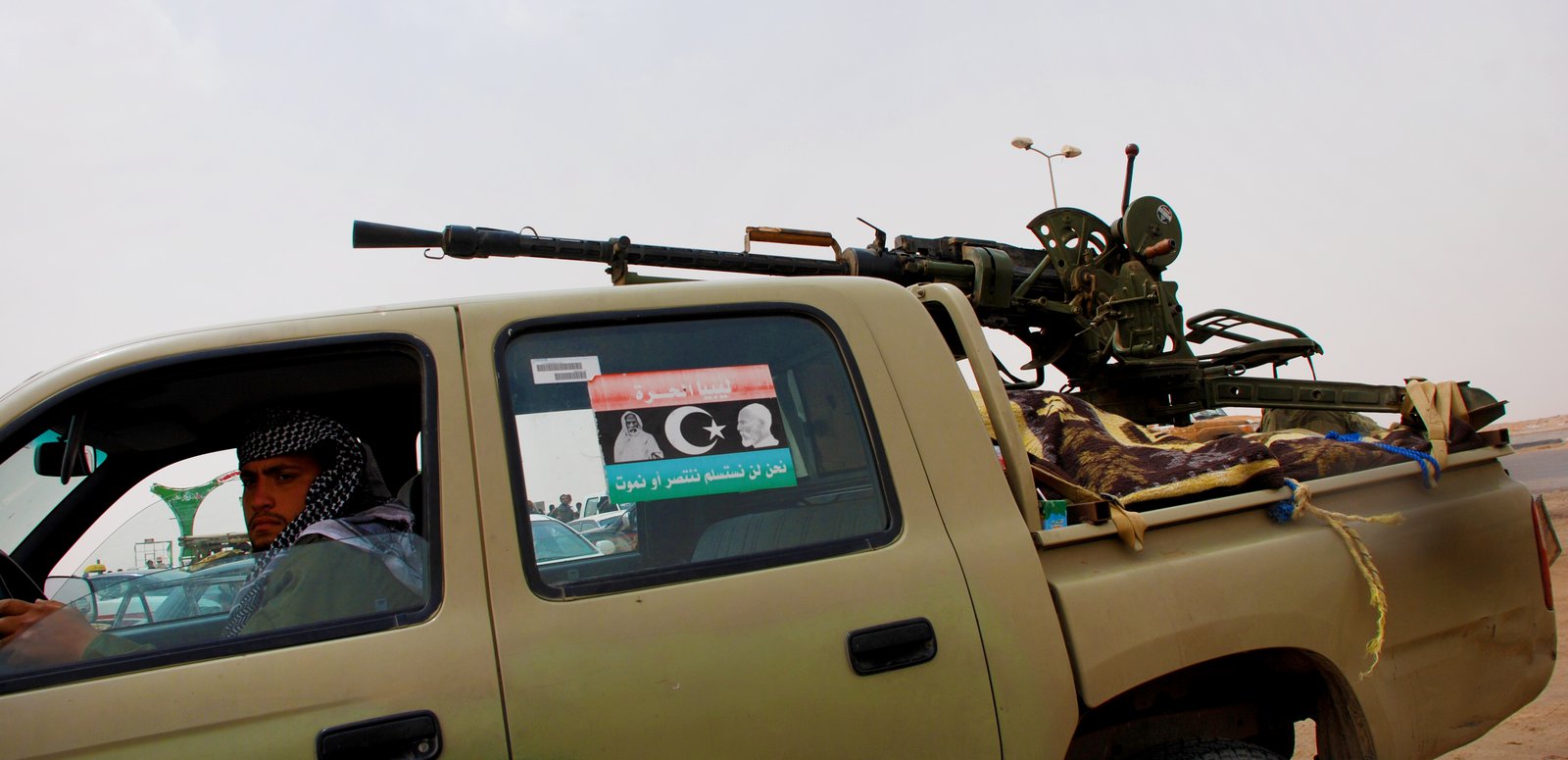
We don’t know exactly how or where Gleb Mostov died in Libya, though it was likely on the frontlines just a short drive south of the capital of Tripoli. There, from the fall of 2019 until early 2020, roughly a thousand Russian paramilitary fighters from the so-called Wagner Group and some regular personnel fought alongside Libyan rebels led by a septuagenarian warlord named Khalifa Haftar in an effort to topple the internationally recognized government in Tripoli. This government, the Government of National Accord or GNA, has itself relied on foreigners to bolster its ranks, most recently in the form of thousands of militia fighters from Syria, including veterans of the years-long war against Syrian president Bashar al-Assad.2 Added to the mix are Sudanese and Chadian gunmen, fighting mostly on Haftar’s side, as well as pro-Assad Syrian fighters.
Foreign belligerents in Libya are not only on the ground. High above the mercenaries, fleets of cheap but lethal drones and foreign fixed wing aircraft have filled Libya’s skies, piloted by personnel from the United Arab Emirates (backing Haftar) and Turkey (backing the Tripoli government), as well as Russian aviators and mercenary pilots from other countries.3 In total, there are at least 10 foreign states that are militarily contributing to the current Libyan conflict.4
For many Libyans, the presence of these foreign combatants outside the capital and across the country have come as a shock. They are the most visible confirmation that the struggle for Libya’s future is being dictated not by Libyans, but by powerful outside states. “This war is out of our hands,” a Libyan aid worker lamented to the author in January 2020.5 A sense of weary resignation accompanies this observation. After all, Libyans point out, predatory colonial powers in the last century jostled for influence over the territory that comprises the modern state of Libya—and this current conflict is also hardly the first time foreigners have used Libyan soil and Libya proxies to wage war on one another.6
The story of how the post-2011 Libyan civil war reached this state of internationalization contains multiple chapters. First and foremost, the political and social fissures catalyzed by the country’s 2011 revolution saw outside powers, some of them geopolitical rivals, lend military support to locally-based armed groups and factions. Many of these forces were deeply suspicious of one another but united to topple dictator Muammar Qadhafi.7 These fissures and competing narratives about the revolution contributed to Libyan elites’ failure to build inclusive political institutions and formal security organizations after Qadhafi’s death.8
The eruption of armed civil war in the summer of 2014, first in Benghazi and then in Tripoli, saw the foreign struggle for Libya move to a new level of militarization and violence, with a significant uptick in weapons shipments to two loosely-constituted factions. The first was the eastern-based “Operation Dignity” faction, led by General Haftar and backed by the Emirates, Egypt, Jordan, Saudi Arabia, and France. Opposing this camp was the Libya Dawn coalition based in western Libya and its militia allies in Benghazi, which was backed by Turkey, Qatar, and Sudan. An array of locally based conflicts and rivalries permeated this conflict, presenting foreign actors further openings to exploit.
Though outside forces intervened directly with airstrikes and some limited raids by special operations forces, Libyans still waged the actual combat. Foreigners intervened according to the traditional definition of a proxy or surrogate war: funneling materiel, intelligence, training, and media support to Libyan military and political actors—many of them highly localized and acting through networks of foreign-based Libyan intermediaries.9 The underlying driver for outside intervention during this phase was ideological—a struggle over Islamists’ place in Libya’s political order, though it also centered on control of economic resources and how much of the old Qadhafi-led order to preserve.10
In April 2019, with the attack of Haftar’s forces on the outskirts of the Libyan capital, the mask of Libyan ownership of the conflict fell away. Though they continued to work through Libyan armed proxies and intermediaries, foreign states committed more of their own combat forces on the ground and in the air. By the end of the year, Tripoli and the western region were flooded with thousands of foreign fighters from Eurasia, Africa, and the Middle East and hundreds of sorties by foreign-piloted drones and fixed-wing aircraft, whose strikes incurred mounting civilian deaths. This phase also saw growth in the sophistication of the information war, led by foreign states in conjunction with Libyan actors or on their behalf.11 The ideological component, while still a motive for the Emiratis and Haftar’s other backers, was accompanied by a fiercer geopolitical power struggle overlaid with a contest for economic spoils.
At the broadest level, Libya’s post-2011 civil wars have been facilitated by a breakdown in global multilateral norms, the diminished authority of the United Nations, American ambivalence and retrenchment, European discord and deadlock, and Russian opportunism. The mounting disorder has been on display most starkly in the UN Security Council’s repeated failures to enact a meaningful ceasefire resolution and foreign states’ continuing contempt for a longstanding UN arms embargo on Libya, with key members on the council working in opposition to the UN Secretary General’s representative in Libya.12 All of this stands in marked contrast to the relative diplomatic unanimity that defined the international response to the 2011 revolution.
Post-Arab Spring strategic rivalries compounded these trends in Libya. Though much attention—especially in the United States—has been focused on Moscow’s designs in Libya, the role of two Middle Eastern powers, the United Arab Emirates and Turkey, has arguably been more consequential for the fate of the country. Abu Dhabi’s policies have been especially decisive at numerous junctures, reflecting a trend of Emirati military adventurism and economic expansion in the region, fueled in part by a “zero tolerance” approach to Islamists and political pluralism more broadly.13 Turkey’s intervention in Libya, in turn, is also part of a bigger push for leadership in the Mediterranean by Turkish President Recep Tayyip Erdoğan that has deeper domestic, ideological, and economic roots.14
Both countries’ hegemonic aspirations have been enabled partly by the vacuum of American leadership in Libya and also a degree of backing and acquiescence from Washington, given these states’ longstanding roles as U.S. partners in the Middle East. Beyond this, Libya’s geographic position on the margins of America’s core security and economic concerns in the Middle East means that Washington has been unwilling to invest significant resources, either in Libya directly or in dissuading its regional allies from meddling. This diplomatic absence, along with mixed signals on Libya and a markedly pro-Emirati stance under the Trump administration, has fueled the conflict. It has also contributed to European paralysis and invited Russia’s opportunistic intervention.
Despite the active role of foreign actors, Libyans themselves have been essential in internationalizing the conflict. Bereft of institutions, Libya’s fragmented landscape has been dominated by Libyan elites, many of whom solicited foreign patronage to bolster their position against rivals. One outcome of this personalized transnational activism has been the erosion of Libyan sovereignty—a recurring facet of Libya’s modern history that has precedent in Libyan elites’ collaboration with the Ottomans, Italians, French and British.15 In the post-2011 period, this personalization of the foreign proxy war has been exacerbated by Libya’s fragmentation but also Libyans residing overseas in Doha, Istanbul, Abu Dhabi, Amman, and other foreign metropolises. Acting as power brokers and fixers for the flows of arms, money, and media support, these individuals complicated the principal-agent dynamic by inserting a layer of arbitration that introduced the possibility of miscalculation, errors, or outright defections. This high-risk, multi-level chain of command, combined with the multiplicity of Libyan and outside actors more broadly, has protracted Libya’s chaos.
Added to this, Libya’s hydrocarbon resources have long been a magnet for international involvement and predation.16 In the wake of the Arab Spring, control over this wealth became a prize between competing Libyan factions, disincentivizing the forging of durable truces and also enabling local actors to solicit outside aid with promises of contracts and payments. Relatedly, Libyan political elites and armed group leaders have parked oil-derived wealth in European and Middle Eastern banks and real estate, often cementing foreign partisanship, but also handing a degree of leverage to foreign actors in the form of asset freezes and sanctions. 17 The economic incentives wielded by local Libyan proxies, though not uniform across the country, differentiate Libya’s war from the Middle East’s other proxy conflicts, like Lebanon and Syria, where foreign states provide funding to local allies. Commenting on the differences with Lebanon, the former UN envoy to Libya Ghassan Salamé controversially asserted, "the truth is that Libya can pay for its own suicide."18 Yet the inability of a single Libyan faction to achieve territorial or political dominance and—especially in the case of eastern Libya—international norms against the illicit export of oil have meant that local Libyan actors have often failed to meet the economic expectations of their outside patrons.19
Seasoned observers of Libya have argued that Libya’s civil war, especially its post-2019 phase, embodies the intersection of several military and technological trends with potentially far-reaching consequences.20 The nature of these shifts, combined with the multipolarity mentioned above, has given foreign competition in Libya a distinctive character marked by opacity, lethality, and toxicity. The widespread deployment of armed drones, which mitigates personnel risks to interveners and affords a degree of clandestinity, is the result of the proliferation of these weapons across the Middle East from foreign suppliers, namely China, and indigenous manufacturing advances, in the case of Turkey. Airstrikes in Libya from these craft, and also fixed-wing airplanes, have been insulated from serious scrutiny because of the aforementioned international disorder and scorning of embargo norms, but more importantly Western diplomatic protection of the most egregious of the violators, the United Arab Emirates.
In addition, all sides in Libya’s war have relied upon foreign contract fighters, mercenaries and—in the case of Russian and even Turkish involvement—“semi-state” auxiliaries.21 This is reflective of a broader, global trend of privatizing and outsourcing expeditionary military force, driven in part by the lucrative rise of private military companies and availability of recyclable, pay-for-hire fighters from poorer, conflict-wracked states in Africa and the Middle East.22 While generally exhibiting low combat proficiency, the impact of these foreign ground and air forces on battlefield developments in Libya has arguably been more decisive than that of foreign combatants in the Middle East’s other proxy wars, in Syria and Yemen.23
On top of these military developments, Libya has seen an increasingly sophisticated informational battle for public opinion, waged by foreign states through traditional and social media channels, foreign lobby firms, and co-opted journalists, in which foreign influence is often difficult to discern. This disinformation war is another means for outside actors to shape the Libyan conflict with minimal blowback or penalties.24
The rest of this report is divided into four sections, examining the Libyan war chronologically to recount its history and draw out the above themes. The first addresses how foreign intervention and rivalries played out during the 2011 revolution and the post-revolutionary period until 2014. The second section addresses the proxy war in the context of the Dignity versus Dawn civil war and its aftermath until 2019, and the third section examines the battle for Tripoli and the post-2019 phase, characterized by increasingly direct intervention by foreign powers. The fourth and concluding section offers scenarios for the future of international involvement in Libya and provides lessons from Libya’s experience of proxy warfare.
Citations
- This account of the funeral of the Russian officer Gleb Mostov is taken from Ilya Barabanov and Pavel Aksenov, “The Circumstances of the Death are ‘Not Our Rusiness.’ An Officer Who Died in Libya was Buried near Orenburg,” (in Russian) BBC Russia, February 14, 2020, https://www.bbc.com/russian/features-51501122. The author is grateful to Carnegie colleague Andrew Weiss for assistance in translation.
- Frederic Wehrey, “Among the Syrian Militiamen of Turkey’s Libya Intervention,” The New York Review of Books, January 23, 2020, https://www.nybooks.com/daily/2020/01/23/among-the-syrian-militiamen-of-turkeys-intervention-in-libya/
- Melissa Salyk-Virk, “Airstrikes, Proxy Warfare, and Civilian Casualties in Libya,” New America, June 2020, https://www.newamerica.org/international-security/reports/airstrikes-proxy-warfare-and-civilian-casualties-libya/
- Oliver Imhof, “Libya: A Year of Living Dangerously,” Airwars, April 6, 2020, https://airwars.org/news-and-investigations/
- Author interview with a Libyan aid worker, Misrata, Libya, January 2020.
- One of the most oft-cited examples is the Italo-Ottoman War, 1911-12. For a correspondent’s firsthand account, originally published in 1913, see Francis McCullagh, Italy's War for a Desert: Being Some Experiences of a War-Correspondent With the Italians in Tripoli (London: Forgotten Books, 2018).
- See Peter Cole and Brian McQuinn, eds., The Libyan Revolution and Its Aftermath (London: Hurst, 2013). For a useful review of this book and others on the 2011 revolution, see Lisa Anderson, “A Pool of Water: Reflections on the Libyan Revolution,” Lamma: A Journal of Libyan Studies, Issue 1, 2020, https://punctumbooks.com/titles/lamma-a-journal-of-libyan-studies-1/
- For the post-2011 period, see Frederic Wehrey, The Burning Shores: Inside the Battle for the New Libya (New York: Farrar, Straus & Giroux, 2018).; Jacob Mundy, Libya (Hot Spots in Global Politics), (Cambridge: Polity Press, 2019); Wolfram Lacher, Libya’s Fragmentation: Structure and Process in Violent Conflict (London: I.B. Tauris, 2020); Ulf Laessing, Understanding Libya After Gaddafi (London: Hurst, 2020).
- Frederic Wehrey, “Is Libya a Proxy War?,” The Washington Post, October 24, 2014, https://www.washingtonpost.com/news/monkey-cage/wp/2014/10/24/is-libya-a-proxy-war/.
- Irene Constantini, “Conflict Dynamics in Post-2011 Libya: A Political Economy Perspective,” Conflict, Security & Development 16, no. 5 (2011): 405–422.; Jalel Harchaoui and Mohamed-Essaïd Lazib, Proxy War Dynamics in Libya (Blacksburg: VT Publishing, 2019), https://doi.org/10.21061/proxy-wars-harchaoui-lazib
- See Wolfram Lacher, “Drones, Deniability, and Disinformation: Warfare in Libya and the New International Disorder,” War on the Rocks, March 3, 2020, https://warontherocks.com/2020/03/drones-deniability-and-disinformation-warfare-in-libya-and-the-new-international-disorder/. Also, Matt Herbert, “Libya’s War Becomes a Tech Battleground,” Institute for Security Studies, October 8, 2019, https://issafrica.org/iss-today/libyas-war-becomes-a-tech-battleground
- For a compelling account of how Security Council members undermined efforts at a peaceful, political resolution of Libya’s conflict, see the June 30, 2020 podcast interview by Humanitarian Dialogue with UN special representative Ghassan Salamé: https://player.captivate.fm/episode/5165b6ba-897a-418a-9953-82107663b013
- For a discussion of the domestic drivers of this policy under the Crown Prince of Abu Dhabi (and effective ruler of the UAE) Muhammad bin Zayed, see Kristian Coates Ulrichsen, “Reflections on Mohammed bin Zayed’s Preferences Regarding UAE Foreign Policy,” Arab Center, Washington DC, July 24, 2020, http://arabcenterdc.org/policy_analyses/reflections-on-mohammed-bin-zayeds-preferences-regarding-uae-foreign-policy/. For a broader discussion of the Emirates’ regional activism, see Guido Steinberg, “Regional Power United Arab Emirates: Abu Dhabi Is No Longer Saudi Arabia’s Junior Partner,” SWP Research Paper, July 2020, https://www.swp-berlin.org/10.18449/2020RP10/. For a useful framework to assess the Emirates’ ideational fear of transnational Islamism reverberating at home, see Lawrence Rubin, Islam in the Balance: Ideational Threats in Arab Politics (Palo Alto: Stanford University Press, 2014).
- Michael Young, “The Lure of Regional Hegemony,” (Interview with Soli Özel) Diwan blog, Carnegie Endowment for International Peace, July 27, 2020, https://carnegie-mec.org/diwan/82349
- Lisa Anderson, “’They Defeated Us All’: International Interests, Local Politics, and Contested Sovereignty in Libya,” The Middle East Journal 71, no. 2 (Spring 2017).
- For economic resources as a draw for outside intervention, see Michael G. Findley and Josiah F. Marineau, “Lootable Resources and Third-Party Intervention into Civil Wars,” Conflict Management and Peace Science 32, no. 5 (November 2015), pp. 465–486, http://www.michael-findley.com/uploads/2/0/4/5/20455799/resources_civil-war-intervention_may2013.pdf, pp. 2
- Mark Furness and Bernhard Trautner, “Reconstituting Social Contracts in Conflict-Affected MENA Countries: Whither Iraq and Libya?,” World Development, Volume 135, November 2020, https://www.sciencedirect.com/science/article/pii/S0305750X20302114
- “Libya Committing Suicide, Squandering Oil Riches: UN envoy,” France 24, May 23, 2019, https://www.france24.com/en/20190523-libya-committing-suicide-squandering-oil-riches-un-envoy
- This is especially evident in Haftar’s inability to sell oil on the global market including to his patron the United Arab Emirates, despite repeated attempts, largely because of pressure from the United States. Benoit Faucon, Jared Malsin, and Summer Said, “U.A.E. Backed Militia Leader’s Bid to Take Control of Libyan Oil Exports,” The Wall Street Journal, July 13, 2018. https://www.wsj.com/articles/u-a-e-backed-militia-leaders-bid-to-take-control-of-libyan-oil-exports-1531474200
- See Lacher, “Drones, Deniability and Disinformation.” Also, Ishaan Tharoor, “Libya’s War Could be a Snapshot of the 21st Century’s New Normal,” The Washington Post, January 10, 2020, https://www.washingtonpost.com/world/2020/01/10/libyas-war-could-be-snapshot-21st-centurys-new-normal/. For the global dimensions of these trends see Andreas Krieg and Jean-Marc Rickli, Surrogate Warfare: The Transformation of War in the Twenty-First Century (Washington, DC: Georgetown University Press, 2019)
- Kimberly Marten has usefully coined the term “semi-state” to refer to Russia’s global deployment of Wagner Group fighters, arguing that the paramilitary group does not fit standard definition of private military companies. See Kimberly Marten, “Russia’s Use of Semi-State Security Forces: The Case of the Wagner Group,” Post-Soviet Affairs, 35:3, 2019, 181-204
- On the outsourcing and privatization of military force, see Sean McFate, The Modern Mercenary: Private Armies and What They Mean for World Order (New York: Oxford University Press, 2014). For historical antecedents, see Janice E. Thomson, Mercenaries, Pirates, and Sovereigns: State-Building and Extraterritorial Violence in Early Modern Europe (Princeton, NJ: Princeton University Press, 1996).
- Author e-mail exchange with a UN diplomat working on Libya, June 2020.
- For an overview in the 2019 phase, see Atlantic Council Digital Forensics Research Lab, “A Twitter Hashtag Campaign in Libya: How Jingoism Went Viral,” Medium, June 6, 2019, https://medium.com/dfrlab/a-twitter-hashtag-campaign-in-libya-part-1-how-jingoism-went-viral-43d3812e8d3f