A Chapter of: The Digital Government Mapping Project
Introduction
Madeleine Albright has observed that most countries are relying on institutions designed in the nineteenth century and technology from the twentieth century to solve the challenges of the twenty-first century. In the past, there were few options for pursuing system-level improvement in the operation of public institutions outside of political change. However, this dynamic is shifting thanks to the emergence of a new generation of digital tools that can transform the delivery of public value for hundreds of millions of individuals at a time. Developing modular, open source technology platforms that address core public sector challenges such as validating eligibility for public benefits, collecting taxes, and tracking revenue can provide profound improvements in public administration.
Not coincidentally, the governments that have delivered effective responses to the coronavirus pandemic—South Korea, Estonia, Taiwan, and New Zealand—all power their institutions with world-class digital platforms. COVID-19 has accelerated demand for next-generation technology solutions that have the potential to dramatically improve the provision of government services and help deliver greater resilience in the face of unprecedented challenges. Unfortunately, the vast majority of governments have neither the plans nor capacity to build their own high-quality digital infrastructure. The resulting gaps in digital services are undermining public health and economic welfare.
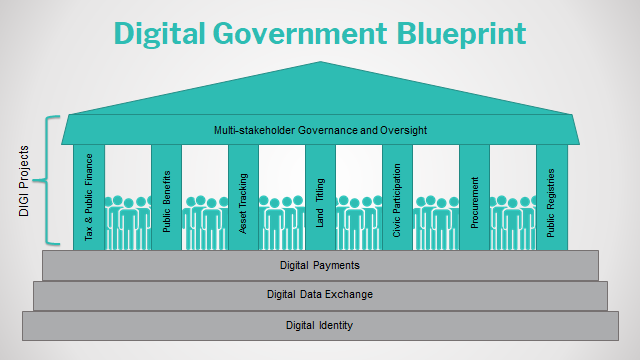
In May 2018, a group of leading experts from the public sector, private sector, and civil society convened at the Rockefeller Foundation’s Bellagio Center to define critical government functions that could be upgraded as part of a civic technology stack. These include foundational systems such as digital identity, data management, and payments along with an application layer for services including:
- Taxation and public finance
- Public benefits
- Asset tracking
- Land titling
- Civic participation and voting
- Procurement
- Public registries for vital records and commercial information
As the field has gained momentum since 2018, this conceptual framing has continued to guide our work and this mapping project.
The Digital Government Mapping Project is a compendium of leading platforms that policymakers, technologists, civil society leaders, and strategists can benchmark as they consider how to leverage digital solutions within their societies. The report also catalogues key insights from existing digital systems that governments should consider when constructing a civic stack.