
The Digital Government Mapping Project
Abstract
The use of modular, open source digital platforms can provide dramatic improvements in the efficiency and accountability of public institutions. Deployed together, digital government platforms can form integrated government operating systems with the potential to transform the relationship between citizens, the state, and society. A growing number of governments are deploying digital platforms to power their public institutions, but to date there has not been a comprehensive effort to map progress in this space. New America’s Digital Impact and Governance Initiative (DIGI) catalogued successes in this nascent field to illuminate how governments and other stakeholders are harnessing digital platforms to bring public institutions into the twenty-first century. The Digital Government Mapping Project is a compendium of leading platforms that policymakers, technologists, and strategists can evaluate and benchmark when building a strategy to digitize their societies.
Acknowledgments
We would like to extend a special thanks to our interviewees, whose deep perspective into the emerging world of digital government platforms oriented our research:
- Govind Shivkumar, Investments Principal, Omidyar Network
- Robert Opp, Chief Digital Officer, United Nations Development Programme
- Kevin O'Neil, Director of Data and Technology, The Rockefeller Foundation
- Lesly Goh, Senior Fellow, Digital Impact and Governance Initiative
We would especially like to thank the Rockefeller Foundation for supporting our work and serving as a thought leader on digital transformation.
Downloads
Introduction
Madeleine Albright has observed that most countries are relying on institutions designed in the nineteenth century and technology from the twentieth century to solve the challenges of the twenty-first century. In the past, there were few options for pursuing system-level improvement in the operation of public institutions outside of political change. However, this dynamic is shifting thanks to the emergence of a new generation of digital tools that can transform the delivery of public value for hundreds of millions of individuals at a time. Developing modular, open source technology platforms that address core public sector challenges such as validating eligibility for public benefits, collecting taxes, and tracking revenue can provide profound improvements in public administration.
Not coincidentally, the governments that have delivered effective responses to the coronavirus pandemic—South Korea, Estonia, Taiwan, and New Zealand—all power their institutions with world-class digital platforms. COVID-19 has accelerated demand for next-generation technology solutions that have the potential to dramatically improve the provision of government services and help deliver greater resilience in the face of unprecedented challenges. Unfortunately, the vast majority of governments have neither the plans nor capacity to build their own high-quality digital infrastructure. The resulting gaps in digital services are undermining public health and economic welfare.
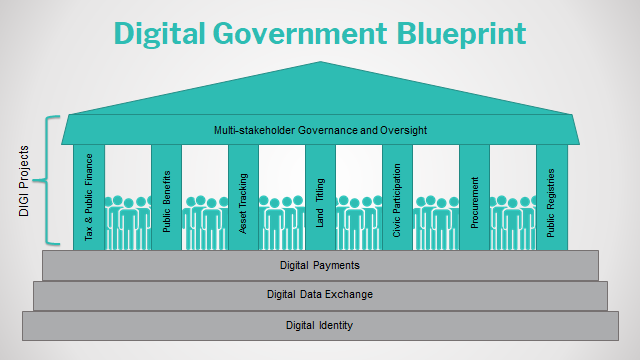
In May 2018, a group of leading experts from the public sector, private sector, and civil society convened at the Rockefeller Foundation’s Bellagio Center to define critical government functions that could be upgraded as part of a civic technology stack. These include foundational systems such as digital identity, data management, and payments along with an application layer for services including:
- Taxation and public finance
- Public benefits
- Asset tracking
- Land titling
- Civic participation and voting
- Procurement
- Public registries for vital records and commercial information
As the field has gained momentum since 2018, this conceptual framing has continued to guide our work and this mapping project.
The Digital Government Mapping Project is a compendium of leading platforms that policymakers, technologists, civil society leaders, and strategists can benchmark as they consider how to leverage digital solutions within their societies. The report also catalogues key insights from existing digital systems that governments should consider when constructing a civic stack.
Our Approach
Our primary goal in creating the Digital Government Mapping Project is to equip policymakers and leaders pursuing systemic digital transformation with a reference guide to the work of other actors building integrated digital ecosystems for government services. The Digital Government Mapping Project aims to accelerate the design and development of platforms for the public sector by helping technologists and policymakers learn from leaders in this field and lay the groundwork for future discussions about open standards and platform interoperability.
Our research approach follows the conceptual architecture of the “digital government stack” initially discussed at the 2018 Rockefeller Foundation Center convening in Bellagio, Italy. This framework identifies three foundational layers of digital protocols (digital identity, data exchange, and digital payments) that underpin other digital government applications (public registries, land titling, taxation, procurement, benefits management, and civic participation) and facilitate government service provision. Since the Bellagio convening, there has been widespread acknowledgement among government leaders that digital transformation will be a key driver of economic development and institutional modernization. Our hope is to help leaders familiarize themselves with this nascent field.
New America’s Digital Impact and Governance Initiative (DIGI) conducted informational interviews with stakeholders in philanthropy, multilateral organizations, and government. The conversations illuminated key considerations for digital transformation leaders and helped identify platforms of special interest. Based on these conversations, the DIGI team developed a set of questions to identify projects that could assist government leaders seeking to understand different approaches to building a civic stack:
- Does the digital government platform address a significant challenge for a large population?
- To what extent is the digital government platform sustained and legitimized by a political or institutional mandate?
- Does the digital government platform have a framework for multi-stakeholder oversight?
- Is the digital government platform backed by institutional funders and implementers who can support long-term development?
- To what extent does the digital government platform embrace public benefit technology principles such as open architecture and open data, interoperability, and open source software?
Based on these considerations, our team conducted research to identify and catalogue platforms with the greatest potential to inform the work of policymakers. A number of organizations including Civic Hall, the Digital Public Goods Alliance, Digital Square, and the Digital Impact Alliance have assembled impressive field guides that display a broad array of digital solutions and organizations that leverage technology for social impact. We encourage readers to explore these resources further to find digital tools to address social needs such as health, education, and job skills.
Our objective is narrower in scope: we’ve assembled a curated toolbox of digital government platforms that leaders can reference as they build more effective institutions. This report does not attempt to delineate the boundaries of the field or establish a comprehensive framework for how to design and deploy digital government platforms. Instead, it functions as a Step 0 that we hope can inform future efforts toward those ends.
Digital Government Platform Tracker
The Digital Government Platform Tracker is a catalogue of digital government platforms that strengthen public institutions. The examples represent the work of different jurisdictions and organizations to build digital government platforms that improve public services for their constituents. We hope the tracker will be a living resource and encourage readers to submit recommendations of additional digital government platforms that may merit inclusion.

Key Findings
The concept of a digital “stack” comes from the world of computing. A software stack is a group of independent software components that work together to accomplish a specific task. For example, sending an email requires different pieces of software to compose the message, connect to the network, transmit the data, and ultimately reassemble the message for a reader on the other side. Cars provide a useful analogy: they are made up of different subsystems like transmissions, engines, stereos, and climate control, which can be exchanged for different systems if needed. Just as tires can be swapped out to drive on snow or maximize gas mileage, technologists can change out pieces of a stack without compromising the integrity of the entire system.
Foundational layers of most digital government stacks include digital identity, data management, and digital payments. These systems provide core functionality to help manage tasks including public finances, benefits, and procurement. Similarly, cars can operate without air conditioning or a radio, but they cannot run without an engine, transmission, or brakes.
Many public services depend on establishing identity, exchanging data, and transferring resources. For instance, Germany laid the groundwork for a digital healthcare system by constructing digital infrastructure to share standardized electronic medical records so that patients, doctors, pharmacies, and hospitals could leverage a common information network. Germany’s digital identification and data exchange systems enabled a national coronavirus response that has proven far more effective than what has been possible in countries with more fragmented healthcare systems, such as in the United States.
Though many national digital systems have not collapsed data silos, some nations are embracing a whole-of-government approach to managing information. National platforms like Estonia’s X-Road system and the IndiaStack along with multilateral efforts such as UNDP’s Building Blocks refugee payment system are pioneering new models for how nations can leverage and protect citizens’ data. The coronavirus has catalyzed further innovation in this area. Germany and Switzerland are experimenting with data models that give individuals control of their information to preserve privacy while still enabling governments to solve urgent challenges. Ultimately, allowing citizens to own their personal data while ensuring common data standards to facilitate interoperability may emerge as a best practice in the field.
Digital Government Platforms Take Many Shapes
Some governments such as the United Kingdom have built modular and open source tools for reuse both within and across national governments. Others, such as in Estonia, Singapore and India, have adopted whole-of-government approaches to digital government platforms that integrate with civil society and the private sector systems through APIs and other interoperability enablers. A growing coalition of governments, private firms, philanthropic actors, and civil society organizations are beginning to weave together these national efforts to develop digital platforms into a coherent global movement.
Here are a few examples drawn from our platform tracker:
DHIS2 is the world’s largest health management information system (HMIS). It is an open source platform used by health facilities, doctors, and clinics in 72 low- and middle-income countries with national-scale deployments in 58 countries. DHIS2 can be adapted to a diverse range of local settings and needs while still exchanging data between different users because it leverages well-established data standards and open source software. The platform can manage the logistics of cold-storage transport units for vaccines, monitor the health of pregnant women in rural communities, and track outbreaks of infectious disease. DHIS2 recently added a module specifically for detecting and managing public health responses to COVID-19. A global team of software developers maintains DHIS2 by fixing bugs for all users of the software worldwide.
MOSIP, or the Modular, Open Source Identity Platform, is a digital identity platform that enables countries to build their own identity systems and adapt the platform to local needs. Thanks to MOSIP’s modular design, countries can configure unique instances of the software to fit local privacy requirements, integrate with different partners for credentialing and authentication, and comply with cybersecurity regulations. MOSIP also works with companies that manufacture identification tools, such as biometric scanners and electronic identity cards, to create security standards and accreditation to foster growth and competition in the identity services industry. MOSIP is currently working with Morocco, the Philippines, Guinea, Ethiopia, and Sri Lanka. The project is supported by the Bill & Melinda Gates Foundation, the Omidyar Network, and the TATA Trusts.
UK Notify is an open source tool developed by the U.K. Digital Government Service to notify constituents of various status updates with government applications or processes. Since 2016, UK Notify has been adopted by nearly 500 organizations for use in over 1,500 public service applications. The U.S. Department of Veteran Affairs and Canadian Digital Service are using UK Notify to deliver pandemic-related public health announcements.
10 Principles for Building a Digital Government Stack
Throughout the research process, our team uncovered an important finding: there is no single formula for building a digital government platform. Governments have taken different approaches to building digital public services from organizing different types of stakeholders to managing varying degrees of digital accessibility. However, through our research for the Digital Government Mapping Project and related reports like Building and Reusing Open Source Tools for Government, a set of common principles arose that seem to help digital government platforms become success stories.

1. Modularity
While a handful of countries have built impressive, tightly integrated digital stacks, these outliers are the exception rather than the rule. Both technically and politically, it is usually easier and less expensive to create smaller solutions that can be easily reconfigured and optimized as circumstances change. Just like a set of Legos, modular platforms can be reassembled to address needs and opportunities that may not have been anticipated when they were first created.
UK Notify demonstrates these benefits. After the solution was initially deployed in the UK, it was adapted to meet new challenges by the Australian Digital Transformation Agency, the U.S. Department of Veteran Affairs, and the Canadian Digital Service. Along the way, the system developed new capabilities. For example, Canadian engineers added French language support to the original tool. Doing so not only fulfilled a national mandate to make the software available in French and English, but also provided new functionality that the UK and French-speaking communities might be able to draw on in the future. The flexibility of modular solutions is a huge advantage at a time when technology and public needs are both evolving rapidly.
2. Open Source
Most of the work performed by governments is similar regardless of whether it is in New York, New Delhi, or Freetown. Almost all governments have to provide public benefits and services, collect taxes, maintain registries, and carry out a pretty well-defined set of other responsibilities that could be streamlined using technology. As the example above illustrates, governments are slowly waking up to the opportunity to develop and share open source solutions to power the public sector rather than building duplicative solutions of varying quality. Along with modular design, open source development can help governments cooperate to develop best-in-class solutions, adapt them to meet their own needs, and quickly scale them across borders to benefit other communities at minimal extra cost.
One of the benefits of open source development is that it allows civil society to examine the systems governments implement and point out design flaws, security risks, and threats to privacy and civil rights. A contact tracing app deployed in India was found to have numerous security bugs and led public authorities to open source the code for additional review by the global security community. Since then, hundreds of security flaws have been identified and fixed thanks to the power of crowdsourced engineering talent made possible by open source. DIGI’s Building and Reusing Open Source Tools in Government report provides a guide for how open source solutions can foster innovation in the public sector.
3. Ethical Design
Far more than companies and customers, governments have a responsibility to look after the interests of their citizens. That includes prioritizing privacy when deploying digital government platforms. In the same way nuclear power can light up a city or destroy it, and steel can build hospitals or machetes, digital platforms can advance human dignity or undermine human rights. Regional models for data governance have solidified in the United States, EU, and China, but almost every week brings new reports highlighting the failings of these frameworks.
In the same way responsible governments use checks and balances to prevent the abuse of power in carrying out policy, public sector technology systems must guard against bad actors using well-intentioned systems to exploit those who use them.
4. Multi-stakeholder Governance
The task of protecting citizens’ interests on digital platforms is too important to be left to government alone. Communities should rely on multi-stakeholder oversight when developing and deploying new technologies.
Multi-stakeholder bodies can inspect technology systems before they are deployed to check for algorithmic biases, dangerous governance models, or other unintended consequences. Decentralizing control of technology systems adds a layer of complexity to governance, but also offers crucial safeguards against potential abuse.
5. User Ownership of Data
Individuals often cede control of personal information to private firms or government bodies that exploit it for financial or political purposes. Centralized data models create opportunities for those with access to private information to not only surveil individual activities, but also manipulate user behavior. As governments begin to leverage digital platforms to power their institutions, they should help citizens’ own and control their personal data. Societies may need to rethink data ownership and data protection rules to realize this goal.
Placing users at the center of public data architecture could give individuals more autonomy over how private firms, governments, and researchers use sensitive personal information. Some emerging models, such as the “Data for Common Purpose” initiative developed by the World Economic Forum, are laying the groundwork for public-interest data frameworks that will enable societies to harness the power of big data while still granting individuals more control. Data trusts can also help negotiate on consumers’ behalf to rectify information asymmetries and help individuals monetize the value of their data or maintain higher degrees of privacy. Governments should look to the World Economic Forum’s recently released Presidio Principles for an innovative new values framework on how to reassert individuals’ rights and build more decentralized, resilient data models.
6. Interoperability
Individual digital platforms are proving how digital solutions can revolutionize the delivery of public value. But digital systems will be much more powerful if they are combined into an integrated set of systems that create a whole greater than the sum of its parts. If governments embrace common standards and data portability protocols they could facilitate the development of a broader range of interoperable platforms for the delivery of public value.
The Government Technology Agency of Singapore (GovTech) addressed this challenge by building APEX, a centralized API exchange designed to enable government agencies to share information between their data silos and externally with private entities. APIs make it easier and more secure to share data. A project named MyInfo uses APIs to share data between government agencies and banks when new customers open an account. MyInfo not only provides a better, faster experience for the user but also reduces costs for banks and deters data theft. MyInfo has been integrated into Singapore's National Digital Identity platform, which accelerates business-to-business transactions through use of government-verified data and equips citizens with a secure login interface for private and public digital services. Tools that bolster interoperability can eliminate inefficiencies and create safer data ecosystems for users, businesses, and governments.
7. User-centered Design
Policymakers should include users in the process of designing, testing, and improving digital platforms for the public sector. User-centric design principles draw expertise and opinions from the communities affected by digital tools, and bring them into the design effort to ensure that all groups, particularly marginalized communities, have a voice in how tools are developed and deployed. Collaborative human-centric design processes lead to more inclusive digital tools and reduce the risk of unintentional harm.
The State of New Jersey, the Heldrich Center for Workforce Development at Rutgers University, and DIGI’s team at New America sought to create a platform to help residents experiencing joblessness find their way back to employment. User research revealed that re-entering the workforce can feel overwhelming, so the designers developed features to break up the job application process into manageable tasks and guide the user through the stress of job searching. The State's Office of Innovation led multiple rounds of testing with small groups of job seekers to incorporate their feedback into the final design of the platform. By leveraging user-centric design principles, we developed a tool that caters specifically to the needs of the citizens it was designed to serve.
8. Digital Equity
As governments build digital platforms, they should explicitly plan to meet the needs of people with limited access to the internet or digital technology. Digital transformation has the potential to increase inequities with digitally-marginalized populations.
Governments should build public utilities such as APIs and adoption training that not only increase access to services, but ensure that all communities can benefit from innovation. The Indian Government pursued this path when they created the NUUP, a banking protocol that enables mobile phone users to transmit banking information over GSM networks. The NUUP provides banking services to users of cell phones who otherwise would have been excluded from the access to financial services made possible by the smartphone-native BHIM app. Governments worldwide should explore methods to layer analog and digital systems to ensure that communities with varying access to digital tools will not be left behind by digital transformation.
9. Building for Resilience
The speed with which the coronavirus pandemic crippled the global economy, buckled healthcare systems, and crushed national pandemic response plans has created a resilience crisis that is engulfing public institutions. Unemployment insurance in many U.S. states is a case in point. Citizens filing for benefits in the middle of the pandemic were asked to find fax machines to submit forms that were then processed using COBOL, a programming language that has been obsolete for decades. This archaic process made it difficult for anyone to access benefits and excluded many marginalized populations completely.
One of the advantages of using digital services is that they can foster resilience by providing multiple, redundant pathways to access public services. From low-cost telemedicine as a fallback when in-person care is unavailable to digital and mail-in balloting to supplement in-person voting, the principle of optionality should apply to all essential services. Providing citizens with multiple paths to access vital services creates safeguards when things go wrong. Digital platforms not only expedite inefficient analog service delivery processes but also create intentional redundancies to reduce risk when analog systems fail.
10. Design for High and Low Digital Capacity
The pandemic has illustrated that digital capacity does not necessarily follow traditional indexes of development. While the United States mailed paper stimulus checks to 70 million Americans, governments in Pakistan, Argentina, and Peru leveraged digital payments systems that support more than one third of their populations. Modular, open source digital public infrastructure can allow emerging markets to adopt next-generation systems that allow them to leapfrog a generation of development and also help countries with antiquated legacy systems catch up.
As coalitions and innovators begin to produce digital public goods to build more effective institutions, they should try to ensure that their solutions can be adapted to work in different contexts with varying levels of digital capacity.
The Work Ahead
The diplomat Dean Acheson wrote of being “present at the creation” as representatives from across the world came together to build a new generation of institutions and solutions following the Second World War. In the shadow of a catastrophic global crisis, leaders realized they needed to renovate the foundational structures of society. Communities had just experienced the devastation that accompanies the collapse of public institutions, and there was global resolve to prevent such a horrific crisis from recurring. The global architecture that emerged from that moment — including the United Nations and the Bretton Woods institutions — is still with us 75 years later. It has helped save generations from the scourge of another world war. As we survey the hundreds of thousands of lives we have lost to the coronavirus pandemic, we have reached an analogous moment; today, we need social and institutional innovation of a similar magnitude. Realizing this vision will require sustained focus on and investment in two areas: establishing institutional architecture to support these efforts and creating innovative funding models to ensure the financial viability and sustainability of this work.
Institutional Architecture
In government, staffing is policy. The governments that have been most successful at deploying digital government platforms in their institutions typically devote specific ministries and departments to the task of improving the quality of their public sector technology. Organizations such as Finland and Estonia’s Nordic Institute for Interoperability, India’s Unique Identification Authority, South Korea’s Ministry of Science and ICT, and Canada’s Digital Academy offer examples of institutions that coordinate resources, talent, and strategies to accelerate the development of next-generation digital public infrastructure.
Every country should build domestic governmental capacity to help guide their public institutions in employing technology. There is a massive institutional gap in most countries, including the United States, that have not designated specific governmental bodies to develop overarching plans to deploy public sector technology. The need for more coordination on digital public infrastructure is particularly acute in federal political systems that devolve responsibility for administering public programs like benefits distribution and identity management to state and local authorities. But governments of all sizes could benefit from a Department or Ministry of Innovation and Technology. These coordinating bodies can break down data silos between government agencies, create a cross-agency national digital public infrastructure strategy, educate government officials on the merits and risks of next-generation digital systems, and channel staffing to increase the capacity of the public sector to build and integrate new systems.
At the same time, there is a growing need for new multilateral institutions to develop, host, and deploy digital platforms for public institutions. Pioneering partnerships including the Digital Public Goods Alliance, the Digital Impact Alliance, and the Prosperity Collaborative are demonstrating the importance of collaboration in this area. As authoritarian countries develop tightly integrated digital surveillance systems, it will be critical to offer alternatives based on accountability and transparency. Multilateral institutions can help establish best practices for responsible use, share open source solutions across the public sector, and establish standards for interoperability.
Funding Mechanisms
Governments, technologists, civil society, and philanthropic institutions should begin exploring new models to fund the development and deployment of digital public infrastructure. Digital government platforms will require funding mechanisms that incentivize sustained investment, iterative improvement, and public accountability. Hitting this trifecta is a tall order. However, broader use of open source solutions coupled with greater international coordination could enable countries rich and poor to build far more effective technology systems at a fraction of the cost of their current technology outlays. The federal government in the U.S. alone spends nearly $100 billion on public sector technology each year.
Early ventures in creating open digital ecosystems and international public-private partnerships illuminate how innovative funding models can sustainably finance digital government platforms. A recent report by the Omidyar Network and Boston Consulting Group observes that digital identity platforms Aadhaar and MOSIP used public and philanthropic funds to finance initial development and deployment, and later began charging fees for businesses to access the benefits of an established digital identity ecosystem. Other models like Estonia’s e-Residency platform allocate resources to the platform from the cost-savings generated through more efficient government services. In the public health sector, the global vaccine alliance Gavi corrects market failures by pooling demand from low income countries and coordinating vaccine production to lower inoculation costs. Economic growth catalyzed by better public health enables developing countries to co-finance their vaccines. Coalitions of governments, funders, and civil society organizations could guide the technology industry towards better social outcomes by adopting such a model.
Due to the long lifetimes of these projects, innovative finance mechanisms could also induce pension funds and sovereign wealth funds to invest in public technology platforms. Already, there are compelling models such as Ontario’s land registry that provide examples of how pension funds could provide the up-front liquidity necessary to develop world class technology and later benefit from long-term, stable financial returns. Hybrid models that use philanthropic capital to de-risk early stage platform development and long-term public and institutional investment to support deployment and maintenance could enable rapid scaling of successful systems.
Conclusion
It’s time to launch a Digital Decade. Over the next 10 years, technologists and global leaders should work together to develop and deploy modular, open source, interoperable technology platforms to power the public sector. The UN Secretary-General Data Strategy has already called for realizing the potential of data to inform policy decisions and build stronger communities in a “Decade of Action.” That objective will depend on having high quality digital technology platforms powering public institutions.
The work ahead will be immensely complex and challenging. However, forging an ecosystem of open source solutions for improving governance presents one of the most important opportunities of our time, easily on par with the Green Revolution, mass vaccination, and other great public health interventions of the 20th century in its potential impact. Indeed, fixing broken public institutions may be the only pathways to achieving the Sustainable Development Goals by 2030.
The vision for this movement is increasingly clear. However, building such a movement won’t be easy. And, even under the best scenarios, the task of creating modular, open source platforms to power the public sector will lead to a journey, not a destination.
Checklist for Building Digital Government Platforms
Modularity – Building monolithic single-use systems wastes time, money, and engineering talent. Modular systems enable governments to deploy solutions more quickly and efficiently. The public sector needs a greater focus on developing common standards in order to realize the full potential of this approach.
Open Source – Using open source code helps governments cooperate to develop best-in-class solutions, adapt platforms to meet community needs, and scale solutions to benefit more people at minimal extra cost.
Ethical Design – Governments should prioritize security and privacy when designing and deploying digital platforms. Policymakers must design public sector technology systems with checks and balances to prevent bad actors from using well-intentioned systems to invade privacy and erode trust.
Multi-stakeholder Governance – Providing responsible oversight of digital infrastructure is too important to be left to governments alone. Civil society, academia, and the private sector all have a role in ensuring that public technology platforms are used responsibly. Governments should hardwire critical technology systems with multi-stakeholder governance to prevent abuse both at the time of deployment and by future administrations.
User Ownership of Data – Current data models both in the private sector and authoritarian countries are highly centralized. Societies need to rethink data ownership and empower users to control their own personal data. A user-centered data model could allow more equal access to data insights while preventing government and private sector overreach.
Interoperability – An integrated set of digital government platforms could create a result that is greater than the sum of its parts. If governments embrace common standards and data portability protocols they could facilitate the development of a broader range of interoperable platforms that empower individuals and improve the delivery of public value.
User-centered Design – Public sector technologists should include users in the process of designing, testing, and improving digital platforms. Collaborative human-centric design processes lead to more inclusive digital tools and reduce the risk of unintentional harm.
Digital Equity – Digital transformation has the potential to increase inequities due to the digital divide that affects digitally-illiterate populations and resource-deprived communities. Governments should build tools that ensure those with varying access to technology can benefit from digital transformation.
Building for Resilience – Digital services foster resilience by providing new avenues to accessing public services. Governments should build redundancy into their digital tools by layering them atop analog systems to reduce risk and prevent single-point-of-failure vulnerabilities.
Design for High and Low Digital Capacity – Digital infrastructure varies between countries. Coalitions and innovators should ensure that their solutions are sufficiently modular and adaptable to different contexts so they can scale to jurisdictions that have lower levels of technological capacity.
More About the Authors

Tomicah Tillemann

Ben Gregori

Jordan Sandman
Senior Program Coordinator, Digital Impact and Governance Initiative
Issues
Programs/Projects/Initiatives
Related