A Chapter of: The Baccalaureate and Beyond
Demographics and Areas of Study of FCS Baccalaureate Graduates
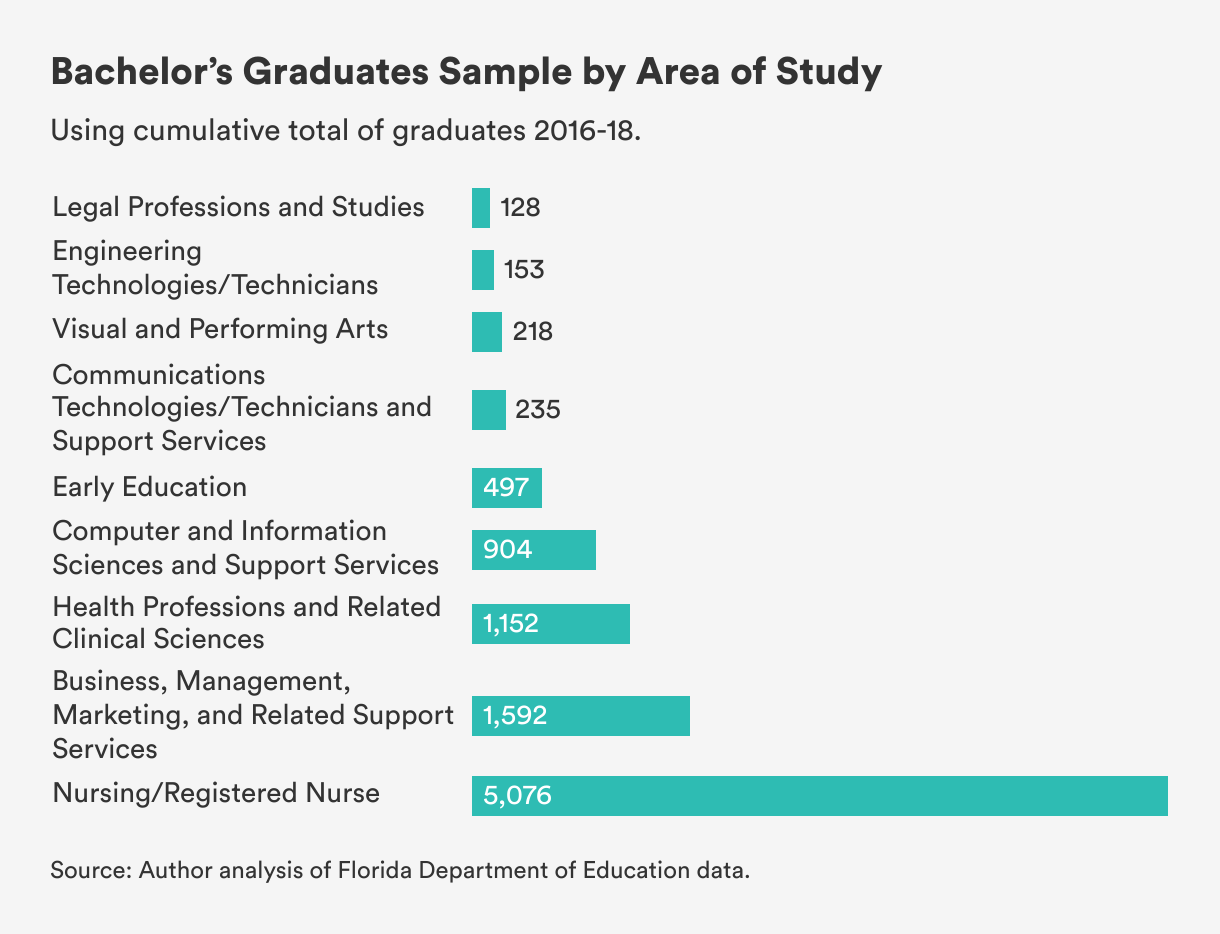
Florida’s community colleges offer bachelor’s degrees across a wide range of career fields, from health care to business to information technology. As Figure 1 depicts, bachelor of science in nursing programs are by far the largest in my sample, comprising 54 percent of bachelor’s degree conferrals in the data. While one can become a registered nurse with an associate degree, many employers are pushing current nurses to earn a bachelor’s degree and still others require a bachelor’s degree for leadership roles in care settings.8 Similar trends are apparent in other allied health fields such as respiratory therapy: an associate degree may provide entry into the field, but career advancement will likely require a bachelor’s degree. These labor market trends, in turn, help explain the large share of graduates from the health professions compared to other disciplines in this sample.
After health care, degrees in business are the largest in this data set followed by computer and information science. These programs can open up new opportunities for career growth for those who want to build on their associate degrees without having to enroll in a four-year institution that may not be as experienced in supporting working adult students who want to earn a bachelor’s degree.
Community colleges tend to enroll a more diverse population of students, and baccalaureate graduates in this analysis were very similar to associate graduates in terms of race and ethnicity. The share of baccalaureate graduates in the sample who were Black (16 percent), Latinx (20 percent), and white (53 percent) fell within one percentage point of those of associate degree graduates. Furthermore, the share of FCS baccalaureate graduates in several racial and ethnic groups closely mirrors that of the population of Florida. The share of Black; white; and Asian-American, Native Hawaiian, and Pacific Islander (3 percent) baccalaureate graduates fell within one percentage point of those respective groups’ share of the Florida population.9 However, Latinx individuals were underrepresented among FCS graduates (20 percent) compared to their share of the state population (26 percent). In comparison, graduates from Florida state universities in 2016–17 were more likely to be Latinx (27 percent) than FCS bachelor’s graduates in this sample, slightly higher than the share of Latinx people in Florida.
However, state university bachelor’s graduates were less likely to be Black (12 percent) than FCS graduates (16 percent) in this analysis.10
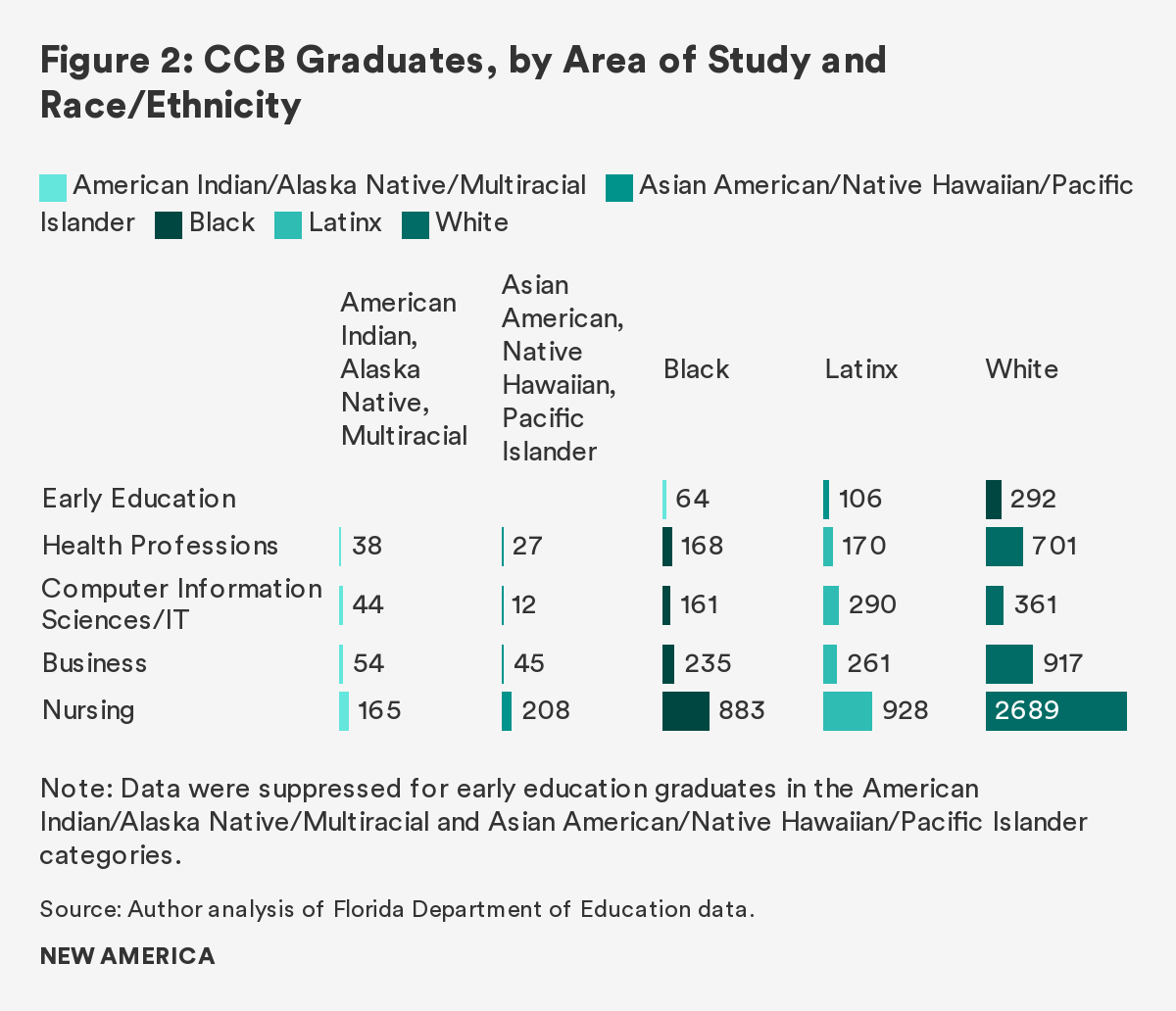
The racial and ethnic composition of CCB graduate cohorts varied by sector, as shown in Figure 2. Over half of IT graduates (58 percent) were people of color, with Black (19 percent) and Latinx (33 percent) graduates particularly well-represented. Approximately 47 percent of Floridians are people of color, and the remaining areas of study with data available for analysis fell short of this share of graduates of color, though nursing (45 percent) came close to mirroring the population.
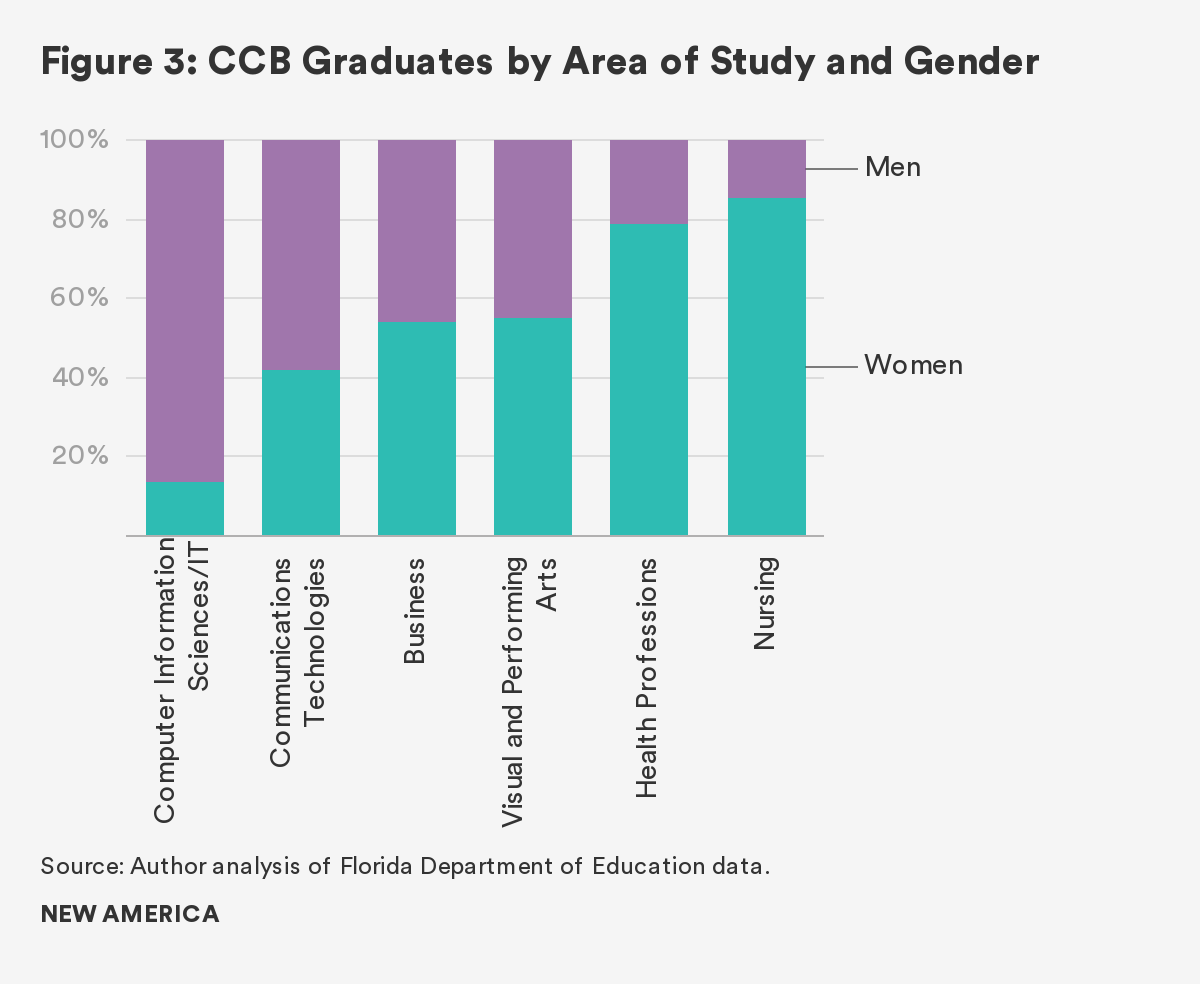
Overall, this sample of baccalaureate graduates is heavily weighted toward women, who comprised 70 percent of all graduates in the sample (Figure 3). Removing nursing graduates, the cohort is very similar to the gender breakdown of all baccalaureate graduates. In 2015–16, 57 percent of bachelor’s graduates nationwide were women, compared to 56 percent in this sample with nursing graduates removed.11 No great surprises emerged in the gender composition of various sectors of baccalaureate programs. Consistent with national trends, nursing and health professions were heavily female (85 percent and 79 percent, respectively), and computer science/IT was heavily male (86 percent). However, one noteworthy finding was over half (54 percent) of baccalaureate business graduates in the sample were women, compared to 47 percent of business bachelor’s graduates nationally.12
Education and engineering technologies graduates are absent from Figure 3. This is because there were 11 male graduates of early childhood education associate degree programs across the state of Florida in 2016; data for all other years at both levels of education were suppressed, meaning there were not even 10 graduates in a given year and credential level across the FCS. With all values but one therefore suppressed, I was unable to conduct a gender analysis for this sector. Similar challenges arose—in the reverse—for engineering technologies. In no year were there 10 or more female graduates of engineering technologies bachelor’s degree programs. These results suggest gender segregation is so strong in these two areas of study that analysis was impossible with available data.
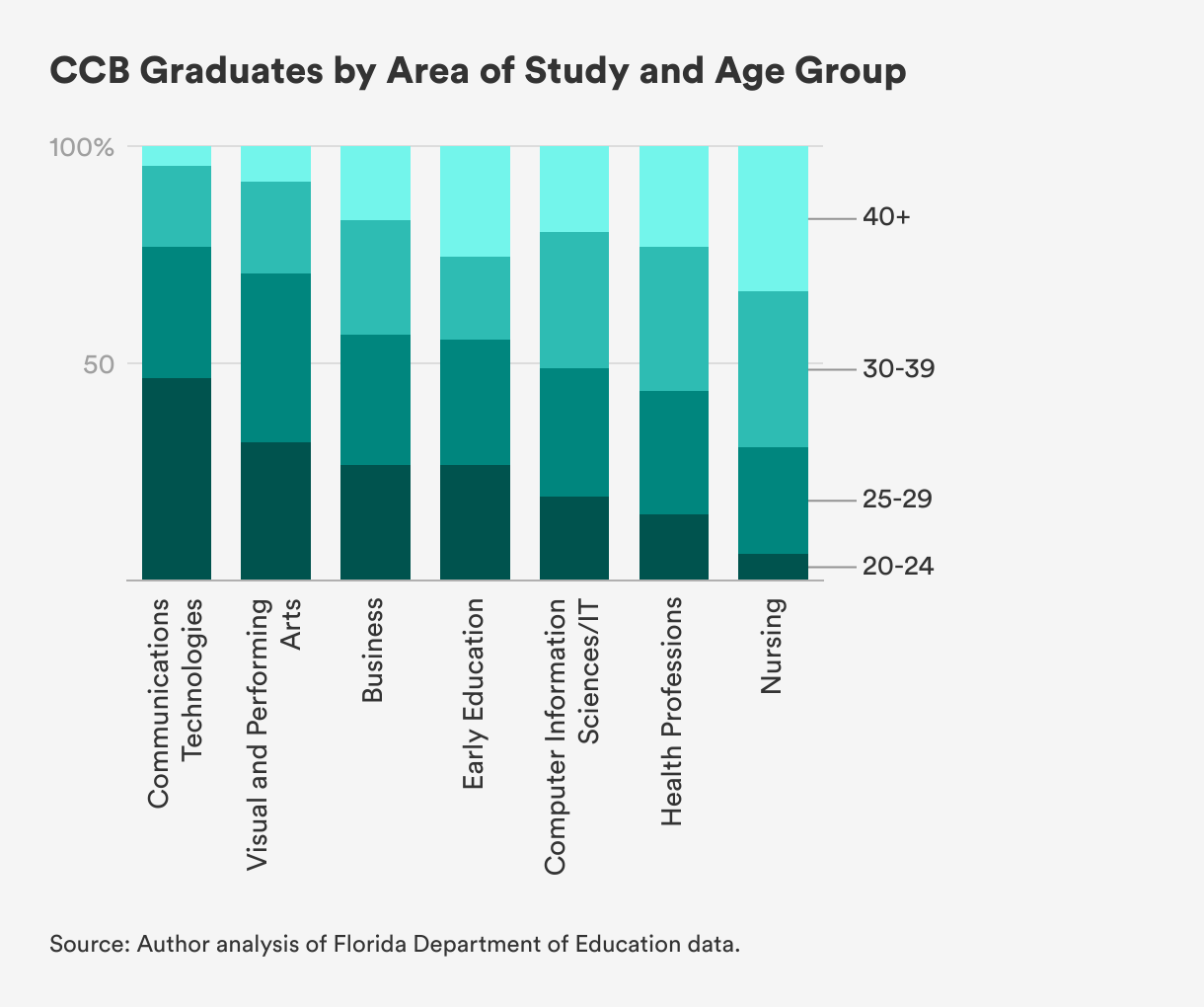
FCS baccalaureate graduates are, overall, older than associate graduates in similar fields. Fifty-eight percent of bachelor’s graduates were 30 or over, compared to 45 percent of associate degrees in corresponding fields of study. Even when excluding nurses—the area of study with the oldest graduates—from the analysis, 47 percent of FCS baccalaureate graduates were 30 or older. However, variability across programs suggests the baccalaureate cohort is comprised of both students who move quickly from an associate program into a bachelor’s program and those who may have been out of higher education for some time who returned to secure their bachelor’s degree.
For instance, baccalaureate graduates in business and education were younger than associate degree graduates in those areas of study. It could be that individuals in these sectors are intending to earn a bachelor’s degree from the time they enroll in the community college and are leveraging the lower cost of community college programs to do so in a more affordable way. On the other hand, nursing, health professions, and legal professions baccalaureate graduates were considerably older than associate graduates in the same sectors. One possible explanation would be increasing credential requirements in nursing and other allied health professions, such as respiratory therapy and dental hygiene, leading experienced professionals to return to college and pursue an additional degree. IT and engineering technologies graduates were very similar in age at the associate and baccalaureate level, with baccalaureate graduates very slightly older. And pay gaps were greater at the bachelor’s degree level in these same areas of study.

Citations
- While the push for bachelor’s degrees to be the educational standard for registered nurses dates from the mid-1960s, the pressure on nurses to earn a bachelor’s degree has accelerated since the publication of the Institute of Medicine’s 2011 report The Future of Nursing: Leading Change, Advancing Health, which called for 80 percent of registered nurses to hold a bachelor’s degree by 2020. Though the field fell short of this goal, it continues to push for increased bachelor’s degree attainment.
- U.S. Census Bureau (website), Florida Race and Ethnicity, 2018: American Community Survey 1-Year Estimates Data Profiles, https://data.census.gov/cedsci/table?q=Florida%20Race%20and%20Ethnicity&tid=ACSDP1Y2018.DP05&vintage=2018
- State University System of Florida Board of Governors, State University System of Florida 2017 Annual Equity Report, https://www.flbog.edu/wp-content/uploads/2017-SUS-Equity-Report.pdf
- U.S. Department of Education, National Center for Education Statistics (website), Table 318.10, “Degrees Conferred by Postsecondary Institutions, by Level of Degree and Sex of Student: Selected Years, 1869–70 through 2027–28,” April 2018, https://nces.ed.gov/programs/digest/d17/tables/dt17_318.10.asp?current=yes
- Here, I am looking at 2017–18 national data in tables 322.40 and 322.50 Bachelor's degrees conferred to males [and females, respectively] by postsecondary institutions, by race/ethnicity and field of study: 2016–17 and 2017–18., https://nces.ed.gov/programs/digest/d19/tables/dt19_322.40.asp and, https://nces.ed.gov/programs/digest/d19/tables/dt19_322.50.asp for males and females, respectively. This is a rough comparison because the sample from FLDOE does not include all business baccalaureate programs, only those that correspond to a specific program of study at the associate level.