Distance Learning Technologies
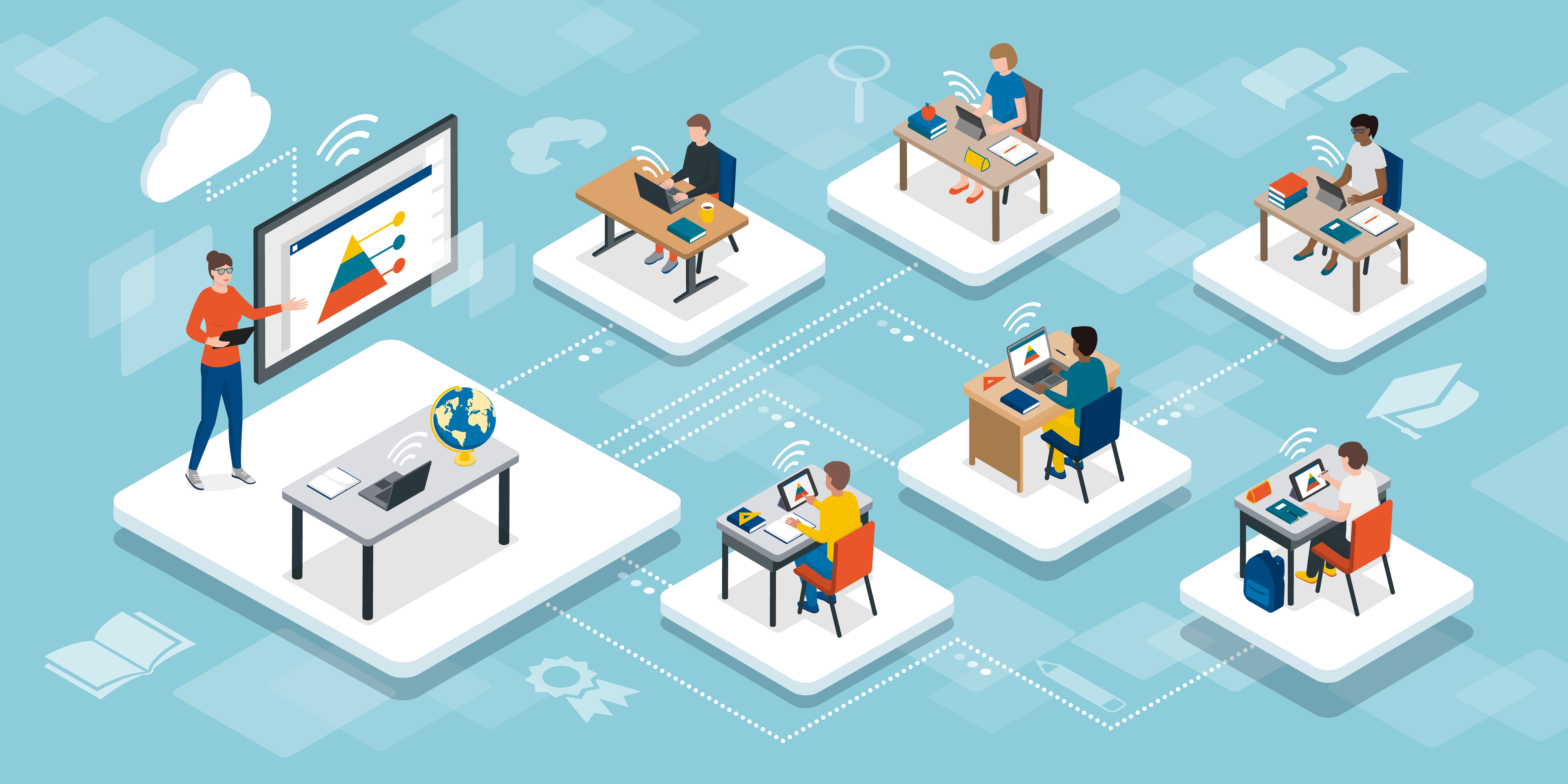
Higher education has slowly and steadily adopted distance learning over the past two decades. By the fall of 2018, 35 percent of all postsecondary students were enrolled in distance learning classes,20 and just prior to the pandemic, 88 percent of all postsecondary institutions offered at least some completely online courses.21 The technologies for providing remote learning have rapidly grown and transformed. There are now a multitude of ed tech tools used in higher education online programs: learning management systems like Canvas and Blackboard, lecture capture software such as Kalture, video conferencing platforms such as Zoom and WebEx, online exam proctoring tools such as ProctorU, and many others. Some schools also choose to outsource the partial or full provision of their distance learning programs to companies known as online program managers (OPMs). The following section provides an overview of the main technologies used for online learning and the privacy concerns they pose.
Learning Management Systems
Initially introduced in the late 1990s, learning management systems (LMSs) have become the central technology tool for colleges in creating, distributing, and managing educational content. They have seen a rapid transformation from their beginnings as simple web pages and content libraries, and they now provide a number of tools for course organization and delivery, collaborative interaction, measuring and assessing student learning, and other functions. In recent years, the LMS market has moved away from in-house LMSs to cloud-based solutions provided by companies such as Canvas.
In the past, many schools mainly used LMSs to support and supplement in-person classes, providing the ability to create structured course content, access reading materials, and administer quizzes, among other functions. LMSs are now often used for hybrid and remote learning as well. Most LMSs have functionality for providing virtual classrooms and online learning through various integrated tools. Many universities have leaned more heavily on these functions of their LMS platforms with the shift to online learning caused by the COVID-19 pandemic.22
LMSs, with their host of applications, often serve as large repositories of student data that institutions can use for analytic purposes. Increased remote learning will add new volumes of video and learning data captured in the course of online classes. As data continues to amass in LMSs, privacy risks increase, both from the potential for data breaches and the potential for misuse of data. Concerns have also been raised about what happens to these troves of data when LMS companies are sold.23
Videoconferencing
Videoconferencing tools are often essential to remote learning, enabling live classes and allowing students and teachers to communicate and collaborate virtually. Most LMSs have integrated videoconferencing capabilities,24 but Zoom and other videoconferencing platforms are frequently being used as separate, supplemental tools during the pandemic as well.25
Video streams and recordings (as well as audio) from online learning may be considered education records under FERPA in certain circumstances. The video needs to be directly related to a student. This includes classes and other educational situations where students are on video asking questions, making presentations, or appearing in any other way that would make it possible to personally identify the student. This can be simply attending a videoconferenced class with the camera on.26
Video from classes are often recorded and saved so they can be rewatched by students later. This means that missteps, embarrassing moments, and other video data that students may not want others to see can be collected and stored. Turning on the camera for remote classes also means virtually allowing others into a student’s home.27 A great number of personal details can often be gleaned through the presence of other people, personal objects, photographs, and calendars. Without proper security and privacy controls, other parties could potentially access these recordings.
Students from high-risk populations, including undocumented immigrants, may face immediate threats to their safety as a result of images, videos, and other information collected in online classes. For example, remote students who are citizens of countries with censorship laws may face prosecution for comments made in online classes.28 In addition to students, family members, and friends who happen to be captured on video (or audio) during a student’s class could also potentially be at risk.
While FERPA does protect against sharing of video educational records with law enforcement without consent, there are exceptions. The "law enforcement" exception relates to records and surveillance video maintained by the school's “law enforcement unit” (those designated to monitor the safety of the school and enforce laws).29 Under FERPA, these records are not considered educational records and can be disclosed without consent to law enforcement. Video data from online learning, while considered an education record under FERPA, may be disclosed to law enforcement only in the event of a “health or safety emergency”30 or by judicial order or subpoena.31 However, videos of online classes usually include images of multiple students, creating concerns that law enforcement could potentially misuse this data should they gain access to it, targeting vulnerable populations. This could possibly be done by mining videos using facial recognition tools.
In addition to the privacy risks from school or law enforcement access, entrance to live videoconferences by uninvited individuals is a high-profile problem that became apparent in the early days of the COVID-19 outbreak. Unauthorized entries into meetings and classes were frequently made by individuals, often for the purpose of disruption.32 The prevalence of this occurring on Zoom popularized the term “Zoom-bombing.”33 Increased awareness of this issue has led to better security practices in using videoconferencing tools. Platforms have improved safeguards and security options, and users have learned to configure settings to make meetings more secure through password requirements, restricting screen sharing to host only, creating waiting rooms for new participants, and other changes. However, Zoom-bombing still remains a problem for schools.34
Online Program Management Companies
Creating a distance learning program has large costs in up-front development, data storage, and maintenance that many institutions do not want to take on themselves. Some colleges thus choose to outsource creating and administering their online learning courses to third-party contractors known as online program management companies (OPMs). As online learning continues during the pandemic and beyond, more and more schools will likely consider partnering with an OPM.35
Many OPMs provide a bundle of services that go beyond the implementation of online learning technology. They can also handle marketing, recruitment, and retention services for institutions. While some OPM contracts are fee-for-service based, others are revenue-based. Revenue-based agreements provide OPMs with sizable financial incentives to enroll students, as they often receive half or more of tuition revenue.36 As OPMs serve multiple online college programs, personal information from student applications can be repurposed for marketing, raising potential privacy concerns. Contracts can permit student application information from one school to be used by the OPM to market another school to students that the OPM provides services for (and thus may have a financial incentive in increasing enrollment for). The value of this data to OPMs can be significant. In 2014, OPM 2U paid the University of California-Berkeley $4.2 million to use data from student applicants to market another school to those students.37
Institutions are facing increasing pressure from the higher education policy community to be more transparent about the terms of their relationships with OPMs,38 including clarity about data privacy. A recent analysis of public colleges’ contracts with OPMs conducted by the Century Foundation found that 32 percent had “vague and/or no protections on the use of students’ data and information.”39 Schools often omit any mention of the role of OPMs in their online programs, much less clear details of the privacy protections implemented under their auspices.40
Remote Proctoring
With an inability to have in-person exams during the shift to online learning, college use of remote proctoring software and services, like Proctorio and Examity, has surged.41 These tools can work within existing LMSs, or as a stand-alone service.42
Proctoring tools can be invasive and capture large amounts of data. Audio and video of the student and the environment the student is taking the exam in is recorded, eye movements are tracked, mouse movements and other computer activity are recorded, and proctors can remotely access and control the student’s computer.43 Proctoring has become increasingly automated, requiring little human involvement. Facial recognition can be used to help authenticate the student’s identity. The system then monitors the test taker for the duration of the exam, flagging suspicious or abnormal test-taking behaviors using advanced analytics.
If not fully automated, and a human proctor is required, remote proctoring is ordinarily done from an office, where supervisors can monitor the actions of the proctors. The lockdowns due to the COVID-19 pandemic, however, have forced many companies to allow their proctors to work remotely, raising additional privacy concerns regarding the lack of oversight of proctor behavior.44
When an online proctored test begins, students are usually required to show photo identification to their laptop camera.45 Depending on the ID used, the proctor collects data such as name, signature, address, driver’s license number, and passport number. Breaches or misuse of identification data that include citizenship or national origin information raise privacy concerns for both undocumented students and other groups at risk of discrimination, persecution, or law enforcement actions based on this information.
Like videoconferencing, there are many opportunities beyond the direct recording of the student for privacy leaks through objects in the test taker’s environment that the camera may capture. The risk is greater in certain ways, as remote proctoring often requires the test taker to begin by showing the entire room that the test is being taken in. Also, unlike remote classes, where a student has the option of turning their camera off, during a remote proctored exam students must leave their camera on and stay in front of the camera for the full duration. Given that test taking can be a high-stress situation, embarrassing moments may be captured.46
Mobile Applications
Almost all LMS platforms have some ability to track the learning activity of students. Schools’ primary stated aim of this tracking is to improve student retention and graduation rates. However, colleges are also increasingly tracking where students go. Institutions use students’ phones to collect data on their location, citing a number of purposes, including monitoring attendance and tardiness,47 mental health,48 and for campus safety.49 Many institutions have increased tracking for COVID-19 tracing purposes, sometimes through required downloads of tracking apps.50 Some schools have also considered the use of wearable health monitoring devices.51 Using technology for contact tracing may have benefits in expanding traditional manual tracing systems and providing rapid alerts to potentially exposed individuals, but it raises a number of privacy and civil liberties concerns.52
While schools mainly use networks of Bluetooth transmitters and wireless access points on campus to collect location information on students, with the continuing pandemic there may be an increased desire to track both on-campus and hybrid learning students—not only when they are on campus, but as they leave to go home or otherwise go off campus. While direct tracking by the institution is less of a concern with fully remote students, who are not required to use special tracking apps or devices during the pandemic, mobile apps may still be collecting GPS location data. Some schools have their own mobile apps53 that provide campus-based maps and information, but may be used by remote students as well to access grades, class schedules, and other information, and thus schools could still potentially track these remote students’ location. LMSs can include mobile apps as well that allow students to access educational materials and participate in online classes and class discussions. These and other third-party ed tech apps may collect location data, either for potential use by the institution or for marketing and advertising purposes.54
Predictive Analytics
Predictive analytics is the analysis of current and historical data through various statistical means and data mining tools to make predictions about future events. Higher education uses predictive analytics for a number of purposes, including identifying students most in need of advising services, developing adaptive and personalized learning programs, and managing enrollment and retention. In the past it was an involved process to export data from LMSs for analysis, but current LMS technologies often integrate data extraction and analytic tools.
Institutions are understandably interested in how students are adapting to the increased use of online learning. A poll conducted by EDUCAUSE in May 2020 found that demand from college administrators for analytics on student success increased 66 percent since the start of the pandemic.55 The largest increase in demand for data was for information related to students’ usage of technology tools.56
The desire to make analytics increasingly precise creates an incentive for schools to collect greater amounts and more types of data, leading to surveilling students not only more intensely while learning, but also outside of a learning environment, for instance seeing how often students visit the library or a gym.57 Analytics providers are also now beginning to use machine learning and other artificial intelligence approaches. These often require very large volumes of data to train the algorithms used, increasing the potential privacy harms of breaches. There is also concern that predictive analytics efforts will have a larger privacy impact on low-income students and students of color, groups that tend to have a higher percentage of the at-risk student populations that predictive analytics focuses on.58
Citations
- “Fast Facts: Distance Learning”, National Center for Education Statistics, accessed September 3, 2020, https://nces.ed.gov/FastFacts/display.asp?id=80
- D. Christopher Brooks, Susan Grajek and Leah Lang, “Institutional Readiness to Adopt Fully Remote Learning”, EDUCAUSE, April 9, 2020, https://er.educause.edu/blogs/2020/4/institutional-readiness-to-adopt-fully-remote-learning
- Richard Garrett, et al., CHLOE 5: The Pivot to Remote Teaching in Spring 2020 and Its Impact, The Changing Landscape of Online Education, 2020. https://encoura.org/project/chloe-5-the-pivot-to-remote-teaching-in-spring-2020-and-its-impact/
- Jeffrey R. Young, “As Instructure Changes Ownership, Academics Worry Whether Student Data Will Be Protected”, EdSurge, March 17, 2020, https://www.edsurge.com/news/2020-01-17-as-instructure-changes-ownership-academics-worry-whether-student-data-will-be-protected
- Via open-source tools such as BigBlueButton, or through commercial videoconferencing platforms like Microsoft Teams, and Google Meet.
- Richard Garrett, et al., CHLOE 5: The Pivot to Remote Teaching in Spring 2020 and Its Impact, The Changing Landscape of Online Education, 2020. https://encoura.org/project/chloe-5-the-pivot-to-remote-teaching-in-spring-2020-and-its-impact/
- “When is a photo or video of a student an education record under FERPA?”, U.S. Department of Education, accessed September 8, 2020, https://studentprivacy.ed.gov/faq/when-photo-or-video-student-education-record-under-ferpa
- Instructors face this as well.
- Karin Fischer, “Instruction Under Surveillance”, Chronicle of Higher Education, September 30, 2020, https://www.chronicle.com/article/instruction-under-surveillance
- “What Is A ‘Law Enforcement Unit’ Under FERPA?”, U.S. Department of Education, accessed September 30, 2020, http://studentprivacy.ed.gov/faq/what-“law-enforcement-unit”
- Schools are required to record “the articulable and significant threat” that formed the basis for the disclosure, and the parties to whom the information was disclosed. See “What Does “Articulable And Significant Threat” Mean?”, U.S. Department of Education, accessed September 29, 2020. https://studentprivacy.ed.gov/faq/what-does-%E2%80%9Carticulable-and-significant-threat%E2%80%9D-mean
- “FAQs on Photos and Videos under FERPA”, U.S. Department of Education, accessed September 29, 2020, https://studentprivacy.ed.gov/faq/faqs-photos-and-videos-under-ferpa
- Tony Wan, “Holding Class on Zoom? Beware of These Hacks, Hijinks and Hazards”, EdSurge, March 27, 2020. https://www.edsurge.com/news/2020-03-27-holding-class-on-zoom-beware-of-these-hacks-hijinks-and-hazards
- Taylor Lorenz and Davey Alba, “‘Zoombombing’ Becomes a Dangerous Organized Effort”, New York Times, April 3, 2020, https://www.nytimes.com/2020/04/03/technology/zoom-harassment-abuse-racism-fbi-warning.html
- Alex Wigglesworth, “UCLA investigates ‘Zoom-bombing’ attacks during online classes”, Los Angeles Times, October 10, 2020. https://www.latimes.com/california/story/2020-10-10/ucla-zoom-bombing-attacks
- Alejandra Acosta, Clare McCann, Iris Palmer, Considering an Online Program Management (OPM) Contract, New America, September 15, 2020. https://www.newamerica.org/education-policy/reports/considering-online-program-management-opm-contract/
- Stephanie Hall and Taela Dudley, Dear Colleges: Take Control of Your Online Courses (New York: The Century Foundation, September 12, 2019). https://tcf.org/content/about-tcf/tcf-analysis-70-university-opm-contracts-reveals-increasing-risks-students-public-education/
- Margaret Mattes, The Private Side of Public Higher Education (New York: The Century Foundation, August 7, 2017). https://tcf.org/content/report/private-side-public-higher-education/?agreed=1
- Kevin Carey, “The Creeping Capitalist Takeover of Higher Education,” Highline, April 1, 2019, https://www.huffpost.com/highline/article/capitalist-takeover-college
- Stephanie Hall and Taela Dudley, Dear Colleges: Take Control of Your Online Courses (New York: The Century Foundation, September 12, 2019). https://tcf.org/content/about-tcf/tcf-analysis-70-university-opm-contracts-reveals-increasing-risks-students-public-education/
- Kevin Carey, “The Creeping Capitalist Takeover of Higher Education,” Highline, April 1, 2019, https://www.huffpost.com/highline/article/capitalist-takeover-college
- Colleen Flaherty, “Big Proctor”, Inside HIgher Ed, May 11, 2020 https://www.insidehighered.com/news/2020/05/11/online-proctoring-surging-during-covid-19
- And some schools simply use Zoom or other videoconferencing platforms for proctoring purposes. See Susan Grajek, “ EDUCAUSE COVID-19 QuickPoll Results: Grading and Proctoring”, EDUCAUSE REVIEW, April 10, 2020, https://er.educause.edu/blogs/2020/4/educause-covid-19-quickpoll-results-grading-and-proctoring
- Monica Chin, “Exam Anxiety: How Remote Test-proctoring Is Creeping Students Out”, The Verge, April 29, 2020, https://www.theverge.com/2020/4/29/21232777/examity-remote-test-proctoring-online-class-education ; And also limit the student’s online access to specific IP addresses, prevent switching windows or accessing any other application, and block functions such as copying and pasting.
- Drew Harwell, “Mass school closures in the wake of the coronavirus are driving a new wave of student surveillance”, April 1, 2020, Washington Post, https://www.washingtonpost.com/technology/2020/04/01/online-proctoring-college-exams-coronavirus/
- Identity management tools may be used in conjunction with proctoring software to further verify that the student taking the exam is the one who’s actually enrolled. Some of these tools use public records and other databases to cull identity questions relating to residential history and other characteristics that only the enrolled student would know.
- Such as getting sick on camera, as per the story related in Harwell April 1, 2020 article.
- Mará Rose Williams And Souichi Terada, “Invasive Or Helpful? Mu Using Students’ Phones To Track If They Are In Class Or Not”, Kansas City Star, January 21, 2020, https://www.kansascity.com/news/state/missouri/article239139523.html
- Drew Harwell, “Colleges are turning students’ phones into surveillance machines, tracking the locations of hundreds of thousands”, Washington Post, December 24, 2019, https://www.washingtonpost.com/technology/2019/12/24/colleges-are-turning-students-phones-into-surveillance-machines-tracking-locations-hundreds-thousands/
- Douglas Belkin, “No Place to Hide: Colleges Track Students, Everywhere”, Wall Street Journal, March 5, 2020, https://www.wsj.com/articles/the-many-ways-college-students-may-be-tracked-on-campus-11583354852
- Kate Cox, “College Contact-tracing App Readily Leaked Personal Data, Report Finds”, Ars Technica, August 20, 2020, https://arstechnica.com/tech-policy/2020/08/college-contact-tracing-app-readily-leaked-personal-data-report-finds
- Lilah Burke, “Monitoring Vital Signs for COVID-19”, Inside Higher Ed, August 11, 2020, https://www.insidehighered.com/news/2020/08/11/university-use-wearable-tech-track-covid-campus ; Of more relevance for on-campus or hybrid students, FERPA’s “health or safety emergency” exception may allow disclosure of health related data without consent.
- Koustubh “K.J.” Bagchi, et al., Digital Tools for COVID-19 Contact Tracing: Identifying and Mitigating the Equity, Privacy, and Civil Liberties Concerns, Edmond J. Safra Center for Ethics, July 2, 2020. https://www.newamerica.org/oti/policy-papers/digital-tools-covid-19-contact-tracing-identifying-and-mitigating-equity-privacy-and-civil-liberties-concerns/
- https://www.osu.edu/downloads/apps/ohio-state-app.html
- Alfred Ng, “Education Apps Are Sending Your Location Data And Personal Info To Advertisers”, CNET, September 1, 2020, https://www.cnet.com/news/education-apps-are-sending-your-location-data-and-personal-info-to-advertisers/
- Kim Arnold, et al., “EDUCAUSE COVID-19 QuickPoll Results: Student Success Analytics”, EDUCAUSE, May 28, 2020, https://er.educause.edu/blogs/2020/5/educause-covid-19-quickpoll-results-student-success-analytics
- Kim Arnold, et al., “EDUCAUSE COVID-19 QuickPoll Results: Student Success Analytics”, EDUCAUSE, May 28, 2020, https://er.educause.edu/blogs/2020/5/educause-covid-19-quickpoll-results-student-success-analytics
- Drew Harwell, “Colleges are turning students’ phones into surveillance machines, tracking the locations of hundreds of thousands”, Washington Post, December 24, 2019, https://www.washingtonpost.com/technology/2019/12/24/colleges-are-turning-students-phones-into-surveillance-machines-tracking-locations-hundreds-thousands/
- Jeffrey R. Young, “Researchers Raise Concerns About Algorithmic Bias in Online Course Tools”, EdSurge, June 26, 2020, https://www.edsurge.com/news/2020-06-26-researchers-raise-concerns-about-algorithmic-bias-in-online-course-tools ; Christine Bannan and Margerite Blase, Automated Intrusion, Systemic Discrimination, New America, October 8, 2020, https://www.newamerica.org/oti/reports/automated-intrusion-systemic-discrimination/