
Harnessing Micro-credentials for Teacher Growth
Abstract
New America analyzed the national landscape of educator micro-credentials (MCs) to determine how to best harness their potential to more successfully attract, develop, and retain great teachers. We find MCs to be a promising alternative to more traditional (and largely ineffective), compliance-focused teacher professional development, as well as an effective vehicle for defining and determining eligibility for some teacher roles. Whether MCs will fulfill their promise will depend largely on the ability of education leaders to set an appropriately and consistently rigorous bar for quality in MC offerings, as well as to ensure sufficient and appropriate implementation processes and supports outside of the MC offerings themselves. To aid in these efforts, we summarize early best practices for ensuring quality MC offerings as well as lessons learned about the necessary conditions for teachers to succeed with MCs. As an added resource, New America has developed a companion Model State Policy Guide with recommendations for policymakers looking to integrate MCs into their educator professional development, license renewal, and advancement systems.
Acknowledgments
We are grateful to the many local and state education leaders, micro-credential providers, practitioners, and researchers who generously shared information about their micro-credential efforts to inform this project, and reviewed early report drafts. Special thanks to the NC Partnership for Micro-credentials task force (including Myra Best of digiLEARN; Michael Martin, Katherine McKnight, and Angela Quick of RTI International; and Tom Tomberlin of the NC Department of Public Instruction) for providing input at various stages of the work. This brief also benefited from the invaluable contributions of many of our New America colleagues: editorial insights from Sabrina Detlef and Elena Silva, and design and communication support from Julie Brosnan, Fabio Murgia, Riker Pasterkiewicz, and Joe Wilkes. New America’s PreK–12 education team is generously supported by the Alliance for Early Success, the Belk Foundation, the Bill & Melinda Gates Foundation, the Heising-Simons Foundation, the Hewlett Foundation, the McKnight Foundation, and the W. Clement and Jessie V. Stone Foundation. The views expressed in this report are those of its authors alone and do not necessarily reflect the views of these foundations.
Executive Summary
Introduction
How can we attract, develop, and retain more high-quality teachers, particularly in our highest-need schools as interest in becoming and remaining an educator is declining? As with many intransigent public issues, there is no single solution. But there is an effort underway to leverage a digital tool that might help: micro-credentials (MCs).
High-quality MCs verify a discrete skill that educators demonstrate by submitting evidence of application in practice. They promote a stark change from the compliance-focused approach to professional development (PD) that has existed for decades, and offer an approach to better defining career pathways and eligibility for teacher leader roles to help retain those who might otherwise leave the profession.
New America’s analysis of data from leading MC providers and interviews with a broad swath of other stakeholders within the MC ecosystem—including states and local education agencies (LEAs)—demonstrates that MCs are a still-emerging but growing field. Just among the three major MC platforms for educators, there are, at last count, well over 1,000 MCs currently available, and thousands of educators across all 50 states and Washington, DC have earned at least one.
And states are beginning to incorporate them into policy: New America’s analysis found that 26 have formal educator MC policies or programs in place, for career advancement, additional license endorsements, license renewal, and ongoing professional learning more broadly. A significant number of states provide LEAs wide latitude to define and/or certify PD via relicensure credits. Other states authorize regional education service agencies or other organizations to develop and approve professional learning experiences for meeting state license renewal requirements, which can include MCs.
But research on MCs is lacking, and many questions remain, particularly around defining and measuring MCs’ quality and impact. This first-of-its-kind project begins this work by assessing the national landscape and providing lessons for harnessing MCs’ potential for improving teacher learning and advancement in four key areas: designing and assessing MC offerings; putting educator MCs into practice; state and local policies; and impact on teacher practice and student learning.
Key Findings and Recommendations
MCs can help attract and retain highly talented teachers by formally assessing and recognizing previously unrecognized skills and providing opportunities for increased responsibilities related to those skills, along with compensation in line with those responsibilities. And while MCs are primarily focused on the assessment of competency, high-quality MCs also have significant potential to improve the quality of PD, and hence, the quality of instruction.
However, it is too soon to say whether MCs will fulfill this potential. This is in part because most systems have not had MCs in place long enough—or at a broad enough scale—to assess impact. And measuring the impact of MCs broadly is difficult due to the wide variation in current offerings and approaches.
As the applications and aspirations of MCs become more ambitious, their quality must keep pace. Conducting additional research on how to ensure MCs are valid and robust measures of teacher competence, and assessing the impact of MCs on teacher practice and student outcomes, should be key areas of focus for education policymakers and philanthropies as more state and local education agencies (LEAs) implement MC initiatives. In the meantime, our research takes the high-level principles for MCs issued in 2020 by the Chief Council of State School Officers’ relicensure task force one step further by identifying five core aspects of a quality MC offering and specific related best practices:
● Area of focus and level of specificity: The MC competency is the proper “grain size” (i.e., small, discrete, and demonstrable) and backed by research.
● Quality of embedded resources and supports: Resources provided should be evidence-based and clearly connected to the competency.
● Quality, clarity, and type of evidence requested: Required articles of evidence are valid, rigorous, representative demonstrations of the specified skill.
● Quality of assessment process: Evidence is consistently and accurately evaluated against high-quality criteria and measurement procedures by well-trained assessors, and clearly defined in a rubric that can be understood and applied by both candidate and assessor.
● Transparency and comparability of earned MCs: Requirements and the submitted evidence to achieve those requirements must be transparent and easily comparable by potential recognizers.
States should establish quality standards for MCs’ assessment components, drawing upon the best practices detailed in this research, so that MCs can be recognized as holding consistent value regardless of location of employment. But quality MC offerings are not sufficient for positive impact. The quality of the implementation and supports for educators occurring outside of the MC offering are just as, if not more, important as the design and assessment of the MCs themselves.
State and local leadership must support the elements of high-quality PD, and the integration of MCs into an effective professional learning and advancement system, by ensuring that:
- Any PD opportunities, whether connected to MCs or not, are aligned with professional learning standards and the federal definition of high-quality PD. In many cases, the state will have greater capacity and resources than a regional or local entity to guide alignment, and develop high-quality teacher development opportunities, both with and without MCs.
- Systems are in place to help determine which educator PD opportunities and elements produce the best return on investment (ROI). ROI should take into account both the success rate in helping teachers earn MCs on related competencies, and a longer-term assessment of impact on instruction and student outcomes.
- The design and implementation of MC policies and systems is careful and iterative. Policies should start with a clear goal and plan of action and involve stakeholders early in the policy development process to address concerns and incorporate ideas. Phase in initiatives gradually, analyzing data and stakeholder experience to address issues as they arise.
- The design of any human capital policies that involve MCs, including any associated incentives, is clearly driven by the intended goal and application of the policy. It will be important to make policy design and implementation choices that align with the intended objective(s). For example, there is a difference between using MCs for ongoing PD and using them for advancement: the former has the goal of growing skill in one’s current role, while the latter has the goal of validating skill for entry into a new role. To leverage MCs for ongoing learning, either current MC offerings will require adaptation to offer more direct development opportunities, or greater outside resources must be provided to fulfill development goals.
- A system is developed to rigorously vet and convey the quality of MC offerings. Quality guidelines should be consistent to ensure that an MC earned for one use (e.g., ongoing professional learning), could also meet requirements for another use (e.g., license renewal or advancement requirements). Ensuring digital badges or other documentation of MCs offered can be thoroughly explored and verified by potential employers is another key aspect for ensuring transparency around quality and allowing MCs to hold currency.
- Educators are provided with clear and frequent communication on what high-quality MCs are and how engaging in them could help them and their students. Use language that helps separate the MC itself from the process leading up to the earning of the MC. Clearly communicate that MCs are a tool that can promote the kinds of PD activities that align with evidence on best practices for adult learning, even though they are not typically PD in and of themselves and make a clear distinction between MCs and digital badges. Nurturing local champions is an effective strategy for promoting broader engagement.
- High-quality MC offerings are curated to align with educators’ and students’ needs. Educators should have some discretion in choosing what learning and/or advancement opportunities to pursue based on their own interests and goals. However, those decisions should be a “guided choice,” scaffolded within a set of options that will move school and LEA objectives forward as well.
- Educators engaging with MC offerings are provided the quality and level of support necessary to succeed. While high-quality MC offerings typically embed some resources and/or supports within them, they are generally not sufficient to support teachers' professional learning on their own. Relevant, differentiated high-quality related learning resources must be made accessible for each given MC competency. Educators also need sufficient quality and quantity of timely, individualized coaching and feedback (from instructional leaders familiar with MCs) as well as opportunities to engage in a cycle of inquiry with peers (ideally in person, but virtually as necessary) to pursue the MC during contracted hours.
- MCs are implemented as a tool for furthering equity rather than reinforcing current discrepancies in student access to quality teaching. An opt-in approach to MCs may lead to only the most well-resourced schools or LEAs being able to provide high-quality MC opportunities, leaving less well-resourced ones, and the students they serve, further behind. State and regional education agencies can help support equitable MC implementation efforts by recruiting a representative sample of LEAs to participate in the first phase of any initiative, and focusing funding and implementation support to the LEAs most in need as early in the rollout as possible.
- States, LEAs, and schools have full access to all of their MC data and use that data to inform ongoing policy and practice. The research base on MC impact is thin. Access to data enables a better understanding and harnessing of MCs’ potential impact on teaching practice and student achievement. It can also help states and LEAs better target professional learning opportunities and make smarter purchasing decisions, motivating MC issuers to improve the efficacy of their offerings.
Like any specific tool to improve our K–12 education systems, MCs are not a silver bullet. Reaping success from MCs requires more than simply layering MCs on top of, or next to, policies and processes already in place. It requires making bigger shifts to professional learning and advancement systems—particularly a culture and mindset shift from compliance to ongoing growth. Tackling long-standing issues with educator development and advancement systems may be less exotic than adopting a novel digital tool, but, if they are left unaddressed, most educators will struggle to attain MCs, many schools will continue to struggle to retain good teachers and develop them into great ones, and students with the greatest needs will continue to struggle as well.
For recommendations on developing strong state-level human capital policies incorporating micro-credentials, see the report’s companion brief, Micro-Credentials to Promote Teacher Quality and Retention: A Model State Policy Guide.
Introduction
When schools closed due to COVID-19 this spring, many parents learned what education researchers already knew—that teachers are key to student success.1
So how do we attract, develop, and retain more high-quality teachers, particularly in our highest-need schools—during the COVID-19 crisis and after—as interest in becoming and remaining a teacher is declining?2 As with many intransigent public issues, there is no single solution. But there is an effort underway to leverage a digital tool that has the potential to improve teacher efficacy and retention: micro-credentials (MCs).
High-quality MCs verify a discrete skill that educators demonstrate by submitting evidence of application in practice. They offer a stark change from the typical teacher professional development* (PD) processes that have existed for decades. A recent national survey found that only one-third of teachers were satisfied with the PD opportunities currently being offered through their school.3 Teachers offered two primary complaints: opportunities were too generic, and schools did not provide sufficient time for them to engage in the work.
MCs could change the check-the-box culture of teacher professional learning. Instead of having to pursue the same content as every other teacher, educators could have a myriad of online MC options to choose from, ideally based on individual, school, or local education agency (LEA) needs. Instead of being focused on how many hours an educator engages in a particular professional learning experience, MCs require demonstration of competency (typically in a teacher’s own classroom), vetted against a rubric. Educators who fall short of meeting the competency receive feedback explaining what they need to improve and can continue to hone their practice until submitted evidence shows skill mastery.
Additionally, state education agencies (SEAs) and LEAs can use MCs to better define teacher roles and career pathways and help retain teachers who might otherwise leave the field. But many questions remain around defining and measuring the quality and impact of MCs. This report draws on relevant research and the most recent available data from leading MC providers and users to examine the potential of educator MCs to improve teacher learning and advancement, and lessons on how to best harness this potential.
*Note: Some in the education field differentiate between stand-alone workshops and seminars, which they call “professional development” (PD), and experiences that are more embedded in the classroom work of teachers, which they call “professional learning.” In this paper, the term “PD” is used throughout to refer to any type of experience that a practicing teacher engages in (on a voluntary or a required basis) with the explicit intention of improving his or her practice. When we use the term “professional learning” in this paper, it is to refer to a desired outcome of PD—learning leading to improved practice—or the system of adult learning within which all PD experiences fit.
Citations
- Youki Terada, “Understanding a Teacher’s Long-Term Impact,” Edutopia, February 4, 2019, https://www.edutopia.org/article/understanding-teachers-long-term-impact
- Frustration in the Schools: Teachers Speak Out on Pay, Funding, and Feeling Valued (Arlington, VA: Phi Delta Kappan, September 2019), https://pdkpoll.org/wp-content/uploads/2020/05/pdkpoll51-2019.pdf
- Tyton Partners, “National Teacher Pulse Survey: Reflections on Professional Development” (PowerPoint presentation, October 14, 2020), https://tytonpartners.com/wp-content/uploads/2020/10/10.14.2020_K-12-Teacher-PD-Pulse-Survey.pdf
The Need to Improve Professional Learning and Advancement
How Teacher PD Currently Falls Short
Investments in teachers’ professional learning in the United States are substantial. Most public school teachers’ employment contracts specify a required number of PD hours per school year—a 2014 Bill & Melinda Gates Foundation study estimated that teachers engage in an average of 68 hours of district-directed professional development (PD) activities per year, and a total of 89 hours per year when self-guided PD is included.4 All told, roughly $18 billion is invested in PD annually from a variety of federal, state, and local sources5 (although this does not capture the amount teachers spend on PD out of their own pockets). The bulk of the federal portion of this funding—$2.3 billion in fiscal year 2020—comes through Title II of the Elementary and Secondary Education Act, which can be used for educator professional learning, among other activities.6 Overall, it has been estimated that most LEAs spend between 1 and 3 percent of their total budgets on teacher PD,7 although there is wide variation across agencies.8
Teacher PD Investments At-A-Glance (2014 Estimates)
Overall spending: Over $18 billion ($5,747 per teacher)
Overall hours: 278.8 million (89 hours per teacher)
But this large investment9 does not translate into high quality or relevance of learning opportunities. A significant portion of teachers’ PD is done to fulfill state-mandated “credit hours,” time-based units that teachers must earn in order to retain or advance the license that allows them to work in public schools.10 Most of this PD does not reflect the scientific evidence on how adults best learn (e.g., personalized, sustained areas of focus over time, with formal opportunities for guided practice, collaborative feedback, and individual reflection).11 In fact, PD often manifests itself as the exact opposite: all teachers in a school, regardless of their experience or subject area, attend lecture-based trainings on the same topics, with no opportunities to practice concepts or follow up with peers or supervisors on how they incorporated them in the classroom. A nationally representative survey of teachers in 2015 found that only 20 percent were satisfied with current approaches to PD.”12
The following What Happens vs. What Works charts provide more details on the PD offering and PD system level approaches that teachers often experience relative to those proven to improve teacher competence and/or retention.

These current PD practices culminate in lower teacher satisfaction, decreased retention, and unhealthy school cultures, in addition to lower overall quality of instruction—all of which have detrimental effects on student learning and other outcomes.13
As discussed in detail in New America’s 2016 No Panacea report, several obstacles exist to achieving a high-functioning system of teacher professional development and advancement. One obstacle that can impede every aspect of such a system is a compliance-focused professional culture that eschews risk and vulnerability, oftentimes in conjunction with the belief that professional improvement is unnecessary.14 As we wrote in No Panacea, “for meaningful collaboration to occur…teachers need more than structures that provide time and space to meet together. They also need to establish trusting relationships with each other, demonstrate respect for each other’s viewpoints, and be open to considering a new way forward that may not fit neatly with one’s preferred methods of teaching. But historically…teachers have worked in isolation, tucked away in their own classrooms,” which creates “cultural norms [against]…asking for assistance…in improving their practice.”15
Additionally, many teachers have felt that implementation of the more rigorous performance evaluation systems rolled out over the past decade has been more focused on categorizing teachers as “good” or “bad” rather than identifying and supporting growth,16 which has limited their comfort with voicing professional struggles, as well as evaluators’ comfort in highlighting them.17
When teachers do regularly seek out meaningful opportunities to grow professionally, it often goes unrecognized. The outcome of these ineffective approaches to PD is that they leave many teachers with the view that PD is something they must endure, rather than something that supports them and their students.
How Pathways to Advancement Fall Short
These issues with PD are compounded by minimal opportunities for teachers to advance their careers. Teachers looking to progress professionally often have to become school or district administrators, or even leave education altogether. The rare opportunities for teachers to gain increased recognition, authority, and compensation while staying in the classroom are often tied to experience or degree attainment, instead of demonstrable, on-the-job skills. And recent attempts to observe and recognize ability in the classroom have not panned out as expected. For example, despite policies aimed at improving performance evaluations, principals remain reluctant to provide their teachers with constructive feedback even when they are aware of areas for improvement.18 As a result, almost all teachers receive high ratings with little differentiation in areas for growth. This outcome can be particularly demotivating for our most skilled teachers, increasing the likelihood that they will leave the profession seeking recognition and and reward for their superlative skills.19
Given this lack of support and opportunity, it is not surprising that the educator workforce is sometimes described as a “leaky bucket,” with substantial turnover in many schools across the U.S., particularly in those serving our highest-need students.20 Alarmingly, a 2019 poll reported half of teachers seriously considering quitting the profession, a statistic that COVID-19 could increase further.21 The leaky bucket is not a recent phenomenon; researchers and policymakers have wrestled with how to recruit and retain teachers for decades.22
Research shows that high teacher turnover rates in schools negatively impact student achievement for all the students in a school. Which means the biggest losers from current educator advancement policies and practices are students, particularly the low-income students and students of color most in need of strong teacher talent.
Citations
- Boston Consulting Group, Teachers Know Best: Teachers’ Views on Professional Development (Seattle, WA: Bill & Melinda Gates Foundation, 2014), http://k12education.gatesfoundation.org/resource/teachers-know-best-teachers-views-on-professional-development/
- Boston Consulting Group, Teachers Know Best.
- ESSA Title II, Section 2003, https://www2.ed.gov/policy/elsec/leg/essa/legislation/title-ii.html
- LEA budget proportion estimates from Hayes Mizell, Why Professional Development Matters (Oxford, OH: Learning Forward, 2010), https://learningforward.org/wp-content/uploads/2017/08/professional-development-matters.pdf
- For example, a recent analysis of 2013–14 school year spending in Minnesota districts estimated $1,438 per teacher annually, while The New Teacher Project (TNTP) found that large urban LEAs were spending an average of $18,000 per teacher annually in the 2014–15 school year. See Alexander, Nicola & Jang, Sung Tae. (2019). Expenditures on the Professional Development of Teachers: The Case of Minnesota. Journal of Education Finance. 44. 385-404. https://experts.umn.edu/en/publications/expenditures-on-the-professional-development-of-teachers-the-case ; TNTP, The Mirage: Confronting the Hard Truth About Our Quest for Teacher Development (New York: TNTP, 2015). https://tntp.org/assets/documents/TNTP-Mirage_2015.pdf.
- As of 2014, there were 3.132 million teachers in public elementary and secondary schools. National Center for Education Statistics, Digest of Education Statistics Table 208.20. Public and private elementary and secondary teachers, enrollment, pupil/teacher ratios, and new teacher hires: Selected years, fall 1955 through fall 2020 (Washington, DC: Institute for Education Sciences, 2019), https://nces.ed.gov/programs/digest/d16/tables/dt16_208.20.asp. Time and financial investments estimated by Boston Consulting Group, Teachers Know Best: Teachers’ Views on Professional Development (Seattle, WA: Bill & Melinda Gates Foundation, 2014), http://k12education.gatesfoundation.org/resource/teachers-know-best-teachers-views-on-professional-development/
- Stephanie Hirsh, “Choosing Between What Matters and What Counts,” Education Week, March 4, 2015, http://blogs.edweek.org/edweek/learning_forwards_pd_watch/2015/03/choosing_between_what_matters_and_what_counts.html
- Also see Learning Forward (website) for its “Standards,” which says “Standards for Professional Learning outline the characteristics of professional learning that leads [sic] to effective teaching practices, supportive leadership, and improved student results” at https://learningforward.org/standards-for-professional-learning/
- Grunwald Associates LLC and Digital Promise, Making Professional Learning Count: Recognizing Educators’ Skills with micro-credentials (San Mateo, CA: Digital Promise, 2015), 5.
- Melissa Tooley and Kaylan Connally, No Panacea: Diagnosing What Ails Teacher Professional Development Before Reaching for Remedies (Washington, DC: New America, 2016), 19–20, https://d1y8sb8igg2f8e.cloudfront.net/documents/NA_NoPanaceaPaper7.7.pdf
- Tooley and Connally, No Panacea.
- Tooley and Connally, No Panacea.
- Reform Support Network, Educator Evaluation Communications Toolkit: Tools and Resources to Support States in Communicating about Educator Evaluation Systems (Washington, DC: U.S. Department of Education, September 2013), https://www2.ed.gov/about/inits/ed/implementation-support-unit/tech-assist/educator-evaluation-communications-toolkit.pdf
- Kevin Close and Audrey Amrein-Beardsley, “Learning from What Doesn’t Work in Teacher Evaluation,” Phi Delta Kappan, August 24, 2018, https://kappanonline.org/learning-from-what-doesnt-work-in-teacher-evaluation/
- Matthew A. Kraft and Allison F. Gilmour, “Revisiting the Widget Effect: Teacher Evaluation Reforms and the Distribution of Teacher Effectiveness,” Educational Researcher 46, no. 5 (2017): 234–249, https://scholar.harvard.edu/files/mkraft/files/kraft_gilmour_2017_widget_effect_er.pdf
- The Irreplaceables: Understanding the Real Retention Crisis in America’s Urban Schools (New York: TNTP, 2012), https://tntp.org/publications/view/the-irreplaceables-understanding-the-real-retention-crisis
- Emma Garcia and Elaine Weiss, U.S. Schools Struggle to Hire and Retain Teachers (Washington, DC: Economic Policy Institute, 2019), https://files.epi.org/pdf/164773.pdf
- Frustration in the Schools; and Madeline Will, Catherine Gewertz, and Sarah Schwartz, “Did COVID-19 Really Drive Teachers to Quit?” Education Week, November 10, 2020, https://www.edweek.org/ew/issues/teacher-retirements/teachers-said-covid-19-would-drive-them-to.html
- TNTP, The Irreplaceables: Understanding the Real Retention Crisis in America’s Urban Schools
Understanding “Educator Micro-credentials”
The Rise of Educator Micro-credentials
In 2014, a nonprofit dedicated to expanding access to high-quality virtual learning experiences named Digital Promise saw a burgeoning approach in the technology industry as a promising tool for helping address some of these issues with professional learning and advancement: micro-credentials.23 In 2015, Digital Promise collaborated with BloomBoard, a company that provides a digital platform for educator MCs, to introduce the first MC platform for educators.
Since then, these two entities have developed their own independent platforms, and the number of other entities offering MCs to engage teachers in professional learning and offer career growth has multiplied exponentially. Issuers include regional and local education agencies, as well as nonprofit and for-profit organizations that often focus on a specific content area or aspect of teaching. Even traditional institutions of higher education are developing MCs as a new way to reach the teacher market for development and advancement. Just among the three major MC platforms for educators, there are, at last count, well over 1,000 MCs currently active. BloomBoard and Digital Promise host over 500 active MCs each, and the National Education Association (NEA) offers nearly 200 as part of the labor union’s teacher development portfolio.
Just among the three major MC platforms for educators, there are, at last count, well over 1,000 MCs currently active.
Defining Micro-credentials
People often use the term “micro-credentials” definitively, as if everyone in the ecosystem agrees on what they are and are not. New America’s analysis finds this is far from the truth.24
For the purpose of consistency and clarity, we define educator MCs as follows: A verification of a discrete skill or competency that a teacher has demonstrated through the submission of evidence assessed via a validated rubric. Educator MCs are similar to other credentials, like degrees or diplomas, in that they provide public recognition and a way to signal knowledge and/or skills held, but they differ in their focus on demonstrated application of one specific “micro” competency in practice.
The MC offerings available from the entities interviewed for this project largely meet this definition of MC, and hereafter, all references to MCs assume this definition. However, the number of entities providing offerings labeled “micro-credentials” is growing rapidly, and many are not aligned with the definition of MC used here.
Several entities play complementary roles in the process of earning a high-quality educator MC. See The Micro-credential (MC) Ecosystem for terms and descriptions for each, and a visualization of how they interact in The Process to Earn a Micro-credential below.
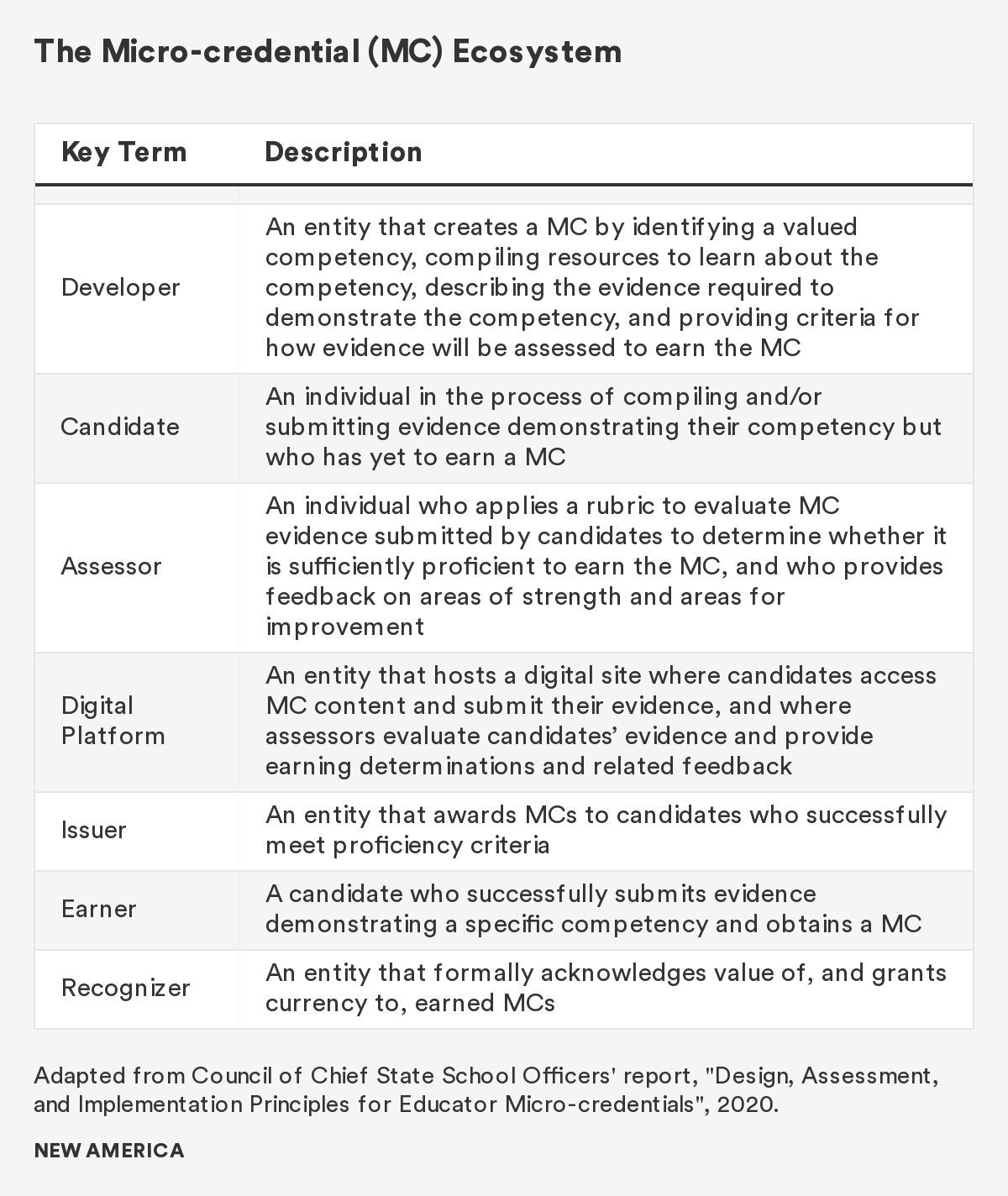

Note: In addition to being developers and issuers of their own MCs, the three most prominent organizations currently offering MCs (BloomBoard, Digital Promise, and NEA) also provide a digital platform for others to develop and issue MCs. For the purpose of this research, we will use the term “provider” to refer both to MC platforms and to individual MC issuers, although a few of the smaller platforms (e.g., Frontline Education) do not develop and issue their own MCs.
Citations
- Melissa Tooley and Joseph Hood, “Schools Take a Lesson from Tech Industry to Develop and Retain Strong Teachers,” EdCentral (blog), New America, September 14, 2020, https://www.newamerica.org/education-policy/edcentral/tech-microcredentials-develop-and-retain-strong-teachers/
- The notion that a MC provides public recognition of knowledge and skills held is similar in the higher education and the PreK–12 educator space. However, the process of attaining one is typically quite different. For example, in higher education—and massive open online course (MOOC) providers in particular—a MC may be earned when an individual completes some subset of coursework in a specific subject/skill area that is more than a single course but less than a full degree. In higher education spaces, the term “competency-based” denotes that a course or module is self-paced, and any demonstration of competency is often simplified to the idea of successfully completing an online assessment or assignment, without necessarily implementing any skills in practice. This approach may be appropriate for individuals who have yet to enter the workforce but is less relevant for individuals in the workforce who are engaging in MCs with the specific goal of influencing their practice.
Findings
Existing research on micro-credentials is lacking. Several organizations have published questions for states and LEAs interested in incorporating MCs to consider as they begin the process,25 but few have provided concrete direction to education leaders in approaching this work. Even the design, assessment, and implementation principles for educator MCs released in 2020 by a task force convened by the Chief Council of State School Officers26 (CCSSO)—a nonprofit composed of leaders of U.S. state K–12 education systems—were intentionally left high-level (see full principles list in Appendix B).
Our findings fill this research gap across four key areas: (1) designing and assessing MC offerings; (2) putting educator MCs into practice; (3) developing and implementing state and local policies; and (4) measuring impact on teacher practice and student learning.
First, we provide a comprehensive review of the national landscape, highlighting the similarities and differences that exist within the MCs offered that meet most, if not all, of the CCSSO-developed principles.27 (See a summary of Similarities and Differences within the Educator Micro-credential Ecosystem in Appendix C).
We also offer deep analysis of what has—and has not—led to successfully meeting various policy and practice objectives with educator MCs, in order to provide lessons and best practices to guide future MC efforts.
1. Designing and Assessing Micro-credential Offerings
Landscape Overview
One of the core characteristics that distinguishes a MC from other tools tied to PD and advancement is its assessment component. Nearly every entity engaging with educator MCs agreed that high-quality MCs were a demonstration of competency, but their perspective on what type of evidence is necessary to demonstrate that competency varied. Currently, the assessment of educator knowledge and competence can take several forms. From shallowest to deepest, it could measure: “whether an educator understands an idea or concept, can apply the idea or concept in a mock setting, can implement the idea or concept in the classroom, or can reflect on [their] experience using the idea or concept.”28 Likewise, the type of evidence that an educator would need to provide for each of these assessment types varies.
This is another area where different definitions and uses of terms can cause confusion. For example, even many entities who would agree that “implementation of practice” is a necessary component of the MC often are typically only asking for evidence of “application of competency” as defined above.
Some entities require even greater depth of evidence beyond employing the skill on one discrete occasion (or with one discrete MC) to ensure that the teacher has truly incorporated the competency into instructional practice. This can take the form of issuers requiring longitudinal evidence rather than “point-in-time” evidence. For example, BloomBoard and Digital Promise try, when possible, to require submitted articles of evidence from multiple points in time during the implementation process.29 For a single MC, they may require that a teacher submit a pre-implementation survey or data, then proof of implementation (perhaps a video of practicing that skill in class), and subsequent post-implementation data highlighting impact.
Most MC providers want teachers’ development of evidence to be a professional learning experience in itself. To this end, most providers refrain from providing specific examples of what successful artifacts look like in order to prevent teachers from just trying to recreate the example without significant work and reflection. Instead, providers attempt to set appropriate expectations for what successful submissions should entail by sharing the rubric used to assess the evidence. The level of detail in assessment rubrics varies, with some issuers providing specific descriptions of what the assessors are looking for, and others appearing to just repeat the objective of the competency (e.g., for a “checking for understanding” MC, simply indicating that to earn the MC, the candidate must demonstrate an adequate understanding of the key facets of checking for understanding). When a rubric lacks clarity and detail, it can be difficult for the educator to know (and meet) a given MC’s expectations.
Attempts to ensure quality of the individual assessors differs in many ways, from requiring demonstrated expertise in the competency (often by completing one or more MCs themselves, as Kettle Moraine School District in Wales, Wisconsin does), engaging in formalized training on using the specific MC’s rubric (as BloomBoard, Teaching Matters, etc., do), to initial and ongoing validation of assessment skills through spot-checks relative to a “master rater” or other attempts to ensure inter-rater reliability of scoring and feedback. BloomBoard’s approach is to have each assessor demonstrate the ability to score a given MC with at least 80 percent consistency relative to a “master” scorer.30 Digital Promise leaves the decision of who will assess up to the individual issuers on its platform, but requires each assessor to go through assessor training, and the first 50 MCs submitted must be rated by two assessors in order to help norm and ensure inter-rater reliability.31 Other providers, such as NEA, require that two assessors rate every submission and come to consensus. NEA also attempts to have the individual who developed the MC be one of the initial assessors, and it requires that all assessors be subject-matter experts and take an online course in proper MC assessment practices.32
Responsiveness of evaluators can depend on the issuing organization. Most providers use in-house staff (e.g., Center for Teaching Quality (CTQ), Kettle Moraine, Members Impacting Students; Improving Curriculum (MISIC), Kentucky Valley Educational Cooperative (KVEC), the Friday Institute at North Carolina State), but others hire current or retired educators in a gig-work model (e.g., BloomBoard, NEA, and Teaching Matters).33 Entities who have hired staff dedicated to the review of MCs are typically able to provide earning decisions and feedback on a quicker and more consistent basis than entities using in-house staff for whom assessing MCs represents only a small fraction of their work.
Beyond the assessment process itself, the “grain size” of the skill or competency the MC is assessing is another point of design variation within the field. Currently, the granularity of teaching skills that MCs are being used to assess ranges “from small and specific (e.g., ‘using wait time effectively’) to big and broad” (e.g., “understanding school-based data”).34 There is general agreement that if a MC is too broad it would be overwhelming for the educator and the issuer would not be able to accurately assess the competency. In these instances, several providers we interviewed felt strongly that such a MC needed to be broken down into smaller individual MCs.35
However, it is still unclear how developers actually determine whether MCs are “right sized” and encompass what the CCSSO calls a “substantive yet discrete set of skills that correspond with the demonstrated competency.”36 Without clarity on the appropriate method for determining grain size, some providers are relying upon a time-equivalency approach, as this is the current metric for fulfilling state license renewal requirements. The number of hours being provided for a given MC by the various entities we researched ranged widely, from three to 20, with little clear rationale for the differences. Some providers are backing into grain size, trying to find an evidence-based but sufficiently “micro” competency and estimating the average number of hours they think an educator should take to complete it. Others are looking at a state’s course credit hour requirements for license renewal and providing a constant number hours per MC to align with requirements in an easily divisible way (e.g., if 30 credit hours are required, making all MCs equivalent to five credit hours), regardless of the actual number of hours it will likely take educators to complete it.
While MCs do embed some resources to learn about and develop competencies, the depth and level of quality vary. When MCs were initially launched, providers tended to offer relatively superficial resources for educators to learn about the competency at hand which often proved to be inadequate. Many providers have recognized that teachers need to have deeper, more comprehensive resources integrated into MCs and have put additional emphasis on these in more recent iterations of their offerings.37
In most cases, the MC provider supplies links to selected articles and other resources that are relevant to the competency. However, the depth and form of resources offered differs. Some providers include high-level resources with the expectation that educators will identify additional resources if they need to (e.g., some of Digital Promise’s offerings). Some providers offer specific training materials tied to their MCs (e.g., the Friday Institute’s massive open online courses (MOOC) offerings). Other providers offer opportunities for educators to receive coaching or feedback along the way (e.g., nonprofit organizations that pair MC offerings with other PD opportunities, BloomBoard’s additional-cost virtual coaching option, etc.), whereas others only provide feedback upon formal submission of evidence for review (e.g., NEA and Digital Promise).
As highlighted above, significant variability exists in the grain-size, resources, required evidence, and rubrics across different MC providers. This is true even for MCs with very similar titles. An examination of four formative assessment MCs across several platforms found variance in required articles of evidence, including word length, types of evidence, and rubric rigor. No two sets of learning resources were the same, and they drew from diverse origins and mediums. For example, brief blog posts were presented alongside dense academic articles. Given this variation, it is difficult for state or local education agencies to determine which MCs are most likely to have the desired effects on teacher practice and retention when incorporated into PD and advancement efforts.
Best Practices in MC Design and Assessment
The large variation in MC perspectives and approaches in existence is the driver of a key question on many policymakers, and educators, minds: “What makes a quality micro-credential?” Quality necessitates that the MC itself is backed by research, but also that the skill it represents is discrete (proper grain size), that its required demonstration (via articles of evidence) is rigorous and representative of that skill, and that it is clearly defined in a rubric that can be understood and applied by both candidate and assessor. Such qualities are not automatically “baked in” to every MC. More specific details on the core five aspects of a quality MC follow.
Area of Focus and Level of Specificity
Before any other aspect of a MC can be considered, the topic and scope of what it covers are essential elements to get right.
- The competency being assessed must be shown by research to move teacher practice and thus student learning or, for burgeoning areas in education, have strong evidence indicating that it is likely to do so.
- Prior research on effective teacher PD finds that content-specific PD is most likely to shift practice and student outcomes although many MCs are currently grade- and subject-agnostic.38
- MCs should reflect narrow, discrete, actionable skills. A MC cannot certify, for example, a broad skill like “classroom management,” because classroom management is not in and of itself a measurable skill.
- Because they are meant to be specific, a MC for a very small, single competency may not have a significant impact on teacher practice by itself. Several MCs focused on a common goal (stacking) are necessary to capture a full skill set. For example, a teacher should not be able to earn a MC in classroom management, but could earn a stack of MCs in a set of complementary “micro” skills that as a whole encompass classroom management.
- The name of each MC must accurately and specifically reflect the competency demonstrated in it, both to ensure clarity when educators are searching for an appropriate MC to meet their individual needs, and for recognition and currency purposes. Employers will not—and should not—value MCs if they are not confident that the name of the MC reflects the skill the individual holds.
Quality of Resources and Embedded Supports
Resources provided to aid in demonstration of the given competency should be evidence-based and clearly connected to the competency.
- Resources need to be coherent, focused, and comprehensive enough to provide sufficient assistance to educators with a low starting level of knowledge and skill in the given competency to earn the MC.
- Educators should have a vehicle to ask clarifying questions and receive answers from the provider before submission to help ensure that they are on the right track toward earning the MC.
Quality, Clarity, and Type of Evidence Requested
Any evidence requested must be a valid demonstration of the competency in question, based on the best possible existing research. However, some types of competencies are not sufficient on their own (e.g., demonstration of knowledge), requiring further parameters for evidence.
- Developers should strive to require evidence on several dimensions of competence (knowledge, application, implementation, etc.) to provide a comprehensive picture of the MC candidate's skill, and make quality of MCs more consistent, since right now, some MCs ask for some of these types of evidence, while others ask for other types, making it difficult to compare quality.
- Rubrics need to be transparent and detailed enough that educators’ and assessors’ understanding of expectations are clear and aligned.
- Providers should refrain from providing examples of articles of evidence that met a rubric’s expectations so that educators cannot try to just replicate what a previous educator has submitted.
- The evidence requested should strive to gather information about the characteristics of the teachers’ students and ask teachers to demonstrate that they can successfully employ the competency with all of their students.
Quality of Assessment Process
Ensuring a trustworthy summative MC assessment process requires two elements: high-quality criteria and measurement procedures for evaluating evidence (typically via rubric) and a strong, consistent process for training and fine-tuning the ratings of the assessors themselves.39
- The rubric should identify the criteria for successfully earning the MC, with similarly defined criteria for unsuccessful submissions. The rubric should also clearly indicate how evidence requested is intended to address each of the criteria.
- Determining the appropriate weight for each piece of requested evidence is an important consideration in rubric design.40
- While the earning of MCs is an up-or-down decision, the scale used to assess evidence should be more nuanced (e.g., measured on a five- or seven-point scale) to ensure greater accuracy in rating.
- Ideally, this nuanced data would be shared with MC candidates and earners post-submission, to provide detailed and useful feedback for improvement.41
- Training assessors on how to accurately apply the rubric to evidence submitted is essential for accurate scoring. This requires providing opportunities for assessors to practice applying the rubric and compare their score to a “master” score (i.e., the score given to the same set of evidence by an expert assessor). A reviewer should only be considered calibrated after her or his review and scoring of evidence sources consistently aligns with the “master” score.
- It is also important to develop an ongoing process, potentially annually, for reviewer calibration to ensure reviewers continue to effectively and consistently apply the rubric.
- Given that MC evidence often requires application of skill in practice, assessment of submissions needs to happen quickly to provide initially unsuccessful candidates with an opportunity to resubmit after making improvements.
- BloomBoard found that receiving feedback in less than one week after submission was crucial for educator success and continued engagement, in its survey of 542 MC participants.42 Providers will likely need staff dedicated to the review of submissions in order to provide earning decisions and feedback in a timely way.
- Having the same assessor evaluate re-submissions helps ensure continuity of feedback, and minimize frustration on the part of the candidate. A candidate should not receive new or different feedback on parts of the submission that were initially deemed acceptable.
- Using internal versus external assessors has different advantages. (For more details, see Potential Advantages of Internal vs. External Assessors below.)
- One possible way to capture the best of both approaches is to have an internal coach help provide training and/or feedback to teachers leading up to submission of MC evidence but have a third-party assessor evaluate the submission with sufficient information about the teachers’ context. More research on this area is needed.
Potential Advantages of Internal vs. External Assessors
Advantages of internal assessors:
- Some teachers prefer to have assessors with whom they have formed trusting relationships (peers or coaches) and with whom they can collaborate throughout the process.
- Internal assessors are more likely to understand the context in which a teacher is working.
Advantages of external assessors:
- Some teachers may feel more comfortable and more willing to try and fail with someone outside of their school or LEA.
- External assessors could be more objective because of no prior relationship with those they are assessing.
- External assessors may have a broader perspective of what strong practice looks like across various contexts.
- Some implementing entities, such as HPS, found that external assessors allowed them to scale up teacher MCs without having to hire additional staff to ensure sufficient quality and turnaround time.
Transparency and Comparability of Earned MCs
To allow MCs to provide value to their holders, the requirements and the submitted evidence to achieve those requirements must be transparent and easily comparable by potential recognizers.
- Most major MC providers follow the IMS Open Badges standard for technical specifications.43 However, MC providers must consistently populate the various available badge fields in order to provide the depth of information necessary for adequate review or comparison.
2. Putting Educator Micro-credentials Into Practice
Landscape Overview: Educator Interest, Engagement, and Experience
Teacher Awareness of and Interest in Micro-credentials
While more recent data is lacking, a nationally representative survey of teachers in 2015 by Digital Promise found 15 percent of teachers were “somewhat familiar” with the concept of MCs, and only 4 percent said that they were “extremely or very knowledgeable.”44 The same survey found that once teachers were introduced to MCs as a concept, 31 percent said “they are extremely or very likely” to try them when they become available, and another 34 percent were “somewhat interested.”
Of 19 distinct MC features highlighted in the survey, teachers were least interested in displaying digital badges or sharing them on social media. One teacher observed, “I don’t need to show off badges on Facebook, I need to improve next week’s lessons.”45 The two most appealing factors were the opportunity to learn new skills and the opportunity to hone existing skills, with roughly 70 percent of teachers citing each factor as “appealing or very appealing.”
Most teachers are not stumbling upon MCs when searching for PD and learning opportunities. Digital Promise believes that a majority of educators access a particular MC on their platform because they are directed toward it by an issuer, professional development entity, school, or LEA.46 This is particularly true if it is their first MC engagement. As illustration, the majority of the educators accessing the Friday Institute’s MCs on Digital Promise's platform do so because they are engaged in courses which use those MCs to assess competency on the material they are learning.47
How Many Teachers Have Engaged with Micro-credentials to Date, and Who Are They?
Given that educators may be enrolling in and earning MCs across multiple platforms, it is difficult to calculate the total number of educators who have engaged with and earned MCs to date. Based on our analysis of data provided by Digital Promise and the National Education Association (NEA), two of the largest educator MC platforms, we can say with certainty that thousands of educators across all 50 states and Washington, DC have earned at least one MC.48 New America calculates that, on these two platforms alone, 2,232 educators earned 4,219 MCs between September 2019 and September 2020.49
Within states, LEAs, and schools, MCs are still largely an opt-in approach, which means that those engaging in MCs are not necessarily representative of the teaching population as a whole. For example, to date, Juab School District in Utah is unique in adopting MCs as a district-wide opt-in model supported with financial and PD credit incentives. Since the 2016–17 school year, 50 teachers have earned 300 MCs, but roughly two in three of its teachers have yet to even earn one. A pilot program by the Washington Professional Educator Standards Board (PESB) offers one of the broadest samples of MC participants in a state to date, with teachers from 29 districts participating in a grant program.50 Participating districts ranged from urban to rural and served a diverse range of students.51
The 2015 Digital Promise survey also found that early MC adopters reflected a wider range of experience levels and were less motivated by extrinsic factors compared to later adopters, who were more likely to be older and more driven by extrinsic factors, such as financial incentives.52 Early adopters said that lack of information, cost, and lack of administrator support or knowledge were the three biggest barriers to trying MCs. In general, those less satisfied with current PD activities were also less likely to be early adopters, indicating that cynicism regarding current PD offerings is a likely barrier to adoption.
New America has not been able to secure data from the various MC platforms or providers that would help us further understand the profile of the LEAs, schools, or teachers who are opting in, or the characteristics of their students.53 What is apparent is that which teachers have access to MCs is largely a matter of local leadership and even happenstance.54 However, in at least one state that implemented an “opt-in” MC pilot, SEA staff indicated that the “districts that have been active have been districts with money…mainly medium to large districts."55
Educator Experience with Micro-credentials
The overwhelming take on high-quality MCs from teachers who have engaged with them is that there are significant “pros” to the approach: they offer greater personalization and choice (both in terms of content and in terms of when teachers engage in the experience) and are more likely to have an impact on their practice and student learning.56 On the “cons” side, teachers find MCs more difficult to successfully complete, requiring more time and effort compared to typical PD experiences and requiring a greater level of self-motivation. This feedback dovetails with reviews of competency-based education at the higher education level.57
Some survey data highlight teachers’ general perceptions about the value of engaging in MCs. An exit survey conducted by Washington State’s PESB, after the third iteration of its MC pilot, asked participating educators to respond to the statements: “Working on my micro-credential submission has had a positive impact on my practice as an educator,” “Working on my micro-credential submission has had a positive impact on my students,” and “I would be open to working on another micro-credential in the future.” Educators gave an average response of 3.9 out of five for each of the three questions, where 1 indicated “strongly disagree” and 5 indicated “strongly agree.”58 Another survey by the Friday Institute of individuals who engaged in MCs it offered found that 97 percent of respondents who had completed at least one MC indicated they wanted to pursue more in the future.59
However, educator perceptions of MCs' value, and their eventual success in earning MCs, can be tempered by the relative ease and convenience of their experience, including their use of the digital platform's interface (See Importance of the MC Platform User Experience for more details).
Importance of the MC Platform User Experience
Having an easy-to-navigate, intuitive technological interface is crucial if educators are to be expected to virtually submit their articles of evidence. In Seven Lessons Learned from Implementing Micro-credentials, the Friday Institute, a research institute at North Carolina State focused on innovations that help improve schools, observed that the “online platform matter[s].”60 After receiving feedback from educators that it was difficult to submit all of the necessary materials and to understand the MC earning decision, the Friday Institute adjusted its platform accordingly. Following this change, the number of educators who did not complete the MC they enrolled in decreased from 55 percent to 27 percent. Additionally, 12 of 23 educators resubmitted artifacts after feedback, up from zero resubmissions prior to the platform changes.
Lessons: Necessary Conditions for Successful Implementation
While high-quality MC offerings typically embed some resources and/or supports within them, they are generally insufficient in supporting teachers' professional learning on their own. The MC principles published by CCSSO acknowledge that MCs are just one tool within the larger system of professional learning and advancement for teachers.61 The quality of the implementation and supports for educators occurring outside of the MC offering are just as important as the design and assessment of the MCs themselves, if not more so.
Because of the relatively low level of educator familiarity with MCs, along with the relatively high level of effort and motivation required to earn them, several key conditions will be necessary for authentic, widespread educator engagement and success with MCs: effective communication and local champions; provision of sufficient, regularly available time to work on MCs or related professional learning activities; instructional supports, including coaching and peer collaboration structures; and a culture shift to enable comfort with professional vulnerability, struggle, and even temporary failure.
Effective Communication and Local Champions
The first condition is simple: educators must understand the what, how, and why of MCs. Decades of policies and practices have been implemented without incorporating teacher input and have made teachers wary of the next “fad” in education reform. Teachers need to know what the process of earning an MC entails, and how earning one could benefit them and their students.
Strong school and LEA leader communication about MC’s value and support for successful engagement can lead to greater investment in MCs among teachers. In successful implementation at Walker-Gamble Elementary School in South Carolina, almost every educator and administrator named the LEA superintendent’s involvement and support as a key element in facilitating school-wide buy-in (with the superintendent herself actually joining one of the learning teams).62 Seminole County School District in Florida leveraged principals who volunteered to promote the work among their teachers, and also encouraged principals to look for MCs on educators’ resumes.63 Leaders at Harmony Public Schools (HPS) in Texas indicate that having school leader encouragement is critical for both initial teacher engagement with and successful earning of MCs. As Burak Yilmaz, director of instruction at HPS, explained, MCs got “pushed down [a teacher’s] priority list” when they were not a focus of local leadership.64
Designating and empowering peer advocates is another way to encourage teachers beyond the early adopters to embrace MCs. For example, Teaching Matters found that their MC pilot programs that were most successful had “champions” at the local level advocating for their implementation and promoting them in the school building. Several school systems have developed or are planning to develop MC “ambassador,” “facilitator,” or “navigator” roles for teachers who have completed MCs themselves and are able to encourage and support other teachers through the process.65
Solid communication and support by local education leaders and peer influencers is always important when introducing new initiatives, but especially important in garnering support for MCs because they require a more intensive, higher-caliber effort than what educators have historically encountered in the realm of PD and advancement. This is particularly true for “higher stake” use cases, such as obtaining relicensure credits or advanced roles, especially when more familiar, less risky options are still available. Many teachers view meeting license renewal requirements as a box that they must check to maintain employment that happens to include stipulations to develop professionally.66 Hours-based attainment of PD credit may be largely ineffective and compliance-oriented, but it is certainly easier. To illustrate this, consider: all educators who attend traditional “sit-and-get” PD receive credit for being there regardless of whether they learned anything or ever apply that knowledge in their classroom. In contrast, of the 161 Harmony Public School teachers who earned MCs in the 2018–19 school year, 33 percent earned after the first attempt, 48 percent earned after the second attempt, and the remainder took between three and five attempts.67
Regular, Dedicated Time for PD
Communicating the benefits of MCs from trusted school and LEA leadership can help facilitate teacher buy-in, but more structural changes to the workday will be needed to engage a sizable number of teachers. Results from the U.S. Schools Staffing Survey from either side of the turn of the 21st century showed that those working in high-minority schools participated in more PD but had less scheduled time for PD during their contracted hours than teachers in other schools.68 Linda Darling-Hammond and colleagues posited that this was because federal legislation had increased the funds that could be leveraged for PD in high-need schools, but school schedules and structures had not shifted correspondingly.69
Similar risks exist for the success of educator MCs. Regular, dedicated time to work on MCs was cited nearly unanimously (by interviewees70 and in prior research) as one of the greatest factors determining whether they can fulfill their potential. In a survey of teachers enrolled in their performance assessment MCs, CTQ and Digital Promise found that “every one of the teachers pointed out that they needed more, and different types, of time to learn about and develop the assessment competencies being measured.”71 Separately, teachers who were part of Charleston County School District MC pilot but did not complete a MC cited “lack of time” (59 percent) as the chief reason why they did not submit articles of evidence, far outpacing any other reason.72 A majority of teachers in a 2020 Digital Promise survey also reported that having dedicated time to work on the MC (76 percent) would be “definitely” or “very motivating” to their completing another one.73
The provision of time during contracted hours to work on MCs appears to increase the number of teachers engaging in MCs, as well as the rate of successful completion. For example, South Hamilton CSD in Iowa required all of its teachers to engage in a remote instruction MC with the onset of COVID-19 and almost all completed it.74 HPS prevents its educators’ PD time from being infringed upon by other responsibilities so they can focus on MCs.75 In the first few months of the COVID-19 pandemic in the U.S., Digital Promise observed a 20 percent increase in submissions, and a 135 percent increase in registered users over the same time period, which it partially attributed to teachers having less scheduled instructional time as schools figured out how to serve students in a remote environment.76
The need for additional time aligns with what researchers already know about educator PD—and retention—in the U.S.; American teachers have fewer contracted hours available for planning and professional learning than teachers in almost every other developed country,77 which leads many to plateau in skill or to leave the classroom altogether.78 And, often, a substantial proportion of contracted PD hours occur over the summer, when no students are present. When this occurs, teachers miss out on two critical experiences: engaging in a cycle of inquiry to grow professional practice, and demonstrating competency in an authentic environment (a requirement for most high-quality MCs).
Finally, shifts in communication and time use for other types of training will be necessary to achieve this goal. Currently, required trainings regarding safety, technology use, and a variety of other local policies are often referred to as “PD” and put on the school or district PD calendar on the same footing as developing key instructional practices. While these types of compliance-oriented trainings are necessary, LEAs could shift them to an asynchronous virtual format and achieve the same results, ensuring that they are no longer a core focus of scheduled PD time.
Support from Colleagues: Coaching and Peer Collaboration Structures
Dedicated time to engage in a cycle of inquiry and related PD opportunities is critical, but for the long-term success of MC implementation, teachers will also need ongoing, differentiated support from their colleagues through coaching and peer collaboration. Not every teacher will need the same level of support to earn MCs: much depends on the level of initial knowledge and skill in the given competency area, as well as preferred working styles. It also depends on the resources embedded in the MCs themselves, which are generally not sufficient on their own for developing the competency in question. However, even more experienced and motivated teachers working to achieve MCs to take on teacher leader roles often struggle without targeted support.79
In interviews with state and local education leaders, school instructional leaders, and MC providers, nearly every entity cited individualized coaching as substantially boosting the potential of MCs. Making dedicated coaching available has a significant impact on whether teachers successfully engage in and complete MCs.80 The Center for Teaching Quality (CTQ), a nonprofit focused on improving public school systems (including by providing professional learning services using MCs), found that the earn rate for its MCs increased by 30 percent with targeted support.81 Kelvey Oeser from the Texas Education Agency observed that a key reason its MC pilot was not as successful as anticipated was due to a lack of job-embedded coaching. She said, “there are ways to connect MCs to job-embedded coaching, but the MC [offering] itself does not necessarily ensure that the structures, expertise, and capacity for this coaching will happen, and we found…that many of the districts we worked with did not have those [pieces] in place.”82
Coaches must also be sufficiently familiar with MCs to be able to effectively guide others through the learning and earning process. Interviewees indicated that having colleagues in the building familiar with and able to support work with MCs appears to increase engagement and persistence to completion. But LEA and school administrators and instructional coaches often have difficulty providing meaningful support to teachers engaging in MCs without some deeper exposure and training themselves. Many, therefore, had their coaches and/or other instructional leaders enroll in the MCs they expected teachers to engage in, either first or at the same time.
Because of the rigorous nature of a high-quality MC, it takes teachers longer to successfully complete MCs when they are working on them in isolation.83 Opportunities for peer collaboration and professional learning communities (PLCs)—either within a teacher’s own building, LEA, or virtually with others working on the same MCs—can help. Peers can serve as partners in learning and practicing the necessary skills for a given MC, and can even provide feedback on the evidence before it is submitted for evaluation.84 HPS found the schools that were most successful at incorporating MCs were those with PLCs that encouraged the work and integrated it into what they were already doing.85 Additionally, the value of collective knowledge and skill building is likely much more valuable than individual knowledge and skill building, and this is not an aspect automatically built into the MC process.
More evidence of the value of learning communities for successful MC completion abounds. The NEA observed a positive educator response to the virtual “National and Statewide PLCs,” led by its MC assessors, that it put in place to support educators during the COVID-19 pandemic.86 Washington State identified PLCs as the chief driver of successful completion of MCs: a survey found that MC candidates were more satisfied and more likely to be successful in their submissions when they felt supported by collaborative learning systems rather than working in isolation.87 Washington PESB officials particularly stressed the role of learning communities in building resiliency and support for teachers in re-submitting evidence for MCs for which they were initially rejected. The state viewed PLCs as so important that it required any grantee in its MC pilot to bring teachers together in person at least once.88
Many schools and LEAs already have PLCs or other professional collaborative structures in place but have not figured out a way to fully harness their potential. In these places, MCs can not only benefit from collaboration, it can be the catalyst for it by helping facilitate strong inquiry-based learning practices where they did not previously exist.89 For example, research has identified several features that seem critical for successful professional collaboration, including having teacher-leaders trained to use explicit protocols to guide teams through “a process of identifying student learning problems, selecting instructional strategies, analyzing student work for evidence of impact, and honing strategies until they achieved results.”90 The structure of high-quality MCs could help provide the foundation for teacher leaders to work from. In a 2016 report, CTQ described MCs as offering colleagues a “common currency” for articulating and documenting specific knowledge and skills as they learn and work together.91 KVEC embraces such a community approach, facilitating in-person and remote collaboration for educators pursuing MCs in pursuit of solutions to common school-level problems of practice.92
Culture Shift
As with educator PD as a whole,93 the success of MCs hinges on a growth-focused professional culture. When presented within a compliance-oriented culture or set of policies around PD, it is not surprising that many teachers choose the most straightforward path to fulfill requirements, or at least one unlikely to expose areas of imperfection. For example, when Tennessee implemented its initial MC pilot for license renewal, offering six CEUs for completing a MC, a substantial number of educators chose to pursue a MC in a competency they already held, rather than an area for growth.94
The challenging nature of MCs, combined with entrenched attitudes about traditional PD activities, has necessitated significant culture shifts in schools and LEAs that are implementing MCs. The LEAs that are successfully implementing MCs beyond their most motivated teachers appear to be those that emphasize that professional learning is important for every educator, not just those who are new or “ineffective.” They articulate the goal of teacher PD as authentic and relevant continuous improvement, acknowledging that everyone has areas to grow, while recognizing and rewarding areas of strength. Also, they set expectations up front that MCs are more rigorous than previous PD by making it clear that many educators will not earn an MC on their first attempt; they frame the feedback teachers will receive and incorporate for subsequent resubmissions as an integral part of the learning process. Developing trust and a “not yet” growth mindset in schools, rather than a fear of failure, is essential for building the culture necessary for deep professional learning to take place.
This type of culture shift may well be the “secret ingredient” to implementing MCs successfully. But it is also likely to be one of the most difficult to source, as it must be grown, not bought.
3. Developing and Implementing State and Local Policies
Landscape Overview: Why, Where, and How MCs Are Being Used
Why do States and LEAs Use MCs?
In broad strokes, most states are using MCs to target a specific need or learning area. This is particularly the case when it comes to rolling out new competencies, addressing statewide learning needs, or providing targeted certification for specific labor shortages (for example, a dearth of STEM educators). Others see MCs as a strategy to bring more diversity into the teaching profession by making it more accessible and affordable. For example, “stacks” of MCs could be substituted for higher education credits or in lieu of traditional licensure exams.95
The motivation behind the use of MCs also aligns with the movement toward “competency-based education” in both K–12 and postsecondary education. Since Carnegie units were first developed in 1906,96 credentials have largely been measured using these, which are based on the number of hours expected for someone to physically attend classes in a given course of study. Ongoing professional learning has also been prescribed and documented primarily in terms of time, through continuing education units (CEUs).97 A shift away from Carnegie equivalents began over two decades ago in the postsecondary space, when Western Governors University instituted a self-paced model of learning where moving through the courses and credentialing programs was based on how quickly students met defined competencies rather than a predetermined timeline. The concept has caught on more recently in K–12 schools, with several states engaging in an “Innovative Assessment pilot” with competency-based education through the federal Elementary and Secondary Education Act.98
A significant number of the schools and LEAs that were early adopters of MCs for teachers did so in their quest to move to a personalized student learning model.99 These entities believed that in order to enable a more individualized learning approach for students, teachers needed to use this model for their own learning.
Finally, some smaller LEAs, such as Juab School District in Utah or Mountain Home Public Schools in Arkansas, see MCs as a way for them to compete for educator talent with bigger, higher-paying LEAs by providing motivated teachers with stipends and greater career advancement opportunities.100
Which States Promote MCs and for What Purpose?: Educator Human Capital Policy Type (as of August 2020)
| Any | Career Pathways and Advancement | License Renewal | Ongoing Professional Learning (Developed Own MCs) | Licensure Endorsements | |
|---|---|---|---|---|---|
| Number of States | 26 | 5 | 3 | 15 | 8 |
New America’s analysis found that 26 states have formal educator MC policies or programs in place.101 Six states have laws in place that define and/or outline the use of MCs for educators: Arkansas, Delaware, Mississippi, Oklahoma, Texas, and Virginia. (See “State Laws Regarding Educator Micro-credentials” in Appendix D.)
At least five states have, or are developing, programs that use MCs for career pathways and advancement. Arkansas and Louisiana have implemented state-recognized teacher leadership roles that can be earned by earning MCs, and Oklahoma is currently developing a similar system. Missouri is developing an alternative pathway for principals to earn a career certificate by earning 15 MCs.102 South Carolina is experimenting with MCs for teacher leadership and principal induction.
In three states—Tennessee, Utah, and Massachusetts—educators can count earned MCs toward license renewal through defined “exchange rates” that specify the Carnegie unit equivalent of each earned MC.
Fifteen states have developed or are developing their own MCs for professional learning and/or development, either in partnership with another entity or independently. Eight states allow MCs to be used for specific licensure endorsements.103 While most of these endorsements are focused on a specific educator shortage area, Louisiana has developed two certifications for teacher leaders that are attained via earning a stack of MCs: Content Leader and Mentor Teacher (each with multiple possible concentration areas).
Additionally, a significant number of states—such as Montana, North Carolina, South Carolina, South Dakota, and Texas—provide LEAs wide latitude to define and/or certify PD via relicensure credits. Other states authorize regional education service agencies or other third-party organizations (e.g., MISIC in Iowa) to develop and approve professional learning experiences for meeting state license renewal requirements, which can include MCs.104
How Do States Implement MCs?
States are still experimenting with MCs by piloting them with a subset of educators or LEAs or providing them as one of several options available to all educators. In very few places are MCs mandated. Most states and LEAs lean more toward choice, with educators engaging in MCs on a voluntary basis. This is due in part to an emphasis on local control when it comes to educator professional learning, and even attainment of some advanced roles, giving LEAs wide latitude to adapt MCs to their context.
While educators are mostly engaging in MCs on a voluntary basis, wide variation exists in the level of autonomy and breadth of the MC choice set that educators are provided. Some of the entities employing MCs for teacher leadership roles or other forms of advancement are very prescriptive about which MCs and other requirements candidates must engage in to attain the designation (Louisiana); some are very prescriptive about which MCs and other requirements but allow for choice in provider and approach (Arkansas, which allows several prescriptive pathways for teacher leader licensure); while others are prescriptive about the foundational set of MCs that must be attained, but allow flexibility around which “elective” MCs can fulfill the requirements (the Kentucky Educational Development Corporation (KEDC) and Juab School District). For MCs focused on ongoing professional learning (i.e., not specifically tied to advancement), some LEAs and schools require educators to engage in specific MCs, while others give educators wide latitude to pick MCs that best align with their interests. One unique case is Kettle Moraine School District in Wisconsin, which encourages teachers to develop their own MCs using a district-developed template.105
Across states, LEAs, and even the MC providers themselves, perceptions also vary widely about the need for—and the appropriate currency and level of—incentives offered to educators for engaging in and successfully completing MCs.
Some, such as Digital Promise, believe that providing currency and incentives tied to the earning of MCs is necessary and valuable, but that these decisions should be determined at the local level based on context.106
Others have more prescriptive beliefs about incorporating incentives. For example, NEA believes that the successful earning of MCs should translate into increases in base salary, and this is the approach that Kettle Moraine and Clark County Education Association are taking. Some entities, including but not limited to Arkansas, Louisiana, and Kettle Moraine, are creating opportunities for teachers to advance and take on leader roles in order to promote professional learning for colleagues. BloomBoard has created “role cards,” which are a list of the MCs that an educator would complete to demonstrate required competencies for a particular role or designation. Both Arkansas and Louisiana have worked with BloomBoard to create a set of MCs for designated teacher leader roles, and KEDC has created an approved route to advanced licensure in Kentucky using this type of approach. Harmony Public Schools is providing stipends to teachers who complete MCs and is also providing significant bonus pay for effective teachers who complete MCs and meet other eligibility requirements. Some providers, such as MISIC, are working within current license renewal system policies and taking a CEU-equivalency approach and trying to make each MC a rough estimate of expected number of hours in order to ensure that MCs hold value within the current license renewal system.107
Krystle Bassett from Juab School District shared her view that “incentives are initially important [to drive engagement], but become less important over time, because teachers see the impact and ultimately are driven by doing well by their students.”108 Currently, Juab takes one of the most comprehensive approaches to incentives, including nearly all of the approaches above: each MC is worth 0.5 credits on the district salary schedule, and teachers also have the potential to earn relicensure points. Teachers who complete all 12 of the MCs in a given teacher leader pathway receive a 5 percent increase in base salary. In order to maintain that increase, teachers must renew their advanced credentials with a tapering continuation of engagement with MCs: over the next three years, they have to engage at one-half the previous period’s rate (complete six new MCs), and then over the following three years have to engage at one-half the previous period’s rate (complete three new MCs). After that, the teacher leader base salary increase is permanent.
Lessons Learned: Policy Development and Rollout
Starting with the End in Mind
While states and LEAs have adopted myriad approaches to incorporating educator MCs, those that appear to have experienced the smoothest, most successful implementation (1) began with a clear, realistic idea of what they hoped to achieve by adopting MCs, informed by a deep understanding of this mechanism’s strengths and weaknesses; (2) created a theory of action to realize that objective; (3) discussed their goal(s) and theory of action with stakeholders; and (4) aptly integrated MCs into relevant parts of educator human capital systems.
Understanding where MCs most naturally fit into educator human capital systems is important for ensuring policies are designed in ways that best leverage the potential of MCs. MCs were initially developed as a tool to demonstrate and showcase skills that had already been developed rather than as a way to develop the skills themselves. Initially, MCs were attached to some other formal learning experience, such as a boot camp or a MOOC.109
High-quality MCs can promote professional learning by reflecting a cycle of inquiry where teachers plan how to incorporate a practice into their instruction, utilize the practice, assess its impact, and reflect upon how to further improve—and curate the evidence to show they did so. But, on their own, most MCs are typically not a good mechanism for training on a topic, as the learning experience is rather open-ended and self-directed. To leverage MCs for ongoing professional learning, either current MC offerings will require adaptation to offer more direct development opportunities, or greater outside resources must be provided to fulfill development goals.
On their own, MCs are typically not a good mechanism for training on a topic. To leverage MCs for ongoing professional learning, either current MC offerings will require adaptation to offer more direct development opportunities, or greater outside resources must be provided to fulfill development goals.
Several entities have engaged in processes for creating clear frameworks or maps for how teachers could qualify to take on a particular designation, role, or advanced licensure status. By mapping needs and roles, and what skills are necessary to meet those needs, an entity may also decide a particular goal would not be a good fit for fulfillment with MCs. If an entity determines MCs can play a role in qualifying candidates, stacks of MCs can then either be developed or chosen to meet the necessary requirements—much like how a teacher identifies the skills they want students to exemplify and then creates an assessment to measure them. The work of Arkansas, KEDC, and Louisiana demonstrate how BloomBoard’s “role card” approach aligns with this process. Some other MC providers focused specifically on teacher advancement, such as Teaching Matters, take a similar approach.
Several states have tried to roll out MCs without a clear connection to other human capital policies and found that they had difficulty engaging educators, who viewed them as not worth the time and energy required. One Texas official believes there was lower than expected teacher uptake of MCs during the state’s MC pilot in 2017 because the state did not clearly connect them to existing professional learning systems.110 Education officials in South Carolina offered that “we can’t ask teachers to do more if they don’t know where this is going to show up with renewal and advancement,” and there were also concerns “with ensuring portability from district to district.”111
Even states with a clear purpose, theory of action, and road map for how MCs intersect with other human capital policies in place have had to retroactively adjust their efforts to ensure that the professional learning resources being provided outside of the MCs align clearly with the MC tasks and rubrics. For example, because Louisiana began building out its external training resources prior to finalizing the design of its MCs’ assessment portions, it had to revisit and better align the training to the assessed competencies during the rollout phase.112
And intersection and alignment with human capital policies alone is likely not even sufficient. A report from a Carnegie Corporation working conference on educator MCs explains why, drawing on school improvement research which finds "that interventions that involve and align more aspects of the instructional process are more likely to exert influence. For example, when teachers worked with replacement curricular units aligned with outcome assessments, standards for learning, and professional development (PD), improvements in instruction and student learning were more likely to result than if teachers only worked with one or two of these elements."113 Most states are striving to align MCs with state teaching standards, but not going much beyond that. However, individual LEAs, such as HPS, shared that they have felt the need to customize the MCs they are using to better reflect the language and concepts traditionally used in their ongoing PD, curricula, etc.114
States can also play an important role in setting standards and processes for vetting MCs to ensure they are of sufficient quality, a practice that is currently largely, if not solely, left to the MC providers. (For best practices identified to date, see Designing and Assessing Micro-credential Offerings in Findings section.)
Relevance through Focused “Voice and Choice”
Giving teachers “voice and choice” can be an incentive for them to engage in MCs, as educators cite the ability to choose their own learning path as one of the primary reasons they currently seek out informal PD opportunities.115
But too much freedom could lead teachers to engage in MCs that are either not high-quality or are not critical to improving their practice; either will fail to better promote student success. In fact, in many states, teachers already have substantial freedom to choose their PD activities to satisfy license renewal requirements. However, because these options are so vast, and the tools to vet them almost non-existent, teachers and their students attain little, if any, value from them.116 Acknowledging this, many of the LEAs and states we researched found it beneficial to provide some parameters around which MCs could and should be pursued.117
Why entities select particular MCs in these “guided choice” models varies; some see state standards as driving the choice set, while others believe the options should be more closely aligned with the more focused, granular elements found in teacher observation rubrics. The scope of the choice set is also often determined by the expressed purpose of engaging in MCs, and the level of standardization or customization viewed as appropriate for the “use case.” For example, the menu of curated MCs is typically most limited for new endorsements or paths for advancement, and broader for license renewal— and ongoing PD more generally—to reflect the reality of individualized needs and interests. Even then, states and LEAs often provide guidance to teachers and their supervisors or coaches for how to utilize student data and personal performance data in creating PD goals and selecting MCs that align with them.
Some entities are even using MC data to help identify and support teachers’ development needs and interests, such as Kettle Moraine School District. SkillsForce, a recently launched educator MC platform, has also developed a learning management system (LMS) model to help organizations analyze data on their MCs and their educators and make connections between them.
Selecting Credential Currency and Appropriate Incentives
Due to micro-credentials’ novelty and relative difficulty compared to traditional PD and advancement opportunities, most educators have been unlikely to engage with MCs independent of an appropriate incentive.
Currently, there is no agreed-upon currency or incentives for engaging in MCs. Part of this is due to lack of familiarity with the level of knowledge and skill represented by a given MC or stack of MCs compared to more traditional signals. For example, nearly all employers assume that a master’s degree signifies a higher level of preparation than a bachelor’s degree.
Another reason is the lack of standardization across MCs: the level of knowledge and skill represented by a given MC or stack of MCs varies from one issuer to another, making it difficult to provide value to the earner. Educator MCs are not formally accredited, recognized, or evaluated by third party organizations. The exceptions are postsecondary institutions which have agreed to offer degree credits for MCs, or state entities with authority to provide license renewal credit or certificate endorsements. But even those approaches differ from institution to institution. This means that, similar to many other credentials, educators and recognizers value the MCs as a function of their knowledge of and trust in the developer and/or issuer.
If MCs are to secure clear, consistent value within educator human capital systems, their reliability and validity will need to be assured. Connecting Credentials, a collaborative of more than 3,000 stakeholders in the credentialing ecosystem, released a working report in 2017 that identified quality as one of the three foundations for trust in any given credential.118 One of the most powerful roles states can play is to set standards that secure a minimum level of quality in MCs, which will create trust in the credentials and allow them to hold currency. The state “guarantees” that a given MC holds a certain value by first ensuring it meets a set of standards, and then providing guidance on the appropriate value that the standard-meeting MC (or stacks of MCs) holds for a specific purpose (e.g., license renewal vs. advancement). Educators can then engage in MCs confident that there will be some level of return for their effort.
If MCs are to secure clear, consistent value within educator human capital systems, their reliability and validity will need to be assured.
A 2015 survey found that most teachers are not very interested in the potential for displaying digital badges for MCs earned.119 Our research finds that attaching real currency and value to MCs—such as financial stipends, advanced teaching roles, and/or credit toward re-licensure or required PD—can provide teachers the additional motivation needed to engage. However, the appropriate type, level, and ultimate influence of the chosen currency depends on several factors. Of particular weight is whether the stakes for success are high and whether there is a less challenging or “risky” alternative pathway available. For example, the teachers in Tennessee’s initial MC license renewal pilot who chose to pursue a MC for a skill they already held because they needed a certain number of credits to retain their license (high stakes) were behaving rationally, opting for the “sure thing” over possible failure.120 But this response did little to help them harness MCs for the state’s intended purpose of improving instruction.
State and LEA approaches to incentives and currency for MCs must take into account the current policies and practices surrounding professional learning and advancement. For example, certain supports (coaching, PLCs, and/or other dedicated time for PD, etc.) are not only necessary for MCs’ long-term success, but they are also desired and valued by teachers more generally.121 Offering deeper support to teachers who choose to engage in MCs in lieu of other approaches could be one way to incentivize engagement in LEAs where high-quality coaching and collaborative learning opportunities are lacking, but less of a motivator in an LEA where these supports are already abundant. Another example is the issue of who pays the fee associated with engaging in a MC.122 In some states and LEAs, teachers finance all or most of their own PD activities to fulfill license renewal requirements. In others, teachers expect that their employer will help them satisfy any PD hours they need for relicensure during designated in-service days. Where state or local provision of PD has been the norm, educators will likely be more resistant to MCs if they are expected to cover the cost. Several entities we spoke with shared that educators are unlikely to choose to pay for MCs out of their own pockets to satisfy relicensure requirements, particularly when there are more convenient, cost-effective, and less risky routes available.
The incentives and currency attached to other options for achieving the same goal must also be considered when determining the appropriate incentives and currency for MCs. For example, when educators are presented with equal value for pursuing a typical PD opportunity—such as attending a seminar with no assessment of knowledge gained or practice affected—and completing a rigorous MC to attain relicensure credit, the first option is a no-brainer for most.
The Carnegie Corporation educator MC working conference report contended that “as policy incentives increase in potency, more teachers will respond but with potential adverse consequences on authenticity."123 A few MC providers we interviewed verified this concern, sharing that they sometimes receive submissions where an educator is clearly “throwing out everything in the hope something will stick,” instead of investing deeply in the process.
This dynamic can in part be attributed to human psychology, necessitating a balance between extrinsic motivation and intrinsic motivation. The sweet spot appears to be in supporting teachers in pushing through anxiety or discomfort (a neurological state that is actually necessary to warm up the brain for a highly concentrative state) with a new or difficult task to the point where they begin to see rewards for their efforts, producing low levels of joy.124 But if the extrinsic rewards attached are too great, individuals interpret the “joy” as solely related to the reward, not to the task they are doing. Top neuroscience,125 behavioral psychology,126 and economic127 research indicates that to increase employee productivity and quality, extrinsic rewards should be minimal or even non-existent. Instead, researchers advise setting personal milestones along the way for successfully completing a goal—something that a stack of MCs in a particular competency area naturally helps educators do.
However, for intrinsic motivation to work as it should, employees must feel that they are being adequately compensated for the work they are already doing. It is likely that teachers in many states, some of whom are working multiple jobs to make ends meet,128 do not currently feel this way. This makes it more difficult to predict how they will respond to any incentives and/or currency offered for MCs. But evidence suggests that having more opportunities for ongoing development and advancement tied to adequate salary increases could play a role in retaining effective teachers.129 This approach could be particularly compelling for mid-career teachers (between six and 20 years of experience) who are more likely than other teachers to leave the profession.130
Ensuring Portability
For educator MCs to be successful in the long run, they must be portable, meaning that the currency they hold with employers remains relatively consistent and stable even when teachers move between schools or LEAs.
The most critical condition for portability, at least within a given state, is that the level of quality is relatively high and consistent from MC to MC (see Best Practices in MC Design and Assessment in Findings section for more information). Currently, most LEAs and SEAs are currently relying on third-party MC providers to guarantee quality, and therefore by association, portability as well.
While a few LEAs have developed their own high-quality MCs, portability of these MCs’ to other LEAs remains low, since developing high-quality standards and processes for vetting MC quality is beyond the current capacity of most LEAs. Similarly, when individual LEAs develop policies and practices around currency, it limits teachers’ confidence that an earned MC would hold currency if they were to become employed at another LEA. As a result, teachers are less likely to want to invest in earning MCs, particularly when there are other options available for attaining pay raises or advanced roles. As such, several states have seen the need to take the helm for determining which MCs “count” toward earning advanced designations, such as teacher leader roles.
Some states, including Texas, are discussing how to convey MC value and ensure portability by developing a process by which educators can include MC attainment on their certificates, although none have done so yet. This is most likely to occur via a badge on a digital certificate, so ensuring that MC providers follow IMS’ Open Badge standard for technical specifications will help create transparency and uniformity and facilitate MC portability.131
Creating MC Currency and Portability: The Case of Kentucky
Kentucky is an interesting case study for allowing for local flexibility while still maintaining intrastate portability. It recently adopted regulations enabling teachers to achieve an advanced “Rank 2” license status and accompanying salary increase, through an alternate approach to completing a master’s degree. Kentucky-based LEAs, institutions of higher education, and other education organizations can submit an application to the SEA proposing an alternate approach to meeting the rigorous requirements outlined by the SEA.132 Kentucky Educational Development Corporation (KEDC) is one entity the state has approved to implement an alternative Rank 2 model.133 KEDC has created a three-year, 24-MC pathway that balances a set of core pedagogical practices with room for individualization. Each MC was carefully vetted for quality by KEDC and selected based on alignment with the evidence-based competencies it had determined were most critical for advanced educators. KEDC’s MC Rank 2 pathway costs significantly less than enrollment in a traditional master’s degree program—an incentive likely to motivate teachers to engage in MCs despite their unfamiliarity.134 However, such state-specific advanced designations earned via MCs do not hold currency outside the state the way a master’s degree or National Board certification does.
Ideally, in the longer term, MCs would be portable across state lines, but, without some national standard-setting body for MCs, this seems unlikely. States each have their own initial and ongoing licensure processes, and for years have struggled to figure out simple ways to ensure license “reciprocity” between states. The portability of MCs presents many of the same challenges.135
Sufficient, and Equitable, Allocation of Resources
Developing and implementing clear, coherent, and impactful policies and practices that integrate MCs into human capital systems requires significant capacity (for example, hiring more coaches) and financial resources. But financial and human capital resources are not currently equally available for all schools, with those serving the highest-need student populations often being the most under-resourced. Any implementation of high-quality MCs into educator human capital systems will also be inequitable if the needs and resources of its individual schools and LEAs are not a primary determinant of how much state-based aid is offered and how it is allocated.
Access to sufficient resources for success also impacts school and LEA decisions about whether to apply to participate in pilots. Many smaller and/or less-resourced LEAs will not have the capacity to respond to lengthy applications without support, let alone implement their plans with fidelity.136
Some entities have allocated resources to account for existing inequities in their systems. For example, Louisiana focused its teacher leadership MC pilots on educators in its highest-need LEAs and it provided substantial financial support and technical assistance.137 Instead of punishing schools that were struggling to implement state-required PLCs, Georgia focused technical assistance in those regions to assist with implementation.138 HPS has also been focused on equity in its rollout, monitoring MC implementation at its most struggling schools in comparison to others so it can respond to any challenges that may arise.139 In some places, regional education service agencies, such as KEDC, have stepped in to apply to state innovation programs on behalf of the small, under-resourced LEAs that they serve.
Importance of Iterative Implementation
Arkansas originally made MCs mandatory for its new teacher induction programs. But shortly after, the state had to change course and make MCs voluntary after many educators struggled to earn one, in part because their mentors were not able to adequately support them.140
Arkansas’s experience is the perfect cautionary tale; failing to implement MCs iteratively, via pilots or other small-scale programs, increases the possibility that educators will become frustrated with any initial flaws, and the MC initiative will fail, or at least require greater effort to convince educators to give it another try. With this in mind, most states and LEAs implementing MCs have started by piloting the work with a small population and then scaling up slowly while working out any kinks. Those that did not take this approach found that some educators had already written off MCs by the time they had addressed issues. MCs are new, and capacity building—both in terms of guaranteeing support and ensuring educator comfort with a new approach—is needed prior to any far-reaching mandate.
This paper’s companion Model State Educator Micro-credential Policy Guide explains further how policy choices and implementation can help micro-credentials to meet their potential.141
4. Measuring Impact on Teacher Practice and Student Outcomes
The educator MC theory of change is that a teacher who can demonstrate an evidence-based competency at a given point of time will continue to apply that competency in future practice, leading to better student outcomes. There is little rigorous research to date about if or how MCs impact the quality of ongoing teacher practice or student outcomes in the short or long term. However, a few studies demonstrate at least some correlation between the two.
The Friday Institute studied the effects of providing teachers with feedback and opportunity to earn MCs as part of a MOOC end-of-unit performance assessment (the “treatment” group) as compared to teachers who had to submit the same performance assessment without feedback or the potential to earn a MC (the “control” group).142 Both groups were required to submit evidence (their choice of video, student work, or other documentation of classroom practice) and reflections on their practice, and both had access to the rubric used to evaluate their submissions. The treatment and control groups had similar levels of engagement and persistence in the MOOC. But educators in the treatment group scored higher on the rubric than those in the control group, indicating that feedback and possibility of earning a MC led to better ultimate performance. However, there is no evidence that teachers in either group continued to implement the skill in their classroom upon completion of the assessment.
In her doctoral dissertation, KVEC’s Jennifer Carroll found that students taught by educators participating in MCs performed significantly better on the Northwest Evaluation Association Measures of Academic Progress (NWEA MAP) test, a nationally-normed, adaptive, suite of general knowledge assessments, than peers who did not.143 However, because teachers chose whether to enroll in a MC, there is the possibility that the results are due to selection bias (i.e., more effective teachers were more likely to enroll in a MC than less effective teachers).
One reason we do not have more information about the impact of MCs is their sheer newness, but another is access to data. Several LEAs and states described how they are unable to access their own data on the MC platform that they use. Without it, they are unable to make necessary modifications, or to assess engagement and other outcomes.
Even with more access to data, the variability in MC offerings themselves, in addition to the equally important elements scaffolding MC attainment (e.g., coaching) and the incentives and currency attached to them, would make it very difficult to generalize any findings about MC impact on teacher practice or student outcomes. Any further research on impact must strive to understand how these differences impact the ability of MCs to meet their intended objectives. For example, research should try to assess whether requesting certain types of evidence of competency from educators is more likely to predict ongoing incorporation of this competency into practice.
Citations
- American Institutes for Research (AIR) developed a “Quality Criteria Tool” to help states consider necessary structures for successful MC implementation, as well as criteria for evaluating proposed or offered MCs for quality. See Cross-State Collective Inquiry Project: Micro-Credential Quality Criteria (Washington, DC: American Institutes for Research, 2019), https://www.ctc.ca.gov/docs/default-source/commission/agendas/2020-08/2020-08-4i-micro-cred-quality-crit-508.pdf?sfvrsn=4a652eb1_2. The Southern Regional Education Board Micro-credential Work Group brought SEA officials together to discuss pathways for PD, including MCs and ultimately developed a framework with the assistance of South Central Comprehensive Center and the Appalachia and Southeast Comprehensive Centers. Beverly Mattson, John Ross, and Kerri White, Micro-credentialing in an Educational Human Capital System Framework (Fairfax, VA: Cross-Comprehensive Center and SEA Micro-credentialing Work Group, 2019), http://www.sc3ta.org/plugins/amp/documents/3414/2019_09_17_Final_CC_SEA_Work_Group_MC_Framework.pdf. The National Education Association (NEA) and the Center for Great Public Schools (CGPS) has created a “NEA Micro-credential Implementation Planning Toolkit” for NEA affiliates considering MC implementation. The website includes a Readiness Checklist, Planning Guidance, Program Launching Guidelines, Implementation Guidelines, general MC Guidance, a PLC Facilitator Guide, promotional materials and graphics, and general resources to share: see NEA (website), “Micro-credentials,” http://cgps.nea.org/micro-credentials/affiliate-resources/
- National Education Association (NEA) and New America’s Education Policy program co-chaired the task force with Digital Promise. See the list at Council of Chief State School Officers (CCSSO website), “Design, Assessment, and Implementation Principles for Educator Micro-credentials,” https://ccsso.org/sites/default/files/2020-01/Micro-credentials%20-%20Design%20Principles_FINAL_1.pdf
- While this was true of the entities we interviewed for this project, the number of entities issuing something labeled MCs is increasing rapidly, and many do not align with New America’s definition of micro-credentials.
- The Teacher Quality Programs Technical Assistance Center (TQP TA Center), “Designing a Rigorous Micro-Credential Assessment Process to Verify Mastery of Competencies: Key Considerations,” July 2019, https://tqp.grads360.org/services/PDCService.svc/GetPDCDocumentFile?fileId=34632
- “Statistically perfect” in this context is 80 percent reliability. Jason Lange (Co-Founder and President, BloomBoard), in discussion with authors, October 7, 2020.
- Lange in discussion with authors, October 7, 2020; and TQP TA Center, “Designing a Rigorous Micro-Credential Assessment.”
- Odelia Younge (Director, Micro-credentials, Digital Promise) and Christina Luke (Director, Digital Certifications and Credentialing, Digital Promise) in discussion with authors, October 6, 2020.
- Ann Nutter-Coffman (Manager, Teacher Quality, NEA) in discussion with authors, September 23, 2020.
- Series of discussions with authors: Alesha Daughtrey (Executive Director and Partner) and P. Ann Byrd (President and Partner), Center for Teaching Quality, September 17, 2020. Patricia Deklotz (Superintendent, Kettle Moraine School District) and Theresa Ewald (Assistant Superintendent of Teaching & Learning), Kettle Moraine School District, September 25, 2020. Sue Beers (Executive Director) and Ann Bartelt (District Support Team), MISIC, July 24, 2020. Alexandra Manuel (Executive Director) and Maren Johnson (Associate Director, Educator Preparation and Credentialing), October 13, 2020, Washington Professional Educator Standards Board. Robert Brown (Professional Learning Lead for Micro-credential Policy) and Jennifer Carroll (Professional Learning Lead), KVEC, September 21, 2020. Alex Dreier (Instructional Design Lead) and Mark Samberg (Director, Technology Programs), Friday Institute for Educational Innovation, August 28, 2020. Lange, October 7, 2020. Nutter-Coffman, September 23, 2020. Evan O’Donnell (Director of Analytics and Innovation), Teaching Matters, September 9, 2020.
- Melissa Tooley and Taylor White, Rethinking Relicensure: Promoting Professional Learning Through Teacher Licensure Policies (Washington, DC: New America, 2018), https://www.newamerica.org/education-policy/policy-papers/rethinking-relicensure/; and Digital Promise (website), “Understanding School-Based Data,” https://microcredentials.digitalpromise.org/explore/understanding-school-based-data
- Discussion with authors: Beers and Bartelt, July 24, 2020 and Lange, October 7, 2020.
- CCSSO, “Design, Assessment, and Implementation Principles.”
- Discussion with authors: Lange, October 7, 2020 and Younge and Luke, October 6, 2020.
- Michael S. Garet, Andrew C. Porter, Laura Desimone, Beatrice F. Birman, and Kwang Suk Yoon, “What Makes Professional Development Effective? Results from a National Sample of Teachers,” American Educational Research Journal 38, no. 4 (2001), http://www.jstor.org/stable/3202507
- TQP TA Center, “Designing a Rigorous Micro-Credential Assessment.”
- TQP TA Center, “Designing a Rigorous Micro-Credential Assessment.”
- Jeff Sauro, “Is a Three-Point Scale Good Enough?” MeasuringU, August 13, 2019, https://measuringu.com/three-points/#:~:text=Four%2Dpoint%20scales%20communicate%20intensity,opinion%2C%20and%20a%20neutral%20point; and Matt Clifford (Principal Research Scientist) and Patricia Garcia-Arena (Principal Researcher), American Institutes for Research, in discussion with Melissa Tooley, November 10, 2020.
- Lange, email message to authors, December 15, 2020.
- For more information see IMS Global (website), “Open Badges v2.0 IMS Final Release,” https://www.imsglobal.org/sites/default/files/Badges/OBv2p0Final/index.html
- Grunwald Associates and Digital Promise, Making Professional Learning Count.
- Grunwald Associates and Digital Promise, Making Professional Learning Count.
- Younge and Luke in discussion with authors, October 6, 2020.
- Dreier and Samberg in discussion with authors, August 28, 2020.
- Digital Promise (website), “Micro-credential Policy Map,” https://digitalpromise.org/initiative/educator-micro-credentials/micro-credential-policy-map/
- Estimate based on aggregating data shared by Digital Promise and NEA. This is the maximum number of educators that earned MCs, as it is possible that some educators earned MCs on both platforms. Correspondence with BloomBoard indicates that in the last year, nearly 6,000 individuals submitted 10,000 MCs via its platform, although it declined to share how many MCs were actually earned, or the number of earners.
- The Potential of Micro-credentials in Washington State (Olympia: State of Washington Professional Educator Standards Board, 2019), https://www.pesb.wa.gov/resources-and-reports/reports/the-potential-of-micro-credentials-in-washington-state-report/
- In aggregate, the students served by districts in the pilot were slightly more racially diverse and less poor than state averages.
- Grunwald Associates and Digital Promise, Making Professional Learning Count.
- The major MC platforms either do not have or did not provide us with data on the characteristics of the educators engaging in MCs and their reasons for doing so.
- For example, Teaching Matters is a New York-based organization offering a comprehensive teacher leadership development approach with MCs, and most of its MC clients have been in the New York metro area. Members Impacting Students; Improving Curriculum (MISIC) is a nonprofit consortium of LEAs primarily in Iowa (and one Ohio) that has naturally engaged member districts in its MCs. Overall, a wide variety of geographic areas are currently utilizing MCs, from rural (e.g., Kentucky Valley Education Cooperative (KVEC), a consortium of Kentucky LEAs), to suburban (Kettle Moraine School District in Wisconsin), to urban (Harmony Public Schools in Texas). Some LEAs are very small (South Hamilton Community School District in Iowa), some average-size (Juab School District in Utah), and some big (Clark County School District in Nevada, via its local education association). Some serve more affluent students (Kettle Moraine School District), while others mostly serve students experiencing poverty (KVEC). While some of the LEAs we were able to study served a largely white student population, others served a more diverse, majority Black, indigenous, and people of color (BIPOC) student population.
- Lilla Toal-Mandsager and Libby Ortmann, Office of Educator Effectiveness and Leadership Development, South Carolina Department of Education, in discussion with authors, September 29, 2020.
- Micro-credentials and Teachers: What Do We Know? What Do We Still Need to Learn? (Washington, DC: Center on Great Teachers & Leaders at American Institutes for Research, 2020), https://gtlcenter.org/sites/default/files/Micro-credentials_for_Teachers%20_%20AIR.pdf
- A review of competency-based education programs at Western Governors’ University (WGU) found that, “student reviews of WGU tend to praise its convenience and flexibility, but suggest that the design requires a high level of student initiative and persistence.” Elena Silva, Taylor White, and Tomas Toch, The Carnegie Unit, A Century-Old Standard in a Changing Education Landscape (Washington, DC: Carnegie Foundation for the Advancement of Teaching, 2015), https://www.carnegiefoundation.org/wp-content/uploads/2015/01/Carnegie_Unit_Report.pdf
- The Potential of Micro-credentials in Washington.
- Lauren Acree, Seven Lessons Learned from Implementing Micro-credentials (Raleigh, NC: Friday Institute for Educational Innovation at the NC State University College of Education, 2016), https://www.fi.ncsu.edu/news/seven-lessons-learned-from-implementing-micro-credentials/
- Acree, Seven Lessons.
- CCSSO, “Design, Assessment, and Implementation Principles.”
- Center for Teaching Quality, “Leading Improvement, Together; Walker-Gamble Elementary & The South Carolina Collective Leadership Initiative,” 2019, http://www.teachingquality.org/wp-content/uploads/2019/05/WalkerGamble_CTQ.pdf
- Christina Kuriacose and Allida Warn, A Movement Towards Personalized Professional Learning, An Exploration of Six Educator Micro-credential Programs (Boston, MA: Center for Collaborative Education, 2018), https://www.cce.org/uploads/files/CCE-Micro-credentials-White-Pape.pdf
- Burak Yilmaz in discussion with authors, July 27, 2020.
- Discussion with authors: Yilmaz and Robert Thornton (Curriculum Director and Grant Facilitator), Harmony Public Schools, July 27, 2020 and Jim Beeler (Senior Director, College Access Partnerships), Appalachian State University, September 14, 2020; and Kuriacose and Warn, A Movement Towards Personalized Professional Learning.
- Stephen Sawchuk, “Is Teacher Recertification Broken?” Education Week, December 6, 2017, https://www.edweek.org/tm/articles/2017/12/06/is-teacher-recertification-broken.html
- Benjamin Feit, Guodong Liang, Zhaogang Qiao, and William J. Slotnik, Harmony Supporting Top Educators Program (H-STEP): Year Three Evaluation Report (Boston, MA; Community Training and Assistance Center, February 2020), https://c2b98a61-fb2c-416b-9ac0-b09b146f61c4.filesusr.com/ugd/0889be_3ec200d39fb94305ac1cb1d77bceaed6.pdf
- The authors defined “highest-need” as schools with the greatest proportions of minority, low-income, and limited English proficient students. Linda Darling-Hammond, Ruth Chung Wei, Alethea Andree, Nikole Richardson, and Stelios Orphanos, Professional Learning in the Learning Profession: A Status Report on Teacher Development in the United States and Abroad (Dallas, TX; National Staff Development Council, 2009), https://edpolicy.stanford.edu/library/publications/187
- Darling-Hammond et al., Professional Learning.
- For example, BloomBoard’s founder called time “the number one barrier to success in micro-credential implementation.” Lange, email message to authors, December 15, 2020.
- Barnett Berry and P. Ann Byrd, Micro-credentials and Education Policy in the United States (San Mateo, CA: Digital Promise and Center for Teaching Quality, 2019), https://digitalpromise.org/wp-content/uploads/2019/06/mcs-educationpolicy.pdf
- South Carolina Department of Education and the Center for Teaching Quality, South Carolina Micro-credential Pilot: CERRA and Charleston County Pilot (Columbia: South Carolina Department of Education, 2017).
- Christina Luke and Viki M. Young, Integrating Micro-credentials into Professional Learning: Lessons from Five Districts (San Mateo, CA: Digital Promise, 2020), https://digitalpromise.org/wp-content/uploads/2020/10/Integrating-Micro-credentials.pdf
- Cathy Stakey (Instructional/Technology Coach PreK-6), South Hamilton Elementary, in discussion with Melissa Tooley, October 26, 2020.
- Yilmaz and Thornton in discussion with authors, July 27, 2020.
- The timeframe of data collected was from February through April 2019. Christina Luke in discussion with authors, June 3, 2020.
- Darling-Hammond, et al., Professional Learning.
- Timothy D. Walker, “The Ticking Clock of Teacher Burnout,” The Atlantic, September 29, 2016,https://www.theatlantic.com/education/archive/2016/09/the-ticking-clock-of-us-teacher-burnout/502253/
- Discussions with authors: Daughtrey and Byrd, September 17, 2020; O’Donnell, September 9, 2020; Brooke Molpus (Executive Director, Academic Strategy), Louisiana Department of Education Management, October 29, 2020.
- Lange, email message to authors, December 25, 2020.
- Daughtrey and Byrd in discussion with authors, September 17, 2020.
- Kelvey Oeser (Deputy Commissioner of Educator Support), Texas Education Agency, email message to authors, November 10, 2020.
- Yilmaz and Thornton in discussion with authors, July 27, 2020. They also noted that those who did not work within a PLC had to resubmit their articles of evidence more often than peers who had PLC or coaching support.
- Beers, email message to authors, July 24, 2020; Berry and Byrd, Micro-credentials and Education Policy in the United States.
- Yilmaz and Thornton in discussion with authors, July 27, 2020.
- Nutter-Coffman in discussion with authors, September 23, 2020.
- The Potential of Micro-credentials in Washington.
- Manuel and Johnson in discussion with authors, October 13, 2020.
- Micro-credentials: Driving Teacher Learning & Leadership (Carrboro, NC: Center for Teaching Quality, 2016), https://www.teachingquality.org/wp-content/uploads/2018/04/Microcredentials_driving_teacher_learning.pdf
- Beyond “Job-Embedded:” Ensuring That Good Professional Development Gets Results (Santa Monica, CA: National Institute for Excellence in Teaching 2012), https://www.niet.org/assets/ResearchAndPolicyResources/688a72b19e/beyond_job_embedded_professional_development.pdf
- Micro-credentials: Driving Teacher Learning.
- Brown and Carroll in discussion with authors, September 21, 2020.
- Deklotz and Ewald in discussion with authors, September 25, 2020; and Kuriacose and Warn, A Movement Towards Personalized Professional Learning.
- Machel Mills (Director, Professional Learning Systems, Teachers and Leaders Division) and Amy Wooten (Executive Director, Educator Licensure and Preparation), Tennessee Department of Education, in discussion with Melissa Tooley, October 26, 2017.
- Jon Marcus, “More Students Are ‘Stacking’ Credentials en Route to a Degree,” WIRED, June 2, 2020, https://www.wired.com/story/students-stacking-credentials-route-degree/
- The Carnegie Foundation for the Advancement of Teaching (website), “What is a Carnegie Unit?” https://www.carnegiefoundation.org/faqs/carnegie-unit/#:~:text=The%20unit%20was%20developed%20in,unit%E2%80%9D%20of%20high%20school%20credit
- Tooley and White, Rethinking Relicensure.
- U.S. Department of Education (website), “Innovative Assessment Demonstration Authority (IADA),” last modified January 17, 2020, https://www2.ed.gov/admins/lead/account/iada/index.html
- Kuriacose and Warn, A Movement Towards Personalized Professional Learning; and Deklotz and Ewald in discussion with authors, September 25, 2020.
- Krystle Bassett (Innovation and Instruction), Juab School District, in discussion with Melissa Tooley, October 23, 2020. Lange, email message to authors, November 16, 2020.
- For our purposes, a state was counted as having a formal educator MC policy or program if there was some effort at the SEA level to either: explicitly define state policy around MCs in a published resource, use MCs for a state-recognized endorsement or certificate, develop MCs using state resources, use state resources to pilot MC(s), or establish state-widecareer pathways using MCs. If state resources were expended toward MCs, we counted that as active, rather than passive, state action toward MCs. Our tally of state policies is slightly lower than that of some other organizations. For example, see the map on Digital Promise’s website created in partnership with Center for Teaching Quality and NEA, https://digitalpromise.org/initiative/educator-micro-credentials/micro-credential-policy-map/
- Missouri Association of Elementary School Principals and Missouri Association of Secondary School Principals, “Missouri’s Introduction to an Alternative Path to Recertification Micro-credentials,” https://maesp.com/resources/Documents/MICRO-CREDENTIALS/microcreditials%20flyer.pdf
- Virginia: science, technology, engineering, and mathematics (STEM) endorsement areas, including computer science; Rhode Island: computer science; Oklahoma: severe-profound disabilities for special education teachers; Missouri: developing pathway for obtaining education specialist degree, career certificate for principals; Minnesota: endorsements (and certifications) for alternative career teachers and technical education teachers; Illinois: Professional Educator license endorsements in Learning Behavior Specialist 1, and Early Childhood Special Education through a partnership with American College of Education; and Arizona: computer science endorsement.
- Beers and Bartelt in discussion with authors, July 24, 2020.
- Deklotz and Ewald in discussion with authors, September 25, 2020.
- Younge and Luke, email message to authors, November 16, 2020.
- Beers and Bartelt in discussion with authors, July 24, 2020. Note that the number of hours that MISIC offers educators for each MC is less than that provided by other entities, despite the MCs being relatively on par with other entities in terms of grain size. The process of translating MCs into credit hours is not standardized. Most entities choose to provide the same credit hour equivalency for all MCs regardless of actual time estimated to complete.
- Bassett in discussion with Melissa Tooley, October 23, 2020.
- Tooley and Hood, “Schools Take a Lesson from Tech Industry;” and discussions with authors: Dreier and Samberg, August 28, 2020 and O’Donnell, September 9, 2020.
- Oeser in discussion with authors, November 3, 2020.
- Toal-Mandsager and Ortman in discussion with authors, September 29, 2020.
- Molpus in discussion with authors, October 29, 2020.
- Gary Sykes, “Micro-credentials for Educators: Research to Inform and Interrogate an Innovation: Report on a Conference,” unpublished paper prepared by Educational Testing Service for the Carnegie Corporation of New York, 2018.
- Yilmaz and Thornton in discussion with authors, July 27, 2020.
- RTI International, “Micro-credential Focus Group: Emerging Framing Ideas” (virtual presentation to the North Carolina Partnership for Micro-Credentials, November 23, 2020).
- Tooley and White, Rethinking Relicensure.
- For example, see page 7 in Kuriacose and Warn, A Movement Towards Personalized Professional Learning.
- Connecting Credentials, Building Trust in the Quality of Credentials (Ann Arbor, MI: Corporation for a Skilled Workforce and Lumina Foundation, 2017), http://connectingcredentials.org/wp-content/uploads/2017/11/Trust-FINAL.pdf
- Grunwald Associates and Digital Promise, Making Professional Learning Count.
- Mills and Wooten in conversation with Melissa Tooley, October 26, 2017.
- Dian Schaffhauser, “Teachers Like Coaching for PD, but Impact Could be Greater,” The Journal, February 10, 2020, https://thejournal.com/articles/2020/02/10/teachers-like-coaching-for-pd-but-impact-could-be-greater.aspx; and K–12 Dive (website), “Survey: Teachers Want More Time for Collaboration,” https://www.k12dive.com/news/survey-teachers-want-more-time-for-collaboration/518381/
- Depending on the MC provider, educators may be charged for each MC they choose to engage in and/or submit evidence for assessment.
- Sykes, “Micro-credentials for Educators.”
- “Change Your Brain: Neuroscientist Dr. Andrew Huberman,” episode 533 of Rich Roll podcast, https://www.richroll.com/podcast/andrew-huberman-533/
- “Change Your Brain.”
- David Burkus, “Extrinsic vs. Intrinsic Motivation at Work,” Psychology Today, April 11, 2020, https://www.psychologytoday.com/us/blog/creative-leadership/202004/extrinsic-vs-intrinsic-motivation-work
- For example, see Daniel H. Pink, Drive: The Surprising Truth About What Motivates Us (New York: Riverhead Books, 2009).
- Regional differences in pay result in varying attitudes: A 2018 PDK poll found that 60 percent of teachers in the Northeast, 47 percent on the West Coast and roughly 30 percent of teachers in the South and Midwest said they are fairly paid. For more information, see CNBC Make It (website), “50% of Teachers Surveyed Say They’ve Considered Quitting, Blaming Pay, Stress and Lack of Respect,” https://www.cnbc.com/2019/08/09/50percent-of-teachers-surveyed-say-theyve-considered-quitting-teaching.html; and Karen Hawley and Nicole Katz, “Teacher Salaries: A Critical Equity Issue,” State Education Standard 18, no. 3 (2018), https://www.erstrategies.org/news/teacher_salaries_a_critical_equity_issue
- The Irreplaceables.
- Emma García and Elaine Weiss, U.S. Schools Struggle to Hire and Retain Teachers (Washington, DC: Economic Policy Institute, April 16, 2019), https://www.epi.org/publication/u-s-schools-struggle-to-hire-and-retain-teachers-the-second-report-in-the-perfect-storm-in-the-teacher-labor-market-series/
- For a full list of specifications, see IMS Global (website), “Open Badges v2.0 IMS Final Release,” https://www.imsglobal.org/sites/default/files/Badges/OBv2p0Final/index.html
- Rob Akers (Associate Commissioner), Office of Educator Licensure & Effectiveness, Kentucky Department of Education, in conversation with authors, October 2, 2020.
- Latishia Sparks (Programs and Partnerships) and Charles Rutledge (Educational Consultant), Kentucky Educational Development Corporation, in conversation with authors, November 13, 2020.
- Of the 24 MCs, 20 are mandated MCs (aligned with Danielson’s observation rubric), and the final four MCs function as a personalized “capstone” action research project. Rutledge and Sparks in discussion with authors, October 9, 2020.
- Alyssa Evans, Cassidy Francies, and Tiffany McDole, 50-State Comparison: Teacher License Reciprocity (Denver, CO: Education Commission of the States, June 24, 2020), https://www.ecs.org/50-state-comparison-teacher-license-reciprocity/
- Laura Varlas, “Education Funding: Underwater and Overdue for Reform,” ASCD 16, no. 3 (2010), http://www.ascd.org/publications/newsletters/policy-priorities/vol16/issue3/full/[email protected]
- Molpus in discussion with authors, October 29, 2020.
- Shauntice Wheeler (Title II, Part A Program Manager at State Activities and Professional Development), Georgia Department of Education, in discussion with authors, October 9, 2020.
- Yilmaz and Thornton in discussion with authors, July 27, 2020.
- Sandra Hurst (Diretor, Office of Educator Effectiveness), Arkansas Department of Education, in discussion with authors, August 13, 2020.
- Melissa Tooley and Joseph Hood, Harnessing Micro-credentials for Teacher Growth: A Model State Policy Guide (Washington, DC: New America, 2021), https://www.newamerica.org/education-policy/reports/harnessing-micro-credentials-for-teacher-growth-a-model-state-policy-guide/
- Lauren Acree, Jim Creager, Eric Wiebe, and Mary Ann Wolf, “The Impact of Micro-credentials on Professional Learning in a Massive Open Online Course for Educators” (American Educational Research Association Annual Meeting, New York, 2018). The MOOC was separated into six distinct units, and each unit had a corresponding MC that those in the treatment group could earn. The study focused on units 2, 3, and 4, which respectively examined working memory, executive function, and motivation in the classroom.
- Jennifer S. Carroll, “A Quantitative Study of the Impact of Micro-credentials on Educator Professional Learning,” (PhD diss., University of the Cumberlands, 2019).
Conclusions and Recommendations
Incorporating micro-credentials into educator professional development and advancement systems can help refocus these systems’ role in recognizing growth and overall quality of teacher practice and related student outcomes.
While MCs are primarily focused on the assessment of competency, high-quality MCs have significant potential to improve the quality of PD, and hence, the quality of instruction, by:
- Making it more relevant by identifying and targeting personalized areas for growth
- Providing resources that draw upon the best available research and evidence of impact for a given competency
- Promoting greater engagement and satisfaction with professional learning by increasing teacher agency
- Promoting learning by doing
- Providing feedback on practice and opportunities to learn from mistakes
- Modeling best practices in teaching by following an inquiry-based learning and feedback process
MCs also offer significant potential in allowing teachers to showcase their skills and advance professionally regardless of experience level or degrees held. MCs can help attract and retain highly talented teachers by formally assessing and recognizing previously unrecognized skills and providing opportunities for increased responsibilities related to those skills, along with compensation in line with those responsibilities.
However, it is too soon to say with certainty whether MCs will fulfill this potential. This is in part because most systems have not had MCs in place long enough—or at a broad enough scale—to assess impact. And measuring the impact of MCs broadly is difficult due to the wide variation present in current offerings and approaches, not only in their approach to assessment, but also in the depth and specificity of the resources presented.
When educator MCs were initially introduced, most were not attached to high stakes, such as advanced roles or license renewal. As the applications and aspirations of MCs become more ambitious, their quality must keep pace. In order for MCs to reach their full potential, education leaders must come to consensus about what high-quality MCs are and are not. States, rather than LEAs, should establish quality standards for MCs’ assessment components so that MCs can be recognized as holding consistent value regardless of location of employment. Ideally, there would be a nationally accepted definition of quality for MCs—and potentially an external, unbiased reviewer (like Consumer Reports)—so that MCs could be portable between states as well.
Conducting additional research on how to ensure MCs are valid and robust measures of teacher competence, and assessing the impact of MCs on teacher practice and student outcomes, should be a key focus for education policymakers and philanthropies as more state and local education agencies implement MC initiatives. In the meantime, the lessons and best practices detailed in this report offer a clear starting point for determining quality offerings and approaches.
State and local leadership can demonstrate that it understands and supports the elements of high-quality PD, and the integration of MCs into an effective professional learning and advancement system, by ensuring that:
- Any PD opportunities, whether connected to MCs or not, are aligned with professional learning standards and the federal Every Student Succeeds Act’s definition of high-quality PD. In many cases, the state will have greater capacity and resources than a regional or local entity and should harness these to develop high-quality teacher development opportunities, both with and without MCs. For example, states can provide guidance to instructional leaders for how to effectively embed MCs into collaborative structures like PLCs and tools for development such as individual professional growth plans. States can also leverage regional education service agencies as partners in the work.
- Systems are in place to help determine which educator PD opportunities and elements produce the best return on investment (ROI). ROI should take into account both the success rate in helping teachers earn MCs on related competencies, and a longer-term assessment of how instructional practice and student outcomes change.
- The design and implementation of MC policies and systems is careful and iterative. Determine what success would look like for the given objective and work backward. Collaborate with stakeholders early in the policy development process to address concerns and incorporate their ideas. Policies should start small and phase in gradually over time, analyzing data and stakeholder experience to address issues as they arise.
- The design of any human capital policies that involve MCs, including any associated incentives, is clearly driven by the intended goal and application of the policy. It will be important to make policy design and implementation choices that align with the intended objective(s). For example, there is a difference between using MCs for ongoing PD and using them for advancement: the former has the goal of growing skill in one’s current role, while the latter has the goal of validating skill for entry into a new role. As a result, two different approaches to incentives and currency are necessary to effectively motivate the desired behavior, and support educator success in attaining the desired outcomes. See companion Model State Policy Guide for further details.144
- A system is developed to rigorously vet and convey the quality of MC offerings. The value that MCs hold must be investigated and assured through formal processes. The market is not a sufficient quality control mechanism, as popularity does not necessarily translate to effectiveness. Quality guidelines should be consistent to ensure that an MC earned for one use (e.g., ongoing professional learning), could also meet requirements for another use (e.g., license renewal or advancement requirements).Ensuring digital badges or other documentation of MCs offered can be thoroughly explored and verified by potential employers is another key aspect that must be in place to ensure transparency around quality and allow for MCs to hold currency.
- Educators are provided with clear and frequent communication of what high-quality MCs are and how engaging in them could help them and their students. Use language that helps separate the MC itself (which, like any other credential, is what is earned upon completion of an activity that indicates the holder has knowledge and/or skills that should translate in the job market) from the process leading up to the earning of the MC. Clearly communicate that MCs are a tool that can promote the kinds of PD activities that align with evidence on best practices for adult learning, even if they are not PD in and of themselves. Also, make a clear distinction between MCs and digital badges, which may be perceived as faddish.145 Even “competency-based” is not clear enough, as how institutions of higher education (IHEs) think about “competency-based education” and MCs is different from how K–12 has approached and defined them. This is something those in the field need to continue to think through if IHEs are planning to play a role in the MC ecosystem.
- High-quality MC offerings are curated to align with educators’ and students’ needs. Educators should have some discretion in choosing what professional learning and/or advancement opportunities to pursue based on their own interests and goals. However, those decisions should be a “guided choice,” scaffolded within a set of options that will move school and LEA objectives forward as well. MCs for license renewal can be much more focused on school and LEA goals, while MCs as part of individual professional growth plans can allow for greater flexibility and personalization, while still ensuring a focus on better serving students. Curating a smaller set of vetted MCs for teachers to choose from also allows schools and LEAs to better support teachers throughout the process, and better enables teachers to collaborate toward meeting common individual and school goals. It also limits the burden put on state education administrators tasked with assessing the quality of MCs.
- Educators engaging with MC offerings are provided the quality and level of support necessary to succeed. Relevant high-quality related learning resources must be made accessible on a given MC competency relative to the prior skill and knowledge level of the teacher engaging in it. While this is a particular concern for novice teachers who already face a steep learning curve, it is true for experienced teachers as well. Other instructional resources, such as curricula, should reflect and not contradict the shifts in practice that high-quality MCs are requesting of educators. Educators also need sufficient quality and quantity of timely, individualized coaching and feedback and opportunities to collaborate with peers in a cycle of inquiry on the MC competency being pursued during contracted hours. Instructional leaders should learn about and experience MCs themselves in order to have adequate knowledge to guide teachers through the process. Educators in very small schools or LEAs and educators who are “singletons” in terms of role or subject matter should have access to virtual peer collaboration and coaching opportunities (sometimes via the MC platforms themselves). However, a broad-scale virtual approach is less likely to positively shift the overall professional learning culture within a given school or LEA.
- MCs are implemented as a tool for furthering equity rather than reinforcing current discrepancies in student access to quality teaching. An opt-in approach to MCs may lead to only the most well-resourced schools or LEAs being able to provide high-quality MC opportunities, leaving less well-resourced ones, and the students they serve, further behind. One way state and regional education agencies can help support equitable MC implementation efforts is by recruiting a representative sample of LEAs to participate in the first phase of any initiative, and offering additional resources to high-need LEAs to assist with implementation. Resources offered to high-need schools should cover the added compensation for any new teacher leader roles, and for new positions in the event that a teacher leader will have to spend less time leading their own classroom. Providing this compensation will simultaneously help build a culture of collaborative professional learning and aid retention efforts in these schools.146 If possible, states should oversample from high-need LEAs to ensure a sufficient base size for data analysis and to focus funding and implementation support to the LEAs most in need as early in the rollout as possible.
- States, LEAs, and schools have full access to all of their MC data and use that data to inform ongoing policy and practice. Access to data enables a better understanding and harnessing of MCs’ potential. It can provide a deeper understanding of educator motivation and persistence related to various educator human capital policies, including those viewed as compliance (e.g., license renewal) versus personal growth and advancement. Data access allows for evaluation of the relationship between earning MCs and teaching practice and student achievement, including which aspects of or approaches to MCs appear to have the most impact. It can also help states and LEAs better target professional learning opportunities, and make smarter purchasing decisions, moving away from a “pay-per-service” mindset toward one that motivates MC issuers to improve the efficacy of their offerings.147
Like any specific tool to improve our K–12 education systems, MCs are not a silver bullet. The issues with both traditional PD offerings (the available tools, vehicles, and resources) and with professional learning systems (the structures, policies, and practices supporting and giving meaning to the PD offerings) are well-documented and long-standing. While our research finds that high-quality MCs have significant potential to positively impact the former, they will not be successful without significant shifts to the latter— particularly a culture and mindset shift from compliance to ongoing growth. Reaping success from MCs requires making bigger shifts to systems, rather than simply layering MCs on top of, or next to, policies and processes already in place. The elements of educator development and advancement systems may be less exotic than a novel digital tool but, left unaddressed, most educators will struggle to attain MCs, many schools will continue to struggle to retain good teachers and develop them into great ones, and students with the greatest needs will continue to struggle as well.
For more detailed recommendations on designing and implementing effective human capital policies incorporating micro-credentials, see New America’s companion brief, Harnessing Micro-Credentials for Teacher Growth: A Model State Policy Guide.148
Citations
- Tooley and Hood, Harnessing Micro-credentials for Teacher Growth: A Model State Policy Guide, https://www.newamerica.org/education-policy/reports/harnessing-micro-credentials-for-teacher-growth-a-model-state-policy-guide/
- RTI International, NC Feasibility Study Report to the North Carolina Partnership for Micro-Credentials, (prepared for digiLEARN, unpublished, November 2020); RTI International, “Micro-credential Focus Group: Emerging Framing Ideas.”
- Joellen Killion, Cindy Harrison, Amy Colton, Chris Bryan, Ann Delehant, and Debbie Cooke, A Systemic Approach to Elevating Teacher Leadership (Oxford, OH: Learning Forward, 2016), https://learningforward.org/wp-content/uploads/2017/08/a-systemic-approach-to-elevating-teacher-leadership.pdf; https://www.ecs.org/wp-content/uploads/Mitigating-Teacher-Shortages-Teacher-leaders.pdf
- Heather Staker, Thomas Arnett, and Allison Powell, Developing a Student-Centered Workforce through Micro-credentials (Lexington, MA: Christensen Institute, 2020), https://www.christenseninstitute.org/wp-content/uploads/2020/09/student-centered_microcredentials_final.pdf
- Tooley and Hood, Harnessing Micro-credentials for Teacher Growth: A Model State Policy Guide.
Appendices
Appendix A: Research Background and Methodology
New America’s Education Policy program has been engaging in research and analysis on the topics of educator professional learning, retention, and advancement for a decade, and has been engaged in conversations and research on educator MCs since their inception. In early 2020, New America teamed up with digiLEARN149, a North Carolina-based non-profit organization, as the state considered if and how to incorporate educator MCs into policy. digiLEARN convened a group of key state stakeholders to learn about MCs and develop recommendations for the State Board of Education, and New America contributed its expertise to the project as an advisor, as well as by undertaking research to provide insights into the current national micro-credentials ecosystem.
Our methodology for this expansive project included:
- Review of prior research and writing on educator MCs
- Data collection and analysis from the three leading MC platforms
- Interviews with over 37 MC ecosystem stakeholders across 22 states and Washington, DC, including six SEAs, three regional education service agencies, eight representatives of LEA and educator associations, and six technical platform and/or digital service providers, including one national education association (see full list below)
- Integration of pre-existing research on state MC policies and our own independent review of policies on public-facing state websites
List of Interviews Conducted
| Entity | Staff Member(s) | Date(s) |
|---|---|---|
| American Institutes for Research | Jason LaTurner, Verna Lalbeharie, and Lisa Lachlan | 9/10/20 |
| American Institutes for Research | Mark Clifford and Patricia Garcia-Arena | 11/10/20 |
| Appalachian State University | Jim Beeler | 8/20/20 and 9/14/20 |
| Arkansas Department of Education | Sandra Hurst | 8/13/20 |
| ASSETT at Radford University | Matt Dunleavy and Lisa Thompson | 8/14/20 |
| BloomBoard | Jason Lange | 7/24/20, 9/30/20, and 10/7/20 |
| Capella University | Jillian Klein | 10/13/20 |
| Center for Teaching Quality | Alesha Daughtrey and Ann Byrd | 9/17/20 |
| Clark County Education Association | Brenda Pearson | 10/21/20 |
| Digital Promise | Odelia Younge and Christina Luke | 6/3/20, 7/6/20, and 10/6/20 |
| Education Elements, Inc. | Lauren Acree | 10/21/20 |
| Friday Institute | Alex Dreier and Mark Samberg | 8/28/20 |
| Frontline Education | Elizabeth Combs | 10/1/20 |
| Georgia Department of Education | Shauntice Wheeler | 10/9/20 |
| Harmony Public Schools | Burak Yilmaz and Robert Thornton | 7/27/20 and 11/4/20 |
| Illinois Regional Office of Education #17 | Molly Allen | 10/20/20 |
| Illinois Regional Office of Education #19 | Mark Hansen | 10/20/20 |
| Illinois Regional Office of Education #28 | Gail Fahey | 10/20/20 |
| Instructional Management System Global | Bruce Umpstead and Jeff Bohrer | 7/21/20 and 8/20/20 |
| Juab School District | Krystle Bassett | 10/23/20 |
| Kentucky Department of Education | Rob Akers | 10/2/20 |
| Kentucky Educational Development Corporation (KEDC) | Latishia Sparks and Charles Rutledge | 10/9/20 and 11/13/20 |
| Kettle Moraine School District | Patricia Deklotz and Theresa Ewald | 9/25/20 |
| Open Education Global | Kristina Ishmael | 8/20/20 |
| Kentucky Valley Educational Cooperative (KVEC) | Robert Brown and Jennifer Caroll | 9/21/20 |
| Learning Forward | Elizabeth Foster | 10/19/20 |
| Louisiana Department of Education | Brooke Molpus | 10/29/20 |
| Members Impacting Students; Improving Curriculum (MISIC) | Sue Beers and Ann Bartelt | 7/24/20 |
| National Board for Professional Teaching Standards (NBPTS) | Peggy Brookins | 11/10/20 |
| National Education Association (NEA) | Ann Nutter-Coffman | 9/23/20 and 7/21/20 |
| Public Impact's Opportunity Culture | Stephanie Dean | 9/24/20 |
| RANDA Solutions | Marty Reed | 8/14/20 |
| South Hamilton Community School District | Cathy Stakey | 10/26/20 |
| SkillsForce | Bryan Scanlon | 10/28/20 |
| South Carolina Department of Education | Lilla Toal-Mandsager and Libby Ortmann | 9/29/20 |
| Teaching Matters | Lynette Guastaferro and Jennie Brotman | 6/28/18 |
| Teaching Matters | Evan O'Donnell | 9/9/20 |
| Tennessee Department of Education | Machel Mills and Amy Wooten | 10/26/17 |
| Texas Education Agency (TEA) | Kelvey Oeser | 11/3/20 |
| Washington Office of Superintendent of Instruction (OSPI) | Julia Fallon and Barbara Soots | 9/9/20 |
| Washington Professional Educator Standards Board (PESB) | Alexandra Manual and Maren Johnson | 10/13/20 |
| Western Governors University (WGU) | Mark Milliron | 10/12/20 |
Appendix B: Reprint of Council of Chief State School Officers’ “Design, Assessment, and Implementation Principles for Educator Micro-credentials”
Design Principles
The design principles were developed to support the development of meaningful micro-credentials. Those serving in the role of creating and publishing micro-credential options for educators should consider each of these principles to promote quality in their design.150
Non-Technical Design Considerations
- Consistent: Micro-credentials should include consistent categories for ease of use (including the name of the competency, the key method(s), evidence-based rationale for why the competency is important including supporting research, suggested and available resources for developing the competency, submission guidelines, and evaluation criteria).
- Evidence-based: Micro-credentials should capture skills and competencies that are supported by high-quality, peer-reviewed research.
- Contextual: Micro-credential submissions should capture the authentic learning context in which the educator operates.
- Right-sized and -labeled: Micro-credentials should cover a substantive yet discrete set of skills that correspond with the demonstrated competency, and should be labeled in a way that accurately describes the competency.
- Resourced: Micro-credentials should be accompanied by relevant, evidence-based, and publicly accessible resources that provide sufficient information, tools, and support for developing the competency.
- Demonstrable: Micro-credentials should require educators to provide substantive evidence of demonstrating the named skill/competency in their practice in real and varied circumstances, including via a representative sample of students’ work, when applicable.
- Reflection-oriented: Assessment should enhance the learning experience by prompting educators to reflect on their practice of the named skill/competency and the associated evidence submitted.
- Clear and transparent: As part of the micro-credential design process, issuers should design and publish scoring rubrics which provide detailed expectations for both the earner and the assessor.
- Construct validity-minded: Artifacts, demonstration(s) of learning, and other components of the evidence required to earn the micro-credential are relevant and consistent with the desired skill/competency being developed.
Technical Design Considerations
- Shareable: Micro-credentials should be awarded as digital badges that meet the Open Badge Standard and contain the relevant metadata,151 can be visually displayed, and are portable across technical platforms.
Assessment Principles
The assessment principles were developed to support valid and reliable micro-credential assessment. Those serving in the role of designing content, assessing micro-credential evidence, issuing micro-credentials, and recognizing/providing value for micro-credentials earned by educators should consider each of these principles to support transparency between issuers, assessors, recognizers, and earners.
- Competency-based: Assessment should be based on the evidence that was submitted as proof of demonstrating the targeted competency based on the rubric, not the time it took to learn or demonstrate the skill.
- Tailored assessment: Assessment criteria and rubrics should be tailored to align with the specific competency, not based on a generic rubric.
- Targeted feedback: Assessors should provide feedback aligned with the published rubric so educator can learn and grow from the micro-credentialing attempt, regardless of the issuing decision.
- Qualified assessors: Assessors should 1) be trained in and understand the competency and its required submission components and associated rubric, 2) make objective decisions, and 3) have no conflict of interest in the issuing decision.
- Reliable assessors: Issuers should establish and periodically review validity and reliability of assessors’ ratings to ensure quality and consistency of scoring.
Implementation Principles
The implementation principles were developed to support appropriate use of micro-credentials for educators. Those serving in the role of supporting and/or recognizing educator professional growth and advancement should consider each of these principles in support of a competency-based approach to professional learning and pathways, as should the educators selecting micro-credentials to earn.
- Vertically Aligned: Micro-credentials should be clustered with related skills, sequential when appropriate, and stackable to communicate the development of a family of skills.
- Goal-driven: Selection of micro-credentials should be informed by an educator’s individual professional needs or goals and state, district, or school needs or goals.
- Collaborative: The implementation and resulting educator learning experience should promote collaboration and interaction with colleagues (including through feedback loops and reflections).
- Currency: Formal incentives should be established so that “stacks” of high-quality micro-credentials can provide value to the earner, such that consistent demonstration of competency in a given topic area or toward a specified goal is formally recognized as part of licensure, relicensure, career advancement, and/or compensation policies.
- Supported with Policies: Policies and structures should be in place that support the integration of high-quality micro-credentials as a component of professional pathways including through communication, implementation, and monitoring supports.
Appendix C: Similarities and Differences within the Micro-credential Ecosystem
The educator MCs currently offered tend to be similar in these ways:
- Accessed through a digital platform that provides resources and details for earning an MC
- Available “on demand” (assuming full, open access to platform, which currently only Digital Promise and NEA provide; NEA will soon start charging non-members for access)
- Require teachers to produce and submit evidence that they have created and/or implemented
- Use a rubric to evaluate the evidence submitted and determine whether an MC is earned
- Provide candidates with the rubric that assessors use to evaluate submitted evidence
- Often accompanied by a digital badge that can be displayed for public recognition152
- Often stackable, meaning that they are developed to align with and add breadth and depth to a subset of other MCs within a skill set or area of competency
The educator MCs currently offered differ from each other in terms of:
- The developing entity (e.g., national teacher association or local affiliate, digital education service platform, SEA, regional education service agency, LEA, etc.)
- “Grain size” of the skill or competency to be demonstrated
- Quality and applicability of associated professional learning resources offered or required
- Level of breadth, depth, and “coherence” of MCs available (often via stacks, and sometimes aligned with specific roles153)
- Quality and “depth” of evidence required to earn a MC (e.g., are artifacts of teacher work and student work required, and over what time frame?)
- Whether candidates receive feedback prior to submission of evidence or only after
- Quality of evaluating entity characteristics and qualifications
- Internal (educator(s) in the school or LEA) vs. external, third-party assessors (an employee of the issuer, or expert educators hired by the issuer or digital platform)
- Relevance and rigor of criteria for assessor selection and initial training
- Existence and rigor of process to ensure ongoing rater reliability
- Quality of the process for assessing the evidence submitted, including rubric design
- Length of time between submission and receipt of earning decision and feedback
- Intended application (i.e., as a tool to fulfill PD requirements, career advancement, etc.)
- Presence of incentives for educators and what those are
Appendix D: State Laws Regarding Educator Micro-credentials (as of November 2020)
- Arkansas code approves MCs for PD if approved by the department,154 as an option to “obtain credit for required professional development through a micro-credentialing process approved by the division,”155 and it authorizes the Division of Elementary and Secondary Education to approve PD obtained through a MC process.156
- Delaware allocated $850,000157 via HB 225 for its “DE Literacy Plan,”158 one aspect of which includes utilizing MCs and related bonuses to support and incentivize educators to improve professional practice in ways that promote student success in the area of early literacy.159
- Mississippi HB 357 mandates the creation of MCs “designed to recognize participants' specifically demonstrated leadership abilities” in "the Mississippi Initiative for Rural Turnaround Leadership pilot program;" $150,000 is to go to the program annually (although not necessarily for MCs).160
- Oklahoma’s SB 1436 established an option to receive a standard certificate "in the area of severe-profound disabilities” upon completion of "a micro-credentialing program.” It also required that special education teachers with five years of experience or those with a state board-approved MC “in a special education area” be paid 7.5 percent above the prevailing wage paid to those who teach nondisabled students, with a required 10 percent above the prevailing wage if the teacher has five years of experience and a state board-approved MC.161
- Texas HB 2424 created “a micro-credential certification program for public school educator continuing education.”162 The board of education is authorized to propose rules for a program to issue MCs “related to an educator’s certification class,” approve providers to offer MC courses, and record an educator's earned MCs “on the agency’s Educator Certification Online System (ECOS)” and that “educator’s public certification records.” As of writing, this program was unfunded and therefore not being actively pursued by the TEA.163
- Virginia’s code authorizes its department of education to establish a program for earning “microcredentials in science, technology, engineering, and mathematics (STEM) endorsement areas.” It requires the department of education to establish a work group to determine the proper number of MCs necessary to award an add-on endorsement in STEM areas, and PD points must be awarded toward license renewal for MCs earned that do not count toward an endorsement.164
Citations
- digiLEARN provides opportunities for teachers and schools to accelerate digital learning
- Reprinted with permission from CCSSO, “Design, Assessment, and Implementation Principles.”
- Metadata refers to information about the earner’s skills and achievements such as the MC name, date issued, evidence required, assessment criteria, etc.
- Most platform providers follow the Instruction Management System (IMS) Open Badges Standard for technical specifications. The IMS Open Badges Standard is maintained by Instructional Management System Global, a learning consortium focused on promoting edtech interoperability. As part of its role, it maintains technical standards for digital badging and certifies those that adhere to those standards. IMS certified digital badges include metadata with embedded descriptive markers that support the relationships between the issuer, standards, activities, artifacts created, experiences, and quality of evidence. For more information see IMS Global (website), “Open Badges v2.0 IMS Final Release,” April 12, 2018, https://www.imsglobal.org/sites/default/files/Badges/OBv2p0Final/index.html
- Several states’ and all of BloomBoard’s offerings are aligned with specific teacher or teacher leader roles.
- Arkansas Code Annotated, §6-17-704-d (2017), https://www.arkleg.state.ar.us/Bills/Document?type=pdf&chamber=HB&source=Bills&bill=1646&ddBienniumSession=2017%2F2017R
- Arkansas Code Annotated §6-17-705-d (2017), https://www.arkleg.state.ar.us/Bills/Document?type=pdf&chamber=HB&source=Bills&bill=1646&ddBienniumSession=2017%2F2017R
- Arkansas Code Annotated §6-17-707-e-2 (2017), https://www.arkleg.state.ar.us/Bills/Document?type=pdf&chamber=HB&source=Bills&bill=1646&ddBienniumSession=2017%2F2017R
- House Bill 225, 150th General Assembly, §95-02-00 (DE 2019), https://legis.delaware.gov/BillDetail?LegislationId=47647
- Delaware Department of Education, Literacy Plan, Prekindergarten to Grade 3 (Dover: June 2019), https://www.doe.k12.de.us/cms/lib/DE01922744/Centricity/Domain/167/literacy-5c-20s_6_24_19_final.pdf
- Office of the Governor (website), “Governor Carney’s 2019 Legislative Session Recap,” https://governor.delaware.gov/recap/
- House Bill 357, 2019 Regular Session, §1 (MS 2019), http://billstatus.ls.state.ms.us/documents/2019/html/HB/0300-0399/HB0357IN.htm
- Senate Bill 1436, 57th Legislature, 2nd Session, §4 and §5 (OK 2020), http://webserver1.lsb.state.ok.us/cf_pdf/2019-20%20INT/SB/SB1436%20INT.PDF
- House Bill 2424, 86th Legislature, §1 (TX 2019), https://capitol.texas.gov/tlodocs/86R/billtext/html/HB02424I.htm
- Oeser in discussion with authors, November 3, 2020.
- Code of Virginia, § 22.1-299.7 (2019), https://law.lis.virginia.gov/vacode/22.1-299.7/
More About the Authors

Melissa Tooley
Director, Educator Quality