Bridging Digital Equity and Culturally Responsive Education in PreK–12
Acknowledgments
Special thanks to New America colleagues Lisa Guernsey, Elena Silva, Kristina Ishmael, Jenny Muñiz, Amanda Armstrong, and Sabrina Detlef for their editorial support, as well as Riker Pasterkiewicz, Julie Brosnan, and Hana Hancock for their communications support. New America would like to thank the William and Flora Hewlett Foundation for its generous support of this work.
Bridging Digital Equity and Culturally Responsive Education in PreK–12 by Sabia Prescott is licensed under CC BY-ND 4.0.
Downloads
Framing the Problem
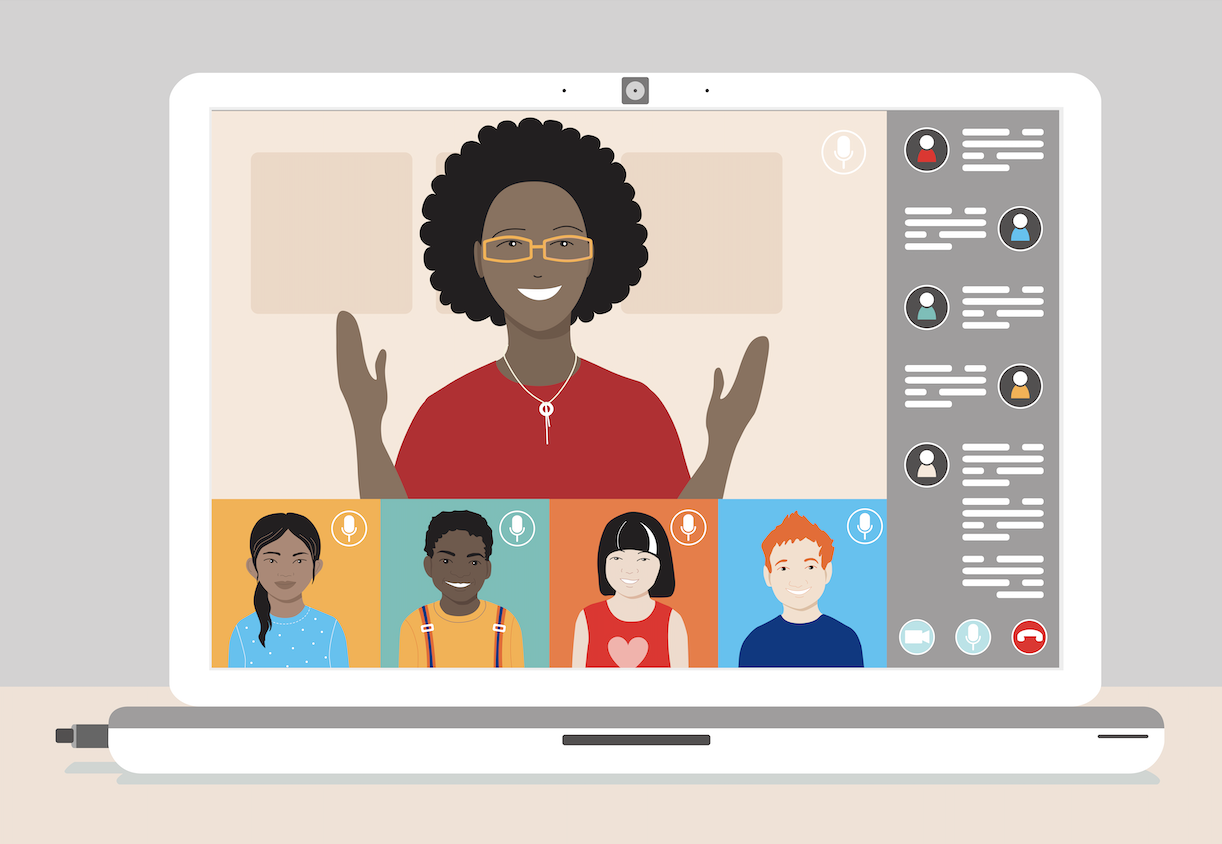
Since March 2020, the coronavirus pandemic has closed school buildings across the United States, at some point forcing remote instruction for virtually every public school. As COVID-19 cases continue to rise, many school districts have either required students to take courses remotely or are using a hybrid approach that switches between in-person instructional time and remote learning, which is typically online. Both models present unique opportunities for teachers and students to engage safely during the pandemic, but they may also exacerbate challenges teachers already faced in the classroom. While schools and districts must constantly adjust to new operating guidance and rapidly changing plans—many on shrinking budgets and staff rosters—teachers themselves are left to navigate many aspects of remote learning. Pandemic pedagogy, a nickname for remote and hybrid learning during the coronavirus crisis, requires educators to wear many hats, including, but not limited to, those of teacher, social worker, curriculum designer, and instructional technologist.
For the districts that are still remote or remote again following the spike in COVID-19 cases in the fall, the challenges of digital equity are particularly salient. Large numbers of students did not have the devices, broadband, or access to digital materials needed to learn remotely. While some districts found temporary solutions through community support and partnerships with internet service providers, they were not robust enough to ensure all students were reliably connected to the internet and able to fully engage in online instruction. Now, months later, there is growing evidence of the worsening digital divide, or the gap between roughly 15 million U.S. students with reliable home internet and those without. While this divide has existed as long as the internet itself, the pandemic has caused a full reliance on broadband that may mean significant learning loss for some students. Many teachers are now struggling to meet state and school standards while their administrations are faced with meeting digital needs of students in a sustainable way.
For the districts that are still remote or remote again following the spike in COVID-19 cases in the fall, the challenges of digital equity are particularly salient.
While schools are focused on getting digital instructional materials into the hands of students, political events unfolding around the country have renewed a national conversation about what exactly those materials ought to be. From the protests sparked by the murders of George Floyd and Breonna Taylor and the divisive rhetoric surrounding the 2020 presidential election, to mutual aid efforts trying to mitigate the effects of job loss and food shortages exacerbated by the pandemic—heightened public discourse around racial and social issues is building broad support for the types of culturally responsive education some Black education leaders and scholars have long called for.
Culturally responsive education (CRE), sometimes called culturally relevant pedagogy or teaching, is “an approach that challenges educators to recognize that, rather than deficits, students bring strengths into the classroom that should be leveraged to make learning experiences more relevant to and effective for them,” as defined by New America’s Jenny Muñiz. More than simply recognizing students’ traditions or history, CRE requires improvements toward equity at every level, including systemic changes toward a more diverse teacher workforce and rigorous, relevant learning experiences for all students. Gloria Ladson-Billings, an expert on American teaching practices and professor emerita at the University of Wisconsin at Madison, first introduced this concept more than 20 years ago. Since then, scholars and educators have built on the idea to account for today’s context, in which many instructional materials and common pedagogical practices do not reflect, represent, or validate the lived experiences of a now-majority of PreK–12 students. Evidence shows that many instructional materials—including books and textbooks, visual media, and primary sources—not only misrepresent or fail to represent multiple identities, but often perpetuate harmful stereotypes and biases through the use of a single, Eurocentric perspective.
To add to these challenges, pandemic pedagogy has starkly underscored the ways in which public schools are designed for those with technological, social, and economic privilege. As teachers are asked to deliver engaging, relevant, and responsive lessons to students with vastly different resources and capacities, often across different platforms and with little guidance from schools, they have less time, support, and capacity than ever. On top of that, many are being asked to do it all without regard for the mental and physical toll that comes with processing national (racial reckoning) and mass (global pandemic) trauma.
In part because of the breadth and depth of these challenges, the goal for many schools during the pandemic has been to maintain the status quo as seamlessly as possible, to keep students on track, engaged, and meeting the demands of teachers, families, and local and state standards. But the challenges exacerbated by the pandemic have made it clear that “normal” for many students wasn’t working before the pandemic and is not working now. “Normal” looked like deep digital divides and gross resource inequities. By aiming for the status quo, we may be missing out on an immense opportunity to leverage this moment for bold, transformational change.
What will it take to capitalize on this moment and create the sustained change that students have long needed? What are the biggest needs, challenges, and opportunities of this moment?
The Roundtable
To better understand the intersection of digital equity and CRE, and what it will take to use this moment as a catalyst for change, we convened 11 educators, scholars, and instructional technologists virtually in the fall of 2020 from different backgrounds: PreK–12 classroom educators, professors of teachers colleges, K–12 school leaders, and subject specialists. The goals of the conversation were to unearth the challenges, needs, and opportunities educators are experiencing around digital equity and CRE, and to understand how they have changed or have been affected during the pandemic (see appendix for list of participants).
This brief highlights key parts of this conversation and contextualizes what we’ve heard from educators who are rethinking what pandemic pedagogy can do. The conversation engaged those whose work focuses specifically on leveraging technology and digital tools for equitable, responsive education. Building on previous New America work on culturally responsive education, digital equity, teacher preparation, English learners, and students with disabilities, this project is the beginning of a new line of work exploring how to create a more inclusive and equitable education system.
Learning from Roundtable Participants
To guide the discussion, we posed a set of questions along three themes: curating and implementing culturally responsive materials; redefining and building digital equity; and bolstering educator support. We had three main questions:
- What types of content and materials do students and teachers need most right now?
- How do practitioners define digital equity and cultural responsiveness, and to what degree do they factor into the challenges or opportunities for accessing these materials?
- What are the biggest barriers to accessing and teaching these materials and what solutions are educators using to meet these challenges?
The conversation explored both broad context and nuanced pieces to this narrative, in some cases either underscoring or challenging our previous thinking. Overwhelmingly, we heard from educators that this moment is indeed unlike any other and that many of the challenges it presents could be used as opportunities to improve if teachers had the time and support they needed. By and large, the educators we spoke with do not want to simply see the inequities of in-person education recreated digitally. Rather, they want to see remote and hybrid learning used to fully engage all students. Below are three key takeaways from our conversation on how to do that, and what it might take.
Takeaways from the Conversation
In order to truly capitalize on this moment, said the participants, we should:
1. Expand definitions of curriculum “quality” to include representation, relevance, and inclusion.
Participants honed in on the mismatch between the content and perspectives of instructional materials and textbooks and many students’ lived experiences. In many cases, maintaining the status quo during the pandemic means students are continuing to learn from materials that don’t reflect their perspectives or identities, but those materials are now digital. Even before the pandemic, this type of content invalidated and failed to represent many students’ identities and realities, and sustaining the use of these materials as the goal during the pandemic sends a strong message to students. Part of the challenge of working toward a more inclusive definition, said the educators, is time and collaboration. So much of the work to build better, more relevant materials is done in silos by individual teachers and school leaders in different districts, across different states—many without the time and support from their administrations that they need. Now, with the COVID-19 closures putting even greater strains on teachers’ time and capacity and students struggling to engage, finding ways to develop better materials is both more important than ever and increasingly more difficult.
As participants noted, some districts are becoming more aware of this issue but few real changes are being made to address them. Gholdy Muhammad, an associate professor of education at Georgia State University, explained that state standards need to better align with the goals of CRE. “People are talking about CRE more and more, but the standards we still use were not written to reflect the histories, identities, and liberation of Black and Brown people.” The question she posed, echoed by others in the group: Is it ethical to keep learning standards as they are?
People are talking about CRE more and more, but the standards we still use were not written to reflect the histories, identities, and liberation of Black and Brown people.
While the standards for what makes resources high-quality vary slightly from state to state, few standards include cultural relevance or representation in their definitions. As Muñiz has written, CRE is integral to effective, engaging pedagogy and resources for everyone. One possible opportunity to create more inclusive materials is through the use of open educational resources, or OER. Unlike proprietary textbooks, OER are free to use, adapt, and reshare, making them more accessible and collaborative than other texts. With shrinking school budgets and difficulty getting physical materials to students, more teachers and leaders are looking to OER as one possibility. While openness doesn’t guarantee inclusion, these resources could be one way to help redefine quality texts.
2. Reconceive what digital equity means and what it looks like in practice.
Traditionally, digital equity has simply referred to the divide between students who have access to wireless internet and the physical devices needed to participate in online and virtual learning, and those who don’t. Prior to COVID-19, it was often talked about in the context of physical learning environments; which schools have 1:1 devices for children, or which schools rely on federal programs such as E-rate to provide internet in their buildings. As New America’s Open Technology Institute describes in its recent report, issues of connectivity and device access is an urgent and worsening problem during COVID-19.
But the definition of digital or tech equity ought to be expanded, said roundtable participants, to rethink the goals and opportunities for using instructional technologies. As Antoinette Dempsey-Waters, a history teacher in Arlington, VA, suggested, in addition to getting devices to all students, we ought to also focus on whether instructional technology has students’ actual interests in mind. Are we using tech as a tool to prepare students for paths and careers that are viable and attainable for them, or are we simply using it as another inequitable measure of ability? After all, access to technology that doesn’t serve students isn’t all that useful.
Martin Cisneros, director of technology at Berryessa Union School District in San Jose, CA, said that before he considers adopting new technologies, he asks, “how does this tool advance student agency?” Particularly at a time when nearly every student, teacher, and school leader is relying on technology for every part of their day, the ways in which that tech aids or hinders student capacity is critical. As with instructional materials, reframing the discourse around digital equity means thinking of the role it plays for students as equally important to their access to it. We ought to be concerned with what tech tools actually do for students, in addition to which students have them. This type of goal shifting also requires a mindset shift: technology is a tool to be used toward the goal of responsive, equitable learning, rather than the goal itself.
… reframing the discourse around digital equity means thinking of the role it plays for students as equally important to their access to it.
The instructional technologists and leaders in the group urged others to use every opportunity to ask these questions of the tech tools they’re using. With more people building this dialogue, we might create more awareness and intention around true digital equity.
3. Provide teachers the support and learning they need to deliver digital equity and culturally responsive learning experiences.
Teacher learning and support was at the forefront of discussions of both CRE and digital equity. From those currently in the classroom to those at colleges of education, the message was clear: teachers need support now more than ever. While they’re being asked to wear multiple hats and play different supporting roles for students, families, and school leaders, teachers themselves are in need of supports that are, in many cases, decreasing. Some of the biggest challenges we heard were strains on teachers’ time, capacity, and opportunities for professional learning to help them meet both the new and growing needs of remote learning. With more demands and often fewer instructional and prep hours, teachers are having to do more with less time and energy. This, combined with the mental and emotional toll of the events of 2020 has severely reduced capacity for many. On top of this, many teachers were not masters of instructional technology before the pandemic started and now must quickly learn, adapt, and implement new tools to do their job.
Beyond technological support, another key need we heard is teacher professional learning that prepares educators, particularly white educators, to teach inclusive, representative, and equitable content effectively. Adina Sullivan-Marlow is the coordinator for teacher effectiveness and preparation at the San Diego County Office of Education, and a founder of EquityEDU, a nonprofit that supports more equitable education for all students. As she put it, “we can’t leverage this moment for change without teachers, and teachers can’t fully participate until they have the support they need to do so.” If educators do not have the guidance and capacity to address the obstacles brought on by the pandemic, this moment will be a challenge rather than an opportunity.
Looking Forward
The roundtable gave voice to how we might use the disruption of the COVID-19 pandemic to rethink practices and policies that have long failed to serve a majority of students. The biggest challenges that surfaced in the conversation had to do with how we think about “good” or quality materials and learning, what an equity framework might do if it accounted for students’ real interests, and what it will take to help teachers meet the needs we identified. By and large, our participants were in agreement that few things will change unless we address teacher and student needs in more responsive and sustainable ways.
This conversation was useful, but it was only one (virtual) session with limited time. Each of these ideas and challenges invite more questions, more experiences and more possibilities for students and teachers in the coming year. Here are some of the key questions participants are asking moving forward:
- Given the immense pressures and asks of educators currently, what are realistic steps toward addressing these issues of digital and social inequity?
- What opportunities do the new virtual norm create for breaking out of silos? How might those in policy and leadership better collaborate and learn from those in classrooms?
- How might we work student voice into this conversation? What avenues could we create for students to participate in the creation of education policies that most affect them?
As the roundtable brought to light, one of the biggest challenges in thinking through these issues is translating questions, thoughts, and experiences to tangible action and steps. Fairly easily, the group identified problems and challenges in their own work and at their own schools, but it was much harder to identify key steps toward addressing them.
In recognizing both this challenge and the need to capture more voices and ongoing dialogue, New America will embark on work over the next year to continue to facilitate conversations and turn over ideas for change. Our team will host additional roundtable discussions, interviews, and conversations with education stakeholders to help break down the silos that so often prevent collaboration and dialogue.
We are seeking PreK–12 students, educators, and leaders at all levels interested in the work of improving culturally responsive teaching and digital equity to participate in our work and share their experiences. If this is you and you’re interested in participating in this work or learning more, please contact us at [email protected].
Appendix
Roundtable participants:
Martin Cisneros, director of technology, Berryessa Union School District
Katie Cherry, technology integration specialist, Alexandria City Public Schools
Antoinette Dempsey-Waters, history teacher, Arlington County Public Schools
Beth Holland, partner, The Learning Accelerator and digital equity advisor, CoSN
Renata Jones, assistant professor, College of Education and Human Development, Georgia State University
Roberto Lozano, associate superintendent of equity, innovation, and social justice, Las Cruces Public Schools
Gholdy Muhammad, associate professor, College of Education and Human Development, Georgia State University and principal, HILL Pedagogies
Ace Parsi, senior consultant, Equity Journey Partners
Tammie Schrader, regional science and computer science coordinator, Northeast Washington Education Service District
Laura Spencer, director of academic innovation, Elite Academic Academy
Adina Sullivan-Marlow, coordinator for teacher effectiveness and preparation, San Diego County Office of Education and founder, EquityEdu
New America participants:
Amanda Armstrong, research fellow, Education Policy program
Lisa Guernsey, director, Teaching, Learning & Tech, Education Policy program
Kristina Ishmael, senior research fellow, Education Policy program
Jenny Muñiz, research fellow, Education Policy program
Sabia Prescott, policy analyst, Education Policy program
Elena Silva, director, PreK–12, Education Policy program
More About the Author

Sabia Prescott
Policy Analyst, Education Policy