A Chapter of: Design Principles for Financial Aid Offers
Discussion and Recommendations
For years, New America has advocated for better and more transparent financial aid offers so students and families understand how much financial aid they will receive, how much they will have to pay right now, and how much they will have to pay back through loans. Now, with a serious and long-lasting economic downturn due to the coronavirus pandemic, these communications will be even more crucial for understanding which college is the best financial fit for a family.
In concert with Decoding the Cost of College, this user research on financial aid offers can help determine some of the best methods and formats for communicating price and financial aid. Based on the research, we created one final prototype, New America University, which reflects all that we learned from our initial focus groups, our Financial Aid Offerpalooza, and the two rounds of consumer testing. This prototype is meant to be an example of how information can be clearly communicated so that students and families can understand the information correctly on their own.
A financial aid offer must contain all the following information:
- Price, including indirect expense estimates
- Financial aid offered, with distinctions made between grants/scholarships and federal student loans
- Mathematical calculations that present what students and their families will ultimately need to pay
- Other financing options to help students and families pay off any remainder
- Next steps they have to take to receive, reduce, or decline the aid
The offer should also indicate who the financial aid is for, since we found that students and parents liked the personalization, and whether the package was calculated based on the student being full- or part-time, in-state or out-of-state for public schools, and living on or off campus.
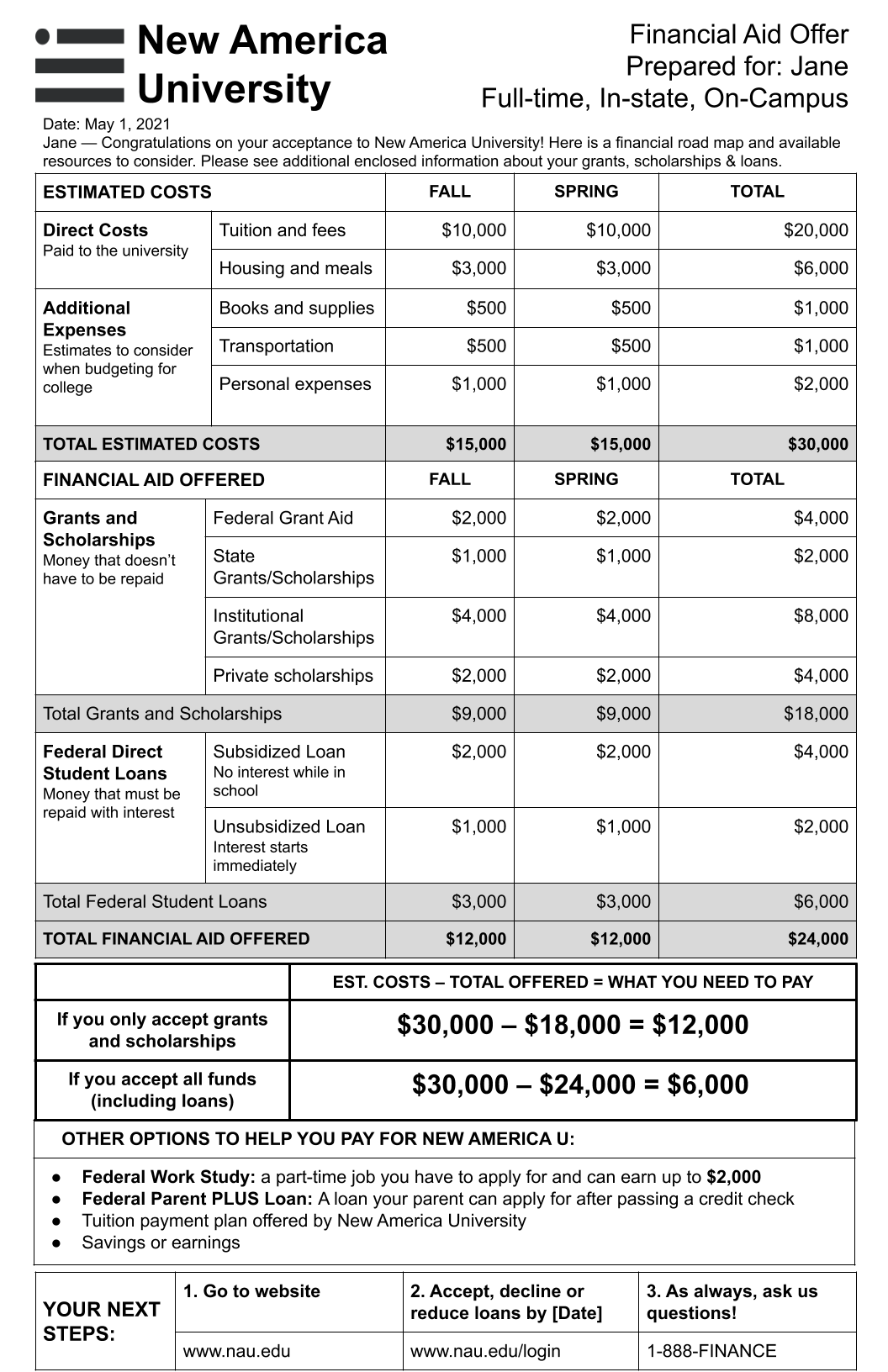
Information on full cost of attendance should come first. Our research revealed that students are most interested in seeing price information first, and then aid. Although there was some confusion among participants about indirect costs and whether they should be included in the offer, it will still be important to present this information since it is part of the federally defined cost of attendance. Instead, we believe indirect costs should be renamed “additional expenses,” with a simple explanation such as “estimates to consider when budgeting for college” beneath. We also think it is important to rename “room and board” because “housing and meals” will be more clear.
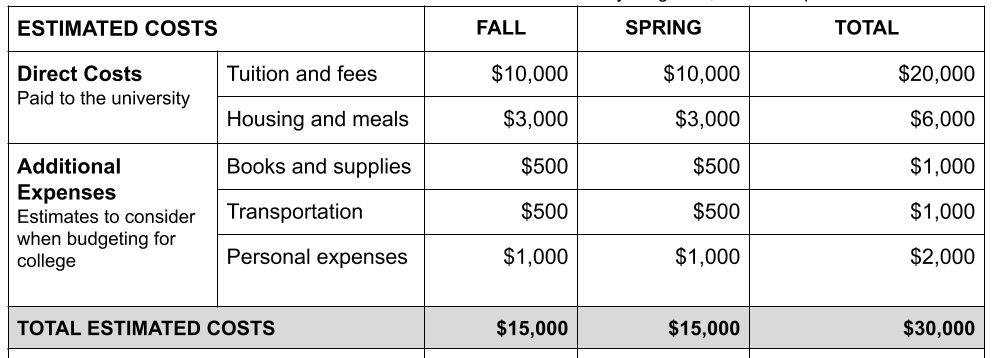
After presenting the full cost of attendance, grant and scholarship aid should be listed and totaled, and then federal student loans should be listed and totaled. We believe it is important to include a simple explanation of what grants and scholarships are, such as “money that does not need to be repaid.” There also needs to be a brief explanation of what loans are, and that explanation must also make clear the difference between subsidized and unsubsidized loans. Once loans and grants are totaled within their own respective sections, they should be added together to give students and families an idea of the overall financing available to them.
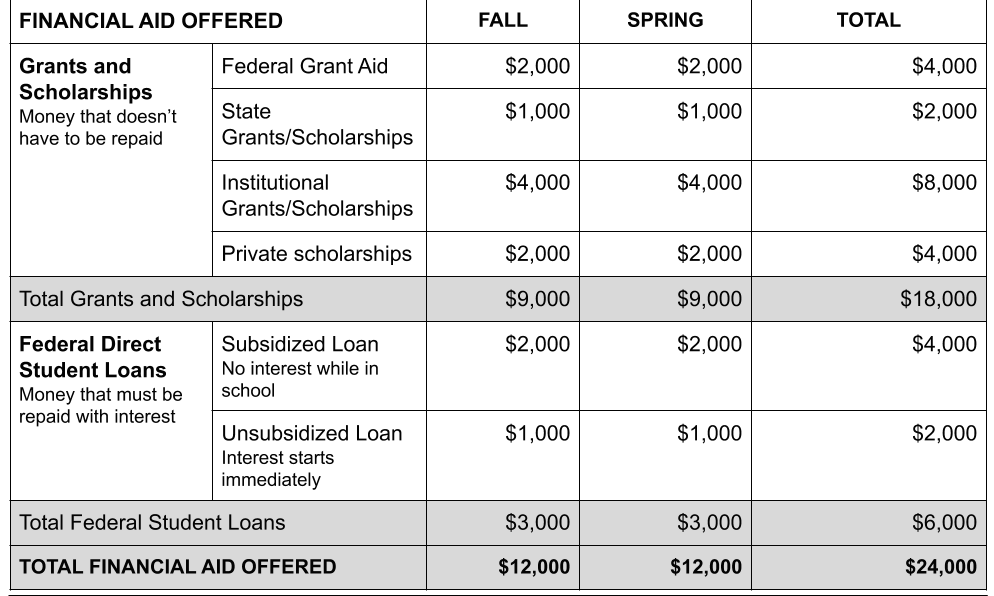
Financial aid offers must include a net price calculation and should also provide a calculation that includes both grants and loans. The federal definition of net price is the total cost of attendance, subtracting grants and scholarships. Since the net price calculation is not commonly known among students and parents, the offer must describe and present the calculation in very simple terms, taking the total presented in the first part of the letter, and subtracting grants and scholarships. Then a separate equation should clearly explain the subtraction of loans.

Once students and families understand the costs they have left to cover, it is important to provide them general information about other options they have for covering the remaining costs. This section of the offer is where information on Federal Work-Study and the federal Parent PLUS loan should be located. This section can also include other options such as savings and earnings, private loans, and tuition payment plans. Several participants in our phase two research particularly liked the idea of tuition payment plans, so institutions that offer them should communicate these plans in financial aid offers, if possible.

Every offer must include the next steps students and their families have to take and contact information if they have questions. What students must do to accept, decline, or reduce aid included in the offer must be spelled out, as well as the relevant dates by which they have to take these actions. Participants also liked having a phone number or email address so they knew who to call if they had any questions.

In designing financial aid offers, there is a tension between simplicity and the provision of more information. New America undertook this design process assuming the financial aid offer would be like a cover sheet. For this reason, the offer is presented to the student, Jane in this case, as a “road map” and includes the most salient information to meet our stated success criteria, with enough white space to make it legible. Our assumption is that more information will be provided to the student on the back of this sheet, through other documents accompanying the offer, or electronically through hyperlinks. For example, while the offer indicates the size of the institutional grant award, further information would have to be included to show the breakdown of institutional scholarships and their terms and conditions. Similarly, more information on federal student loans would be needed, including the interest rate that will be charged and repayment options.

Limitations and further research
Our research recreated how financial aid offers have been typically designed over the years: something that can be printed on a regular sheet of copier paper in black and white. Increasingly, however, these communications are delivered electronically via email, PDF, through student information systems (portals), or highly personalized software. One participant in our research mentioned he had received an electronic financial aid offer that had illustrated confetti pop out when he opened it. We still believe, and our focus groups backed this up, that families want to have both electronic and paper options. Though at a minimum, any financial aid offer should be optimized for mobile devices so that students and families can access it and read it anywhere and from any device.
In addition, we focused exclusively on financial aid offers for first-time undergraduate students. More research is needed on ways to present price and financial aid information to graduate students given the particularities of graduate school education financing (such as the federal Graduate PLUS loan and research/teaching assistantship stipends). More research is also needed on how offers should be designed for returning students. Another group of students that might require a different financial aid offer consists of returning students; they will already have familiarity with offers and might find data on their total indebtedness to date useful.
The role of state and federal policy in financial aid offers
Students who apply to multiple colleges and universities are not able to compare financial aid offers from different institutions effectively. Every institution currently designs its own financial aid offer and there are no standardized terms or formatting, so students and families cannot make apples to apples comparisons. This means that families often operate under misguided assumptions about which school is the best financial fit for them.
During phase two of our research, we asked prospective students and parents whether it would be helpful if financial aid offers were standardized or if colleges should have full control over how they present the information. Participants agreed that they want offers to follow a similar format to make comparison easier among schools but still allow some flexibility for a college to add its personality. One participant noted that the introduction at the top of a letter, for example, “gives you a little insight as to the culture of each individual school.” A few also pointed out that a similar format is important to prevent colleges and universities from making it seem like families would owe nothing, “just to make sure that colleges aren’t producing false information or misleading like Sky University,” as one participant cautioned.
To prevent misleading pricing information, some federal and state policymakers have been pushing to standardize financial aid offers so that all colleges and universities have to present their information within the same template. The State University of New York system, for example, is required to provide a standardized financial aid offer template—known as Smart Track—to all students at its 64 campuses.10 The U.S. Department of Education has also encouraged institutions to voluntarily adopt its College Financing Plan (formerly known as the Financial Aid Shopping Sheet, developed by the Obama administration) which is another standard template.11
Voluntary efforts only go so far, however. In order to ensure all students receive common financial aid offers, Congress should pass the bipartisan, bicameral Understanding the True Cost of College Act, which was first introduced in 2012 and was most recently re-introduced in 2019 by Senators Grassley (R-IA), Ernst (R-IA), and Smith (D-MN) and Representative Van Drew (R-NJ). This bill would require colleges and universities to provide a common financial aid offer to every accepted student who applies for financial aid. The measure would not preclude colleges from providing more information, as long as any additional information uses standard financial aid terminology. The common financial aid offer would be developed by stakeholders and would be rooted in user-centered design, similar to the user research we conducted for this report.
Students and parents should not need a Rosetta stone when navigating financial aid offers. Our research shows the information and formatting needed to successfully interpret a college’s price, the contents of its financial aid package, and what remains to be paid or repaid in the future. Being able to easily understand this information from one school, let alone compare that information between schools, would empower students and families to have conversations about what college or university is the right social, academic, and financial fit for their family.

Citations
- SUNY (The State University of New York, website), “SUNY Smart Track Is…,” https://www.suny.edu/smarttrack/about-smart-track/
- U.S. Department of Education (website), “The College Financing Plan,” https://www2.ed.gov/policy/highered/guid/aid-offer/index.html