A Chapter of: Displaced in the Sun Belt
Norfolk City, Virginia
“The same communities are being impacted doubly by COVID and by eviction at the same time right now.” – Researcher, RVA Eviction Lab at VCU18
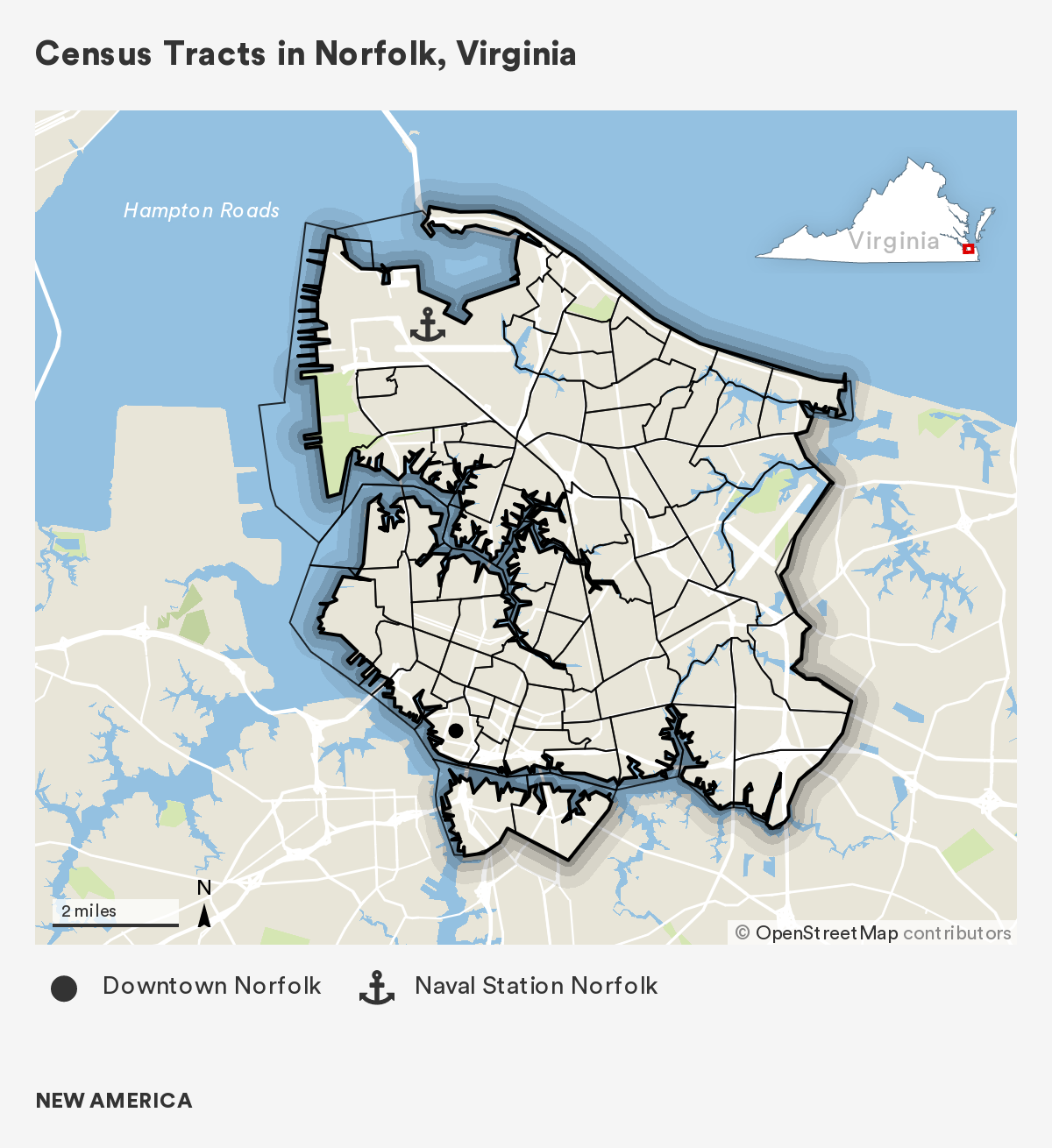
Norfolk City,19 an unincorporated county-equivalent in Virginia, is one of nine cities and seven counties that comprise the Hampton Roads metropolitan area. Located at the mouth of the Chesapeake Bay, Norfolk City is mostly surrounded by water, lending the city importance from a military and transportation standpoint. It is home to the largest naval base in the world, Naval Station Norfolk, as well as roughly 242,700 residents.
Forty-three percent of Norfolk City residents are non-Latinx white, and the rest of the city is 42 percent Black, 9 percent Latinx, and 4 percent Asian. Norfolk’s large military present accounts for 16 percent of residents, over double the nationwide average.
Since the start of the COVID-19 pandemic, Norfolk City has experienced roughly 10,500 cases and 120 deaths. As of November 2020, the unemployment rate in Norfolk was 6.8 percent, which is more than double the level of unemployment during the same time in 2019. Further, results from the U.S. Census Bureau’s Household Pulse Survey shows that 22 percent of Virginia residents expect to lose income from employment in the next month. This same survey revealed that 32 percent of renters and homeowners surveyed expected to be evicted or foreclosed upon in the next two months.
When and Where Are People Losing Their Homes?
Overall Housing Loss: Residents in Norfolk City, Virginia experienced housing loss at a rate of 5.4 percent between 2017 and 2019, meaning roughly one in 18 renters and homeowners with a mortgage lost their homes each year. This is nearly more than double the housing loss rate of the rest of Sun Belt counties we examined.
Unlike the other sections in this report, we are unable to produce a housing loss rate map for Norfolk City, as we analyze foreclosures at the census tract level, and evictions at the zip code level.
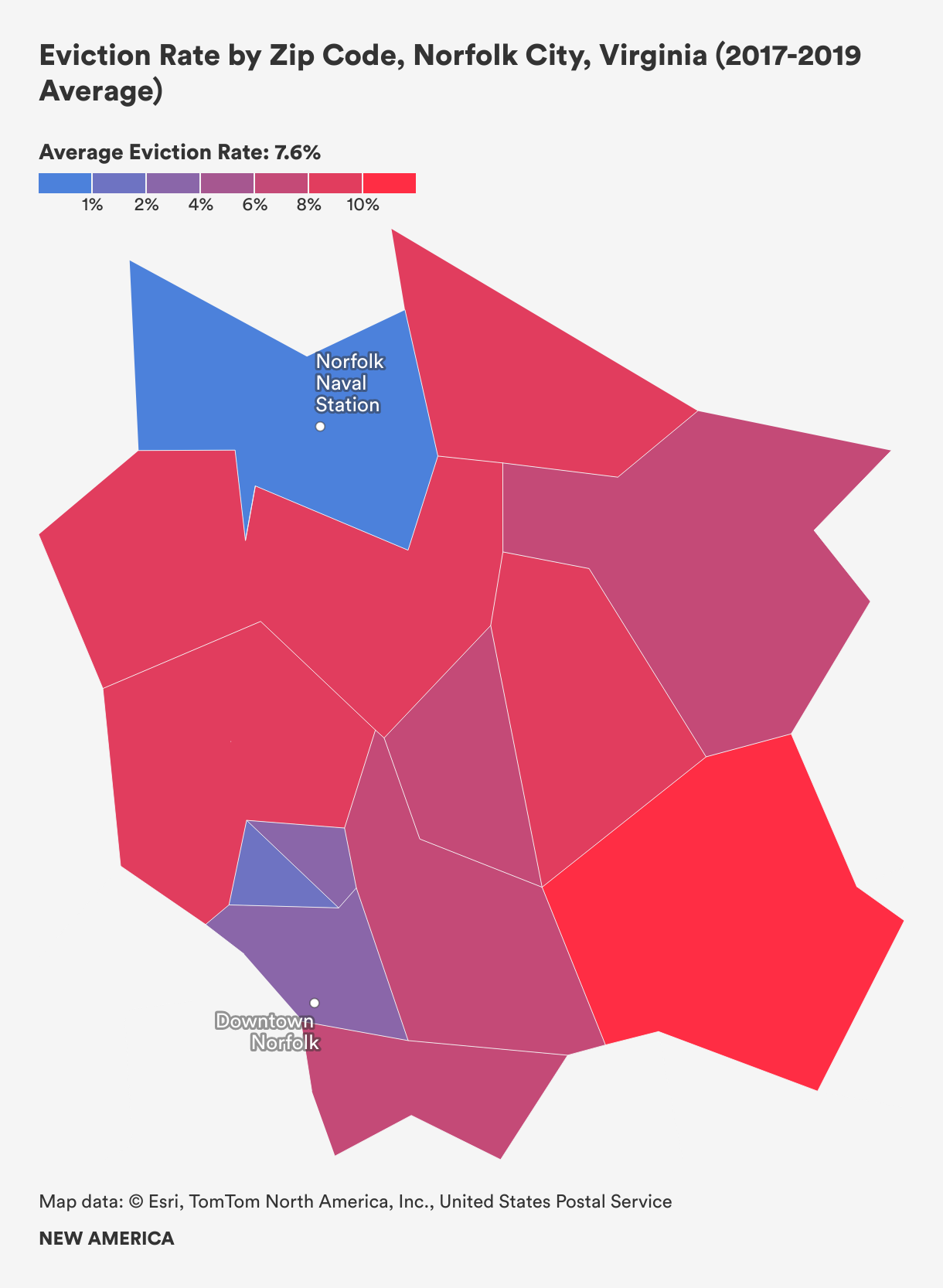
Evictions: Just over half of Norfolk residents rent their homes, and yet evictions accounted for 90 percent of housing loss from 2017 to 2019. Over this three-year period, 11,327 households were evicted, resulting in an eviction rate of 7.6 percent, among the highest in the country.
A Spotlight on Summer Evictions
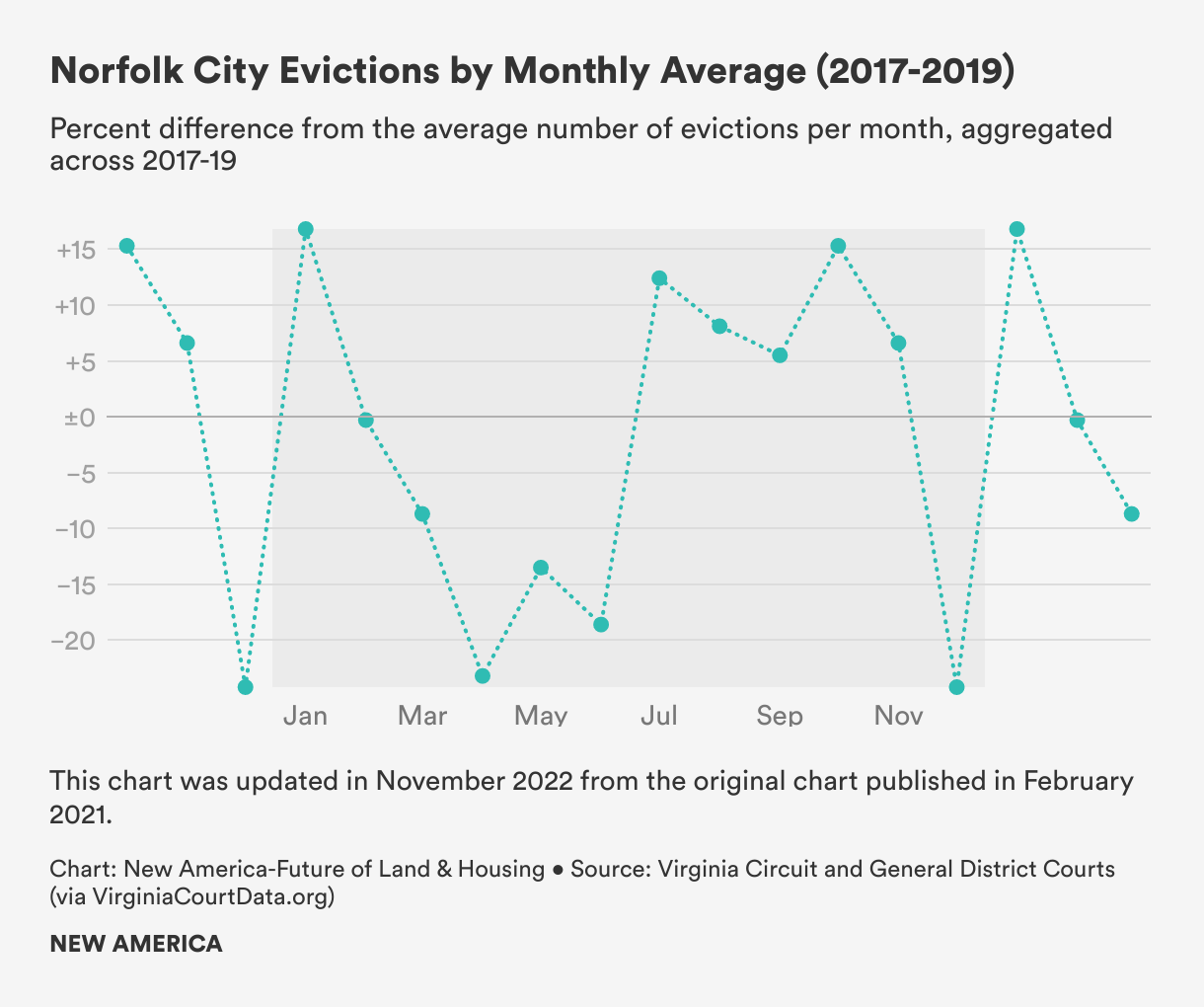
Evictions in Norfolk City peaked in July and remained steady and high throughout the summer and into the fall, before dropping sharply in October and November.
Mortgage Foreclosure: Homeowners are at much lower risk of housing loss than renters. Forty-three percent of residents own their homes, and yet mortgage foreclosures only accounted for six percent of housing loss from 2017 to 2019. During that time period 1,276 households were foreclosed upon in Norfolk City, resulting in a foreclosure rate of 1.5 percent. While this foreclosure rate is slightly higher than the average foreclosure rate across all Sun Belt counties, it is nowhere as acute as the city's eviction rate.
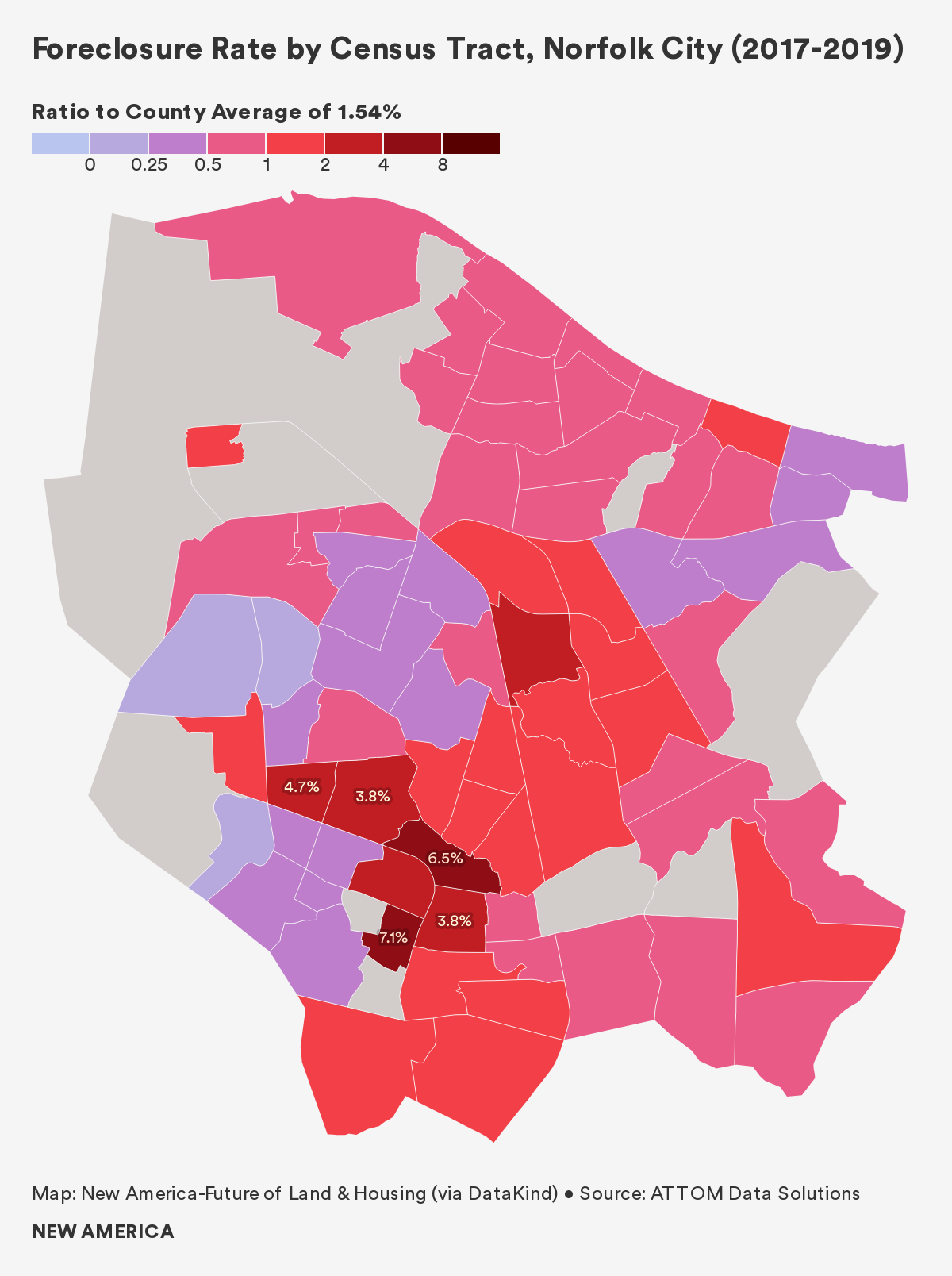
Higher foreclosure rates in Norfolk are clustered in tracts neighborhoods to the southwest of the Lafayette River, such as Lindenwood and Barraud Park. In these neighborhoods, foreclosure rates were four times the county average.
Who Is Losing Their Home?
Similar to other counties in the Sun Belt, we found a strong relationship between mortgage foreclosure and race. Census tracts with a larger share of Black households saw higher rate of foreclosure. We also saw higher rates of foreclosures in census tracts in which more residents took public transportation to work and in census tracts with higher proportions of single parent households.
Housing Loss and COVID-19
Local housing experts interviewed for this study explained that prior to the pandemic, affordable housing in Norfolk City was constrained by several factors. Little to no available land combined with flood risk means that new housing must be built vertically. Further, much of the existing affordable housing stock is older and in poor condition.
Norfolk’s large military presence impacts rent prices in Norfolk and surrounding areas. One interviewee noted that landlords periodically raise rents knowing that the military pays housing allowances to its employees. This practice has reverberating impacts for the rest of the residents living in Norfolk County, most of whom are severely housing cost-burdened. Interviewees also noted that displaced residents often move to more affordable Hampton Roads cities, including Chesapeake and Virginia Beach. Lastly, interviewees emphasized that homelessness is a major issue, in part because of inadequate shelter availability.
Stakeholders said they do not believe state and local governments have adequately stabilized households impacted by COVID-19 since the establishment of the statewide eviction moratorium. Norfolk City allocated $2 million to the Norfolk Redevelopment and Housing Authority (NRHA) to help fund rent and utility assistance, as well as programs offering rental and loss mitigation counseling. Aid is distributed through local non-profits. However, local stakeholders emphasized that the onerous application requirements for recipients of COVID relief funds, which include proof of loss of income, previous tax returns, among other documentation, has hampered aid distribution.
While program staff for a non-profit involved in aid distribution noted the high degree of interagency collaboration, another program director at a different local non-profit explained that outreach to low income and high impacted areas is limited. This stakeholder says there is virtually no visibility or awareness of resource availability in some communities, and that engagement and outreach to local nonprofits has been insufficient.
Policy Solutions
Our policy recommendations to mitigate housing loss amid COVID-19 can be found in the report section: “Housing Loss in the U.S. Sun Belt.”
Updated at 9:00 a.m. on November 9, 2022: This report has been changed to to update thee eviction analysis in this section and better reflect zip code-level data from virginiacourtdata.org. This update eliminates the need to proportionally assign eviction records from the zip code-level to the census tract-level. This update results in changes to any Norfolk City analysis or data visualization that relied on eviction rates, both in this section and in the Housing Loss in the Sunbelt section.

Citations
- From an interview with contributing author Jack Portman.
- We chose to omit Census Tract 51710990000 from our Norfolk City maps, as it is located entirely in the Chesapeake Bay and does not include any households.