
Table of Contents
Harris County, Texas
“In Texas, we know that Black and Brown workers are absorbing direct health outcomes from this pandemic, and these problems converge and overlap with housing instability.” – Housing Data Specialist, Houston1
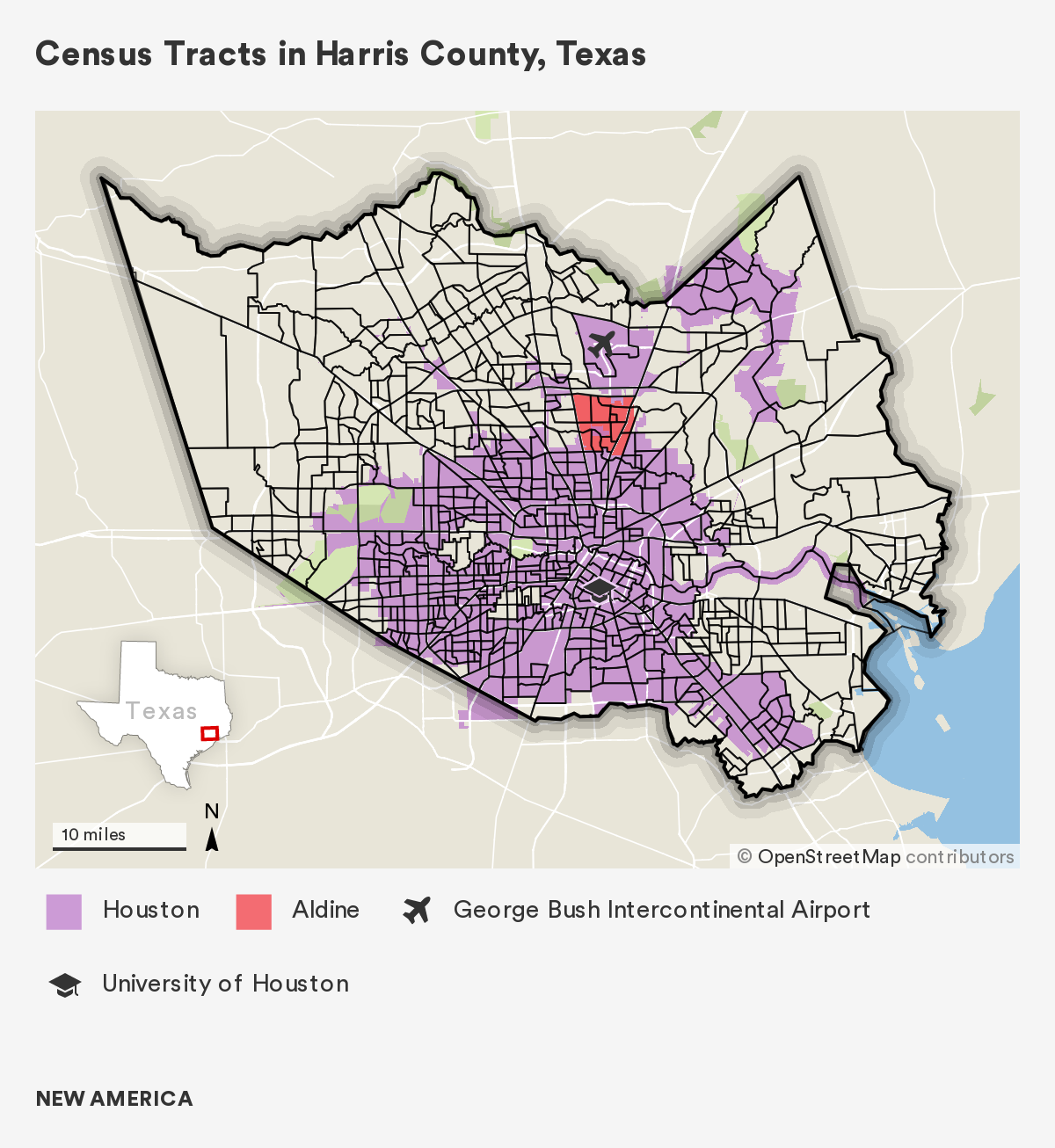
Sitting on Galveston Bay and the Gulf of Mexico in southeast Texas, Harris County is the third-most populous county in the United States, with approximately 4.7 million residents. The county is dominated by the city of Houston, a sprawling urban center and the fourth-largest city in the country. Known worldwide as the home to NASA’s Mission Control, major industries include energy, healthcare, and higher education.
Harris County is demographically diverse. According to the U.S. Census Bureau, 44 percent of the population is Latinx, 20 percent is Black, 7 percent is Asian, and 29 percent is non-Latinx white. Researchers at Rice University note that Houston is “often referred to as the most racially diverse metro area in the country and a harbinger of the types of demographic shifts the nation is likely to face in the future.” Yet Houston is also similar to other major cities throughout the United States, as minority communities have long suffered from discrimination in housing, education, employment, and policing. Income disparities persist between races, and many neighborhoods remain highly segregated.
Nearly one-third of those surveyed in the Houston-The Woodland-Sugar Land Metro Area believed that an eviction or foreclosure is somewhat or very likely in the next two months.
The county continues to experience a surge in recorded COVID-19 cases, with the Latinx community most impacted, among all races and ethnicities. Joblessness remains high—the most recent unemployment rate in November 2020 was 9 percent, a 143 percent increase from the previous year. Housing insecurity is also high—the most recent Household Pulse Survey, conducted by the U.S. Census Bureau, found that nearly one-third of those surveyed in the Houston-The Woodland-Sugar Land Metro Area believed that an eviction or foreclosure is somewhat or very likely in the next two months.
When and Where Are People Losing Their Homes?
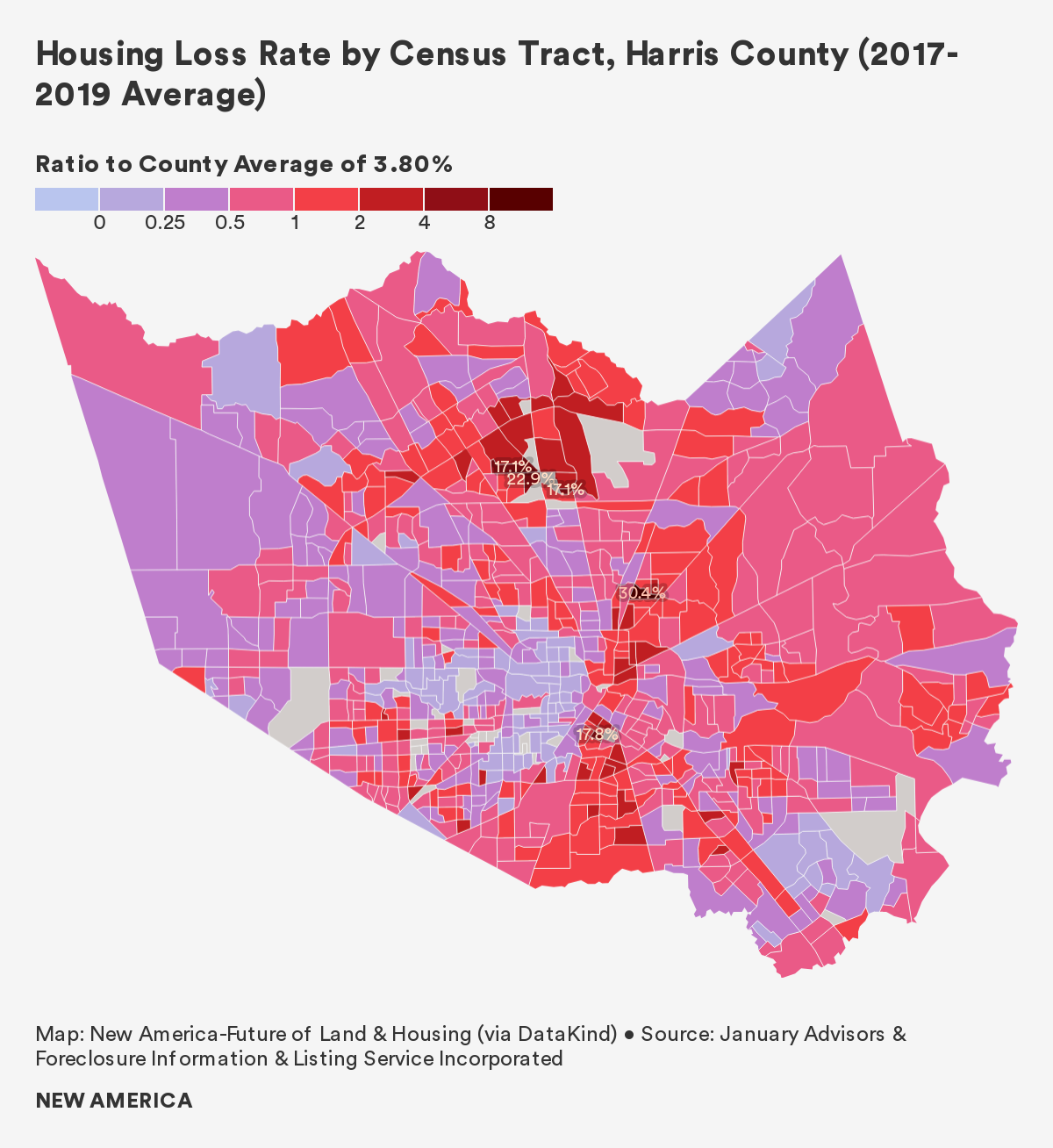
Overall Housing Loss: Harris County residents experienced a housing loss rate of 3.8 percent between 2017 and 2019. In total, approximately 400,000 people lost their home during these three years. The housing loss rate in the county slightly increased during our study period, driven primarily by an uptick in evictions.
Census tract 2307, in the Scenic Woods neighborhood northeast of downtown Houston, experienced the county’s highest average loss rate: just above 30 percent. Each year, nearly one in three households in this tract lost their home. Socioeconomic indicators further suggest a distressed and marginalized community: a third of residents live below the poverty line, as the median household income is a mere $25,313 and home values sit at $77,800, or two-fifths the county average. The tract is nearly 100 percent Black and Latinx.
Housing loss is also acute in a cluster of census tracts to the west of George Bush Intercontinental Airport, around the town of Aldine. Many tracts in this area expressed average rates of loss between 10 and 23 percent, up to 6 times the Harris County average. Of note, the geographical proximity of hard-hit census tracts to airports is a trend that we previously observed in other locations, such as Forsyth County, North Carolina and Maricopa County, Arizona.
Finally, a census tract very close to the University of Houston experienced a housing loss rate of 17.8 percent between 2017 and 2019. Three-fourths of residents in the tract are Black, and nearly 61 percent live below the poverty line. The median household income is only $15,538. In general, tracts squeezed between the university and William P. Hobby Airport expressed housing loss rates two to three times the county average.
Evictions: A little less than half of all Harris County residents rent their homes, but evictions accounted for 79 percent of all housing loss. In total, 111,038 renter households were evicted during our study period, at a rate of 5.3 percent per year.
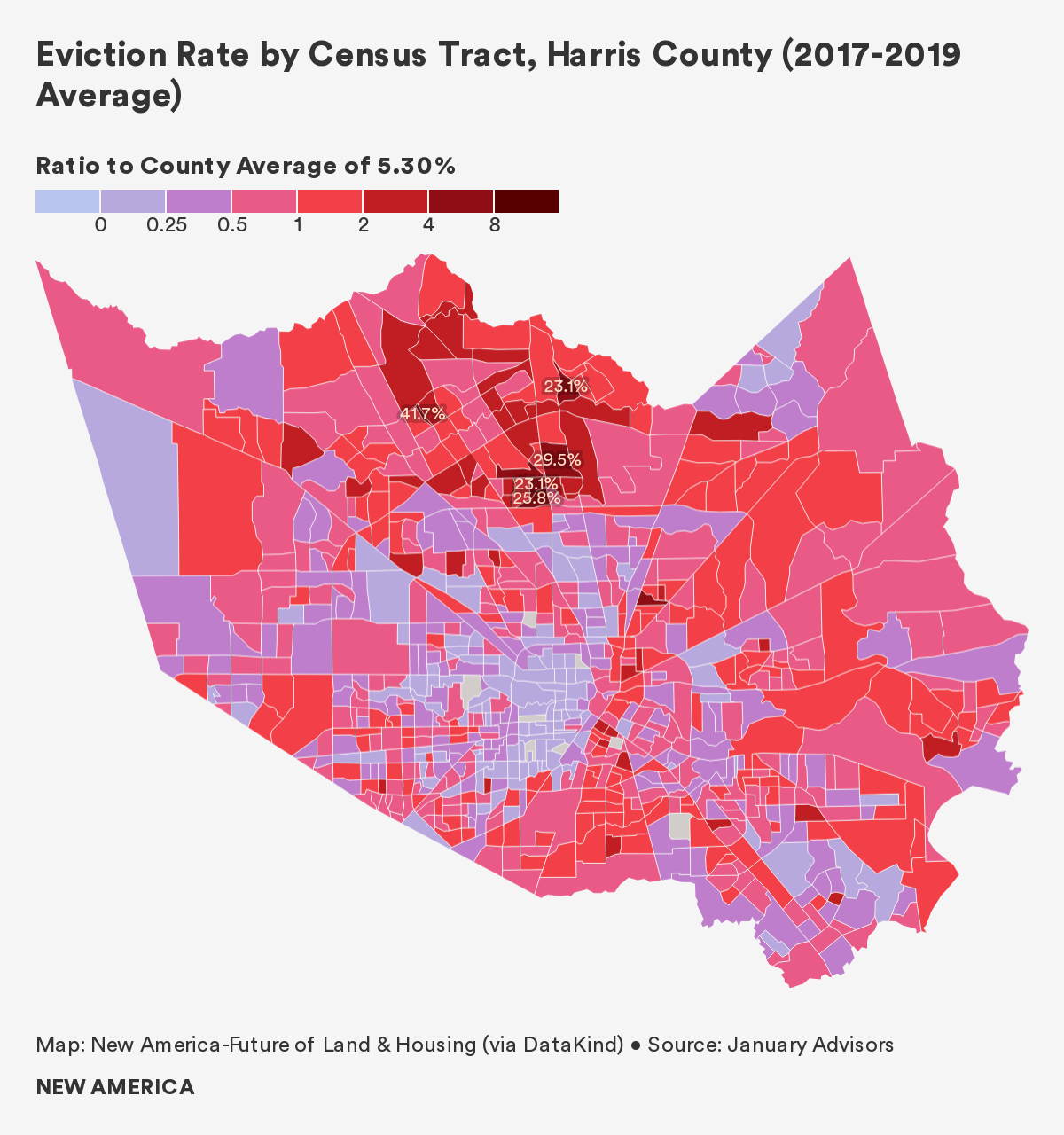
A cluster of census tracts to the north of downtown Houston, near George Bush Intercontinental Airport and the small town of Aldine, experienced some of the county’s highest eviction rates. A number of these tracts suffer from high poverty rates, and between one-fifth and one-third of renters experienced eviction in an average year. In particular, one census tract expressed an average eviction rate of 42 percent between 2017 and 2019, although it must be noted that only 4 renter households live in the tract.
Predominantly minority-majority census tracts to the northeast and southeast of downtown Houston also experienced high rates of eviction, areas that are predominantly minority-majority. The county’s second hardest-hit census tract sits in the northeast neighborhood of Scenic Woods and had an average eviction rate of 36 percent. This tract has a median household income of $25,313, only two-fifths the county average, and is two-thirds Black.
A grouping of census tracts in Baytown, a city towards the eastern edge on the county and sitting in Galveston Bay, experienced eviction rates nearly double the county average. According to estimates from the U.S. Census Bureau, Baytown is nearly half Latinx and 18 percent Black.
The Eviction Lab at Princeton University has been tracking eviction filings in Houston since the start of the pandemic.2 Filings dropped sharply in March and April 2020, and increased at a slow but steady pace for the rest of the year. Overall, Eviction Lab has recorded 19,423 filings in Harris County since March 15, 2020, approximately one-third of what the county usually sees. This finding is not surprising: state- and national-level eviction moratoriums, along with increased government aid, is likely contributing to this decline in filings.
The Seasonality of Evictions in Harris County: Bucking the Trend?
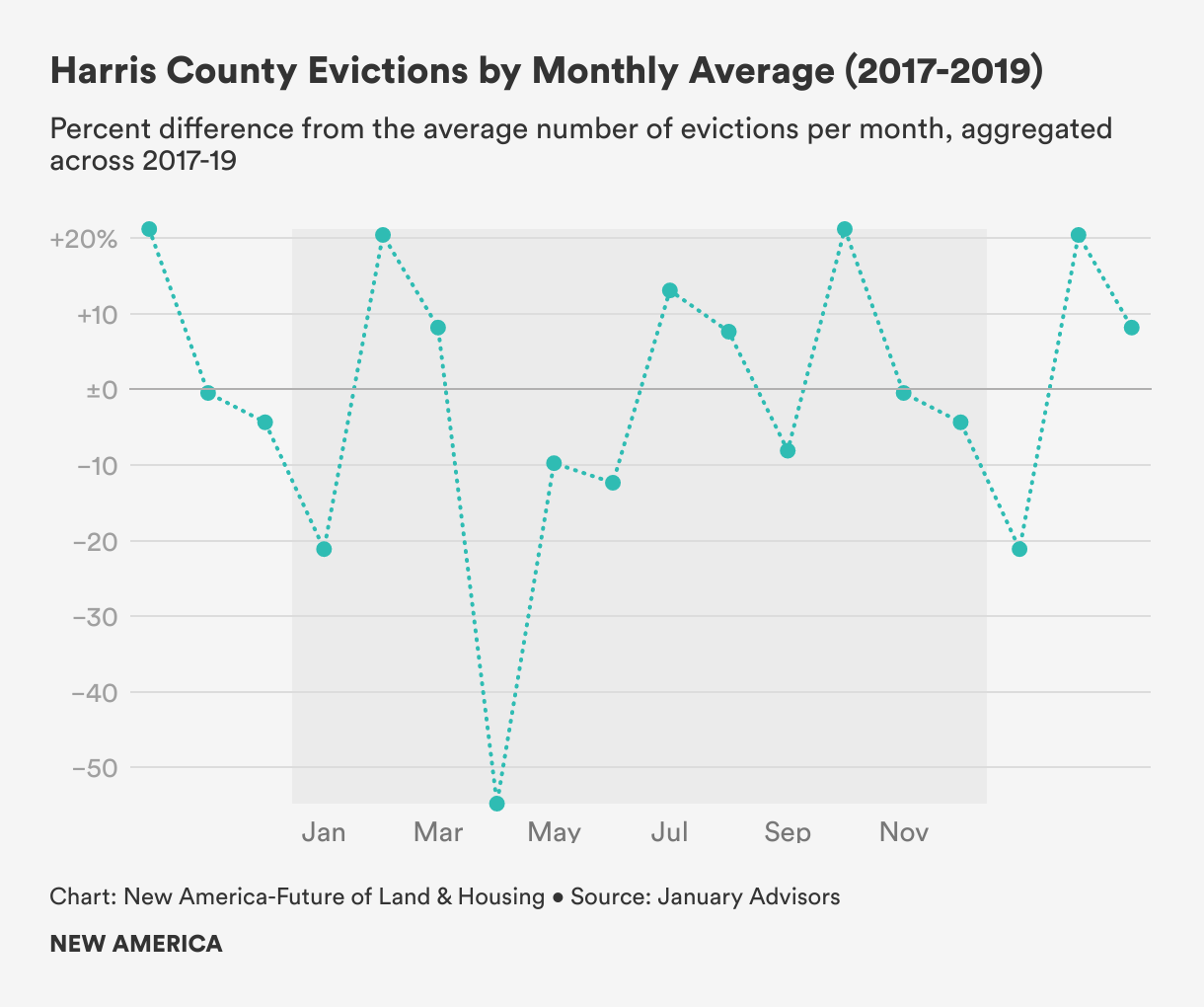
In contrast to our findings in many other U.S. counties, evictions in Harris County do not spike during the summer months. Instead, they spike in February, fall sharply until April, and then climb until the fall. October had the highest average number of evictions between 2017 and 2019, with 3,915. This peak is nearly a 96 percent increase from the average low of 1,992 in April.
We are unsure why this bimodal distribution occurs, and further research is needed.
Mortgage Foreclosure: Fifty-five percent of Harris County residents are homeowners, but mortgage foreclosure only accounted for one-fifth of all recorded housing loss during the three-year study period. Overall, 28,850 households were foreclosed upon, for a rate of 1.8 percent.
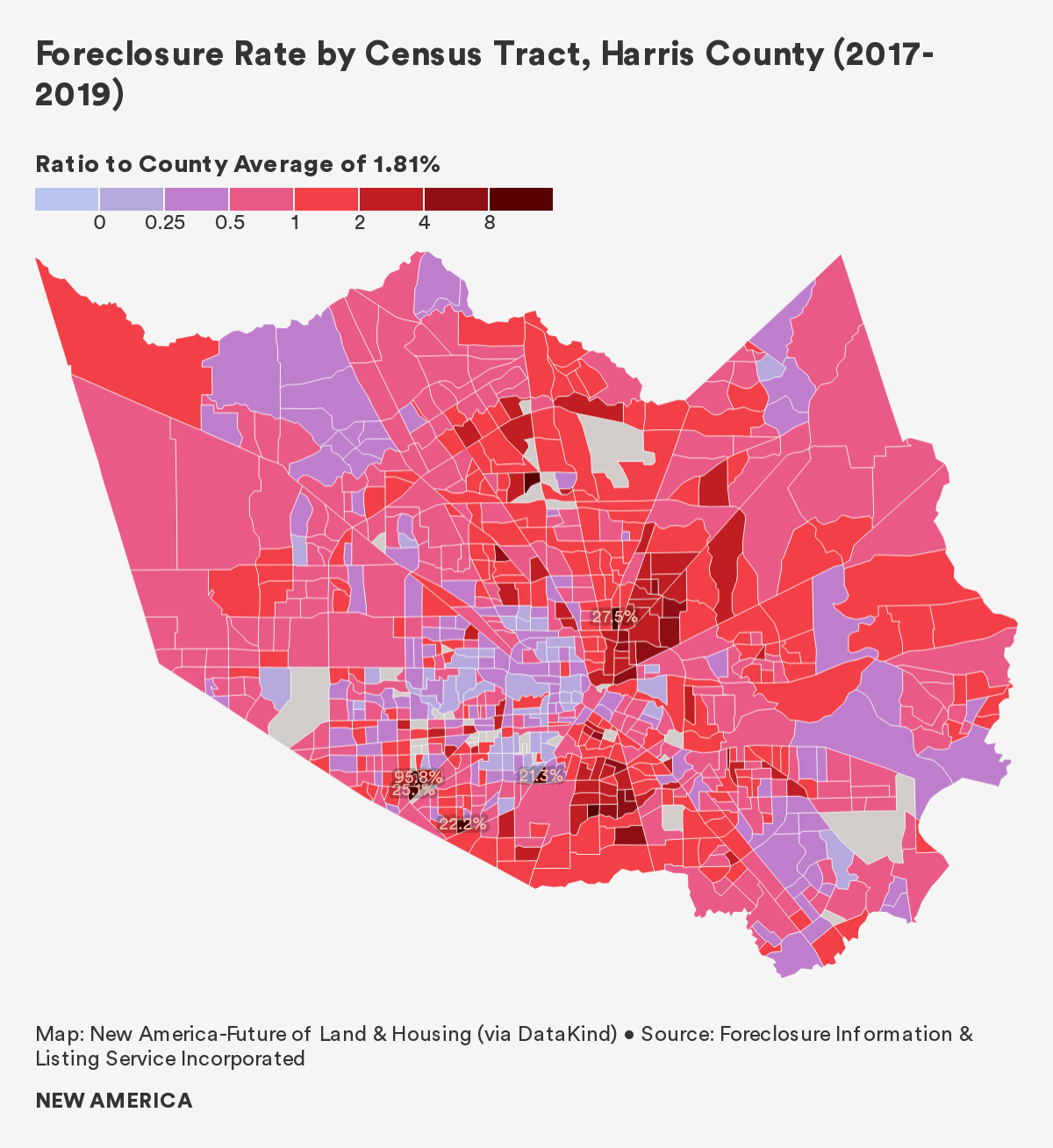
However, while the county average was relatively low, multiple neighborhoods experienced extremely high foreclosure rates (a variation we did not see in many of our other case studies). High mortgage foreclosure rates were clustered in three areas within Harris County: to the northeast of downtown Houston, near the neighborhoods of Scenic Woods and East Houston; to the west of William P. Hobby Airport, around the Myrtle, Sunnyside, and Westwood Park neighborhoods; and in the southwest of the county, close to Alief and Chinatown.3 In many of these neighborhoods roughly a quarter of all homeowners with a mortgage are losing their homes to foreclosure, nearly fourteen times the county average. In general, these areas are majority Black or majority Latinx.
Who is Losing Their Home?
Correlation analysis of Harris County shows that as the percentage of Black households in a census tract increases, so does the housing loss rate. By contrast, census tracts with more white households and with higher median household incomes had lower rates of housing loss.
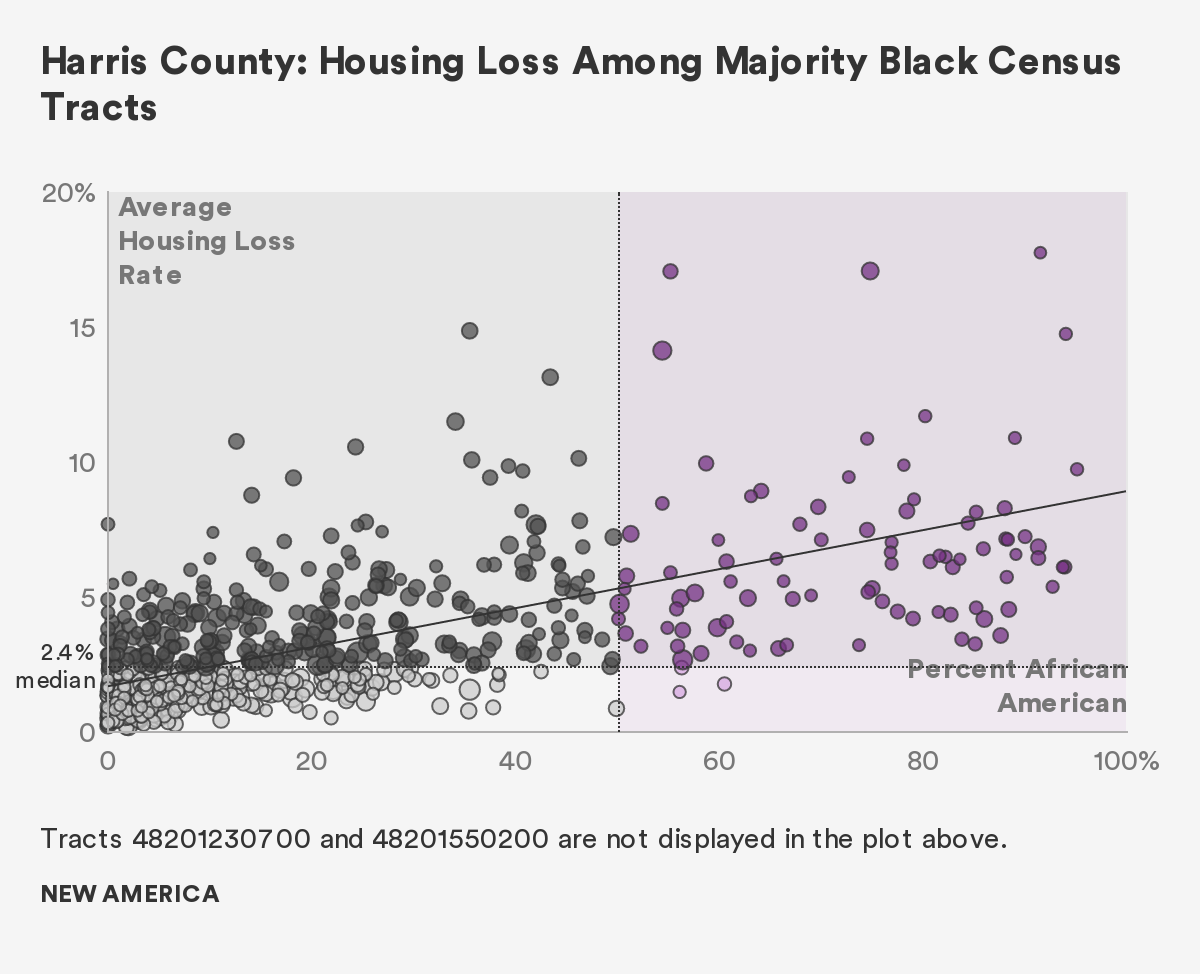
To better understand the relationship between housing loss and Black households, the strongest relationship we found, we categorized census tracts such that they fell into one of four categories: by whether the population was majority or minority Black (above or below 50 percent) and by the housing loss rate (above or below the county median of 2.4 percent).While we saw great variation in whether majority non-Black census tracts experienced above or below median housing loss rates (upper and lower left quadrants), we found that nearly all tracts with majority Black households, close to 95 percent, have housing loss rates above the median (upper right quadrant).
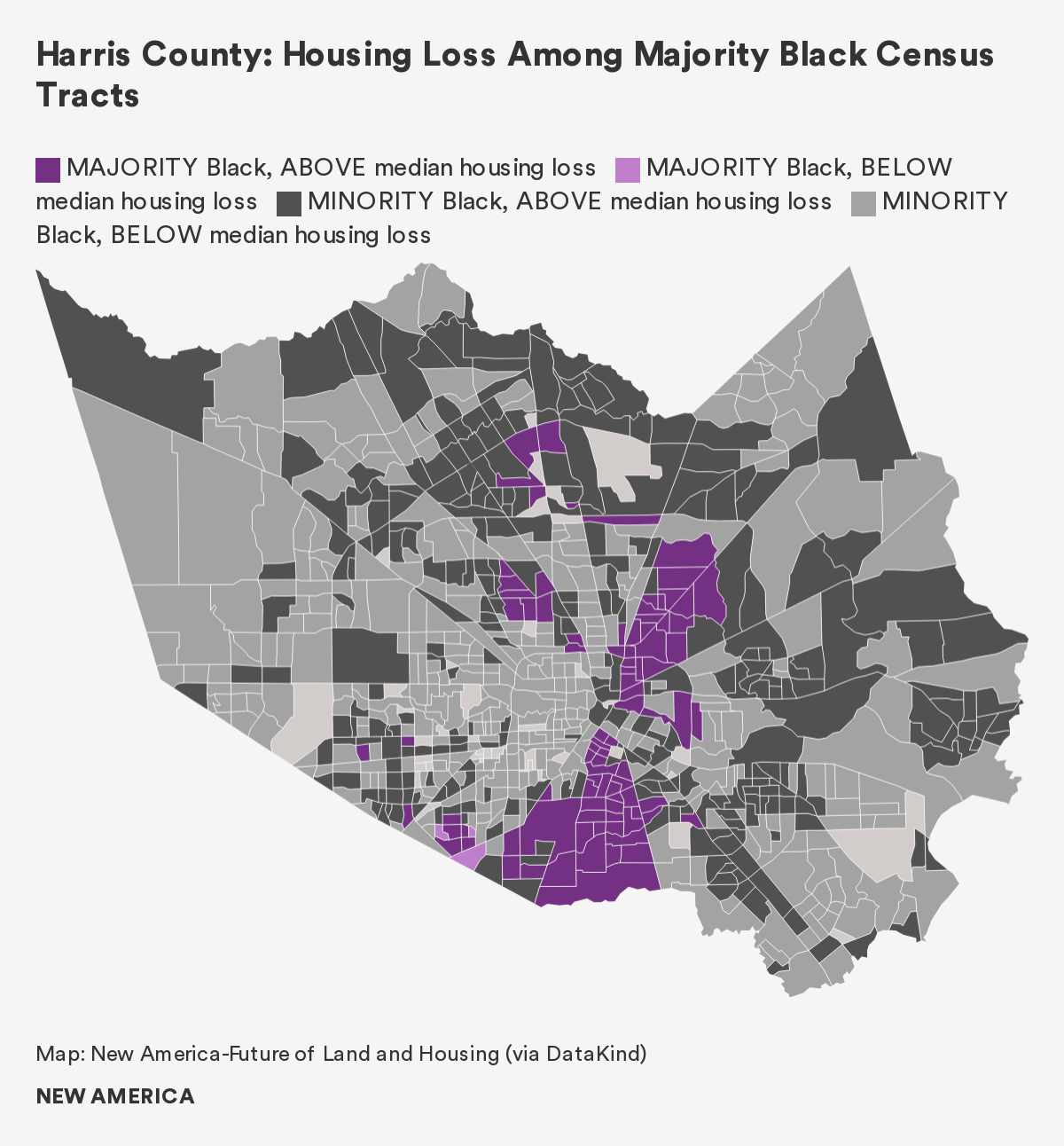
To see where in Harris County the relationship between Black households and housing loss is most prominent, we mapped this data and see that neighborhoods with majority Black households and above average housing loss are clustered to the northeast of downtown Houston and directly south, in Southeast Houston, Sunnyside and South Acres/Crestmont Park. Tracts that have minority Black populations with above average housing loss rates are geographically dispersed all over Harris County, both in Houston and in the surrounding areas.
Most surprising, census tracts with higher percentages of Latinx households displayed a slightly negative relationship with displacement, despite the fact that several interviewees noted that the Latinx community is generally at-risk of home loss, specifically evictions. We believe that correlation analysis fails to demonstrate this association because Latinx renters, and especially marginalized immigrant populations, may experience informal evictions that are not recorded by the county court system.
Housing Loss and COVID-19
Most interviewees in Harris County readily expressed that renter households were more vulnerable to housing loss than homeowners. The COVID-19 pandemic, along with the subsequent recession, only exacerbated existing pressures on renters, notably the lack of livable wages and an acute affordable housing shortage. Stakeholders pointed out that landlord-friendly laws, as well as a very quick eviction process, contribute to the heightened risk of displacement. A tenant can be served an eviction notice if they are three days late in paying rent.
In contrast to our quantitative findings, interviewees asserted that Latinx renter households, and especially immigrants and undocumented residents, are very at-risk of eviction. This incongruity may be due to the fact that informal evictions are prevalent in Latinx communities. Perhaps some tenants recognize that they are hopelessly behind on rent and move out on their own accord with the aim of keeping an eviction filing off their rental history. Alternatively, a landlord may change the unit’s locks or threaten a renter with an eviction filing, avoiding formal legal processes. One stakeholder estimated that informal evictions account for 30 percent of all evictions in Harris County.
A tenant can be served an eviction notice if they are three days late in paying rent.
One major consequence of displacement in Harris County is overcrowding, or the “doubling up” of households, which is extremely worrisome amid a pandemic. For low-income families, or families with frontline workers, overcrowding can lead to negative health consequences. “Doubling up” can also disrupt education if children have to switch school districts, or if the new living arrangement stretches resources related to remote learning.
A counterintuitive finding mentioned by three interviewees is that the cost of the cheapest rental units in Harris County is staying the same or actually increasing. Low-income rental households that usually rent Class C Properties are now aiming to save money by moving into even lower-quality housing. Demand and rent have increased as a result.
Pandemic rent relief has so far been insufficient. In Harris County, tenants apply for housing aid, but their landlords approve the grant. Money is then sent directly to the landlord. However, many landlords were not incentivized to participate in aid programs at the outset of the pandemic, and were unwilling to work with tenants to complete applications. Even when tenants do receive one-time aid, landlords can still file an eviction the next time rent is late. Most concerning is that undocumented immigrants are excluded from CARES Act funding, despite the fact that the undocumented community is particularly at-risk of housing loss. As a result, only a small amount of alternative aid was available to undocumented communities, and many were afraid to access it.
Policy Solutions
Our policy recommendations to mitigate housing loss amid COVID-19 can be found in the report section: “Housing Loss in the U.S. Sun Belt.”
Citations
- From an interview with contributing authors Alberto Rodríguez and Cassandra Robertson.
- Of note, an “eviction filing” is not the same thing as an “eviction.” An eviction filing initiates the formal eviction process within a court system. A filing does not mean that a tenant was actually evicted. Most times, a formal eviction is the result of a disposition or a summary judgment, and the tenant must vacate the rental unit in question. source
- A census tract in southwest Harris County experienced a near unbelievable foreclosure rate of 96 percent, although it must be noted that only 8 owner-occupied households with a mortgage live in the tract.