A Chapter of: Providing Care Changes Men
III. Men and Work-Family Conflict: The Heavy Toll on Men who are High-Intensity Caregivers and/or Parents
Work, Not Care, is the Main Source of Work-Family Conflict
Men who give care—High-Intensity Caregivers and/or Parents, HICP, as well as Other Fathers—report up to four times more work-family conflict than men who are Non-Caregivers, another key indicator from the survey data about how the experience of providing care can shape men’s lives. (Figure 7) Just 10 percent of Non-Caregiving men, for instance, reported feeling that they had to put off work because of the demands on their time at home, compared to 41 percent of HICP men and one third (33 percent) of Other Fathers.
A key finding, however, is that among men who care, men who are High-Intensity Caregivers and/or Parents who have ever cared for adults or children with special needs experience more work-life conflict and stress and lower levels of pride and satisfaction with their caring roles than do Other Fathers who have never cared for children with special needs. Men who are High-Intensity Caregivers and/or Parents, HICP, are also as likely as HICP women to miss work or reduce work hours due to care demands. In this section, we will explore work-life conflict, satisfaction with care, and burnout by gender and care experience, and how men’s stronger ties to work and breadwinner identity make it difficult, or seem impossible, for many of them to find time to both work and care.
When it comes to work-family conflict, researchers have identified two primary modes: work-to-family conflict, when the demands of work spill over and take away time for life, family, and care; and family-to-work conflict, when family responsibilities spill over and interrupt time and attention from work.
In a sign of the large influence the American overwork culture has in our lives, all three groups—High-Intensity Caregivers and/or Parents, HICP, Other Parents and Non-Caregivers—experienced far more work-to-family conflict than family-to-work conflict, meaning work disrupts home life far more than care work gets in the way of paid work. These findings reinforce research showing that both work and family are “greedy institutions” that demand time, attention, and energy, but that, in the United States, where there are no public policies guaranteeing paid annual leave, paid sick or paid leaves for care, and where work hours are among the longest of any advanced economy, work is the greedier institution.
Figure 7
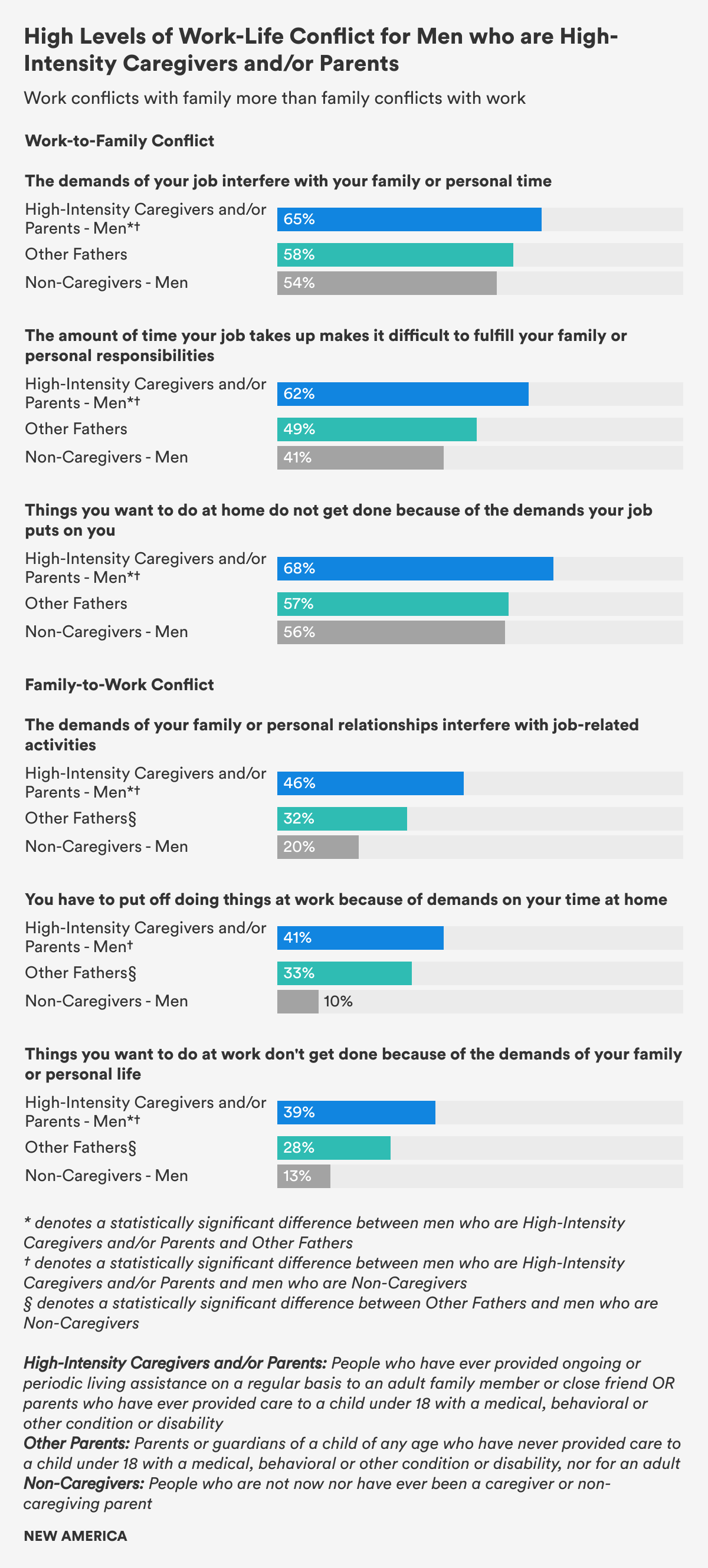
For instance, about twice as many men who are High-Intensity Caregivers and/or Parents, HICP, (65 percent) and Other Fathers (58 percent) said the demands of their job interfere with their family or personal time than reported that their family responsibilities interrupt their work, which was noted by 39 percent of HICP men and 28 percent of Other Fathers. Given that men in the HICP group perform so many more care tasks (as described in section two), it is noteworthy that HICP men are still more likely to say that work interferes with family responsibilities, rather than family responsibilities interfere with work.
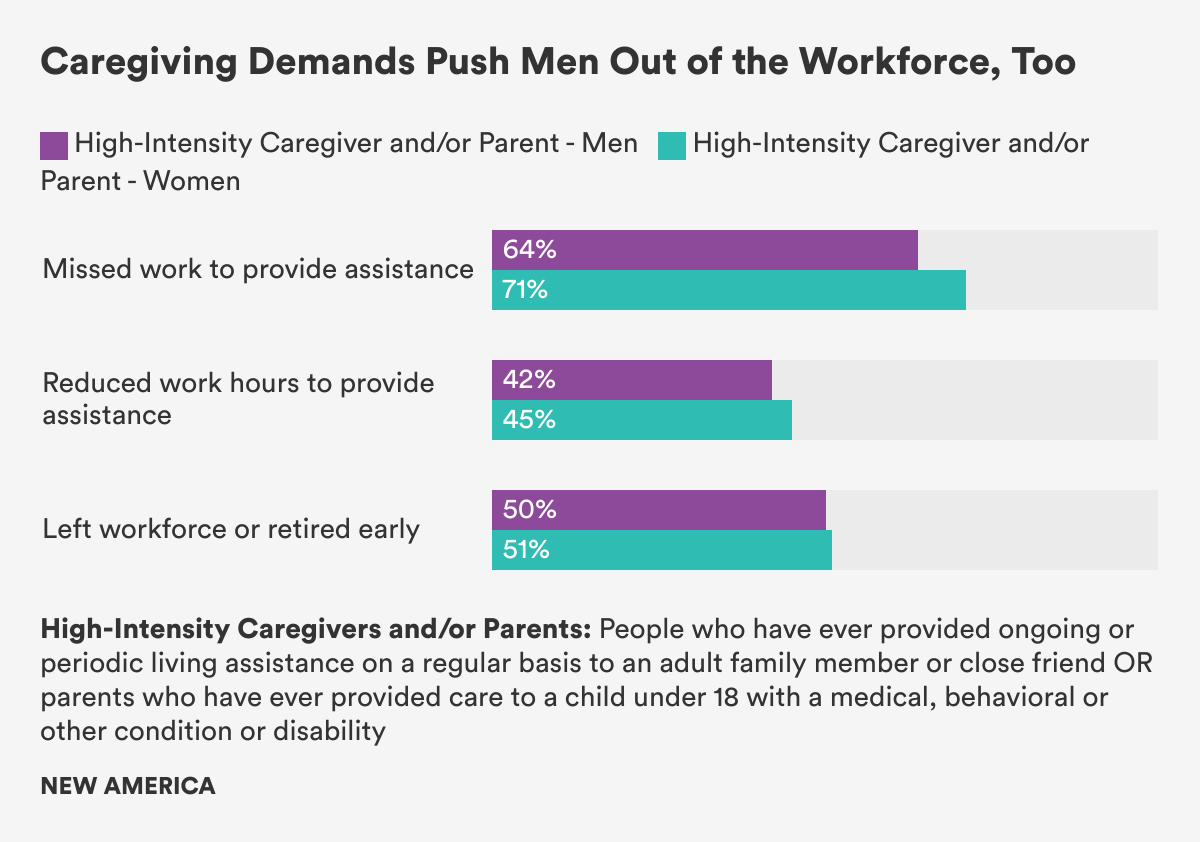
Perhaps most importantly, we found that large shares of employed men who are High-Intensity Caregivers and/or Parents, HICP, reported missing work, reducing work hours or leaving the workforce entirely because of care duties. (Figure 8) While 71 percent of employed HICP women said they had missed work to provide care, so had 64 percent of HICP men—and this difference between genders was not statistically significant. More than 40 percent of employed High-Intensity Caregivers and/or Parents of both genders had reduced their work hours to provide care, and more than 50 percent of employed High-Intensity Caregivers and/or Parents of both genders had left the workforce or retired early to provide care.
Figure 8
Men who are High-Intensity Caregivers and/or Parents Experience More Work-Life Conflict
Providing care to loved ones and others is a complicated experience. Care work can be physically, emotionally, and mentally draining, depleting, exhausting, and lead to burn out. It can, at the same time, also be a source of great joy, satisfaction, pride, connection, and meaning. In our survey, 85 percent of High-Intensity Caregivers and/or Parents, HICP, who have cared for an adult or a child with special needs and Other Parents who have never cared for a child with special needs found their care work satisfying. Nearly 90 percent of High-Intensity Caregivers and/or Parents, HICP, and Other Parents said they felt respected inside and outside their families for their care work, though fewer of the youngest carers and parents in both groups ages 18 to 29—67 percent—felt proud to talk about their caring roles compared to 81 percent of those ages 30 to 44.
However, in our survey data, we found significant differences in the experiences of High-Intensity Caregivers and Parents, HICP, and those of Other Parents when it comes to both the stresses and joys of care work. These differences between these caregiver groups transcended gender lines, although there were a couple of notable gender differences.
On five of the six work-family conflict measures, High-Intensity Caregivers and/or Parents, HICP, experienced more work-life conflict than Other Parents. For instance, roughly two-thirds of both HICP men and women reported that the demands of their jobs made it difficult to fulfill family or personal responsibilities, compared to 49 percent of Other Parents. Among High-Intensity Caregivers and/or Parents, HICP, men and women were equally likely to experience work-family conflict: There were no statistically significant differences by gender.
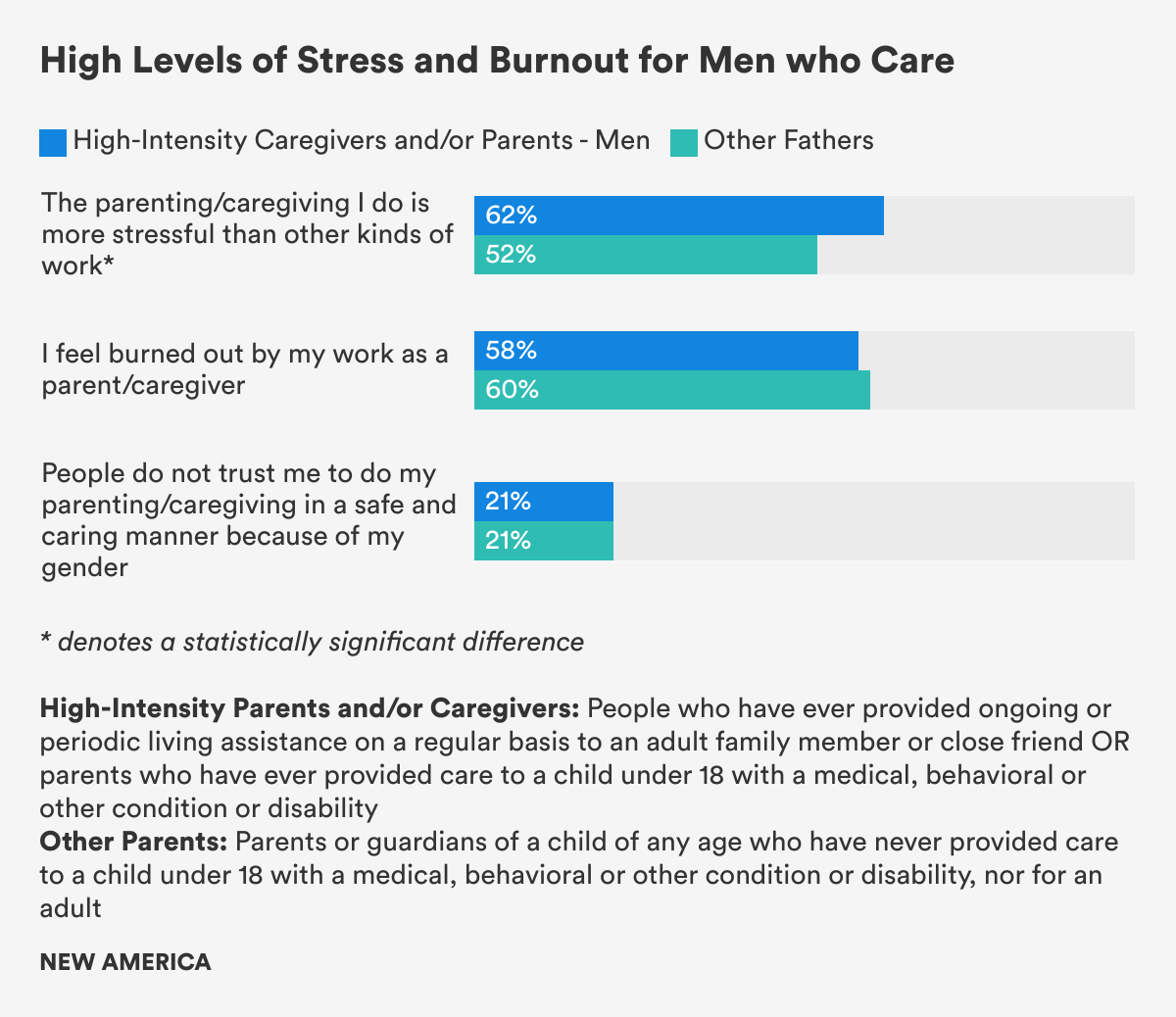
In looking only at men, we found statistically significant differences between men who are High-Intensity Caregivers and/or Parents, HICP, compared to Other Fathers on every measure, save one: burnout. HICP men felt less respected for their care work than Other Fathers both inside and outside of their families. And compared to Other Fathers, HICP men reported higher levels of stress, lower levels of satisfaction, and fewer opportunities for growth in their care work—an indication, perhaps, that while parenting a child with no special needs can be exhausting, it is also ultimately a joyful and meaningful experience watching a child grow to independence. Caring for a child with a medical, behavioral, or other condition or disability, or for an older adult in declining health is perhaps no less meaningful, but can also be much more demanding, stressful, and time-intensive.
Figure 9
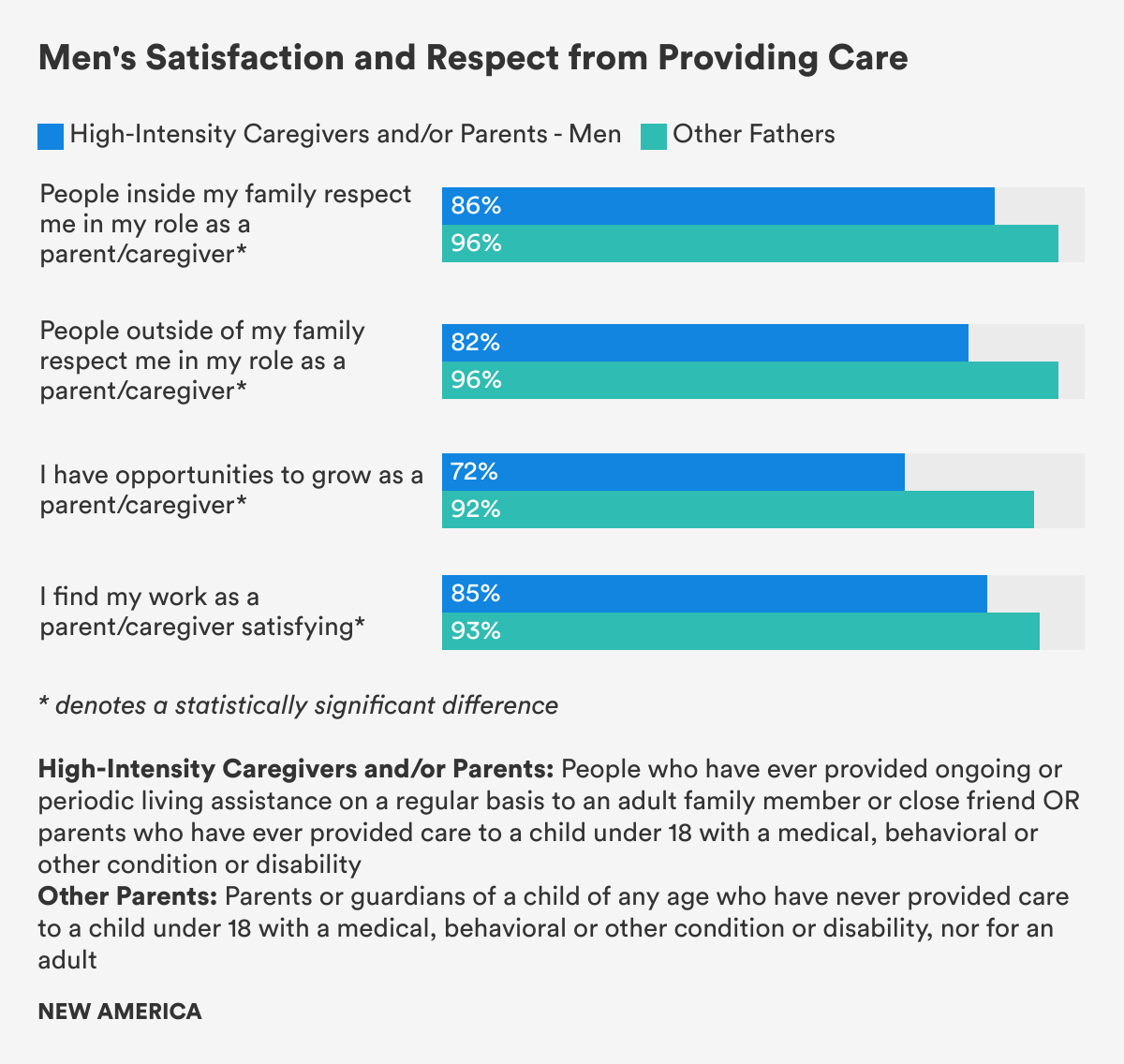
When it comes to gender differences, though the percentages are still quite high, fewer men who are High-Intensity Caregivers and/or Parents, HICP, felt respected by people outside their families than HICP women by a statistically significant margin (82 percent of HICP men to 88 percent of HICP women). And among the Other Parents, significantly more of these mothers (98 percent) felt they had opportunities to grow as a parent compared to these fathers (92 percent). In contrast, about 70 percent of HICP men and women felt they had opportunities to grow as caregivers.
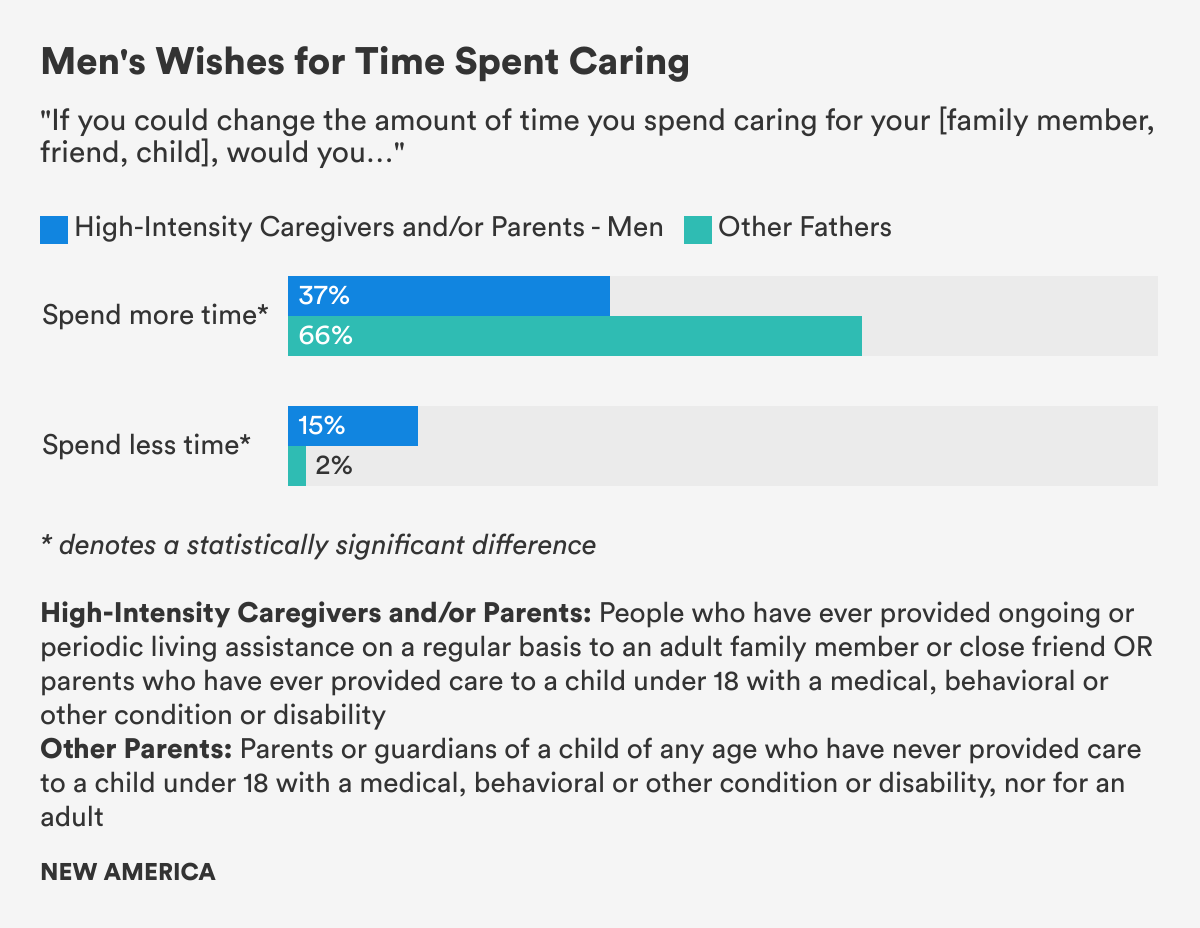
High-Intensity Caregivers and Parents, HICP, were also less likely than Other Parents to say they would like to spend more time caring—53 percent of Other Mothers and a substantially higher two-thirds of Other Fathers said they wished they could spend more time caring for their children. That contrasts with just 34 percent of HICP women and 37 percent of HICP men. Fifteen percent of men who are High-Intensity Caregivers and/or Parents, HICP, and 18 percent of HICP women said they wished they could spend less time caring, compared to a scant 2 to 3 percent of Other Parents.
Figure 10
Two-thirds of High-Intensity Caregivers and/or Parents, and Other Parents Feel Burned Out by Care Demands
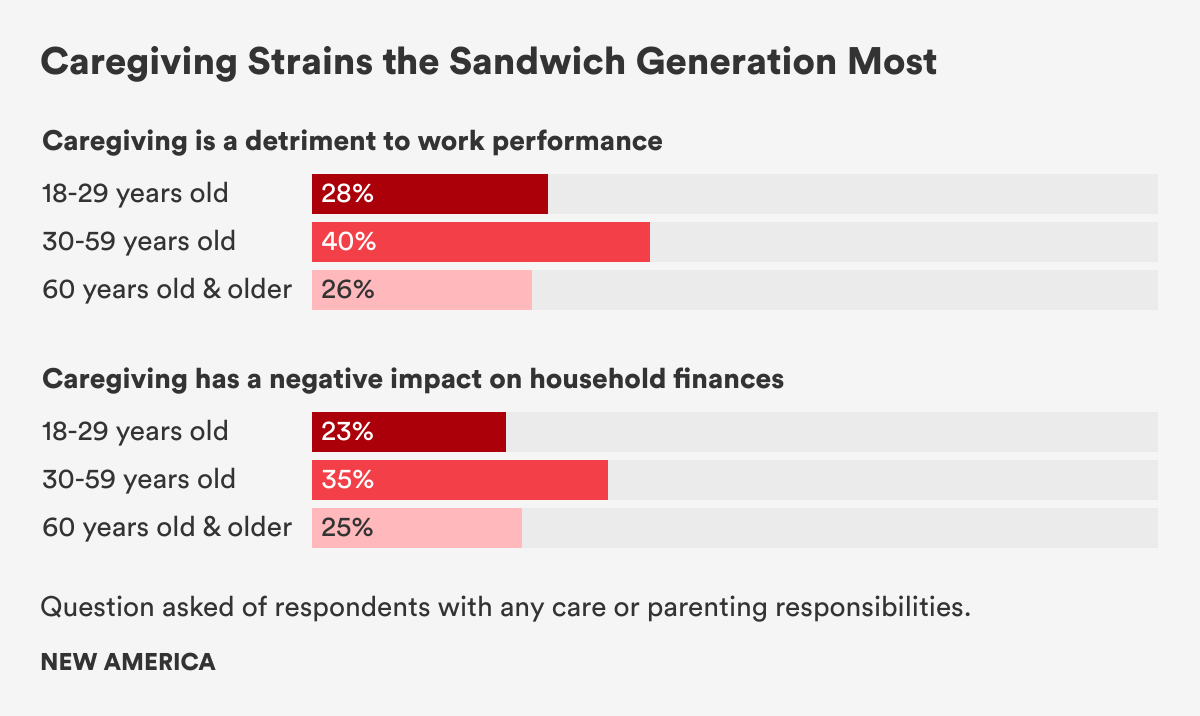
More than six in 10 High-Intensity Caregivers and/or Parents, HICP, reported feeling burned out from care responsibilities at least sometimes or said that it’s more stressful than other work. Nearly half reported that care work has negatively impacted their stress and mental health, while 32 percent reported a negative impact on physical health and 30 percent on family finances. Respondents between the ages of 30 and 50—the height of the “frenzied families” era of care responsibilities as parents and sandwich generation carers for aging parents or loved ones—said care work was more likely to have a detrimental effect on their paid work and family finances compared to those in younger and older age groups.
Families that care for aging adults and people with disabilities face difficult financial struggles. A 2016 survey by AARP, for instance, found that family carers spend about 20 percent of their income on care activities, amounting to about $7,000 per year in out-of-pocket expenses.
Figure 11
Among High-Intensity Caregivers and/or Parents, HICP, who have ever cared for an adult or child with special needs, 64 percent of women and 58 percent of men say they feel burned out by their care work. Similarly, among Other Parents who have never cared for a child with special needs, 65 percent of these mothers and 60 percent of fathers said they feel burned out by their care duties.
Although our survey found similarly high levels of burnout for High-Intensity Caregivers and/or Parents, HICP, and Other Parents, previous research has found that parents of children with special needs are at higher risk of burnout than parents of children with no special needs. Research has also likened the chronic stress that mothers of disabled adolescent children experience to the stress of combat. Fathers of children with special needs, likewise, have been shown to experience far higher stress levels than fathers of children with no special needs. Fathers whose children have chronic illness or disability can have what’s been described as “hunter-provider anxiety”—a fear of failing to find or keep a regular job while at the same time balancing the often high financial costs and time demands of care responsibilities.
Research has also likened the chronic stress that mothers of disabled adolescent children experience to the stress of combat.
This research has also found that the three keys to mitigating stress and burnout, particularly for those who care for adults, include being supported by family and friends, having time to rest and recuperate, and feeling appreciated by those whom one is caring for.
In our data, we asked High-Intensity Caregivers and/or Parents, HICP, if they had support for their often heavy caring duties. HICP men and women reported having roughly similar levels of emotional support. About 45 percent of men and women said they had “lots of people” they can talk to about their care responsibilities—a surprising finding, given that previous research has found that men are less likely to have social networks or feel comfortable talking about concerns about their care responsibilities, which can lead to feelings of isolation. Sons caring for elderly parents have higher levels of emotional and financial strain, compared to fathers or spouses.
Figure 12
As far as physical support or sharing the load, about one-third of men and women who are High-Intensity Caregivers and/or Parents, HICP, said they do not have others they can count on to help them with their care duties.
One-third of men and women who are High-Intensity Caregivers and/or Parents, HICP, said they do not have others they can count on to help them with their care duties.
In terms of support, the only statistically significant difference we found between genders for High-Intensity Caregivers and/or Parents, HICP, was in their access to resources to enable them to take a break when they need it. Far more HICP men, 53 percent, said they had access to resources to give them a needed break than HICP women, 40 percent.
What to make of that? It could be that because of men’s higher earning power—fueled by the gender pay gap that rewards men and male-dominated professions more than women and female-dominated ones—and the traditional masculine identity tied to finances and breadwinning, they have the power to pass off care duties to women when they need a break, whereas women are less likely to be able to do so. Or that men who are High-Intensity Caregivers and/or Parents, HICP, are more likely than HICP women to have the financial resources to hire others or outsource care when they need respite, as well as the expectation that they deserve to rest. Women, as previous research has found time and again, not only have fewer resources, but they feel more responsible for care work, tied to their traditional role as carers, feel less entitled to take time off for rest or to take care of themselves, and are more likely to feel guilty admitting that they even need it.
Men who are High-Intensity Caregivers and/or Parents Need Support at Work to Manage Work-Life Conflict
In our focus groups, men’s stronger ties to paid work over care work, and the expectation that they should prioritize financially providing for others came through clearly. In the general population focus group discussions, men tended to believe it was more difficult to combine full-time work and caring than women did, with eight out of the 13 men saying it would be impossible or difficult. Just two out of 13 women in the general population group similarly said it would be difficult to combine full-time work with care responsibilities, but quickly went on to imagine how flexible schedules and supportive bosses and coworkers could help make it work.
“There is no way I could continue with my current job and being a caregiver. My job is far too demanding on its own. If I had to provide this care, I would likely need to take a leave of absence or resign. And that certainly introduces financial and health insurance issues for me and my family. A supportive employer with a good leave policy would be required,” said Geff.
In the focus group discussion among men who care for an adult, many men in this group as well couldn’t see a way to combine full-time work and care responsibilities. “I don’t think I could do it all the time … especially with a full-time job. I think I would need time and training to make it possible, or to be two people,” said James, who cares for his mother.
But unlike the men in the general population group, the men who had cared for an adult began to imagine what they would need to combine work and care, including flexible schedules, and supportive managers and work environments. Still, the men in this group had a clearer understanding of the toll combining work and care takes than those in the general population group of men. “There is not enough time in the day for those two jobs to make it a reality,” said Oliver, who cares for his wife. “If I was working full-time caring for an adult and at the same time working my regular full-time job, I would be burned out quickly.”

Providing Care Changes Men
- Executive Summary
- Introduction
- I. Providing Care Can Shape Men’s Attitudes and Beliefs
- II. Men Who Care
- III. Men and Work-Family Conflict: The Heavy Toll on Men who are High-Intensity Caregivers and/or Parents
- IV. An Overwhelming Majority of Men Value Care and Believe it Should be Equally Shared. But Belief Isn’t Associated with Practice.
- Conclusion
- Methodology