A Chapter of: Providing Care Changes Men
II. Men Who Care
Who They Are
Although women are still expected to be primary carers, the United States, in reality, is a nation of carers composed of people of all genders, including men. In our nationally representative survey, a large majority—nearly three-fourths of all respondents—identified as someone who provides care to a loved one.1
As a reminder, in analyzing our survey data, we found significant overlap in the number of people who have both ever cared for adults and parents who have ever provided care for a child with special needs, as well as in their attitudes and experiences. For these reasons, we grouped them together as High-Intensity Caregivers and /or Parents, HICP.
And though more women than men said they have ever cared for adults or children with special needs (56 percent), more than four in 10 men (45 percent) said they, too, have been responsible for this often labor intensive yet invisible and underappreciated care work. Although this gender difference is statistically significant, the finding that so many men are engaged in such high-intensity caregiving challenges the long-standing conventional wisdom that most men don’t provide care, don’t want to, or don’t know how to.
An additional 23 percent of our sample identified as parents who have never cared for a child with special needs, called Other Parents in this report, to distinguish them from the parents of children with special needs in the HICP group. This Other Parents group was evenly split between women and men (51 to 49 percent, respectively). And 26 percent of our sample were neither parents nor had they ever cared for an adult. This Non-Caregiver group was more male than female (59 to 41 percent, respectively).
Figure 2
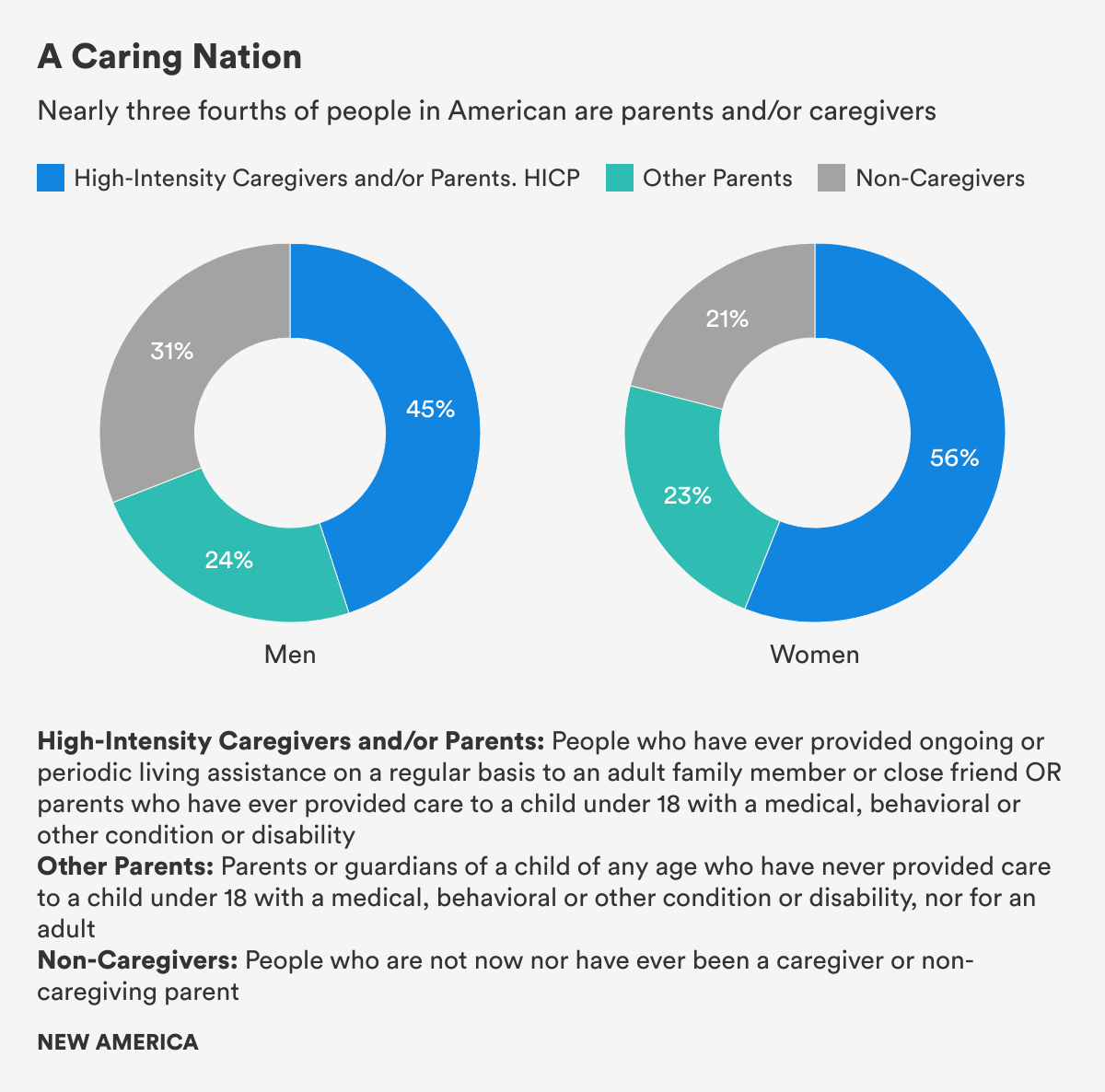
The finding that 45 percent of men have ever cared for an adult as the U.S. population ages tracks with research by AARP and the National Alliance for Caregivers. They found two in five men, or 39 percent, had cared for an adult in the past 12 months, compared to 61 percent of women.
Just under 60 percent of those in our High-Intensity Caregiver and/or Parent, HICP, group who have ever cared for an adult or a child with special needs were employed, the same as the percentage of Non-Caregivers. Those in the Other Parent group—that is, parents who have never cared for a child with special needs—were more likely to be employed (71 percent). But there was no difference between the three groups in the share who worked part-time, full-time, or more than full-time. Almost a quarter of all three groups (including 23 percent of those in the High-Intensity Caregiver and/or Parent group) reported working more than 40 hours per week.
When asked “Have you ever provided ongoing or periodic living assistance on a regular basis to an adult family member or close friend,” men were more likely than women to say “no”—62 percent to 54 percent. Yet in keeping with the finding that America is a nation of carers, whether people recognize it or not, our survey found that even men in the Non-Caregiver group have in fact performed active caring tasks, as the following section will describe.
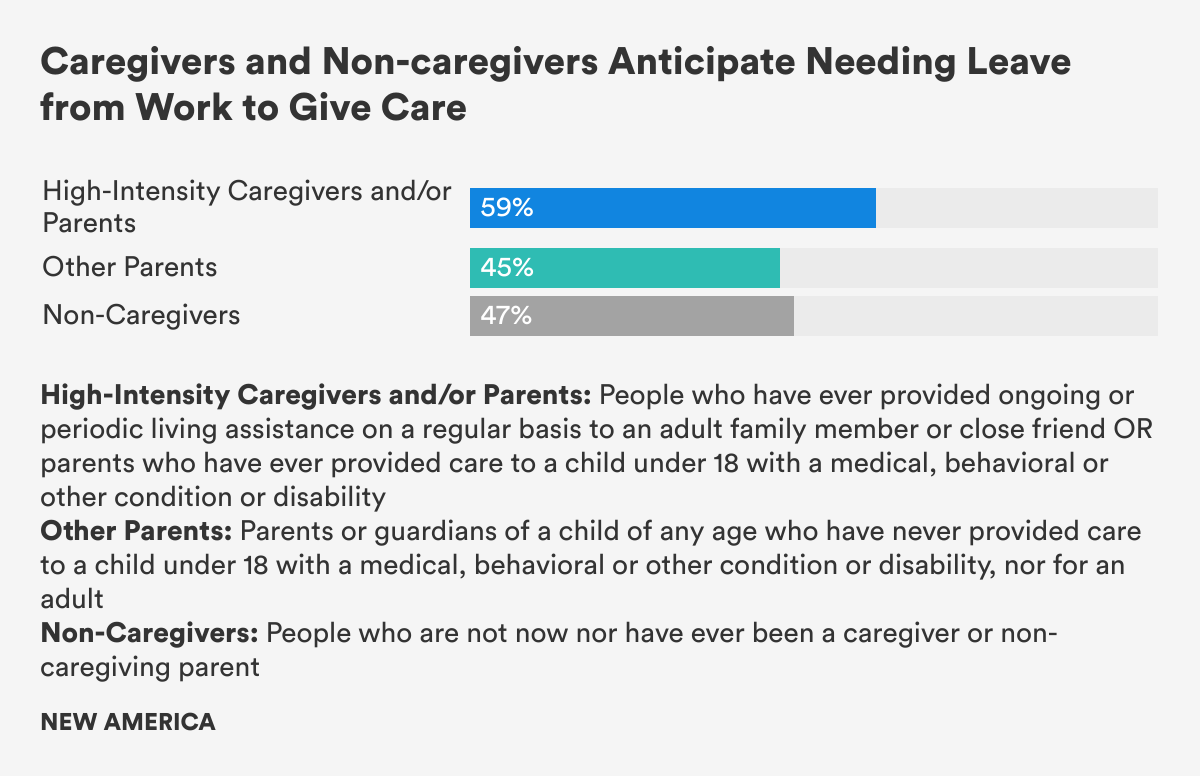
Moreover, large shares of people in all of our groups—High-Intensity Caregivers and/or Parents, HICP, Other Parents, and even Non-Caregivers—said that they anticipate needing time off work to give care in the near future. That includes not only 59 percent of HICP and 45 percent of Other Parents, but nearly half (47 percent) of those who do not have care responsibilities, suggesting that they anticipate that they will need to care for others in the future.
What Men Who Give Care Do: Pretty Much What Women Who Give Care Do
When it comes to what men who care actually do, research over the years has shown that men tend to do more hands-off tasks managing care, like home maintenance, car repair, and keeping track of finances. Fathers are more likely to play with children and be engaged in activities tied to learning and academics that are typically not bound by time deadlines. Mothers, on the other hand, are more likely to be responsible for much more of the task-heavy, time-bound day to day caring tasks of feeding, bathing, dressing, or administering care. So it may not be surprising that research has found that fathers tend to be less stressed and happier than mothers. Our research sheds new light on the tasks and activities that men who give care actually do, how they feel about it, and how it impacts their stress and health.
A previous Better Life Lab report on fathers found that large shares of fathers reported being actively engaged in both hands-on and hands-off parenting tasks. (That report was based on the same survey data but combined the data on all parents, regardless of whether they had cared for a child under 18 with a medical, behavioral, or other condition or disability.) Yet that report found that, on every measure of parenting tasks, mothers reported doing more than fathers by statistically significant margins on all tasks, save one—playing with children.
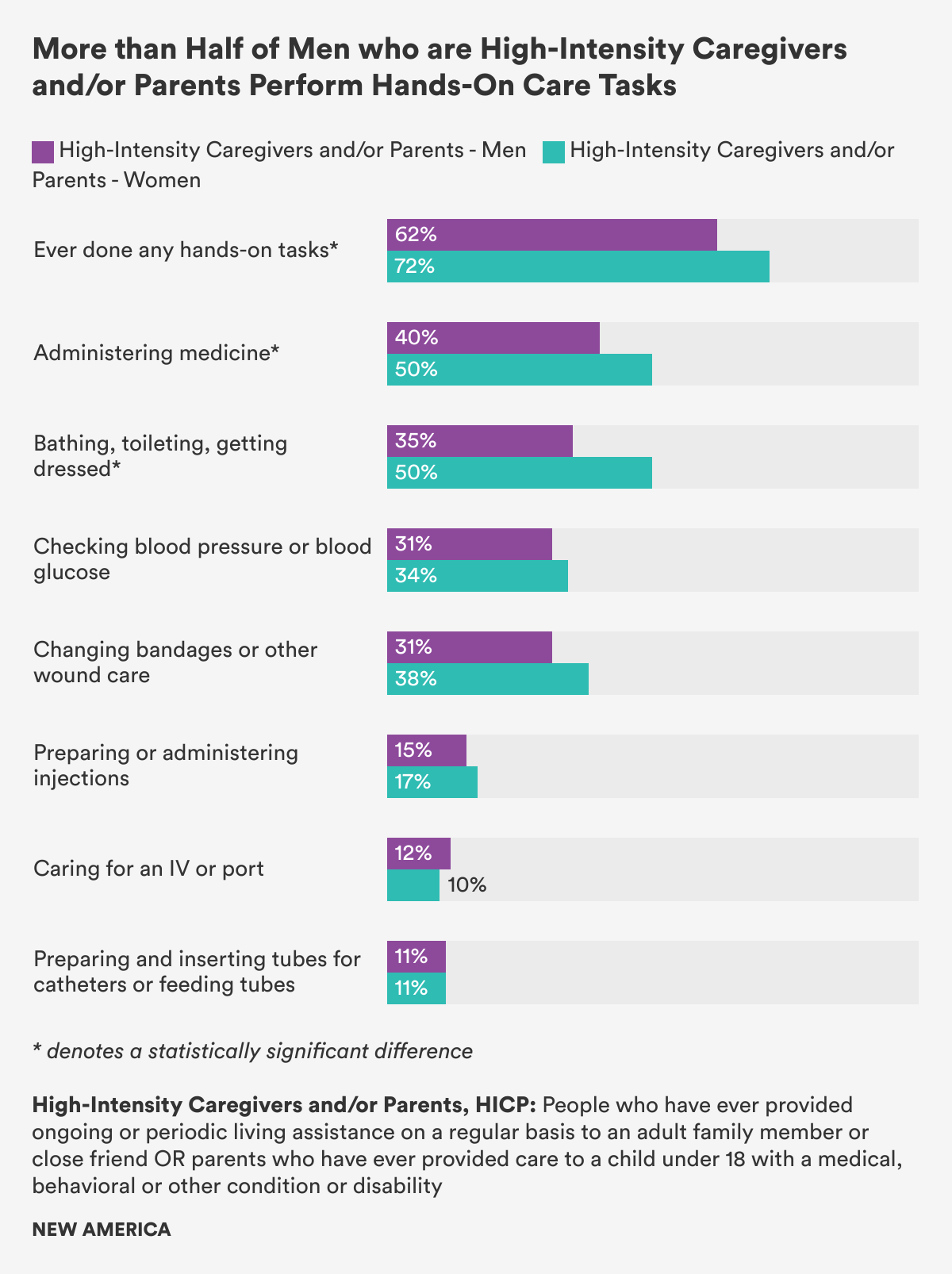
Our survey asked whether respondents had ever done any of the 15 “types of ongoing or periodic living assistance for an adult family member or friend who has/had a serious illness, or a disability, or needs extra help.” This list included two types of activities: “hands-off” tasks that keep the household running, keep the care recipient fed, and ensure the recipient gets medical care and medicine, and “hands-on” tasks that involve more intimate and medical care of the care recipient’s body. Hands-off tasks were much more common than hands-on tasks for both men and women. (Figures 3 and 4)
More than 90 percent of men and women in the High-Intensity Caregiver and/or Parent, HICP, group who have ever cared for an adult or child with special needs reported ever having done any of eight hands-off caring tasks, and the average number of these tasks men and women reported doing was the same (five). The only statistically significant differences between men and women in this group for hands-off caring tasks were for providing transportation outside the house and for household maintenance like mowing or fixing things, reported by 72 percent of HICP men and 58 percent of HICP women.
There was slightly more evidence of gendered caring when it came to the hands-on tasks: 72 percent of women who are High-Intensity Caregivers and/or Parents, HICP, performed hands-on tasks compared to 62 percent of HICP men. However, it’s important to note that nearly two-thirds of men who care for adults or parents of children with special needs are also performing intimate hands-on care tasks—a far higher share than predominant cultural stereotypes of men as absent or unwilling providers of care. Similarly, women who are High-Intensity Caregivers and/or Parents, HICP, reported performing 2.1 hands-on tasks on average, whereas men with these same care responsibilities reported performing 1.7 hands-on tasks. While this difference is statistically significant, meaning that it is unlikely to be due to random chance, it still amounts to a difference of less than one task between the genders.
It is important to note that we asked whether someone had “ever” done these care tasks, and did not capture how much or how often someone performs them. Time diary research shows that women spend about twice as much time on housework and caring than men do. Still, when it comes to the types of care tasks, we found that men who care for adults or fathers of children with special needs are more similar to women with the same care responsibilities than cultural stereotypes may recognize.
… are more similar to women with the same care responsibilities than cultural stereotypes may recognize.
In terms of specific hands-on caring tasks, there were only two significant differences between men and women who care for adults or parents of children with special needs. Women who are High-Intensity Caregivers and/or Parents, HICP, were more likely to administer medicine than HICP men (50 percent of women vs. 40 percent of men), just as HICP women were more likely to bathe, dress, and help with toileting (50 percent of HICP women vs. 35 percent of HICP men.) For all other hands-on tasks, there were no other statistically significant differences between the genders.
Figure 3
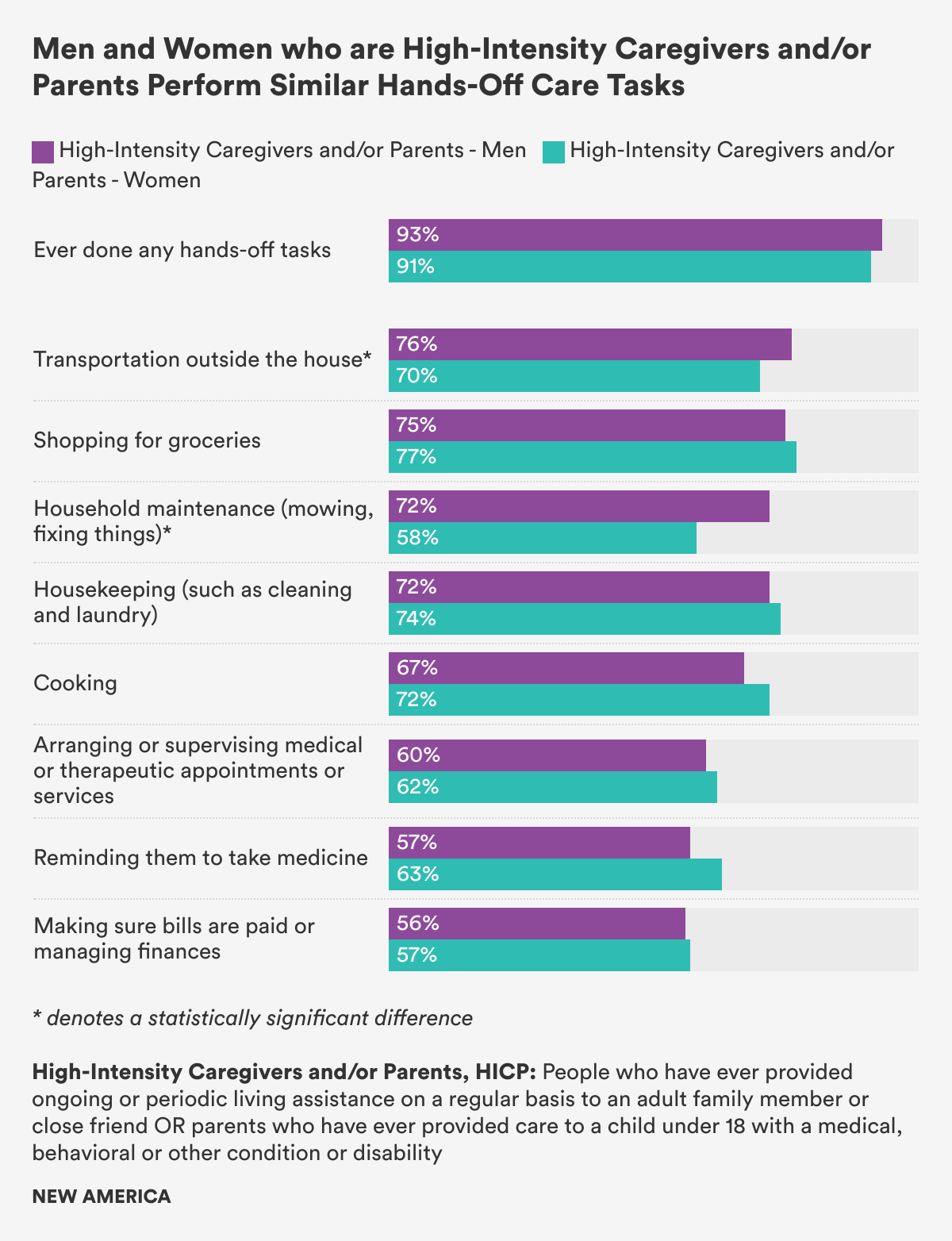
Figure 4
Non-Caregivers Also Give Care
More than half of the Other Parents who have never cared for a child with special needs (58 percent of fathers and 65 percent of mothers in this category) and nearly a quarter of the Non-Caregiver group had nevertheless performed hands-on caring tasks for an adult. Just as for those in the High-Intensity Caregiver and/or Parent group who have ever cared for adults or children with special needs, the most common hands-on tasks performed by those in the Other Parent and Non-Caregiver groups were administering medicine, changing bandages, and assisting an adult with bathing, toileting, and getting dressed.
Among Other Parents and Non-Caregivers, the only statistically significant gender difference in terms of caring tasks is that men in both groups were more likely than women in both groups to perform household maintenance. (Figure 5)
It is interesting to note that so many individuals who do not identify themselves as caregivers are actually doing so many hands-on and high-intensity caregiving tasks for adults. That may indicate that they’ve provided occasional help, or that they may have a limited view of care. Our focus groups, as discussed in section one, illustrated this point as well: A number of men in the general population group didn’t see themselves as caregivers, even though, upon reflection, they were performing many caring and/or parenting tasks.
Figure 5
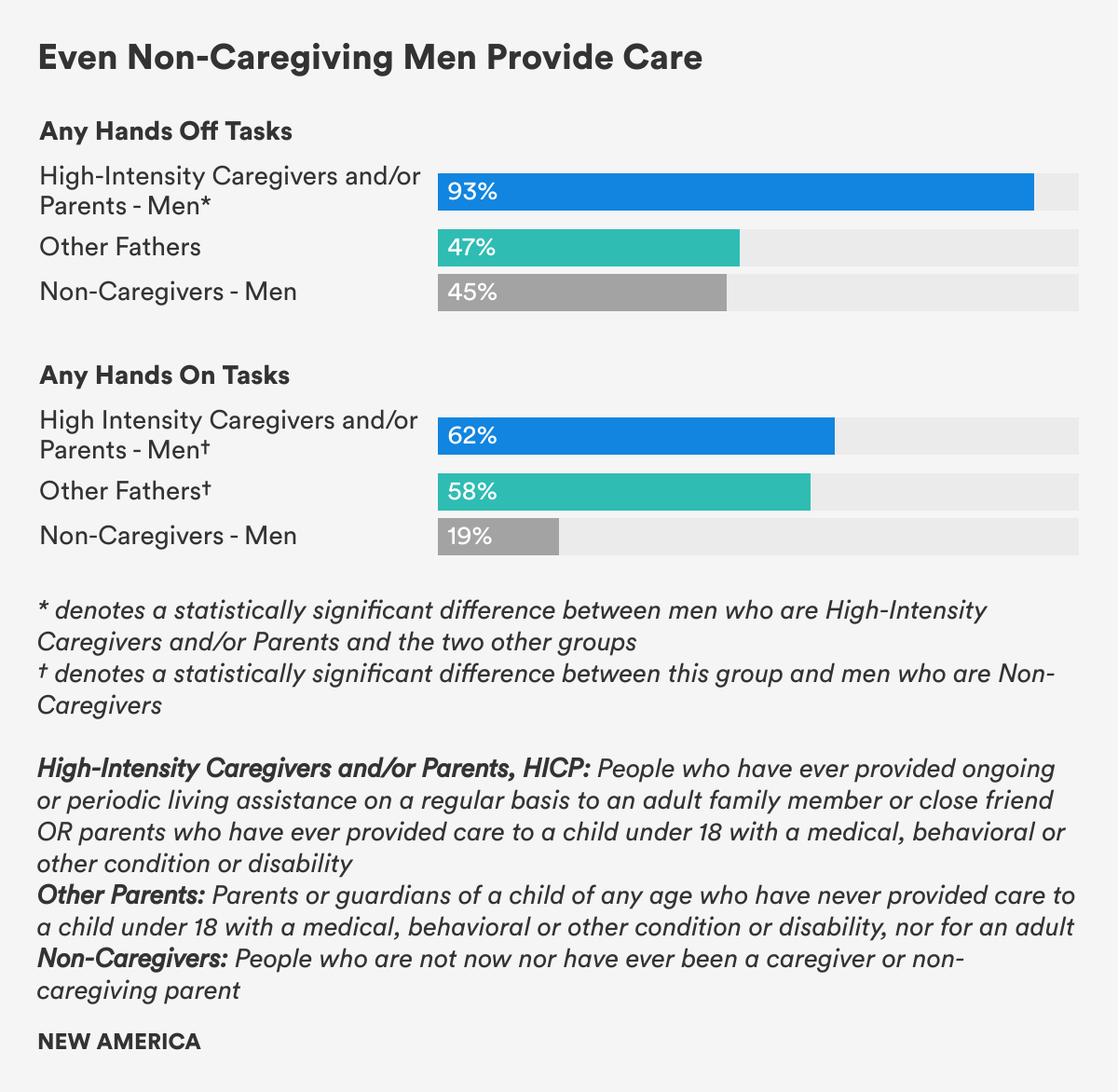
Though we found few gender differences, we did find that the family care responsibilities at home are often much more demanding for men who are High-Intensity Caregivers and/or Parents, HICP, than for the men in the other two groups. Men who care for adults or fathers of children with special needs performed up to six times more caring tasks than Other Fathers and men who are Non-Caregivers by a statistically significant margin on each of the 15 different caring tasks.
… performed up to six times more caring tasks than Other Fathers and men who are Non-Caregivers.
For instance, men who are High-Intensity Caregivers and/or Parents, HICP, perform far more hands-on and hands-off tasks: 93 percent of HICP men say they have ever done any hands-off tasks, averaging 5.3 tasks, compared to 47 percent of Other Fathers, who averaged 2 tasks. And 62 percent of HICP men say they have done the more intensive and intimate hands-on tasks, compared to 25 percent of Other Fathers. Understanding these differences in hands-on caring is critical, as previous research has found that men say they are untrained and find aiding with personal care most stressful of all caring tasks.
Men Need Paid Family Leave in Order to Care
More High-Intensity Caregivers and/or Parents, HICP, who have ever cared for an adult or a child with special needs said they had used paid family and medical leave from work to give care (41 percent) than Other Parents who have never cared for a child with special needs (27 percent). But in both of these groups (HICP as well as Other Parents), men and women were equally likely to have used paid time off to provide care. However, other research shows that the vast majority of workers do not have dedicated paid family and medical leave to care for a new child or an ill or disabled loved one.
While policymakers look for solutions, our data provides critical evidence of the need for comprehensive paid family and medical leave as they consider public paid leave policy options. Our data shows that the inclusion of paid leave for family care responsibilities is critical. The leading federal policy proposal, the Family and Medical Insurance Leave Act (FAMILY) Act, and several state paid family and medical leave programs include up to 12 weeks of paid leave for family care responsibilities—responding to this widespread need. However, the paid leave program Congress enacted for federal employees, and some alternative paid leave proposals pending in Congress, cover only new parents who need to provide care for a newborn or newly adopted child. As our data shows, there is a vast swath of people who are struggling to combine work and intensive, sometimes years-long care responsibilities—and this important constituency would be excluded from paid leave proposals that cover only new parents. The universe of people who need paid family leave may be even bigger than surveys show: Even 16 percent of people who have never given care, the Non-Caregiver group in our study, said they had taken a paid leave from work to give care.
The universe of people who need paid family leave may be even bigger than surveys show.
Research has found that when men take paid leave, their spouses and partners are more likely to return to work, enjoy better health, and advance in their careers. Thegender pay gap also narrows. One study of families in Sweden even found that for every month of leave a father takes, his partner’s earnings increase by 6.7 percent.
Indeed, many men who take paid parental or paternity leave tend to become more involved in care work, willing to work flexibly and share care with their partners, which, over time, not only increases gender equity at work and home, but as research shows, has led to better relationships, less family stress, healthier, happier children, and even longer lives for men.
In our previous Better Life Lab report exploring men and paid family leave, one of the most surprising findings is that men anticipate needing to take time off work to care for loved ones just as much as women do. Three in 10 men and women surveyed expected needing to take time off work in the future to care for a new baby. And half of the respondents—men and women alike—anticipated needing time off to take care of a sick, disabled, or elderly family member.
One of the most surprising findings is that not only do similar shares of men and women with care responsibilities anticipate needing to take time off work to give care in the future but so do similar shares of men and women who have no care responsibilities. (Figure 6) In all three groups—High-Intensity Caregivers and/or Parents, HICP, Other Parents and Non-Caregivers—there is no difference by gender in the share of those who anticipate needing to take leave from work to give care, whether following the birth or adoption of a child or to care for an adult or family member with a serious illness or disability.
In our focus groups of men with care responsibilities and subsequent research, we heard stories of men longing for their own “maternity leave,” wishing they had had more supportive workplaces so they could have more time with family. Several men related the sometimes outrageous lengths they had to go to—saving up sick days for years, draining vacation time, even quitting jobs—so they could take some time off work to care for the people they love.
Many said taking leave was critical not only to be the kinds of fathers and sons they wanted to be but for their wives and partners to live the kind of lives they had hoped for. The main reason people said men take leave from work to provide care—84 percent—is because it’s the right thing to do. Some men in the focus groups say they’re filled with “guilt and resentment” that their inability to take adequate parental leave set the stage for their wives and partners to become the primary carers, forced to dial back at work in order to carry the heavier load at home.
Many said taking leave was critical not only to be the kinds of fathers and sons they wanted to be, but for their wives and partners to live the kind of lives they had hoped for.
Joe Ferrante, one of our focus group members who agreed to a longer follow-up interview and to be identified by name, is a mortgage banker based in New York. He believed he was one of the small share of men in the United States actually covered by a firm’s voluntary paid paternity leave policy—13 percent—but he did not realize the limits of that policy. First, the company didn’t make it easy for him to find out about, much less actually use it. And then, just before his parental leave was to start, he learned that his company would only cover his minimum-wage base salary if he took paternity leave, rather than compensate him for his paternity leave at his usual higher rate, which took into account the commission he relies on to pay his bills. He was so angry that he quit. “My manager told me, basically, ‘Look, just take sick days and vacation days, and that’ll cover the time,’” he said. “I thought that was ridiculous. That took away from my vacation. I should’ve gotten my regular paternity leave.” Joe’s story illustrates that even the disproportionately well-paid professional men who are more likely than others to have paid parental leave may not be able to use it.
Even Richard Petts, a sociology professor at Ball State University who studies men and care, said in an interview that he had trouble taking time off under the university’s family leave policy. “I was told if I wanted to take a day or two off, that was fine. If I wanted to take more time, I would need a note from my wife’s doctor saying that she was incapable of taking care of our child.” That was in 2012.
If I wanted to take more time, I would need a note from my wife’s doctor saying that she was incapable of taking care of our child.
Dave Sucharski, a man in our focus group of fathers who agreed to a follow-up interview and to be identified by name, felt anguish that he did not have access to paid paternity leave when his wife gave birth after a difficult labor. Though their daughter was in the neonatal intensive care unit, he was back at work after he’d used up a week and a half of his vacation time. His wife was forced to take unpaid leave, because, he said, someone had to care for the baby. “I just don’t think it’s accepted by society, by the business world, that this is something a husband, a man, should do,” Sucharski said. “There’s pressure that that’s not my job. My job is to be the breadwinner. Not to be home with ice packs and baby bottles. It’s really sad and really frustrating to me. I just wish I could have spent more time at home.”
And consider the story of Jay Lane, a man who shared his experience of care in the COVID-19 pandemic in an interview. Lane left his job as an assistant gas station manager in Maryland after his managers rejected his request to take unpaid leave through the Family and Medical Leave Act, as he was entitled to under federal law. Though Lane felt strongly about being present for his then-fianceé after the birth of their daughter and had been saving up for months to be able to afford unpaid leave, he still expected to be the primary breadwinner and his partner to take on all the care duties. His “help,” he expected, would be temporary at most.
But when the pandemic hit, he was furloughed from a new job and he began sharing care equally with his partner. The experience itself changed him. He's not only shared tasks like laundry, dishes, cooking, and feeding and changing the baby (“I never realized how many diapers a baby can go through. I never realized how much work it is to take care of a baby.”), he’s also watched her learn to crawl, take her first steps, and begin to talk. Now, he’s noticed that his daughter will seek him out to soothe her, play with her or help her sleep, whereas when he was working full-time before the pandemic, she gravitated toward her mother. Lane is now planning a much different return to work, one that will enable him flexibility and time to continue to be engaged in care work. “I want to make sure I keep building those bonds with her,” he said, “so that she can count on me as well.”
Figure 6

Providing Care Changes Men
- Executive Summary
- Introduction
- I. Providing Care Can Shape Men’s Attitudes and Beliefs
- II. Men Who Care
- III. Men and Work-Family Conflict: The Heavy Toll on Men who are High-Intensity Caregivers and/or Parents
- IV. An Overwhelming Majority of Men Value Care and Believe it Should be Equally Shared. But Belief Isn’t Associated with Practice.
- Conclusion
- Methodology
Citations
- While the survey and focus group data report on men and women as a binary, the Better Life Lab recognizes gender identity as a spectrum and respects nonbinary identities and people of all genders.