A Chapter of: Providing Care Changes Men
Executive Summary
We set out in this report to better understand men who give care—who they are, what they do, and how they think. We did so by comparing the experiences of men who have ever provided care—whether to adults, children, or children with a medical, behavioral, or other condition or disability—with men who have not. We initially sought to explore a central question: whether men’s experience of providing care influenced their attitudes about the value of care. We were curious to explore whether men valuing care would be associated with them doing more of it.
It’s a critical question. Men say they want to share care work equally with their partners. But they don’t. Understanding what stops men from taking on more care responsibilities, and, when they do, what encourages them to continue, is key to creating not only more gender equity, but better health and wellbeing for men, women, children, and families.
In a nationally-representative survey of 2,966 American adults, conducted in partnership with NORC at the University of Chicago and five online focus group discussions using 20|20 Research’s QualBoard facilitation platform collected before the outbreak of the COVID-19 global pandemic, we found that men in general, regardless of their care experience, overwhelmingly say they do value care, with large majorities saying the unpaid care work of home is just as important as paid work. We found, as other surveys have, that large majorities of men say that men should share care work equally with women. And yet we found that men’s belief in gender equality and the value of care did not necessarily translate into men taking on more care responsibilities. In fact, there is a substantial disconnect between what men say is ideal when it comes to sharing care work, and what they actually do.
Instead, what became clear, particularly in analyzing the focus group discussions and in journalistic interviews conducted with a variety of men to capture men’s experience providing care during the pandemic, is that the experience itself of providing care is key. These conversations, in addition to the survey data, suggest that the experience of providing care is what can shape men’s attitudes about care or transform men’s lives.
The notion that men’s experience providing care can shape attitudes, beliefs, and behaviors was most apparent in our focus group discussions. Men who had experience providing care were much more likely than men in the general population group to say that men, not just women, have a natural instinct to care, that providing care is a skill that can be learned, and that society’s expectations and workplace structures are often what keep men from giving care. These conversations showed that it is far easier for men to express a belief that care should be equally shared and much more difficult for men to act on that belief. Further, men who’ve experienced caring for another showed a much more complex and nuanced view of care itself. We asked participants in two focus groups of men to provide images of a “caregiver.” Nearly all the men in the general population group offered photos of female nurses or female uniformed home health aides in medical settings or with the elderly with walkers or wheelchairs. Yet men in the group who had experience caring for an adult, in sharp contrast, shared personal photos of themselves, their children and families, or intimate images of hands clasped or an embrace. In other words, men without the experience of directly providing care immediately associated care with women. And those who had provided care immediately saw themselves.
Terminology
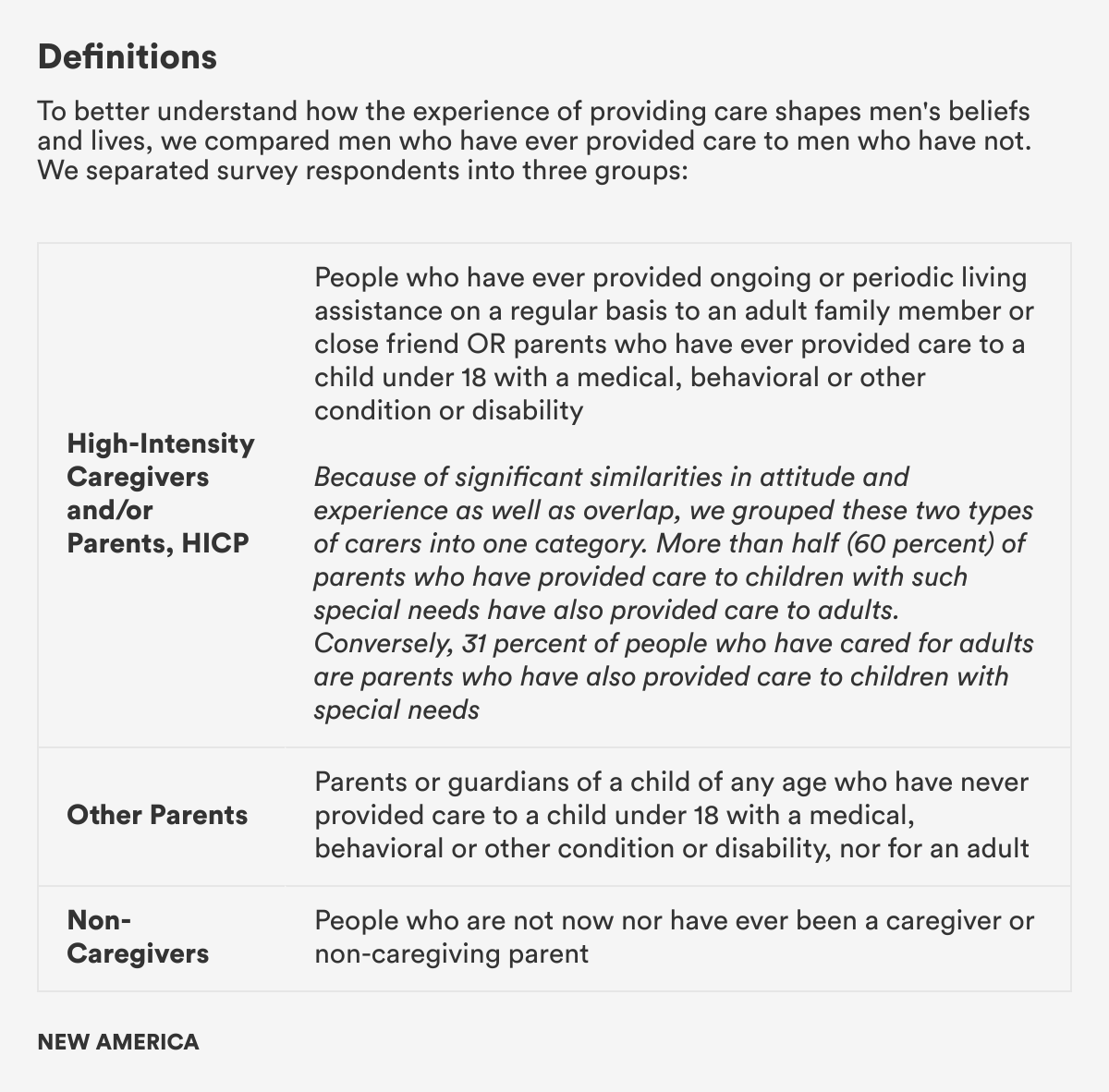
High-Intensity Caregivers and/or Parents: In analyzing our survey data, we initially planned to analyze and compare the experiences of three groups of men: men who care for adults, fathers, and men who are not caregivers. However, it quickly became clear that a significant number of respondents have both provided care for an adult family member or close friend, and are, at the same time, parents who have cared for a child under 18 with a medical or behavioral condition or disability (special needs.) In our survey, 60 percent of parents who have cared for children with special needs have also cared for an adult. Conversely, nearly one-third of those who have cared for an adult are also parents who have cared for children with special needs. And across 27 comparisons, we found only three statistically significant differences in attitudes between those who care for adults, parents who care for children with special needs, and those who fall into both categories. For these reasons—because there is so much overlap in actual people and because of the similarities in attitudes—we chose to group these adults together as High-Intensity Caregivers and/or Parents, abbreviated in this report as HICP.
We compared the experiences and attitudes of those in the HICP group to parents who have never cared for a child with special needs, a group we labeled Other Parents (or Other Fathers, when discussing men exclusively.) We compared both of these groups of caregiving adults with those who have never provided care, i.e. Non-Caregivers. To increase our understanding of men’s experiences with caregiving, some of our analyses compared these three groups while looking only at men, while for other questions, we compared men in the HICP or Other Parent group to women in these groups.
Caregiving: The word “caregiving” means different things to different people, and even is defined differently in national surveys conducted by different organizations. For some, it encompasses a wide variety of caring activities—parenting, caring for an adult, self-care, paid and unpaid care work—on behalf of a variety of people. Others define the word narrowly. For instance, federal legislation and some advocacy organizations refer to “family caregivers” as adult family members or others and who provide ongoing assistance to people with a “chronic or other health condition, disability, or functional limitation.” For the purposes of this report, we use the term “caregiving” to refer to a broad range of care tasks and responsibilities, including hands-on and hands-off care and parenting. Thus, we also refer to two of our three groups—the HICP and Other Parent groups—as “caregiver” groups, because individuals in both these groups perform the broad range of care tasks and responsibilities that we consider to be caregiving.
In exploring men’s experience with care, a central question remains—what keeps men from doing a more equal share of the care work in the United States that they say they say is their ideal? We found evidence that traditional gendered expectations do play a role. But those are shaped and reinforced by inflexible and demanding work cultures, financial pressures, a lack of family-supportive public policies, and cultural expectations about who should or is best suitable for caring. Together, these forces keep men from having the often transformative experience of providing care, and from sharing care responsibilities equally.
Although the data was collected before the global pandemic, it can serve as both a baseline to measure change as well as a useful guide in better understanding men’s experience providing care, the channels that enable them to do it, and the barriers that keep them from it, how it transforms them, and the lasting impact men’s caregiving may have in the future.
Key Findings
The experience of providing care can shape men’s views about care. We asked participants in two focus groups of men to provide images of a “caregiver.” Nearly all the men in the general population group offered photos of female nurses or female uniformed home health aides in medical settings or with the elderly with walkers or wheelchairs. Men in the group who had experience caring for an adult, in sharp contrast, shared personal photos of themselves, their children and families, or intimate images of hands clasped or an embrace.
A Caring Nation
- Nearly three-fourths of all survey respondents are High-Intensity Caregivers and/or Parents, HICP, who have ever provided care to an adult or child under 18 with a medical, behavioral, or other condition or disability (special needs) or Other Parents of children without special needs.
- Although more women fell into the High-Intensity Caregiving and/or Parenting group (56 percent), more than four in 10 men (45 percent) said they, too, have provided this labor-intensive and often invisible care for adults or children with special needs at some point in their lives as well.
Men Value Care and Want to Share Care Work Equally
- Overwhelming majorities of men—more than 80 percent—regardless of their experience providing care or not, believed that unpaid care work at home is as valuable as paid work, valuable to society, and that men and women should share care responsibilities equally.
- The gap between the ideal and actual behavior is large: 91 percent of all survey respondents said care work should be equally shared between men and women. Yet 45 percent said that caring responsibilities fall primarily on women, (46 percent said the care was shared equally. Just 4 percent said caring responsibilities fall primarily on men.)
Men and Women Differ on How Much Men Provide Care
- Men were nearly twice as likely as women (60 percent vs. 32 percent) to say that the division of care labor is equitable when a family member has a serious illness, or a disability, or needs extra help as they get older.
- Roughly one-third of men who are High-Intensity Caregivers and/or Parents, HICP, and Other Fathers said they lived in families where men do the majority of care work at home. Fewer HICP women and Other Mothers, roughly one in five, said the same.
Men who are High-Intensity Caregivers and/or Parents Carry a Heavy Load
- Men who care for adults or fathers of children with special needs perform many of the same care tasks that women with the same care responsibilities do, with six in 10 HICP men performing the intimate hands-on tasks more often associated with women, like administering medicine, bathing, toileting, getting dressed, and changing bandages.
Men who Provide Care Face Work-Life Conflict and Burn Out
- Men who are High-Intensity Caregivers and/or Parents, HICP, experience more work-life conflict than Other Fathers and men who are Non-Caregivers—41 percent of HICP men said they had to put off work because of the demands on their time at home, compared to 33 percent of Other Fathers and just 10 percent of men who are Non-Caregivers.
- More than two-thirds of employed men who are High-Intensity Caregivers and/or Parents, HICP, reported missing work, reducing work hours, or leaving the workforce entirely because of care duties, similar to the shares of HICP women.
- Regardless of gender, six in 10 caregivers—both High-Intensity Caregivers and/or Parents and Other Parents—reported feeling burned out by their care responsibilities.
Men Anticipate Needing Time Off Work to Care
- Large shares of people in all groups anticipate needing time off work to give care in the future, including nearly half, 47 percent, of Non-Caregivers.
Men who Care Face Mistrust and Stigma
- One in five caregiving men, both High-Intensity Caregivers and/or Parents and Other Fathers, said that people do not trust them to give care or to parent in a safe and caring manner because of their gender.

Providing Care Changes Men
- Executive Summary
- Introduction
- I. Providing Care Can Shape Men’s Attitudes and Beliefs
- II. Men Who Care
- III. Men and Work-Family Conflict: The Heavy Toll on Men who are High-Intensity Caregivers and/or Parents
- IV. An Overwhelming Majority of Men Value Care and Believe it Should be Equally Shared. But Belief Isn’t Associated with Practice.
- Conclusion
- Methodology