Does Ranked-Choice Voting Reduce Racial Polarization?
This brief is part of a series by the Electoral Reform Research Group, a collaboration between New America, Stanford University’s Center on Democracy, Development, and the Rule of Law, the American Enterprise Institute, and the Unite America Institute. To find the full report of the study summarized below, click here.
Overview
To examine whether ranked-choice voting (RCV) improves moderation and reduces racial polarization in the electoral arena, we analyzed a large dataset of ranked ballots and precinct-level data from Bay Area mayoral elections from 1990 to 2020.
Research Question
Does switching from first-past-the-post (FPTP) to ranked-choice voting (RCV) reduce racially polarized voting?
Key Findings
- RCV implementation does not seem to reduce the level of racially polarized voting for the overall electorate.
- The conclusion holds even after examining each pair of racial groups included in the study (Asian American, African American, Hispanic, and white voters) separately, and using different ways to cluster voters based on their ranked preferences.
- The conclusion remains the same even after taking into account three necessary conditions (co-ethnic voting, no dominant group, and preference for moderate parties) for RCV to reduce inter-group polarization.
Background and Research Design
Ranked-Choice Voting and Moderation Hypothesis
Political scientists have long investigated whether switching from first-past-the-post (FPTP) to ranked-choice voting (RCV) moderates inter-ethnic conflict in the electoral arena in multi-ethnic societies. Under FPTP (also known as winner-take-all or plurality), voters can choose only one candidate and the candidate with the most votes (plurality) wins a single seat assigned to a single district. Under RCV, voters cast ballots by ranking one or more candidates and the candidate with majority support wins either outright or after a series of vote transfers in which the candidates with the fewest first preferences are sequentially eliminated.
Scholars have argued that RCV encourages voting across racial lines because it incentivizes candidates to take more moderate policy positions and rely less on negative campaigning. This is because a competitive RCV candidate in a diverse jurisdiction must appeal not only to voters from her own racial or ethnic group but also those from other groups who may potentially give her their second- or third-preference ballots. In contrast, the same candidate running under FPTP is more likely to be able to win on the support of members of her own group alone. Therefore, there is an expectation that voters’ choices will be less polarized under RCV than under FPTP. Other studies, however, have reported somewhat mixed empirical findings on this "moderation hypothesis." Several researchers, for instance, have argued that RCV can but does not necessarily produce such a moderating effect on ethnically polarized voting patterns.
While previous studies draw different conclusions from various contexts, what they have in common is that they have not directly analyzed all available information contained in individual-level ranked ballots (and whether voters’ preferences are sharply divided along racial and ethnic lines), despite the fact that RCV is the very system that aggregates voters’ ranked preferences. Instead, previous research has either analyzed aggregated election data or voters’ first choices in individual ranked ballots. To fill this gap in the research, we tested the moderation hypothesis by drawing from the literature on rank data analysis in statistics and mathematics to newly collected U.S. election data. Using all available information in individual ranked ballots, tested if RCV implementation mitigated the degree to which voters of different racial groups, including Asian American, African American, Hispanic, and non-Hispanic white voters, systematically support distinct candidates—a phenomenon known as “racially polarized voting” in the literature on minority representation, redistricting, and voting rights.
Bay Area Mayoral Election Data
To test this hypothesis and measure the degree of racially polarized voting, we leveraged data from California’s Bay Area, where four cities—San Francisco, Oakland, San Leandro, and Berkeley—replaced FPTP with RCV for their mayoral elections between 2007 and 2012. We collected data on contested mayoral elections in this region’s 60 most populated cities between 1990 and 2020, including 5.5 million ranked candidate preferences from individual-level ballot data in RCV elections, and candidate vote shares from more than 13,635 precincts in FPTP elections.
Measuring racially polarized voting with ranked ballot data raises unique challenges. The biggest challenge is the vast number of distinct ways voters can “cast a ballot” with RCV. For example, the 2014 Oakland mayoral election featured 16 candidates and voters were allowed to rank up to three candidates. When accounting for voters who ranked their first and second preferences only, voters had 8,178 unique ways of expressing candidate preference in this election. This suggests that, for each pair of racial groups studied, we would need to look at 33,435,753 comparisons of two unique rankings and examine whether voters of different races have different voting patterns (and repeat this for all pairs of racial groups).
To overcome this problem, we applied so-called cluster analysis, or "clustering," to our RCV data. The purpose of using cluster analysis is to categorize and reduce a large number of distinct ranked preferences into a sensible number of “voting blocs” (or clusters) where voters’ preferences are more similar to each other within clusters than across them. Using a statistical model developed for rank data, we estimated three voting blocs in each election and assigned each voter to one of the three clusters based on their ranked ballots. Similarly, we assigned each voter in FPTP elections to one of three voting blocs by whether voters voted for the winner, runner-up, or the other candidates.
Another challenge is that due to secret ballot rules our election data do not include information about voters' self-reported race and ethnicity. To address this issue, we supplemented our election data with demographic data and estimated the number of voters who belong to each cluster for each racial group using ecological inference. We computed the degree of racial polarization based on the results of the ecological inference.
Findings and Implications
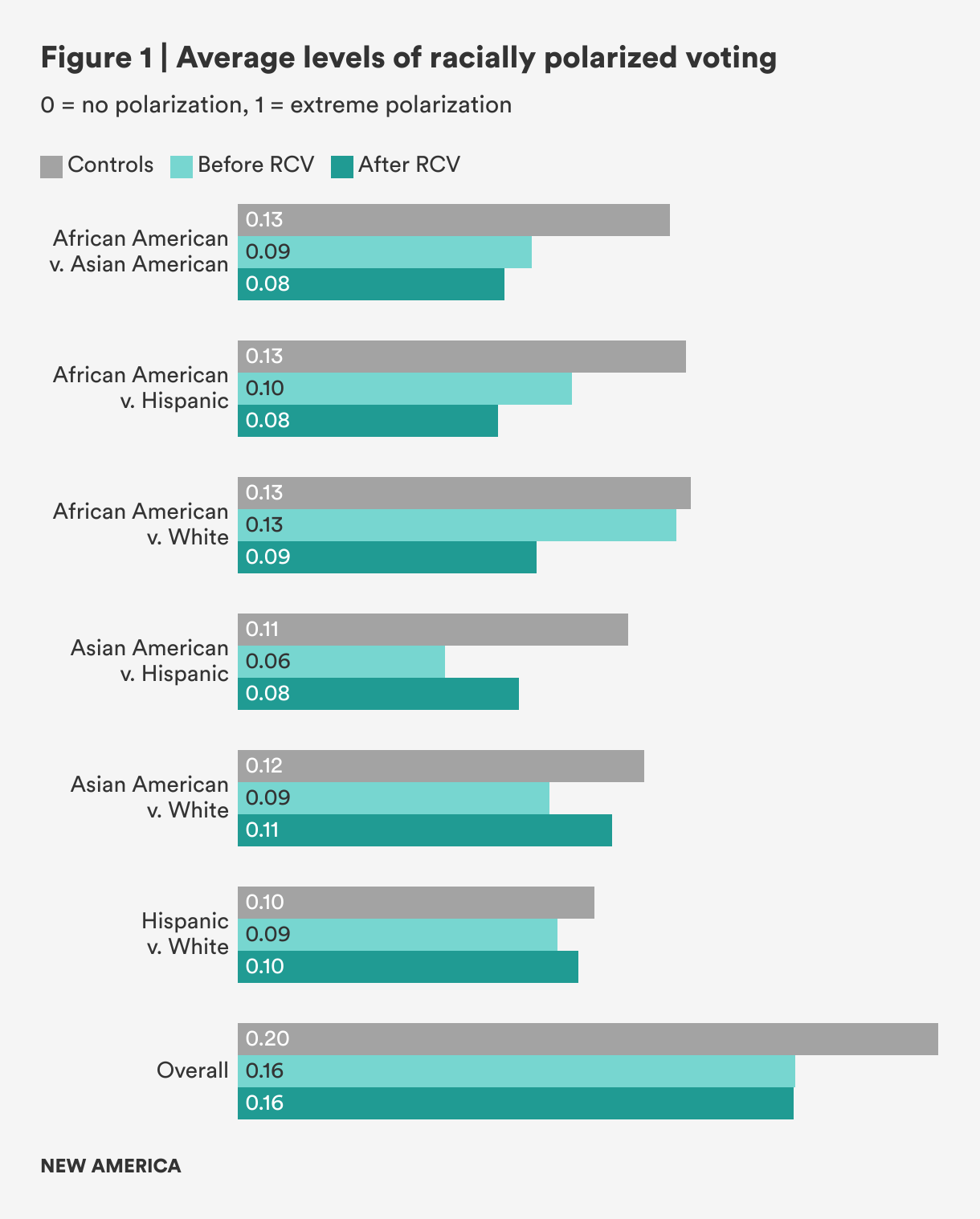
Figure 1 visualizes the average level of racially polarized voting across three types of cities: “Controls” (cities that have never used RCV), “Before RCV” (San Francisco, Oakland, San Leandro, Berkeley before using RCV), and “After RCV” (the four cities after using RCV). On this scale, a score of 0 means that voters of different groups support each candidate at the same proportion (no polarization) and 1 means that they support completely different candidates (extreme polarization).
The top three bars, under “Overall,” show two important findings: (1) the four cities, on average, have a lower level of racially polarized voting than the other cities even before adopting RCV, and (2) it does not appear to decrease after RCV implementation. Similarly, the other bars visualize the average level of racial polarization across the status for each pair of racial groups. While the average scores are lower for RCV elections than for FPTP elections for the overall electorate and some pairs, the difference between the average polarization scores before and after RCV implementation (and between before RCV and control cities) is not statistically large enough to draw a definitive conclusion about such differences.
To ensure that our analysis did not overlook important differences between the four RCV cities and those that have never used RCV, we then accounted for several theoretically relevant factors, such as the proportions of Asian, Black, and Hispanic voters and the level of residential segregation for Asian, Black, and Hispanic residents. Even after accounting for these differences, we found no evidence to support the hypothesis that RCV reduces racially polarized voting. Moreover, we performed multiple robustness checks (the details of which are available in the full paper) by using six different ways to estimate voting blocs in our data. These checks led to the same conclusion.
Investigating further, we looked at three conditions that a group of scholars has articulated as necessary for RCV to reduce inter-group polarization. These conditions are that (1) minority voters prefer co-ethnic candidates, (2) no group numerically dominates the other groups, and (3) voters prefer moderate candidates to more extreme candidates. After accounting for these conditions, RCV implementation still appears not to reduce the degree of racially polarized voting.
Finally, we considered whether the potential presence of strategic ballot concentration—when voters only rank one or two candidates in an attempt to concentrate their voting power to their preferred candidates, a practice also known as "plumping"—may have influenced our empirical analysis. We found circumstantial evidence that some voters may be engaging in plumping by only ranking their top one or two candidates instead of ranking the full slate of three candidates. Specifically, voters on average seem to prefer different ordered sets of candidates depending on how many candidates they rank. Future research should investigate how this behavior impacted our main conclusion.
These results offer several implications for the RCV movement in the United States. Most importantly, our findings suggest that advocates and researchers should not take for granted that local implementation of RCV will automatically diminish the level of racial polarization, at least at the voter level. Additionally, our approach may also help researchers quantify and compare the degree of racially polarized voting under RCV and FPTP for use in redistricting and voting rights cases. Finally, more mathematical and simulation-based research must be done to theorize whether and under what conditions RCV can reduce inter-group polarization in multi-ethnic societies.
Conclusion
The hypothesis that ranked-choice voting induces political moderation remains one of the central arguments for election reform. Analyzing novel data with a unique measurement strategy based on rank data analysis, we attempted to offer direct evidence for the moderation hypothesis focusing on voters’ expressed preferences. Our evidence suggests that switching from first to RCV neither mitigates nor increases the degree of racial polarization among voters. Future research should improve our analysis by bringing a stronger research design for causal identification.
View and download the full report here.
Acknowledgments
I would like to thank New America, the Electoral Reform Research Group, and Arnold Ventures for their generous financial support that enabled the data collection in this research. For helpful comments and valuable feedback, I would like to thank Matthew Hayes, Chris Hughes, Shiro Kuriwaki, Randy Stevenson, and participants of the panels at the MPSA, SPSA, and ERRG workshop.
Downloads
More About the Authors

Yuki Atsusaka