#2 Half of Working Adults with a Short-Term Certificate Earn Poverty-Level Wages
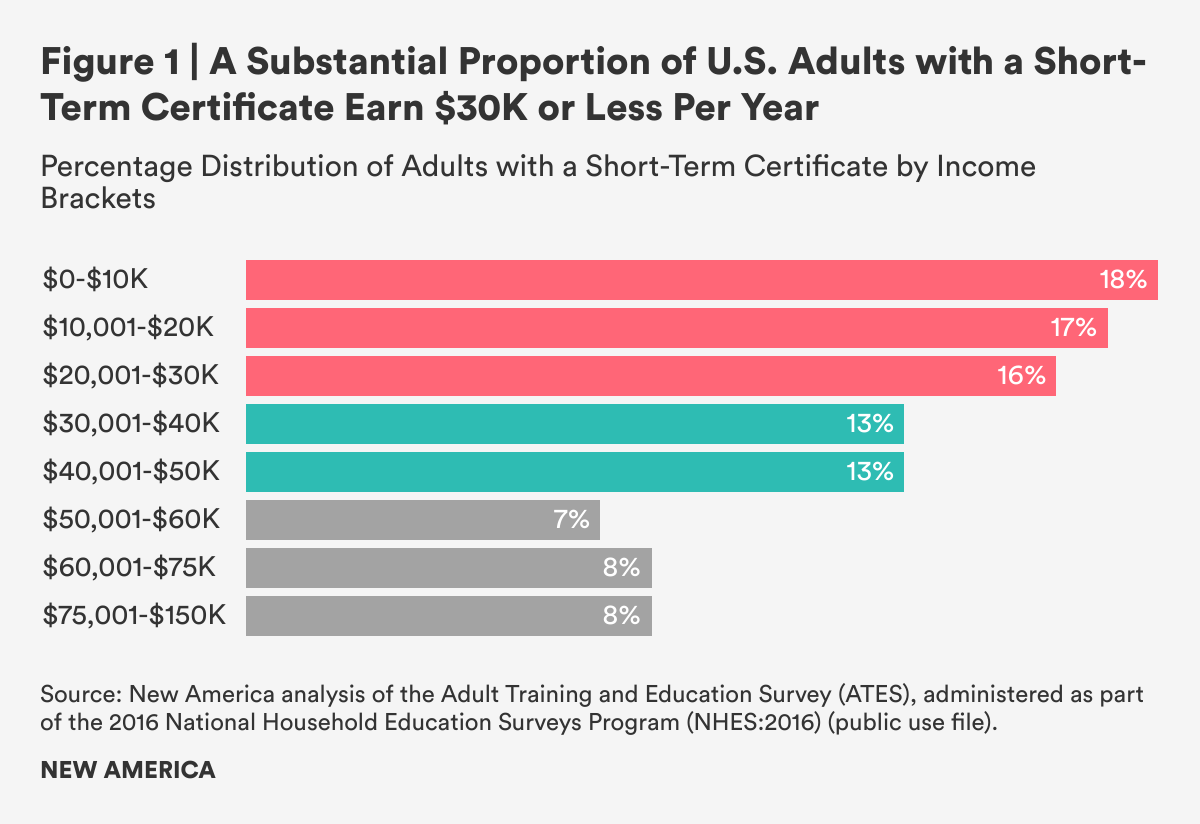
Although students pursue short-term credentials for economic stability, Figure 1 shows more than half of adults with a short-term certificate who are employed earn $30,000 or less per year,20 which is below the national poverty line for a household of four.21 The median yearly income for those with a short-term certificate ranges from $20,001 to $30,000 per year.22 With the highest concentration (18 percent) of short-term certificate-earners making $10,000 or less annually, obtaining only a short-term certificate is not a likely vehicle towards economic mobility for the average student.
People of Color and Women Earn Far Less Than White Graduates with Short-Term Certificates
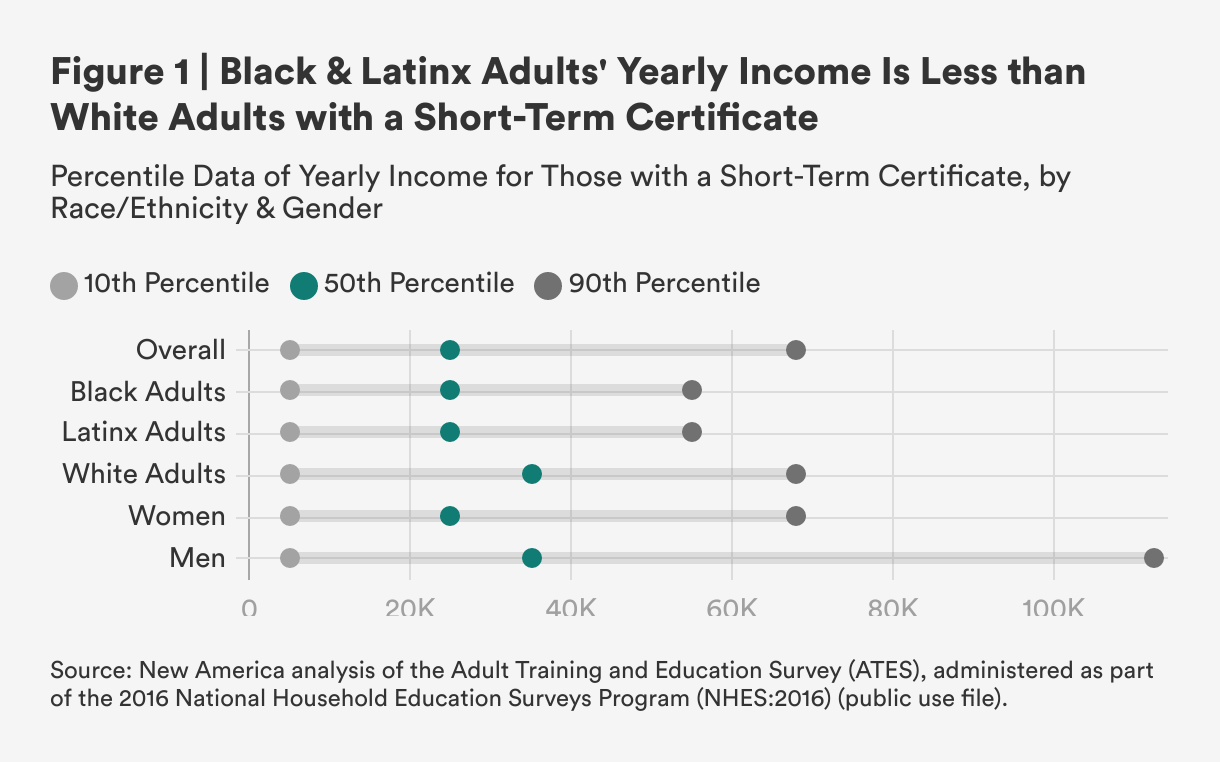
The earnings disparity for short-term certificates (15 weeks or fewer) is noticeably adverse for students of color and women. Figure 2 shows that, among those with a short-term certificate, the median yearly income is less for minority students than for white students. The median yearly income for Black and Latino/Latina adults with a short-term certificate is $10,000 to $20,000 less than the median yearly income of their white counterparts who hold a credential of similar length.
We find similar patterns across gender, where Figure 2 shows the median yearly income for women with a short-term certificate is less than that for men who also have a short-term certificate. These findings echo the current literature suggesting that men tend to experience economic benefits from non-degree credentials, while women with comparable credentials do not.23 Some of the disparity can be attributed to the fact that male-dominated industries yield higher wages compared to female-dominated fields.24 Yet even accounting for the disparity in earnings based on gender-dominated industries, there are longstanding systemic inequities within the U.S. labor market that are unfavorable to the pay of women.25
Certain Popular Fields Pay Far Less and Reify Inequities
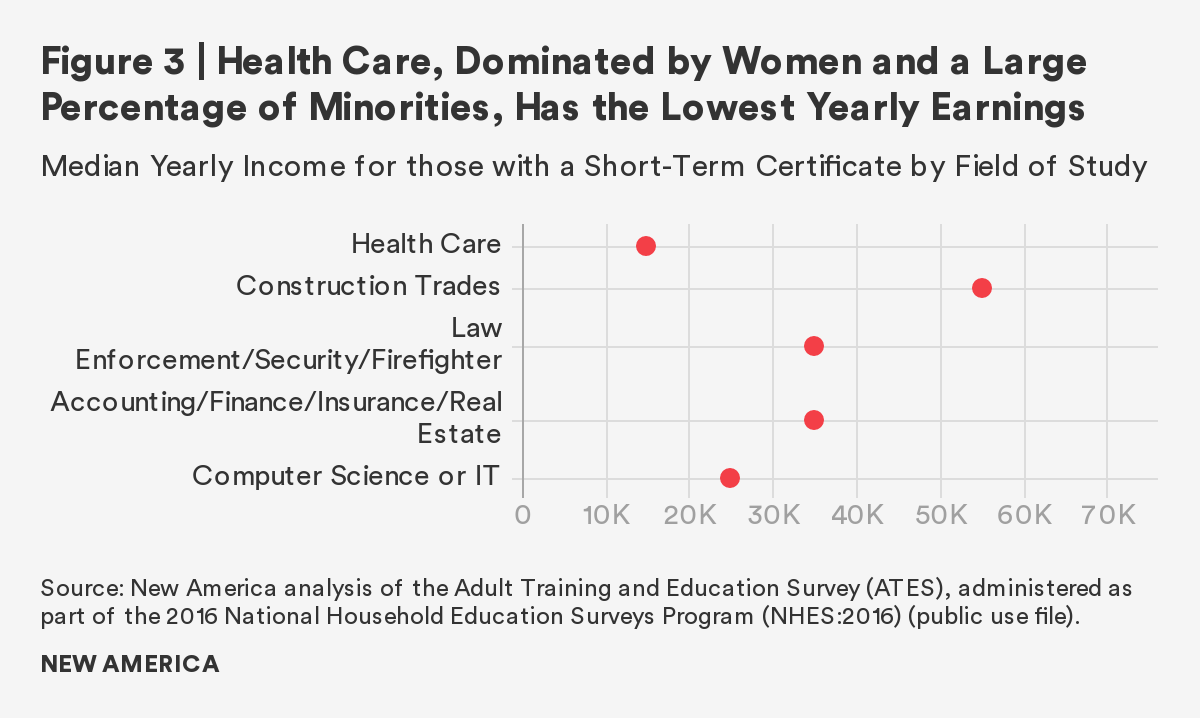
Figure 3 shows the median yearly earnings for the five most popular fields of study for short-term certificates. Health care and construction trades are the most popular fields of study for short-term certificates. Yet health care, a field of study dominated by women and a large percentage of people of color, has the lowest yearly earnings compared to the other four fields of study. The annual median income for adults with a short-term certificate in health care range between $10,001 and $20,000; those with a short-term certificate in construction trades (male-dominated) have median yearly earnings ranging from $50,001 to $60,000.
In addition, we found that adults with a short-term certificate in health care have the lowest rates of employment compared to the other four fields of study.26 Not only does a certificate of fewer than 15 weeks in health care yield very low pay, students are also at a higher risk for job instability. Stability is a benefit that many students who enroll in these programs are looking for.
“This is a downside to the job because there is so much work that we are required to do and the pay is dishearteningly low.” – Certified Nursing Assistant, Richmond, VA

Five Things Policymakers Should Know About Short-Term Credentials
- Introduction
- #1 Students Hold High Hopes That a Short-Term Credential Will Allow Them to Enter a New Field
- #2 Half of Working Adults with a Short-Term Certificate Earn Poverty-Level Wages
- #3 Most Adults Believe Their Short-Term Certificates Are Useful for Getting a Job—Even if the Job Is Unrelated to Their Credential
- #4 Many Adults with a Short-Term Certificate Are Not Employed
- #5 Students Think Hands-On Training is Useful, But Few Adults with Short-Term Certificates Receive This Training
- Discussion and Conclusion
Citations
- Includes earnings from wages, salary, commissions, bonuses, or tips from all jobs over the past 12 months. It is not assumed that these jobs are in the related industry of the earned certificate.
- U.S. Department of Health & Human Services, ASPE (website), Poverty Guidelines, “HHS Poverty Guidelines for 2021,” January 15, 2021, https://aspe.hhs.gov/poverty-guidelines
- New America analysis of ATES.
- Lul Tesfai, Kim Dancy, and Mary Alice McCarthy, Paying More and Getting Less (Washington, DC: New America, 2018), https://www.newamerica.org/education-policy/reports/paying-more-and-getting-less/
- Jizhi Zhang and Ceylan Oymak, Participants in Subbaccalaureate.
- Joan C. Williams, Reshaping the Work-Family Debate: Why Men and Class Matter (Cambridge, MA: Harvard University Press, 2010), chapter 3.
- New America analysis of ATES.