#1 Students Hold High Hopes That a Short-Term Credential Will Allow Them to Enter a New Field
Nearly every participant in our focus groups19 believes education and training are critical to their career and articulate four top reasons for enrolling in a short-term program:
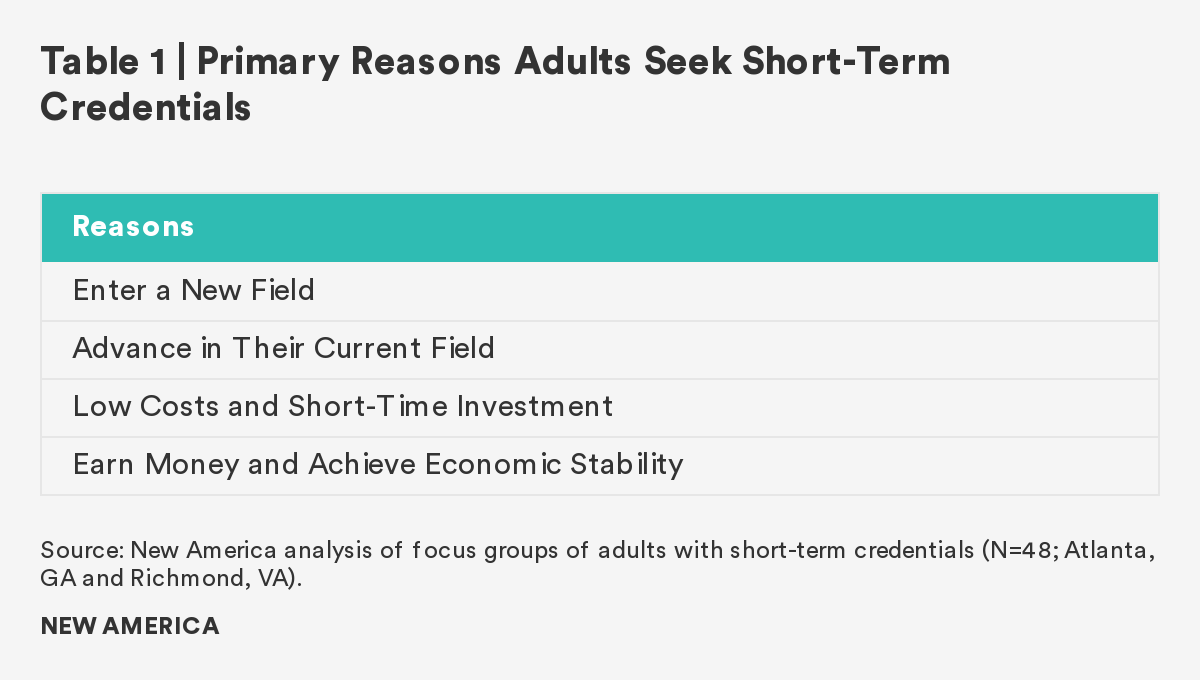
For the majority of adults in our focus groups, a short-term program is a way to change careers and enter into an entirely new field. This particularly applies to truck drivers, real estate agents, and others who need to earn a certification or pass a test to gain entry into their desired industry. Participants in the focus groups hope these short-term programs will help them overcome barriers to break into a new career path.
Others see short-term programs as one step on a longer career path, especially those working in the health care field or whose employers paid for the class as continuing education. For these students, enrolling in a short-term program is a means of advancement in their current field. For example, many certified nursing assistant (CNA) students or those working in health care facilities see their short-term credential as a step towards promotion to a management position. Some participants who take classes with their employer acquire the short-term credential to expand their knowledge in their current field. For example, some students with a child development associate (CDA) credential take classes as a required continuing education credit for their current job.
In both cases, students believe short-term programs are a way to enter into a new field or advance within their current field at a lower cost and with less time than a longer degree program. Students perceive short-term programs as a quick, cheap, and low-stakes option to earn a postsecondary credential with the hopes of immediately earning more money. Students enroll in these programs to ultimately help them achieve economic stability—a financial privilege they desire and believe they are unable to achieve without a short-term credential.
Earning a short-term credential “is my way to actually make some real good money… financial freedom.” – Truck Driver, Richmond, VA

Five Things Policymakers Should Know About Short-Term Credentials
- Introduction
- #1 Students Hold High Hopes That a Short-Term Credential Will Allow Them to Enter a New Field
- #2 Half of Working Adults with a Short-Term Certificate Earn Poverty-Level Wages
- #3 Most Adults Believe Their Short-Term Certificates Are Useful for Getting a Job—Even if the Job Is Unrelated to Their Credential
- #4 Many Adults with a Short-Term Certificate Are Not Employed
- #5 Students Think Hands-On Training is Useful, But Few Adults with Short-Term Certificates Receive This Training
- Discussion and Conclusion
Citations
- Lake Research Partners conducted focus groups of 48 adults with short-term credentials on behalf of New America, February–May 2020 (Atlanta, GA and Richmond, VA).