A Chapter of: Public Libraries and the Pandemic
Methodology
This project used both quantitative and qualitative methods to better understand the shifts in use of and access to libraries (primarily public libraries31) and their online resources before and during the COVID-19 pandemic. We conducted two online surveys. The first was of the general public (n=2,620), fielded from September 25th to October 13th, 2020. It was conducted with a cross-section of adults in the United States chosen to be representative on age, race and ethnicity, gender, and geography using SurveyMonkey’s opt-in database of approximately 15.5 million users. The second was fielded from December 1st through 31st, 2020, with educators and professionals who worked for community-based organizations (n=118), called “educators” for short in the results to follow. These educators learned about the survey through newsletters and social media channels associated with members of our project’s work group, including the Digital Public Library of America, the National Association for Media Literacy Education, the National Digital Inclusion Alliance, and Data & Society Research Institute.
The purpose of the surveys was to gauge awareness and attitudes toward libraries (with most of the questions related to public libraries), usage of their online resources, and the impact of the COVID-19 pandemic on these usage patterns. In addition to the surveys, we conducted virtual focus groups with members of the general public and informal one-on-one interviews with public library experts (representing a diversity of geographic regions, communities, and programming) to better understand their challenges and opportunities during the pandemic. For complete descriptions of the methodologies used, see appendices 1 and 3.
Limitations
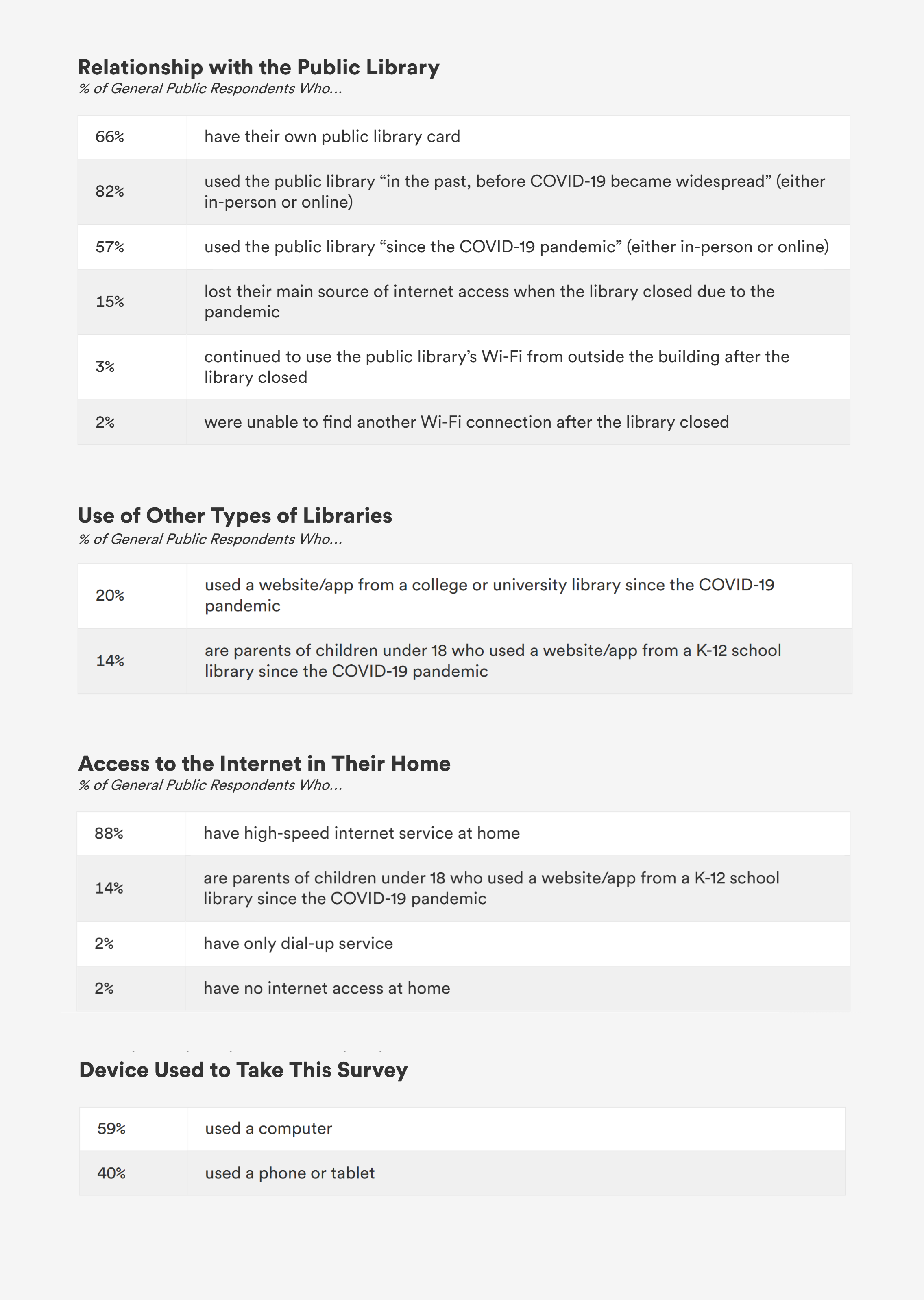
Both surveys were conducted online, with respondents answering questions via smartphones or computers; results therefore do not include people who have no access to a device or internet connection. Eighty-eight percent of respondents to this general public survey said they had high-speed internet access at home, a higher percentage than the 73 percent of respondents to the Pew Research Center’s annual survey who report having broadband access at home.32 Since the survey asks about online use of library assets, this is an important limitation in these findings and indicates potential for further work. If anything, we believe it is logical to assume that a fuller sampling of the American public designed to include those with no access to a device or internet connection would underscore the trends shown in the data. For more information, see About Our General Public Respondents.
The educator survey—displayed as The Educators’ Perspective in the findings section of this report—was not designed to be representative of the universe of professionals who might interact with or communicate about the public library, and thus the findings are not generalizable. Both surveys were conducted in English.
About Our General Public Survey Respondents
The majority of the 2,620 adults who took our survey had experience with their public library and other libraries before the COVID-19 pandemic and continued to connect with their local libraries in some way during the pandemic. The table below provides more detail on our respondents' relationship with the public library, their use of other types of libraries (such as school libraries), the degree of access to the internet they have at home, and the devices they used to take the survey.

Citations
- Nearly all questions in the survey were explicitly about public libraries; a subset of questions asked respondents if they used a website or app from a college or university library or a K-12 school library. For more, see our sidebar on General Public Survey Respondents.
- Pew, “Internet/Broadband Fact Sheet.” The lower percentage of respondents with high-speed internet access at home in the Pew surveys (73 percent, vs. 88 percent in this survey) likely reflects the broader recruitment methods used by the Pew Research Center, which uses postal mail to invite people to join its panel, provides tablets and computers for those without digital devices, and supports languages other than English. Such measures were cost prohibitive for this New America snapshot study. Also note slight variation in the words used to describe high-speed access: the Pew survey asked about “broadband” whereas we asked respondents whether they accessed the internet at home via “high-speed internet service (wireless or wired).” See Q27 in appendix 2.