A Chapter of: Use It or Share It
VI. Scarcity to Abundance: Opportunities to Expand Shared Access
As the National Broadband Plan recommended, unoccupied FCC-held spectrum is the most obvious category of spectrum that should be made accessible for opportunistic access, even if only on a temporary basis. While a couple of those bands are discussed below, a far more potent focus would be an expedited analysis of federal mid-band spectrum—particularly between 2900 and 4500 MHz—that cannot be cleared for reallocation by auction, but which could be opened for shared access by the private sector under stringent conditions (e.g., geolocation database control, coordination zones, power limits, sensing or incumbent-informing systems). A third category includes the many valuable but grossly-underutilized commercial bands. Discussed below are two satellite bands—at 4000-4200 MHz and at 12.2-12.7 GHz—that offer a near-term opportunity to free up spectrum as infrastructure for more high-capacity fixed wireless service in rural and other underserved areas. A low-power unlicensed underlay similar to the authorization of LPI across the entire 6 GHz band is another possibility.
More broadly, the FCC should open a NPRM that proposes adding a use-it-or-share-it authorization for all terrestrial flexible use bands that have not been built out in substantial portions of the country. Much of the prime spectrum auctioned over the past decade remains fallow, particularly in many rural and small town areas, and at least conditional and temporary access to that spectrum capacity should be considered as part of this effort.
A. Underutilized Federal Bands
The adoption and implementation of the CBRS three-tier sharing model clearly demonstrates that the unused spectrum capacity in federal bands—including bands vital to national security—can be shared for commercial use. When the PCAST proposed opening the Navy radar band at 3550-3650 MHz for sharing, it focused entirely on a use-it-or-share-it approach. The 2012 PCAST report recommended that the FCC and the National Telecommunications and Information Administration (NTIA) collaborate to “immediately start the process to modify its rules to allow ‘general authorized access’ devices to operate in two bands on the NTIA Fast track list, specifically the 3550-3650 MHz (radar) band and another to be determined by the NTIA and FCC.”101 The Wheeler FCC later concluded that the PCAST’s longer-term vision of a three-tier hierarchy for sharing federal spectrum could be achieved by extending the new CBRS band to include the adjacent and lightly-licensed (but also lightly-used) 3650-3700 MHz band and auctioning 70 megahertz as PALs.
PCAST’s highest recommendation was that the president should declare it is “the policy of the U.S. government to share underutilized Federal spectrum to the maximum extent possible that is consistent with the Federal mission, and require the Secretary of Commerce to immediately identify 1,000 MHz of Federal spectrum in which to implement the new architecture and thereby create the first shared-use spectrum superhighways.”102 While ambitious, this recommendation reflected the large swaths of low- and mid-band spectrum that serve critical federal operations, yet leave the vast majority of these bands unused in most places and at most times.
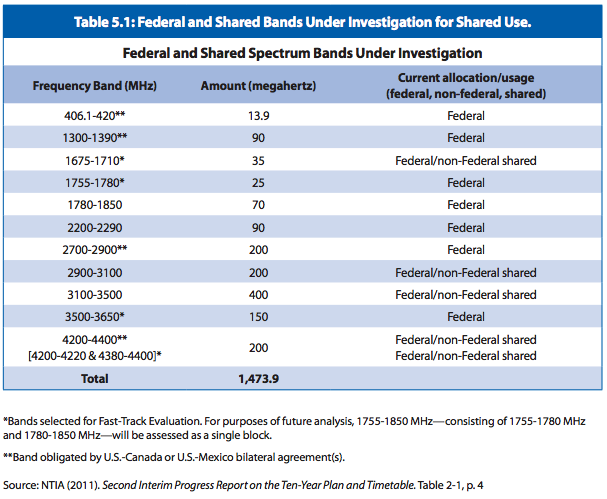
NTIA’s Office of Spectrum Management estimated in 2009 that 18 percent of the frequencies below 3700 MHz are allocated exclusively for federal use and another 51 percent is shared, with Federal use primary and private sector use secondary.103 This means that roughly 60 percent of the spectrum below 3700 MHz is predominantly allocated for federal use, a share that has declined relatively little over the past decade.104 Of the roughly 2400 megahertz of federal spectrum allocations below 3.7 GHz, over 1700 megahertz involves radar, radio navigation, and air telemetry systems, the effective operation of which are indeed critical to national security. At the same time, spectrum measurement studies indicate that the military and other agencies actually use very little if any of that capacity on most days and in most geographic locations, particularly at ground level and in more densely populated metro areas where more spectral capacity is most needed.105
Yet, despite the proven ability of a Spectrum Access System to protect military operations in the CBRS band (both shipborne and land-based radar systems), the approach has yet to be extended to other federal bands with substantial unused capacity. As discussed below, NTIA studies are ongoing and the 3450-3550 MHz radar band is likely to be effectively reallocated during 2021, but the overall effort has been far slower and more fragmented than the PCAST report and resulting Executive Memorandum by then-President Obama anticipated.106 The failure to move faster to authorize unused federal spectrum for at least opportunistic shared use (such as on a GAA basis) has an enormous opportunity cost.
Bands reserved for federal use are particularly well-suited for opportunistic access. Unlike a private sector licensee, NTIA and the federal users it coordinates should be expected to balance their own needs with the public interest in expanding available wireless broadband capacity. It is now well-established that database and sensing technologies give the military and other agencies the ability to enforce priority-in-use over opportunistic private users at any time. Even prior to the recent implementation of the CBRS three-tier sharing system, DoD opened up extensive military radar bands (most notably in the 5 GHz band) for passive sharing with low-power unlicensed users equipped with “smart radio” technology that is able to detect if radar is operating and vacate the channel in under one second. 107
Unlike most privately-licensed bands, federal spectrum use—and especially the military, which occupies most federal bands—is likely to be negatively correlated with dense urban areas. Military bases and training exercises, for example, are rarely located within the ten largest metropolitan areas. In addition, for purposes of low-power, short-range offload, there is greater opportunity for access to very wide channels on shared federal bands (particularly radar bands) than in most non-federal licensed bands.
The following frequency bands—1,190 megahertz of federal spectrum—should be studied with greater urgency for their potential to help turn the perception of spectrum scarcity into a reality of relative abundance:
3100-3550 MHz: Lower 3 GHz Band
The PCAST report particularly homed in on the potential for what it called a shared-use “spectrum superhighway” across the vast, nearly 1,000 megahertz expanse of federal radar bands between 2700 and 3650 MHz.108 NTIA identified this entire 950 megahertz as a potential candidate for shared commercial use a decade ago and specified the 3550-3600 MHz band for fast-track evaluation in its 2010 10-year plan.109 Responding to the PCAST recommendation, the FCC in 2015 made that top 100 megahertz the centerpiece of its CBRS three-tier sharing innovation. In December 2019, after the NTIA confirmed it was assessing the feasibility of sharing the entire 3100-3550 band,110 the FCC adopted a NPRM seeking comment on how best to facilitate shared use of that 450 megahertz.111 Both the NTIA’s study and the FCC’s proceeding derived from a 2018 Congressional mandate that the NTIA, in consultation with the FCC, report by March 2020 on the feasibility of “allowing commercial wireless service, licensed or unlicensed, to share use of the frequencies between 3100 megahertz and 3550 megahertz.”112
In an initial technical study, NTIA identified the top 100 megahertz in the 3450-3550 MHz band as the most promising portion for sharing.113 NTIA initially concluded that because high-power airborne, shipborne, and ground-based radar systems “use the entire band throughout the United States and its possessions, including near and over the most populated areas,” a dynamic, time-based sharing mechanism “present[s] a potentially attractive approach to both protecting federal systems and providing viable commercial operations.”114 This led advocates of dynamic sharing to propose that 3450-3550 MHz could be shared most effectively by incorporating it into the three-tier sharing framework that governs the adjacent CBRS band.115 Navy radar operates across both bands.
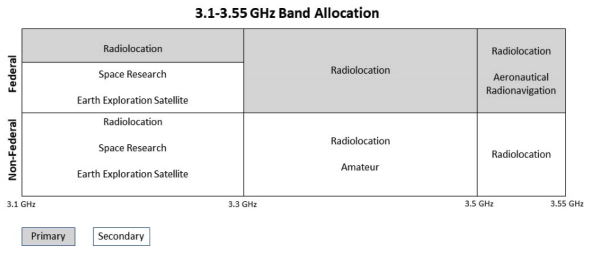
The Trump administration, however, came to the conclusion that most radar operations in 3450-3550 MHz could be consolidated into other parts of the band, allowing the FCC to propose a more traditional “flexible use” licensing approach based on an auction that would also reimburse DoD for costs (as provided under the Commercial Spectrum Enhancement Act).116 This led directly to the FCC adopting a FNPRM in October 2020 proposing that the entire 100 megahertz should be auctioned under a framework compatible not with the adjacent CBRS band—and its PALs covering relatively small areas (counties)—but with the C-band at 3700-3980 MHz, which is characterized by high power, very large license areas (Partial Economic Areas), and no coordination of opportunistic GAA use of locally-vacant spectrum. Advocates of exclusive and of shared-use spectrum continued to disagree on which framework would be most beneficial to the public interest in a robust 5G wireless ecosystem. The Order on auction rules remained pending at the time this paper was finalized.
Regardless of the FCC’s decision on the 3450-3550 MHz sub-band, the new FCC and NTIA in 2021 have an opportunity to revisit the PCAST recommendations and to take a more holistic view of the lower 3 GHz band. NTIA and DoD have consistently indicated that clearing military radar systems off spectrum below 3450 MHz will be far more difficult, a challenge that will be exacerbated if the DoD consolidates radar operations currently using 3450-3550 MHz lower in the band. According to NTIA spectrum use studies, the sub-bands below 3450 MHz are more congested and less amenable to clearing.117 They contain a mix of airborne, seaborne, land-based, and mobile radar operations relied upon by the Air Force, Army, Navy, Coast Guard, and for other national security-related applications.118 As the PCAST Report recognized, an effort to replace and move military systems to different spectrum, even if feasible, is likely to be unduly disruptive, cost tens of billions of dollars, and take a decade or longer. This view is reflected in the recommendations of a 2019 report by DoD’s Defense Innovation Board, which concluded that in a reasonable time frame, dynamic sharing would be far more feasible and acceptable from the military’s perspective.119
Perhaps the biggest obstacle to band clearing today, though, is the question of where military systems could move given that all comparable spectrum is assigned and is in use for other incompatible services. Unlike cellular mobile or certain other services, there are no close substitutes for military radar systems available from private wireless operators. In short, there is a near-term opportunity to open a contiguous 350 megahertz from 3350-3700 MHz under a common three-tier sharing framework providing both licensed PALs and general authorized access to a very diverse range of users and new use cases.
Even if a substantial portion of the lower 3 GHz military spectrum can be cleared and auctioned for flexible use licensing, the FCC has an opportunity to extend opportunistic access to the entire 3100-3550 GHz band on a use-it-or-share-it basis. Coordinated sharing of unused licensed and Navy spectrum is already operational in the adjacent CBRS band on a GAA basis. Multiple SAS databases and sensing networks tested by NTIA and certified by the FCC are successfully managing co-existence between licensees (PAL holders), the Navy, and GAA users in the neighboring 3550-3650 MHz band. Because of its proximity, the commission can immediately extend the same SAS and sensing technology used to manage the use-it-or-share-it rule in CBRS to the 3.45 GHz band.120
While CBRS is already facilitating innovation and competition by a diverse range of rural ISPs and enterprise users, extending a use-it-or-share-it authorization to adjacent military spectrum will give both PALs and GAA users access to large swaths of contiguous GAA spectrum that can dramatically increase the capacity and quality of their networks. While opportunistic access by small rural ISPs and others is likely to persist for many years primarily in rural areas, smaller urban areas where carriers are typically slower to deploy will also see benefits from the availability of this contiguous GAA spectrum.
Two other recent developments have the potential to further increase the capacity and utility of the lower 3 GHz spectrum authorized for coordinated sharing. First, NTIA is collaborating with the DoD to develop an automated, real-time, Incumbent Informing Capability (IIC) to be operated “in conjunction with DoD to notify commercial entities when the latter would need to cease operations.”121 This could, in time, replace the coastal sensing networks (Environmental Sensing Capability, or ESC) that currently listen for Navy radar and alert SAS administrators when commercial users (both PAL and GAA) must temporarily be moved off one or more channels in the CBRS band.122 Some SAS administrators argue that the sensing networks reduce the spectrum available for sharing far more than needed to protect Navy radar because they generate false positives and severely limit CBRS operations in “whisper zones” in areas where sensors are located. Since the sensors are monitoring the CBRS frequencies, the “need to protect the sensors from interference prevents nearby utilization of the very band that the networks are designed to support.”123 The expectation is that an Incumbent Informing Capability, managed by NTIA and DoD, can make more granular and accurate reports of military use directly to the Spectrum Access Systems.
Second, DoD is exploring whether it is practical to leverage the lower 3 GHz band to support and help pay for a new 5G network built to satisfy the military’s particular security requirements and functions. There has been much speculation and debate about whether a separate 5G network is needed for national security and, if so, whether it would be government-run or a public-private partnership that could also sell bandwidth or other services while ensuring government operations priority access at all times. DoD requested comment in response to a Request for Information in September 2020.124 While this debate seems likely to continue under the Biden administration, the relevant issue here is incentives. The military generally has nothing but disincentives to open radar bands in 3 GHz for shared use. However, if the unused spectrum capacity directly supported and helped to fund enhanced DoD digital capabilities (such as through auctions that could pay for modernizing and even moving Navy and Air Force radar systems to different frequencies), the incentives could be aligned to a degree that would lead more quickly to optimizing both federal and private sector use of the spectrum.
2900-3100 MHz: Maritime Radionavigation and Weather Radar
Even lower in 3 GHz is the 2900-3100 MHz sub-band allocated to federal and commercial shipborne radars required on most passenger and cargo ships for safety under an international maritime treaty, as well as for weather monitoring.125 Similar to the 3100-3650 bands discussed above, it appears that the band could be open for licensed and/or unlicensed (GAA) shared use across most of the nation. The upper 100 megahertz of the band appears to be used entirely for maritime radionavigation. Like the CBRS band, coordination by one or more certified AFCs—and either the coastal sensing networks certified to protect Navy operations at 3550-3650 MHz, or the new IIC noted above—could enable at least low-power, opportunistic use even along most of the nation’s coastlines (where a majority of Americans live).
The lower half of the band is the upmost portion of a 300 megahertz band (2700-3000) that is used for weather monitoring. A network of Next Generation Weather Radar (NEXRAD) systems operating in the 2700-3000 MHz band “provide quantitative and automated real-time information on (rainfall amounts/rates, wind velocity, wind direction, hail, snow, etc.) with higher spatial and temporal resolution than previous weather radar systems.”126 NEXRAD sites also collect data used to generate severe weather warnings. According to the Department of Commerce (NOAA), NEXRAD consists of relatively few (160) fixed sites.127 Although NEXRAD sites may require a relatively large protection area, there is no reason to believe that coordination zones cannot be enforced by the same AFC mechanism (e.g., a SAS) that would be safeguarding maritime radar operations.
If a SAS could coordinate the protection of NEXRAD sites, this would apply equally to the 2700-2900 MHz band segment, since the weather radar systems at those sites operate across that band as well. However, the 2700-2900 MHz band would likely be a lower priority for shared use. It is more heavily used across the country by a variety of radar systems and principally by surveillance radar (ASR) systems for air traffic control near both commercial and military airports nationwide. As of 2015 these fixed, ground-based systems were deployed at nearly 900 airports and airfields.128 While this represents the number of frequency assignments, the radars could be located at multiple sites in and near the airport. NTIA also reports that each of the military services and the FAA maintain a small number of sites for research, development, and testing of radar systems.
4400-4500 MHz and 4800-4940 MHz: DoD and Law Enforcement
While not enough information is available to know for certain, the exclusively federal bands—4400-4500 MHz and 4800-4940 MHz—should be studied for potential consolidation and/or sharing. According to NTIA, these two sub-bands are part of a larger band of 540 contiguous megahertz between 4400 and 4940 MHz. NTIA use reports for the sub-bands all state that “[m]any systems authorized to operate in” each sub-band “typically have a tuning capability from 4400 MHz to 4940 MHz.”129
The most prevalent use across the entire band is fixed wireless data links (2,500 as of 2015), which typically occupy relatively narrow frequency channels and can be protected through geolocation database coordination. Similarly, astronomical observations made on 4825-4835 MHz occur at only five active and fairly remote observatories.130 The 4400-4500 MHz band is “one of the few available to the military for training,”131 while the 4800-4940 band “is used by the military at test ranges and naval ports around the US.”132 There are assignments across the entire 450 megahertz band for law enforcement and drug interdiction activities. In sum, although each of these sub-bands had a total of just over 1,400 assignments for a variety of use cases as of 2015, because they can tune across a much larger contiguous band of 540 megahertz, it certainly appears that the band is a prime potential candidate for at least coordinated shared access.
B. Underutilized Commercial Bands
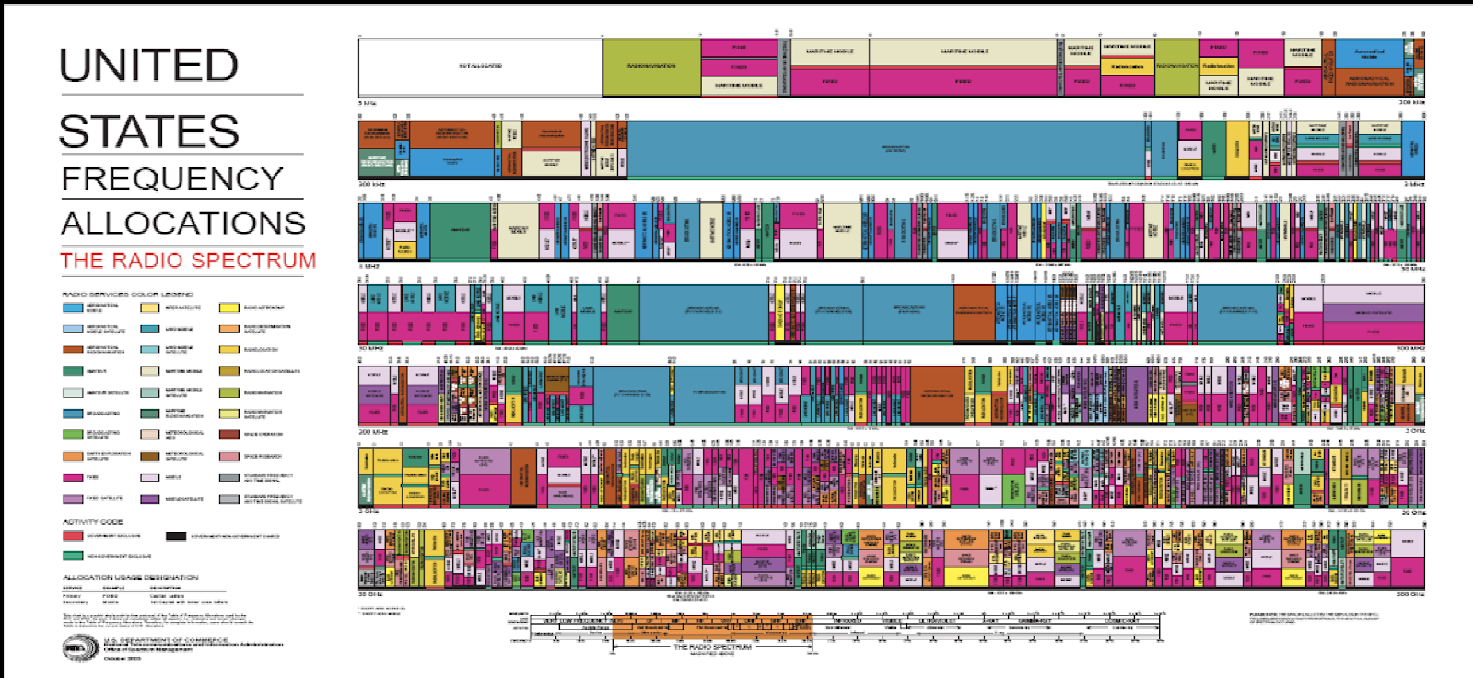
It has long been recognized that the NTIA’s famously complex frequency spectrum chart is in part a map of fossilized allocations of spectrum for services viewed as compelling long before wireless broadband made low- and mid-band spectrum immensely more valuable.133 TV broadcasters, fixed and mobile satellite services, and fixed microwave links have been among the services consolidated or pushed off their underutilized allocations to accommodate emerging technologies and consumer demand. For the past two decades, the FCC’s emphasis has been to clear swaths of spectrum for reallocation and auction to mobile cellular services. Since 2012, when Congress gave the commission incentive auction authority, three grossly underutilized bands have been reorganized, with the resulting auction providing incentive payments to vacating incumbents: the 600 MHz TV band, the lower C-band from 3700 to 4000 MHz, and the 39 GHz millimeter wave band. Arguably the upcoming auction for unassigned portions of the 2.5 GHz band, once reserved exclusively for the Educational Broadband Service (EBS), is another example, since the FCC has reallocated the band to flexible use and incented the original nonprofit licensees to either sell or lease their spectrum by relieving them of any obligation to use the spectrum for educational purposes.
While these efforts focused herculean policy innovations on underutilized bands that could yield substantial contiguous spectrum for the mobile industry (4G and now 5G), there are not many (if any) remaining candidate bands for reallocation among commercial bands in the most valuable low- and mid-band frequency range. However, there are underutilized non-federal bands that present an opportunity to authorize coordinated shared access to vacant spectrum on at least an opportunistic unlicensed or lightly-licensed (GAA) basis. As noted earlier, a use-it-or-share-it policy would need to be authorized on a band-by-band basis, in some cases in response to a request for waiver or a petition for rulemaking by aspiring band entrants. But the FCC itself can, as it did with incentive auctions, identify bands that could free up very substantial and valuable spectrum, particularly where it could serve as public infrastructure to facilitate more and better broadband service in rural and other underserved areas.
Two bands that stand out for their near-term potential in this respect have been proposed by sharing advocates:
12 GHz Band: 12.2-12.7 GHz
The 12 GHz band is shared on a co-primary basis by multiple satellite and terrestrial services, yet underutilized to a degree that has drawn diverse support for a FCC proceeding to consider both more flexible terrestrial licensed and opportunistic use.134 Proponents argued that the 500 contiguous megahertz in the band offers an opportunity to adopt a sharing framework that greatly expands the availability of spectrum for both fixed and mobile broadband deployments with mid-band propagation characteristics.135 Two of the three primary satellite licensees operating in the band (DirecTV and SpaceX, but not DISH Network) opposed considering more intensive terrestrial use of the band. In January 2021 the commission adopted a “neutral” NPRM to consider if and how the band can accommodate more intensive terrestrial broadband operations, including potentially mobile, fixed, and unlicensed uses.136
Ironically, the current sharing between satellite and terrestrial users originated in a petition premised on the use-or-share concept. Until 2002, the band was used exclusively for direct broadcast satellite (DBS) services and continues to be shared by DirecTV and DISH. More than two decades ago an innovative start-up, Northpoint Technology, proposed that because all DBS is a one-way transmission down to receiving dishes on customer homes that must point south (since the satellites remain stationary over the equator), it could operate a one-way terrestrial broadband service if its antennas only pointed north.137 The two services could operate anywhere on a co-channel basis without interference. The FCC agreed and authorized a new multichannel video and data distribution service (MVDDS).138 Unfortunately for the investors in Northpoint, the FCC also decided that licenses for MVDDS should be auctioned. The company went out of business and MVDDS remains a dormant, one-way authorization.
Nearly two decades later, more flexible and two-way use of 500 contiguous megahertz with upper-mid-band propagation characteristics could be highly valuable for both mobile 5G and for very high-capacity fixed wireless, both in less densely populated areas (where fiber can be cost prohibitive) and for enterprise IoT networks. In 2016 the current MVDDS license holders filed a petition for rulemaking to consider the feasibility of coordinating two-way and flexible use for terrestrial broadband.139 Complicating coordination is the fact that the band also has a co-primary allocation for the non-geostationary, low-earth orbiting (NGSO) satellites that several companies plan to launch in large numbers to provide ubiquitous broadband connectivity. One such provider, SpaceX, has already begun deploying a rural broadband service that, like the two DBS providers, uses 12 GHz as the downlink to customer receiving stations.
A 2020 filing by OTI and a coalition of public interest groups opined that “a use-it-or-share-it opportunity at 12 GHz will help expand affordable broadband services in rural, tribal, and other communities where there is a limited economic incentive for a national or regional carrier to offer service, but still a real economic need for the community.”140 Even if the FCC decides to grant flexible use rights to MVDDS licensees, the need to protect satellite reception may necessitate terrestrial power limits much lower than in other bands used for wide-area 5G coverage (such as the post-auction C-band). As a result, initial deployments in the band would most likely be in urban, suburban, and other higher-density areas where an investment in greater capacity justifies the cost. Rather than leave as much as 500 megahertz fallow in underserved rural and other less-densely-populated areas, a use-or-share approach on a secondary, coordinated basis can facilitate high-capacity fixed broadband (both point-to-point and point-to-multipoint).
At a minimum, the band appears well-suited to a low-power underlay under traditional Part 15 rules that could be limited to indoor-only use, just as the FCC recently adopted LPI across the entire 6 GHz band. A contiguous 500 megahertz of spectrum would allow for the creation of new high-bandwidth channels capable of supporting Wi-Fi 6 and other unlicensed innovation.
4000-4200 MHz: Revisiting the Upper C-band for Rural Broadband
The recent epic debate over the consolidation and reallocation of 280 megahertz of C-band spectrum for flexible use terrestrial licensing through an auction that concluded in January 2021, generating $80.9 billion for the U.S. Treasury, is familiar to almost everyone.141 All 500 megahertz of the 3700-4200 MHz C-band had long been dedicated to the FSS, which uses it to relay live video and data from content providers to cable headends, local TV and radio broadcast stations, some churches, and other content distributors. However, with advances in technology and declining demand, the FCC determined that existing FSS operations could be consolidated into the upper 200 megahertz of the band, between 4000 and 4200 MHz. In March 2020 the FCC released an order reallocating the lower 300 megahertz of the band by auction and providing incentive payments for the expedited consolidation of FSS earth stations into the top 200 megahertz.
What received far less attention was a second proposal in the FCC’s original NPRM that sought comment on whether—regardless of how much of the band is reallocated for flexible use licensing—it is feasible and desirable to authorize fixed wireless operators to coordinate use of vacant spectrum and “operate on a secondary basis vis-à vis FSS in any part of the band in which FSS continues to operate during a transition period to accommodate repacking and, thereafter, on a frequency-coordinated basis to protect actual FSS operations.”142 The proposal derived from a 2017 petition for rulemaking, filed by the Broadband Access Coalition, asking the FCC to authorize fixed wireless ISPs to coordinate use of vacant spectrum in the ongoing FSS portion of C-band on a first-in-time licensed basis.143 The Public Interest Spectrum Coalition (PISC) further proposed the FCC authorize opportunistic access (e.g., GAA license by rule) to unused frequencies in the lower portion of the band until future flexible-use licensees commence service in that local area, much the same as the use-or-share rules adopted for the adjacent CBRS band and coordinated by SAS administrators.144
While incumbent FSS licensees opposed the proposal, arguing it would disrupt the C-band transition and inevitably cause harmful interference to FSS earth stations, sharing advocates explained that unlike mobile broadband, fixed wireless deployments (point-to-multipoint, or P2MP) use directional antennas that permit the local coordination of sectors even where earth stations are in the area, but located outside the beam of the base station and client device return path.145 Even after the FSS is consolidated into the upper 200 megahertz, the number of earth station sites would actually fall since some are using the cost reimbursement paid by auction winners as an opportunity to switch to fiber. The remaining receive sites will simply be tuning into a larger number of transponders on satellites restricted to using 4000-4200 megahertz.
A study by a leading wireless engineer, Virginia Tech Professor Jeffrey Reed, showed that despite making very conservative assumptions about fixed wireless use (e.g., co-channel sharing, high CPE height), there should be no concern about harmful interference to earth stations provided that Part 101 frequency coordination is required, as it has been during the many years the Fixed Service (FS) and FSS licensees have shared C-band and other bands.146 The Reed study demonstrated that every megahertz of FSS spectrum can be coordinated for P2MP deployments in 78 percent of the geographic area of the United States, where more than 80 million Americans live, without causing harmful interference to incumbent earth stations or TV/radio consumers.147 The study found that “P2MP systems can operate co-channel with all existing C-band earth stations . . . without causing harmful interference.”148
Ultimately, the FCC’s March 2020 Report and Order declined to authorize use of the band for fixed wireless P2MP “at this time,” concluding that “more intensive point-to-multipoint Fixed Service use of the 4.0-4.2 GHz band before the transition is over could dramatically complicate the repacking and relocation of FSS operations and earth station registrants.”149 However, leveraging the proximity of CBRS and the proven ability of the SAS to coordinate opportunistic GAA use of PAL spectrum continues to make the entire 3700-4200 MHz band an attractive candidate for a use-it-or-share-it rule. The C-band transition is well underway and once it is largely complete, the FCC should reconsider allowing more intensive shared use.
C. Vacant and Warehoused Spectrum
A third category of bands that should be prioritized for at least temporary access on a coordinated and local basis are bands that lie fallow either because they are part of the FCC’s inventory of unassigned spectrum or because they remain unused several years after initial assignment. As noted in Section II above, the shutdowns associated with the early months of the pandemic crisis motivated the FCC to rapidly grant STAs for the use of generally unused spectrum in two bands that offer an example in each category: auctioned-but-returned AWS-3 spectrum in the 1.7 GHz band (unassigned) and the lower 5.9 GHz band (mostly unused). The 1.7 GHz spectrum had been returned by licensees contesting the outcome of the AWS-3 auction concluded in early 2015, while the lower 5.9 GHz band was in active use for auto safety pilot programs, but only at a small number of locations.
While the pandemic provided the impetus to make these bands available to wireless ISPs able to incorporate it immediately into their networks, there are at least two other bands—the 2.5 GHz band and lower 37 GHz band—that remain grossly underutilized and, in fact, are entirely unoccupied across most of the country despite being the subject of a recent FCC rulemaking. Although this may change as new FCC allocations and rules are implemented, in the meantime the commission should consider permissive waivers or other actions that affirmatively encourage opportunistic use of the fallow spectrum.
The most valuable of these is the 2.5 GHz band (2496-2690 MHz) that for decades has been allocated exclusively to the EBS. EBS licensees operate in 114 megahertz of the band and the remaining 80 megahertz is assigned to Broadband Radio Service (BRS). The stated purpose of EBS was to grant spectrum to colleges, school districts, and other eligible educational institutions to provide broadband, video, and other services. Some licensees, such as Northern Michigan University, are using the spectrum to connect not only their own students, but also K-12 students lacking broadband at home.150 But most licensees today lease the spectrum, principally to T-Mobile. The band is also used primarily in metro markets— and is unassigned and “currently lies fallow across approximately one-half of the United States, primarily in rural areas.”151 In July 2019 the FCC adopted an order that rescinded the educational use obligation, reallocated the entire band for flexible use, and will tentatively auction the unassigned portions of the band before the end of 2021.152 Since the 114 megahertz of EBS spectrum is unused in a majority of locations—and much will remain so for years even after an auction—the commission should affirmatively welcome requests for STAs and other potential opportunistic use of this extremely valuable mid-band spectrum.
A second band in limbo is the lower 37 GHz spectrum allocated for shared federal and non-federal use in the FCC’s 2016 Spectrum Frontiers Order, which reallocated and reorganized the 37 and 39 GHz bands.153 In that Order the FCC designated a total of 1,850 megahertz across the two millimeter wave bands for auction and set aside 600 megahertz at the bottom of the 37 GHz band to “create a space for both Federal and non-Federal users to share on a coequal basis and set out a process for defining how that sharing will be implemented.”154 Although the auction for 37-39 GHz flexible use spectrum (fixed and mobile) concluded in early March 2020, there has been virtually no progress since 2016 in establishing a framework for dynamic sharing between federal and non-federal users in the lower 37 GHz band.
The FCC adopted only a very high-level concept of the sharing framework for this 600 megahertz set-aside between 37 and 37.6 GHz. The Order provided that non-federal users would be authorized by rule (similar to CBRS) and receive Shared Access Licenses (SALs). “SALs will be widely available to provide easy access to spectrum, including for new innovative uses and for targeted access where and when providers need additional capacity,” the Order stated.155 Both federal and non-federal users will “access the band through a coordination mechanism, including exploration of potential dynamic sharing through technology in the lower 600 megahertz, which we will more fully develop . . .”156
The accompanying Further Notice of Proposed Rulemaking also proposed an explicit use-it-or-share-it rule for the upper 1,000 megahertz of the 37 GHz band: “we propose to permit shared access of the unused portions of the five channels in the upper band segment, under certain conditions.”157 However, after control of the FCC changed parties in 2017, the Second Report and Order “declined to adopt any use or share regime for any of the Part 30 bands at this time.”158 This Order did not directly dispute the feasibility of opportunistic use without interference, but simply agreed with mobile industry objections that “whatever the speculative benefits may be, they are greatly outweighed by the likelihood that a use-or-share approach will discourage investment and delay deployment in these bands.”159 Without explanation, this conclusion directly contradicted not only the FNPRM, but also the conclusions reached by the commission in 2015 and 2016 when it authorized use-or-share access to PAL spectrum in CBRS and to flexible use 600 MHz spectrum following the TV incentive auction.160
With respect to shared use of the 37 to 37.6 GHz band segment, although the 2016 Spectrum Frontier Order adopted some features that would support a sharing framework similar to CBRS (e.g., site-based registration, a mechanism for dynamic coordination, and the same technical rules that apply to the rest of the 37 GHz band),161 it did not decide if all 600 megahertz would be effectively available on a GAA basis or on a first-in-use basis; nor did the Order decide if an automated frequency coordination system (e.g., a SAS) would be needed. Also left open is how federal users will coordinate and whether future federal operations will receive priority and protection from interference even though the band is allocated for sharing on a co-equal basis between federal and non-federal users. The FCC in 2021 should both finalize a sharing framework and, in the meantime, welcome any opportunistic use of the entire 37 GHz band that can be coordinated with the small number of existing federal uses.
Use It or Share It
- Executive Summary
- I. Introduction
- II. Major Recent Precedents for “Use-it-or-Share-it”
- III. Major Benefits of a Use-it-or-Share-it Policy
- IV. The First Amendment Imposes Limitations on the Government’s Power to Limit Non-Interfering Use of Spectrum
- V. Operationalizing Harmful Interference: The FCC’s Balancing Approach
- VI. Scarcity to Abundance: Opportunities to Expand Shared Access
- VII. Conclusion
Citations
- PCAST Report, Recommendation 7.1, at page xiv.
- PCAST Report, Recommendation 1.1 at page x, 7.
- Karl Nebbia, Director, NTIA Office of Spectrum Management, presentation to the Commerce Spectrum Management Advisory Committee (CSMAC), Dec. 9, 2009.
- See PCAST Report at 8.
- See Mark McHenry, “NSF Spectrum Occupancy Measurements: Project Summary,” Shared Spectrum Company (August 2005). McHenry’s 2005 study collected frequency use data in six locations along the East coast in 2004 and documented an average total spectrum use of between 0 and 3% at rooftop level across hundreds of MHz of federal spectrum.
- See Barack Obama, “Executive Memorandum – Expanding America’s Leadership in Wireless Innovation, The White House (June 13, 2013), available at https://obamawhitehouse.archives.gov/the-press-office/2013/06/14/presidential-memorandum-expanding-americas-leadership-wireless-innovatio.
- For a brief history of how DoD shares radar bands with the private sector, and a proposal describing how federal agencies can take affirmative steps to facilitate expanded and more efficient band sharing, see Michael Marcus, “New Approaches to Private Sector Sharing of Federal Government Spectrum,” New America, Wireless Future Program Working Paper, at 4-6 (June 2009).
- The PCAST Report’s “highest recommendation is that the President issue an Executive Order to prioritize 1,000 MHz of Federal spectrum for review and implementation to create the Nation’s first shared-use spectrum superhighways.” PCAST Report at 7.
- U.S. Dept. of Commerce, Plan and Timetable to Make Available 500 Megahertz of Spectrum for Wireless Broadband, at 7 (Oct. 2010), https://www.ntia.doc.gov/files/ntia/publications/tenyearplan_11152010.pdf; see also U.S. Dept. of Commerce, Quantitative Assessments of Spectrum Usage (Nov. 2016) (finding potential opportunities for sharing spectrum existed in the 3505-3550 MHz band), https://www.ntia.gov/files/ntia/publications/ntia_quant_assessment_report-no_appendices.pdf.
- See U.S. Dept. of Commerce, Annual Report on the Status of Spectrum Repurposing at 20 (Aug. 2019),https://go.usa.gov/xparp.
- Notice of Proposed Rulemaking, Facilitating Shared Use in the 3.1-3.55 GHz Band, WT Docket No. 19-348 (Dec. 12, 2019). See also Report and Order and Further Notice of Proposed Rulemaking, Facilitating Shared Use in the 3100-3550 MHz Band, WT Docket No. 19-348, at ¶ 53 (Oct. 2, 2020) (proposing that 3450-3550 MHz band be reallocated for auction with obligations to prioritize military use during national emergencies).
- MOBILE NOW Act as incorporated in the Consolidated Appropriations Act, 2018, Pub. L. No. 115-141, 132 Stat. 348, Division P, Title VI, § 605(a) (2018).
- See Edward Drocella, Robert Sole, Nickolas LaSorte, Technical Feasibility of Sharing Federal Spectrum with Future Commercial Operations in the 3450-3550 MHz Band, NTIA Technical Report 20-546, at viii-ix (rel. Jan. 2020). “In the aggregate and in some cases individually, the federal systems use the entire band throughout the United States and its possessions, including near and over the most populated areas.” Ibid.
- Id. at viii-ix.
- See, e.g., Comments of Dynamic Spectrum Alliance (DSA), Facilitating Shared Use in the 3.1-3.55 GHz Band, WT Docket No. 19-348 (Feb. 21, 2020); Comments of CommScope, WT Docket No. 19-348 (Feb. 21, 2020), at 4-5; Comments of Federated Wireless, WT Docket No. 19-348 (Feb. 21, 2020), at 2; Comments of Wireless Internet Service Providers Assn (WISPA), WT Docket No. 19-348 (Feb. 21, 2020), at 3; Comments of the Open Technology Institute at New America and Public Knowledge, WT Docket No. 19-348 (Nov. 20, 2020).
- See Letter from Charles Cooper, Associate Administrator, NTIA, to Ronald T. Repasi, Acting Chief, Office of Engineering and Technology, FCC, and Donald K. Stockdale, Jr., Chief, Wireless Telecommunications Bureau, FCC, WT Docket No. 19-348, at 1 (Sept. 8, 2020).
- U.S. Dept. of Commerce, Feasibility of Commercial Wireless Services Sharing with Federal Operations in the 3100-3550 MHz Band, at 11 (July 2020) (“NTIA July 2020 Report”) (“the lower portion of the band is more congested and includes additional systems that have not been analyzed”), available at https://www.ntia.doc.gov/files/ntia/publications/ntia_3100-3550_mhz_mobile_now_report_to_congress.pdf.
- See NTIA, Federal Government Spectrum Use Reports: 225 MHz – 7.125 GHz, “3100-3300 MHz Report” (Dec. 1, 2015), available at https://www.ntia.doc.gov/page/federal-government-spectrum-use-reports-225-mhz-7125-ghz.
- Defense Innovation Board, The 5G Ecosystem: Risks and Opportunities for DoD, Recommendation #1, at 28 (April 2019), available at https://media.defense.gov/2019/Apr/04/2002109654/-1/-1/0/DIB_5G_STUDY_04.04.19.PDF (“DoD stands to significantly benefit if it shares some of its sub-6 GHz spectrum.”). See also Milo Medin and Gilman Louie, “Clearing the Air on 5G,” Texas National Security Review (March 13, 2020), available at https://warontherocks.com/2020/03/clearing-the-air-on-5g/ (“Sharing spectrum could take just two to three years instead of the 5 to 10 years that vacating requires, would cost millions of dollars instead of billions, and would not put national security operations at risk.”)
- See Comments of Google, Facilitating Shared Use in the 3.1-3.55 GHz Band, WT Docket No. 19-348 (Nov. 20, 2020) (“Google 2020 Comments”). “Expanding SAS capabilities below the 3.55 GHz boundary to support such ‘extended GAA’ operation would be straightforward.” Ibid.
- NTIA July 2020 Report at 11. See also Charles Cooper, “NTIA Pursues Innovative Spectrum Sharing Plan That Could Deliver Boost to 5G,” NTIA Blog (Dec. 15, 2020), available at https://www.ntia.doc.gov/blog/2020/ntia-pursues-innovative-spectrum-sharing-plan-could-deliver-boost-5g. An IIC can facilitate “easier and quicker spectrum access for commercial wireless services[, opening] the door to innovative, real-time automation.” Ibid.
- See presentation of Charles Cooper, Associate Administrator, NTIA, at Dynamic Spectrum Alliance Global Summit 2020, available at https://www.youtube.com/watch?v=13Pk1hpA3vs&feature=youtu.be.
- Google 2020 Comments at 11 (“[t]oday, millions of potential users are blocked from using CBRS spectrum due to the proximity of ESC sensors”). See also Letter from Megan Stull and Andrew Clegg, Google, to Marlene H. Dortch, FCC, Facilitating Shared Use in the 3100-3550 MHz Band, WT Docket No. 19-348 (Dec. 15, 2020).
- U.S. Department of Defense, “Defense Spectrum Sharing Request for Information” (Sept. 18, 2020), available at https://beta.sam.gov/opp/4851a65e2b2d4d73865a0e9865b0c28a/view.
- See NTIA, Federal Government Spectrum Use Reports 225 MHz – 7.125 GHz, “2900-3100 MHz Report” (Dec. 1, 2015) (“NTIA 2900-3100 Use Report”), available at https://www.ntia.doc.gov/page/federal-government-spectrum-use-reports-225-mhz-7125-ghz. The International Convention for the Safety of Life at Sea (SOLAS) is an international maritime treaty that sets minimum safety standards in the construction, equipment and operation of merchant ships.
- NTIA 2900-3100 Use Report at 1.
- National Oceanic and Atmospheric Administration, National Centers for Environmental Information, “NEXRAD,” https://www.ncdc.noaa.gov/data-access/radar-data/nexrad.
- See NTIA, Federal Government Spectrum Use Reports 225 MHz – 7.125 GHz, “2700-2900 MHz Report,” at 3 (Dec. 1, 2015), available at https://www.ntia.doc.gov/page/federal-government-spectrum-use-reports-225-mhz-7125-ghz.
- See, e.g., NTIA, Federal Government Spectrum Use Reports 225 MHz – 7.125 GHz, “4400-4500 MHz Report” (Dec. 1, 2015) (“NTIA 4400-4500 MHz Use Report”), available at https://www.ntia.doc.gov/page/federal-government-spectrum-use-reports-225-mhz-7125-ghz.
- NTIA, Federal Government Spectrum Use Reports 225 MHz – 7.125 GHz, “4800-4940 MHz Report,” at 2 (Dec. 1, 2015) (“NTIA 4800-4940 MHz Use Report”), available at https://www.ntia.doc.gov/page/federal-government-spectrum-use-reports-225-mhz-7125-ghz.
- NTIA 4400-4500 MHz Use Report at 1.
- NTIA 4800-4940 MHz Use Report at 1.
- NTIA, United States Frequency Allocation Chart, https://www.ntia.doc.gov/page/2011/united-states-frequency-allocation-chart.
- See, e.g., Letter from CCA, CCIA, INCOMPAS, Public Knowledge and Open Technology Institute, Petition for Rulemaking to Permit MVDDS Use of the 12.2-12.7 GHz Band for Two-Way Mobile Broadband Service, RM-11768 (filed May 26, 2020).
- See Letter from Public Interest Organizations to Chairman Ajit Pai, FCC, Petition for Rulemaking to Permit MVDDS Use of the 12.2-12.7 GHz Band for Two-Way Mobile Broadband Service, RM-11768 (July 9, 2020); Letter from Dynamic Spectrum Alliance, RM-11768 (filed Aug. 21, 2020); Letter from Federated Wireless, RM-11768 (filed June 15, 2020).
- FCC, Notice of Proposed Rulemaking, Expanding Flexible Use of the 12.2-12.7 GHz Band, WT Docket No. 20-443 (rel. Jan. 15, 2021).
- See Thomas Hazlett, The Political Spectrum (New Haven: Yale U. Press, 2017), at 242-243.
- Amendment of Parts 2 and 25 of the Commission’s Rules to Permit Operation of NGSO FSS Systems Co-Frequency with GSO and Terrestrial Systems in the Ku-Band with Frequency Range, Memorandum Opinion and Order and Second Report and Order, 17 FCC Rcd 9614 (2002).
- MVDDS 5G Coalition Petition for Rulemaking to Permit MVDDS Use of the 12.2-12.7 GHz Band for Two-Way Mobile Broadband Service, RM-11768 (filed Apr. 26, 2016).
- Letter from Public Interest Organizations to Chairman Ajit Pai, FCC, Petition for Rulemaking to Permit MVDDS Use of the 12.2-12.7 GHz Band for Two-Way Mobile Broadband Service, RM-11768 (July 9, 2020).
- See generally Sascha Segan, “What is C-band and What Does it Mean for the Future of 5G?”, PC Magazine (Dec. 29, 2020), available at https://www.pcmag.com/news/what-is-c-band; See also Monica Alleven, “C-band's first phase tops charts with $80.9B,” FierceWireless (Jan. 15, 2021), https://www.fiercewireless.com/regulatory/c-band-clock-phase-auction-tops-charts-80-9b.
- Notice of Proposed Rulemaking, Expanding Flexible Use of the 3.7 to 4.2 GHz Band, GN Docket No. 18-122, at ¶¶ 116, 119 (rel. July 13, 2018).
- Broadband Access Coalition, Petition for Rulemaking, RM-11791 (filed June 21, 2017).
- Comments of the Public Interest Spectrum Coalition, Expanding Flexible Use of the 3.7 to 4.2 GHz Band, GN Docket No. 18-122, at 13, 17-21 (Oct. 29, 2018).
- See Broadband Access Coalition, Notice of Oral Ex Parte Presentation, GN Docket 17-183 and RM-11791 (March 29, 2018) (“Google/BAC Technical Presentation”). The technical analysis and presentation to FCC staff can be found at: https://tinyurl.com/y3gjx9cu.
- Ex Parte Presentation by Prof. Jeffrey H. Reed et al., “3.7-4.2 GHz FSS and Fixed Wireless Access Co-channel Coexistence Study,” GN Docket No. 18-122 (July 15, 2019) (“Reed Study”), available at https://tinyurl.com/yxejzq84.
- Id. at 3. (“The study utilizes conservative assumptions. In addition to the assumption of co-channel operations and the protection of all earth stations currently in IBFS regardless of protection status, the study includes additional conservative assumptions. These include, but are not limited to, a propagation model that takes clutter and terrain into account on a statistical basis rather than the use of actual buildings, trees, berms, hills, and mountains that afford greater protection; using a height for Customer Premise Equipment (CPE) of 7-10 m, which exceeds typical CPE height of ~5-7 m for actual installations; and assuming 100% duty cycle of P2MP transmissions in both directions.”).
- Id. at 2.
- Report and Order, Expanding Flexible Use of the 3.7 to 4.2 GHz Band, GN Docket No. 18-122, at ¶¶ 330-331 (rel. March 3, 2020).
- See Michael Calabrese and Amir Nasr, The Online Learning Equity Gap: Innovative Solutions to Connect All Students at Home, Open Technology Institute at New America, Report, at 35-36 (Nov. 2020), available at https://www.newamerica.org/oti/reports/online-learning-equity-gap/. Northern Michigan University uses EBS to maintain a wireless broadband network that extends internet access to its own students and to K-12 students in a large swath of the state’s rural Upper Peninsula who lack adequate fixed internet service at home.
- FCC, Notice of Proposed Rulemaking, Transforming the 2.5 GHz Band, WT Docket 18-120, at ¶ 1 (May 10, 2018). Some EBS spectrum remains unlicensed and unused in urban areas. “Since 1983 the Commission has allowed EBS licensees to lease their excess capacity to commercial providers, but it has required EBS licensees to retain five percent of their capacity for educational use, and it further has required that they use each channel at least 20 hours per week for educational purposes.” Id. at ¶ 4.
- FCC, Report and Order, Transforming the 2.5 GHz Band, WT Docket 18-120 (rel. July 11, 2019).
- FCC, Report and Order and Further Notice of Proposed Rulemaking, Use of Spectrum Bands Above 24 GHz For Mobile Radio Services, GN Docket No. 14-177 (July 14, 2016) (“37 GHz Order & FNPRM”).
- Id. at ¶ 18. NTIA supported this outcome, as did spectrum sharing advocates such as Dynamic Spectrum Alliance, Starry and public interest groups. See Id. at ¶¶ 109-110 and Letter from Paige R. Atkins, Associate Administrator, Office of Spectrum Management, NTIA to Julius Knapp, Chief, Office of Engineering and Technology, FCC, at 4 (July 12, 2016).
- 37 GHz Order & FNPRM at ¶ 117.
- Id. at ¶ 113.
- Id. at ¶ 460.
- FCC, Second Report and Order and Memorandum Opinion and Order, Use of Spectrum Bands Above 24 GHz For Mobile Radio Services, GN Docket No. 14-177 at ¶ 225 (rel. Nov. 22, 2017).
- Id. at ¶ 226.
- See, e.g., 2016 Spectrum Frontier FNPRM at ¶ 461 (“we believe that the prospect of future shared access (on a coordinated and noninterference basis) to the remainder of the band may create incentives for investment and innovation in the shared channel.”)
- Id. at ¶¶ 448-449.