A Chapter of: Working and Learning During the Pandemic
Health and Safety Measures
Schools and workplaces across the country have instituted new health and safety monitoring tools for the stated purpose of allowing operations to continue or resume while minimizing COVID-19 infection. Though it has been over a year since this pandemic began, it is still not clear to what extent these tools serve their purpose.9 Furthermore, many employers and school administrators are continuing to wrestle with the question of how to implement these tools in a privacy-protecting manner.
Though there have been a variety of health monitoring tools deployed, we will focus on two prominent tools that our panelists discussed: thermal imaging systems and health monitoring wearables. After describing each tool, we will provide an account of how relevant stakeholders—including the affected students and workers as well as experts in various fields—have responded to the tool’s rollout. Finally, we will detail how the schools and workplaces deploying these tools have responded to stakeholder feedback.
Thermal Imaging Systems
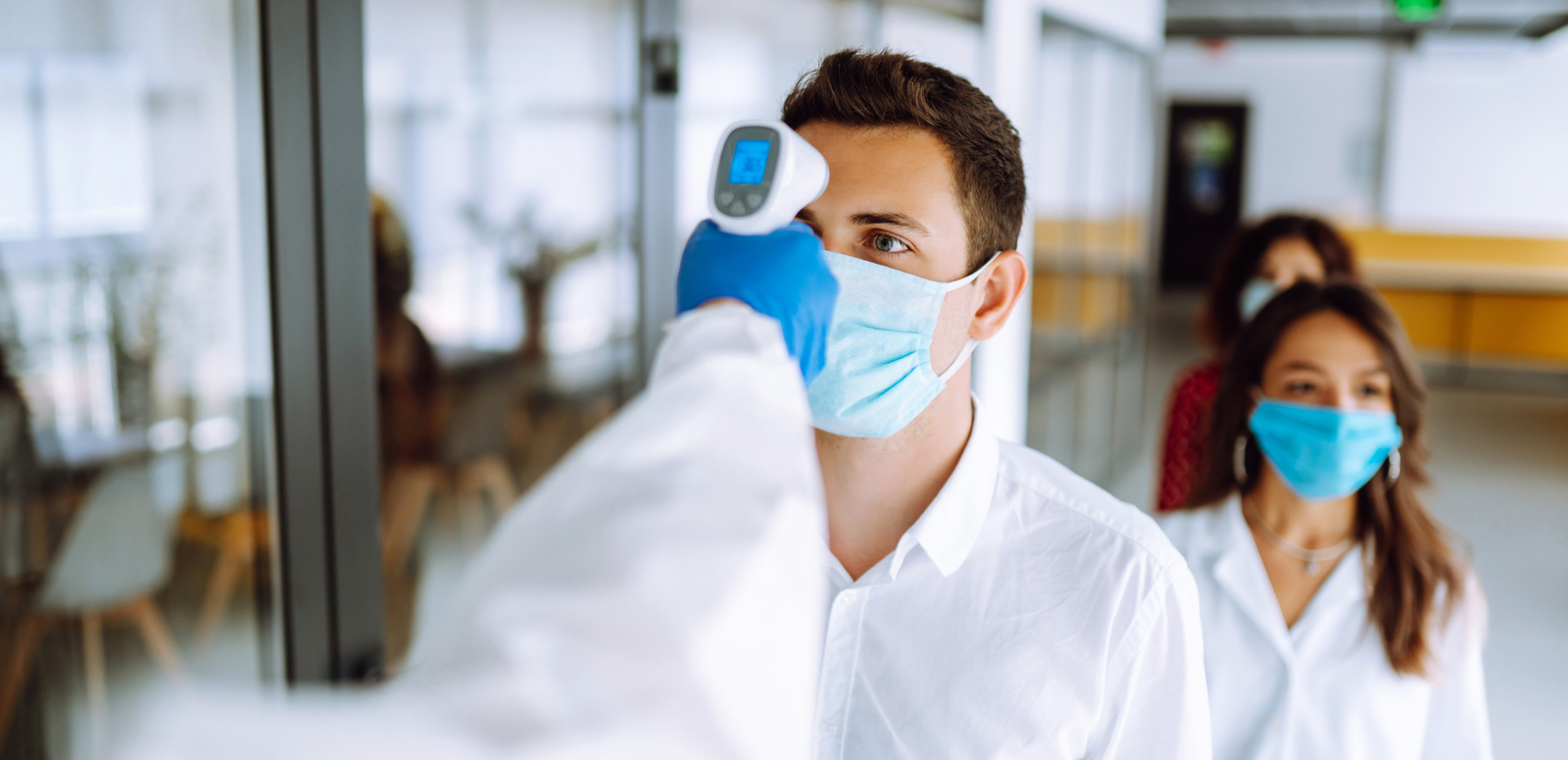
Based on early guidance from the Centers for Disease Control (CDC), schools and employers commonly consider high fever to be a major symptom of COVID-19.10 Many schools11 and workplaces12 use mandatory temperature checks as a health and safety measure for those working or studying in person. In order to avoid possible viral transmission when taking temperatures, the Food and Drug Administration (FDA) recommends the use of contactless thermometers.13 There are two main types of contactless thermometers: thermometer guns used to manually take temperature from a short distance,14 and thermal imaging cameras which use infrared sensing, sometimes paired with facial recognition, to automatically measure the temperature of anyone in range.15
Vendors have begun to offer contactless thermometers to schools and businesses across the country as a response to the onset and continuation of the COVID-19 pandemic. For example, a number of Subway restaurants in Southern California16 and colleges across the country17 have implemented PopID kiosks. Originally designed to use facial recognition to allow employees into their workplace and let customers pay with their face, the kiosks can now be retrofitted with a thermal camera, allowing the kiosk to measure employee and student temperature automatically.18 Video technology company OneScreen offers a similar facial recognition-based security and temperature measurement system that has been installed in schools from New York to California.19
Despite the popularity of thermal imaging technologies as a pandemic-related health measure, public health and privacy experts have criticized the accuracy of these technologies and the utility of relying on fever as an indicator of COVID-19 infection. According to more current guidance from the CDC, the prevalence of asymptomatic or mild cases among those who can nevertheless spread the virus makes mandatory temperature checks insufficient health and safety measures on their own.20 Additionally, privacy experts argue that thermal imaging systems not only have dubious public health value, but also erode civil liberties by normalizing persistent and invasive surveillance, especially in the case of thermal imaging systems equipped with facial recognition.21 As opposed to thermometer guns, thermal imaging cameras capture much more than temperature, tracking individuals’ movements, and in some cases biometric identifiers.22
Workers themselves subjected to this invasive technology have pushed back. Last fall, former Amazon employee Michael Jerinic sued Amazon under the Illinois Biometric Information Privacy Act (BIPA) for allegedly collecting employee biometric data without soliciting consent during mandatory thermal imaging temperature checks.23 Amazon has not publicly responded to the allegations of BIPA violations made by Jerinic.
Additionally, some school administrators and education privacy experts have expressed concern over the use of thermal imaging, including Catherine Cullen. Cullen, a school board member of Rio Rancho Public Schools in New Mexico, voted against a measure to acquire OneScreen thermal imaging kiosks for the district, citing civil liberties and data governance concerns.24 Ultimately, Rio Rancho Public Schools voted to purchase OneScreen tablets, but resolved not to use the kiosks’ facial recognition capabilities.25
Other education experts are urging schools to be cognizant of the inaccuracy of thermal imaging systems. During the panel, Anisha Reddy, Youth & Education Privacy Policy Counsel at Future of Privacy Forum, recommended that school districts not turn students away from school solely on the basis of a temperature check. “A temperature check may not be super accurate, so there should be another human level of a decision-making process before a student is turned away from school,” she urged.
Wearables for Health Monitoring
Some schools26 and workplaces27 have responded to the challenges of the pandemic by making health monitoring wearables a mandatory or optional part of in-person operations. This section will focus on the deployment of wearables in schools and workplaces for the purposes of location-tracking and symptom monitoring.28
In the context of the pandemic, wearables that track the location of students and workers have been deployed for two interrelated purposes. The first is to aid in contact tracing, or the tracking of who an infected person may have come into contact with and thereby infected.29 Some firms have built their own in-house contact tracing applications that they market to other companies. For example, the consultancy firm PwC’s contact tracing suite, Check-In, uses either a mobile app or a wearable device to collect proximity data from employees. Once an employee reports themselves as ill, an administrator can see at a glance who the worker has come into contact with and can then begin notifying these individuals of their possible exposure.30 When PwC reopened its first office last spring in Shanghai, the company required that all returning workers use Check-In,31 and as of August of last year has planned to make the use of Check-In mandatory at all PwC offices in the United States.32
The second purpose of deploying location-tracking wearables in schools and workplaces is to enforce social distancing guidelines. Wearable devices like the TraceTag affix to a worker’s hardhat or are worn on the body. If workers contravene social distancing guidelines by standing too close to each other, the TraceTag sets off an audible alarm and begins to flash, warning the worker to step back. A number of such wearable devices, the TraceTag included, also serve as passive location trackers in order to facilitate contact tracing.33 Gilbane Building Company, one of the largest construction companies in the United States,34 has issued TraceTags to all carpenters at a number of its job sites, utilizing the tool to enforce social distancing guidelines and conduct contact tracing.35
Along with deploying wearable devices for location tracking purposes, some schools and workplaces are utilizing wearable devices to monitor COVID-19 symptoms. Detroit’s Oakland University has been using the BioButton, a coin-sized device worn on the skin that continuously monitors vital signs and temperature, to conduct student symptom monitoring.36 That data is uploaded to a dashboard, where administrators in schools or workplaces can track symptoms of potential infections.37 Like the TraceTag, the BioButton has the secondary purpose of facilitating contact tracing.38
Expert opinion on the use of wearable health trackers as a means to limit COVID-19 infection is mixed. Ethics experts like those at the Harvard Safra Center argue that the proliferation and enforced use of wearable health monitors could normalize public and private surveillance of the body, paving the way for location tracking long after the threat of COVID-19 abates.39 Far from denying this possibility, some vendors have leaned into it, making it a selling point. Airista Flow, a vendor of wearable trackers, has published a blog post detailing possible post-pandemic use cases of their tracking tags, including ensuring “people/assets stay within (or outside of) predefined boundaries.”40
Some students and workers subject to these technologies have pushed back. As part of its reopening plan for Fall 2020, Detroit’s Oakland University had planned to make it mandatory for students returning to campus to wear the BioButton.41 In response, a senior at the university started a petition asking the university to make the wearing of the BioButton optional due to the technology posing a “large overreach in terms of student and staff privacy.”42 The petition quickly garnered thousands of signatures, and within a week Oakland University acceded to its demand.43
Among medical experts opinions on the use of wearables as a means of pandemic response tend toward cautious and qualified approval. Dr. Amesh Adalja of the Johns Hopkins Center for Health Security suggests that, if combined with a genuine institutional concern for safety and an otherwise robust pandemic response plan, wearables can serve as a useful pandemic response tool.44 Other medical experts argue for more transparency with health monitoring wearables, with one research paper proposing that such wearables include labels that enumerate appropriate use cases and clearly convey the measurement accuracy of said wearables.45 Still others view the proliferation of health monitoring wearables during the pandemic as an opportunity to collect large volumes of data that could train machine learning algorithms to detect asymptomatic cases of COVID-19.46
Wilneida Negrón, a panelist and director of Policy & Research at Coworker.org, suggested that employees who find that wearables are entering their workplace learn from athletes, who have long had to deal with wearable technology and ensure that their data is protected from abuse. “People that are in the athletic field or sports have had to wear wearables historically for many years. . . And so looking at how those athletes have been able to create that governing structure and that collective bargaining agreement is a period of learning. What is language and what other sectors can we learn from?” Education privacy experts can also learn from these data governance agreements in service of addressing the rollout of wearable technologies in schools.
At some workplaces that have deployed health-monitoring wearables, there have been rumblings of discontent. In June of last year, it became publicly known that Amazon was testing the use of wearables that emit a sound if workers stand in close proximity.47 Amazon warehouse workers, who had not been informed of these tests, expressed disapproval at the possibility of these wearables being implemented, with some noting that warehouse working conditions make the six-foot distance requirement impossible.48 Whether this discontent fizzles away as wearables become more common, boils over into widespread and open opposition, or is resolved through negotiation and legislation, is yet to be seen.
Citations
- “Infrared Fever Detectors Used for COVID-19 Aren’t As Accurate As You Think,” IEEE Spectrum, Dec. 11, 2020, https://spectrum.ieee.org/news-from-around-ieee/the-institute/ieee-member-news/infrared-fever-detectors-used-for-covid19-arent-as-accurate-as-you-think
- “Interim Clinical Guidance for Management of Patients with Confirmed 2019 Novel Coronavirus (2019-nCoV) Infection,” Internet Archive Wayback Machine, Jan. 30, 2020, https://web.archive.org/web/20200201032438/cdc.gov/coronavirus/2019-ncov/hcp/clinical-guidance-management-patients.html
- “Schools Are Doing COVID-19 Temperature Checks: Do They Really Help?,” Education Week, Nov. 10, 2020, https://www.edweek.org/leadership/schools-are-doing-covid-19-temperature-checks-do-they-really-help/2020/11
- “Facial recognition temperature scanning, wearables and voice biometrics deployed for COVID-19 spread prevention,” Biometric Update, Aug. 3, 2020, https://www.biometricupdate.com/202008/facial-recognition-temperature-scanning-wearables-and-voice-biometrics-deployed-for-covid-19-spread-prevention
- “Non-contact Temperature Assessment Devices During the COVID-19 Pandemic,” FDA, June 19, 2020, https://www.fda.gov/medical-devices/coronavirus-covid-19-and-medical-devices/non-contact-temperature-assessment-devices-during-covid-19-pandemic
- “Non-contact Infrared Thermometers,” FDA, May 23, 2020, https://www.fda.gov/medical-devices/general-hospital-devices-and-supplies/non-contact-infrared-thermometers
- “Thermal Imaging Systems (Infrared Thermographic Systems / Thermal Imaging Cameras),” FDA, Jan. 11, 2021, https://www.fda.gov/medical-devices/general-hospital-devices-and-supplies/thermal-imaging-systems-infrared-thermographic-systems-thermal-imaging-cameras
- “Employers Rush to Adopt Virus Screening. The Tools May Not Help Much.,” New York Times, May 14, 2020, https://www.nytimes.com/2020/05/11/technology/coronavirus-worker-testing-privacy.html
- “University of Mississippi deploys PopID automated temperature testing,” Kiosk Marketplace, Aug. 28, 2020, https://www.kioskmarketplace.com/news/university-of-mississippi-deploys-popid-automated-temperature-testing/
- “Secure, contact-free building access using facial recognition,” PopID, Feb. 23, 2021, https://www.popid.com/entry
- “How Schools and Businesses Are Reopening Using New Tech: GoSafe in the News,” OneScreen Solutions, Sep. 19, 2020, https://www.onescreensolutions.com/en/blog/how-schools-and-businesses-are-reopening-using-new-tech-gosafe-in-the-news/35060052689
- “FAQs for Workplaces & Businesses,” CDC, Feb. 11, 2021, https://www.cdc.gov/coronavirus/2019-ncov/community/general-business-faq.html
- “Temperature Screening and Civil Liberties During an Epidemic,” ACLU, May 19, 2020, https://www.aclu.org/sites/default/files/field_document/aclu_white_paper_-_temperature_checks.pdf
- “Research shows gains in biometric identification from thermal images as contracts increase,” Biometric Update, Jan. 15, 2020, https://www.biometricupdate.com/202001/research-shows-gains-in-biometric-identification-from-thermal-images-as-contracts-increase
- “Amazon COVID-19 Scans Ignore Workers' Rights, Ill. Suit Says,” Law360, Oct. 8, 2020, https://www.law360.com/articles/1318190/amazon-covid-19-scans-ignore-workers-rights-ill-suit-says
- “Schools Adopt Face Recognition in the Name of Fighting Covid,” Wired, Nov. 03, 2020, https://www.wired.com/story/schools-adopt-face-recognition-name-fighting-covid/
- “Schools Adopt Face Recognition in the Name of Fighting Covid,” Wired, Nov. 03, 2020, https://www.wired.com/story/schools-adopt-face-recognition-name-fighting-covid/
- “Reopening Schools Issue Brief: Wearable Technologies & COVID-19,” Student Privacy Compass, Aug. 3, 2020, https://studentprivacycompass.org/reopening-3/
- “Back to Work: Wearables Track Social Distancing and Sick Employees in the Workplace,” IEEE Spectrum, May 1, 2020, https://spectrum.ieee.org/the-human-os/biomedical/devices/wearables-track-social-distancing-sick-employees-workplace
- “Wearables and the Internet of Things for Health,” Research Gate, Sep. 27, 2016, https://www.researchgate.net/profile/Michael_Schwartz31/publication/309853585_Wearables_and_the_Internet_of_Things_for_Health_Wearable_Interconnected_Devices_Promise_More_Efficient_and_Comprehensive_Health_Care/links/5ec3fb0aa6fdcc90d685abf2/Wearables-and-the-Internet-of-Things-for-Health-Wearable-Interconnected-Devices-Promise-More-Efficient-and-Comprehensive-Health-Care.pdf
- “Contact tracing and COVID-19: What is it and how does it work?,” Mayo Clinic, Dec. 15, 2020, https://www.mayoclinic.org/diseases-conditions/coronavirus/expert-answers/covid-19-contact-tracing/faq-20488330
- “Check-In: A PwC Product,” PwC, Feb. 23, 2021, https://www.pwc.com/us/en/products/check-in.html
- “Your Boss May Soon Track You At Work For Coronavirus Safety,” NPR, May 8, 2020, https://www.npr.org/2020/05/08/852896051/your-boss-may-soon-track-you-at-work-for-coronavirus-safety
- “Scared of going back to the office? Companies hope these apps will help,” CNN Business, Aug. 20, 2020, https://www.cnn.com/2020/08/19/tech/back-to-office-business-covid-apps/index.html
- “In the Time of COVID-19 – How Will You Maintain Safe Working Distances?,” Triax, Feb. 23, 2020, https://www.triaxtec.com/social-distancing-contact-tracing/
- “ENR 2020 Top 400 Contractors,” Engineering News-Record, Feb, 23, 2021, https://www.enr.com/toplists/2020-Top-400-Contractors-Preview
- “Union Carpenters Utilizing New Technology to Better Social Distancing,” Eastern Atlantic States: Regional Council of Carpenters, May 28, 2020, https://eascarpenters.org/union-carpenters-utilizing-new-technology-to-better-social-distancing/
- “Wearable BioButton now available to campus community,” Oakland University News, Nov. 19, 2020, https://oakland.edu/oumagazine/news/campus-community/2020/wearable-biobutton-now-available-to-campus-community-
- “NEW! BioButton™ COVID-19 Screening Solution,” BioIntelliSense, Feb. 23, 2021, https://biointellisense.com/biobutton
- “Website, Application, and Product User Terms of Use,” BioIntelliSense, Oct. 2020, https://biointellisense.com/legal/website-and-product-user-terms-of-use
- “Ethical Implementation of Wearables in Pandemic Response: A Call for a Paradigm Shift,” Edmond J. Safra Center, May 18, 2020, https://ethics.harvard.edu/files/center-for-ethics/files/18ethicalwearables.pdf
- “POST-COVID USE CASES: YOU HAVE THE TAGS, LET’S PUT THEM TO OTHER USES!,” Airista Flow, Oct. 9, 2020, https://blog.airistaflow.com/blog/post-covid-use-cases-0
- “The Hot New Covid Tech Is Wearable and Constantly Tracks You,” New York Times, Nov. 15, 2020, https://www.nytimes.com/2020/11/15/technology/virus-wearable-tracker-privacy.html
- “Make the BioButton Optional for Staff and Students at Oakland University,” Change.org, Aug. 3, 2020, https://www.change.org/p/oakland-university-make-the-biobutton-optional-for-staff-and-students-at-oakland-university
- “BioButtons become optional after public outcry,” The Oakland Post, Aug. 7, 2020, https://oaklandpostonline.com/32739/campus/biobuttons-become-optional-after-public-outcry/
- “University walks back mandatory health tracking devices for students to control COVID-19, but experts say it could have been a 'good thing',” Yahoo! Life, Aug. 3, 2020, https://www.yahoo.com/lifestyle/university-walks-back-mandatory-health-tracking-devices-students-control-coronavirus-spread-211500160.html
- “Wearables in the SARS-CoV-2 Pandemic: What Are They Good for?,” JMIR Publications, Dec. 22, 2020, https://mhealth.jmir.org/2020/12/e25137
- Continuous on-body sensing for the COVID-19 pandemic: Gaps and opportunities,” ScienceAdvances, Sep. 2, 2020, https://tinyurl.com/pandemic-gaps
- “Amazon is testing a wearable device that lights up and beeps when warehouse workers get too close to each other,” CNBC, Jun. 16, 2020, https://www.cnbc.com/2020/06/16/amazon-tests-wearable-social-distancing-device-for-warehouse-workers.html
- “Amazon faces backlash over Covid-19 safety measures,” BBC, June 17, 2020, https://www.bbc.com/news/technology-53079624