

Keeping Student Trust
Abstract
The use of student data to inform decision-making and communication is still evolving in higher education. Often missing from campus conversations about use of student data are student voices about their preferences and needs.
NASPA and New America engaged in a joint research effort to better understand student perceptions of data use within higher education. Insights from these discussions with students led to a set of recommendations for campus administrators about the uses of different types of data, the tools for collecting and sharing that data, the areas of data-related training for faculty and staff, and the framing and delivery of outreach messages informed by student data.
Acknowledgments
We are grateful for many insights and contributions from colleagues. Special thanks to the Bill & Melinda Gates Foundation for supporting this work and the wonderful students who took the time to share their perspectives with us. We are also grateful for the editorial support of Amelia Parnell, Vice President for Research and Policy at NASPA – Student Affairs Administrators in Higher Education and Rachel Fishman, Deputy Director for Research at New America. Communications and graphics support came from Riker Pasterkiewicz, Julie Brosnan, Hana Hancock, and Fabio Murgia and copyediting support from Sabrina Detlef.
This report is based on research funded by the Bill & Melinda Gates Foundation. The findings and conclusions contained within are those of the authors and do not necessarily reflect positions or policies of the Bill & Melinda Gates Foundation.
Downloads
Introduction
The use of student data to inform decision-making and communication tactics is still an evolving practice in higher education. Colleges and universities may collect and leverage a variety of data on students—including their demographics, financial aid status, academic performance, and more—to help target and tailor their outreach and support efforts. The COVID-19 pandemic has prompted discussions about new ways institutions can collect and use students’ location and social media data to monitor (and sometimes report) their behavior and prevent campus virus outbreaks. Moreover, the pandemic has heightened campus interest in tracking student data to better understand how students are faring in online learning environments and the need to intervene with the right resources at the right time. The Chronicle of Higher Education recently published an article titled, “The Surveilled Student,” which outlined the ways that students’ information is used to track their location and use of institutional resources, and how that tracking has been heightened for public health and other reasons during the pandemic.1
Often missing from campus conversations about use of student data, however, are student voices about their preferences and needs. While institutions consider student needs and experiences in the abstract, those may not align with students’ realities and actual preferences. NASPA – Student Affairs Administrators in Higher Education and New America—a policy research organization—engaged in a joint research effort to better understand student perceptions of data use within higher education.
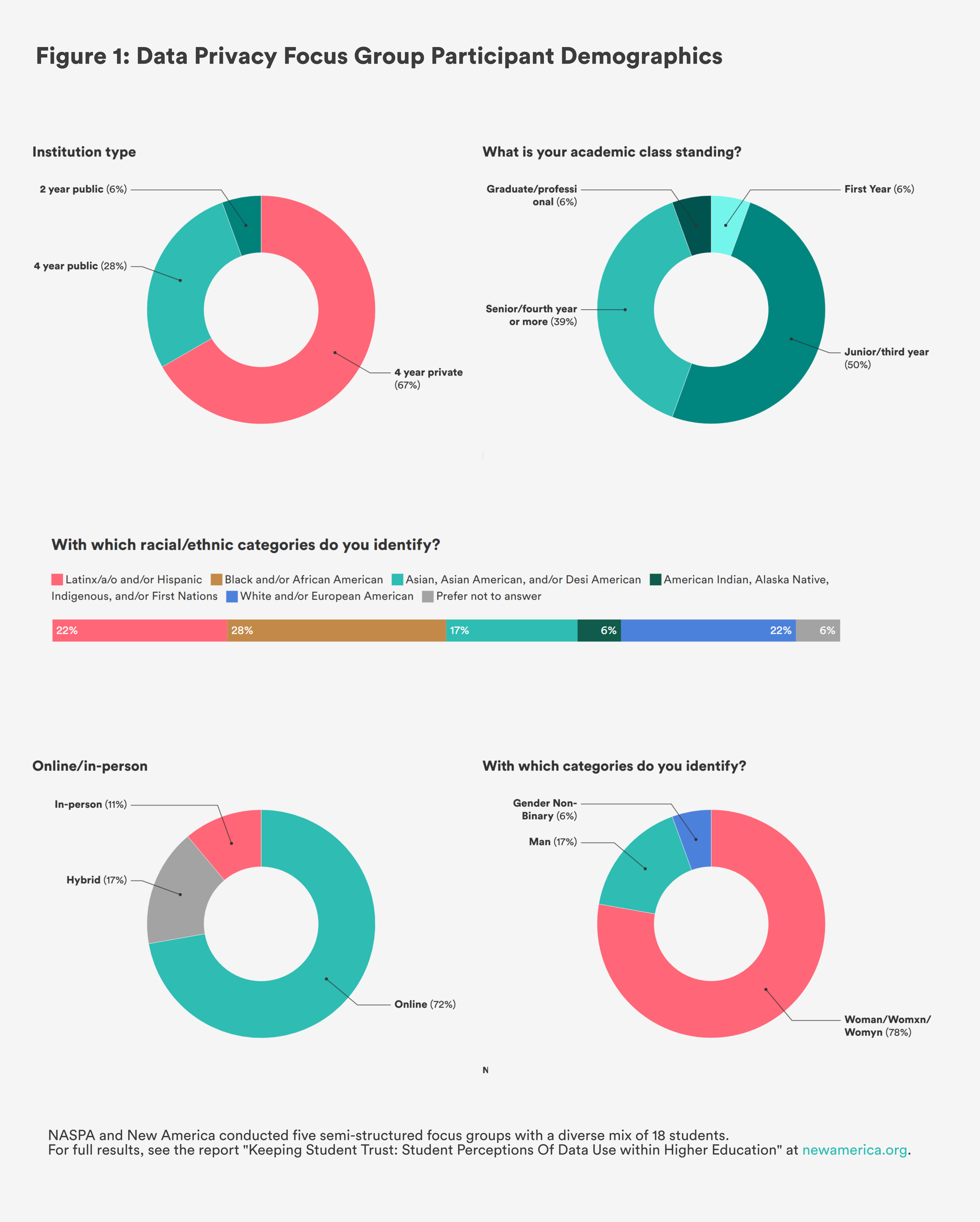
NASPA and New America conducted five semi-structured focus groups with a diverse mix of 18 students (see Figure 1).
Students were asked to react to a variety of scenarios with questions about how colleges may use or track student data (see the appendix for more on the methodology). Questions focused on understanding how students’ comfort levels may change based on:
- Whether data are collected by a higher education institution vs. a third-party company
- Type of data collected (i.e., data about student location, demographics, financial aid, and academic performance)
- Data used in COVID-19-related monitoring scenarios (i.e., social media monitoring, contact tracing mobile applications, and proctoring software)
- Data used for resource sharing and targeted outreach (i.e., notice about eligible scholarship opportunities, on-campus financial resources, social clubs and events, and tutoring and advising services)
Insights from these discussions led to a set of recommendations for institutions and campus administrators related to different uses of data; tools for collecting and sharing data; areas of data-related training; and framing and delivery of outreach messages informed by student data.
Citations
- Katherine Mangan, “The Surveilled Student,” The Chronicle of Higher Education, February 15, 2021, https://www.chronicle.com/article/the-surveilled-student
Key Themes
Our findings are influenced by the context in which the student participants currently operate. For example, students who were taking classes in person had very different perspectives on the trade-offs between data privacy and the ability to be on campus and learn and live among their peers. Students from smaller campuses had more trust in their institutions in general than students from larger institutions. The focus groups resulted in a number of key themes, which, while not generalizable to all students at all institutions, provided deep and insightful perspectives. First, we explored students' thoughts on the institutional collection and use of specific data, including the use of third-party companies, social media data, location data, and the use of proctoring software. Then we examined students' perceptions of trust when it came to institutional use of their data to craft interventions. We were interested in their ideas about transparency, the messenger used for a given message, and when this work can step over the line into paternalism.
Citations
- Katherine Mangan, “The Surveilled Student,” The Chronicle of Higher Education, February 15, 2021, https://www.chronicle.com/article/the-surveilled-student
Institutional Collection and Use of Data
Third-party companies
In the focus groups, the moderator asked students to differentiate among the types of data that they might be required to share with their institution, and whether it made a difference if that data were managed by their institution or third-party companies. For the most part, throughout all focus groups, there was consensus among all student participants that they had significantly more trust in colleges and much more limited trust in companies. One student said,
I would definitely say I'm less concerned about my institution collecting data. Because they generally don't ask for data a whole lot of the time, besides what they get from, like the basic application type stuff. And I think FERPA2 just makes me feel better, because it's like federal law. And as a student in higher ed who has worked in very FERPA protected areas, it's very much like, FERPA is a big deal. Institutions are really, in my opinion, going the extra mile to protect student data.
Another student expressed similar feelings about institutions having and using student data. She seemed to see it as part of the trade-off for attending the institution, because she felt like she gave the institution her data when she applied. Conversely, she felt less secure about how corporations use her data. She indicated that knowing companies use her data does not stop her from doing what she wants to do, but it does concern her more than her institution’s use of her data. Another student agreed, expressing that she takes it for granted that institutions are collecting data on her, such as when she is on campus or when she is accessing campus Wi-Fi networks. Another student said that she simply does not think much about how her institution uses her data: “I don't think I'm necessarily concerned about my institution's use of data privacy; I haven't really thought a lot about it. Because it's really not in my face often.” This lack of concern may also be a sign that institutions could be more transparent in informing students about how they collect and use data.
Students were asked if they would be comfortable sharing their location data or even health data with their institutions in order to be compliant with COVID rules. Most students agreed that they would be much more comfortable sharing that information via an institution-created and managed application than one managed by a third-party or external company. “I would prefer an institution-based app,” one student said, continuing, “but I also wouldn't necessarily not use a third-party app. At the end of the day, I feel like desperate times call for desperate measures. And in order to stop the spread of COVID I would probably do what it takes to like be a part of that.” Another student expressed similar sentiments, saying that she would choose to use an institution-based app. She felt as though when she used third-party apps on campus, the name of the company is not recognizable, and as a result, she does not really know where her data is going. Another student agreed, saying that he would be more comfortable using an app if it is university-owned, but far less comfortable if the institution partnered with a third-party app, especially if it involved knowing his location on campus. Student distrust of third-party COVID-related applications have made headlines at some institutions. A COVID tracing application being used at one institution was found to have security flaws that could have resulted in students’ test results being exposed to the public. Concern over the security flaws led to a petition, signed by more than 1,600 students, to call for the institution to terminate its use.3
Some students expressed that while they were not necessarily comfortable with the third-party apps that their institutions are using, they did not feel like they had much choice in using them. One student said that she did not want to take part in some of the monitoring that was happening, but that she had already paid for housing for the year and she felt like she did not have the opportunity to opt out of using the app.
Beyond the privacy issues surrounding health data for COVID purposes, students demonstrated limited knowledge about how colleges work with third-party applications or external companies and the ways that institutions might already share student data with those companies. One student worried about how institutions could use third-party applications to infringe on student privacy rights: “I think like these location systems can definitely be used against students in a very negative way. If institutions are not being quite transparent of what they're using the data for and sort of the parameters around it, then I definitely think that should be an area of concern for all of us. Because I already know not to bring my phone to a protest. Particularly because not only can the school track it, but also the state as well. Or federal government and state government.”
The lack of trust in companies was top of mind for students throughout the focus groups. Many students mentioned being influenced by The Social Dilemma, a Netflix documentary focused on social platforms and the ways they trample user privacy. Students had a strong sense that social media and other internet companies are listening to users to serve them up to advertisers. One student said, “I'll say that I'm not as worried about my university taking my data. But I will say after watching The Social Dilemma on Netflix, I think that data usage is completely on my mind. Now. I still wouldn't say it's crippling. I don't, like, stay up every night thinking about it. But it's definitely more of [an] awakening of how much information is stored and how much is used on a daily basis.”
Location data
Students had mixed feelings about colleges using their location data. Many were okay with it as long as it was to combat COVID-19 outbreaks on campus. As one student put it, “I have been contact traced a ton because I am on campus and going to classes in person. I don't think that it's personally a security issue or a privacy issue for me, because the welfare and safety of our students is at risk.” But others—even during a pandemic—were wary of their college using or having access to their location and some were willing to avoid campus to prevent it. “It would sort of be very alarming to me [if my school traced my location]….I think in the era of COVID, we're asked that type of question on a daily [basis] of how much [privacy] are you willing to give away in order to maintain a sense of safety,” said another student.
Students were asked how they felt about institutions using their location data to provide them support services, without COVID in the picture. The reactions were very negative. One student described it as giving him “an authoritarian regime kind of vibe.” Another described feeling uneasy, because “now my school is tracking my every move and they…what else do they know? It's just kind of really weird.”
The student responses to the use of location data by their institutions have larger implications for colleges. Even those generally positive about using location data to fight the pandemic wanted to make sure colleges had clear rules about how they would stop using and destroy data when it was no longer needed. “There'd have to be a clear end. I wouldn't want that to continue after the pandemic so [there would need to be] transparency between the university and the students about when that data will stop being collected…and how they're getting rid of that information afterwards,” was how one student articulated it.
Another theme that emerged was that students are wary of ways that their universities might target them with this type of data. As one student said, “it really just creates an opportunity for those location services to be weaponized against students of color in particular.” Colleges have a long way to go to build trust with marginalized members of their communities. Students also noted that colleges fail to effectively coordinate their communications, making students less likely to trust them with sensitive information. One student who was generally positive about colleges using his location to help gave the caveat that students should be able to opt out of a reminder based on location because “considering the way information is sent and shared on a college campus, you don't want to get the same message…from four different sources.” Other students felt that a nudge to do something the college thought was important undermined their autonomy. “I know what a library is, I know that I can go there for resources. A text alert I don't think is necessary,” said one student, making it clear that she thought the nudge was paternalistic.
Social media divide
The topic of social media monitoring by institutions was one that drew significant interest from the student participants. Their responses varied widely, from grave concern about how social media was used during COVID to determine risk of exposure to no concern about the privacy of student social media accounts. Some students reacted very negatively to the idea of social media monitoring while others were resigned to it. Some students felt that if their peers choose to make their social media information public, it was fair for institutions to monitor it to make sure they were following the rules.
One student against social media monitoring stated, “I think that's a complete violation. Your private social media is your private social media.” Another student explained his feelings this way: “I think institutions are in a very sort of precarious space where they're trying to figure out what does it mean to be a community, particularly what it means to be a digital community….And they're basically targeting students in a way by using constant surveillance. Social media was already about visibility, but institutions are weaponizing it in a way to remove students from their campus.” He went on to say that students are now more cognizant of who is monitoring their social media and who has access to it, and that many students now wonder whether their posts will be seen either by other students who could report them for policy violations or the institution itself. He indicated that the sense of personal space versus what is now seen as public space has changed since the beginning of the COVID pandemic.
Another student said that her friends are now being extremely cautious about their social media use. She mentioned a friend who had been kicked off campus after the first week of school because someone reported her for posting something on social media that violated the social distancing rules. She indicated that many of her peers have limited their friends on Facebook and Instagram because they are worried about their accounts being used against them by their institution.
Although they were in the minority, other students seemed completely unconcerned about the institution monitoring student social media accounts. One said, “I mean, if your social media is public, and the university sees it, then that's sort of on you.” Another student said that he would prefer an institution monitor students’ locations through a third-party application rather than monitoring their social media accounts in order to maintain COVID safety protocols.
Other students seemed to make an exception about social media monitoring by institutions for public health reasons. One shared, “I don't think it makes sense for them to go on social media, unless they have a case that has like been confirmed….I think if there's a party, and there's an instance where you need to have proof [or] you need to know who else was there, it might make sense to go on someone's account and ask their permission to see their account, if it's private. Otherwise, I don't really see why they need to be lurking on social media." A different student indicated the struggle that students have in reconciling the desire for safety with the desire for privacy. She did not want her institution monitoring her social media account, but she knew that many students were still having parties at her campus. She said that she is comfortable with the institution monitoring social media accounts for that purpose, but only because she knew she was not engaging in that behavior herself and the monitoring would help to keep her safe.
Another common theme that came up for students was the peer-to-peer monitoring of social media. In some instances, they indicated that institutions were encouraging this peer monitoring, or a “snitch” system where students report their peers for violations of the COVID safety measures. One student indicated acceptance of this type of monitoring by peers:
I definitely don't love the idea of our universities monitoring our social media, but I know that right now, they kind of have a system in place where if you follow someone on social media and see a party happening, you can report it, which I feel like is a little bit better, because then it's like, student-to-student and you're putting it out to your followers [to see]….So I feel like you're already kind of exposing yourself, so it doesn't bother me as much if it comes from [a situation where] I follow my friend’s account, they're doing this, and I reported it, rather than…our universities…stalking our pages.
Other students felt strongly that this was a method for institutions to put the onus on students to monitor themselves, by weaponizing their social media accounts. One said that her institution created a specific web site called “[institution name] Snitch” where students can upload pictures of people hanging out with peers outside of their dorm and report peers who have violated the rules. She said her institution is using the website to kick students off campus and that over 20 students had been sent home based on pictures others had posted of them. Another expressed concern with this peer snitch approach, saying that she has also witnessed students reporting each other at her institution. These students have been sanctioned based on those reports.
Several students repeated this concern, referring to the negative impact these peer-to-peer reporting practices have had (or would hypothetically have) on campus climate. One student who is not currently on campus said that snitching would create such a bad climate that she would not have any fun and that it would not be worth going back to campus if that were the case. She envisioned an environment where she and her peers would all be so scared of being reported that they would just sit in their rooms and do nothing. Another student shared these concerns, saying, “I feel like people would begin to falsely [start] kind of a witch trial moment where everyone's kind of falsely accusing people at this point, just to cause trouble.” But she felt as though universities had managed to display some restraint by not immediately expelling or suspending anyone who was reported and investigating the incident first. She also indicated that she was not sure monitoring would be effective, since students could stay off of administrators’ radar easily by keeping Facebook event pages private.
Students mostly felt like institutions should not monitor students’ social media accounts for instances of COVID violations, but they did understand the privacy versus safety trade-off that that meant. Administrators should take heed, though, about the ways that campus climate can be impacted by encouraging snitch websites or processes where peers can report one another’s behavior. While safety may be maintained or heightened with active social media monitoring and the use of peer reporting structures, these approaches may backfire by creating a climate with which students no longer want to engage.
Proctoring software
Another issue that was raised by several student participants was the invasiveness of proctoring practices and software. These practices are sometimes conducted by individual faculty members and sometimes outsourced by institutions, so that monitoring and proctoring is done by third-party companies. The use of online proctoring software by institutions was commonplace early in the pandemic. As of April 2020, 54 percent of institutions were using online or remote proctoring services, and another 23 percent indicated that they were planning on or considering using them.4
These practices impact students in different ways, as one student parent explained. She was told her exam would be proctored, and that a proctor would be watching her every move. She emailed her professor the following: “‘okay, letting you know, there might be some drawings or whatever in the background. It's not because I'm trying to solve an equation with that. I just have a four-year-old and she's in my room 24/7 with me.’” She said that other times when she has been preparing to take an exam, she has been asked by a proctor why she has a paper next to her on the desk. She has to tell them, “I’m about to take a test. So my four year old is about to practice doing her lettering, right next to me.” She has had to become accustomed to explaining her situation in recent classes, she told us.
Another student described her experience taking the LSAT exam virtually. “I'm not going to lie; it felt a little uncomfortable. Because they are extremely strict about it—like extremely strict about it. I had to show him my surroundings, I had to show him under my desk, I had to turn on my phone turned to selfie mode so that they can see that there's nothing on the screen itself. And then I had to be willing to do everything that the proctor said. So he said, ‘Can you please get up? Can you walk to this wall? Can you walk to that wall?’” She described the feeling as invasive, as the proctor was able to see her anti-Trump poster on the wall, as well as her books and all of her personal belongings.
Other students described the same feeling of having their personal space invaded by professors who insist that students have their cameras on during class. One student described it this way: “I think my concern comes where now that schools are basically allowed into our homes, there's a lot of monitoring with the testing that's happening. With making sure that your eyes stay onto the screen if you're doing a test….There's a sort of a constant surveillance state that's happening, where it wasn't there before, when we were going to classes or being advised or going to events in person.” Another student talked about proctoring processes in which students’ eye movements are tracked; if students look away from the computer screen, they can be accused of cheating. This student said that in one instance she was stopped from continuing an exam because the software program detected someone else using her Wi-Fi network to access an Amazon Fire Stick on a television in her house. She felt very insecure about how the program could detect that level of information about her home situation.
Many students could articulate that this sense of feeling as though their private spaces were being invaded was a trade-off for their ability to take classes virtually. And several students seemed resigned to the situation, expressing a “this is how it is now” sentiment. Other participants, however, expressed a desire for alternatives to this invasion of privacy. These students indicated that they preferred to have open-note or open-book exams that were more thoughtfully crafted to prevent students from cheating. Professors who used applied questions on their exams could still allow for open notes or open books while assessing student learning in the course. This student sentiment has been supported by faculty members who are also wary of using online proctoring companies in their classrooms. One informal poll by an adjunct professor found that 81 percent of professors said they would not use online proctoring software provided by their institution.5
Demographic data
Students had mixed reactions to questions about their comfort with institutional outreach informed by their demographic data. Hypothetical scenarios prompted students to consider ways institutions might suggest resources that seem relevant to them based on different types of demographic data, including first-generation status, Pell-eligibility, and race.
Some students said that they would appreciate receiving personalized messages about programs and supports based on demographic data. One student said that they would support institutions using racial demographic data to do targeted outreach to students about community events on campus, because disaggregating data here might help campuses to take a more critical look at how well they are supporting certain student identities. However, even among students who generally felt comfortable with institutions using their demographic data, most still voiced major caveats. Several shared that they would only feel comfortable with targeted outreach based on demographics if they had opted in to receiving those communications. Students do not want to feel surprised as to why an institution knows that they identify within certain demographic groups, and some level of consent to use their data is preferred. A few students proposed that institutions only use demographic data voluntarily shared by students for outreach, and that students be given the choice to opt in. One explained that supports may not always resonate with the intended students and that those messages can be disruptive. For example, “although I am first-gen, I might be doing really well and I don't need the additional support. So I would prefer that you not blow my phone up with notifications that aren't helpful.”
Students also had varying degrees of comfort depending on the ways in which institutions used the demographic data for different types of outreach. Several students had a negative reaction to the idea of institutions using student financial aid data to send an email with information about the availability of emergency aid and hours of an on-campus food bank. Outreach about food bank availability based on Pell-eligibility data was seen as assumptive and marginalizing, with one student flagging the fact that “not all low-income people are food insecure, and not all food insecure people are low-income.” A student in another focus group agreed, saying, “financial situations can change in an instant” and Pell-eligibility does not always accurately reflect level of food insecurity. Students were much more comfortable with demographics being used to send notifications about scholarships, based on a student’s Pell-eligibility, first-generation status, or race. Still, a couple of students from one focus group session argued that it would be more beneficial for students if information about all scholarship opportunities were available in a centralized location online.
Finally, several students said they were strongly against receiving personalized outreach about clubs and organizations specific to their demographic data. These students cited the idea that this practice could potentially limit their own process of exploring engagement opportunities and experiences on campus. “You don’t want to have it so it’s like, ‘go to these events because you’re Black,’ or ‘go to these events because you’re Christian,’ because then it can kind of limit the amount of growth that you can have and the types of people you’ll get to meet on campus,” explained one student. Students discussed how they value their independence and choice in this area, and that information about organizations and clubs should go out to all students rather than to certain groups.
Citations
- Katherine Mangan, “The Surveilled Student,” The Chronicle of Higher Education, February 15, 2021, https://www.chronicle.com/article/the-surveilled-student
- See the Family Educational Rights and Privacy Act https://www2.ed.gov/policy/gen/guid/fpco/ferpa/index.html
- Lindsay McKenzie, “Security Flaws Found in COVID-19 Tracing App,” Inside Higher Ed, August 21, 2020, https://tinyurl.com/securityflaws
- Susan Grajek, “COVID-19 QuickPoll Results: Grading and Proctoring,” EDUCAUSE Research Notes, April 10, 2020, https://er.educause.edu/blogs/2020/4/educause-covid-19-quickpoll-results-grading-and-proctoring.
- Colleen Flaherty, “Big Proctor,” Inside Higher Ed, May 11, 2020, https://www.insidehighered.com/news/2020/05/11/online-proctoring-surging-during-covid-19
Use of Data to Craft Interventions
Transparency
Several students emphasized the importance of institutions being transparent with how their data are being used. These students touched on multiple aspects of data transparency, including the desire for clear information from the institution on the breadth of data being collected, how those data are being used, who has access to their data, and when data collection and use will end. A student shared their frustration with not knowing where to have their data-related questions answered: “I really don't know how my school will use my data after I graduate. And that's something I've thought about, but like, who do I ask? No one really helps tell you as a student.”
Clear policies and early communications are especially relevant for students who are on campus and confused about the parameters of tracking or monitoring technologies during COVID-19. One student explained that her friend was suspended from campus for violating social distancing protocols as reported through social media monitoring, but that neither of them were aware they were breaking rules. That student also shared how “there’s no appeal process,” adding that the monitoring “puts a lot of us that are on scholarships and stuff in a really weird space, because we have to choose between our privacy and finishing our degree on time and having the funding for that.” Some students agreed that they would trade some aspects of their privacy in order to be on campus during the pandemic, as long their institutions clearly outlined the terms and conditions of data use and the options available to them. Students said being transparent about data use, policy, and monitoring up front can ensure that they can make informed choices and have a shared awareness about expectations.
When sharing reflections at the end of the focus group, one student reiterated the need for transparency between institutions and their students:
When I'm thinking about all these different things [discussed], I'm like, wow, there's a lot of different ways in which [my institution] uses my data. And I think the biggest thing that needs to happen is transparency and just trying to be as transparent as possible, and how students should be able to explain how [their institution] is using their data. Because I wasn't able to do that and that's not right.
The need for clear communication with students about how their data is used has been emphasized in other studies as well. A report by New America highlighted the power of predictive analytics in increasing student success and the potential this tool has to make positive change for students in higher education. But the report notes that this use of data comes with the responsibility of ensuring that findings are appropriately communicated.6 Students are interested in knowing what data their institution collects about them, how data are used, and policies related to data protection. Transparency here can empower students to make informed choices and even encourage active engagement about ways in which they would like their data to be used to improve their campus experiences.
The intervention messenger
Students thought academic interventions were generally helpful as long as the messenger was considered appropriate and trained to provide support. One student said proactive outreach around academic support “would really be helpful because they just don't notice if you're struggling unless you say so first. And I feel like maybe some people are struggling with reaching out and saying, ‘I need help.’”
But students wanted the person who conducted the outreach to be at an appropriate level and in an appropriate role. While students thought advisers or faculty reaching out was helpful, they did not think other students should reach out with assistance or have access to their academic performance. One student recounted a personal experience of this happening. She described it as “very uncomfortable because they passed on my test grade to…student tutors. And so she called me randomly…And I'm like, ‘Who are you? How do you know I failed my Calc 2 exam?’ I have questions. I did not enjoy it…It was just not appropriate.” Another worked as a class teaching assistant and had seen issues with students' grades and passed that along to the professor, because “I wasn't going to reach out to that student because I felt as though that was very intrusive.”
Some were also concerned about alerts going to people who were too high up in the administration and might affect the students’ future. As one student put it, “I wouldn't want [my academic performance data] to be sent to our dean, because that would compromise my reputation. And I'd want it to be sent to someone that I trust, like my advisor, or even my instructor.” Others disagreed and thought that having someone higher up in the administration reach out was better. Colleges could consider conducting focus groups or surveying students to see what types of messengers they are most comfortable with, given how that messenger affects the reception of the message. A NASPA report, 5 Things Student Affairs Professionals Should Know About Managing Email Communication with Students, highlights key considerations about sharing relevant information with students in a timely manner, ways to collect actionable data, and the consequences of misaligned communication efforts.7
Students also wanted to ensure that the messenger was trained to have difficult conversations with students. And a couple of them said that they would prefer personalized, data-informed messages to come from administrators who are sensitive to the impact of challenges outside the classroom that may be impacting a student’s academic performance. One student explained that they would prefer outreach to come from administrators trained in crisis response or trauma-informed approaches. Another student suggested that awareness of existing support resources and training on how to connect students to these resources when needed should be a baseline expectation for all faculty and professors. Colleges should think about the types of training they provide to faculty and staff charged with providing proactive support to students. It is particularly important that these types of interventions are trauma-informed.
Respect for student independence
Many students felt strongly that colleges should treat them as adults and had negative reactions to what they saw as school overreach in trying to get students to do the right thing. This response was consistent for many types of college outreach, from health protocols with COVID to other support services. As one student put it, “I think the job of the university is more support over surveillance…They’re here…to support the students…not for surveillance or not to be like, ‘Oh, you can't do this, or you can't do that,’ because we're all adults.” Another responded to the idea of intrusive advising this way: “we're all kind of adults. We can help ourselves; we don't need our location data and all this information being used…I think that's just an overstep.”
The idea of contacting parents to report COVID-19 violations received particularly negative reactions. “Reaching out to parents feels like a big no-no to me, because we're all adults. And that's a little like, tattle-taling, which is really bad,” said one student. Another added, “It's very strange to me that parents are being contacted about COVID now. Because…you shouldn't know about this at all. Your child is a full-grown adult over the age of 18. Why are your parents being involved?…I have a lot of issues with that. They're over the age of 18. But why are we still treating them like kids?” Colleges should consider the balance between respecting student autonomy and providing a community of support by involving parents. Surveys and focus groups with students can help institutions establish where the line is between helpful and paternalistic.
Citations
- Katherine Mangan, “The Surveilled Student,” The Chronicle of Higher Education, February 15, 2021, https://www.chronicle.com/article/the-surveilled-student
- See the Family Educational Rights and Privacy Act https://www2.ed.gov/policy/gen/guid/fpco/ferpa/index.html
- Lindsay McKenzie, “Security Flaws Found in COVID-19 Tracing App,” Inside Higher Ed, August 21, 2020, https://tinyurl.com/securityflaws
- Susan Grajek, “COVID-19 QuickPoll Results: Grading and Proctoring,” EDUCAUSE Research Notes, April 10, 2020, https://er.educause.edu/blogs/2020/4/educause-covid-19-quickpoll-results-grading-and-proctoring.
- Colleen Flaherty, “Big Proctor,” Inside Higher Ed, May 11, 2020, https://www.insidehighered.com/news/2020/05/11/online-proctoring-surging-during-covid-19
- Alejandra Acosta, How You Say It Matters: Communicating Predictive Analytics Findings to Students (Washington, DC: New America, July 2020), https://d1y8sb8igg2f8e.cloudfront.net/documents/How_You_Say_It_Matters_.pdf
- Alexa Wesley and Jill Dunlap, 5 Things Student Affairs Professionals Should Know About Managing Email Communication with Students (Washington, DC: NASPA, 2020), https://www.naspa.org/report/five-things-student-affairs-professionals-should-know-about-managing-email-communication-with-students
Recommendations
This rich discussion of students’ perceptions of the use of their data in different contexts begins to suggest ways that institutions of higher education should and should not use that data. Too often, we encourage colleges to use student data without properly considering student opinion. Below is a set of 11 recommendations for how colleges can be more thoughtful in their use of data both during and after the COVID-19 pandemic.
Data
- Limit the use of location data. Students were generally uncomfortable with the college using their location data. Before schools decide to use this type of data, they should discuss it with their students and have clear limits around that data.
- Stay out of students’ social media. Most students seemed to think that monitoring student social media accounts, even for public health reasons, is a privacy violation. Some recognized the limitations of privacy expectations when students post information on their own accounts but felt it was a clear violation when students were sanctioned for behavior based on a social media post that was not their own.
- Be mindful of data limitations. Data on demographics are often limited and only tell a small part of a student’s story. Pell-eligibility status, for example, is an imprecise measure of socioeconomic status. Students recommend sending outreach messages related to financial resources to all students and ensuring that a list of these resources is easily accessible online and streamlined with other support information.
- Clearly communicate data policies. Students do not want to be surprised about how their institution knows personal information about them. Institutions should clearly outline policies about data use and have a process in place that allows students to ask questions they may have about their data.
Tools
- Use internal, university-controlled applications, when possible. Students were clear that when given the choice between their schools and third parties, they trust their institutions to use their data responsibly. This preference is not limited to COVID health or monitoring apps; in general, students expressed skepticism about how third-party applications and companies use their data.
- Practice proctoring restraint. Colleges should reduce the number of third-party proctoring companies with which students must interact and should be clear about what data they are collecting. Colleges should be sensitive about the fact that students might find certain types of information intrusive.
- Avoid peer reporting structures. Students felt strongly that peer-reporting structures, or institution sponsored “snitch” websites, were a bad idea. Even those who said that they understood the practice within the confines of a public health crisis expressed sincere hesitation around this practice. Institutions who use this approach may face a backlash by students who no longer find the campus culture welcoming, a consequence that may linger long after the pandemic has passed.
Training
- Train faculty and staff in student outreach. Students wanted to ensure that anyone who reached out to a struggling student was trained in responding to people crisis so they did not inadvertently make the situation worse. Ensuring that the faculty and staff responsible for reaching out to students have the right training is critical for effective intervention.
- Provide training for faculty and staff about online expectations—of faculty and staff. Laying out an institution’s expectations regarding students’ privacy is important. Ensuring that faculty and staff have clear expectations about what they can and cannot require of students and ensures student privacy is important.
Outreach
- Ask students who should communicate with them. Students had strong feelings about who reached out to them to offer any kind of help. Aside from a general acceptance of advisers in this role, these feelings were not always consistent. Colleges should survey or conduct focus groups with their students about what messenger they feel is appropriate for different kinds of outreach.
- Plan your messages thoughtfully. Students reacted negatively to messages that they viewed as paternalistic. They expected their college to treat them as adults. There are probably other messaging missteps that colleges could fall into as well. Colleges should test their messages with students formally (like in focus groups) and informally (in conversation) before they are used.8
Citations
- Katherine Mangan, “The Surveilled Student,” The Chronicle of Higher Education, February 15, 2021, https://www.chronicle.com/article/the-surveilled-student
- See the Family Educational Rights and Privacy Act https://www2.ed.gov/policy/gen/guid/fpco/ferpa/index.html
- Lindsay McKenzie, “Security Flaws Found in COVID-19 Tracing App,” Inside Higher Ed, August 21, 2020, https://tinyurl.com/securityflaws
- Susan Grajek, “COVID-19 QuickPoll Results: Grading and Proctoring,” EDUCAUSE Research Notes, April 10, 2020, https://er.educause.edu/blogs/2020/4/educause-covid-19-quickpoll-results-grading-and-proctoring.
- Colleen Flaherty, “Big Proctor,” Inside Higher Ed, May 11, 2020, https://www.insidehighered.com/news/2020/05/11/online-proctoring-surging-during-covid-19
- Alejandra Acosta, How You Say It Matters: Communicating Predictive Analytics Findings to Students (Washington, DC: New America, July 2020), https://d1y8sb8igg2f8e.cloudfront.net/documents/How_You_Say_It_Matters_.pdf
- Alexa Wesley and Jill Dunlap, 5 Things Student Affairs Professionals Should Know About Managing Email Communication with Students (Washington, DC: NASPA, 2020), https://www.naspa.org/report/five-things-student-affairs-professionals-should-know-about-managing-email-communication-with-students
- Acosta, How You Say It.
Future Implications
As colleges continue to deploy student data to better target supports and make decisions, they should be mindful that students hold many strong views about the use of that data. Transparency and collaboration with students around what data to use, how to use it, and what messages feel least intrusive will go a long way toward building trust and avoiding using data in a way that makes students uncomfortable. The COVID-19 pandemic has heightened the feeling of being tracked and surveilled for many students. And while students understand that this tracking is for public health reasons and they currently tolerate it, they do not want to see similar monitoring practices continue post-pandemic.
There is good news for campus administrators in the comments of these students. Most obvious is that—for the most part—students trust their institutions to use their data appropriately. They understand that institutions want to get helpful resources into the hands of those who need them, but sometimes question the methods they use to go about that outreach. More transparency with students about how their data is used and what they can expect from their institutions in terms of data use will further cement that trust and help students to grow into more data-aware citizens.
Citations
- Katherine Mangan, “The Surveilled Student,” The Chronicle of Higher Education, February 15, 2021, https://www.chronicle.com/article/the-surveilled-student
- See the Family Educational Rights and Privacy Act https://www2.ed.gov/policy/gen/guid/fpco/ferpa/index.html
- Lindsay McKenzie, “Security Flaws Found in COVID-19 Tracing App,” Inside Higher Ed, August 21, 2020, https://tinyurl.com/securityflaws
- Susan Grajek, “COVID-19 QuickPoll Results: Grading and Proctoring,” EDUCAUSE Research Notes, April 10, 2020, https://er.educause.edu/blogs/2020/4/educause-covid-19-quickpoll-results-grading-and-proctoring.
- Colleen Flaherty, “Big Proctor,” Inside Higher Ed, May 11, 2020, https://www.insidehighered.com/news/2020/05/11/online-proctoring-surging-during-covid-19
- Alejandra Acosta, How You Say It Matters: Communicating Predictive Analytics Findings to Students (Washington, DC: New America, July 2020), https://d1y8sb8igg2f8e.cloudfront.net/documents/How_You_Say_It_Matters_.pdf
- Alexa Wesley and Jill Dunlap, 5 Things Student Affairs Professionals Should Know About Managing Email Communication with Students (Washington, DC: NASPA, 2020), https://www.naspa.org/report/five-things-student-affairs-professionals-should-know-about-managing-email-communication-with-students
- Acosta, How You Say It.
Appendix: Methodology
NASPA and New America conducted five virtual, semi-structured focus groups with a diverse mix of 18 students (see Figure 1) from late September to late October 2020. Each 90 minute focus group included up to four students and was moderated by the authors of this brief.
Students were recruited with help from Leadership Enterprise for a Diverse America (LEDA), part of the Today’s Students Coalition which works with students on campus. Students filled out a survey providing their race/ethnicity, gender identity, enrollment status, major/academic area of focus, academic class standing, Pell eligibility status, whether they were online or in-person, and whether they identify as being first-generation or undocumented. The authors reviewed the submissions and scheduled the focus groups. Before the focus group, students were provided with the following information:
- Request for permission to record the conversation
- Request that they turn on cameras if able
- Request that they enter their pronouns and names when logging on
- Reminder that the focus group would take place on RingCentral, so they must download the app beforehand and have access to a computer or tablet (mobile phone was also an option but not preferred)
- Note that they do not need to prepare anything and there are no right or wrong answers
- Note that they will be asked for their thoughts and opinions, and they will hear the experiences and opinions of others.
Students were asked to react to a variety of scenarios with questions about how colleges may use or track student data that were laid out in the moderator guide. Questions focused on understanding how comfort levels may change based on:
- Whether data are collected by a higher education institution vs. a third-party company
- Type of data collected (i.e., data about student location, demographics, financial aid, and academic performance)
- Data used in COVID-19-related monitoring scenarios (i.e., social media monitoring, contact tracing mobile applications, and proctoring software)
- Data used for resource sharing and targeted outreach (i.e., notice about eligible scholarship opportunities, on-campus financial resources, social clubs and events, and tutoring and advising services)
Citations
- Katherine Mangan, “The Surveilled Student,” The Chronicle of Higher Education, February 15, 2021, https://www.chronicle.com/article/the-surveilled-student
- See the Family Educational Rights and Privacy Act https://www2.ed.gov/policy/gen/guid/fpco/ferpa/index.html
- Lindsay McKenzie, “Security Flaws Found in COVID-19 Tracing App,” Inside Higher Ed, August 21, 2020, https://tinyurl.com/securityflaws
- Susan Grajek, “COVID-19 QuickPoll Results: Grading and Proctoring,” EDUCAUSE Research Notes, April 10, 2020, https://er.educause.edu/blogs/2020/4/educause-covid-19-quickpoll-results-grading-and-proctoring.
- Colleen Flaherty, “Big Proctor,” Inside Higher Ed, May 11, 2020, https://www.insidehighered.com/news/2020/05/11/online-proctoring-surging-during-covid-19
- Alejandra Acosta, How You Say It Matters: Communicating Predictive Analytics Findings to Students (Washington, DC: New America, July 2020), https://d1y8sb8igg2f8e.cloudfront.net/documents/How_You_Say_It_Matters_.pdf
- Alexa Wesley and Jill Dunlap, 5 Things Student Affairs Professionals Should Know About Managing Email Communication with Students (Washington, DC: NASPA, 2020), https://www.naspa.org/report/five-things-student-affairs-professionals-should-know-about-managing-email-communication-with-students
- Acosta, How You Say It.
More About the Authors
Issues
Related