The IRS as a Benefits Administrator
Abstract
With its responsibility for the earned income tax credit (EITC), the now-expanded child tax credit (CTC), and, during the pandemic, three rounds of economic impact payments (EIPs), the IRS today is arguably the single most critical benefits administrator in the nation for workers and families. And yet despite these programs’ incredible progress in reducing poverty, and despite great strides by the IRS to implement them successfully, accessing IRS benefits remains too difficult for many low-income families. Millions of eligible households go without assistance they urgently need, and millions more struggle to navigate byzantine bureaucratic processes or lose large portions of their payments to intermediaries. This report presents a comprehensive agenda to increase benefit coverage rates, simplify Americans’ interactions with the IRS, and decrease the portion of IRS benefits diverted to third parties. Recommendations are split into four sections: (1) near-term fixes in 2021, (2) a medium-term agenda to simplify filing, especially for low-income EITC/CTC beneficiaries, (3) statutory simplifications to clarify the programs’ structure, and (4) considerations around monthly or quarterly disbursement of the EITC/CTC. Taken together, these recommendations would forge the 21st century IRS the nation deserves.
Downloads
Introduction: Problems with IRS Benefit Delivery and Goals of Reform
Over the last several decades, the tax code has become an essential component of the federal social safety net. The earned income tax credit (EITC)1 disburses over $60 billion each year and is the country’s largest anti-poverty program for working families; the child tax credit (CTC),2 if the American Rescue Plan’s expansions are made permanent, is poised to become the most significant new expansion of federal assistance since at least the Affordable Care Act, cutting deep poverty among children in half; and when Congress sought to urgently send families money throughout the COVID-19 crisis, it tasked the IRS (Internal Revenue Service) to distribute three stimulus checks, formally known as economic impact payments (EIPs). The IRS today is arguably the single most critical benefits administrator in the nation for workers and families.
But as with so many government programs, there is a gap between policy and reality. When it comes to delivery, these tax code safety net programs—and the IRS, which was not created as a benefits administrator and has never explicitly adopted a benefits administration mission—fall short in several ways.
First, the coverage of these broadly available benefits is far from universal. The EITC, despite its incredible success, reaches only 80 percent of eligible households, a rate stubbornly constant over the years—leaving 5-7 million unserved,3 with lower-income, less-educated, Latinx, and non-English-speaking households more likely to be left out.4 Closing this participation gap would send millions of American families an annual check as big as or larger than last year’s stimulus checks.5 The IRS does not publicly estimate CTC coverage rates at all, but several million households are likely left out.6 And while the IRS made great efforts to get EIPs out in the midst of the pandemic throughout 2020, it is likely that over 5 million eligible households—predominantly from low-income households who most needed it—did not get the first two payments, and can only access them now if they claim a so-called Recovery Rebate Credit (RRC) on their 2020 taxes.7 In a country where 40 percent of households could not afford a $400 unexpected expense, the millions of families unserved by these programs are missing assistance they desperately need.
Second, IRS benefits are governed by a tax code that has grown increasingly complex and difficult for its beneficiaries to understand. This not only makes interactions with the government complex and tedious, limiting the purported incentive effects of the credits,8 but it also actively impedes benefit delivery. The programs’ arcane rules (especially those governing the definition of a qualifying child) make it difficult or impossible for the government to automatically detect eligibility from other data sources, and are sometimes so opaque and misaligned with lived reality that families accidentally run afoul of them, subjecting themselves to onerous audits. The complexity further drives families to use private tax-preparation services, who often charge a hefty fee for the service of translating the government’s rules into plain English.
Third, not all of the money actually gets to beneficiaries. Tax preparation services take advantage of program complexity to insert themselves as middlemen between the IRS and low-income families, and then take a large cut from the benefit, with workers eligible for the EITC paying on average $400—13-22 percent of their refund9 — to tax preparers. Still worse, because the IRS does not have the authority to establish baseline competency standards for unregulated tax preparers, some preparers submit fraudulent tax returns and even steal their clients' payments altogether. The government itself also lessens the impact of these programs by garnishing IRS benefits—unlike all other federal anti-poverty benefits—to offset other government debts like student loans or outstanding tax bills. Meanwhile, predatory financial services charge hefty fees for unbanked families to deposit benefits they currently can only receive via check. Finally, because the benefits only come once a year at tax time, and because families do not know in advance how much they will receive, the effective value of the benefit is reduced.
With the Biden administration expanding the IRS’s benefits portfolio still further, it is essential that the IRS become a modern, effective, and user-focused benefits administrator, responsive to its taxpayers and beneficiaries.
This report envisions a short- and long-term agenda of delivery and design fixes to get there. The ideas detailed here would ensure that low-income Americans get the full assistance they deserve, and that all taxpayers, especially low-income families, have simple, transparent, and painless interactions with the agency. Specifically, we envision:
- Better uptake of existing policies:
- At least 90 percent of EITC-eligible households get the credit, up from the current rate of 80 percent.
- At least 98 percent of EIP-eligible households get their EIP, up from a current rate of roughly 95 percent.10
- At least 95 percent of CTC-eligible households get the credit (current rate not known).
- Simplicity and transparency:
- Most taxpayers have a simple, easy, and truly free method to file taxes directly with the IRS, with as much of the process automated as possible.
- The tax code—and specifically its low-income credits—is clear and transparent, aligned to the realities of modern families, and simple enough to accommodate automation.
- Full access to benefits for low-income households:
- Few low-income households—and far fewer than under existing rules and procedures—face invasive audits, especially over technicalities, like whether the “right” parent has claimed a child.
- Low-income taxpayers do not lose large fractions of their refunds to tax preparers, predatory financial institutions, or the government.
- Low-income households can elect to receive a portion of their benefits in advance, over the course of the year, rather than in a lump sum—via a simple process that puts the onus on the government to make the payment process seamless and easy.
Recommendations are split into four categories:
- Ten immediate administrative fixes—short-term adjustments primarily to improve the implementation of EIPs, but also the implementation of the EITC and CTC. All of these items can be largely implemented without any congressional action,11 and most can be fully implemented in 2021.
- Medium-term filing reforms—a program to create a modern, government-run tax filing option, building on the important progress the IRS made with the EIP portal for non-filers in 2020. This is a two to three year roadmap to improve the interactions tens of millions of citizens have with the IRS.
- Structural program changes—outlines of a legislative package to simplify the credits, making them more transparent to citizens and better mapped to the lived experience of modern families, and making it easier to infer eligibility from external sources. Such reform is critical to the long-term viability of these benefits.
- Advance periodic payments of EITC/CTC—the implementation challenges inherent in proposals to periodically pay advances on EITC/CTC, and recommendations about how a successful implementation could be structured. While advance periodic payments are critical to truly make these credits work for low-income families, there is work to be done to ensure that such a program does more good than harm.
Citations
- For basic information on the structure and operation of the EITC, see the Center on Budget and Policy Priorities’ brief: https://www.cbpp.org/research/federal-tax/the-earned-income-tax-credit
- For basic information on the structure and operation of the CTC, see the Center on Budget and Policy Priorities’ brief: https://www.cbpp.org/research/federal-tax/the-child-tax-credit
- The number of unserved EITC households — usually calculated by linking Census American Community Survey (ACS) data to tax records — is subject to some dispute. The IRS reports that 25 million households get the EITC annually: https://www.eitc.irs.gov/eitc-central/statistics-for-tax-returns-with-eitc/statistics-for-tax-returns-with-eitc, comprising 78% of those eligible, which suggests a gap of 7 million households: https://www.eitc.irs.gov/eitc-central/participation-rate/eitc-participation-rate-by-states. However, the most granular data on the breakdown of the participation gap households comes from the Treasury Inspector General for Tax Administration, which reports only 5 million households in the gap: https://www.treasury.gov/tigta/iereports/2018reports/2018IER004fr.pdf.
- Regarding income, education, and race, see Table 7 of Jones (2014) on EITC participation rates circa 2009: https://www.census.gov/content/dam/Census/library/working-papers/2014/adrm/carra-wp-2014-04.pdf. Note that households in the ‘phase-in’ range are inherently lower income than those in the ‘plateau’ or ‘phase-out’ ranges. Regarding English speakers, see IRS’s information page about EITC: https://www.eitc.irs.gov/eitc-central/about-eitc/about-eitc.
- The average EITC payment is $2,461, https://www.eitc.irs.gov/eitc-central/statistics-for-tax-returns-with-eitc/statistics-for-tax-returns-with-eitc; the average EITC payment among eligible non-claimants is lower, as childless families with more modest EITC payments are more disproportionately included in this group. TIGTA’s research suggests the figure among missing households is $1,460 ($7.3 billion / 5 million households): https://www.treasury.gov/tigta/iereports/2018reports/2018IER004fr.pdf. EIP #1 paid $1,200 per adult and $500 per child.
- In percentage terms, CTC coverage is likely higher than EITC because more higher-income families — who are more likely to file taxes — are eligible. But the same dynamics that lead EITC-eligible families not to claim that credit surely lead a similar number of families not to claim CTC.
- The first two EIPs were structured as credits on 2020 taxes which could be paid in advance by the IRS. If the IRS did not pay the credit in advance during 2020, then taxpayers are permitted to claim the credit on their normal 2020 tax filings.
- The EITC is frequently described by its supporters as “incentivizing work,” since it increases with income (up to a limit). But the power of such an incentive is surely compromised if taxpayers do not even understand it is there, or how it operates.
- Tax refunds are the total payments taxpayers receive from the IRS during filing season, which include any EITC/CTC, as well as the net difference between tax withheld (or paid via estimated tax) during the year and tax owed.
- Public data suggest that around 160-165 million EIPs have been paid: https://www.irs.gov/newsroom/as-required-by-law-all-first-and-second-economic-impact-payments-issued-eligible-people-can-claim-recovery-rebate-credit. The total number eligible is not precisely known, but it is likely approximately 170 million, given that the IRS identified 9 million eligible non-recipients as of September 2020, https://www.irs.gov/newsroom/irs-to-mail-special-letter-to-estimated-9-million-non-filers-urging-them-to-claim-economic-impact-payment-by-oct-15-at-irsgov, at which point 160.9 million EIPs had been paid: https://www.irs.gov/newsroom/irs-statement-on-economic-impact-payments-by-state-as-of-aug-28-2020.
- A few of the items require additional Congressional action for full implementation, but can be partially implemented without Congress.
1. Immediate Technical Fixes
The IRS can undertake a series of immediate administrative reforms to automate certain benefit payments, improve outreach to nonfilers, and optimize the nuts-and-bolts delivery of IRS benefits. These commonsense items can be partially or entirely implemented in 2021, to increase coverage of EITC, CTC, and EIP; and to increase the portion of the benefits that actually reach their intended beneficiaries. Many, to the IRS’s credit, were partially implemented during EIP distribution in 2020.
| Theme | Item | Programs impacted |
|---|---|---|
| Non-filers | [1. Improved outreach to non-filers](https://www.newamerica.org/new-practice-lab/reports/the-irs-as-a-benefits-administrator/1-immediate-technical-fixes/#11-improved-outreach-to-non-filers-for-eip-eitc-ctc) | EIP, EITC, CTC |
| [2. Expanded and improved Expedited Filing Portal](https://www.newamerica.org/new-practice-lab/reports/the-irs-as-a-benefits-administrator/1-immediate-technical-fixes/#12-expanded-and-improved-expedited-filing-portal-for-eip-eitc-ctc) | EIP, EITC, CTC | |
| [3. Automation, direct outreach, and expedited processing for incarcerated people accessing EIPs](https://www.newamerica.org/new-practice-lab/reports/the-irs-as-a-benefits-administrator/1-immediate-technical-fixes/#13-automation-direct-outreach-and-expedited-processing-for-incarcerated-people-accessing-eips-for-eip) | EIP | |
| [4. Updated SSA/VA data sync for EIP automation](https://www.newamerica.org/new-practice-lab/reports/the-irs-as-a-benefits-administrator/1-immediate-technical-fixes/#14-updated-ssava-data-sync-for-eip-automation-for-eip-3) | EIP #3 | |
| [5. EIP automation for non-filers using IRS data](https://www.newamerica.org/new-practice-lab/reports/the-irs-as-a-benefits-administrator/1-immediate-technical-fixes/#15-eip-automation-for-non-filers-using-irs-data-for-eip-3) | EIP #3 | |
| Non-claimant Filers | [6. EITC/CTC auto-payment for some taxpayers](https://www.newamerica.org/new-practice-lab/reports/the-irs-as-a-benefits-administrator/1-immediate-technical-fixes/#16-eitcctc-auto-payment-for-some-taxpayers-for-eitc-ctc) | EITC, CTC |
| [7. Improved outreach to non-claimant filers](https://www.newamerica.org/new-practice-lab/reports/the-irs-as-a-benefits-administrator/1-immediate-technical-fixes/#17-improved-outreach-to-non-claimant-filers-for-eitc-ctc) | EITC, CTC | |
| [8. EITC lookback optimization](https://www.newamerica.org/new-practice-lab/reports/the-irs-as-a-benefits-administrator/1-immediate-technical-fixes/#18-eitc-lookback-optimization-for-eitc-in-tax-year-2020) | EITC (TY2020) | |
| Delivery/Optimization | [9. Offset exemption](https://www.newamerica.org/new-practice-lab/reports/the-irs-as-a-benefits-administrator/1-immediate-technical-fixes/#19-offset-exemption-for-eitc-ctc) | EITC, CTC |
| [10. Improved option of payments via debit card](https://www.newamerica.org/new-practice-lab/reports/the-irs-as-a-benefits-administrator/1-immediate-technical-fixes/#110-improved-option-of-payments-via-debit-card-for-eip-eitc-ctc) | EIP, EITC, CTC |
The 10 items can be considered in three broad categories. Items 1-5 get non-filers into the system, in some cases specifically for claiming EIPs. Items 6-8 ensure that those who file get all of the credits that they deserve. Items 9-10 are delivery/optimization recommendations.
Reaching Non-filers (Items 1.1-1.5)
For all IRS benefits, the most likely households to be underserved are those who do not file taxes at all (so-called “non-filers”). Around 30 million households—including nearly 10 million with earned income—do not file taxes each year,12 largely because their income is low enough that they are not by law required to do so.13 With the EIP, nearly all distribution challenges have stemmed from trying to reach this population. With the EITC, two-thirds of eligible non-recipients are non-filers, representing 3-4.5 million households.14 Historically, this population has been more or less invisible to the IRS, existing outside its core tax-return-driven system. But it is important to keep in mind that the IRS actually has considerable information about non-filers. Most have some income reported to the IRS via information returns like forms W-2 and 1099. It is estimated that, between information returns and tax returns, the IRS has data on 99.5 percent of American adults, meaning that over 90 percent of non-filers are in fact known to the IRS (though the precision and accuracy of that data may vary).
The goal regarding non-filers is to get them the benefits they deserve—a process which may or may not require them to file taxes. In the short term, neither EITC nor CTC can be reasonably paid out without a tax return; both are heavily dependent on family composition and income data that taxpayers must formally attest to. (In the longer run, it is possible to imagine a significantly amended CTC that does not require a return,15 but a credit anything like the EITC will always require some sort of income confirmation.16) For EIP on the other hand, the IRS can impute eligibility using data on hand with high precision,17 and indeed in 2020 paid large numbers of EIPs in the absence of explicit tax returns. For EIP #1 and #2, under current law, the IRS is no longer authorized to pay the credits as advances outside the normal tax return process, so filing is a necessary step.18 But for a prospective EIP #3, however, the IRS may again pursue steps to issue payments to non-filers without any type of return.
Non-filers exist because filing taxes is hard, millions of households earn so little they are not required to file,19 and existing interventions have proven insufficient to make tax filing easy and free for all Americans. In the long run, this core issue must be systemically addressed. (See Section 2 for such a solution.) In the short run, though, there is much the IRS can do to bring more non-filers into the system.
1.1 Improved Outreach to Non-filers (for EIP, EITC, CTC)
Over the course of 2020, the IRS ran an unprecedented outreach campaign to non-filers, encouraging them to file and thus claim the EIP. The work began in the spring, with the IRS making detailed publicity materials available to community organizations and other partners. Then, in September, for the first time, the IRS put its W-2 and 1099 data to direct use, identifying nearly 10 million EIP-eligible non-filers and sending them letters inviting them to file20 and claim the EIP.
This program was an important proof of concept, that the IRS can use its vast trove of information return data to directly encourage benefit take-up. Moreover, it could be significantly improved. The IRS could send multiple rounds of letters, conduct extensive user testing of messages and design (including plain-language rewrites), and collaborate with states (via their tax departments, with which the IRS can exchange data) to implement additional methods of direct outreach. The IRS could also build on federal government outreach efforts for other programs with high reach, for example the Census, which used trusted messengers and multiple modalities to contact hard to reach groups.
Meanwhile, the agency could continue to more actively partner with community organizations and other partners doing their own outreach. The IRS could provide summary statistics about which eligible non-filer households are still outstanding—including zip codes,21 age ranges,22 and industries23 with high rates of eligible non-filers. And the agency could solicit additional feedback about what informational materials or other support would be beneficial to partners.
In future years, when there is no EIP, this outreach program would encourage non-filers to file so as to claim EITC and perhaps CTC.24
1.2 Expanded and Improved Expedited Filing Portal (for EIP, EITC, CTC)
Outreach to non-filers is not enough on its own, however. In fact, a host of recent experiments on EITC take-up have found that direct outreach to non-filers alone yielded minimal or zero impact on their tax filing rates [see Elizabeth Linos et al (2020), Jacob Goldin et al (2021), John Guyton et al (2016)]. Direct outreach might be sufficient if non-filers were simply unaware of the benefits of filing; but the overwhelming majority of non-filers have filed at some point in the past25 and know the benefits of doing so. Lack of awareness is simply not the principal barrier to filing. Rather, non-filers see tax filing as a significant burden, even overwhelming, and are afraid of making mistakes in doing so, which dissuades them from seeing the process through. A team led by Nicole Rappin at Code for America interviewed many such non-filers, documenting this dynamic; in the words of one of them: “I was always worried I was going to make a mistake. I was always like ‘oh my gosh, I’m going to make a mistake, and the IRS is going to come after me.’”26 Outreach alone amounts to inviting non-filers into the house through a locked door. Alongside better outreach, the IRS needs to unlock the door: The agency needs to make filing easier and more straightforward for non-filers.27
In 2020, to facilitate access to EIPs, the IRS did just this: The agency launched the Expedited Filing Portal (more commonly known as the Non-Filer Portal ),28 by which households who are not required to file taxes could register for the EIP without filing a complete tax return. The portal generated a simplified tax return, containing just enough information for the IRS to calculate and issue the EIP. At least 7 million households used the portal, likely an outright majority of the population who were eligible to use it.29 The portal proved that a simple filing experience breaks down a relevant barrier for many households. [The tool was also especially critical for Social Security Administration (SSA) and Veterans Affairs (VA) beneficiaries who automatically received payments for themselves, but needed a simple way to declare their dependents and receive supplemental payments, as Sens. Ron Wyden (D-Ore) and Ben Cardin (D-Md.) forcefully—and ultimately successfully—advocated throughout 2020.]
In Section 2, we argue that this precedent should serve as the basis for far-ranging filing reforms over the course of the next several years. Such lofty goals cannot be accomplished in 2021, however. In the near term, the IRS should maintain the 2020 edition of the portal. It is true that many of the people who would use the portal already did so last year and will now automatically receive EIP #3; but, if the IRS and outside partners are planning to redouble their EIP outreach efforts in 2021, it is counterproductive to simultaneously retreat to a world where it is harder to register for EIP. Moreover, the IRS should examine the feasibility of quickly executing the following improvements:
- Plain language on all landing pages. (Language on forms likely cannot be legally changed in short order.)
- Clarifying edits to the Spanish-language edition of the portal, which users report is even more impenetrable than the English version.
- Mobile responsiveness, for users accessing the form via smartphone. (This item may not be possible with the existing front-end.)
- Limited expansion of front-end functionality allowing users to affirmatively claim EIP #1 and #2 as Recovery Rebate Credits. (In short, the addition of Line 30 from the 2020 Form 1040 to the Portal.)
- Limited expansion of front-end functionality, including collecting sufficient data to pay EITC and CTC for most eligible taxpayers. (In June 2020, the IRS committed to such a step, telling Sen. Sherrod Brown (D-Ohio) that it would be “the future of the IRS.”)
This last point is critical. While the 2020 Expedited Filing Portal was overwhelmingly successful, it had one unintended consequence: Many taxpayers used it to claim the EIP without realizing that it prevented them from e-filing a later complete 2019 tax return to claim other credits, and thus forewent their (sometimes larger) EITC payment in favor of the EIP.30 [See this article for the problem’s impact on one such taxpayer, and Sen. Michael Bennet’s (D-Colo.) letter to the IRS on the issue for further context.] The IRS must ensure this does not happen in 2020. The agency can do so via some combination of: (a) asking enough information to simply pay the EITC and CTC; (b) asking enough information to determine likely eligibility and following up with simple worksheets (called CP-09 and CP-27; see Section 1.7 for more detail) to confirm further eligibility details; (c) waiting to launch the portal until the vast majority of EITC claims have already been submitted, and there is less competition between divergent filing processes; and (d) providing very clear warnings on the landing page about the tradeoffs of using the portal vis-a-vis access to other credits.
1.3 Automation, Direct Outreach, and Expedited Processing for Incarcerated People Accessing EIPs (for EIP)
It is likely that at least one million eligible incarcerated people did not receive EIPs #1 and #2, and, if no significant action is taken, will not receive the third.31 This group may represent as much as 20 percent of the still-unserved EIP-eligible population. Reaching this population is the fastest way for the IRS to dramatically increase EIP coverage rates.
The incarcerated population—nearly all of whom have income below the filing threshold and are thus by definition non-filers32—represents a special case in the distribution of EIPs. People who are incarcerated cannot reliably be reached by outreach letters to their previous known address, and they generally do not have access to the internet to use a simplified filing portal. Moreover, this population was the subject of litigation and changing policies over the course of 2020. Early in the year, the IRS paid EIPs to incarcerated people like anyone else. Then, the agency decided these payments should not be allowed, halting their distribution, and even attempting to claw back those that had been issued. A class-action suit was brought on behalf of a nationwide class of incarcerated people, and a federal court held on September 24 that the IRS’s policy of denying these EIPs was unlawful. Rather than quickly issue the payments, the IRS appealed and lost again in mid-October, when the court also ordered the IRS to undertake outreach steps to incarcerated people, and extend the postmark deadline for 2019 returns. With these delays, the agency’s website did not state incarcerated people’s likely eligibility until October 833 and did not provide clear instructions for incarcerated people until October 29, less than a week before the court-ordered extended November 4 deadline for paper returns.34 The court-ordered outreach mailings to incarcerated people likewise did not reach correctional institutions until late October, leaving their recipients just days to take action. And yet even many of those who managed to meet this deadline did not receive EIPs, as many of the 1040s filed by incarcerated people in the aftermath of the ruling were not processed before the December 15 deadline for allowing payments.35
To make matters still worse, prison rules have gotten in the way of payments and filing processes. Payments arriving on debit cards were confiscated in many correctional institutions, which generally have no method to apply them to prisoners’ accounts. And, some institutions have dutifully confiscated tax forms sent in or out of prisons because, historically, the IRS advised that incarcerated Americans filing taxes were committing fraud, and urged correctional facilities to crack down on the circulation of any tax materials.36
As a result, there are likely around a million incarcerated Americans who never filed to claim EIP at all, and likely many tens of thousands who tried to file after the September 2020 court order but never had their claims processed. Still others allegedly received payments via a debit card that never reached them, and do not know what to do next.
The IRS can undertake the following steps now to reach the incarcerated population:
- Automate payment of EIP #3 to all incarcerated people, using the same processes the IRS followed for SSA and VA beneficiaries. The IRS receives yearly data from correctional institutions under 26 USC 6116 on 2.3 million incarcerated people, including their Social Security Number (SSN), release date, and institution. This is more than enough data to issue checks to all incarcerated people who have not received EIPs.37
- Mail copies of the 2020 Form 1040 to every correctional institution, since filing a 2020 tax return via Form 1040 is now the only way for incarcerated individuals to access EIPs #1 and #2 as Recovery Rebate Credits, and to ensure they receive EIP #3 as an advance payment if automated payments fail. (Via the aforementioned correctional data sync, the IRS has the address of every institution in the country, and already implemented a similar process in October 2020 under court order, but does not appear to have done anything similar in 2021.)38 The mailings should include: (1) two copies of the Form 1040 per incarcerated person, so they can keep one for their own records without accessing a copier; (2) one sheet of clear, plain-language instructions per inmate, clarifying what information must be provided, and how to claim EIPs #1 and #2 as Recovery Rebate Credits;39 and (3) critically, guidance to the correctional facilities that incarcerated people are permitted (and indeed should be encouraged) to fill out these forms, despite previous guidance that IRS forms in prisons were contraband—and explicit instructions to provide this updated guidance to correctional officers. The mailing should also be accompanied by public announcements underscoring the permissibility of the forms in prisons.
- Provide a single mailbox for Forms 1040 filed by incarcerated people, and a dedicated team to process them. Having all incarcerated people file their returns to a single dedicated office within the IRS—rather than filing to disparate local offices across the country—makes it easy for the IRS to identify this group of returns, and allows the administration to assess progress in serving this population. (The IRS in late 2020 set up just such a dedicated address in Austin for these claims.) Dedicating a single team to processing these returns will ensure that any unique issues affecting returns from incarcerated people will be quickly identified and addressed.
- Issue any payments to incarcerated people in the form of checks rather than debit cards. While some institutions—especially federal institutions—have managed to accommodate debit cards, checks are a lower bar, and all correctional institutions have experience accepting checks on behalf of incarcerated people and depositing them into commissary accounts.
- Re-issue via paper check any EIPs #1 and #2 that were originally issued to incarcerated people via debit card but were not received. Many debit cards were intercepted by correctional institutions and did not reach the intended recipients. The IRS can easily identify these payments by determining which debit cards were never activated, and the agency has authority to reissue such payments per an internal IRS chief counsel memorandum dated July 9, 2009, “Replacement Checks for 2008 Economic Stimulus Payments.”
1.4 Updated SSA/VA Data Sync for EIP Automation (for EIP #3)
In April 2020, the IRS issued payments to about 20 million SSA and VA beneficiaries who had not filed taxes, using payment data from those agencies to issue EIPs.40 As noted above, for EIP #1 and #2, absent an act of Congress, such automation is no longer possible, as households must file returns to claim the EIP as a Recovery Rebate Credit. But, for purposes of a prospective EIP #3 in the American Rescue Plan, the IRS will again be free to automate payments without a tax return, and it is critical to repeat the process for SSA/VA beneficiaries.
But importantly, in early/mid-2021, many new beneficiaries will have joined the rolls since April 2020; in an average year, 5.6 million people begin receiving Social Security alone. If and when the IRS uses SSA- and VA-beneficiary data to auto-pay EIP #3 to non-filers, it must perform a new data sync with those agencies, to ensure that automation includes any new beneficiaries.
1.5 EIP Automation for Non-filers Using IRS Data (for EIP #3)
As with Item 1.4, this recommendation under current law applies to prospective EIP #3 only, as EIPs #1 and #2 can no longer be auto-paid as advances.
Via W-2 and 1099 data (so-called “information returns”), the IRS knows a good deal about non-filers who cannot be identified using SSA, VA, or corrections data, including their addresses and SSNs. It is possible that this data may be sufficient to automatically issue EIPs via paper check, to the person’s last known address. The most significant hurdle for such a plan is the unknown reliability of address data on potentially somewhat-outdated information returns. A 1099 issued for a one-time gig in early 2020, for example, may record an address where the recipient no longer lives, especially for a low-income population that is less likely to have a stable address. The IRS may consider restricting auto-payments to people with relatively recent information returns, and relatively stable addresses over the last several years. The IRS may also cross-reference its address data with other address datasets (from other federal agencies, from state departments of revenue, or from commercial datasets) to identify and remove families who may have moved.41
If practicable, at least in some cases, this measure would partially obviate the need for items 1.1, 1.2, and 1.4 for purposes of EIP #3. That said, those measures would still be necessary for other credits and, under existing law, for EIPs #1 and #2. Moreover, even a robust program to automate checks on the basis of wage data would probably miss a meaningful portion of non-filers who have moved or who did not have reliable and recent information returns in the first place. As such, this item complements other items more than it replaces them.

Payments to Non-claimant Filers (Items 1.6-1.8)
Tax forms are complicated, and filers generally have to explicitly claim the credits they qualify for. Unsurprisingly, they often fail to do so. Each year, 1.5-2 million EITC-eligible households file taxes but fail to claim the EITC they are entitled to—about a third of the EITC participation gap.42 (The IRS does not publish similar numbers for the CTC, and EIP has no such analogue since all known eligible households were automatically paid.) In the long run, as with non-filers, a better tax filing system would solve this problem, collecting necessary data items by default so that eligible filers do not slip through the cracks (see Section 2). In the short run, the IRS can get money to these households through a combination of automatic payments and outreach.
1.6 EITC/CTC Auto-payment for Some Taxpayers (for EITC, CTC)
Automatic payments were the keystone of the EIP program. For the most part, rather than wait for in-need households to proactively navigate byzantine tax forms to request an EIP, the IRS simply paid them using the best information on hand. The IRS should generally do the same automation for EITC- and CTC-eligible households.
The simpler case pertains to childless families accessing the EITC. As one of us previously argued at greater length, the IRS has sufficient data from a standard tax return to automatically pay the EITC to childless households who do not claim it. The sole data element not clearly available to the IRS is affirmation that the taxpayer lived in the United States for six months of the tax year.43 But the IRS can infer this from data provided on information returns, and can accept the risk of mild overpayments in a few edge cases. That the six-month residency requirement is the only true sticking point has been made abundantly clear from a 2018 Treasury Inspector General for Tax (TIGTA) report and follow-on correspondence between the IRS and Sens. Sherrod Brown and Catherine Cortez Masto (D-Nev.).44
While significantly more complex, the IRS also has enough information on families with children to pay out the EITC in some cases. On top of the six-month residency requirement described above, the IRS also needs to determine how many qualifying children the taxpayer has. But most EITC qualifying children can be inferred from the dependent listing on Form 1040. Form 1040 includes dependents’ SSNs, and their relationship to the taxpayer. Any dependent with a valid SSN, whose relationship type falls into certain categories, should be a qualifying child under EITC. (Note the converse is not true; some EITC qualifying children will be missing from the dependents listing.) Minor exceptions can apply in cases where two different taxpayers may claim the child, and tiebreaker rules come into effect. But the IRS should be able to identify at least some cases with stable historical data on family structure, in which there are very unlikely to be competing claims,45 and the credit can be paid without meaningful risk of error.
For CTC, the story is much the same as for with-child EITC; in many cases, the needed data can be inferred from the dependent listing on Form 1040.
In this way, the IRS should use its discretion to infer EITC and CTC eligibility from tax filings for households who do claim them, and increase refund payments accordingly.
1.7 Improved Outreach to Non-claimant Filers (for EITC, CTC)
Depending on how aggressive the IRS is in taking the above automation steps, there are likely to be some EITC- and CTC-eligible households who slip through the cracks of automation before tax forms can be improved—those who file taxes, fail to claim the credits, and cannot have their payment automated. Direct outreach to this population can help them access the benefits they deserve.
In fact, the IRS already does some such outreach: each year, the IRS sends several hundred thousand notices to likely EITC-eligible households, called the CP-09 for households with children, and the CP-27 for households without. (The IRS does not appear to have a similar program for CTC, but all of the recommendations here apply with equal strength to a potential analogous CTC program; or a combined program regarding both credits.) The notices alert taxpayers that they may be eligible for EITC, and allow them to claim it by filling out and returning an enclosed form. This program is a powerful proof of concept, but could be very meaningfully improved with clearer forms, more comprehensive outreach, better customer service, and more expansive targeting.
First, according to TIGTA estimates, the IRS only sends these letters to about 20 percent of non-claimant filers, sending 360,000 letters while nearly 2 million households are in the potential universe.46 The IRS skips some households out of an abundance of caution (i.e., if the agency is not very confident of a household’s eligibility, it sends no worksheet)47 and others for procedural reasons (e.g., the tax return was filed on paper instead of electronically).48 This outreach should be conducted to every household more likely than not to be eligible; notices are cheap, and households that are not eligible will simply not respond.
Second, as with the proposed letters to non-filers, the outreach campaign should consist of more than a single letter. Experimental evidence shows that even sending a second wave of exactly the same letter solicits additional claims, boosting the overall response rate of the entire CP-09/CP-27 program by 30-35 percent.49 But, moreover, the IRS has detailed data on non-claimant filers from their tax returns, including addresses and other personally identifiable information. It should prioritize making contact with them via mail, text, and email if possible, and collaborate with local or state actors in a position to do more direct outreach.50
Third, and perhaps most importantly, the IRS must do a better job of designing, user testing, and proofreading the CP-09 and CP-27 letters. The greatest irony here is that the IRS has been through several recent high-profile rounds of scrutiny and improvement with these notices, but still they contain messes of legalese and highly misleading language, if not outright errors.
In 2018, TIGTA found that the CP-09 sent out in 2015 and 2016 contained fundamental errors regarding the eligibility rules, which implied hundreds of thousands of eligible recipient households were not in fact eligible for the credit. Moreover, IRS leadership knew about these errors for two years before taking action to correct them. And yet, despite TIGTA’s reprimands, the 2019 versions of the CP-09 and CP-27 also contain serious errors. First, the 2019 CP-27, covering tax year 2018, erroneously refers in its eligibility criteria to 2016 rather than 2018. (The CP-09 does not make this error.) Still worse, the eligibility criteria that TIGTA criticized in 2018 were still written incorrectly. The third page contains a list of four statements; if any of them do apply to the taxpayer then the taxpayer is not eligible. The second reads: “I did not have earned income or excess investment income in 2016 [sic].” The first half of this is correct; someone without earned income in the year is not eligible. But the second half is inverted; someone who did have excess investment income is ineligible. The sentence should read: “I did not have earned income in 2016; or I did have excess investment income in 2016.” (Of course, better yet, the sentence should be divided into two different criteria.) Additionally, the form refers taxpayers to Publication 596 to define “excess investment income.” But that phrase is nowhere to be found in Publication 596.
Meanwhile, in 2010, Saurabh Bhargava and Dayanand Manoli ran a high-profile experiment in partnership with the IRS about ways to improve the notices and increase take-up. Their results, published in 2015, found that including information about benefit amounts and simplifying the forms significantly increased response rates, and the IRS took both recommendations. Yet while the benefit amount remains in the latest version of the notices, the simplification has significantly eroded over time, with the notices today nearly as complex as during the experiment.51
Despite all these drawbacks, the CP-09 and CP-27 programs are incredibly successful, leading nearly half of their recipients to claim the EITC in an average year.52 If the letters were written correctly and clearly, sent to more households, and paired with additional outreach, this follow-up campaign could easily sweep up the vast majority of non-claimant filers.
1.8 EITC Lookback Optimization (for EITC in Tax Year 2020)
The December 2020 relief bill included an EITC lookback provision, allowing families to use either their 2019 or 2020 income to claim the credit, whichever maximizes the payment amount. The provision was originally intended to ensure families’ pandemic-induced financial losses are not compounded by a smaller EITC—although some advocates have pushed for the measure to be made permanent, accounting for similar income fluctuations in future years.
The lookback choice should be automated: Taxpayers should automatically receive the higher EITC payment, even if they do not explicitly elect the year that generates the larger payment. The IRS has the general authority to identify errors on returns and make adjustments like this one; there is no statutory requirement that a taxpayer file a refund claim in order for the IRS to correct a return and issue a refund.

Delivery/Optimization (Items 1.9-1.10)
1.9 Offset Exemption (for EITC, CTC)
The Treasury Offset Program allows state, local, and federal agencies to garnish government payments to indebted individuals. For example, federal student loan debts can be deducted from an individual’s tax refund check, or tax debts can be deducted from Social Security benefits. Given the urgent need to get funds to the poor, most anti-poverty programs and entitlement programs—including, importantly, EIP—are exempt from most offset, although the details of the offset vary by program.53 But the EITC and CTC, like other tax returns, are subject to offset, meaning some indebted families do not receive their checks at all. In recognition of the EITC’s role as a critical anti-poverty program and the CTC’s role as child assistance, both should be exempted from offset, like Social Security benefits or EIPs. As a rule of thumb, exempting 85 percent of EITC/CTC from all debt offset—with the possibility for more generous exemptions in the case of extreme hardship—would bring EITC and CTC offsets roughly in line with standard policy for Social Security offsets.
Under 26 USC 6402, the IRS does not have the discretion to waive offset for non-tax debts, and so Congress would need to act to exempt the EITC and CTC from offset more broadly.54 However, the IRS does have the discretion to exempt tax debts from offset, and indeed does so on a case-by-case basis using so-called Offset Bypass Refunds. By automating the existing OBR process to apply to EITC-eligible and CTC-eligible households, the IRS can quickly implement the offset exemption for tax debts this year.55
1.10 Improved Option of Payments Via Debit Card (for EIP, EITC, CTC)
At the beginning of the EIP program, payments were available only via paper check and direct deposit, much like normal tax returns—but, in May 2020, the IRS announced that 4 million households would receive their payments on prepaid debit cards, and many more received payments this way for EIP #2 beginning in December 2020. Providing payments on debit cards is a critical accessibility step for the 5.4 percent of American households (over 7 million households) who are unbanked. These families cannot receive direct deposits, and generally must pay high fees to cash checks at predatory businesses. To receive their tax refunds, many of these households rely on Refund Anticipation Checks (RACs), in which tax preparers open temporary bank accounts to receive the refund, charging handsome fees for doing so. Debit cards are a simple way around this issue, and the IRS should make them available as an option for delivering refund payments (including the EITC and CTC) in general: taxpayers would elect when they file to receive their funds via direct deposit, check, or debit card. Given that the filing season is well underway, this is a recommendation that will likely have to wait until the 2022 filing season.
However, there are several implementation lessons learned from the EIP that the IRS should take into account for any future use of debit cards. First, as noted above, the method should be the taxpayer’s choice; sending some households debit cards at random confuses recipients and does more harm than good. Second, if the taxpayer already has a Direct Express federal debit card (from, e.g., the Social Security Administration), the IRS should offer the option of paying the EITC to this card rather than issuing a new one. Third, the IRS must improve the mailings that deliver cards to households. The EIP #1 debit cards arrived in unmarked envelopes for security reasons, leading large numbers of households to unintentionally discard them, as flagged by Rep. James Clyburn (D-S.C.) and House COVID Oversight Committee. Mailers were improved for EIP #2, with a Treasury logo on the envelope, but there is still room for improvement. The IRS should test the card mailers with actual users, and find a strategy that balances security and usability. Finally, the IRS should negotiate cardholder terms on par with—if not more favorable than—those offered for Direct Express cards. While terms did appear to improve from EIP #1 to EIP #2, the EIP card terms still lag behind those offered for Direct Express.56 These details matter for families living paycheck to paycheck.
Depending on the timing of EIP #3 delivery and the flexibility of the IRS’s contract with Metabank, some of these delivery adjustments may be possible for EIP mailers this year.
Citations
- Cilke (2011) estimates around 30 million non-filer households, of whom one quarter have earned income: https://www.ntanet.org/wp-content/uploads/proceedings/2014/029-cilke-case-missing-strangers-know-don.pdf.
- The federal filing minimum is $12,400 for single filers and $24,800 for married filers. Around half of non-filers are senior citizens whose only source of income is Social Security benefits.
- The estimate of two-thirds comes from TIGTA (2018): https://www.treasury.gov/tigta/iereports/2018reports/2018IER004fr.pdf. As noted earlier, there is uncertainty as to the total number of households in the EITC participation gap, which may be anywhere between 5 and 7 million.
- If the CTC were to transition to a universal child allowance with no income limitations, and the definition of a child were changed to be detectable via other means, then it could in principle be paid out without a tax return. That said, such a change would require significant statutory changes, and perhaps even the transition of the program to the Social Security Administration. Further detail in Section 3 (https://www.newamerica.org/new-practice-lab/reports/the-irs-as-a-benefits-administrator/3-statutory-simplification-restructure-eitcctc-and-redefine-child).
- The magnitude of the EITC changes radically according to income, and absent a wholesale overhaul of the American economy and tax system, the IRS cannot be confident it knows the entirety of a household’s income without the household’s input and confirmation.
- Because the EIP is relatively insensitive to income changes, the IRS can be fairly confident that its own income records do not misrepresent a household’s eligibility. The contrast with EITC is significant. Consider a single mother with one child, with $30,000 in W-2 income reported to the IRS and $10,000 in additional business income. Under the EITC, in 2019, she would have been due $1,769 based on what the IRS knows alone, but only $171 with the additional $10,000 factored in. Under EIP, on the other hand, the additional $10,000 makes no difference to her eligibility whatsoever; she remains far under the $75,000 income level where the phase-out begins.
- The CARES act specified that EIP #1 had to be “allowed” — that is, the IRS had to determine eligibility and make the payment — by December 31, 2020 to be issued as an advance. The December COVID bill specified that EIP #2 had to be allowed by January 15, 2021: https://rules.house.gov/sites/democrats.rules.house.gov/files/BILLS-116HR133SA-RCP-116-68.pdf. (Any EIPs #1 and #2 that were not paid as advances can be paid as RRCs on a 2020 tax return filed in 2021.) Legislating a fix to this issue so that the IRS can continue to auto-pay EIPs #1 and #2 would be difficult. The law structures these payments as advances on 2020 taxes. Auto-paying them now, in the middle of the 2020 tax season, would be logistically and legally complicated.
- The federal filing minimum is $12,400 for single filers and $24,800 for married filers. It is likely that nearly 10 million households fall into this category. Census data suggests 3.2 million households of married couples have money income under $25,000, and 5.5 million other households have money income under $10,000: https://www.census.gov/data/tables/time-series/demo/income-poverty/cps-hinc/hinc-02.html.
- Specifically, the letters encouraged non-filers to file using the Expedited Filing Portal.
- Zip codes are available on information returns themselves. The IRS quietly released zip code level counts of non-filer letters sent in September 2020, https://www.irs.gov/pub/irs-utl/number-of-eip-letter-recipients-by-state-and-zip-code.xlsx , which proved critical for some advocates and outreach organizations. Zip code level data was also a hallmark of the Economic Stimulus Rebates of 2008, when Social Security recipients (unlike in 2020) were not automatically paid, and the IRS released data on the counts of SSA recipients by zip code who had not yet received checks.
- The IRS can easily determine the ages of non-filers by matching SSNs to SSA data.
- The IRS can easily determine the industries in which non-filers work by matching employers from information returns to NAICS codes via the employer’s EIN.
- It would be easier from information returns to identify non-filers with low enough income to qualify for EITC than to identify non-filers with children who have CTC eligibility. User testing should determine whether and how to refer to both programs or just one.
- See Table 1 of Guyton et al (2016): https://www.nber.org/system/files/working_papers/w21904/w21904.pdf
- Code for America’s principal conclusions are in this blog post: https://www.codeforamerica.org/programs/getyourrefund. The findings cited here are also based on additional CfA research that has not been publicly released.
- Elizabeth Linos and Jesse Rothstein, two of the researchers behind the 2020 California study showing no effect from EITC outreach, drew much the same conclusion from the failure of their outreach nudges, surmising that over-complicated filing processes prevent outreach alone from working: https://www.npr.org/sections/money/2020/02/04/801341011/the-limits-of-nudging-why-cant-california-get-people-to-take-free-money
- We use Expedited Filing Portal to refer to the Non-Filers: Enter Payment Info Here tool introduced by the IRS in April 2020 and more commonly called the Non-Filer Portal. Expedited Filing Portal better describes the purpose of this tool and its potential future enhancements.
- In a June 30 hearing, Commissioner Rettig confirmed that 6.1 million households had used the portal to date, as referenced in Senator Michael Bennet’s July letter to the IRS: https://www.bennet.senate.gov/public/_cache/files/2/7/27bcf381-7105-4780-a126-3ec64b2bae35/D25462880425AF284695CD4D52EE059D.non-filer-letter-bennet-office.pdf. Congressional staff later reported that the IRS had confirmed at least 1 million more users, although the full number is not publicly known. New America estimated in April 2020 that around 10 million households were eligible to use it: https://www.newamerica.org/pit/reports/relief-payments-poor-delivery-may-prevent-tens-of-millions-of-americans-from-accessing/. That said, it is likely that some of the households who used the portal were not in the primary intended user base, either because they were Social Security beneficiaries whose payments were automated, or because they did indeed have a filing obligation and used the tool erroneously.
- This occurred since, unbeknownst to its users, the Portal filed a tax return for those who used it; and, as a fraud prevention measure, the IRS does not allow taxpayers to e-file two returns in the same year. More detail on this so-called “filing trap” in New America’s July 2020 report: https://www.newamerica.org/pit/reports/cares-act-stimulus-payments/.
- Lieff Cabraser Heimann & Bernstein, the firm that brought the EIP class-action suit on behalf of incarcerated people, provided significant input and guidance on this section.
- Some incarcerated people may technically be filers depending on when they were first incarcerated. In the case of EIPs, an individual who filed taxes in, for example, March 2019 and then was incarcerated in September 2019 would not be considered a non-filer, since EIP #1 and #2 could have been issued on the basis of the 2018 return.
- On October 5, the page was amended (see Question A7) to clarify that information on incarcerated individuals’ eligibility was being updated, https://web.archive.org/web/20201006173054/https://www.irs.gov/newsroom/economic-impact-payment-information-center-topic-a-eip-eligibility-and-general-information#collapseCollapsible1601938126839 , and on October 8, to state their eligibility, https://web.archive.org/web/20201013000154/https://www.irs.gov/newsroom/economic-impact-payment-information-center-topic-a-eip-eligibility-and-general-information#collapseCollapsible1602206200890 , but even then the page — written in dense legalese — noted that the government was appealing the decision, leaving ambiguity about the true status.
- See Question B13: https://web.archive.org/web/20201106115841/https://www.irs.gov/newsroom/economic-impact-payment-information-center-topic-b-requesting-my-economic-impact-payment#collapseCollapsible1603990276907. While the online portal remained open for 17 days after November 4, few incarcerated people have access to the internet to use the portal. Note that even the current version of the EIP FAQ page (as of March 2020) remains unclear in its instructions to incarcerated people, referring to the November 4, 2020 deadline as if it were still in the future: https://web.archive.org/web/20210309185036/https://www.irs.gov/newsroom/economic-impact-payment-information-center-topic-b-requesting-my-economic-impact-payment.
- Lieff Cabraser heard widespread reports of incarcerated people having filed in late October and never receiving their payments. EIPs not processed and allowed by December 31 cannot be issued.
- For example, in a 2005 Congressional hearing on tax fraud perpetrated by inmates, the Chief of IRS Criminal Investigation testified: “In an effort to prevent prisoner refund fraud, we have developed a close working relationship with many states and with individual prison officials. In some instances, tax forms have been removed from prison law libraries, and some states have declared tax materials found in prison cells to be contraband.” https://www.govinfo.gov/content/pkg/CHRG-109hhrg24905/html/CHRG-109hhrg24905.htm
- The data shared under 26 USC 6116 is current as of each September, raising the prospect — as the IRS has pointed out — that some records will be outdated by the time such a policy is implemented. But the potential fallout from any such error is low. If an inmate has moved between institutions, the old institution will forward the check to the new one. If an inmate has been released entirely, the check will simply not be deposited, with the IRS wasting only the relatively negligible cost of printing the check.
- Also, according to some incarcerated people and advocates who have reached out to IRS support lines, the IRS has stated its position is not to distribute any more Forms 1040 to correctional institutions, encouraging incarcerated people instead to consult with their institution’s librarian. Of course, as noted above, correctional institution librarians have been historically encouraged not to make tax forms available.
- The Notice 1444-D that the IRS distributed to incarcerated people in 2020, is reasonably clear, but could likely be somewhat streamlined: https://doc.mo.gov/media/pdf/irs-notice-1444-d-cares-act-economic-impact-payments-incarcerated-individuals. Notice 1446, which IRS also distributed, is less clear, and may have caused confusion: https://doc.mo.gov/media/pdf/irs-notice-1446-request-your-economic-impact-payment-eip.
- IRS announced automated payments for OASDI, https://home.treasury.gov/news/press-releases/sm967 , SSI, https://www.irs.gov/newsroom/supplemental-security-income-recipients-will-receive-automatic-economic-impact-payments-step-follows-work-between-treasury-irs-social-security-administration , and VA, https://www.irs.gov/newsroom/veterans-affairs-recipients-will-receive-automatic-economic-impact-payments-step-follows-work-between-treasury-irs-va , beneficiaries over the course of April 2020. Cilke (2011) estimates that just over half of non-filers, or around 17 million people, are Social Security beneficiaries: https://www.ntanet.org/wp-content/uploads/proceedings/2014/029-cilke-case-missing-strangers-know-don.pdf. New America estimated in April 2020 that there were an additional 3 million SSI/VA beneficiary non-filers: https://www.newamerica.org/pit/reports/relief-payments-poor-delivery-may-prevent-tens-of-millions-of-americans-from-accessing/.
- Additionally, IRS counsel may cite regulatory barriers to this effort, although it is not clear what precisely they would be.
- The one third estimate comes from TIGTA (2018): https://www.treasury.gov/tigta/iereports/2018reports/2018IER004fr.pdf. As noted earlier, there is uncertainty as to the total number of households in the EITC participation gap, which may be anywhere between 5 and 7 million.
- The other requirements — primarily earned and investment income totals — are already reported on any tax return.
- Letter from Senators to IRS: https://www.brown.senate.gov/imo/media/doc/Brown_CortezMasto_EITC_Letter_131201.pdf. Procedurally Taxing blog post describing IRS response to Senators’ letter: https://procedurallytaxing.com/irs-we-applaud-your-work-and-we-feel-your-pain-but-we-need-you-to-do-more-to-get-dollars-out-to-vulnerable-taxpayers/.
- As well as, of course, no competing claims on different returns in practice.
- Note that Manoli and Bhargava (2015) report a larger number of notices sent, approximately 600,000: https://www.researchgate.net/publication/283906006_Psychological_Frictions_and_the_Incomplete_Take-Up_of_Social_Benefits_Evidence_from_an_IRS_Field_Experiment.
- This policy means, for example, that families with college-age children are not included. A twenty-year-old full-time student is a qualifying child under EITC, but a twenty-year-old non-student is not, and the IRS cannot confirm the school enrollment of those children. Erring on the side of caution, IRS policy is to not send a CP-09 notice to such a family.
- Manoli and Bhargava (2015), https://www.researchgate.net/publication/283906006_Psychological_Frictions_and_the_Incomplete_Take-Up_of_Social_Benefits_Evidence_from_an_IRS_Field_Experiment , cite Plueger (2009), http://www.irs.gov/pub/irs-soi/09resconeitcpart.pdf , in explaining the large portion of returns that do not trigger the notices.
- Manoli and Bhargava (2015): https://www.researchgate.net/publication/283906006_Psychological_Frictions_and_the_Incomplete_Take-Up_of_Social_Benefits_Evidence_from_an_IRS_Field_Experiment.
- The privacy of IRS data is of utmost importance, and preserving it raises some challenges for such a program, including limits on how much information the IRS can share with certain outside partners, and what information can be included in direct outreach notices to taxpayers. But, none of these challenges are insurmountable. The IRS can determine which data it is able to share with which partners, and can craft outreach messages that are in line with privacy rules.
- The original baseline notices, and the simplified ones, are available in Bhargava and Manoli’s paper: https://www.researchgate.net/publication/283906006_Psychological_Frictions_and_the_Incomplete_Take-Up_of_Social_Benefits_Evidence_from_an_IRS_Field_Experiment. Compare these to the 2019 notice: https://www.irs.gov/pub/notices/cp09_english.pdf.
- TIGTA reports 360,400 notices and 171,320 claims on average in TY2013-2015; 47.5% of notices lead to a successful claim: https://www.treasury.gov/tigta/iereports/2018reports/2018IER004fr.pdf. TIGTA also reports that up to 20% of notices are returned as undeliverable, meaning that the true response rate among notices received is higher still, closer to 60%. Note that, given the small number of notices sent, the program only increases overall participation by about 1 percent point. Bhargava and Manoli (2015) report response rates ranging from 41 to 52 percent in TY2006-2009. https://www.researchgate.net/publication/283906006_Psychological_Frictions_and_the_Incomplete_Take-Up_of_Social_Benefits_Evidence_from_an_IRS_Field_Experiment (They also report a larger number of CP notices sent overall, with 608,233 total recipients. It is not clear if measurements differ for one or more reasons, or if the number sent declined after their research and before TIGTA’s report.)
- Offset policies vary by both the types of creditors that may garnish funds, and the portion of the benefit that creditors may garnish. EIP #1 waived 100% of all offset except child support; EIP #2 and EIP #3 waive 100% of all offset, including child support. Social Security and Railroad Retirement benefits are generally exempt from 85% of offset regardless of the creditor, https://fiscal.treasury.gov/files/top/TOP-rules-reqs-fact-sheet.pdf , although there are exceptions; for tax debts, for example, the IRS sometimes garnishes less than 15% (for low-income beneficiaries) or more than 15% (if an IRS agent becomes involved and authorizes a so-called “manual levy”).
- 26 USC 6402, which authorizes the program, says that the Secretary “shall” apply offset to refund payments for nontax debts, but the Secretary “may” do so for tax debts: https://www.law.cornell.edu/uscode/text/26/6402. As Barbara Heggie notes in Procedurally Taxing: “The choice of the word ‘may,’ rather than ‘shall,’ means that Congress left an ‘out’ for taxpayers; the Secretary doesn’t have to offset the refund.” https://procedurallytaxing.com/refunds-offsets-coronavirus-tax-relief/
- The IRS has publicly stated that such a move is unworkable for this tax year, but officials appeared to be commenting on a relatively complex version of the proposal, which would involve significant coding to disentangle different portions of taxpayers’ refund payments: https://news.bloombergtax.com/daily-tax-report/irs-cant-fix-virus-rebate-offset-issue-by-start-of-filing-season?context=search&index=0. It remains plausible that the IRS could make the change this year were the rules simplified.
- The debit card terms should match those provided to federal beneficiaries who receive payments via Direct Express. While the EIP card terms, https://www.eipcard.com/cardholder-agreement/ , have improved since first launched (including removing a low cap on daily transfers), they remain inferior to the federal standard Direct Express terms, https://www.usdirectexpress.com/faq.html. For example, EIP cards charge $5 for teller withdrawals, which are free for Direct Express; and ATM withdrawals after the first withdrawal are $2 for EIP, versus $.85 for Direct Express.
2. Create A Modern, Government-Run Tax Filing Option, Starting With “The Portal”
Many of the near-term items presented in the previous section—especially those around non-filers and non-claimant filers—are stopgap measures. They are steps to work around the prevalence of non-filing and the frequency with which filers commit errors on their tax forms and so fail to claim credits. In an ideal world, though, it would simply be far easier to file and far harder to make mistakes when doing so than it is now. This section describes a potential roadmap to get to that world.
2.1 Vision, Principles, and Political Considerations
Many advocates have long envisioned a world in which doing taxes is far less painful for all taxpayers, with the IRS even automating the entire process in simple cases, saving much of the $11 billion Americans spend annually on tax prep services. The IRS would calculate taxpayers’ refund based on existing wage data, and then offer a simple and free tool for taxpayers to make corrections, provide additional information, review calculations, and finally file taxes. Such a system is commonplace in many countries, including Spain, Chile, Sweden, Estonia, and Iceland, and a proposal to create it has been repeatedly introduced in Congress by Sen. Elizabeth Warren (D-Mass.) and other Senate Democrats.57 Not only would such a process bring more non-filers in the door and sharply reduce the number of filers who neglect to claim valuable credits, but it would be a bold step toward federal government responsiveness, building a twenty-first-century experience with the federal agency that has the most direct and intimate involvement in Americans’ lives.
There have been two main barriers to implementing this vision: first, a pledge in the Free File agreement (which governs the IRS partnership with private industry to provide limited free tax prep services for low-income families) that precluded the government from developing such a product;58 and, second, the sheer magnitude of the project itself, which seemed overwhelming and intractable. But recent developments have made both changes newly surmountable. First, in 2019, after an exposé of predatory practices by tax prep companies, the non-compete pledge was removed from the Free File agreement, explicitly freeing the government to provide tax prep services to low-income people directly. Second, in early 2020, the IRS launched the EIP Expedited Filing Portal (also known as the Non-Filer Portal), which allowed users to file a simplified tax return so as to claim the EIP; and, despite serious usability issues, over 7 million did so, a majority of the eligible population. The portal was a powerful proof of concept: The IRS can provide a simplified filing experience for low-income people, and this simpler process, marketed as a method to access generous benefits, can break down relevant barriers for many households. Moreover, it highlighted a straightforward way to begin to iteratively develop the needed functionality for an expanded portal, starting with high-need households and simple use cases.
With these barriers removed, the government—internally with an expanded team at the IRS or with the assistance of the U.S. Digital Service or 18F —can and should build this tool in the coming years. Such a tool would save tens of millions of households from much of the administrative burden of tax filing, putting an average of $400 annually into the pockets of EITC-eligible families who currently use tax preparation services—and could facilitate getting up to $10 billion in unclaimed EITC/CTC to families who critically need it.
Three important principles must guide the development process and sequencing:
- Development should be sequenced to help the lowest-income people first, and those who have the most to gain from filing—specifically, EITC- and CTC-eligible households who do not usually file taxes.
- The tool should be as simple as possible for every use case, so the entire project does not collapse into traditional tax filing.
- The IRS should proceed iteratively and lock-in short term gains before expanding to more complex use cases. Not only is this a best practice in modern tech development, but it helps build support for the program and reduces the risk of the project becoming a political football before it has delivered actual value.
2.2 Revamped EIP Portal as Minimum Viable Product (MVP)
The minimum viable product (the MVP)—the simplest possible version of a new tool that can be made available to users—for this project should be a new and improved version of the EIP Expedited Filing Portal. The portal: (1) serves non-filers only, thus avoiding direct competition with private industry,59 (2) inherently serves very low-income people, and (3) by collecting only a limited set of information to file a lightweight return, enshrines the precedent of keeping the tool as simple as possible, and eschewing functionality that is not strictly necessary.
This proposal anticipates replacing the existing portal, and launching a new one as the MVP of a broader filing reform. The IRS did impressive and powerful work launching the Expedited Filing Portal in 2020 on an incredibly short timeline amid a pandemic—but, given more time, the IRS can do better still. Built on Free File software,60 the existing portal is not written in plain language,61 is not mobile responsive, and is simply not very user-friendly. Moreover, as part of Free File, it is not a government-owned product, and cannot form the basis for a broader reform. A tool like the portal is the first step on the road to broader filing reform, but the current portal is not on that path.
The initial development required for this relaunch of the portal is limited, and it is likely—if a development team began work in early/mid-2021—that the product could be available in time to help eligible families claim EIP #3 before the December 31 deadline.62
2.3 Iterative Development Roadmap
We envision several iterative phases of development, lasting a total of two to three years. For all programs but EIP, the nature of the IRS’s work is that development generally must occur between filing seasons, with new functionality launching in January, for that year’s filing season.63 As such, we provide estimates of which filing season it might be plausible to launch each enhancement, given reasonable research, development, and testing time.

- Phase 1: EIP Portal for non-filers. The MVP, again, is a new version of the EIP Portal: EIP-eligible households without a tax filing obligation use the tool to register for EIP. The potential user base is likely around 10 million households. On the front end, this means collecting relatively limited data from users, and a relatively simple warning about who can or cannot use it. The significant work is the backend connection to the IRS return processing system, which will be the core of the tool over time. Still, such a backend connection should be relatively simple to establish compared to other government technology, since the IRS already provides e-file functionality to myriad external actors. If a team began work in early/mid-2021, at normal development speeds, this new portal should be able to launch this calendar year.
- Phase 2: EITC/CTC/EIP Portal for non-filers. The portal expands to allow households without a filing obligation to claim the EITC and CTC as well. (This expands the functionality, but not the user base.) Notably, the IRS has already agreed to this step in principle, telling Sen. Sherrod Brown in a June 2020 hearing that expanding the portal to cover other IRS benefits is indeed “the future of the IRS.” For simplicity, the IRS may elect to restrict this release to households with W-2 income only. This enhancement means confirming slightly more data about family structure and other requirements (e.g., 6 months’ residency in the United States), and, possibly, some income data.64 These are front-end elaborations, but no new backend connections are required. Given that, as of this writing, the 2021 filing season is already underway and most EITC/CTC returns will be filed within weeks, it is not reasonable to launch this version of the portal this year; rather, this improved version of the portal could be ready in time for the 2022 filing season.
- Phase 3: Tax filing software for simple tax situations. The portal becomes full-fledged tax filing software for households with simple taxes: W-2 income only, and no itemized deductions. This expands the user base to tens of millions of taxpayers—disproportionately low-income taxpayers who currently may rely on unscrupulous or even fraudulent return preparers.65 These are again front-end elaborations only, with minimal new backend;66 in this version, users still enter their own income data. This version of the tool should be able to launch either in the 2022 or 2023 filing seasons.
- Phase 4: Tax filing software that “does taxes for you” in simple situations. This release downloads tax data from IRS systems and calculates tax liability for the user. The user has to enter only limited data about family structure, and add any missing income. The major workload here is setting up a backend connection to IRS income datasets. This version of the tool would likely launch in the 2023 filing season. Note that, to accommodate this enhancement, the IRS may have to either delay the tax filing deadline, or find a way to process income data earlier in the year; under the status quo, the IRS may not have income data ready to support the tool until after the filing deadline has passed. That said, recent updates to the income reporting system, including the new 1099-NEC, have accelerated data reporting to the IRS, such that more income data is processed earlier in the year.67 And processing income data faster still is not at all out of the question; states like California already do so.
- Phase 5: Additional data sources and complexity. Future releases would: (a) accommodate data on family structure submitted by state governments, so that the tool pre-fills family data as well as income data, (b) accommodate more complex tax situations, and (c) provide functionality in languages other than English and Spanish.68
2.4 Creating a Non-online Option
The web application envisioned here will of course provide little benefit to households with no or limited internet access. And, even incorporating best practices in accessibility, the application may—like many online tools—exclude some people with disabilities.69 Alongside its primary work developing a modern and user-friendly web application, the project team should do intensive user research to determine the best way for the IRS to offer a non-online option. This may take the form of phone-based filing (like TeleFile, the 1992-2005 program that allowed taxpayers to file a return via telephone and was used by 4 million filers per year) or a paper solution—provided such paper returns do not go to the back of the IRS processing queue.
2.5 Immediate Implications for 2021 Expedited Filing Portal
A new, USG-built expedited filing portal for EIP claims will not be ready for several months at the very earliest, but there is a benefit to having some version of the portal available immediately. As such, the IRS should consider making the existing Free File expedited filing portal available for the next several months, until the new portal can replace it. Possible near-term improvements to the existing portal are discussed in Section 1.2.
2.6 Implications for Free File agreement
Free File is set to be renewed in late 2021, and the IRS should renew it, as no alternative will be ready by that time. One point is critical however: The IRS must ensure that the non-compete pledge—removed since 2019—does not reappear in the renewed agreement.
Citations
- See Vox’s 2017 overview for more details on existing proposals and international context: https://www.vox.com/2016/4/13/11417676/elizabeth-warren-tax-return-free-filing-tax-day-intuit-hr-block-turbotax-automatic-simple
- While the non-compete language was technically a pledge rather than a requirement of the contract, it was often seen as binding. Specifically, the agreement read: “In recognition of this commitment, the federal government has pledged to not enter the tax preparation software and e-filing services marketplace” -- 8th Free File MOU: https://www.irs.gov/pub/irs-utl/Eight%20Free%20File%20MOU.pdf.
- All users of the Expedited Filing Portal are eligible for Free File.
- Specifically, the portal is built on Free File Fillable Forms, which is a Free File product created by Intuit: https://proconnect.intuit.com/taxprocenter/tax-law-and-news/new-tool-helps-non-filers-register-for-economic-impact-payments/
- The deficit in plain language is extreme enough that the IRS reported over the summer that significant numbers of households not actually eligible to use the tool were using it.
- Such a development timeline would be notably more relaxed than that Congress has required of the new Advance CTC portal mandated in the American Rescue Plan, which is significantly more complex, and is expected to be launched in July.
- Such a yearly development cadence has precedent in the federal government. The team working on Healthcare.gov had to triage fixes to their consumer facing site around the health care open enrollment periods, and had limited windows between open enrollments, similar to the policy timelines of tax season: https://www.theatlantic.com/technology/archive/2015/07/the-secret-startup-saved-healthcare-gov-the-worst-website-in-america/397784/
- How much income must be confirmed is an open question. Because of the plateaus of both credits, and because the IRS already has significant income data on most of these filers, it is possible that existing data is sufficient to pay the credits with low error rates. By attesting their eligibility to use the tool, users would be effectively attesting that they have no other significant unreported income.
- Only 31% of tax filers itemized deductions in tax year 2017, https://www.taxpolicycenter.org/briefing-book/what-standard-deduction , and these are disproportionately high-income taxpayers, https://www.taxpolicycenter.org/briefing-book/what-are-itemized-deductions-and-who-claims-them ; low-income households tend to use the standard deduction. Since the passage of the Tax Cuts and Jobs Act, still more taxpayers have switched to using the standard deduction. Meanwhile, while systematic data is not clearly available, it is likely that W-2-only filers also skew lower income, with wealthier taxpayers more frequently reporting business and investment income.
- This phase may require limited new backend development to process payments from households that have a net tax liability.
- Specifically, with the 1099-NEC, and now-daily IRS and SSA data updates, the IRS may have the vast majority of income data in hand by February 15, the earliest date it can legally pay EITC/CTC refunds.
- The IRS should at least provide full functionality in its seven priority languages, and consider translation to its broader list of 20 languages. More on IRS translation: https://www.irs.gov/about-irs/our-commitment-to-serving-a-diverse-nation
- These two populations — people with disabilities and people with limited internet access — are also likely to overlap: https://www.pewresearch.org/fact-tank/2017/04/07/disabled-americans-are-less-likely-to-use-technology/
3. Statutory Simplification: Restructure EITC/CTC and Redefine Child
The structure of the EITC and CTC today is arguably more the product of historical flukes and path dependence than reasoned policy design. Both credits have been periodically and independently expanded over the decades, while remaining grounded in the basic and unchanging framework of IRS tax filing. The result is a confusing tangle of different rates and phaseouts, and an arcane and dense set of family and income rules that is hard enough for policymakers to wrap their minds around, let alone average families.70 This submerged state hides government policy from its own citizens, drives families scared of making mistakes to use predatory tax preparation services, leads families to commit unintentional fraud and become subjected to invasive audits (which themselves discourage families from claiming credits in future years), and sometimes even fails to allocate benefits to the right recipients.
The complexity of the rules also makes it difficult to take popular steps to improve administration. Advocates of late have made a particular priority of advancing periodic payments of the CTC (and, to a lesser degree, the EITC) throughout the year, a pilot version of which is in the American Rescue Plan. But advance periodic payments require either a daunting amount of paperwork from overburdened low-income families, or a reliable process to automatically detect eligibility levels throughout the year—and the latter is significantly stymied by the rules’ complexity. The first step towards an automated and timely benefit disbursement system is a simplified code.
This section only gestures to two of the major changes that would be required, both of which have long been endorsed by scholars and advocates. Further research is needed to solidify the details of these proposals. Moreover, these fixes require significant and complex legislation. But the effort would pay dividends in clarifying the tax code and streamlining the data required to disburse payments, thus making possible aggressive implementation measures.
3.1 Harmonize and Improve the Definition of Child across Tax Code Provisions
Currently, different tax provisions use slightly different definitions of child, needlessly complicating the code and allowing taxpayers to accidentally claim one credit and not another. Elaine Maag et al (2016) summarize the current status quo in the below table. Because of the misaligned definitions, taxpayers must separately claim each relevant credit, and read all the associated instructions, rather than defining once and for all which children they have.
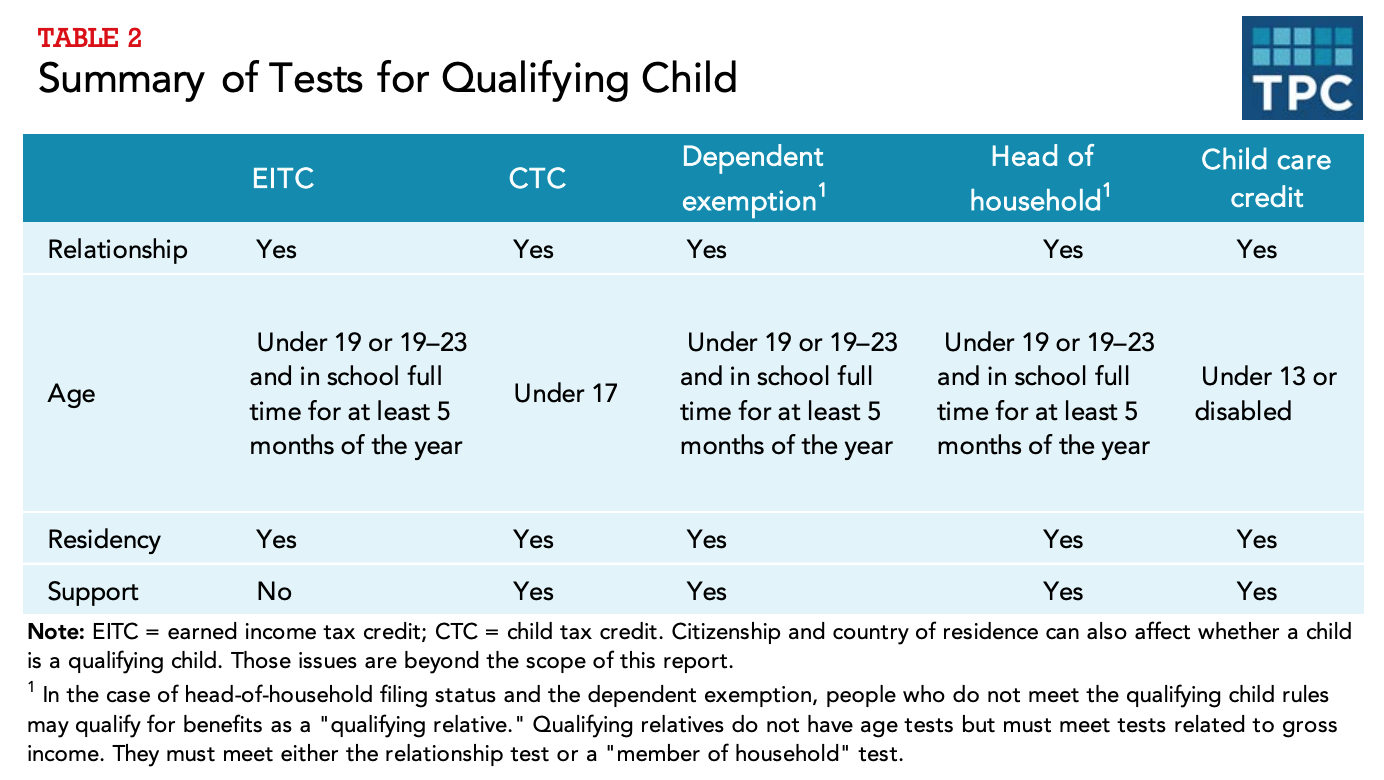
Still worse, though, these complex and opaque definitions tend to fall apart when faced with the realities of non-traditional modern family structures, with the vagaries of the law denying taxpayers EITC eligibility for minors who are, for all intents and purposes, their children. This misalignment was illustrated by Cowan v Commissioner. Jean Cowan, the plaintiff, had effectively claimed her son’s son—her grandson, who lived in her home and whom she supported—as a qualifying child for EITC purposes. But Cowan had never legally adopted her son, whose guardian and de facto parent she had been from the time he was six weeks old. As such, the grandson was technically not her blood relative, and the IRS disallowed the credit. The court agreed. (See Leslie Book’s 2015 article in Procedurally Taxing for further detail on the case.)
Zooming out, it is clear that American families have a clear common understanding of whose children are whose; only around half of 1 percent of dependents are actually doubly claimed under EITC.71 But the IRS estimates that 15 percent of all EITC claims improperly claim a child72—that is, the IRS frequently purports to know that a given child does not belong to a given taxpayer, when real families rarely dispute whose child is whose. The program’s byzantine rules essentially manage to invent custody disputes where none actually exist.
The best solution is to move to a commonsense “primary caregiver” standard, in which families are given latitude to determine who claims a given child, and the IRS investigates only when multiple taxpayers claim the same child (or there is some other clear indication of fraud). (See the National Taxpayer Advocate’s 2016 report for details on the primary carer proposal.) The benefit should, in effect, follow the child, with the government needing no particular role in determining whose child it is except to resolve disputes. This international best practice73 would simplify the code and better reflect the lived experiences of taxpayers. Moreover, it would greatly reduce alleged fraud, thus easing alarm from the Government Accountability Office (GAO) and the Treasury Inspector General, reducing low-income families’ subjection to costly and invasive audits, and eliminating those audits’ follow-on impact in dissuading future tax filing and credit claiming.
This change would also set the stage for greater automatic detection of tax credit eligibility from other data sources. Unlike the current arcane set of rules, a primary caregiver test would bring the tax programs roughly in line with the definition used by other anti-poverty programs like Supplemental Nutrition Assistance Program (SNAP) and Medicaid, raising the possibility that the IRS could solicit data from state social service agencies to determine child relationships, saving families from doing such paperwork. Such data sharing could prove especially critical if efforts move forward to automate advance periodic payments of the CTC.
3.2 Transfer the Child-based Portion of the EITC to the CTC
At present, the IRS administers one program based on the number of children you have (CTC), and one program based both on the number of children you have and the amount you earn (EITC). This makes the EITC a conceptually confusing composite. A better approach would move the child-based portion of the EITC to the CTC, yielding one worker credit (what is currently roughly the childless worker EITC, based solely on income) and one child credit (an expanded version of what is currently the CTC, based solely—or primarily—on family size). Under this new regime, each credit would serve one purpose, clearly and transparently. Note that harmonizing the child definition across the two credits, as discussed above, is a necessary prerequisite for this reform.
This reform has been regularly advocated for years, appearing annually as a highlighted recommendation of the National Taxpayer Advocate (see for example 2016, 2019, and 2020 reports). There has historically been one major barrier to its implementation: holding all families harmless under such a restructuring would be challenging, and advocates are loath to leave poor households worse off after the change.74 The current political moment offers a reprieve from this bind: The Biden administration seeks to greatly expand the generosity of all of these credits, regardless. The American Rescue Plan will, for one year, increase the maximum childless worker EITC to $1,502 from $343, and the maximum CTC to $3,000 (or $3,600 for children under six) from $2,000.75 With all that extra funding in the mix, it is significantly easier to move some funds around without hurting any particular group compared to what they would have received last year.
The change would pay dividends in a simpler and more rational tax code, which achieves clear purposes and which taxpayers can understand, and which does not, for example, impose astronomical effective marginal tax rates on middle-income families due to the confluence of multiple different phase-outs. More importantly, however, it would facilitate easier delivery of the now greatly streamlined worker credit, and could simplify periodic payments. In the new regime, the worker credit (formerly childless EITC) would be based exclusively on income, with no need to collect more complex household structure data. As the IRS has detailed income data already, the realignment would free the agency to make payments based on information it already has on hand. And it would mean that, to the degree the IRS has to wait until later in the filing season to reconcile child claims under the new child definition, the worker credit would not be subject to any such delay, and could be paid as soon as wage data are confirmed.
Finally, the realignment would enshrine the family credit more clearly as what many advocates believe it should be: a true child allowance, not one of two tax arcane credits geared towards making it more affordable to raise children. Congress may even consider transferring administration of this new family credit from the IRS to the SSA, making explicit the program’s role as a (nearly) universal entitlement. The IRS, meanwhile, would continue administering the worker credit, given that credit’s more precise reliance on income data.
Lawmakers and advocates rightly tend to focus on program expansion rather than restructuring when there is political will to make changes. But, confusing programs exact costs over time, and, as multiple programs seek to serve the same population, poor design can diminish their reach and impact. If policymakers agree that the current EITC/CTC structure is misaligned and outdated, and is not one that anyone would choose if starting from scratch—then perhaps it is an opportune moment to right that wrong.
Citations
- Robert Greenstein, John Wancheck, and Chuck Marr at the Center on Budget and Policy Priorities write that the “EITC is one of the most complex elements of the tax code that individual taxpayers face,” https://www.cbpp.org/research/federal-tax/reducing-overpayments-in-the-earned-income-tax-credit , while the Tax Foundation writes that it is “bogged down with some of the most complicated eligibility requirements in the tax code” https://taxfoundation.org/illustrating-earned-income-tax-credit-s-complexity/. Mark Mazur, then at the Tax Policy Center, testified to Congress in 2017 that: “There is a sense among taxpayers and tax policy observers that the tax code is too complex for ordinary Americans to understand their tax obligations and comply with them. This sense of extreme complexity is evidenced by the robust tax preparation and tax software industries, as well as a belief among taxpayers that they are missing out on benefits being claimed by others... Congress...is complicit in this sense of growing complexity; over the past three decades,increasing amounts of social policy have been run through the tax code. While this can be an efficient way to deliver benefits to particular taxpayers, every one of these provisions carries with it eligibility rules and benefit calculations that can overwhelm taxpayers. This proliferation of tax expenditures itself fosters complexity.” https://www.taxpolicycenter.org/publications/comprehensive-tax-reform/full
- See NTA (2019), p. 18, Footnote 82: https://www.taxpayeradvocate.irs.gov/wp-content/uploads/2020/08/JRC20_Volume3.pdf
- The 2014 IRS EITC Compliance Report, which is based on audits of a representative sample of returns, concludes that 50.2% of EITC returns (11.9 out of 23.7 million) have an overpayment (Table 1), and that 30% of EITC returns with known errors have a qualifying child error (Table 4): https://www.irs.gov/pub/irs-soi/EITCComplianceStudyTY2006-2008.pdf
- Both Canada, https://www.canada.ca/en/revenue-agency/services/child-family-benefits/canada-child-benefit-overview.html , and Australia, https://www.servicesaustralia.gov.au/individuals/services/child-support/child-support-assessment/how-we-work-out-your-assessment/your-percentage-care-may-affect-your-payment , among others, use this type of standard.
- Specifically, any reasonable level of the new worker credit would be higher than the current childless worker EITC, and would thus require taking money from somewhere else—presumably from single parents with one child, whose benefits are comparatively generous under the existing regime.
- https://www.americanactionforum.org/insight/the-american-rescue-plans-major-tax-policy-changes/
4. Advance Periodic Payments: A Critical Step that Requires Careful Implementation
Advocates have argued for years76 that the annual lump sum distribution of low-income tax credits undercuts their mission, denying working families support when they need it throughout the year, and leading to perverse financial choices, like families taking out high-interest loans in January against the EITC they expect to collect in March or April. Properly speaking, there are two aspects to this argument: (1) annual lump sum distributions constitute forced savings throughout the year, when families would rather spread out their consumption, and (2) for families with volatile incomes, the delayed disbursement guarantees that they will not see their benefits until they may no longer need them as urgently. The program design borrows from needy families today to pay their potentially-less-needy selves later. The first principle has its benefits; helping families save can be a feature, not a bug, and policymakers would be well-advised to find ways to maintain some of this functionality. The second, though, is pure deadweight loss.
The clear solution is for Congress to authorize the IRS77 to advance portions of the credits on a monthly or quarterly basis throughout the year. In fact, such a measure was included in the American Rescue Plan, with the IRS being tasked to issue monthly advance payments on the 2021 CTC between July and December of 2021, based on TY2020 eligibility.
The appeal of such an approach is obvious, and it is heartening to see it gain traction in Washington. However, advance periodic payments will likely prove more complex to implement than some advocates anticipate, at least publicly, and Congress would be well advised to move carefully. Unlike in other sections of this paper, we outline first some of the reasons for caution, before sketching the outline of a reasonable way to advance this commonsense policy.
4.1 The Challenges of Advance Periodic Payments
IRS eligibility rules, application (that is, filing) procedures, and processing are all fundamentally annual; but periodic payments are monthly or quarterly. Broadly, this contradiction creates two sets of challenges: (1) non-linearities in eligibility, and (2) gaps in information-gathering.78
4.1.1 Annual Eligibility Rules and Monthly Payments
Consider a single mother of two, who has always lived with and cared for her children. In a given year, she continues to live with and care for them until May 31. On June 1, however, she is checked into the hospital for medical issues, and the children stay with their grandparents. Throughout the year, her medical issues persist, such that the grandchildren wind up essentially staying with their grandparents the rest of the year.
Properly speaking, the grandparents can claim the two children under EITC, as they lived with them and cared for them for more than six months. The mother cannot; she lived with them for less than six months. She can only claim (insofar as she is eligible) the childless EITC.
But how would this play out under advance periodic payments? For the first five months of the year, she would presumably receive the EITC with two qualifying children, adding up to, at certain income levels, nearly $2,500.79 But at the end of the year, it would be clear she had no qualifying children under EITC, and would be eligible for no more than a few hundred dollars of childless EITC at most. When she finally did her taxes the following February, it would be clear she received an approximately $2000 overpayment from the IRS, and she would owe the IRS that money. And this would occur even if the IRS was informed promptly on June 1 of the change in family circumstances—which is a big if, and suggests the second, larger issue.
4.1.2 Collecting Information on Changing Circumstances
Suppose that somehow the laws were written such that eligibility were proportional to the portion of the year that a given family structure existed. In such a world, the above illustration would pose no particular problem; the mother would be entitled to the first $2500 of EITC for the year, and the grandparents to the remainder for the next seven months. But there would still remain the tricky question of how the IRS is supposed to know that the children essentially changed custody on June 1, and adjust payments accordingly.
Most advance payment proposals—including the American Rescue Plan version—envision an online tool via which beneficiary families would periodically log in to advise the IRS of changes to their circumstances. On June 1—or at least by June 30—both the mother in the hospital and the grandparents newly taking care of their two grandchildren would log into some web application and advise the IRS that they, respectively, now had zero (mother), or two (grandparents), qualifying children. That is, this overburdened low-income family (who may well be in the 20 percent of EITC-eligible families who do not even manage to file annual taxes to claim the EITC in the spring) would proactively log in to a government website promptly to describe their changed circumstances—and have the foresight to know that this at-first temporary arrangement was going to prove durable enough to justify doing so. (Note while this example illustrates the case of a change in family structure, the same principle applies to a change income. And while changes in income may be easier to recognize and report in the case of a salaried worker getting a raise or a new job, freelancers and gig workers may not have clear visibility into the stability—or lack thereof—of their income month to month.)
One does not need to guess how unrealistic this assumption is; one need merely look at payments of the Advance Premium Tax Credit (APTC) created as part of the Affordable Care Act to defray the cost of private health insurance for low-income families. The APTC, like the theoretical advance EITC or CTC, is paid monthly (though in the APTC’s case directly to insurers rather than to families), and families are expected to log in to their healthcare marketplace to update their information when a life change event impacts the amount of APTC they are entitled to. But, empirically, families do not do so. In tax year 2016,80 according to the IRS, 58 percent of APTC claimants had an overpayment (that is, net owed the IRS PTC at tax time); half of these (29 percent overall) owed over $500, and 25 percent of these (14 percent overall) owed over $1000. Not to mention, as discussed at length throughout this paper, the government historically does not have the best track record in quickly providing simple and accessible software to low-income families. The notion that the IRS would be able to deliver an excellent, modern, and easy-to-use piece of relatively complex software to track life change events before it can roll out a more basic tool to file simple taxes seems hopeful at best.
The APTC, like the proposed advance CTC in the American Rescue Plan, contains a robust safe harbor provision, limiting the amount of money low-income families owe back to the IRS if it turns out their advance payments were too generous, and such a provision is critical in any such implementation. But policymakers and the IRS would have to be ready to start accepting large amounts of actual overpayments from families who, critics will allege, “willfully broke the rules” by neglecting to proactively report their life changes. It seems far more likely that members of Congress and inspectors general will, instead, raise alarms about alleged waste and fraud.
A second option, of course, is to find some way to determine the relevant data without requesting it directly from already overburdened low-income families. In the case of income data, this is not unreasonable, as the IRS already receives quarterly wage and earnings data from businesses, although there remains the trickier point of self-employment income which may not be regularly reported to the IRS. But the situation is far more complex still in the case of qualifying children, where the IRS—at least without significant statutory reforms—has no plausible third-party data source to suggest when a child has moved across households.
Moreover, all of this coexists uneasily with the recommendation above that the definition of qualifying child be simplified to a commonsense standard that the government does not interrogate except in the case of conflicts. Suppose one household claims a child all year in advance payments, but another household claims the child at tax time the following February, and the IRS must reconcile the claims. At this point it either would have to defer to the earlier-claiming family, which may be incorrect and unjust, or risk clawing back the entire payment to that family.
4.2 Recommendations for Implementation
All told, the implementation challenges for advance periodic payments are non-trivial, especially for an already resource-constrained IRS. More details will be forthcoming in future publications, but the following recommendations may help policymakers as they plan out possible nearer-term implementations:
- As much as possible, rely on automatic detection of eligibility, rather than counting on low-income families to file still more data with the federal government. The IRS should be moving in a direction of more automation, not less, and the IRS should design the entirety of the advance payments system with the goal of minimizing burden on families.
- Relying on automatic eligibility detection means that advance payments could not be fully implemented until after significant statutory simplifications (see Section 3), which would make it simpler to detect and calculate eligibility.
- In the case of family structure data, the IRS should examine whether states can share SNAP/Medicaid data on dependents, which is determined and updated by case managers. (Similarly, consider whether APTC data can be shared within the IRS.) Pending the adoption of a simplified “primary caregiver” definition for qualifying children (see Section 3.1), those programs’ records on dependents should closely approximate those of the IRS, and changes recorded in those programs can be taken as a sign that family structure has likely changed.
- Consider starting with advance payments that are based solely on income rather than family structure, since income is easier to detect throughout the year. To address the unknown of self-employment income, consider restricting eligibility—at least at first—to households that historically have had W-2 income only, for at least several years.
- If there must be a new portal to update data throughout the year, it should be built in-house by the government, not outsourced to the Free File Alliance or private industry. The tool should follow best practices in modern web design, including extensive user testing and plain language. High-quality government tech teams like the U.S. Digital Service of 18F would be good candidates for developing such an application.
- Prevent mid-year life events from causing huge overpayments. Either eliminate the six-month minimum for program eligibility, transitioning programs to a by-month credit schedule, or postpone all affected advance payments until after July 1 of a given year, when six months of cohabitation with a child can be confirmed.
- Create a generous enough safe harbor provision and/or restrict advance payments to a small enough portion of the expected total benefits that clawbacks are incredibly rare or non-existent. Especially early on in the program, widespread unexpected clawbacks could discredit the advance payment program—and perhaps refundable tax credits like EITC and CTC entirely—in the eyes of beneficiaries and skeptical policymakers.
- At least at first, run the advance payment program on an opt-in basis, with households choosing to receive advance payments for a given year on the prior year’s tax return.
Citations
- See Steve Holt, Kali Grant, and Funke Aderonmu (2020) for an overview of the issue: http://www.georgetownpoverty.org/issues/matching-timing-to-need/
- Or, of course, the SSA, in a world where the child credit is transferred to that agency.
- For a more colorful account of these issues, see Matt Bruenig’s article on the advance CTC proposal: https://www.peoplespolicyproject.org/2021/01/17/monthly-child-tax-credit-would-be-a-train-wreck/
- The maximum EITC for a single parent with two children is $5828. $5828*5/12 = $2428.33.
- More recent detailed data on APTC payments does not appear to be readily available. Moreover, even if it were, data from the early years of APTC implementation is likely a more reliable guide to the prospective early years of ACTC or AEITC.
Conclusion
The Biden administration has already shown its ambitious intentions to update the American social contract, and to build a government that truly takes care of those in need and plays a central role in breaking down inequities. In a country where an enormous portion of the social safety net runs through the tax code, building the IRS into a world-class benefits administrator is critical to these efforts.
As much as the IRS has gone to great lengths to get benefits to people who need them, and as successful as low-income tax credits have been over the years in reducing poverty, the government can still do more. In the short term, it can reach out aggressively to non-filers and especially those who are incarcerated, and create simplified ways for them to claim credits; it can automate economic impact payments to federal beneficiaries, incarcerated people, and workers with stable addresses; it can use automation and targeted outreach to ensure tax filers get all the credits they deserve; and it can ensure a larger portion of funds get to their recipients by using accessible payment methods and opting not to garnish anti-poverty benefits. In the medium term, it can create a truly free and painless modern tax filing experience, bypassing tax preparers and saving low-income families hundreds of dollars. And in the slightly longer term, Congress can restructure these programs, making them comprehensible to everyday families, consistent with lived experience, and amenable to still greater automation.
Taken together, such measures would be transformative, getting billions of dollars in benefits to millions of families who deserve them, delivering the full value of benefits to tens of millions more who today receive only a portion of what they are entitled to, and making tax filing—a stressful and often expensive experience—essentially painless for tens of millions of Americans. This is the responsive, twenty-first century IRS the nation deserves.
- Introduction: Problems with IRS Benefit Delivery and Goals of Reform
- 1. Immediate Technical Fixes
- 2. Create A Modern, Government-Run Tax Filing Option, Starting With “The Portal”
- 3. Statutory Simplification: Restructure EITC/CTC and Redefine Child
- 4. Advance Periodic Payments: A Critical Step that Requires Careful Implementation
- Conclusion
More About the Authors

Gabriel Zucker
Fellow, Public Interest Technology

Cassandra Robertson

Nina Olson
Executive Director, Center for Taxpayer Rights
Issues
Programs/Projects/Initiatives
Related