Lessons from the Illinois Media Mentor Project
Developing Media Mentors
In 2020, New America embarked on a year-long initiative with librarians in children’s and youth services across three library systems in Illinois. The aim was to build staff members’ skills and confidence in media mentorship—the act of mentoring and providing tailored guidance to students and families in selecting, analyzing, and using media to support learning.1 As media environments become increasingly complicated, this kind of mentorship is crucial to helping families and students get the non-commercial guidance they need to build skills and choose media (including books, videos, apps, and podcasts) that match their needs.
Librarians are often well-positioned to do this kind of mentoring. Media mentorship is, after all, aligned with what many staff members are taught in schools of library and information science. But they need their own support and training on new techniques and programming innovations to keep up with the ever-changing media landscape. This is particularly true if they never received training on how to be responsive to and effective in helping families and youth in underserved communities who have not historically had positive experiences with American educational systems or who have home languages other than English. Librarians need opportunities to think through and explore, with their peers and other experts, how best to respond to the strengths and diverse media needs of the people they serve.
This project was designed to offer those opportunities. It provided two different professional development options for librarians working at the Chicago Public Library, the Schaumburg Township District Library, and the Skokie Public Library. The final forum included those librarians, as well as other educators, researchers, and leaders of school and library organizations around the country. Giving librarians and other educators space and time to talk about and hone these new skills can lead to greater confidence in their roles as media mentors. They can then forge stronger connections with the youth, families, and educators in their communities and can serve as trusted advisors for seeking out and managing media, using new tools, and identifying quality sources and materials.
Building on the Maryland Model
The Illinois project was built on a model that emerged in 2017 in Maryland, where a group of librarians led by Dorothy Stoltz of Carroll County Public Library and Conni Strittmatter of Harford County Public Library created a “peer coaching” model to help librarians learn about and gain confidence in the concept of media mentorship. The program was implemented in 2018 in those two library systems as well as in Baltimore County Public Library.2
The Maryland project started with informal parent discussion groups at sites outside and inside the library (a Head Start center, an elementary school, and a story-hour at a local branch) to determine what families thought about public library services and what help they most needed related to digital media and technology. Concurrently, a group of librarians across systems (with me from New America) designed new tools and observation forms for peer coaching, adapted from the longstanding Every Child Ready to Ready initiative of the American Library Association. We hosted a daylong workshop to introduce concepts and invite librarians to generate new ideas for engaging with children, youth, and families. Throughout the project, librarians and library administrators in the three systems also held monthly discussions with staff about the ALA book, Becoming a Media Mentor. Staff surveys were conducted before and after the year-long project to measure changes in librarian attitudes and confidence in their mentorship skill levels.
By March 2019, media mentorship became the subject of a daylong workshop for 60 youth and children's services librarians from across the entire state of Maryland. It resulted in the development of a free and accessible online toolkit that includes ideas for getting started, information on how to assess staff and community needs, templates for the peer-coaching observation forms, and slides and other resources for workshops and trainings.3
A Pandemic-Driven Shift: The Illinois Model
In March 2020, with a one-year grant from the Robert R. McCormick Foundation, New America embarked on an Illinois version of the Maryland project. Within a few days of the start of the project, the COVID-19 outbreak was named a global pandemic, and it became clear that plans for peer-learning in media mentorship would need to be significantly revamped. Library buildings, in addition to schools and nearly all institutions open to the public, were closing their doors and moving into crisis mode. They were pivoting to figure out how to provide services safely while also assisting with the provision of food and other necessities for families who saw sharp cuts in income and safety net services. When library services were provided, librarians wore masks and social distancing was a must. (See photo below of Skokie Public Library's book mobile.) Travel was halted and plans for in-person gatherings (conferences, meetings, study groups, peer-to-peer learning sessions) were scrapped.
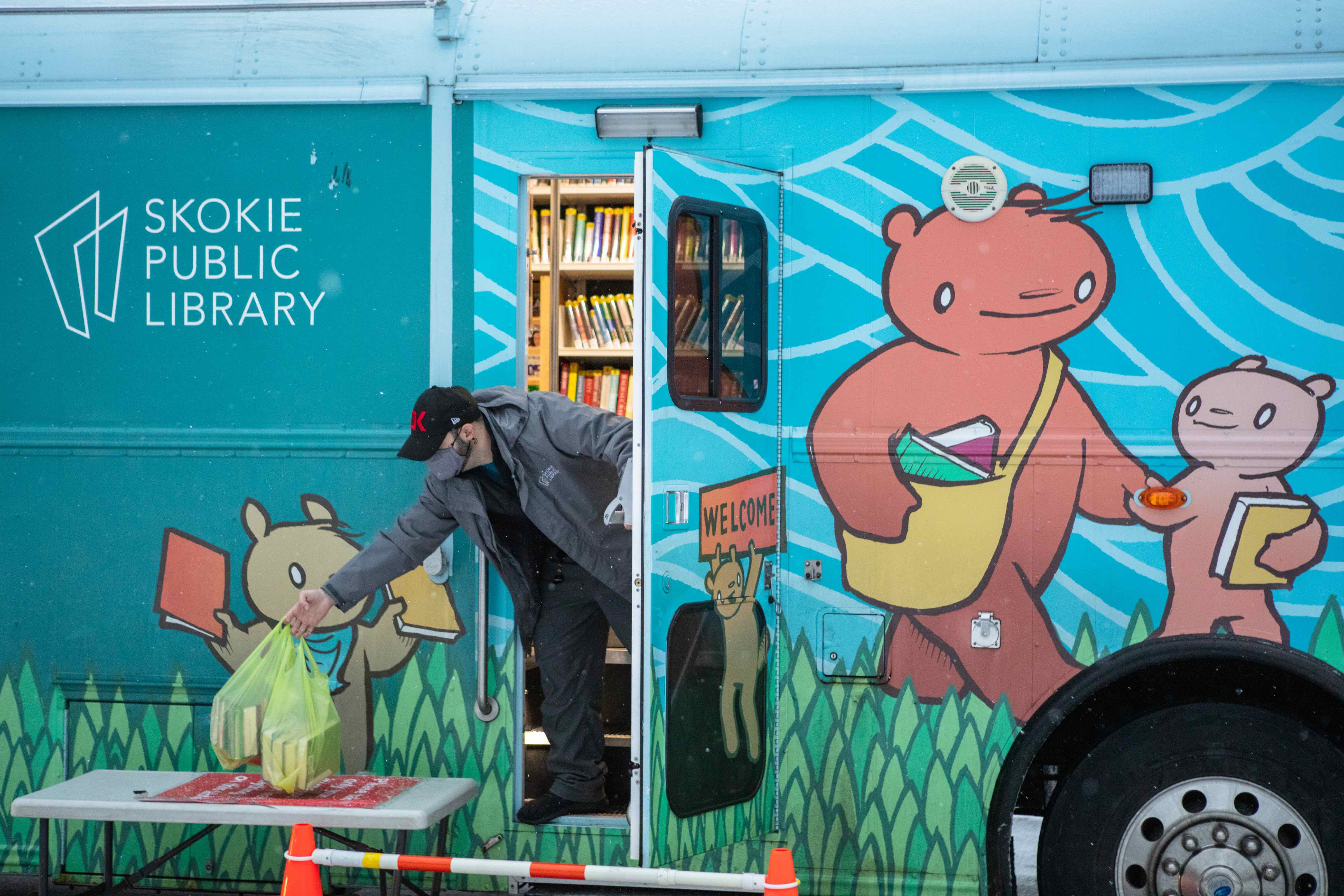
Still, with resolve and patience from our library partners, the project moved forward, albeit virtually, via the Zoom platform for video conferences and webinars. The revised project launched three phases of work: an August program called Read & Chat that engaged staff in afternoon conversations about readings related to media mentorship; a three-day national forum and workshop in early December; and a series of discussion groups with parents and educators to learn more about what they needed from their public libraries.
Read & Chat
We brought in Claudia Haines, the author, with Cen Campbell, of Becoming a Media Mentor: A Guide for Working with Children and Families, to co-create and run the five sessions for library staff throughout August and into early September. Building on the Maryland model, we administered a survey before beginning the sessions to determine the participants’ knowledge base and comfort level with the concepts we planned to address; participants were asked to take a similar survey directly after the Read & Chat concluded to assess growth in these areas.
Most of the one-hour “Read & Chat” sessions were focused on chapters from Haines and Campbell’s book (all participants received a copy of the book by postal mail). Some sessions also included supplementary readings on media literacy and media mentorship, such as my article published in Slate on media mentorship in the age of disinformation.4 They also focused on frameworks such as the Three C’s (content, context, and child) used to help make decisions about what types of media and what situations are best suited for particular children at particular ages and stages.5 Fifty-two staff members attended at least one session and at least 45 were at each session. This provided librarians a chance they may not have otherwise had to meet and talk to each other about media issues, as well as pandemic and virtual learning concerns across their three communities.
Three-Day Forum
Three months later, New America hosted a national forum on media mentorship that included three 90-minute sessions over three consecutive days. This too was conducted via Zoom, in both webinar and meeting formats, enabling people from anywhere to attend.6 More than 200 joined on the first day. (The original plan was to host an in-person conference in Chicago over two days, with hotel stays covered for a few dozen Illinois librarians who lived outside the Chicago area.) The themes of the conference were equity (day 1), media literacy (day 2), and family and community engagement (day 3). Day 3 was also designed for workshopping and sharing ideas in small groups. As with the Read & Chat, participants were surveyed after the event about whether the forum helped them gain skills and confidence in media mentorship.
Results from Staff Surveys
Impact of the Read & Chat
The surveys, which were designed and administered by Elaine Czarnecki of Resources in Reading, had two purposes: to help library directors gauge what their staff members needed (both for designing the Read & Chat sessions and supporting staff afterward) and to illuminate whether these forms of professional development were useful. Questions were designed to detect whether staff members’ comfort levels had increased in using, talking about, and recommending new media.
Read & Chat participants reported increased confidence in their ability to advise families, educators, and students on digital media use. Participants also appeared to gain more knowledge about how to teach or provide resources related to media literacy in particular. For example, 63 percent of staff said that before attending the Read & Chat they were either not at all confident or only slightly confident about using mentorship to promote media literacy. When asked how they felt at the end, that number shrank to 6 percent, and more than 60 percent said that they were now either very confident or extremely confident.
Similar advances appeared in six key findings distilled by Czarnecki (based on responses from 35 out of 52 attendees):
- Opportunities to share resources and ideas led to increased confidence in handling work-related concerns.
- Increased knowledge of the Three C’s led to increased confidence in advisory and programming decision-making.
- Increased awareness of trusted sources for quality digital media led to increased confidence in advisory situations.
- A focus on media literacy led to Increased confidence in using mentorship skills to promote that type of literacy.
- The sessions helped to increase awareness of the value of media mentors.
- Participation led to the desire for additional knowledge.
Participants also had suggestions for improvement, particularly related to the need for more specifics on equity, outreach to families, and cultural responsiveness. For example, one participant said, “We talked a lot about equity issues, but I don't feel much better equipped to handle them when they crop up.”
Impact of the Three-Day Forum
An evaluation survey was administered at the conclusion of each day of the three-day event. More than 200 people attended the national forum on at least one day, including 36 attendees from the Illinois libraries in the year-long project. New America gathered a total of 106 survey responses, with most respondents hailing from a library system other than the three involved in the project. A majority of attendees (71 percent the first day and 77 percent the second) said that the forum increased their confidence in applying what they learned about media mentorship. When asked on day 3 to rate their confidence before and after the event in applying media mentorship knowledge and skills to supporting families' and/or students' use of media, the weighted averages of responses were 3.66 out of 5, compared to 2.88 before.
Other findings:
- Media mentorship topics are applicable and empowering to many professions.
- This level of professional development can increase background knowledge of media mentorship concepts and skills.
- The topics of equity, media literacy, and family engagement & innovative programming are important to developing a positive perception of media mentorship.
- Participation led to the desire for a deeper dive into the materials and resources.
Here are some quotes from survey respondents that provide a glimpse into what needs more attention:
- “Equity is a term that gets thrown around a lot these days and I think it would help to begin with a definition.”
- “I want to encourage the importance of technology literacy in parents rather than having them assume it's always a bad thing (of course in moderation), even in young children.”
- “This is an important topic, but I'd like to bring the conversation down from the conceptual plane to concrete plane.”
- “Many hurdles to overcome staff/timewise.”
- “What my system really needs is affordable, accessible, hands-on training in this topic.”
- “I think this involves an adjustment of emphasis and focus—as when Every Child Ready to Read was first launched, we'll discover we are already doing a lot of the ‘right’ things, but we'll have a better understanding of how those things are supporting the development of media literacy.”
Results from Discussions with Parents
The Maryland project involved an exploration of how parents and caregivers with young children thought of their local public library and their attitudes and beliefs about using digital media and technology with children. This Illinois project aimed to do the same, but in-person discussions were impossible during the pandemic. Instead, using Zoom, consultant Devorah Heitner brought together groups of parents for seven discussion groups (six in English, one in Spanish conducted by translator and facilitator Sebastián González de León) in November and December 2020. These were conversations with a total of 48 parents, four of whom were also educators. Eighteen were South Asian American, 15 Latinx, 13 white, and 2 African American. Facilitators did not ask questions about income level. Parents were recruited through library programs and librarians spreading the word to patrons who had come to their facilities; through food pickup locations; and through social media, such as Facebook groups for parents in a school community.
Questions focused on how families were using technology and media during the pandemic and if, when, or how they used the public library or sought help from librarians. Among the key findings—and a barrier to overcome—was that the parents interviewed for this project did not see libraries as a place to get advice about or learn how to use digital media. As Heitner put it, “for many of them, the library isn’t even on their radar screen—they are going to other parents, and they think it’s on them to figure this out.”
Discussions often turned to parents’ struggles with virtual learning during the pandemic and whether their children would be negatively affected by screen media. One parent raved about GarageBand (an Apple application that enables music-making). Another talked about how e-books have been helpful for her son:
For example, even last week, we had a book for the Diary of a Wimpy Kid, [and] they just go into Hoopla and, spontaneously, we could download it…the moment he…finished the book. So that was so helpful for us, you know, and on the spot; we don't have to go in person, especially when the library is now limiting the in-person capacity. So e-books and audiobooks as well: that helps a lot, especially for the kids.
Participants in all three locations said they mostly turn to other parents for advice on what digital apps and content to share with kids, sometimes using Facebook groups on pandemic parenting and homeschooling. One Chicago parent mentioned reaching out to a friend who is a librarian in another state for advice. A Skokie parent who is also a teacher said, “I have an awesome librarian at my school who teaches me a lot of things and always shares the latest apps and things.”
These parents did not explicitly state that they were looking for guidance or workshops on technology or digital media; instead, they wanted more resources and outreach to help navigate the pandemic, to motivate their kids and keep them focused on schoolwork, and to support their kids’ mental health and well-being. But technology and media issues coursed through their conversations nevertheless. One parent, in describing specific challenges facing her son, gave voice to the concerns of parents of children with disabilities or developmental delays:
I still am having such a hard time with these apps that I'm getting from teachers. Like “compass learning.” That's very hard for my son to use. And I'm just like, I'm sorry…my son can't do that. You know? Um, he sticks to…one with dinosaurs, I believe. And he has developmental delays, so speech is really difficult for him. And then he also has autism, so he can't really sit still. What’s working right now is Happy Numbers. So when I say something like that would be a little more age appropriate and…it's also based on his developmental…where he is. So it doesn't take him too high and it doesn't keep him too low. It moves as he moves. So Happy Numbers is much better and much more age appropriate.
One Chicago parent did say she wanted more help on navigating the technology that was part of her child’s school experience. She wanted assistance in “how to use Google Classroom, how to use Google Slides,” and wished for “some tech help on the phone…someone I could call” to say, “’okay, I have my son's iPad here. Can you help?’”7
Lessons
While every community should develop its own list of ingredients for success, the Illinois project offers three lessons for helping libraries around the country develop successful approaches to media mentorship:
Meet parents and educators where they are.
Results from the parent discussion groups highlighted how much libraries will need to continue to reach out to parents and educators in their communities to make their services known.8 The library directors reviewing the discussion-group data said they want to explore new ways for librarians to become “parent ambassadors.” As one librarian noted, this is about recognizing that “parents need resources and support as much as their children and that children’s library services are not just about services to children, but also to their parents.” Several librarians also talked about making a greater effort to go to the online forums and networks where parents are seeking advice, instead of assuming that parents will come to the children’s section of the library. Several librarians noted that media mentorship also means providing more support and outreach to families who speak a language other English at home. They sought more specific guidance and recommendations for how to do that other than simply providing translated materials. “Skokie has about 80 languages spoken, such a diverse village,” said one survey respondent. “I think going into this topic a little deeper would be useful.”
Continue training sessions that enable librarians to share and learn as peers.
Feedback and attendance rates for both the Read & Chat and the three-day forum showed that library staff, and educators in other sectors, sought out and appreciated learning from peers within and across library systems in these kinds of facilitated workshops. As one library director said she heard from her staff after the forum, “it was so valuable to see what other librarians are doing.” One way to maintain momentum would be for libraries to form “peer support” groups composed of interested staff members across library systems who could meet regularly to talk about new efforts (such as programming for communities, casual interviews with families, or outreach efforts outside library walls) to maintain enthusiasm and facilitate continued growth. Another option is to create space for forums and workshops (virtual or in-person) that are statewide. Not only does this help to signal the importance of media mentorship on a state level, but it provides librarians opportunities to build relationships with staff in other library districts. In fact, last month, Carrie Sanders, coordinator of youth services for the Maryland State Library, did just that, producing a two-day forum and workshop to highlight and extend some of the themes from the December event.
Get more specific about what to do next on the job.
A critical next step for media mentorship initiatives is to help library staff figure out what to do in their day-to-day jobs that would bring their roles more explicitly in line with media mentorship. For example, one survey respondent said, “I would have liked to get a little bit more granular as we talked about media mentorship for different ages.” Getting granular will require library leaders to build in time for planning and piloting new programming for different age groups; partnering with community organizations and schools; modeling new advisory roles; creating space for informally interviewing families about what they need; and building new tools, such as lists of media resources for families and educators, bilingual newsletters for outreach, and checklists for staff for deciding on different forms of media to promote in displays. The American Library Association’s forums and conferences, and the Association for Library Services to Children, which has long promoted media mentorship, also have an important role to play in sharing examples and providing staff with resources and toolkits to support continual learning.
The past pandemic year, as hard as it was, brought new attention and urgency to supporting families and students as they seek out and use digital materials. That, coupled with heightened concerns about news and media literacy across digital information environments, provides strong impetus to continue investments. Now is the time to build on this momentum and support library leaders across the country in scaling up and iterating on these media mentorship models in partnership with families and educators.
Abstract
In 2020, New America embarked on a year-long virtual initiative with librarians in children’s and youth services across three library systems in Illinois. The aim was to build staff members’ skills and confidence in media mentorship—the act of mentoring and providing tailored guidance to students and families in selecting, analyzing, and using media to support learning.
This report provides three lessons for leaders aiming to scale up these efforts. Giving librarians and other educators space and time to talk about and hone these new skills can lead to greater confidence in their roles as media mentors. They can then forge stronger connections with the youth, families, and educators in their communities and can serve as trusted advisors for seeking out and managing media, using new tools, and identifying quality sources and materials.
Acknowledgments
This project was a partnership between three library systems and New America; it was made possible with guidance and support of several youth services directors who were willing to soldier on in the throes of a global pandemic. Big thanks to Amber Creger at Schaumburg Township District Library, Shelley Sutherland and Amy Koester at Skokie Public Library, and Caroline Broeren at the Chicago Public Library. We were honored to have Mary Ellen Messner, then acting commissioner of the Chicago Public Library, involved from the beginning. We appreciated the support of Jeremy Dunn and John Mangahas of the Chicago Public Library at the beginning as well. Thanks to Elaine Czarnecki and Devorah Heitner for their consulting and research expertise; to Claudia Haines of Homer Public Library (Homer, AK) for her guidance and partnership in developing the book study and forum; to Sebastián González de León for Spanish-language translation; and to our advisory board, which included Tammy Dillard-Steels of the Young Adult Library Services Association, Angela Hubbard of the Association for Library Service to Children, Cynthia Robinson of the Illinois Library Association, Carrie Sanders of the State Library of Maryland, Dorothy Stoltz of Carroll County Public Library, and Conni Strittmatter of Baltimore County Public Library. Thanks to Sabia Prescott and Sabrina Detlef for editorial support. This project was funded by the Robert R. McCormick Foundation, and we are grateful to the foundation for its support and for recognizing how the work of media mentorship fits into broader civic engagement and media literacy endeavors around the country.
Downloads
Citations
- During this project, New America published A Guide to Media Mentorship, a five-page explanatory brief that sets this definition and provides background on the impetus for the concept. https://www.newamerica.org/education-policy/policy-papers/guide-media-mentorship/
- Lisa Guernsey, “Maryland Libraries Build a Peer-Coaching Program to Train Media Mentors,” EdCentral (blog), New America, July 11, 2018, https://www.newamerica.org/education-policy/edcentral/maryland-libraries-build-peer-coaching-program-train-media-mentors/
- For example, see the Peer Coaching Media Mentorship Toolkit, a free and open online resource compiled and edited by Conni Strittmatter, then of Harford County Public Library, athttps://sites.google.com/view/hcpl-media-mentorship-toolkits-Media/Donohue/p/book/9781138100367
- Lisa Guernsey, “Confused About Screen Time and Disinformation? You Aren’t Alone,” Slate, June 8, 2020, https://slate.com/technology/2020/06/disinformation-screen-time-media-mentors-librarians.html
- The Three C’s emerged from peer-reviewed studies on the impact of screen media on children and is described in my book Screen Time: How Electronic Media—From Baby Videos to Educational Software—Affects Your Young Child, published by Basic Books in 2012. A second book, co-authored with Michael H. Levine, Tap, Click, Read: Growing Readers in a World of Screens, builds on the Three C’s and includes a free quiz about the Three C’s, available at http://www.tapclickread.org/takeaction/
- Archived video and the agenda for New America’s December 2020 forum on media mentorship is available at https://www.newamerica.org/education-policy/events/online-media-mentorship-forum-and-workshop/
- This request for tech help on the phone also matches the needs observed by the National Digital Inclusion Alliance, which has developed a Digital Navigators program that starts with phone-based assistance. Like media mentors, Digital Navigators also take a human-centered approach to digital equity, providing on-demand and one-on-one support for community members. NDIA and other collaborators are currently working with Salt Lake City Public Library and other institutions to advance Digital Navigator programs. For more, see https://www.digitalinclusion.org/digital-navigator-model/
- This need for expanded outreach was also a finding in Public Libraries and the Pandemic: Digital Shifts and Disparities to Overcome, a report we published in March 2021 and available at https://www.newamerica.org/education-policy/reports/public-libraries-and-the-pandemic/
More About the Author
Lisa Guernsey
Senior Director, Birth to 12th Grade Policy; Co-Founder and Director, Learning Sciences Exchange