A Chapter of: Why Is Eviction Data So Bad?
What is Eviction Data and How is it Gathered?
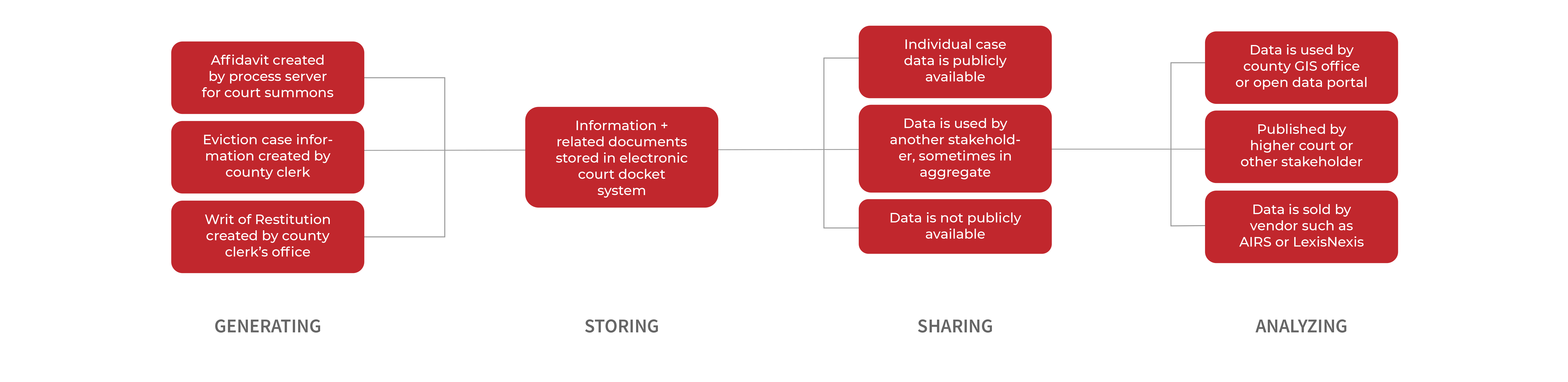
“Eviction data” can refer to any information related to an eviction, however this report focuses on what is known as “formal eviction data” coming from eviction cases that move through county-level civil courts.1 In some cases, we note salient data points that we feel should be part of formal eviction datasets but currently are not.
The data trail for a formal eviction starts when a landlord files an eviction claim in court. In an eviction case, the landlord is usually the plaintiff and the tenant is the defendant. As a case winds its way through the court system, it amasses a dataset that usually includes:
- Case filing number;
- Filing date;
- Address of the rental property related to the case; and
- The names of the plaintiff and defendant.
Once a case is decided, the dataset grows to include the case disposition (or judgment) and the date of disposition.
These data are recorded by court clerks, and are sometimes—but not always—entered into electronic court docket systems. State or local laws may require the individual case data to be publicly available, and this information is sometimes aggregated for administrative or research purposes.
Other relevant data, which is generated outside of case proceedings, includes:
- An affidavit from the process server, summoning a tenant to court. This document is produced at the beginning of the eviction process, and is often scanned into an electronic court docket system.
- A writ of restitution, which authorizes law enforcement to remove an evicted tenant from a rental unit. Landlords usually file this document with a clerk’s office. However, many evicted tenants vacate a property on their own accord, rendering a writ of restitution unnecessary.
Because these other documents are not generated through the centralized court system, they are often either unavailable or extremely difficult to locate.

Hannah Rudin, Making Conversation LLC, for "Why is Eviction Data so Bad?" a 2021 report produced by New America's Future of Land and Housing (Link: https://www.newamerica.org/future-land-housing/reports/why-is-eviction-data-bad/)
In addition to these formal documents, there is a vast array of other data that are related to evictions but not systematically gathered. Examples may include:
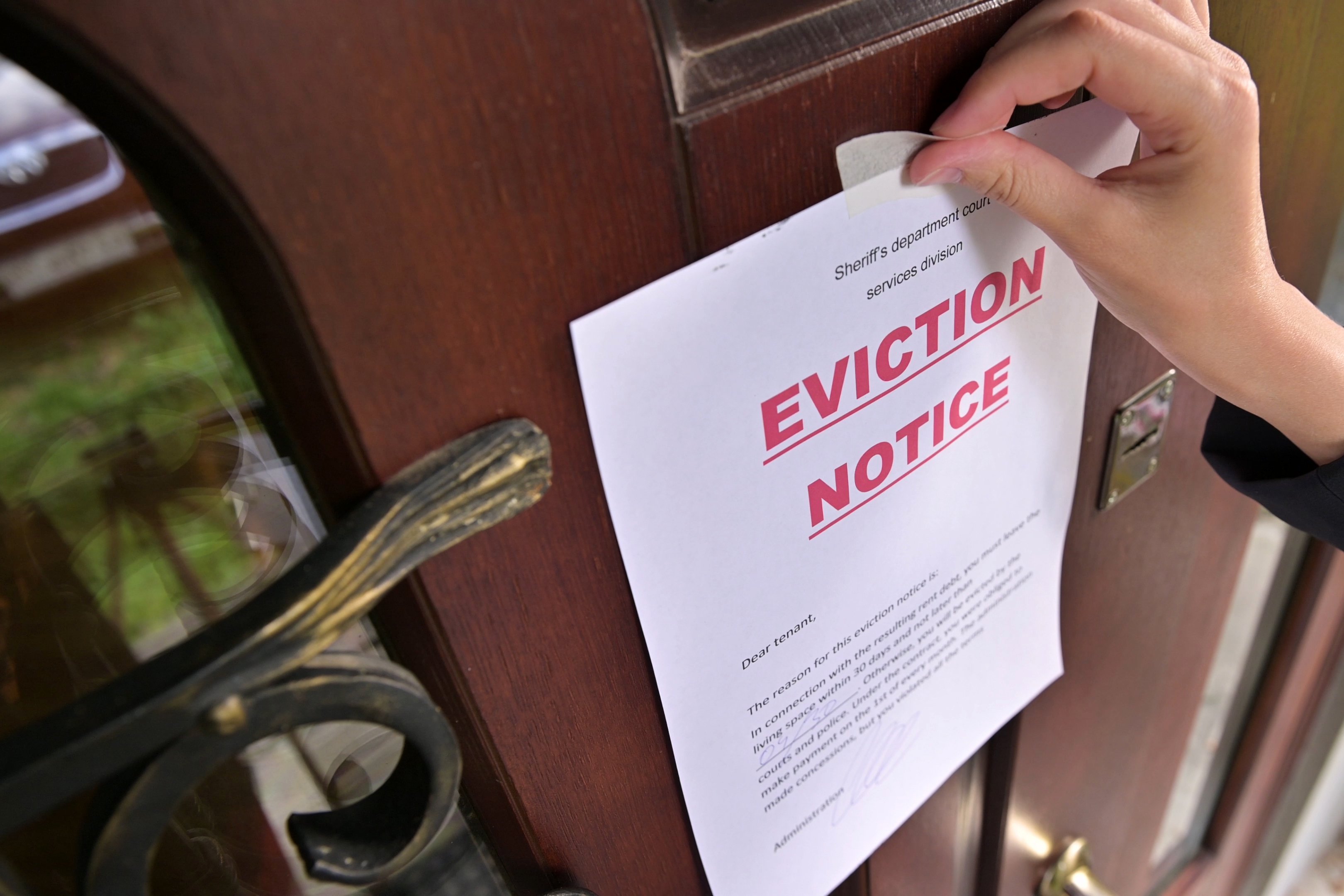
- Physical eviction notice posted by a landlord on a tenant’s door;
- Records of correspondence between a landlord and a tenant regarding late payments or other precursors to eviction;
- Correspondence evidencing an ‘informal eviction,’ where a tenant, usually facing the prospect of a formal eviction, decides to move out on their own; and
- Data related to what happens to the tenant after an eviction, including that tenant’s new address, how long the tenant spent unhoused, and how long the tenant stays at the new residence before moving again.
And, there are vast amounts of demographic data and other data that are useful when structuring eviction interventions, but are not captured because they are not required for court filings. These data may include:
- Whether a property is federally assisted or backed;
- Tenant and landlord race;
- Tenant and landlord income;
- Tenant and landlord age;
- Tenant and landlord immigration status;
- Whether a tenant has children living in the home; and
- Whether a tenant had legal representation in court.2
Citations
- We don’t know the rate of ‘informal’ evictions nationally. However, research by Matthew Desmond, author of Evicted and principal investigator at the Eviction Lab, suggests that in Milwaukee two informal evictions happen for everyone one formal eviction.
- Some courts do capture this data, but it is spotty.